

HubSpot vs RD Station: Honest Comparison (2026)
Your Brazilian marketing team swears by RD Station. Your VP of Sales wants HubSpot. Now you're stuck in the HubSpot vs RD Station debate comparing two platforms that don't really overlap - one's a LATAM-first marketing automation tool, the other's a full customer platform that tries to run your whole go-to-market.
Most "vs" posts pretend they're equals. They're not, and treating them that way is how teams end up paying for features they never use (or buying a tool that can't grow with them).
Let's break it down like a buying decision, not a feature checklist.
30-second verdict
Pick RD Station if you're an SMB running marketing in Brazil or LATAM, your sales team lives on WhatsApp, and you've got fewer than ~5,000 contacts. It's simpler, cheaper, and hiring for it is easy in Brazil because so many marketers already know it.
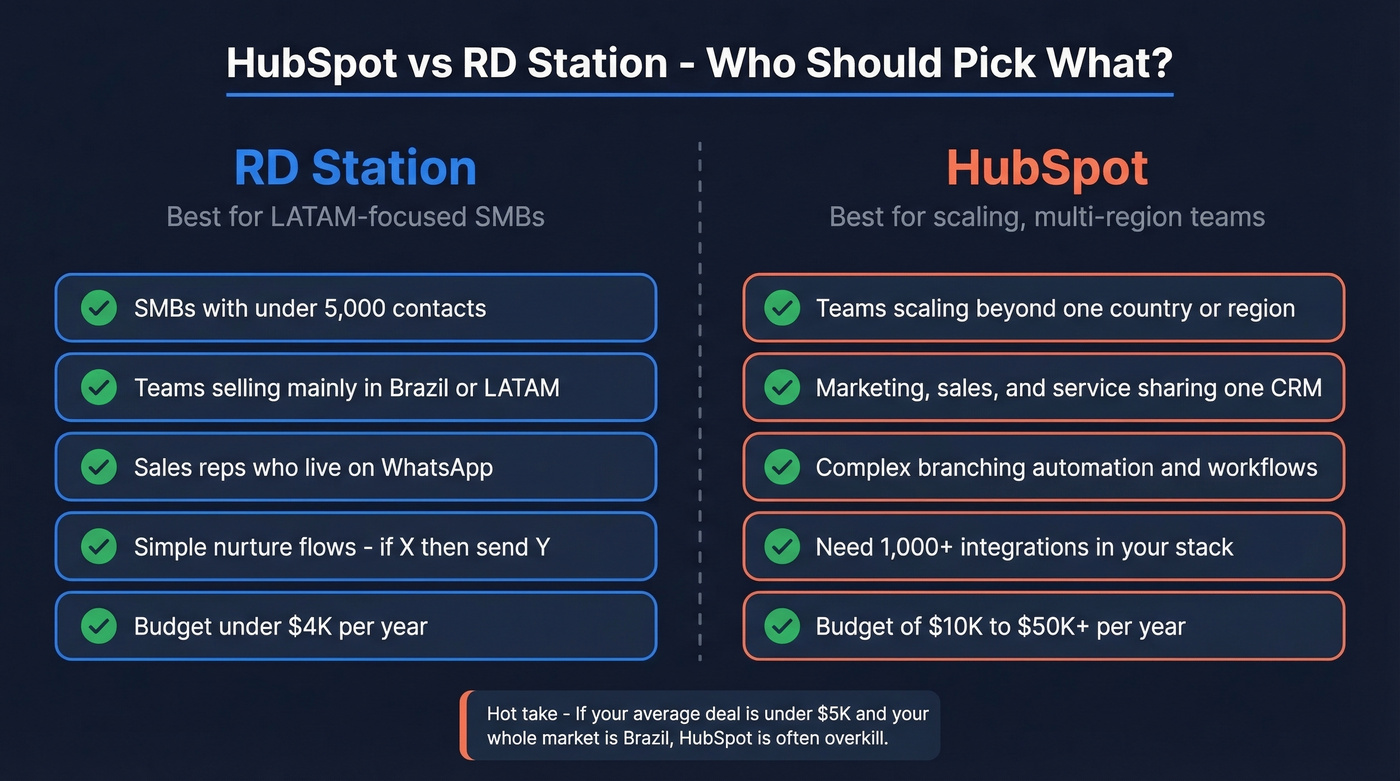
Pick HubSpot if you're scaling beyond one region, need marketing + sales + service to share one system of record, or you're already feeling the limits of linear automation. It costs more because it's built for bigger, messier org charts.
Hot take: if your average deal is under $5K and your whole market is Brazil, HubSpot's often overkill. You'll spend more time configuring it than using it.
Pricing breakdown (what you actually pay)
Both platforms charge in ways that punish messy databases. If your list is bloated with old leads, role accounts, and typos, you'll feel it fast.
| Plan | Monthly price | Contacts | Email sends | Notes |
|---|---|---|---|---|
| RD Station Light | ~$18/mo ($16 promo) | 1,000 | Unlimited | No commitment |
| RD Station Basic | ~$112/mo ($72 promo) | 1,000 | Unlimited | No commitment |
| RD Station Pro | $269/mo | 5,000 | Unlimited (<=250K) | Annual; R$2,699 mandatory onboarding |
| RD Station Enterprise | Custom | Custom | Unlimited | Talk to sales |
| HubSpot Free | $0 | Unlimited contacts (CRM) | Limited | No commitment |
| HubSpot Starter | $20/mo (1 seat) | 1,000 | 5x contacts/mo | |
| HubSpot Pro | $890/mo (3 seats) | 2,000 | 10x contacts/mo | $3,000 onboarding |
| HubSpot Enterprise | $3,600/mo (includes 5 seats) | 10,000 | 20x contacts/mo | $7,000 onboarding |
A couple of practical notes we see teams miss:
- RD Station pricing varies by country. RD Station lists USD pricing for Argentina, Chile, Ecuador, and Peru. Brazilian customers typically pay in BRL.
- HubSpot scales on multiple axes. Contacts are one part. Seats, hubs, and add-ons are where budgets quietly creep. HubSpot also charges for additional contacts (for example: $50 per 1,000 on Starter, $250 per 5,000 on Pro, and $100 per 10,000 on Enterprise).
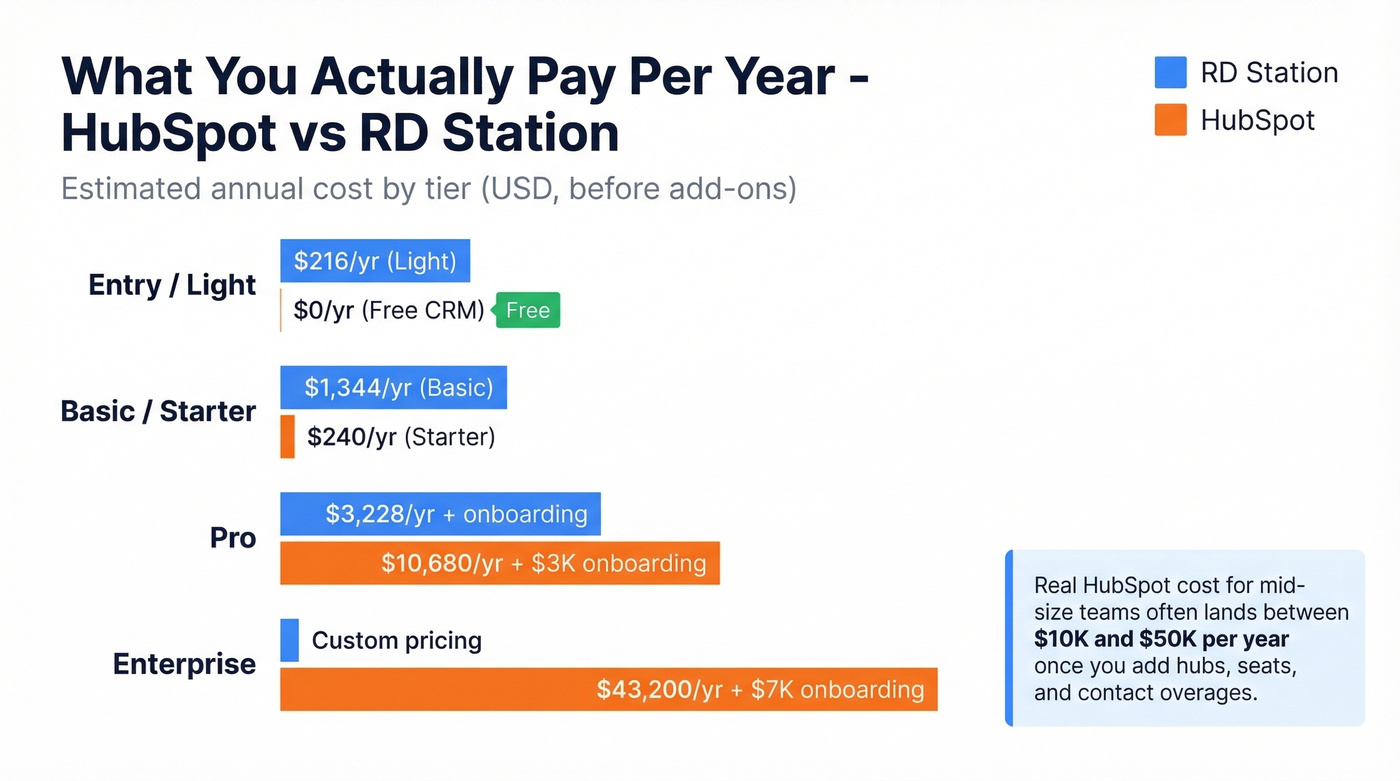
In our experience, the "real" HubSpot number for a mid-sized team lands somewhere between $10,000 and $50,000/year once you stop pretending you'll only buy one hub forever. RD Station Pro at $269/mo is about $3,228/year plus onboarding, so yes, the gap can be enormous.
If budget is tight and your needs are mostly email + landing pages + basic automation, RD Station usually wins on pure math.
Features that actually matter (not the brochure)
| Feature | HubSpot | RD Station |
|---|---|---|
| CRM depth | Full-suite Smart CRM | Basic CRM (3 plans) |
| Automation logic | Advanced branching | Linear workflows |
| AI layer | Breeze AI + Breeze Agents | No comparable agent layer |
| Integrations | 1,000+ | 100+ (incl. Zapier) |
| Third-party needed | Built-in WhatsApp features + WhatStation | |
| Reporting | Custom dashboards | More static reports |
| Lead scoring | Advanced, multi-touch | Basic scoring |
| Support languages | Global | PT / ES / EN |
The real separator: automation complexity
RD Station handles straightforward nurture flows well: "if lead does X, send Y." That covers a lot of SMB marketing.
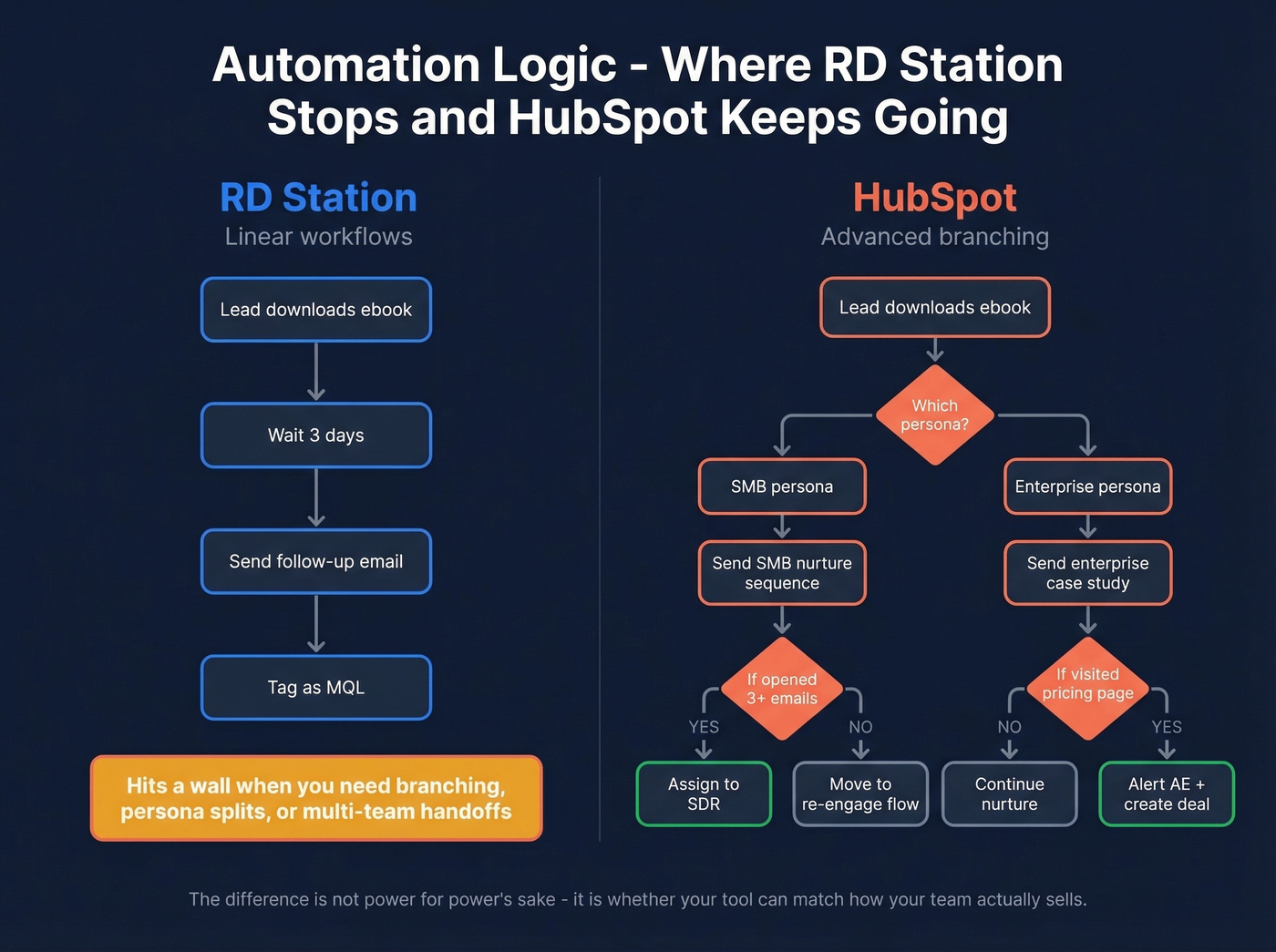
Where it starts to hurt is the moment your team asks for things like:
- different paths by persona, product line, or region
- conditional delays based on engagement
- multi-step handoffs between marketing and sales
- workflows that need to be audited and versioned like real ops work
HubSpot's automation builder is built for that reality. It's not "nice to have" power; it's the difference between a system you can grow into and a system you outgrow.
WhatsApp: RD Station's home-field advantage
If you're selling in Brazil, WhatsApp isn't a channel. It's the channel.
RD Station's WhatsApp workflow is a big reason LATAM teams stick with it. The free WhatStation extension lets reps handle CRM actions directly inside WhatsApp Web: update contacts, standardize messages, and track negotiations without bouncing between tabs. HubSpot can get there, but it usually means third-party tooling and more setup.
Here's a scenario we've seen play out: a 3-person inbound team in Sao Paulo closes deals just fine on RD Station because speed matters more than perfect process. Move that same motion into a 20-person org running multi-region campaigns and shared reporting, and RD Station starts to feel cramped fast.
Integrations and ecosystem
HubSpot's ecosystem is a real moat. If your stack already includes a bunch of tools that need to talk to your CRM (ads, support, billing, enrichment, attribution), HubSpot tends to be the path of least resistance.
RD Station integrates with plenty of tools too, but the long tail isn't as deep. That matters more than people think, because the "one weird integration" always shows up six months after you buy.
For reference:
- HubSpot integrations directory: https://ecosystem.hubspot.com/marketplace
- RD Station integrations page: https://www.rdstation.com/integracoes/

HubSpot or RD Station - neither platform fixes bad contact data. Prospeo enriches your CRM with 98% verified emails and 125M+ mobile numbers on a 7-day refresh cycle. Push clean, accurate leads straight into HubSpot or any CRM via native integrations.
Stop debating CRMs and start filling them with data that actually connects.
What real users say (and what that means)
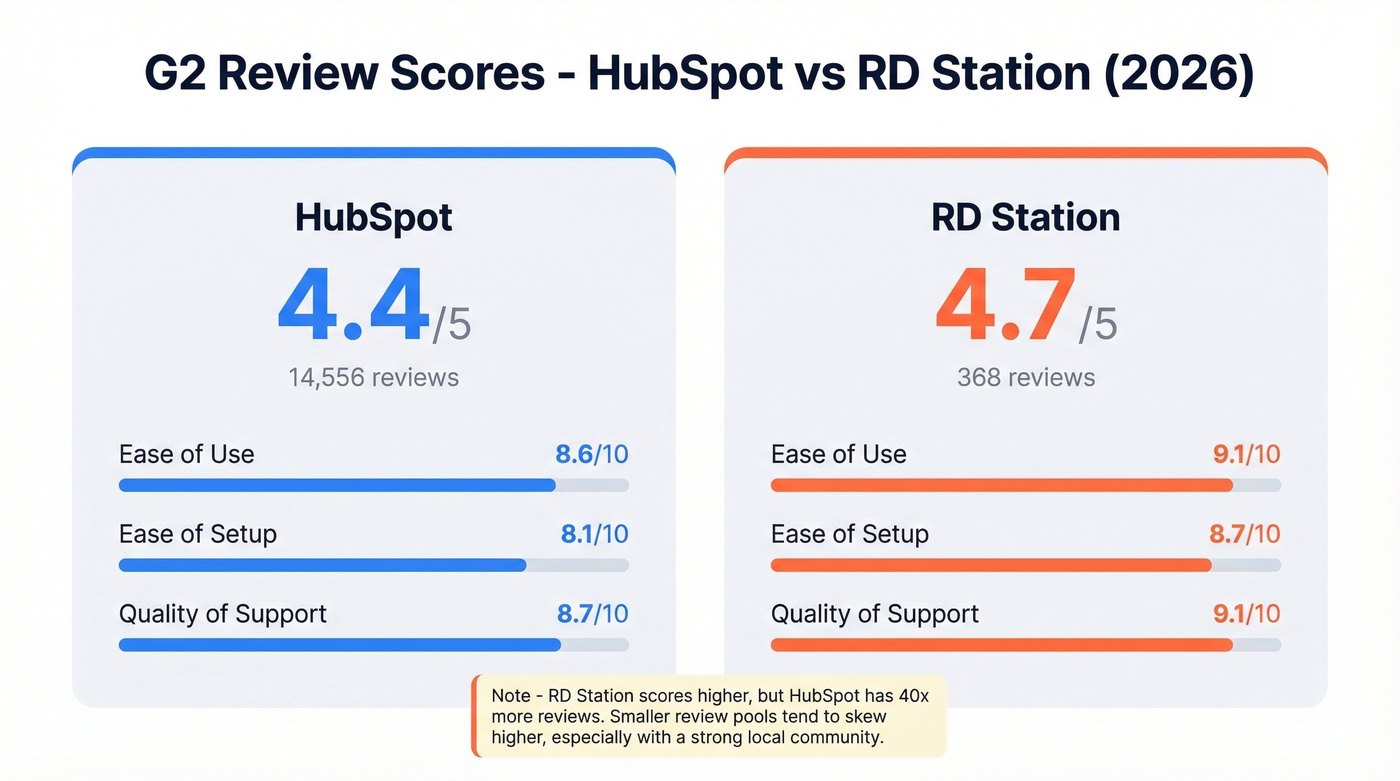
HubSpot sits at 4.4/5 on G2 with 14,556 reviews. RD Station scores 4.7/5 with 368 reviews. The sample size gap matters; a smaller review pool can skew higher, especially when a product dominates one region and has a strong local community.
G2 pages:
- HubSpot on G2: https://www.g2.com/products/hubspot/reviews
- RD Station on G2: https://www.g2.com/products/rd-station-marketing/reviews
Sub-scores snapshot:
| Metric | HubSpot | RD Station |
|---|---|---|
| Ease of use | 8.6 | 9.1 |
| Ease of setup | 8.1 | 8.7 |
| Quality of support | 8.7 | 9.1 |
Look, Reddit threads on r/sales and r/HubSpot consistently complain about the same thing: HubSpot starts friendly, then pricing ramps as soon as you need real automation, reporting, or multiple teams. That's not a scandal; it's the business model. But it's frustrating if you bought it thinking you'd stay on "Starter" forever.
RD Station users tend to praise simplicity and speed. The recurring gripe is customization: templates, segmentation, and reporting can feel limiting once campaigns get more complex and stakeholders start asking for "just one more dashboard."
Switching costs (the part nobody budgets for)
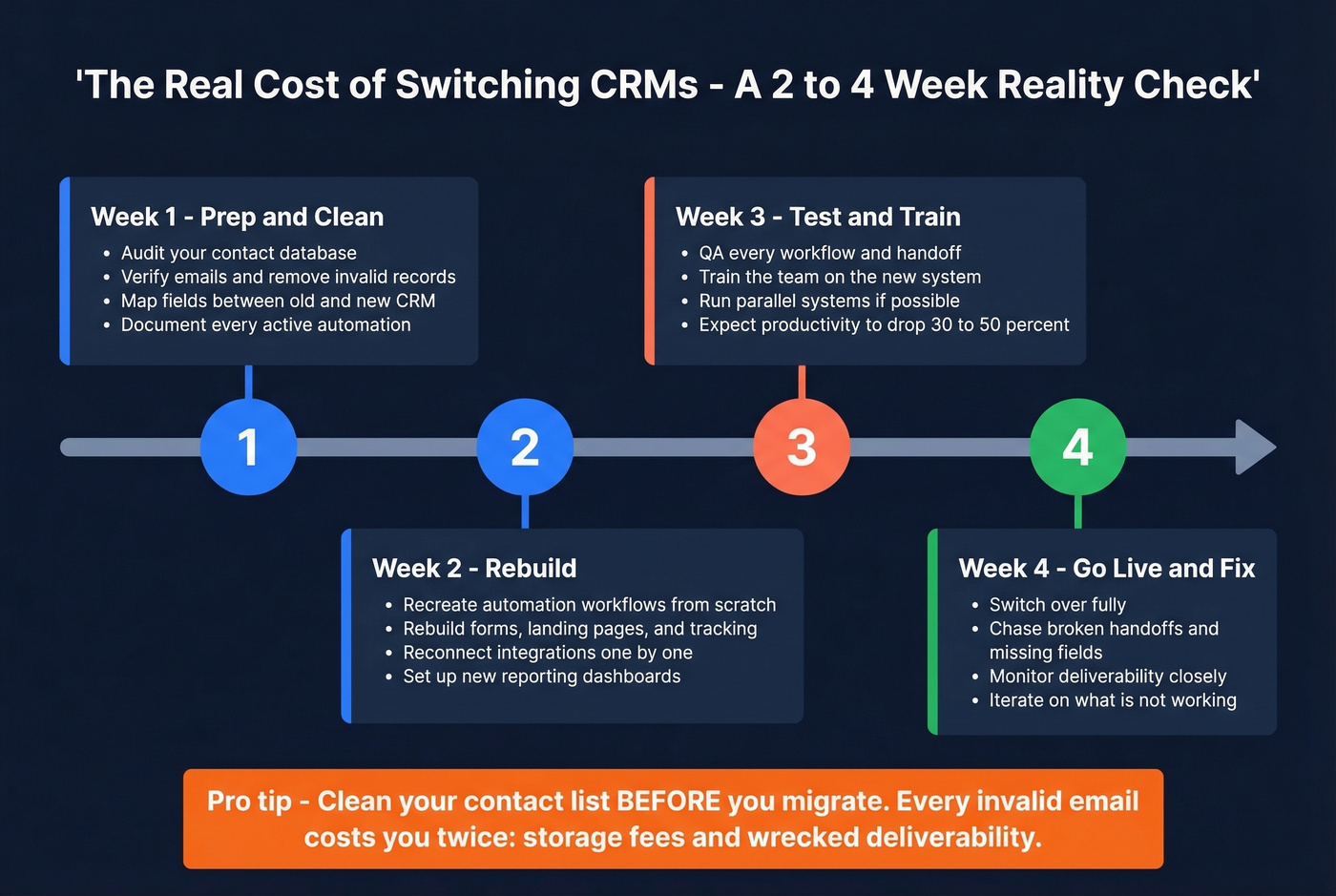
Migrating from RD Station to HubSpot isn't just exporting a CSV and calling it a day. Paid migration services often start around a few hundred dollars for self-serve and go up from there for guided work, depending on records and complexity.
The bigger cost is human:
- rebuilding every automation workflow
- redoing forms, landing pages, and tracking
- retraining the team (and losing velocity while they learn)
- re-connecting your stack and re-testing everything
Budget 2-4 weeks of disruption if you're moving anything beyond a basic setup. We've watched teams try to "do it on a Friday" and then spend the next month chasing broken handoffs and missing fields.
One more thing: if you're switching because "sales hates marketing's leads," a migration won't fix that. Process fixes that. The tool just makes your process more visible.
Clean your data before you migrate (seriously)
Both platforms charge by contacts. Every invalid email costs you twice: you pay to store it, and you pay again when it trashes deliverability with bounces and spam signals.
If you're migrating (or even just re-pricing), clean the list first. It's the easiest win you'll get all quarter.
Prospeo helps here in a very unglamorous but very profitable way: it verifies emails at 98% accuracy on a 7-day refresh cycle, so you're not importing dead contacts and paying contact fees for junk. It also integrates with HubSpot, which makes it simple to push verified contacts into your CRM and keep your database from slowly rotting.
If you want to go deeper than verification, Prospeo also gives you access to 300M+ professional profiles, 143M+ verified emails, and 125M+ verified mobile numbers, plus enrichment and intent data. But even if you only use it for list hygiene before a migration, you'll feel the savings fast.

Switching CRMs is painful enough without importing stale contacts. Prospeo's enrichment API returns 50+ data points per lead at a 92% match rate - so your new system starts clean, not cluttered. Works with HubSpot, Salesforce, and CSV uploads.
Migrate to your new CRM with verified data from day one.
FAQ
Is RD Station only for Brazilian companies?
No. RD Station offers USD pricing for Argentina, Chile, Ecuador, and Peru, with support in English, Spanish, and Portuguese. Still, its ecosystem, community, and training are strongest in Brazil. If you're operating mainly outside LATAM, HubSpot's global footprint gives you more options.
Can I use HubSpot's free CRM and skip Marketing Hub?
Yes, but don't build your whole marketing plan around it. You'll hit limits on automation, reporting, and email sends quickly. It's best used to test the CRM experience and get a team used to logging activity.
HubSpot's pricing page is here: https://www.hubspot.com/pricing
Which platform is better for small businesses?
For LATAM-focused SMBs with under ~5,000 contacts, RD Station usually wins on price and simplicity. For SMBs selling internationally or needing marketing and sales in one connected system, HubSpot can be worth the premium.
The deciding factor isn't headcount. It's complexity: regions, products, handoffs, and reporting expectations.
How do I clean my contact list before importing?
Use an email verification tool before you migrate contacts into either platform. You'll cut bounces, protect your domain reputation, and avoid paying per-contact fees on invalid records.
If you're using HubSpot, Prospeo's HubSpot integration makes it easy to push verified contacts into your CRM so your database stays clean after the move, not just on day one.