

Implication Questions in Sales: The Skill That Separates Top Reps
Your prospect just said, "Yeah, it's not perfect, but we've learned to work around it." Most reps hear that and jump straight into their pitch. Top reps lean in - because that's exactly where the deal gets made.
Neil Rackham's research analyzing 35,000+ sales calls found that top performers ask four times more implication questions than their average-performing peers. Not slightly more. Four times. Consistently.
You don't need 40 questions memorized. You need 3-4 killer ones per persona, researched before the call. Below: a type taxonomy, industry-specific question banks, and a 30-minute call template you can steal today.
What Are Implication Questions?
Implication questions are the "I" in Rackham's SPIN framework (Situation, Problem, Implication, Need-Payoff). Their job is specific: expand implied needs into explicit needs big enough to require action. Where problem questions uncover a pain, implication questions make that pain expensive, urgent, and impossible to ignore.
As Rackham explains in SPIN Selling (Chapter 4, pp. 73-76), the goal isn't to interrogate. It's to help the prospect connect their own dots between a surface-level issue and its downstream consequences. You're a guide, not a prosecutor.
Why They Work
Three principles make these questions disproportionately effective.
Self-discovery creates commitment. When a prospect articulates the consequences themselves, they rarely argue with their own conclusions. You're not telling them they have a problem - they're convincing themselves. This is basic psychology, and it works every single time.
Emotional engagement through ripple effects. Exploring consequences engages the prospect emotionally in a way that listing features never will. The prospect stops evaluating and starts feeling the weight of inaction. That shift is where urgency lives.
Loss aversion. Kahneman and Tversky's research shows humans weigh potential losses roughly twice as heavily as equivalent gains. Framing the status quo as a loss is exactly why consequence-driven questions outperform feature-benefit pitches - you're activating the part of the brain that hates losing more than it enjoys winning.
Four Types of Implication Questions
Not all consequence-exploring questions hit the same way. Here's a taxonomy ranked by difficulty.
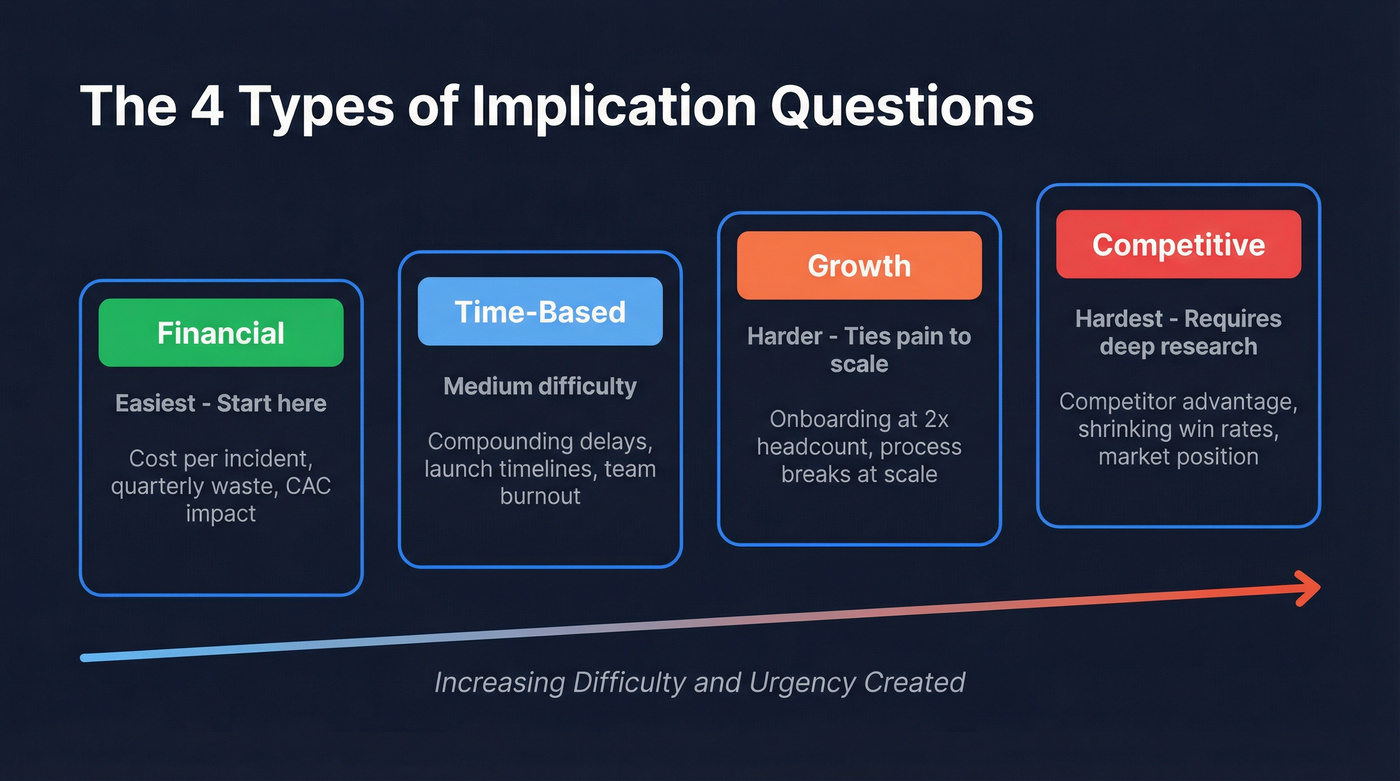
Financial (Easiest)
Financial implications are concrete and hard to dismiss. Start here if you're new to the framework. Ask what a failed process costs per incident, what manual data entry adds up to across the team per quarter, or how the problem affects cost per acquisition. The math always looks bad - and the prospect can't argue with their own numbers.
Time-Based
Time implications connect today's problem to a compounding future cost.
- "If this continues for another two quarters, where does that leave your launch timeline?"
- "How much longer can your team absorb this workload before something breaks?"
Growth
Growth implications tie the problem to scale - the issue gets worse as the company gets bigger.
- "As you add 20 more reps next year, how does this problem scale?"
- "What happens to onboarding time if you double the team without fixing this?"
Competitive (Hardest)
Competitive implications require the most research and the most confidence. They also create the most urgency. Ask what competitors are doing with the time your prospect's team wastes on this problem, or what happens to win rates if a competitor solves it first. These questions require genuine knowledge of the prospect's market, which is why most reps avoid them entirely. That avoidance is exactly why they're so powerful when you do use them.
Examples by Industry
Most SPIN examples still use manufacturing-style scenarios from the 1980s. Here are modern, KPI-anchored examples for four verticals.
SaaS / Software Sales
With 10-11 stakeholders in the average enterprise deal, your questions need to resonate across multiple roles:
- "If your churn rate stays at 8%, what does that do to your net revenue retention targets this year?"
- "How does a 45-day sales cycle affect your CAC payback when you're burning $200K/month on demand gen?"
- "What happens to pipeline conversion if reps keep qualifying leads manually?"
Agencies & Professional Services
- "If utilization drops below 70%, how does that hit your margins on fixed-fee engagements?"
- "What's the cost of scope creep when you don't catch it until the invoice goes out?"
- "How does that affect your ability to retain senior talent when they're stuck on low-margin work?"
Fintech & Financial Services
Compliance-driven industries respond strongly to risk-based questions because the downside is existential, not incremental. Ask what remediation costs when a compliance gap leads to a regulatory finding, what the exposure looks like if fraud detection lags by 48 hours on their transaction volume, or how audit readiness affects their SOC 2 timeline. One well-placed question about regulatory risk can do more work than ten questions about efficiency.
Healthcare IT
- "If patient data isn't reconciled in real time, what does that mean for your next HIPAA audit?"
- "What's the downstream impact on care coordination when clinicians can't trust the EHR data?"
- "How does that exposure affect your cyber liability premiums at renewal?"

Implication questions only work when you've done the research. Prospeo gives you 30+ filters - technographics, funding rounds, headcount growth, buyer intent - so you walk into every call knowing exactly which pain points to probe. 98% email accuracy means you actually reach the decision-maker you prepared for.
Stop winging discovery calls. Research prospects in minutes, not hours.
The Implication Ladder: SPIN Selling in Action
Here's how these questions chain together on a real call. Each answer feeds the next question, and this ladder technique is one of the best SPIN selling examples you can model.
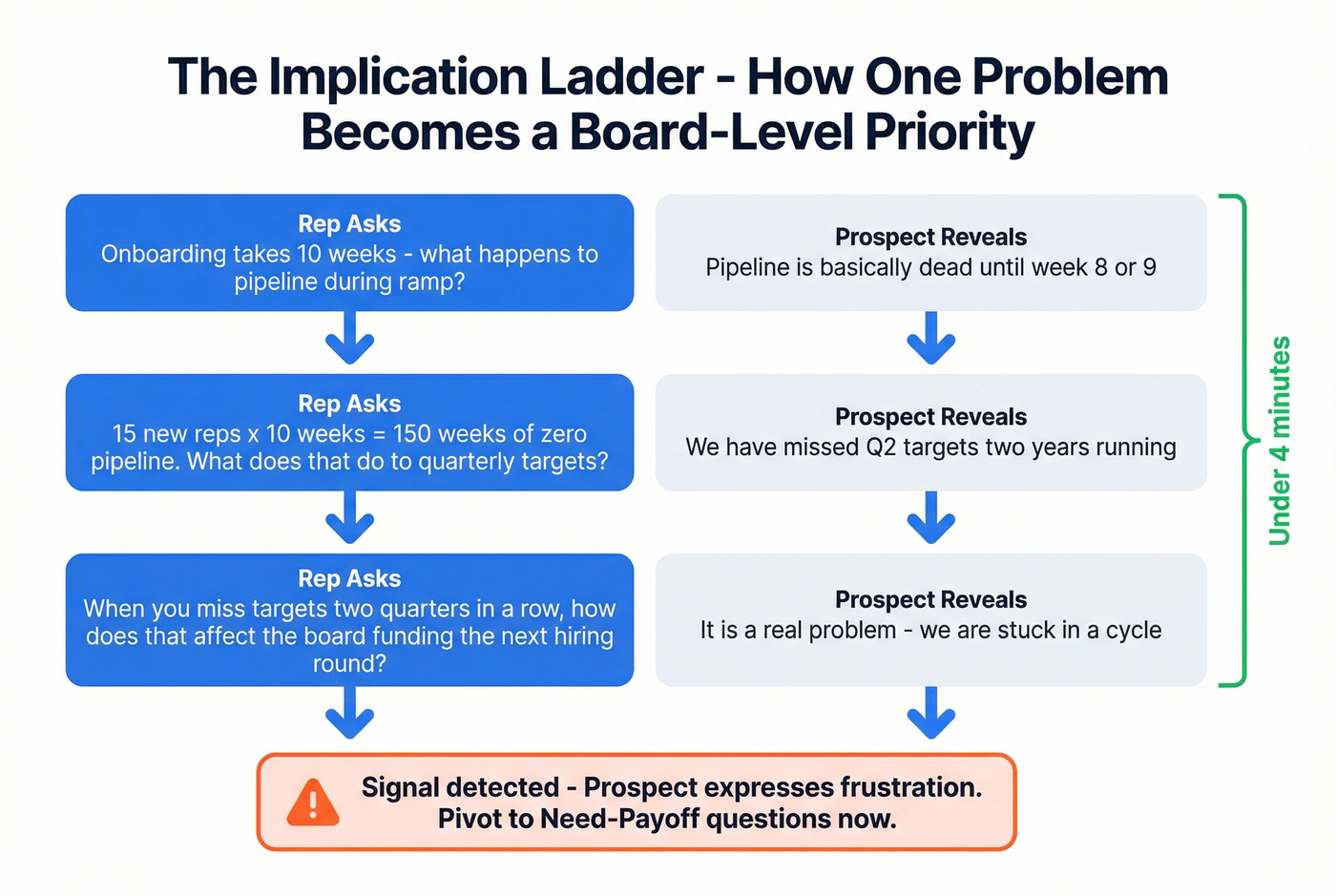
Rep: "You mentioned onboarding new reps takes about 10 weeks. What happens to pipeline during that ramp period?"
Prospect: "It's basically dead. New reps don't generate meaningful pipeline until week 8 or 9."
Rep: "So if you're hiring 15 reps this year, that's roughly 150 weeks of zero pipeline production. What does that do to your quarterly targets?"
Prospect: "We've missed Q2 targets two years running, partly because of ramp."
Rep: "When you miss targets two quarters in a row, how does that affect the board's willingness to fund the next hiring round?"
Notice the rep never pitched. They kept asking "so what?" in different ways until the prospect built the business case themselves. We've seen this ladder technique turn "nice to have" problems into board-level priorities in under four minutes.
Where They Fit in a Call
| Phase | Time | Focus |
|---|---|---|
| Opening / rapport | 5 min | Build context |
| Situation Qs | 5 min | 3-4 questions max |
| Problem Qs | 8 min | Uncover pain |
| Implication Qs | 4 min | Expand pain |
| Need-Payoff Qs | 3 min | Prospect states value |
| Next steps | 5 min | Lock commitment |
| Total | 30 min |
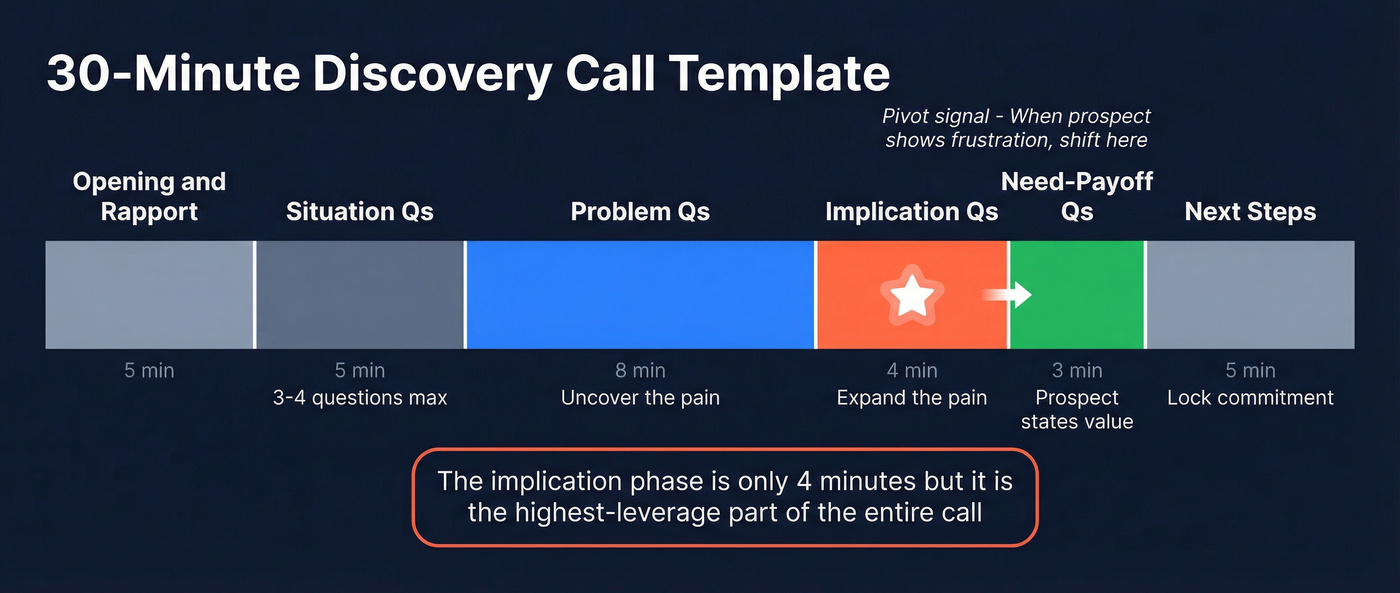
The pivot from implication to need-payoff is everything. When the prospect starts expressing frustration - "Yeah, this is really costing us" - stop expanding the pain and start asking what solving it would mean for them. That's your signal. Don't miss it.
Three Mistakes That Kill the Deal
Pitching too early. The prospect says "it's a bit of a headache" and you launch into your demo. You just skipped the most valuable four minutes of the call. Here's the thing: if you haven't built the seriousness of the problem, your solution sounds like a vitamin, not a painkiller.
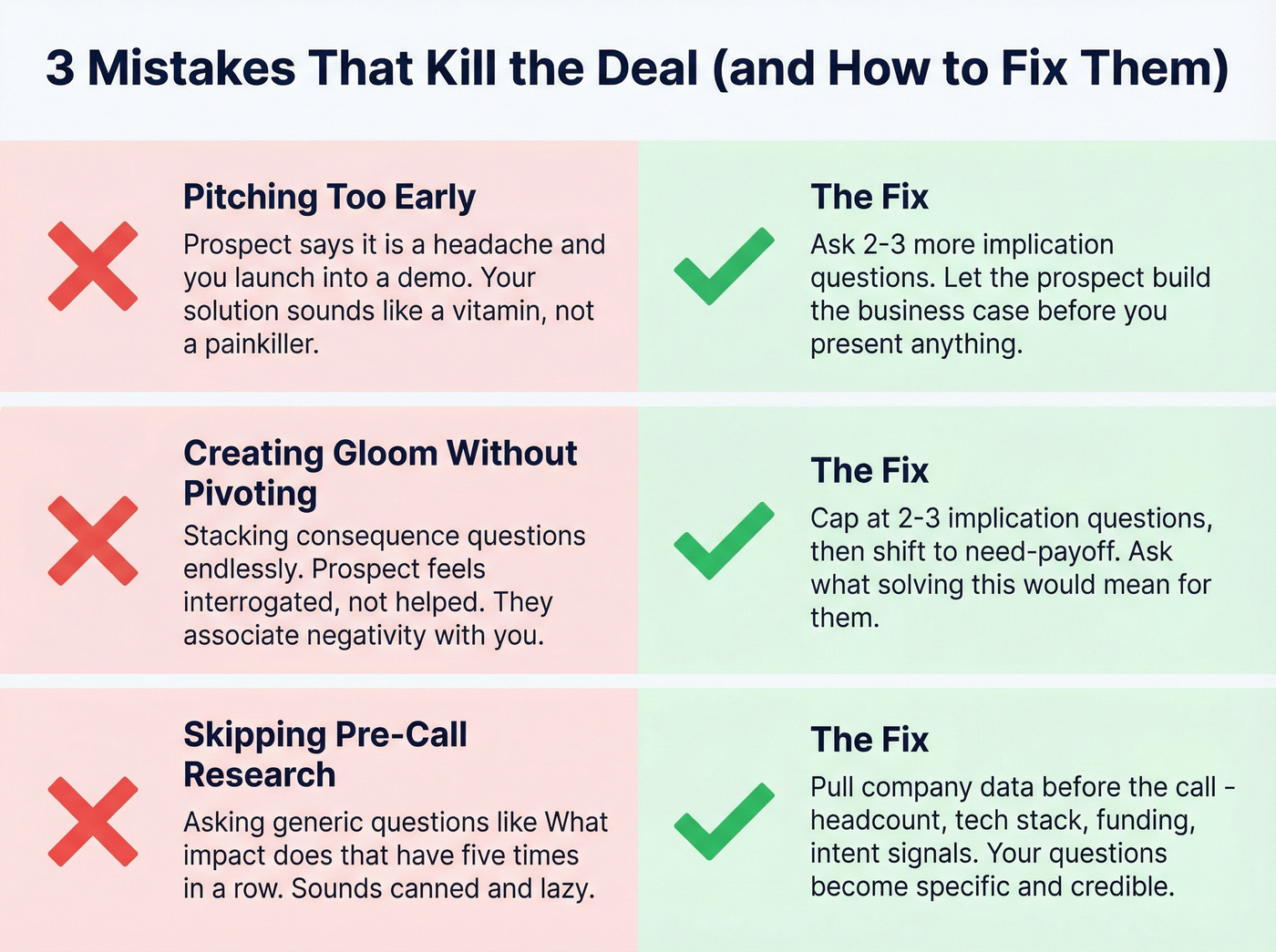
Creating gloom without pivoting. Stack too many consequence questions without transitioning to need-payoff, and the prospect feels interrogated - not helped. The consensus on r/sales is that implication-heavy calls without a solution pivot leave buyers feeling negative about the conversation and, by extension, about you. Two or three sharp implication questions are plenty before you shift gears.
Skipping pre-call research. "What impact does that have on your business?" repeated five times sounds canned. You can't ask sharp questions about a prospect's specific challenges if you don't know their tech stack, headcount trends, or recent funding before the call. Pull the prospect's company profile beforehand - headcount growth, technographics, intent signals. Your questions become dramatically more specific when you know the prospect just raised a Series B, added 40 engineers, and is actively researching your category.
Planning Questions Pre-Call
Use this three-step method before every discovery call:
- Write down a likely problem based on the prospect's role, industry, and company stage.
- List 3-4 consequences - financial, operational, competitive, time-based.
- Convert each consequence into a question. Don't state the consequence; ask the prospect to articulate it.
The mental shortcut: imagine the prospect saying "So what?" after every problem you uncover. Your follow-up questions are the answer - framed as questions, not statements.
In our experience, this planning step is where most reps cut corners, and it's exactly where the real advantage is. A tool like Prospeo can surface 50+ data points per contact - tech stack, growth signals, Bombora-powered intent data across 15,000 topics - so your questions reference the prospect's actual situation instead of generic pain.
One strong opinion we'll stand behind: Implication questions land hardest with decision-makers. Their job is anticipating what can go wrong, so they engage deeply with consequence-based questions. If you're spending your best questions on gatekeepers who can't act on the urgency you're building, skip them. Save your ammunition for the people who can actually sign off.
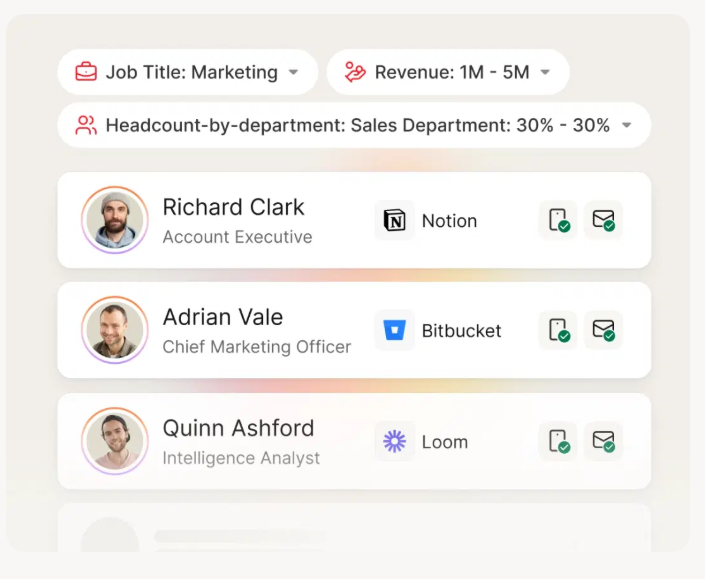
Competitive implication questions require knowing your prospect's market cold. Prospeo tracks 15,000 intent topics so you can see what solutions your prospect is already evaluating - and build questions around the cost of falling behind. Layer that with job change alerts and department headcount data to time your outreach perfectly.
Turn buyer intent signals into the sharpest implication questions on your team.
FAQ
What's the difference between implication and need-payoff questions?
Implication questions explore consequences to build urgency; need-payoff questions get the prospect to articulate the value of solving the problem. Pivot to need-payoff when the prospect starts expressing frustration - that's your signal the pain is big enough.
How many implication questions should I ask per call?
Plan 3-4 persona-specific ones before every call. A well-chained sequence of three sharp questions outperforms ten generic ones every time. Quality and specificity beat volume.
Do implication questions work in short sales cycles?
Yes - even in deals closing under 30 days. One or two targeted consequence questions can shift a prospect from "it's fine" to "this needs fixing." The SPIN framework compresses; you just run a shorter ladder.
How do I research prospects before asking implication questions?
Use a B2B data platform to pull company size, tech stack, funding stage, and intent signals before the call. The more specific your research, the sharper your questions - and the faster the prospect trusts you understand their world.