

Why Marketing Intelligence Matters (And What Most Teams Get Wrong)
You join a B2B company as the first product marketing hire. There's no competitive monitoring, no win/loss analysis, no structured view of the market. The VP asks you to "build out marketing intelligence." You nod, open a Google Doc, and realize you don't even know where the boundaries are.
That's the moment most MI programs go sideways - because the importance of marketing intelligence isn't about collecting data. It's about turning external signals into decisions. You need three things: a framework that separates MI from its cousins, clean data you trust, and a point of view about what the signals mean.
What Marketing Intelligence Actually Is
Marketing intelligence is the ongoing collection and analysis of external data - market trends, competitor moves, customer behavior shifts, regulatory changes - to inform strategic planning and forward-looking decisions. It's not a dashboard. It's not a weekly Google Alert digest. And it's definitely not what one Reddit commenter on r/ProductMarketing called out as the common trap: "just... search Google, monitor LinkedIn, or scrape some websites and call it 'intelligence.'"
The critical distinction is directional. Business intelligence looks backward - what happened last quarter, where revenue came from. Marketing intelligence looks forward - where the market's heading, which segments are emerging, what to do next. In practice, MI feeds battlecards for sales, informs product roadmap priorities, and shapes go-to-market timing. Those concrete outputs are what separate a real program from a research habit.
Let's also clarify marketing intelligence vs market intelligence, since the terms get swapped constantly. Market intelligence is broader - it covers macroeconomic trends, industry sizing, and regulatory shifts that affect an entire sector. Marketing intelligence narrows the lens to signals that directly inform marketing strategy: positioning, messaging, channel selection, and competitive response.
MI vs. Market Research vs. BI vs. CI
These four disciplines get conflated constantly. Here's the cleanest way to separate them:
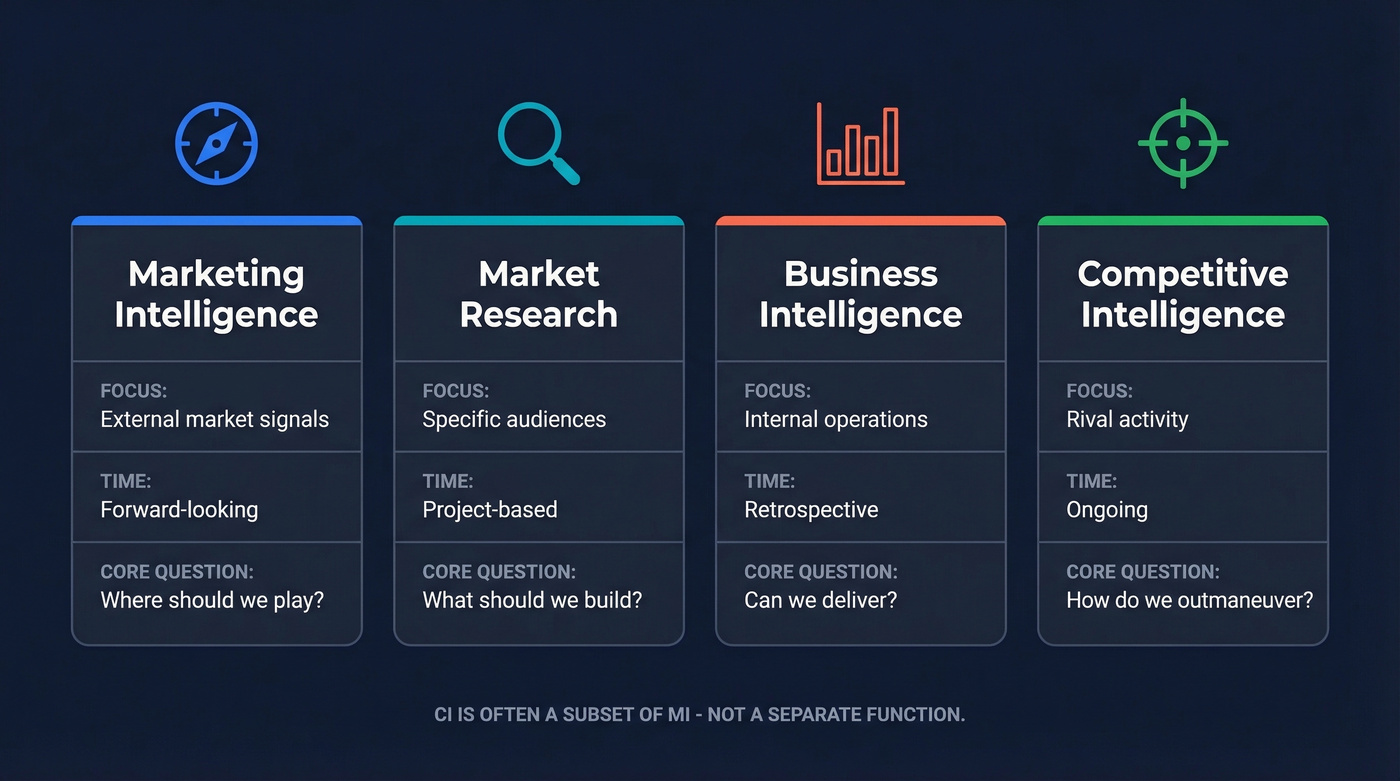
| Discipline | Focus | Time Horizon | Core Question |
|---|---|---|---|
| Marketing Intelligence | External market | Forward-looking | Where should we play? |
| Market Research | Specific audience | Project-based | What should we build? |
| Business Intelligence | Internal operations | Retrospective | Can we deliver? |
| Competitive Intelligence | Rival activity | Ongoing | How do we outmaneuver? |
CI is often treated as a subset of MI, not a separate function. Porter's competitive forces framework is still the best foundation for CI work, but CI alone won't tell you about emerging segments or shifting buyer behavior. A practical way to think about MI scope is through its core components: customer data, competitor activity, market trends, and product performance signals. You need the full lens, not just the competitor slice.
Why Marketing Intelligence Matters, in Numbers
The Measurement Gap
Even in social media - where data is abundant - 97% of executives believe they can communicate value to the business, but only 30% of marketers can actually measure ROI. The gap is worse in channels with less tracking. Without structured intelligence, leadership operates on vibes while practitioners drown in unconnected data.
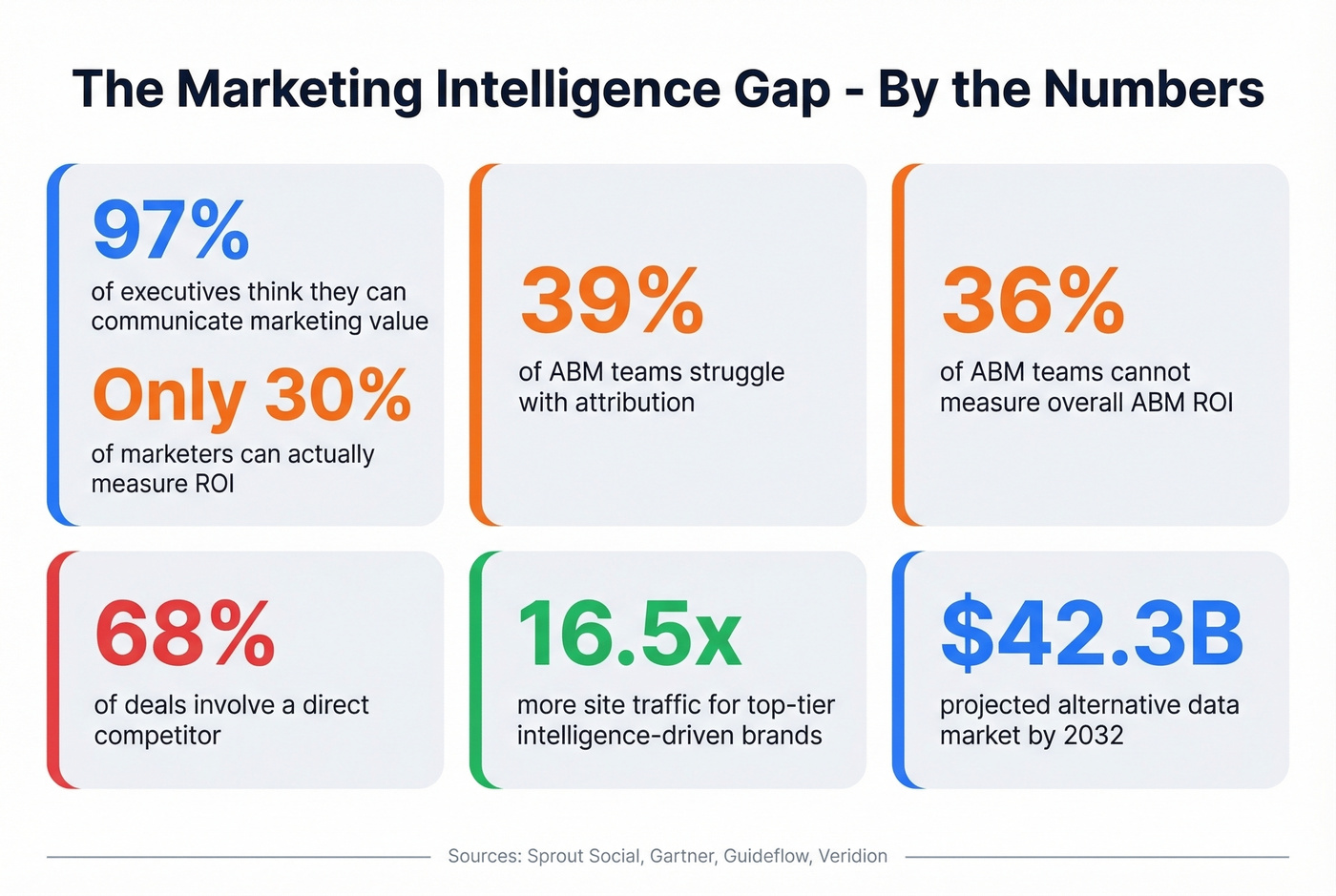
The problem compounds in ABM-heavy orgs. Gartner found that 39% of ABM teams struggle with attribution, and 36% can't measure overall ABM ROI. When you can't prove what's working, budgets get cut - and the MI program is usually first on the chopping block.
Competitive Pressure
68% of deals involve a direct competitor. That number alone justifies a structured CI motion. The CI tools market is projected to hit $1.46B by 2030, and the broader alternative data market is on track for $42.3B by 2032. Flying blind in a multi-competitor deal is how you lose.
What Intelligence-Driven Brands Achieve
Gartner's 2023-2024 Digital IQ Index offers one of the clearest benchmarks. Brands rated "Genius" - the top tier for digital marketing sophistication - generate 16.5x more site traffic than their peers. They're far more likely to hire for data science and ML roles (19% of job posts vs 3%), and nearly twice as likely to deploy guided selling tools (70% vs 36%). Intelligence-driven brands don't just know more. They act on what they know faster.

Intelligence-driven brands act faster because they trust their data. Prospeo's 7-day refresh cycle means your competitive signals are never stale - while most providers update every 6 weeks. Layer buyer intent across 15,000 topics with verified contact data at 98% accuracy to turn market signals into pipeline.
Stop making decisions on data that expired last month.
Mistakes That Kill Your MI Program
We've seen the same anti-patterns sink MI programs across dozens of orgs. Here's what to watch for.
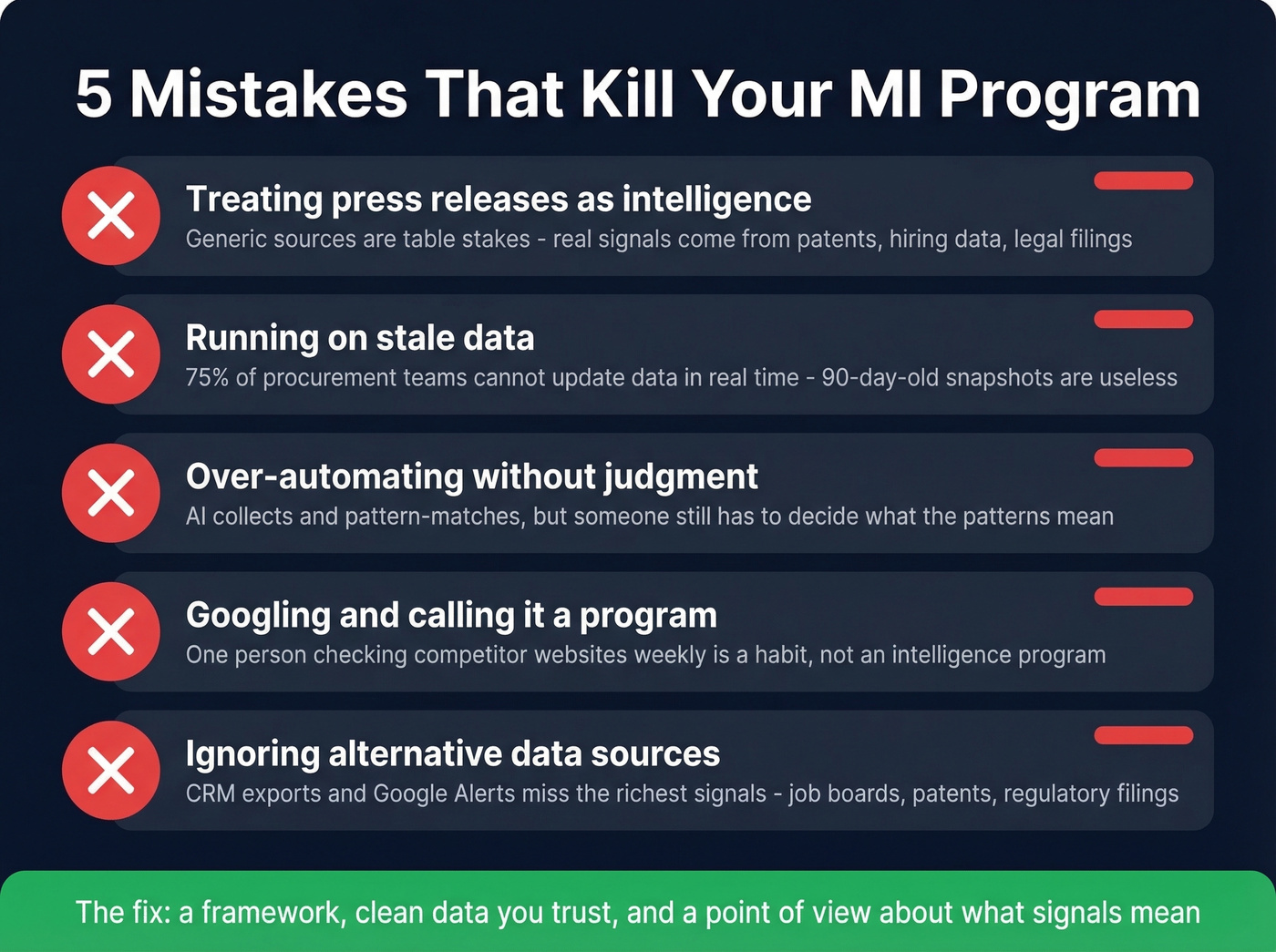
Treating press releases as intelligence. Generic sources are table stakes. Real intelligence comes from alternative data: patent filings, hiring patterns, job posting changes, legal disputes. The teams that win read between the lines.
Running on stale data. 75% of procurement professionals can't update their data in real time. If your competitive snapshot is 90 days old, you're making decisions about a market that no longer exists.
Over-automating without judgment. AI can collect and pattern-match at scale, but someone still needs to decide what the patterns mean. Automation without synthesis produces noise, not insight.
Googling and calling it a program. This one drives us crazy. A common practitioner complaint is that too many teams confuse desk research with intelligence. If your "MI program" is one person checking competitor websites weekly, you don't have a program. You have a habit.
Ignoring data sources beyond the obvious. Teams that rely solely on CRM exports and Google Alerts miss the richest signals. Industry databases, patent registries, job boards, regulatory filings, and social listening platforms all reveal intent before it shows up in pipeline - and most of your competitors aren't looking there.
Collection Methods and the Role of AI
56% of marketers say their company is actively implementing AI, and AI adoption within CI teams jumped 76% year-over-year. Pinterest's Performance+ campaigns deliver [20%+ CPA reductions](https://www.emarketer.com/content/how-ai-rewired-marketing-2025 - breakout-use-cases-marketing-leaders) by automating targeting at a level humans can't match.
AI is reshaping intelligence collection across the board - from automated web scraping and NLP-driven sentiment analysis to real-time alert systems that flag competitor pricing changes within hours. But the real failure is organizational: 70% of employers provide no generative AI training, and 43% of marketers don't know how to get value from the AI tools they already have. The technology is ready. The organizations aren't. That's not a skills gap - it's a management gap.
Building Your MI Foundation
Here's the contrarian take: you don't need a platform. You need a framework and three good tools.
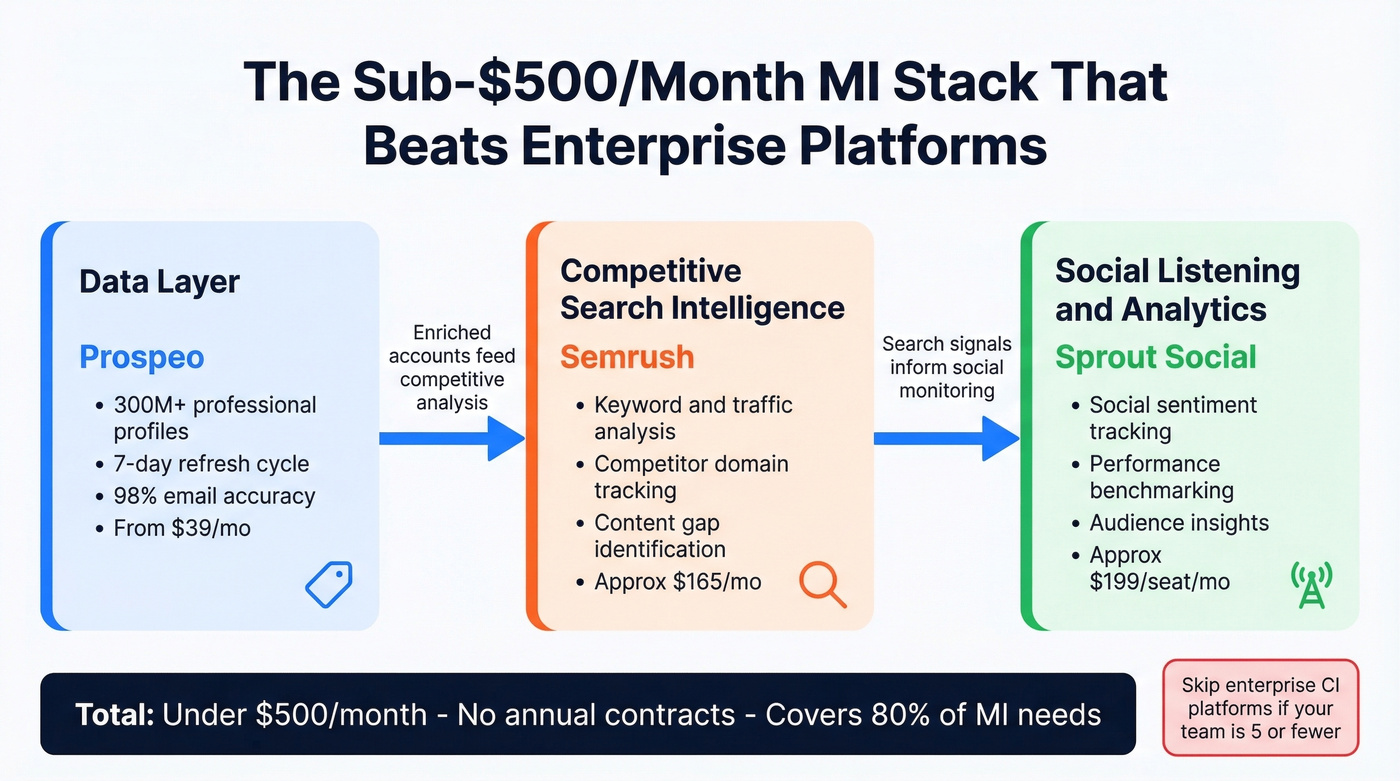
If your average deal size is under $10K, you almost certainly don't need an enterprise CI suite. A $400/month stack will outperform a $40K/year platform that nobody logs into. We've watched teams spend six figures on Klue or Crayon licenses only to find three people actually using them six months later.
The three-tool stack that covers 80% of MI needs: a data provider for contact and account intelligence, an analytics tool for performance intelligence, and a competitive monitoring tool for CI.
For the data layer - the piece you can't skip - Prospeo covers 300M+ professional profiles refreshed every 7 days, with 98% email accuracy. It starts free and scales from ~$39/mo with no annual contracts. One key data sourcing tip for marketing teams: prioritize providers that refresh records on a weekly cadence, not quarterly. Stale intelligence data is worse than no data at all, because it creates false confidence in decisions that no longer reflect reality.
Pair that with Semrush (~$165/mo) for competitive search intelligence and Sprout Social (~$199/seat/mo) for social listening and performance analytics, and you've got a functional MI stack for under $500/month on a single seat. In our experience, the data layer is where most teams either build a real advantage or create a garbage-in-garbage-out cycle. Every downstream insight is only as trustworthy as the contact and account data feeding it.
Skip the enterprise CI platforms if you're a team of five or fewer. They're built for organizations with dedicated competitive intelligence analysts, not for the product marketer who's also writing landing pages and running webinars.

The article makes it clear: 75% of teams can't update their data in real time, and stale snapshots kill MI programs. Prospeo tracks intent signals across 15,000 Bombora topics, pairs them with technographic and hiring data, and delivers verified emails at $0.01 each - so your intelligence actually connects to revenue.
Turn market signals into booked meetings for under $500/month.
FAQ
What's the difference between marketing intelligence and market research?
Marketing intelligence is ongoing, forward-looking analysis of market trends and competitors. Market research is project-based - surveys, focus groups - designed to answer a specific question. Mature organizations run both in parallel, with MI informing which research projects to prioritize.
How do small teams start an MI program?
Start with a reliable data provider, add a free analytics layer like Looker Studio, and pick one competitive monitoring method. A functional stack runs under $500/month. Even lean teams gain a measurable edge when they systematize how they collect and act on external signals.
Is AI replacing marketing intelligence analysts?
No. AI accelerates collection and pattern recognition, but 70% of employers provide no AI training. The bottleneck is synthesis and judgment - deciding what signals mean for your specific market position - and that's a skill AI supports but doesn't replace.
Why is marketing intelligence important for B2B companies?
68% of B2B deals involve a direct competitor, and intelligence-driven brands generate 16.5x more site traffic than peers. Structured MI programs reduce competitive blind spots, improve win rates, and ensure go-to-market timing aligns with actual market conditions rather than assumptions.