

Brand Go-to-Market Strategy: A 2026 Guide
How to Build a Brand GTM Plan That Actually Works
A RevOps lead we know spent six weeks building a GTM plan last year - beautiful slide deck, tight ICP, solid channel mix. The launch flopped because the messaging sounded like every other vendor in the category. The product was differentiated. The brand wasn't.
That's the gap most go-to-market strategy frameworks ignore, and it's exactly what a brand go-to-market strategy solves.
What Is a Brand GTM Strategy?
A brand go-to-market strategy is the cross-functional plan for bringing a product or service to market with a distinct, defensible brand position - not just a launch checklist. It's GTM with a spine. Where a generic GTM plan answers "how do we reach buyers," a brand GTM plan answers "why would buyers choose us over everyone else who reaches them."
Most teams confuse GTM with their marketing plan. They're different animals:
| GTM Strategy | Marketing Plan | |
|---|---|---|
| Purpose | Launch / market entry | Ongoing demand gen |
| Timing | Pre-launch, expansion | Continuous |
| Ownership | Cross-functional | Marketing team |
| Key metrics | CAC, LTV, sales velocity | MQLs, traffic, engagement |
A GTM strategy aligns sales, marketing, enablement, and RevOps around messaging, content, distribution, and execution. A marketing plan is one piece of that puzzle.
The Short Version
- Start with positioning, not channels. Who do you serve, what outcome do you promise, why you? Answer these before touching a media plan.
- Choose your motion by deal size. Sub-$5K ACV? Product-led . $5K-$25K? Hybrid. Above $25K or complex buying committees? Sales-led, full stop.
- Launch internally before you go external. If your AEs can't articulate the value prop in 30 seconds, your market won't either.
- Verify your prospect data before launch day. Bounce rates above 5% damage domain reputation and kill outbound before messaging gets a chance.
- Monitor the first 72 hours obsessively. Initial performance signals tell you whether to double down or pivot - don't wait two weeks to look.
Why Positioning Comes Before Channels
Most GTM failures aren't channel failures. They're positioning failures dressed up as channel problems. You picked the right channels but said the wrong things, so you blame the channels.
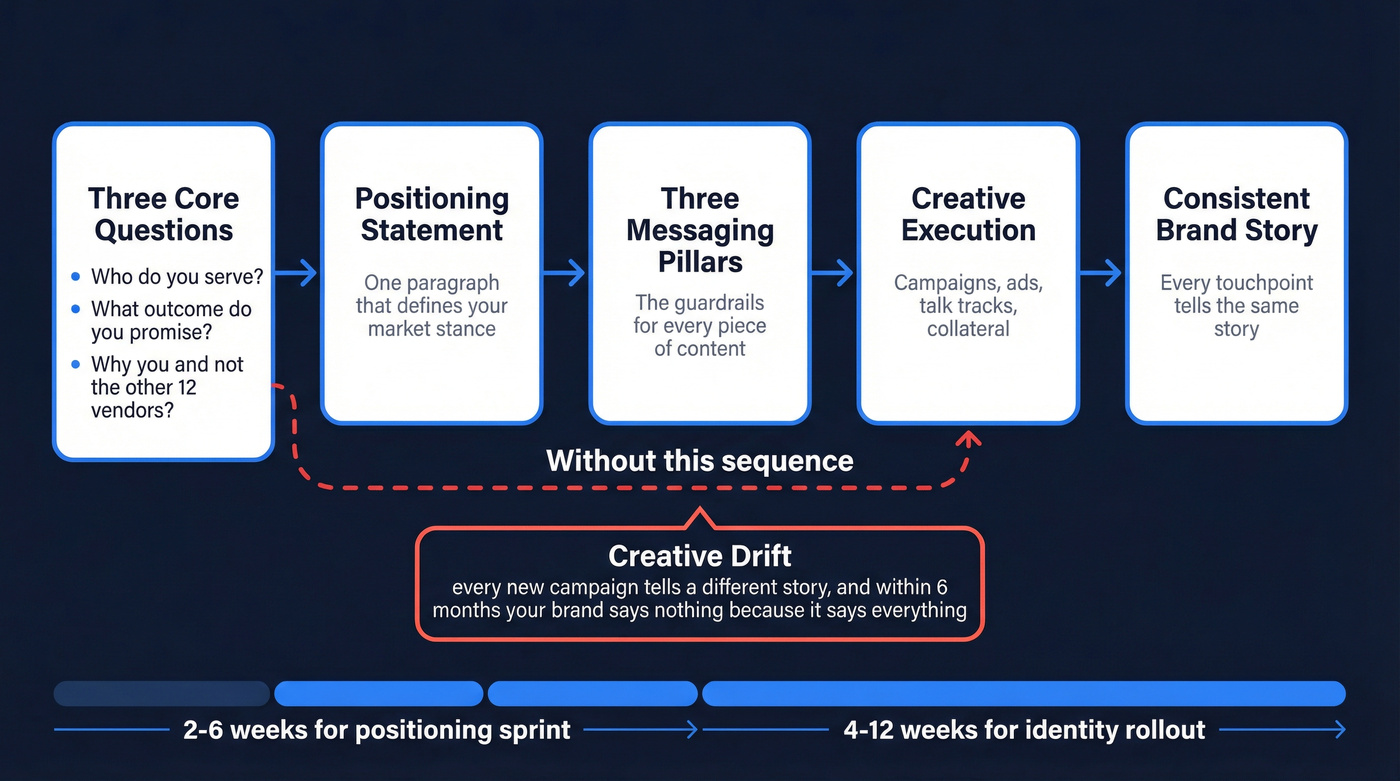
A strong brand GTM starts with three questions:
- Who do you serve? Not "everyone in B2B SaaS" - a specific buyer with a specific pain.
- What outcome do you promise? Not features. Outcomes. "Cut bounce rates from 35% to under 4%" beats "email verification tool."
- Why you? What makes your approach structurally different from the other 12 vendors in the category?
Those answers become your positioning statement, which feeds three messaging pillars, which create the guardrails for every piece of creative your team produces. Without this sequence, you get creative drift - every new campaign, every new hire, every new agency introduces a slightly different story. Within six months, your brand says nothing because it says everything.
Budget 2-6 weeks for the positioning and messaging sprint. Identity rollout - visual system, website, collateral - takes another 4-12 weeks depending on scope.
Here's the thing: feature-heavy messaging is the number one positioning mistake we see. A cybersecurity company listing "AI-powered threat detection, real-time monitoring, automated response" sounds identical to every competitor. The company that says "we stop breaches that your current vendor misses" wins the conversation.
A 6-Step Brand GTM Framework
1. Define your ICP and personas. Go beyond firmographics. Map the buying committee - who initiates, who influences, who signs. Your positioning needs to resonate with all of them, not just the end user.
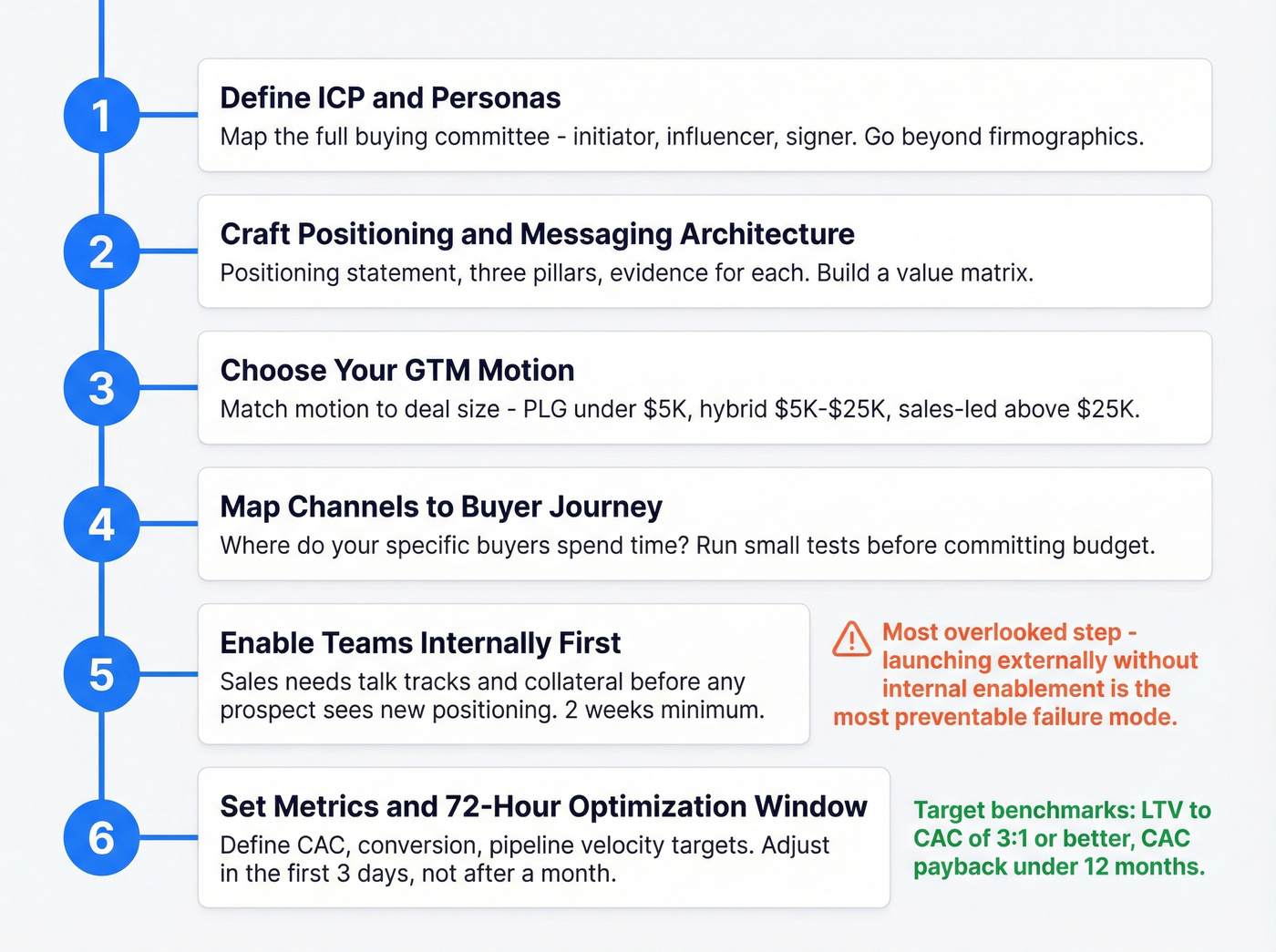
2. Craft positioning and messaging architecture. Build a positioning statement, three supporting pillars, and evidence for each. Many teams use a value matrix to map each persona's pain points against specific messaging. This structured approach is what separates brand GTM from generic launch plans, and we'll dig into it below.
3. Choose your GTM motion. Match your motion to your deal size and buyer complexity. We break this down in the next section.
4. Map channels to the buyer journey. Don't pick channels based on what worked at your last company. Map them to where your specific buyers actually spend time and how they make decisions. Run small tests before committing budget.
5. Enable teams internally before going external. Walk the plan backward from launch day and stress-test timelines with buffers. Sales needs talk tracks, objection handling, and collateral before a single prospect sees your new positioning. Two weeks before external launch is the minimum for readiness milestones.
6. Set metrics and a 72-hour optimization window. Define CAC, conversion rate, and pipeline velocity targets upfront. If early engagement is weak in the first three days, your targeting or messaging needs immediate adjustment - not a "let's give it a month" approach.

Your GTM launch lives or dies on whether outbound actually reaches buyers. Prospeo's 98% email accuracy and 7-day data refresh mean your positioning hits real inboxes - not bounce logs. Teams using Prospeo cut bounce rates from 35% to under 4% and book 26% more meetings than ZoomInfo users.
Don't let bad data kill your GTM before your messaging gets a chance.
Using a Value Matrix in Your GTM Plan
A value matrix gives your go-to-market proposition a repeatable backbone. For each persona in the buying committee, you list their top pain points, the value your product delivers against each pain, and the specific message that connects the two. The result is a grid - persona x pain x value x message - that keeps every team aligned on what to say and to whom.
Without this matrix, sales creates its own talk tracks, marketing writes copy from a different angle, and the buyer hears three stories from one company. With it, your go-to-market proposition stays consistent from the first ad impression through the closed-won handshake. We've seen teams cut their messaging review cycles in half just by having this single artifact everyone references.
Choosing Your GTM Motion
Your deal size dictates your motion more than anything else. Companies are spending $2 in sales and marketing for every $1 of new ARR, and that ratio has climbed 14% since 2024. Picking the wrong motion makes it worse.
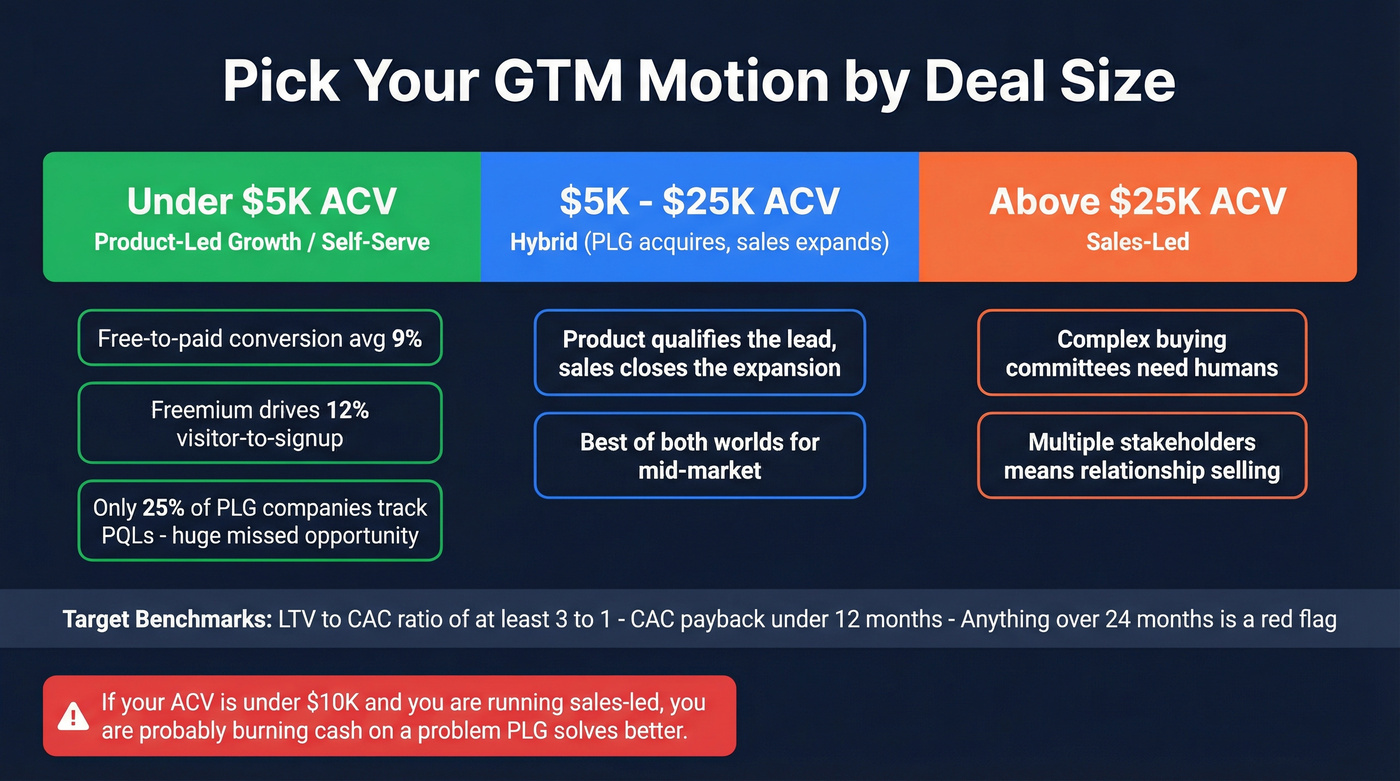
| ACV Range | Recommended Motion | Why |
|---|---|---|
| Under $5K | PLG / self-serve | Low touch, high volume |
| $5K-$25K | Hybrid | PLG acquires, sales expands |
| Above $25K | Sales-led | Complex deals need humans |
| Complex committees | Sales-led regardless | Multiple stakeholders = sales |
PLG benchmarks worth knowing: free-to-paid conversion averages around 9% across models. Freemium models drive 12% median visitor-to-signup conversion, significantly outperforming free trials. And companies using product-qualified leads see roughly 3x higher conversion rates, yet only about 25% of PLG companies actually track PQLs. That's a massive missed opportunity.
Target LTV:CAC of at least 3:1 and CAC payback under 12 months. Anything over 24 months is a red flag that your motion doesn't fit your market.
If your ACV sits below $10K and you're running a sales-led motion, you're probably burning cash on a problem that product-led growth solves better. The math just doesn't work at that deal size.
Why Brand GTM Strategies Fail
The most common failure mode is launching on assumptions instead of buyer behavior. Teams over-rely on internal personas without validating them against real CRM data, surveys, or competitive positioning reviews. In our experience, this kills more launches than any channel mistake. Validate before you build.
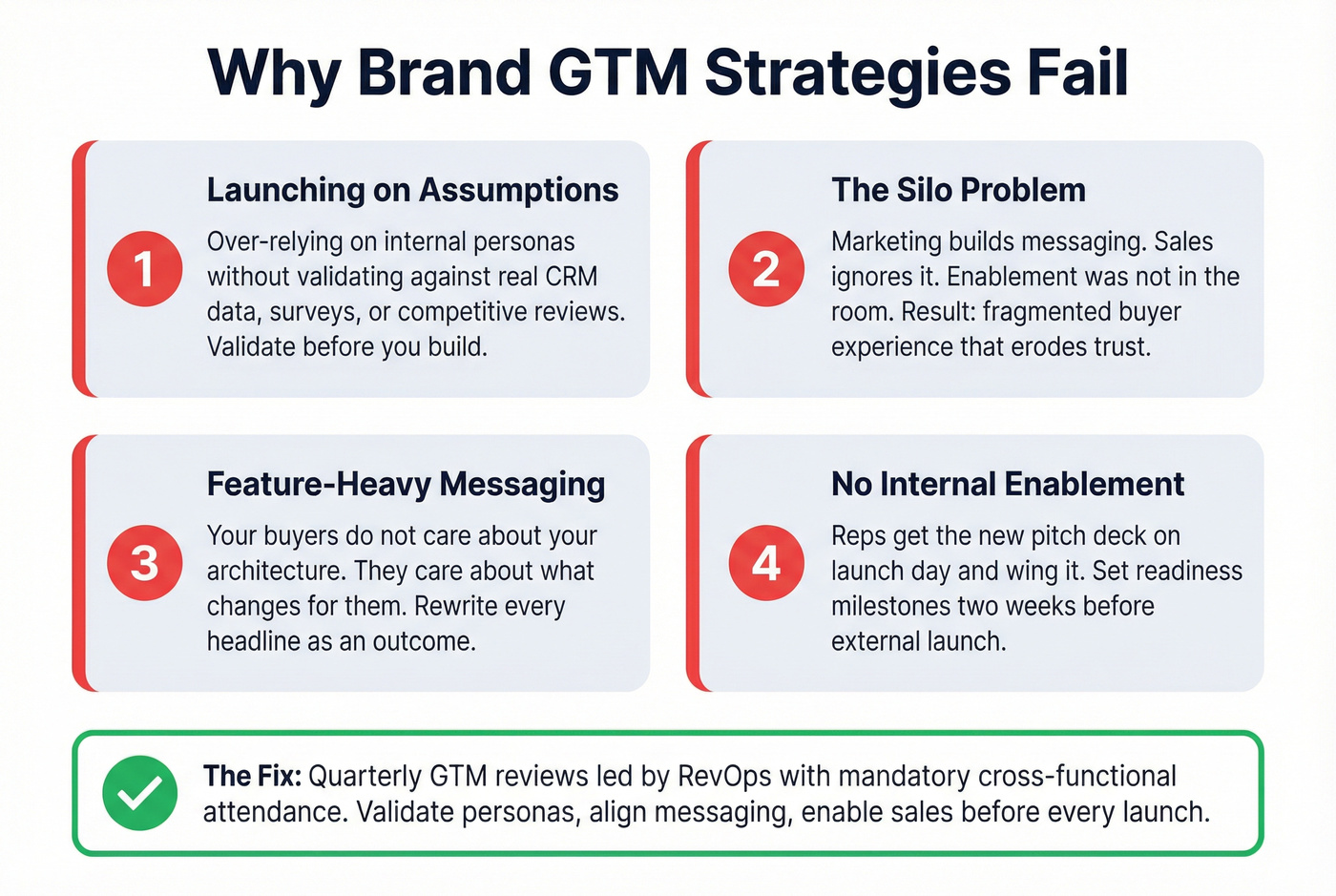
Right behind it is the silo problem. Marketing builds messaging. Sales ignores it. Enablement wasn't in the room. The result is a fragmented buyer experience that erodes trust. We've watched this play out at companies of every size, and the fix is always the same - quarterly GTM reviews led by RevOps with mandatory cross-functional attendance. The consensus on r/sales and r/startups echoes this: misalignment between sales and marketing is the silent killer of launches.
Then there's feature-heavy messaging instead of pain/outcome messaging. Your buyers don't care about your architecture. They care about what changes for them. Rewrite every headline as an outcome statement.
The failure that's most preventable is also the most overlooked - no internal enablement before launch. Reps get the new pitch deck on launch day and wing it. Set readiness milestones two weeks before external launch, and verify your prospect emails before outbound begins. Bad data kills sender reputation before messaging gets a chance. Tools like Prospeo catch invalids before they damage your domain, so your outbound actually reaches the inboxes you're targeting.
Brand GTM Examples That Worked
Oatly scaled rapidly in the US, with revenue growing ten-fold between 2017 and 2018. Their irreverent tone and category-creation messaging ("it's like milk, but made for humans") made the brand inseparable from the product. They didn't just sell oat milk - they sold an identity.
Slack used a freemium product-led motion and viral team adoption to drive expansion, reaching over 8 million daily active users and earning a $27.7B Salesforce acquisition. The brand promise - "where work happens" - was simple enough that any employee could explain it to their manager, which turned users into internal champions without a single sales call.
HubSpot coined the term "inbound marketing" and built an entire content ecosystem as their GTM engine. They didn't just sell software - they created a category. That positioning carried them to $100M ARR by 2012, according to their S-1 filing. Each of these companies succeeded because their go-to-market proposition was inseparable from the brand itself. Buyers understood the promise before they ever spoke to sales.
Let's be honest: most of us won't have Oatly's creative budget or Slack's viral coefficient. But the principle scales down. Even a 5-person startup can nail positioning so tight that every touchpoint tells the same story.
Powering Outbound With Verified Data
Your brand go-to-market strategy is only as good as the data feeding your outbound motion. Bounce rates above 5% damage domain reputation - even perfect messaging lands in spam if the addresses are wrong.

Skip this section if you're running a purely inbound or PLG motion with no outbound component. For everyone else: data quality is the unsexy foundation that makes or breaks your launch. Meritt tripled their pipeline from $100K to $300K per week after switching to Prospeo, dropping bounce rates from 35% to under 4%. That's the difference between a GTM launch that builds momentum and one that stalls in week two.
If you're scaling outbound, follow an email deliverability checklist and keep your CRM hygiene tight so bad records don't leak into sequences.
You just built your ICP, mapped the buying committee, and crafted a value matrix. Now you need verified contact data for every persona on that grid. Prospeo gives you 300M+ profiles with 30+ filters - buyer intent, technographics, headcount growth, funding - so your brand GTM targets the right people from day one.
Turn your ICP definition into a live prospect list in minutes.
FAQ
What's the difference between a GTM strategy and a marketing plan?
A GTM strategy is a cross-functional, launch-focused plan aligning sales, marketing, and enablement around positioning and execution. A marketing plan is ongoing demand generation owned by marketing alone. GTM is time-bound and covers the full buyer journey; marketing plans handle sustained pipeline activity after launch. Gartner's GTM framework offers a useful breakdown of how these functions interact.
How long does it take to build a brand GTM strategy?
Expect 2-6 weeks for the positioning and messaging sprint, then 4-12 weeks for identity rollout, enablement, and channel planning. Building the value matrix typically falls within that initial positioning phase. Total timeline: 6-18 weeks depending on scope.
How do I keep outbound data from killing my GTM launch?
Verify every email before sending. Use a provider with 98%+ accuracy and a weekly data refresh cycle. A 7-day refresh and multi-step verification process keeps bounce rates under 4%, protecting your domain reputation from day one. Validity's 2025 Email Deliverability Benchmark Report shows just how much bad data costs senders in placement rates.