

Inbound vs Outbound SDR: What Each Role Actually Looks Like in 2026
You just got offered two SDR roles. One's inbound at a Series C company with strong marketing. The other's outbound at a scrappy Series A that needs you to build pipeline from nothing. Same title, similar OTE, completely different jobs.
The inbound vs outbound SDR distinction matters more than ever - and the gap between the two keeps widening as AI reshapes both motions. Here's what actually separates them, with real numbers from the Bridge Group's 2025 study of 351 B2B companies.
30-Second Version
| Dimension | Inbound SDR | Outbound SDR |
|---|---|---|
| Lead source | Marketing (MQLs) | Self-sourced / lists |
| Daily focus | Speed-to-lead, qualify | Prospect, multi-channel |
| Core KPI | Response time (<1 min) | Held meetings/month |
| Typical OTE | $75K-$95K | $75K-$95K |
| Difficulty | Moderate | High |
| Best for | Structured ramp, predictable comp | Closing-track career, high ceiling |
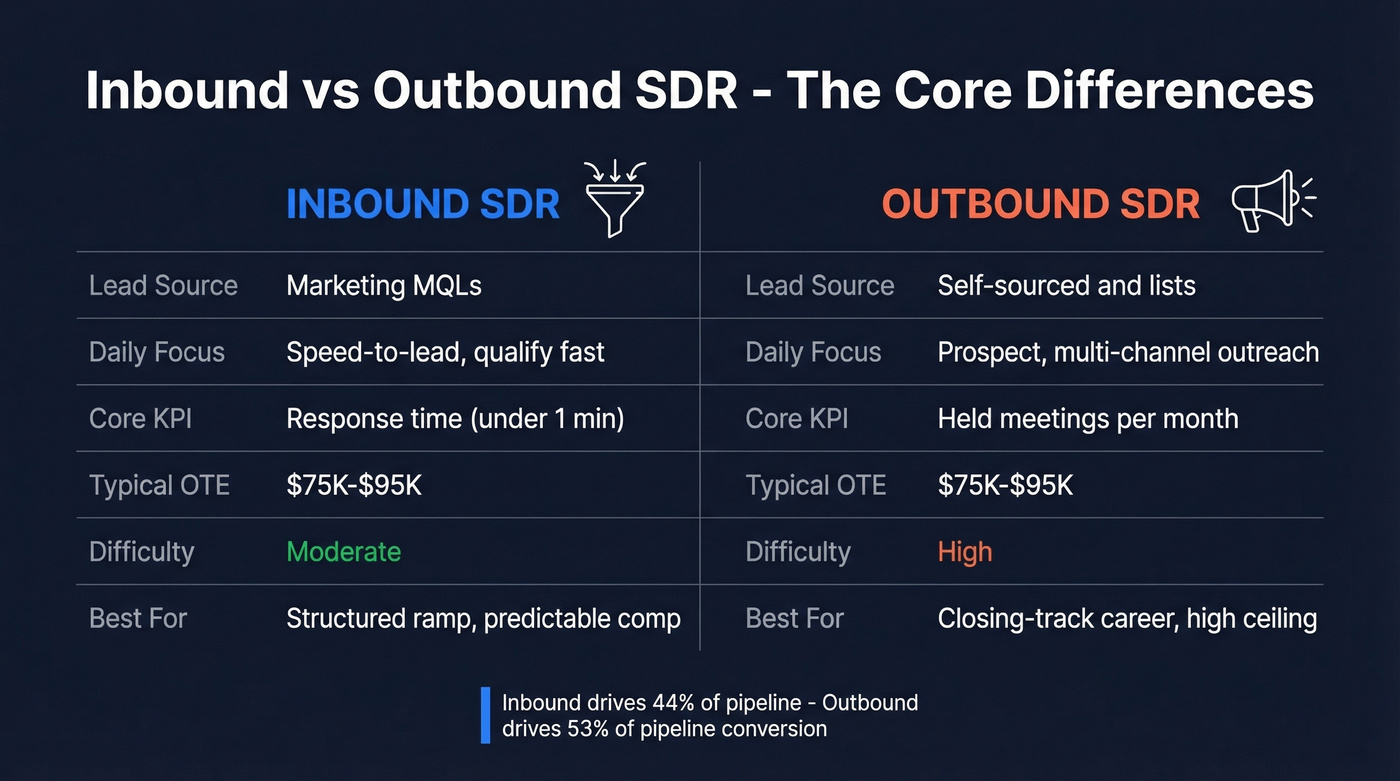
Take outbound if you want skills that transfer directly to closing. Take inbound if you want a smoother ramp and more predictable comp. Either way, data quality is the foundation - outbound SDRs waste 25%+ of their time on bad contacts, and responding fast makes you 21x more likely to qualify than waiting 30+ minutes.
Inbound strategies drive around 44% of sales pipeline, while outbound contributes about 53% of pipeline conversion. If your company only runs one motion, it's leaving money on the table.
Daily Rhythm Compared
How Inbound SDRs Work
Your day revolves around one metric: speed-to-lead. The average B2B team takes 42 hours to respond to a new lead. That's insane. Responding in under one minute drives a 391% conversion lift, and waiting 30+ minutes makes you 21x more likely to qualify the lead.
A typical inbound SDR handles around 15 leads per day: check the routing queue, qualify against ICP criteria, book the meeting or disqualify, update the CRM, repeat. You're basically a triage nurse for marketing's pipeline. When lead flow is healthy, comp is predictable and the job feels manageable. When marketing has a bad quarter, you're staring at an empty queue with no way to generate your own pipeline - and that helplessness is the worst part of the role.
How Outbound SDRs Work
Outbound is structured chaos. Here's a solid block schedule, adapted from OutboundSalesPro's workflow framework:
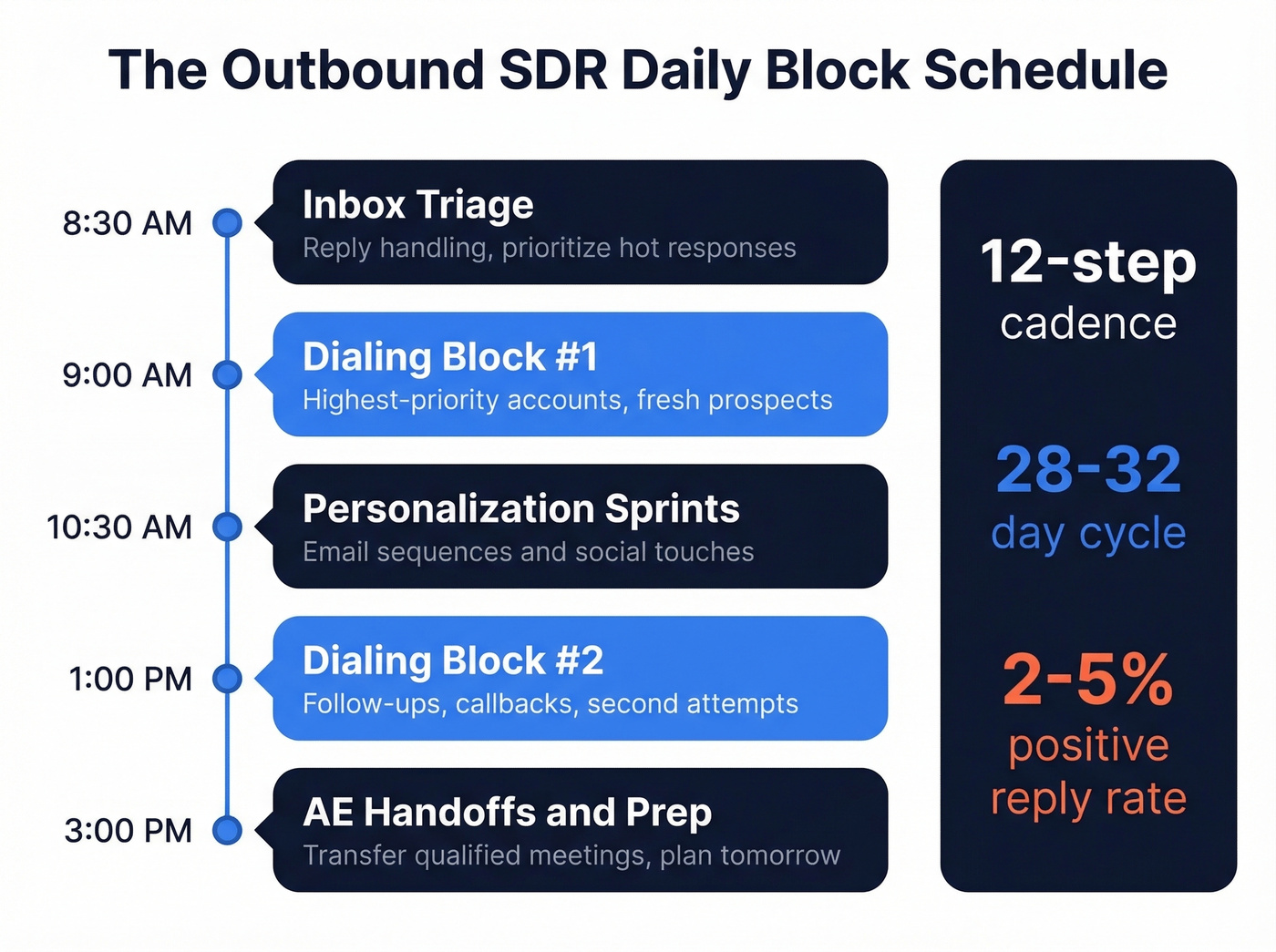
- 08:30 - Inbox triage, reply handling
- 09:00 - Dialing block #1 (highest-priority accounts)
- 10:30 - Personalization sprints (email + social touches)
- 13:00 - Dialing block #2 (follow-ups, callbacks)
- 15:00 - AE handoffs and next-day prep
You're running a 12-step, 28-32 day cadence mixing email, calls, and social touches. Expect a 2-5% positive reply rate and a 10-25% connect-to-meeting conversion. The math is brutal, but the reps who master it become the best closers in any org.

Compensation - Real Numbers
Median SDR OTE sits at $80K across the board, but that number hides a meaningful gap by motion and difficulty. Outbound meetings typically command a 2x higher payout than inbound meetings because they're harder to generate.
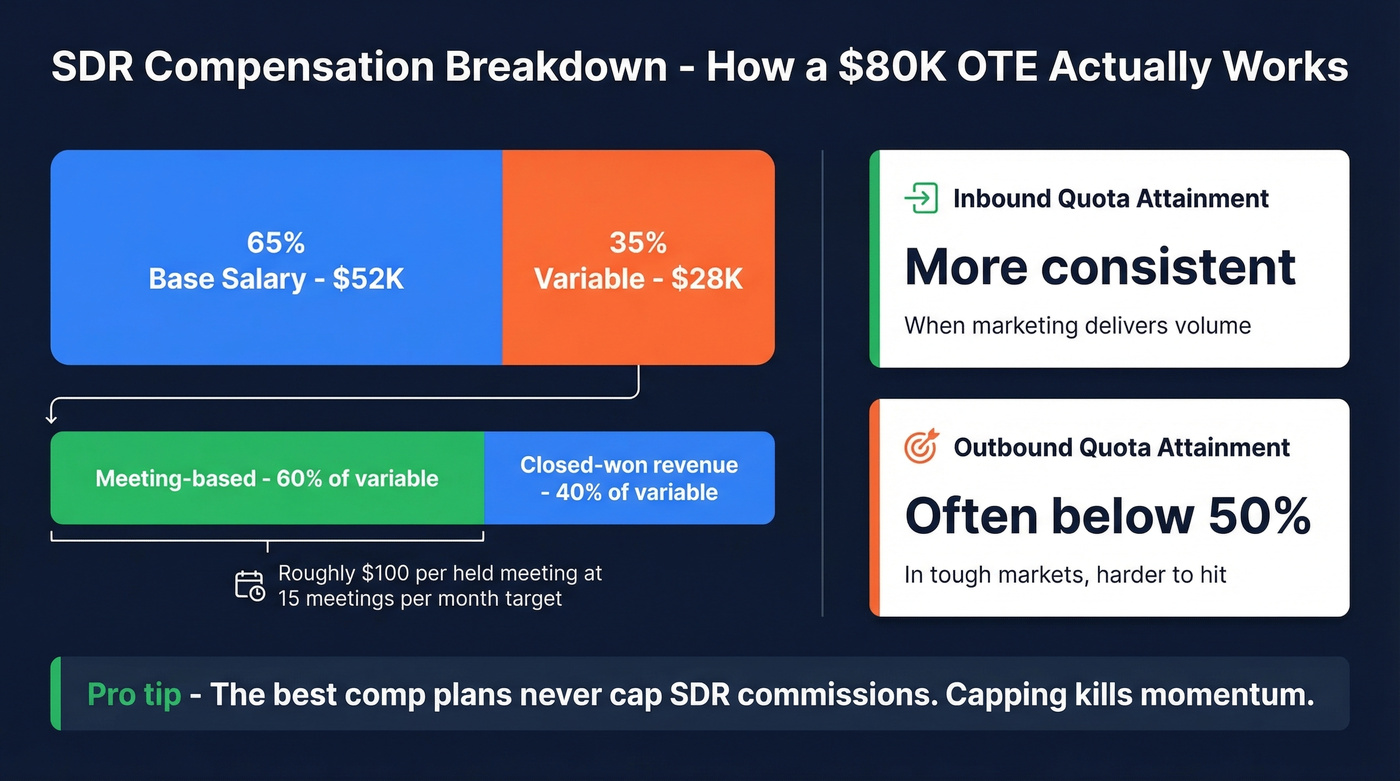
Let's break this down with a $30K variable plan on a 65/35 base-to-variable split: if 60% of your variable is meeting-based and your target is 15 qualified meetings per month, that's roughly $100 per held meeting. The remaining 40% ties to closed-won revenue. Outbound quota attainment often runs below 50% in tough markets, while inbound reps hit quota more consistently when marketing delivers volume. One thing we've seen across dozens of teams: the best comp plans don't cap SDR commissions. Capping kills motivation right when reps are building momentum.

Outbound SDRs live and die by data quality. When bounce rates hit 35%, your domain reputation tanks and even great sequences fail. Prospeo delivers 98% email accuracy and 125M+ verified mobiles - refreshed every 7 days, not 6 weeks. Snyk's 50 AEs cut bounces from 35% to under 5% and grew pipeline 180%.
Stop burning quota on contacts who left six months ago.
Which Role Is Harder?
Outbound. Not close.
You're cold-calling into a world where fewer than 2% of those calls convert. You're writing personalized emails that land in spam. You're building your own pipeline from scratch every single month, and the reset button hits on the first of every quarter whether you're ready or not.
But that difficulty is exactly why outbound skills transfer better to closing roles. One Chili Piper case study showed an outbound team finishing at 118% of their closed-won goal. We've watched reps who grind through outbound for 12-18 months become the strongest closers on any team they join. Inbound is more predictable, but you're dependent on marketing's lead flow. When that dries up, you've got no fallback.
Here's the attribution problem nobody talks about: an outbound touch often creates awareness that later converts as inbound - but the outbound rep gets no credit. This is why allbound models are replacing siloed teams, and why 90% of outbound teams report to Sales while inbound teams are twice as likely to report to Marketing. Bridge Group found 82% of Sales Development orgs align SDRs to AE territories, compared to only 40% of inbound-only teams.
Building Your Tech Stack
Nothing kills outbound productivity faster than bad data. SDRs waste over 25% of their time on inaccurate contacts - wrong emails, disconnected numbers, people who left the company six months ago. When your bounce rate creeps above 10%, your domain reputation tanks, deliverability drops, and even your good emails land in spam.
The impact of fixing this is dramatic. Snyk's 50 AEs saw sourced pipeline jump 180% after cutting bounce rates from 35-40% to under 5%. The foundation matters more than the sequences you run on top of it.
Here's the tool stack that makes both motions work:
| Category | Tool | Use case | ~Price |
|---|---|---|---|
| Contact data | Prospeo | Verified emails + mobiles, 98% accuracy | Free tier; ~$0.01/email |
| Prospecting DB | Apollo.io | Sequencing + database | Free-$79/user/mo |
| Enterprise intel | ZoomInfo | Contact + company data | $15-50K/yr |
| Sales engagement | Outreach | Multi-channel sequences | ~$100-150/user/mo |
| CRM + inbound | HubSpot Sales Hub | Lead routing + CRM | Free-$150/user/mo |
| Power dialer | Orum / Aircall | Outbound calling | $250-350 / $30-50/mo |
| Lead routing | Chili Piper | Speed-to-lead routing | ~$10-30/user/mo |
Allbound teams adopt more tools across the board - 88% use premium professional networking tools vs. 56% of inbound-only teams, and 82% use contact intelligence platforms vs. 56% for inbound-only. More tools isn't always better, but outbound reps who skimp on data quality pay for it in wasted hours. The average SDR-to-AE ratio sits at 1:2.4, so every wasted hour compounds across the pipeline.
Skip ZoomInfo if you're a team under 20 reps - the contract minimums don't make sense at that scale, and you'll get better email accuracy from Prospeo at a fraction of the cost.

Whether you're inbound qualifying MQLs or outbound building pipeline from scratch, bad contact data is the silent quota killer. At $0.01 per verified email, Prospeo costs 90% less than ZoomInfo - and outperforms it on accuracy (98% vs 87%). Teams using Prospeo book 26% more meetings.
Enterprise-grade data without the enterprise contract. Start free today.
AI SDRs in 2026 - Real but Overhyped
The numbers look impressive on paper: 72% of sales teams use some form of AI assistance, and the AI sales tools market hit $3.1B growing at 42% annually. But here's the thing - 88% of AI SDR pilots stall before reaching production.
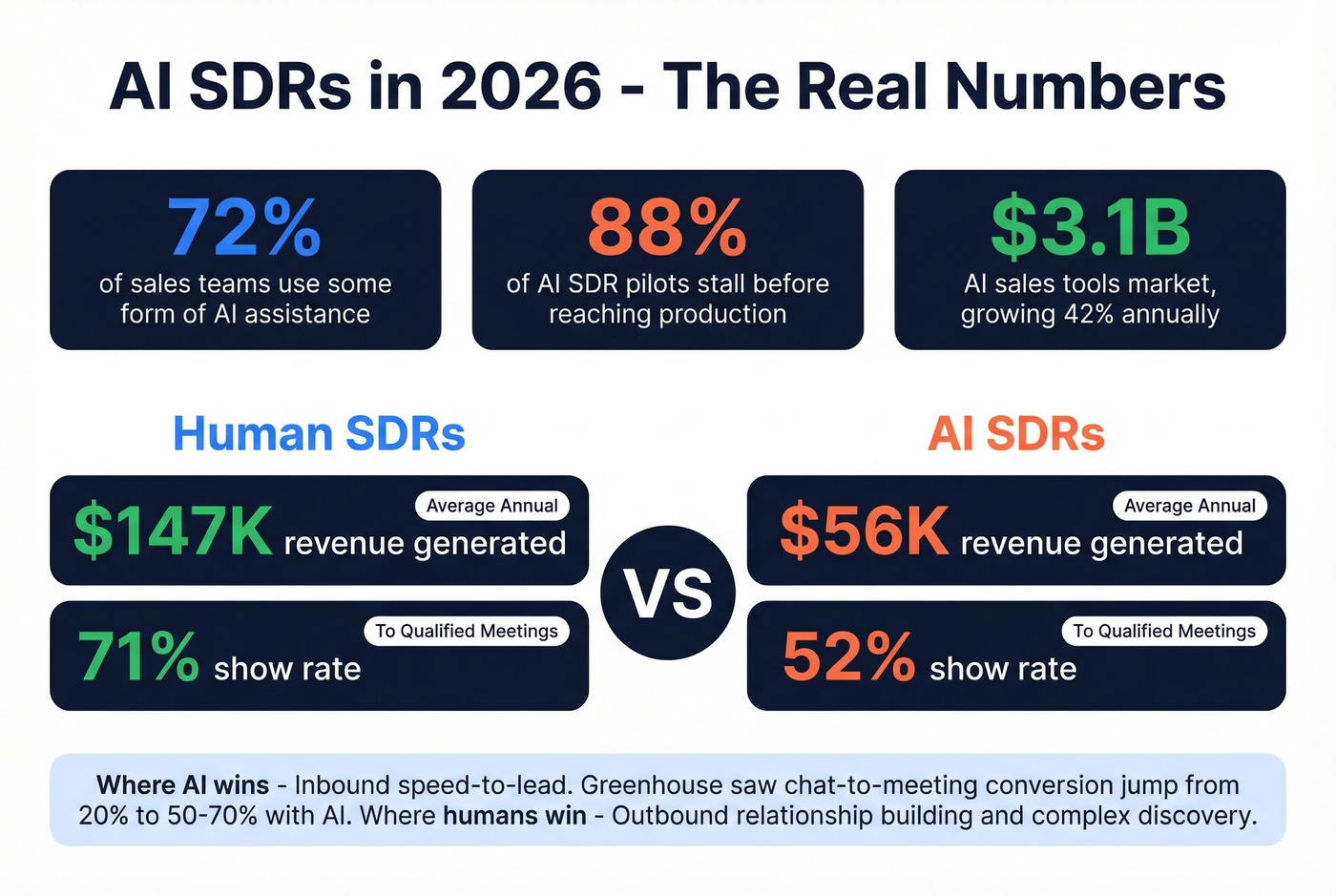
Where AI genuinely works is inbound speed-to-lead. Greenhouse saw chat-to-meeting conversion jump from 20% to 50-70% after replacing human reps with AI for initial engagement. For outbound, humans still dominate. One head-to-head showed human SDRs generating $147K in revenue vs. $56K for AI, with show rates of 71% vs. 52%.
AI handles volume. Humans handle nuance. The hybrid model - AI for initial qualification and data enrichment, humans for relationship-building and complex discovery - is where smart teams are heading. If someone tells you AI is replacing outbound SDRs entirely, they're selling you AI software.
FAQ
Can one SDR handle both motions?
Yes, and the "allbound" model is growing fast. Allbound teams align better to AE territories and adopt more tools across every category. Most mid-market teams are heading this direction, merging their inbound and outbound structures into a single, flexible unit. The consensus on r/sales is that allbound reps develop faster because they're not siloed into one skill set.
What's the difference between a BDR and SDR role?
Outbound BDRs self-source prospects through cold outreach and account research, while inbound BDRs qualify marketing-generated leads. Some companies use "BDR" exclusively for outbound and "SDR" for inbound, though the titles are increasingly interchangeable.
How does discovery differ between the two motions?
Inbound discovery builds on context the prospect already provided - they downloaded a whitepaper or requested a demo, so you dig into specific pain points. Outbound discovery starts cold, meaning you need to earn the right to ask questions by leading with a relevant hypothesis about the prospect's challenges. The skill sets overlap, but the opening 30 seconds are completely different.
What tools do outbound SDRs need most?
A verified contact database, a sequencing platform like Apollo or Outreach, and a power dialer. Data quality matters most - if your bounce rate exceeds 10%, no amount of sequencing fixes it. We've seen teams cut their bounce rates from 35%+ to under 4% just by switching to a provider with a weekly data refresh cycle.
Is content marketing better than outbound for pipeline?
It's not either-or. Content marketing builds long-term inbound pipeline at a lower cost per lead, while outbound generates pipeline on demand for specific target accounts. Companies that layer outbound on top of a strong content engine see the highest conversion rates because prospects recognize the brand before the cold email lands.