

How to Build an Incentive Program for Sales That Actually Moves Revenue
It's Q3 planning. Your CFO wants the ROI of last year's incentive program. You open a spreadsheet and realize you've got no baseline, no control group, and no way to isolate the program's impact from seasonal trends. You're about to present vibes as data.
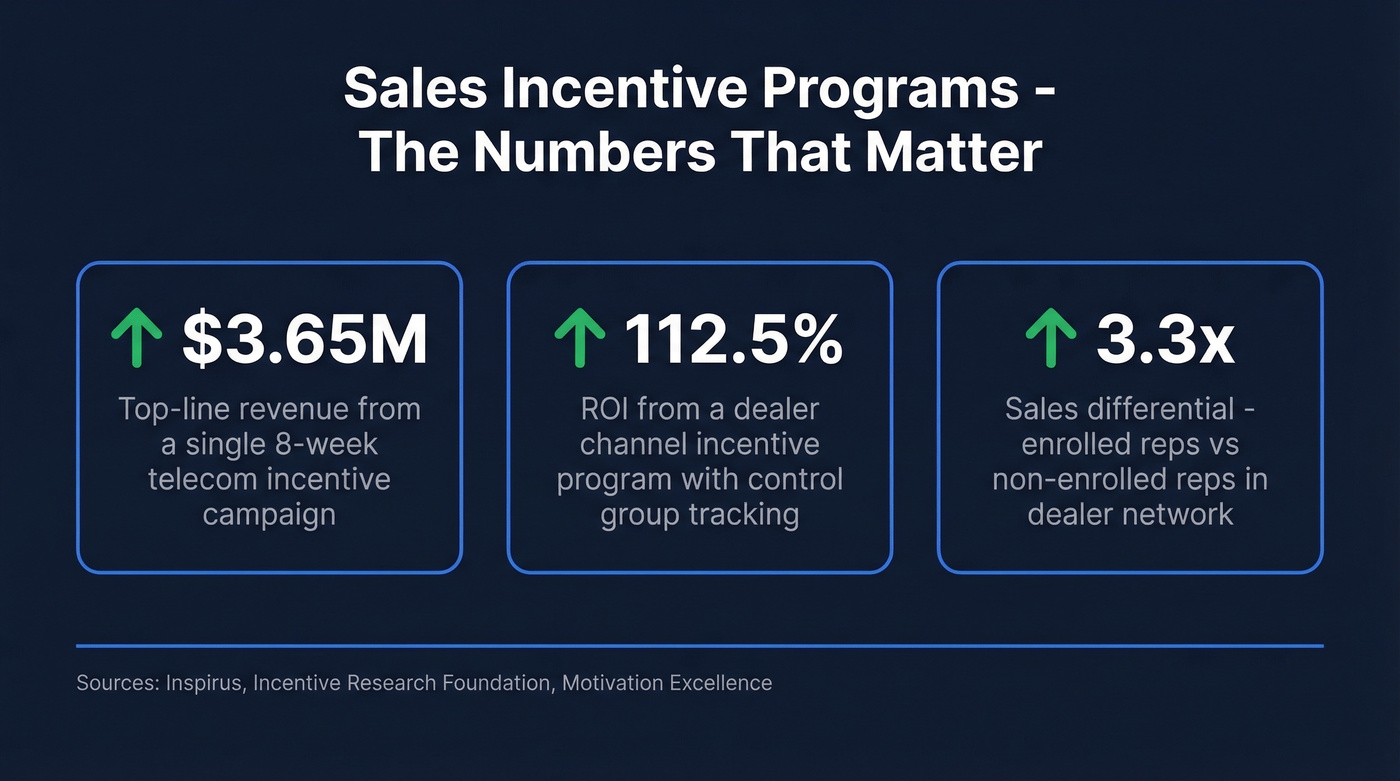
A well-designed incentive program for sales teams works - when it's built right. A telecom company generated $3.65M in top-line revenue from a single 8-week campaign. A dealer channel program delivered 112.5% ROI. Enrolled participants outsold non-enrolled reps by a 3.3x differential in average sales in one dealer network. But most programs never get close to those numbers because they're designed for the wrong people, measured with the wrong data, and killed by problems that are entirely preventable.
Sales turnover runs around 35% - nearly triple the 13% average across all industries. Bad incentive design makes churn worse. The difference isn't budget. It's architecture.
What Actually Works (Quick Version)
Three principles separate programs that move revenue from programs that just move spreadsheets:
Design for the middle 60% of reps, not the top 20%. Your best sellers will perform regardless. The incremental revenue lives in the middle of the bell curve - reps who are competent but need a reason to push harder.
Add activity-based components. A peer-reviewed field study across 305 territories found activity-based incentives produce a 6-9% sales lift. Most companies default to outcome-only because it's easier. That's leaving money on the table.
What a Sales Incentive Program Actually Is
A sales incentive program isn't your standard commission plan. Commission is the baseline - expected compensation for doing the job. An incentive program is the extra layer designed to drive specific behaviors or outcomes over a defined period.
Commission pays reps for closing deals. A structured incentive plan pays them for closing deals in a way that serves a strategic objective - entering a new market, selling a new product line, improving close rates in a specific segment. About 71% of organizations tie compensation to measurable performance goals, which means the other 29% are flying blind.
Types of Sales Incentives
The right structure depends on what you're trying to change and how quickly.
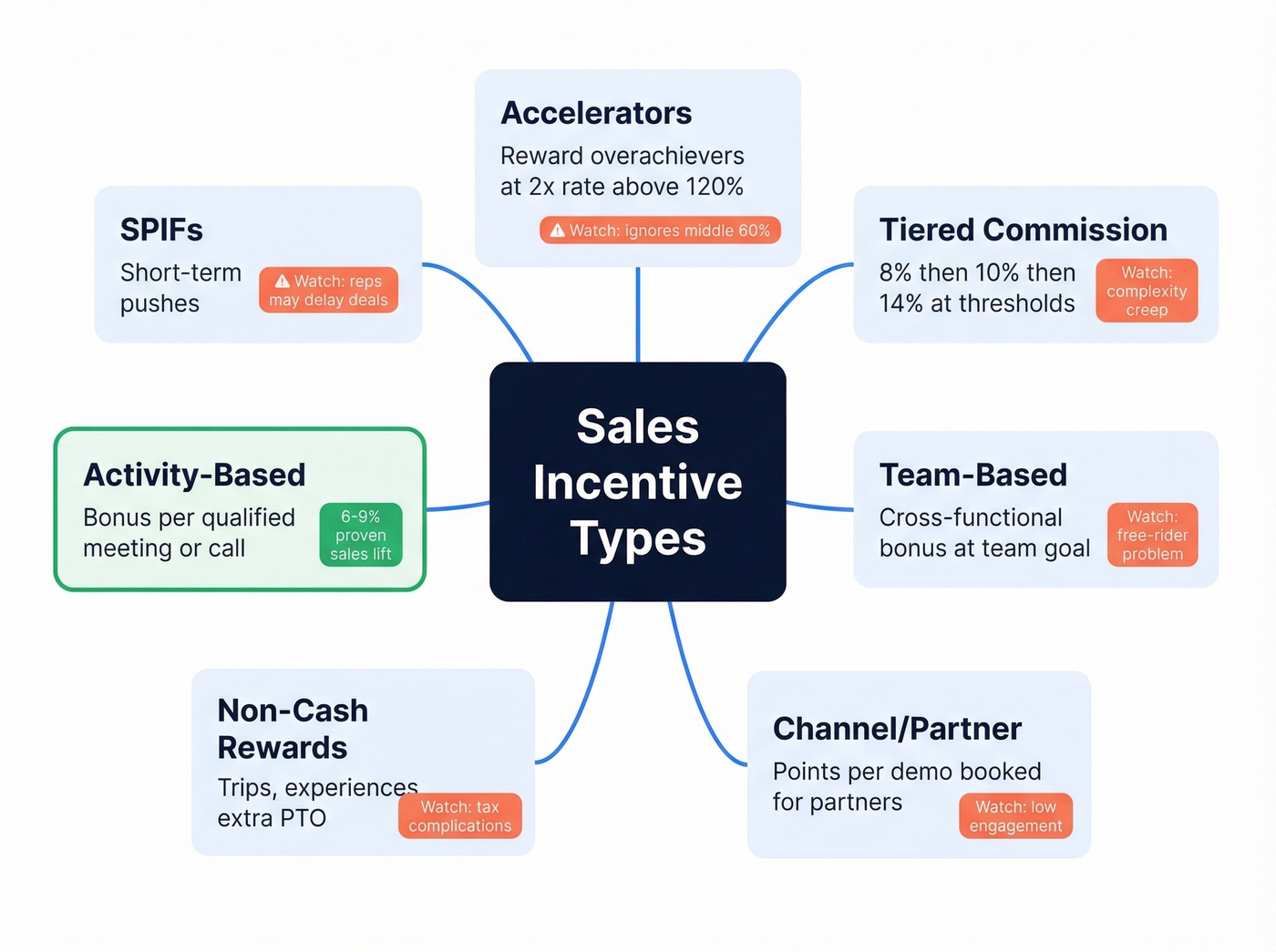
| Type | Best For | Example | Watch Out For |
|---|---|---|---|
| SPIFs | Short-term pushes | $500 per new logo this month | Reps delaying deals to time windows |
| Accelerators | Rewarding overachievers | 2x rate above 120% quota | Ignoring middle 60% |
| Tiered commission | Sustained motivation | 8%/10%/14% at thresholds | Complexity creep |
| Team-based | Cross-functional goals | Team bonus at $1M ARR | Free-rider problem |
| Channel/partner | Indirect sales | Points per demo booked | Low partner engagement |
| Non-cash rewards | Memorable motivation | President's Club trip | Tax complications |
| Activity-based | Behavior change | Bonus per qualified meeting | Requires verified data |
The biggest split is between activity-based and outcome-based incentives. Outcome-based is intuitive - close the deal, get paid. Activity-based rewards the inputs: calls made, demos booked, proposals sent. Most companies lean toward outcomes because they're easier to measure. The research says that's a mistake.
Twenty-seven percent of channel incentive providers' clients run tiered reward structures, and adoption is growing. Gamification elements like leaderboards and milestone badges are especially common for SDR teams where activity volume matters most.
Here's the thing about cash bonuses: they get absorbed into mortgage payments and grocery bills within a week. A trip to Cabo creates a memory and a story reps tell for years. Even when reps say they prefer cash, non-cash rewards often create stronger motivation - a dynamic we'll unpack in the design section below.
How to Design Your Incentive Plan
Define Your Business Objective
Every incentive program needs to answer one question: what business outcome are we trying to accelerate?
"Increase revenue" isn't specific enough. "Grow new logo acquisition in the mid-market segment by 15% in Q4" gives you something to design around. The objective determines everything downstream - which behaviors to reward, which metrics to track, and how to measure success. Consider role-specific objectives too: an SDR program might target qualified meetings booked, an AE program might reward expansion revenue, and a manager-level program might incentivize team attainment rates. The more precise the objective, the cleaner the design.
Pick 2-3 Measures (No More)
Never use more than three measures, and weight each one at a minimum of 20%. Five-component formulas with modifiers and multipliers sound sophisticated. In practice, they confuse reps, create gaming opportunities, and make it impossible to diagnose what's working.
A clean structure: 50% closed revenue, 30% new logo count, 20% qualified pipeline generated. Reps can hold that in their heads and make real-time decisions about where to focus.
Set Targets Reps Actually Trust
87% of sales leaders set quota targets without a structured method. Then they wonder why reps don't trust the targets.
Use the 50/50 heuristic: a well-designed target should be achievable by roughly 50% of your team. If 80% hit it, the bar is too low. If only 20% earn rewards, you've designed a program that demotivates the majority. Run your proposed targets against the last four quarters of actual performance data before you launch anything.
Design the Payout Curve
The payout curve is where the behavioral engineering happens. You need three components: a threshold (minimum performance before any payout kicks in), a base rate (the standard payout per unit above threshold), and accelerators (increased rates at higher achievement levels).
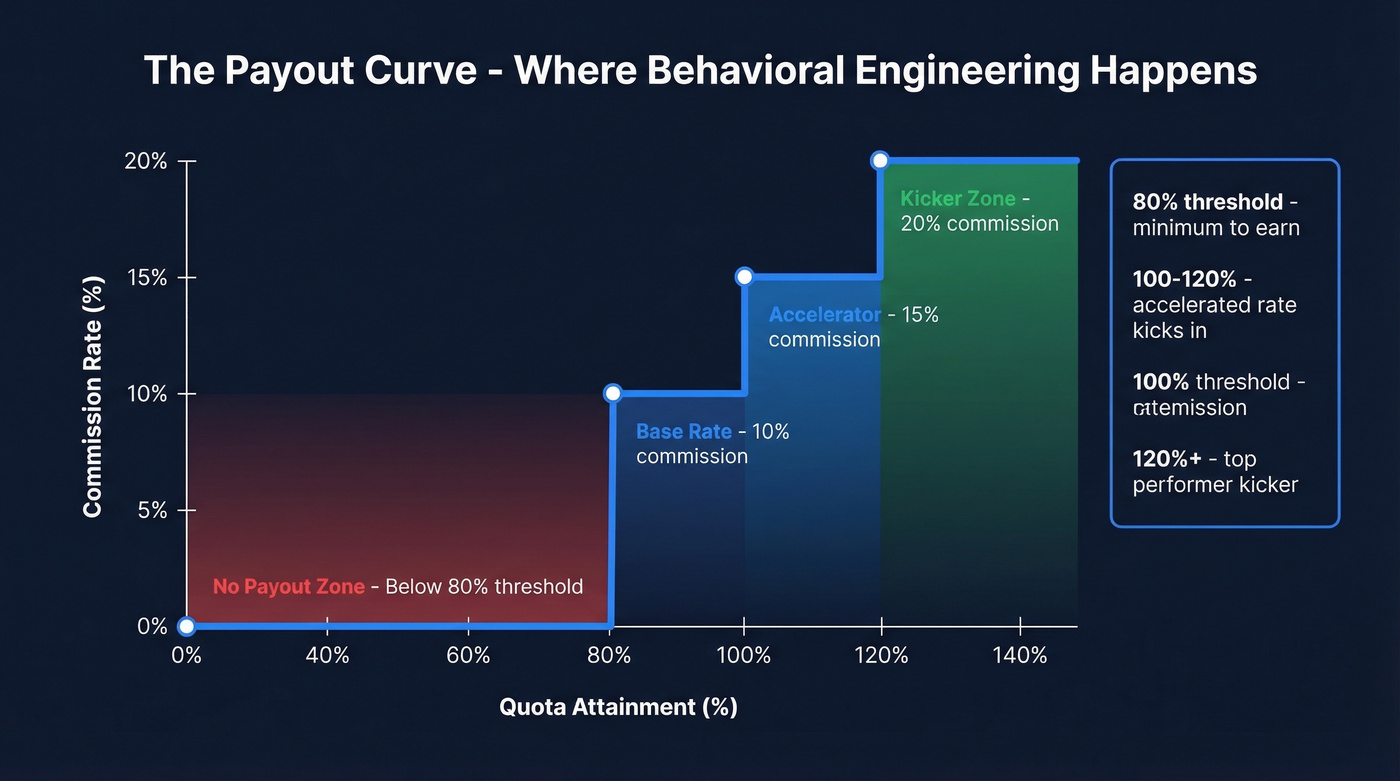
A worked example: threshold at 80% of quota with no payout below this, base commission rate of 10% from 80-100%, accelerated rate of 15% from 100-120%, and a kicker of 20% above 120%. Add decelerators below threshold if you want to discourage sandbagging - but be careful not to punish reps who are genuinely ramping.
Choose Cash, Non-Cash, or Both
Cash is the default, and it's often the wrong one. Behavioral scientists call it the Hedonic Treadmill: a $2,000 bonus feels good for about 48 hours, but a weekend trip to a resort creates a story reps tell at every team dinner for the next year. Non-cash rewards - travel, premium experiences, extra PTO, charitable donations in the rep's name - create stronger motivational pull than equivalent cash amounts.
The practical move is a hybrid. Cash for the core commission structure, non-cash for SPIFs and stretch goals. The telecom case study used exactly this approach - $100 in reward points for a meeting, $400 for a signed commitment, redeemable for an iPad or a charitable donation. Meeting rate hit 10% against a 6-8% goal.
Communicate Like a Product Launch
A brilliant incentive plan that reps don't understand is worse than a mediocre plan they do. Create a one-page explainer, run manager-led walkthroughs, build a simulator or dashboard where reps can model their own earnings, and send weekly progress updates. If you can't explain the payout mechanics in under two minutes, the plan is too complicated. Simplify it until a new hire can calculate their expected bonus on a napkin.
Activity-Based vs. Outcome-Based Incentives
Most incentive programs are purely outcome-based. You close the deal, you earn the bonus. Clean, simple, and leaving a measurable amount of revenue on the table.
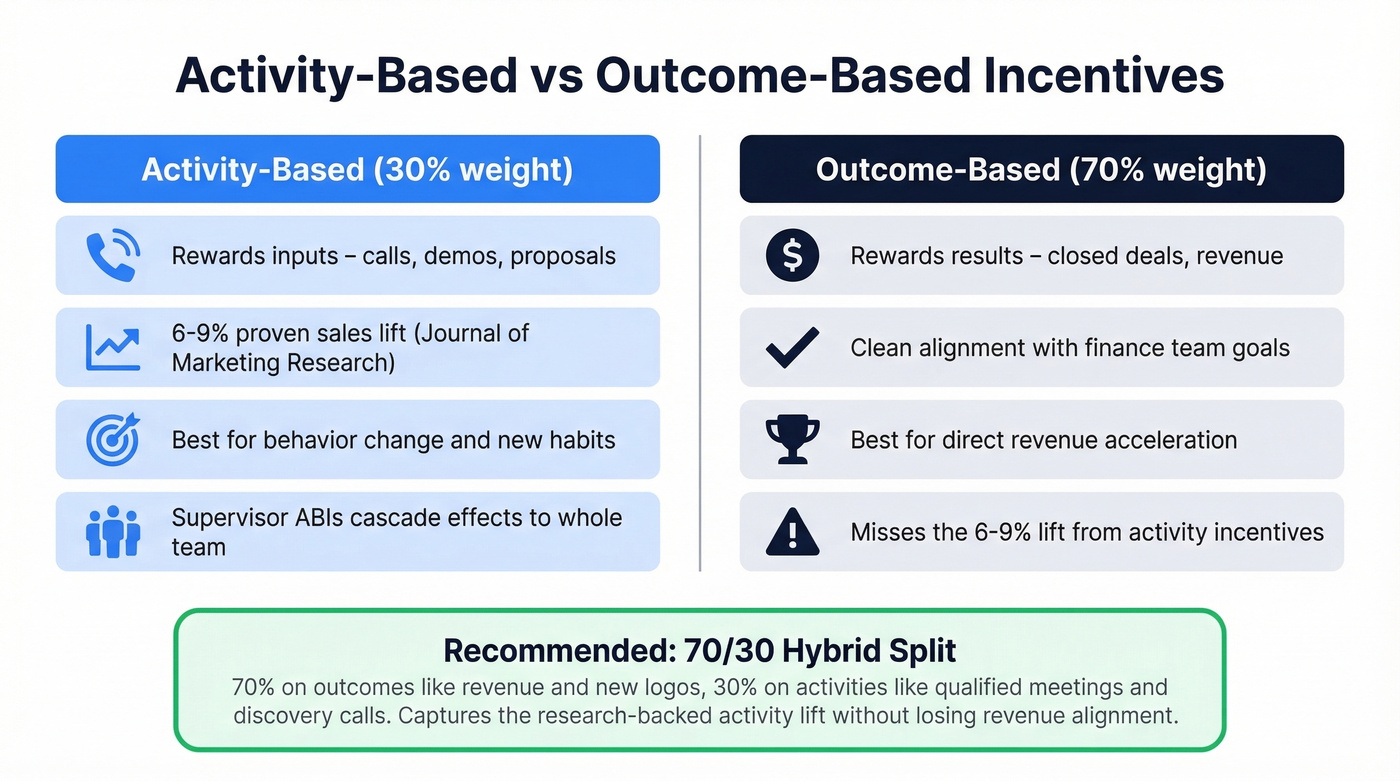
The strongest evidence comes from a 2021 study in the Journal of Marketing Research - a three-year field intervention across 305 territories at a large pharmaceutical firm using a treatment-removal design. Activity-based incentives produced a 6-9% sales lift compared to the no-ABI baseline. That's a controlled field experiment published in a top-tier academic journal, not a vendor white paper.
One of the more interesting findings: when supervisors received ABIs, they exerted behavior control downward on their teams - making supervisor-targeted ABIs potentially more efficient than paying ABIs to every individual rep. You don't necessarily need to incentivize every activity for every person. Target the right level and the effects cascade.
We recommend a 70/30 hybrid split. Seventy percent of incentive weight on outcomes (revenue, new logos, expansion), 30% on activities (qualified meetings booked, proposals sent, discovery calls completed). This captures the proven activity-based lift without losing the direct revenue alignment that finance teams need.
Let's be honest: if your average deal size is under $10K, you probably don't need a complex multi-tier program at all. A simple SPIF on new logos plus clean activity tracking will outperform a sophisticated plan that nobody understands. Save the elaborate architecture for deals where the incremental revenue justifies the design cost.

Activity-based incentives drive a 6-9% sales lift - but only when reps have verified contacts to call. Prospeo gives your team 300M+ profiles with 98% email accuracy and 125M+ verified mobiles, so every incentivized activity connects to a real buyer.
Don't reward reps for dialing dead numbers. Give them data that picks up.
Proving ROI - Three Case Studies
Dealer Channel: 112.5% ROI
The problem: An office equipment manufacturer had no visibility into whether its dealer incentive spend was generating incremental revenue or just rewarding sales that would have happened anyway.
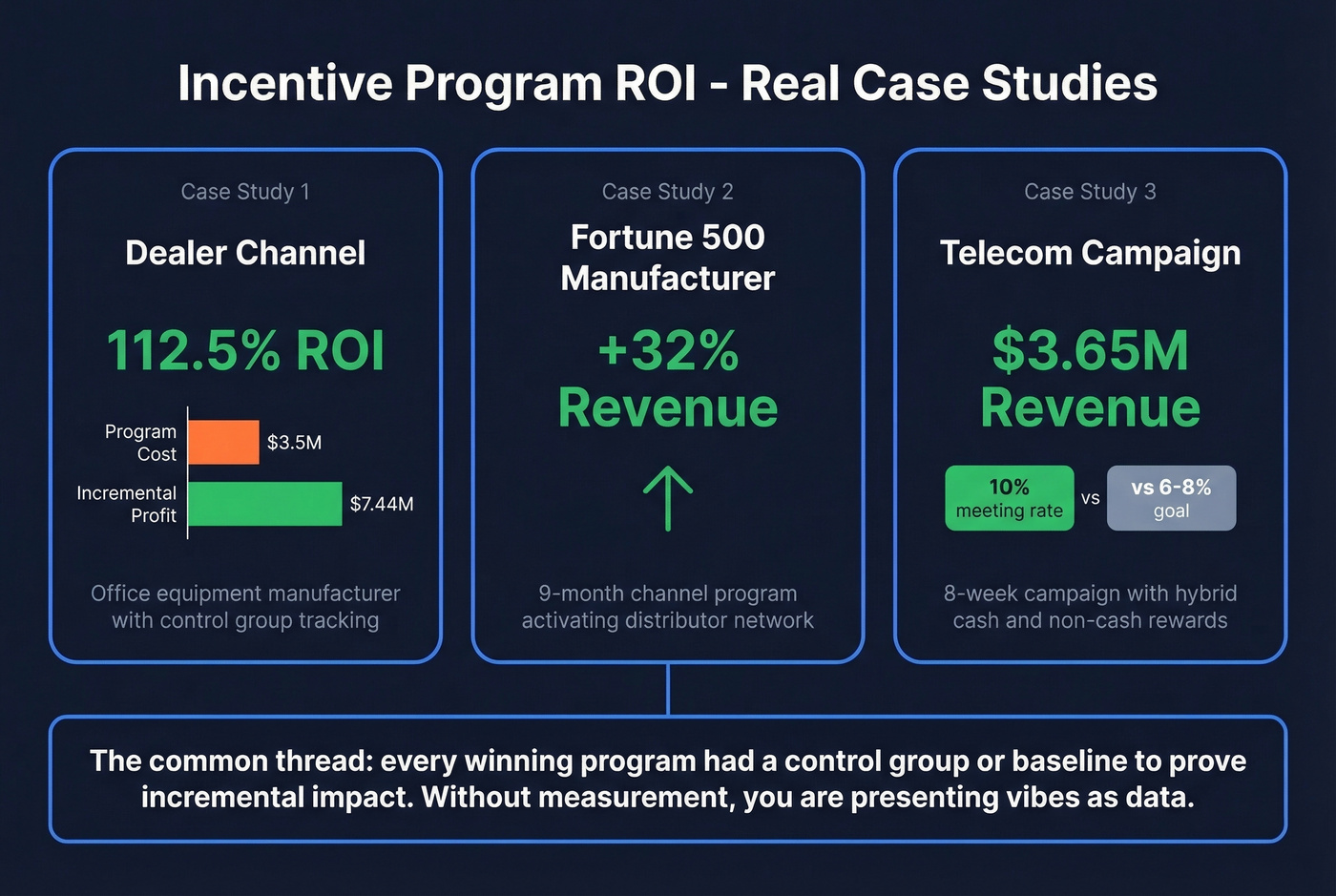
The mechanic: The Incentive Research Foundation tracked the program using a control group of non-participating dealers - something most companies skip entirely. Incremental dealer purchases attributable to the program totaled $37.2M. At a 20% gross margin, that's $7.44M in incremental profit against a $3.5M program investment. The math: ($7.44M - $3.5M) / $3.5M = 112.5% ROI.
Fortune 500 Manufacturer: +32% Revenue
A Fortune 500 manufacturer needed to activate its distributor network, where a large percentage of reps had never engaged with incentive programs. Their 9-month channel program delivered 32% revenue growth, market share gains in 9 of 12 markets, and 19% net operating income. The standout metric: 30% of reward participants were first-time earners - that's the middle 60% in action. Total incremental improvement was $3,934,700 against $3,186,900 in costs.
$3.65M in 8 Weeks
Start with the result: $3.65M added to top-line revenue in two months. A telecommunications provider targeted 2,283 business prospects in wired buildings with a two-tier reward - $100 in points for a meeting, $400 for a signed contract. The 10% meeting rate blew past the 6-8% goal, the 22% close rate converted meetings into $120,787 in new monthly recurring revenue, and the sales team requested the campaign be repeated.
That last part is the best endorsement any program can get.
Another IRF-tracked program at a hand tools manufacturer delivered a 7.5% net sales gain and cut accounts receivable from 59 to 32 days - proof that well-designed incentives improve not just revenue but working capital metrics.
Seven Mistakes That Kill Programs
1. Designing for the top 20% only. Stop building programs that only your best reps can win. The incremental revenue lives in the middle 60% - competent sellers who need a push. Create tiered improvement bands (20%/15%/10% improvement thresholds) so reps compete against their own baseline, not against the team's top closer.
2. Overcomplicated formulas. If your plan has five components, three modifiers, and a matrix lookup, reps will ignore it and sell however they were going to sell anyway. Cap at 2-3 core measures. Build a simulator so reps can model their own payouts.
3. No stress-testing before launch. We've seen this firsthand: three reps stopped booking meetings in the last week of the quarter because they'd already hit their bonus threshold. They were literally leaving pipeline on the table because the plan told them to. Run your proposed plan against 4-6 quarters of historical performance data. Model best case, worst case, and average. Look for perverse incentives before they happen.
4. Sandbagging and deal-timing manipulation. Top reps delay closing deals until a new incentive period starts, especially after exceeding quota in the current period. Use rolling measurement windows instead of hard quarterly resets. Add decelerators that reduce the incentive to hold deals.
5. Incentives tied to untrusted data. If reps don't trust the data feeding their comp calculations - late CRM syncs, attribution errors, stale contact records - they won't trust the program. Audit your data infrastructure before launch. Run your contact list through CRM data cleaning and Prospeo's verification to make sure reps are working with live, reachable contacts rather than stale records that make activity targets structurally unachievable.
6. Ignoring tax and compliance. Gift cards are taxable as ordinary income. Travel awards are taxable at fair market value. If you hand a rep a $500 gift card and don't gross it up, they're getting roughly $350 after taxes - and they'll notice. Budget an extra 25-30% for tax gross-ups. Involve payroll and legal before you finalize reward structures.
7. Poor communication. A plan nobody understands is a plan nobody follows. Run explainer sessions with every team, provide real-time dashboards showing progress toward targets, and make the payout calculation transparent enough that reps can verify their own numbers.
The Data Quality Foundation
Here's the logic chain most guides skip entirely. Activity-based incentives are proven to lift sales 6-9%. But activity targets require reps to actually reach prospects. If your CRM is full of bounced emails and disconnected phone numbers, you've built a reward structure on sand.
We've seen this pattern repeatedly - a company launches a well-designed activity-based program, reps hit the phones, and connect rates are abysmal because the data is 18 months stale. Reps blame the program. Leadership blames the reps. The real culprit is the contact database.
Before you launch any program with activity-based components, run your contact list through verification. It takes minutes and prevents the single most common invisible failure mode.
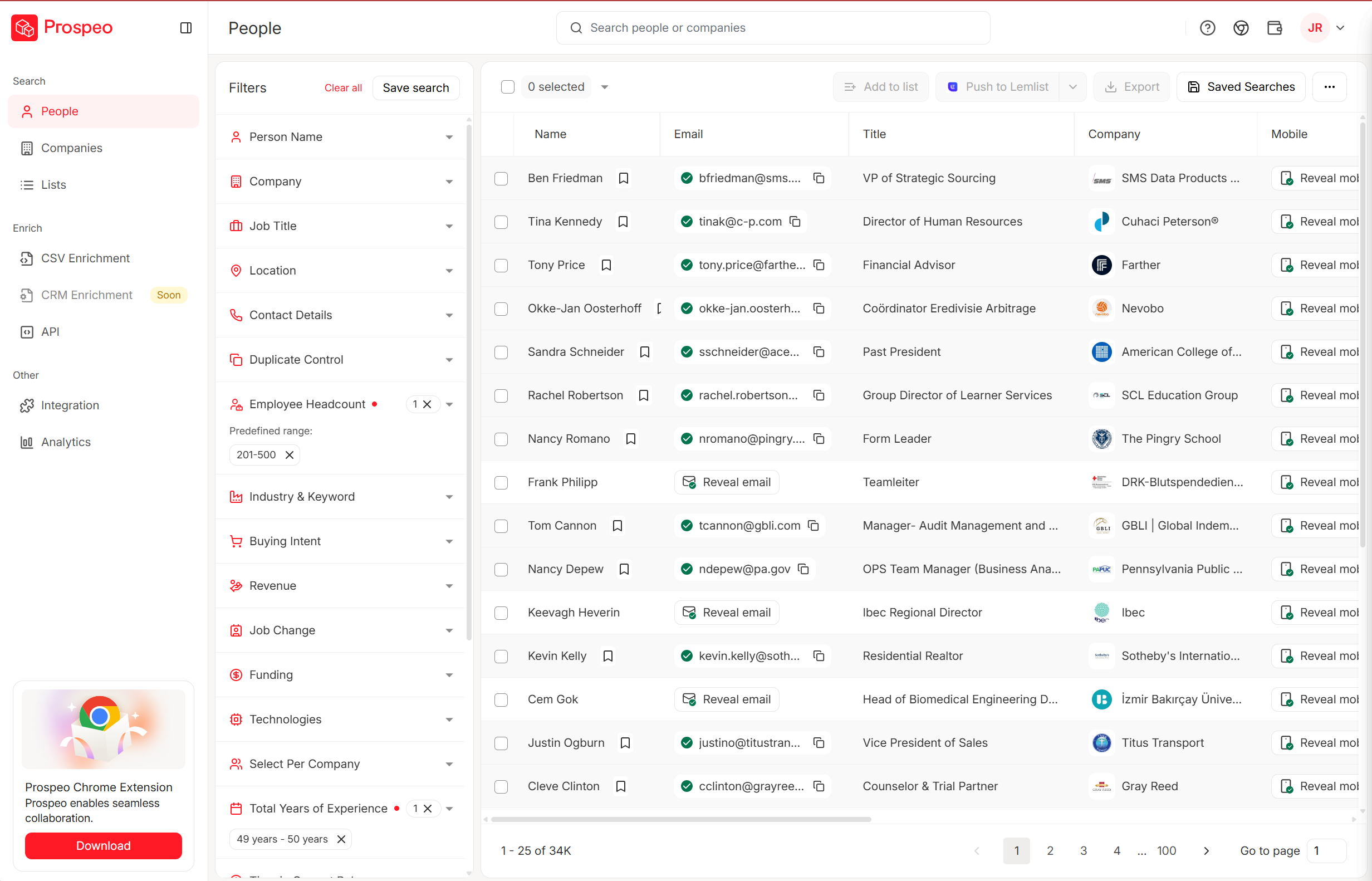
You're designing payout curves and quota targets to motivate the middle 60%. But bad data kills motivation faster than any incentive structure can fix. Prospeo refreshes every 7 days - so your reps hit real prospects, not bounced emails that tank morale and deliverability.
Fuel your incentive program with data reps actually trust.
ICM Software Worth Evaluating
Once you're past about 20 reps, spreadsheets become a liability. One misplaced cell reference means someone's bonus is wrong, and that destroys trust faster than anything else. Forty-four percent of organizations now use AI-powered ICM tools, and adoption is accelerating.
| Tool | Best For | Starting Price | Rating (Reviews) |
|---|---|---|---|
| Everstage | Growth-stage | ~$30K-$70K/yr | 4.7 (271) |
| CaptivateIQ | Mid-market | ~$40K-$80K/yr | 4.6 (219) |
| QuotaPath | SMB | $25/user/mo | - |
| Sales Cookie | SMB | $30/payee/mo | - |
| Xactly | Enterprise | ~$50K-$150K/yr | 4.2 (264) |
| Varicent | Enterprise | Not public | - |
Under 20 reps, a well-built spreadsheet with version control is fine - skip the software spend entirely. Between 20 and 100 reps, QuotaPath at $25/user/month or Sales Cookie at $30/payee/month gives you automation without enterprise overhead. Above 100 reps, CaptivateIQ is the sweet spot - flexible enough to model complex plans, clean enough that RevOps can self-serve without a dedicated admin. Xactly and Varicent are the enterprise incumbents: battle-tested but heavier to implement and significantly more expensive.
Putting It All Together
Design for the middle 60%. Add activity-based components backed by the 6-9% lift research. Stress-test your payout curve before launch. Make sure your contact data is clean enough that activity targets are actually achievable.
Do those four things and you'll be presenting real ROI numbers next Q3 - not vibes.
FAQ
Are sales incentive rewards taxable?
Yes - cash bonuses and gift cards are taxed as ordinary income, and travel awards are taxable at fair market value. Budget an extra 25-30% for tax gross-ups if you want the reward to feel "free" to the recipient. Always loop in your payroll team before finalizing reward structures.
How much should I budget for a sales incentive program?
Most companies allocate 2-5% of the incremental revenue target. The IRF dealer case study showed a $3.5M investment generating $7.44M in incremental profit - 112.5% ROI. Start with a focused pilot, measure rigorously against a control group, and scale what works.
Cash vs. non-cash rewards - which performs better?
Non-cash wins for behavioral change. Cash gets absorbed into bills within days, while travel and premium experiences create lasting memories and stronger emotional associations with performance. Use cash for core commissions and non-cash for SPIFs and stretch goals.
How do you make sure activity-based targets are fair?
Verify your contact data before launch - stale emails and disconnected numbers make activity targets structurally unachievable. Clean data means activity metrics reflect effort, not data quality problems.
How do you measure incentive program success?
Isolate impact using a control group of non-participants or a pre-program baseline. Track incremental revenue, payout-to-revenue ratio, participation rate, and percentage of first-time earners. The Fortune 500 case study's 30% first-time earner rate proved the program activated new sellers, not just the usual top performers.