

Incentives for Sales Teams: The Evidence-Based Playbook
It's the last week of Q3. Your team is sitting at 78% of target, and your VP wants you to spin up a quick contest to close the gap. You throw together a $200 SPIFF, blast it out on Slack, and hope for the best. Two weeks later, your top rep is annoyed because the rules were unclear, your mid-tier reps didn't bother, and finance is asking why you paid out $4,800 with no measurable lift.
Sound familiar? Designing effective incentives for sales teams is harder than it looks - and nearly half of compensation teams have both over- and underpaid commissions within the last year.
The Short Version
- Activity-based incentives lift sales 6-9% in controlled studies - underused and underrated compared to outcome-only comp.
- Non-cash rewards beat cash for memorability. A $500 dinner creates a story your rep tells for years. A $500 gift card gets absorbed into groceries.
- If your reps can't calculate their payout in 30 seconds, the plan is broken. Complexity kills motivation faster than low payouts do.
What Sales Incentives Actually Are
Sales incentives aren't your base salary, and they're not standard commissions. They're the layer on top - the SPIFFs, the contests, the President's Club trips, the recognition programs designed to drive specific behaviors or outcomes beyond the normal comp plan.
The distinction matters because commissions alone don't change behavior fast enough. Only half of organizations give reps real-time visibility into their current and potential earnings. When reps can't see how effort translates to money, motivation drops. Incentives fill that gap by creating short-term, visible, high-signal rewards that connect behavior to outcome in a way that a quarterly commission statement never will.
Think of it in two buckets: monetary rewards like cash bonuses, SPIFFs, and accelerators, and non-monetary rewards like trips, recognition, and development opportunities. The best programs use both.
What the Research Says
Opinions are cheap. Let's look at what controlled studies actually found.
Activity-Based Rewards Lift Sales 6-9%
A 2021 study in the Journal of Marketing Research ran a three-year field intervention across 305 sales territories at a large pharmaceutical firm. Using a treatment-removal design - they added activity-based incentives, removed them, then measured the delta - they found sales gains of roughly 6-9% from each intervention versus the no-incentive baseline.
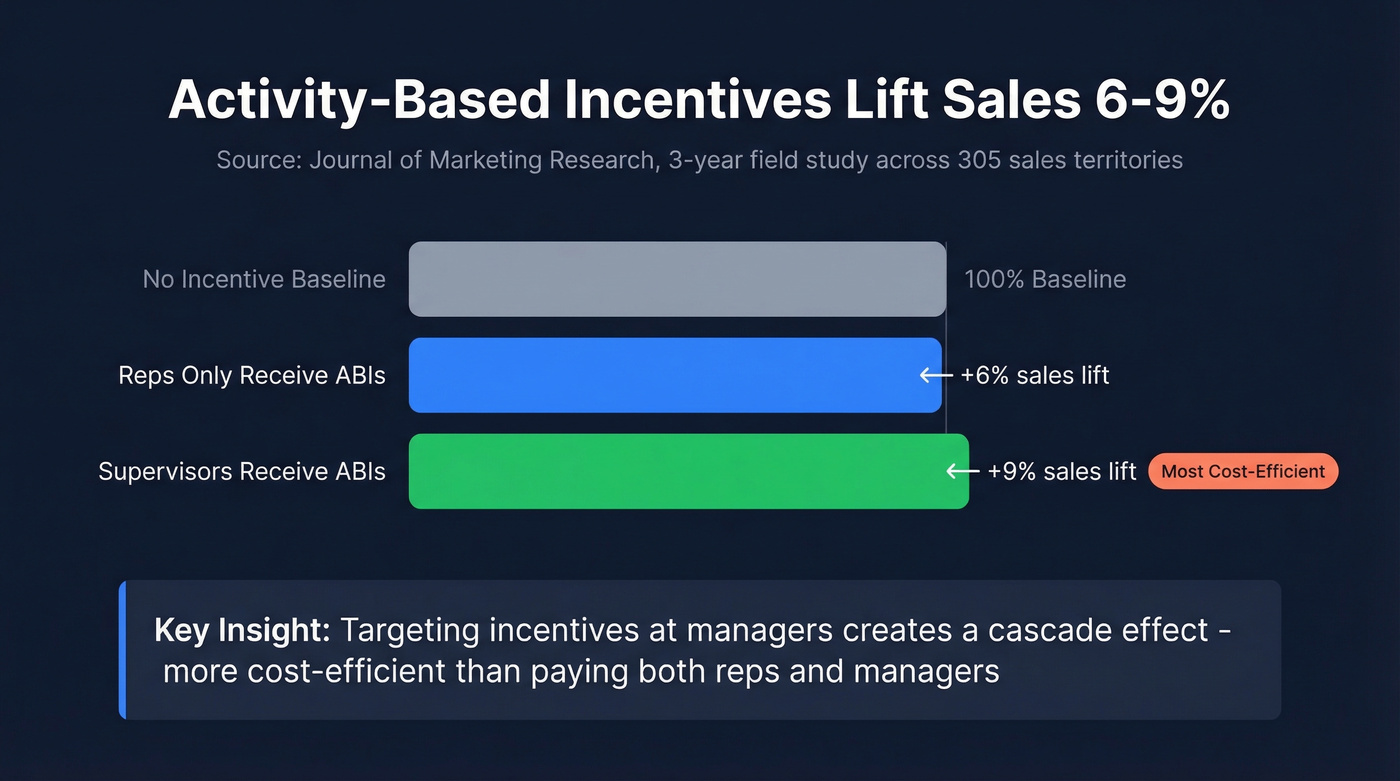
Here's the part most people miss: when supervisors received activity-based incentives, they exerted behavior control downward on their reps. Targeting ABIs at supervisors alone was actually more cost-efficient than paying both reps and supervisors. We've seen this play out in practice too - manager-level incentives create a cascade effect that's hard to replicate by throwing money at individual contributors.
Activity-based incentives are underused. Most teams default to outcome-only comp because it's simpler to design, but the evidence says you're leaving 6-9% on the table.
Group vs. Individual Depends on Brand Strength
A Journal of Marketing study found something counterintuitive: for weaker brands, group incentives where pooled commissions are split equally produced better sales performance. For stronger brands, individual incentives won.
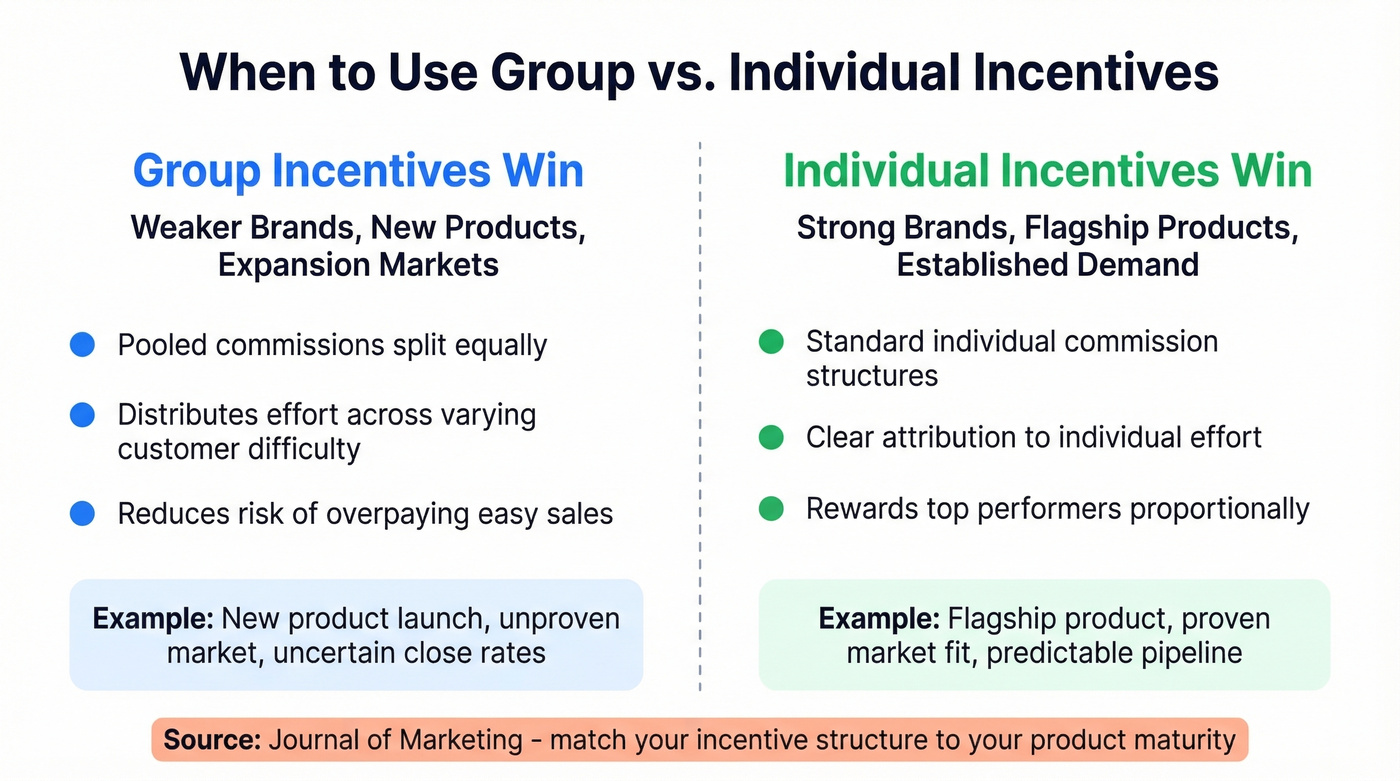
The rationale makes sense once you think about it. Weaker brands have more uncertain outcomes, and individual comp risks overpaying for easy sales while underpaying for the hard ones. Group comp better distributes effort across varying customer difficulty. The practical takeaway: newer product lines and expansion markets get team-based plans. Your flagship product with established demand gets individual comp.
Non-Cash Beats Cash for Memorability
IRF data shows 81% of incentive travel buyers cite talent retention as their primary objective, and 70% want destinations they haven't used before - the novelty itself is part of the reward.
A $500 dinner for two at a great restaurant creates a memory. Your rep tells that story at the next team offsite. A $500 Amazon gift card gets spent on paper towels and phone chargers. Nobody tells a story about paper towels. The psychological literature is clear: experiences create stronger emotional associations than equivalent cash, and those associations drive future behavior.
Best Sales Incentive Ideas That Work
Every idea below includes a budget range so you can actually plan. A well-designed SPIFF should pay for itself with clear incremental revenue lift - and if it doesn't, redesign before running it again.
Monetary
SPIFFs are your go-to for short-term behavior change. Run them for 1-2 weeks, pay $100-$250 per qualifying action - a qualified meeting booked, a demo completed, a new logo closed. Keep the qualifying criteria razor-sharp. Define "qualified meeting" before the contest starts, not after. Longer SPIFFs lose urgency; shorter ones don't give reps time to adjust.
Tiered commission accelerators reward sustained performance. Hit 100% of quota, earn standard rate. Hit 120%, the rate jumps 1.5x. Hit 150%, it doubles. This keeps your top performers pushing past quota instead of sandbagging deals into next quarter. Plan for 15-25% incremental commission spend on the accelerated tiers.
Quarterly cash bonuses of $500-$2,500 tied to specific outcomes work well for account managers and CS roles where the sales cycle is longer and monthly SPIFFs feel arbitrary.
Experiential
President's Club trips remain the gold standard for annual recognition. Budget $5,000-$15,000 per qualifier for international destinations. 75% of surveyed participants say a cruise experience is desirable regardless of destination, which gives you flexibility on logistics.
Team dinners at $500-$1,000 per event work as mid-quarter rewards. Adventure days - go-karting, escape rooms, cooking classes - run $100-$300 per person and build team cohesion alongside motivation.
Recognition
Your top AE just told you she's interviewing. She says: "I hit 140% and got the same recognition as someone at 101%." This happens constantly, and it's entirely preventable.
Create a "Most Improved" award for mid-tier performers - the reps who went from 85% to 110% deserve as much recognition as the rep who cruised to 150% on a fat territory. Public shout-outs in all-hands meetings cost nothing. Leaderboard gamification through your CRM or sales engagement tool creates daily visibility. Budget: essentially zero, which makes the ROI infinite if you do it right.
Hot take: also add a "Most Rejections" award. It sounds counterintuitive, but rewarding the rep who logged the most "no's" in a week encourages higher activity volume and destigmatizes rejection. We've seen teams drive dramatically higher participation rates just by reframing failure as effort. Non-cash recognition like this costs almost nothing but reshapes team culture.
Professional Development
Conference tickets at $500-$3,000, certification sponsorship, and mentorship with executives signal that you're investing in the rep's career, not just extracting quota. Early-career reps especially value development rewards - they're building a resume, not just a commission check.
Team-Based
Group revenue qualifiers work well: when the team hits 110% of collective target, everyone unlocks an experience - a team trip, an extra PTO day, a group dinner. This ties directly back to the Journal of Marketing research on newer product lines and expansion markets.
Collaborative challenges like "book 50 meetings as a team this week" create peer accountability without the toxicity of zero-sum leaderboards. They reward collective effort rather than individual heroics, and in our experience, they're among the most effective structures for teams with uneven territory distribution.
Omnichannel Considerations
Modern reps interact with buyers across email, phone, social, chat, video, and in-person events. Salesforce research has found reps engage prospects across an average of 10 different channels. If your incentive plan only rewards closed deals, you're leaving a lot of pipeline-building work unrewarded.
Build incentive credit for multi-channel engagement - a rep who runs a webinar, follows up via email, and closes on a call should see all three touchpoints reflected, not just the final signature. This is especially important for enterprise cycles where 10+ interactions precede a purchase.
Designing Rewards by Role
One-size-fits-all incentive plans are lazy management. An SDR booking meetings has fundamentally different levers than an AE closing six-figure deals.
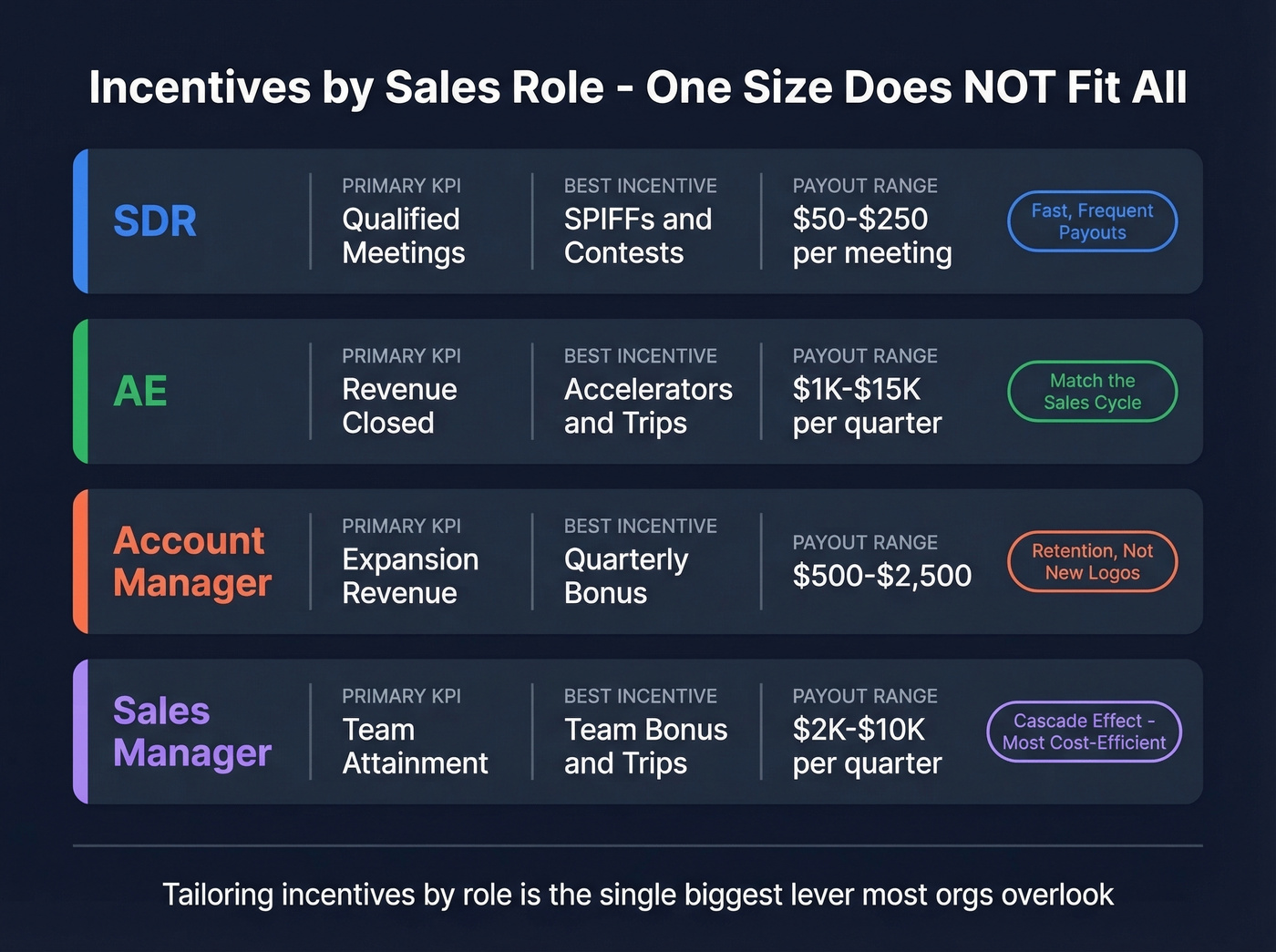
| Role | Primary KPI | Incentive Type | Payout Range |
|---|---|---|---|
| SDR | Qualified meetings | SPIFFs, contests | $50-$250/meeting |
| AE | Revenue closed | Accelerators, trips | $1K-$15K/quarter |
| Account Manager | Expansion revenue | Quarterly bonus | $500-$2,500 |
| Sales Manager | Team attainment | Team bonus, trips | $2K-$10K/quarter |
SDRs respond to frequent, fast-payout incentives. They're early in their careers, often on lower base salary, and motivated by immediate gratification. AEs need longer-horizon structures that match their sales cycle. Account managers need expansion and retention metrics, not new logo metrics. And managers should be incentivized on team performance - the JMR study showed that supervisor-targeted ABIs are more cost-efficient than rep-only plans.
Tailoring reward structures by role is the single biggest lever most orgs overlook.

Your incentive plan is only as good as the pipeline feeding it. When reps chase SPIFFs but half their emails bounce, you're paying for activity that goes nowhere. Prospeo delivers 98% email accuracy and 125M+ verified mobile numbers - so every incentivized action connects to a real buyer.
Stop rewarding effort that bounces. Start rewarding effort that books.
10 Mistakes That Kill Incentive Programs
1. Ambiguous metrics. Define "qualified meeting" and "closed deal" before the contest launches. If reps argue about what counts, you've already lost.
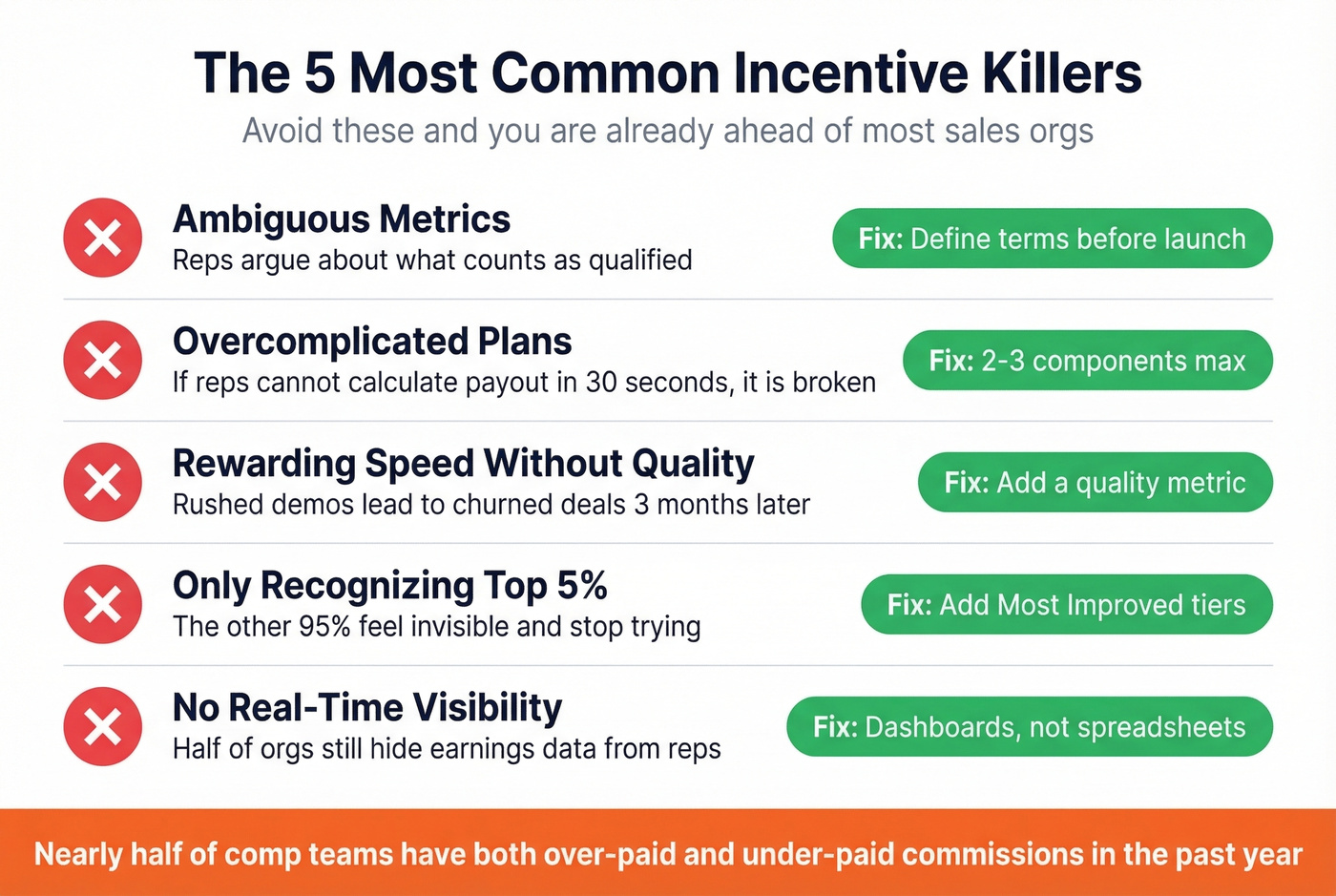
2. Overcomplicated structures. If a rep can't calculate their payout in 30 seconds, simplify. Two to three core components max. Build a simulator if you need complexity.
3. Rewarding speed without quality. A SPIFF that pays per demo completed sounds great until reps rush through 15-minute demos with unqualified prospects. Three months later, those deals churn. Tie at least one metric to quality - customer fit score, 30-day retention, or deal size minimum.
4. Inequitable distribution. Recognizing only the top 5% breeds resentment in the other 95%. Add tiers for "most improved" and "consistent performer."
5. Untrusted data. Nearly half of comp teams have over- and underpaid commissions in the past year. Audit payout accuracy quarterly. If reps don't trust the numbers, they won't trust the program.
6. No real-time visibility. Only half of organizations provide reps real-time visibility into earnings. That's embarrassing in 2026. Fix it with dashboards, not spreadsheets.
7. Ignoring employee feedback. Run a 5-question pulse survey after every incentive cycle. The reps on the ground know what's motivating and what's performative.
8. Failure to iterate. Review quarterly. Monitor payout distribution curves. If 80% of payouts go to 10% of reps, your plan is rewarding territory luck, not effort.
9. Poor communication. Dense PDFs nobody reads kill programs before they start. Use short videos, manager-led sessions, and a one-page summary with examples.
10. Removing incentives without redesign. The consensus on r/sales is clear: reps view incentives as part of their pay, not a bonus. One thread put it bluntly - reps who lose their reward programs start interviewing within the month. If you need to restructure, frame it as a redesign with clear rationale, never as a takeaway.
The Tax Side (Don't Skip This)
Cash and cash-equivalent rewards are always taxable. Gift cards, prepaid cards, checks, digital payments - all of it. No exceptions, regardless of amount. Report them on W-2 gross wages or 1099-NEC for contractors. Supplemental wage withholding runs at a flat 22%.
De minimis fringe benefits get a narrow exception: tangible personal property that's occasional and typically $100 or less. A branded jacket or a holiday ham qualifies. A $100 Visa gift card doesn't - cash equivalents never qualify as de minimis.
Employee achievement awards have annual caps: $1,600 per year under a qualified plan, $400 under a non-qualified plan. These apply to tangible personal property awards for length of service or safety, not to cash bonuses. IRS Publication 525 is the authoritative reference - bookmark it before you design your next program. Under SECURE 2.0, incentives up to $250 to encourage 401(k) participation can qualify for favorable treatment, a useful tool for benefits-adjacent incentive design.
Let's be honest: most sales leaders don't think about tax implications until finance flags a problem. Build withholding into your incentive budget from day one - employer-side taxes and withholding change the true cost of every payout.
Measuring Incentive ROI
Track five metrics: revenue lift per participant, participation rate, payout accuracy rate, rep satisfaction via quarterly pulse survey, and voluntary turnover delta. If you can't measure all five, prioritize revenue lift and participation rate - they tell you whether the program is working and whether reps are engaged.
Budget benchmark: start at 3-5% of total sales compensation budget for non-commission incentives. That gives you room for SPIFFs, recognition programs, and one experiential reward per year without blowing up your P&L.
Before you launch anything, stress-test it. Simulate best-case, worst-case, and average scenarios using historical data. What happens if your top rep closes three whale deals during the SPIFF window? What if nobody qualifies? Use automation to model scenarios before committing budget - doing this manually in a spreadsheet is how you end up with a $50K overpayment surprise in Q4.
The Data Quality Problem
Here's where activity-based incentives break down: if your reps are calling dead numbers and emailing bounced addresses, you're incentivizing busywork. A SPIFF that pays $150 per qualified meeting means nothing if half the contact list is garbage.
We ran into this ourselves when testing activity-based SPIFFs with outbound teams. The reps hitting the highest dial counts weren't booking the most meetings - they were burning through bad numbers. The fix wasn't a better incentive structure. It was better data. Tools like Prospeo solve this with 98% email accuracy and verified mobile numbers on a 7-day refresh cycle, so every dial and every email actually has a chance of converting. The free tier gives you 75 emails plus 100 Chrome extension credits per month to test the difference before committing budget.
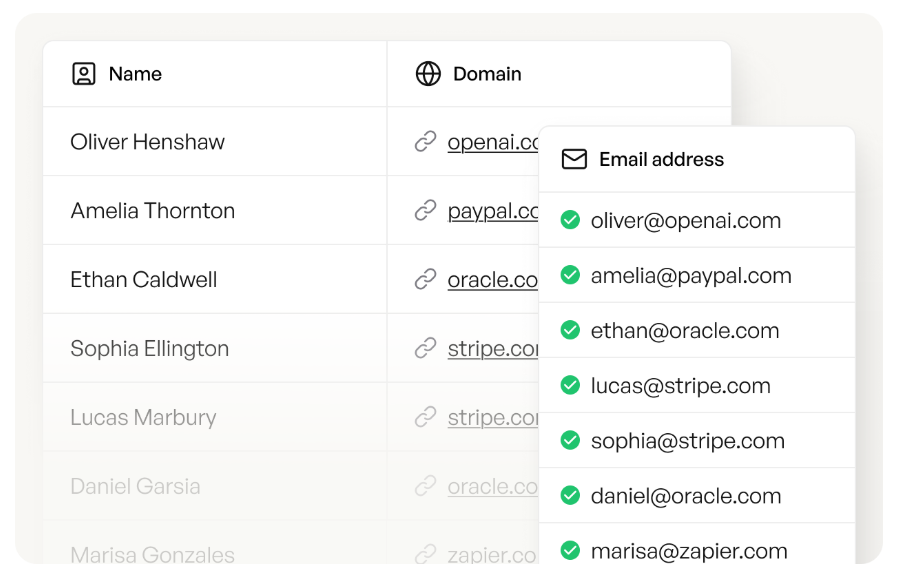
Activity-based incentives lift sales 6-9%, but only when reps have enough qualified contacts to act on. Prospeo's 300M+ profiles with 30+ filters - including buyer intent and job changes - mean your team never runs out of high-quality targets to pursue during a SPIFF window.
Fill the pipeline so your incentives actually have something to accelerate.
2026 Trends Worth Watching
Merchandise rewards in the $50-$100 range are increasing across North America, with logo'd brand-name merchandise appearing in just under 70% of non-cash rewards programs. In Europe, average per-instance merchandise spend jumped from EUR174 in 2023 to EUR232 in 2024.
Gen Z and Millennial reps prefer frequent, authentic recognition over annual blowout events. Points programs, gift cards, and SPIFFs fit this preference - they want to feel rewarded in real time, not once a year at a gala.
The scope is expanding too. 72% of organizations plan to expand incentive compensation to new departments, pulling customer success, marketing, and product teams into structures that used to be sales-only. As incentives for sales teams mature, expect the playbook to spread across the entire revenue organization. The Incentive Research Foundation publishes annual benchmarking data worth reviewing if you're building a business case for leadership.
FAQ
What's the difference between a SPIFF and a commission?
A commission is ongoing compensation tied to every sale. A SPIFF is a short-term bonus - typically $50-$500 - for a specific behavior like booking demos or closing new logos, usually lasting one to two weeks.
Are gift cards taxable as sales incentives?
Yes. Gift cards are cash equivalents and always taxable regardless of amount. De minimis exclusions apply only to tangible personal property like branded merchandise under $100.
How much should we budget for a sales incentive program?
Start at 3-5% of total sales compensation budget for non-commission rewards. SPIFFs typically run $100-$250 per qualifying action. President's Club trips cost $5,000-$15,000 per qualifier.
Do team incentives work better than individual ones?
For newer or weaker product lines, group incentives outperform individual comp by distributing risk across uncertain outcomes. Established products with predictable demand perform better with individual structures.
How do I make sure activity-based incentives reward real work?
Verify your contact data before launching any activity-based program. Reps calling disconnected numbers produce meaningless activity metrics. Clean data turns activity volume into actual pipeline.