

Inside Sales Techniques: Scripts, Frameworks, and Data From Top Performers
It's Tuesday morning. Fifty dials on the board, half the numbers disconnected, pipeline review at 3 PM. You know the feeling. 69% of reps miss quota, and just 17% of reps generate 81% of revenue. The gap between top performers and everyone else isn't talent - it's technique. The reps who consistently hit number run tighter frameworks, handle objections with structure, and never send a sequence to an unverified list.
The Three Things That Actually Move the Needle
If you're short on time, nail these three and skip the rest:
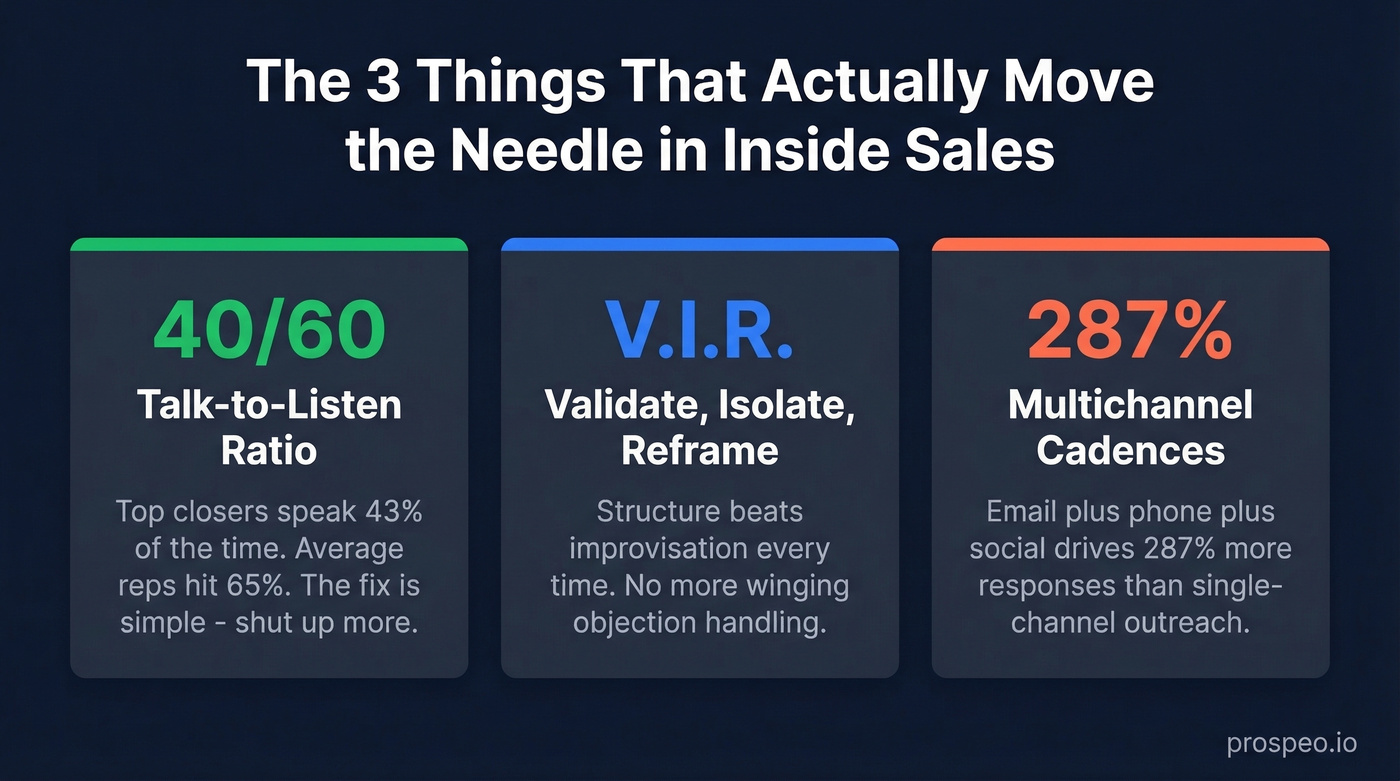
- The 40/60 talk-to-listen ratio. Top-closing B2B reps speak 43% of the time. Average performers hit 65%. Shut up more.
- Validate, Isolate, Reframe for every objection. No more winging it.
- A structured multichannel cadence. Combining email, phone, and social drives 287% more responses than single-channel outreach.
Everything below builds on these shifts.
The Cold Call Framework That Works
The best cold call talk track we've seen comes from a practitioner on r/salestechniques - three years as a top performer, then two years managing a team at a Boston tech company. His framework is dead simple:
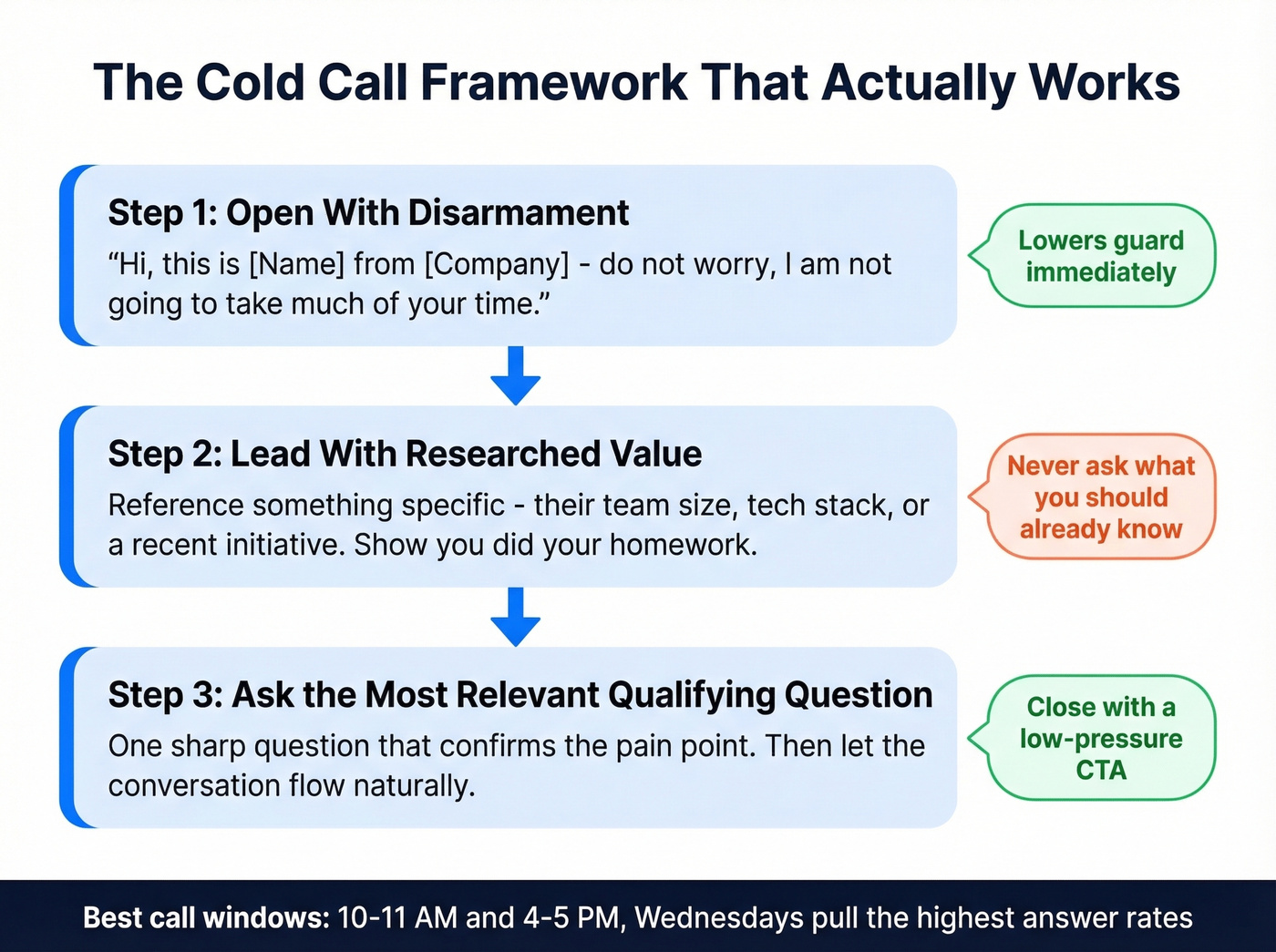
Open with disarmament: "Hi, this is [Name] from [Company] - don't worry, I'm not going to take much of your time."
Lead with researched value: "I understand you manage a team of developers, and we have a plug-in that eliminates the need to redeploy back-end code."
Ask the most relevant qualifying question first: "Can I ask quickly - how long are the redeploys for your team?"
This shows you've done homework. Don't ask questions you should already know the answer to - nothing kills credibility faster than "So, how many people are on your team?" when it's on their company page.
If they confirm the pain, let the conversation flow naturally. Close with a low-pressure CTA: "I'd love to show you a quick demo - if it adds value, I'm happy to provide a free trial." Best-performing call windows are 10-11 AM and 4-5 PM, with Wednesdays pulling the highest answer rates.
Qualification: Pick a Framework and Commit
Modern B2B buying groups include 6-10+ stakeholders, and 57% of the buying journey is done before a prospect ever talks to sales. You need a framework that maps the full decision landscape, not just budget and authority.
| Framework | Created By | Best For | Weakness |
|---|---|---|---|
| BANT | IBM (1960s) | High-velocity inbound, early lead sorting | Too shallow for complex deals |
| MEDDIC | PTC (1990s) | Enterprise, multi-stakeholder deals ($50K+ ACV) | Heavy process, overkill for SMB |
| SPICED | Winning by Design | SaaS, recurring revenue | Requires cross-team alignment |
Don't try to run all three. Pick the one that matches your sales motion and commit.
SPICED works particularly well for SaaS because it weighs emotional and rational buying motives equally. Sample questions: "Describe a typical working day in your team" (Situation). "What frustrates you the most about your current process?" (Pain). "How much time does this problem cost you per week?" (Impact). "By when does a solution have to be implemented?" (Critical Event). We've found that reps who internalize even one of these frameworks outperform reps who "go with their gut" by a wide margin - the structure frees you to actually listen instead of scrambling for your next question.
Handling Objections With Structure
Here's the thing about objection handling: most reps either freeze or launch into a rebuttal. Both kill the deal. The framework that separates structured reps from everyone else is Validate, Isolate, Reframe. "I hear you" lowers defenses. "Is price the only thing stopping us?" prevents moving goalposts. "Let's look at cost vs. ROI" changes the frame.
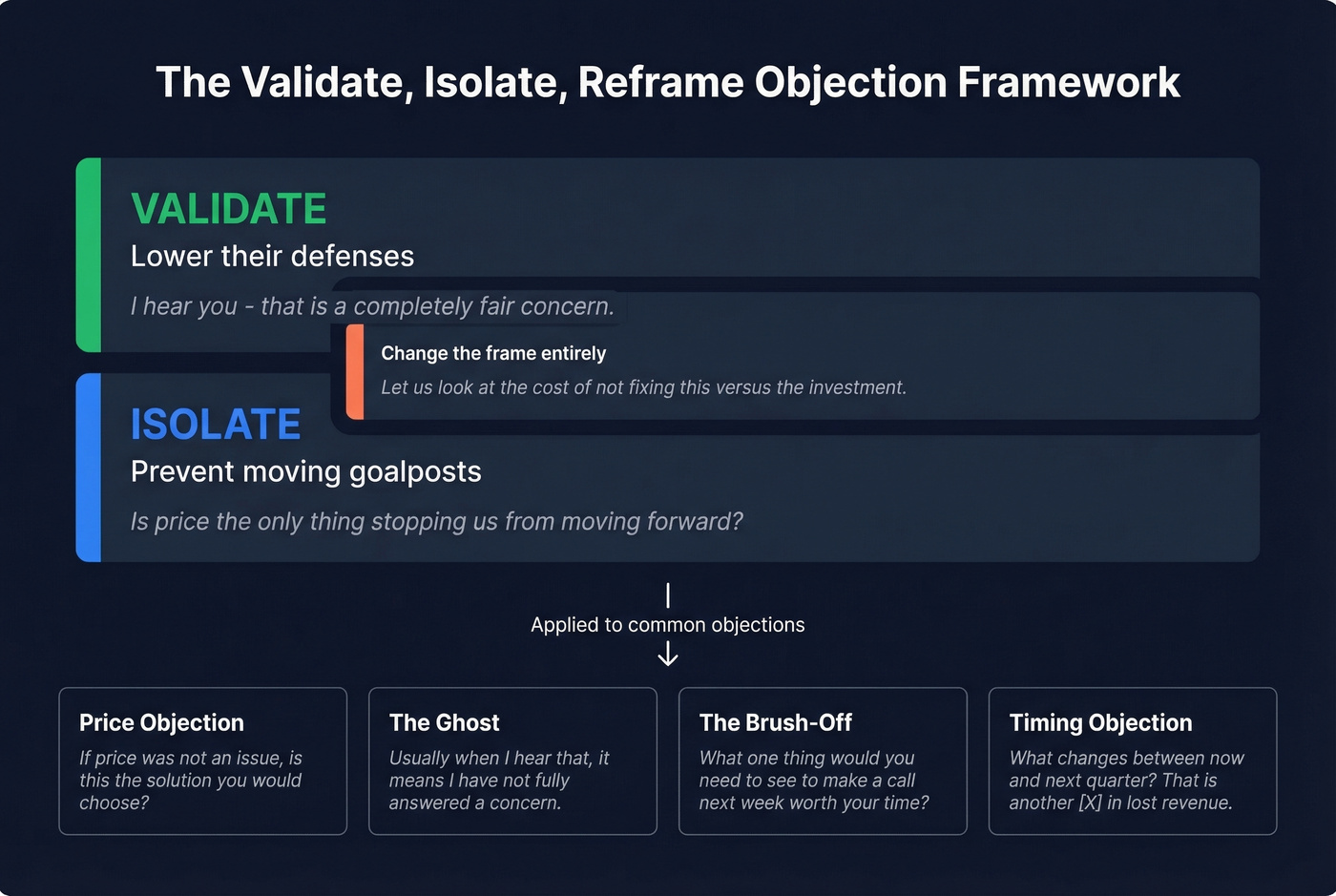
Price objection: "If price wasn't an issue, is this the solution you'd choose? Let's look at the cost of not fixing [Problem] versus the investment here."
The ghost ("I'll get back to you"): "Usually when I hear that, it means I haven't fully answered a concern. Is there something lingering?"
The brush-off ("Just send me an email"): "What one thing would you need to see in that email to make a call next week worth your time?"
Timing objection: "What changes between now and next quarter? If we wait 90 days, that's another [X amount] of lost revenue."
Don't memorize these word-for-word. Internalize the structure and adapt the language to your voice. The pattern matters more than the script.

Every objection framework and cold call script falls apart when half your dials hit disconnected numbers. Prospeo gives inside sales teams 125M+ verified mobile numbers with a 30% pickup rate and 98% email accuracy - so your multichannel cadences actually reach real buyers.
Stop burning cadence touches on dead contacts.
Build a Multichannel Cadence
Single-channel outreach is leaving money on the table. Here's a foundational 5-touch cadence that pulls 18-25% reply rates for SaaS teams:
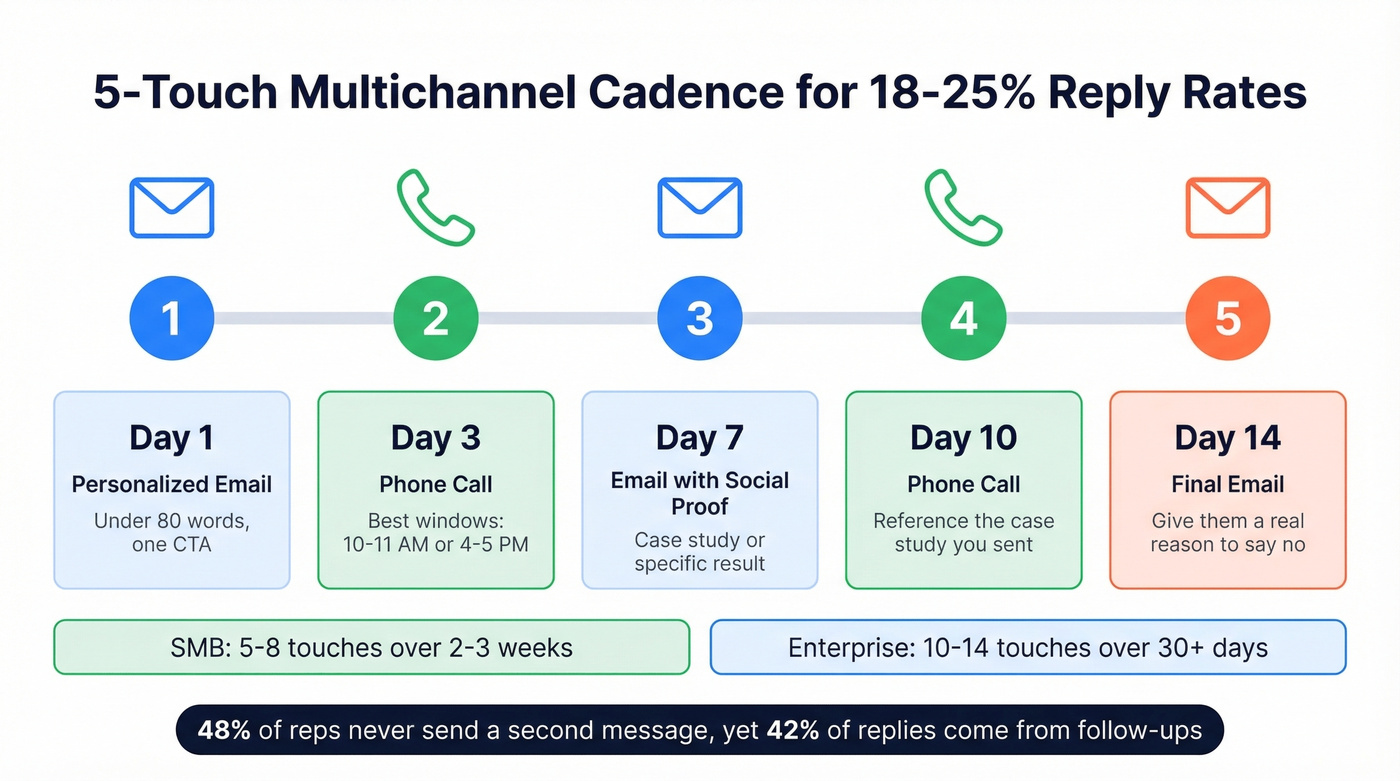
- Day 1: Personalized email (under 80 words, one CTA)
- Day 3: Phone call
- Day 7: Email with case study or social proof
- Day 10: Phone call
- Day 14: Final email - give them a real reason to say no
For SMB, 5-8 touches over 2-3 weeks is the sweet spot. Enterprise deals need 10-14 touches over 30+ days. Teams at Carta and Pave hit 20%+ reply rates using a three-theme cadence that pivots pain points every 10 days - the key principle being to sell one thing at a time. When you change themes, change subject lines.
The numbers are stark: 48% of reps never send a second message, yet 42% of replies come from follow-ups. And please - skip the cutesy breakup emails. "Did you get stuck under a rock?" isn't memorable. It's annoying. Responding within an hour of inbound interest makes you 7x more likely to convert, so speed matters more than cleverness.
Mistakes Killing Your Numbers
Talking too much. Top-closing reps speak 43% of the time versus 65% for average performers. Sales calls with over two minutes of monologue see a 22% drop in engagement. The 40/60 talk-to-listen ratio isn't a suggestion - it's the single highest-leverage behavior change you can make.
Playing free consultant. Giving away strategy insights before confirming qualification turns you into unpaid help. Qualify first, advise second.
How many times have you pitched a feature list when the prospect just wanted to know if you understand their problem? Your window is narrow - 57% of the buying journey is already done before they talk to you. Sell the ability to uncover why pipeline stalled last quarter, not a reporting dashboard. And here's a hot take from our team: if your reps are juggling six different tools to make a single call, your tech stack is the problem, not their technique. Remote selling reduces costs 40-60% compared to field sales, but only if you're not burning that margin on tool bloat.
The Technique Nobody Talks About: Data Quality
None of these inside sales techniques matter if 35% of your emails bounce. Your cadences burn your domain reputation, your sequences never reach inboxes, and your pipeline numbers are fiction. The diagnostic threshold is simple: if you're tracking opens and seeing under 15%, you have a deliverability problem. Under 10%? Stop sending immediately and fix your list.
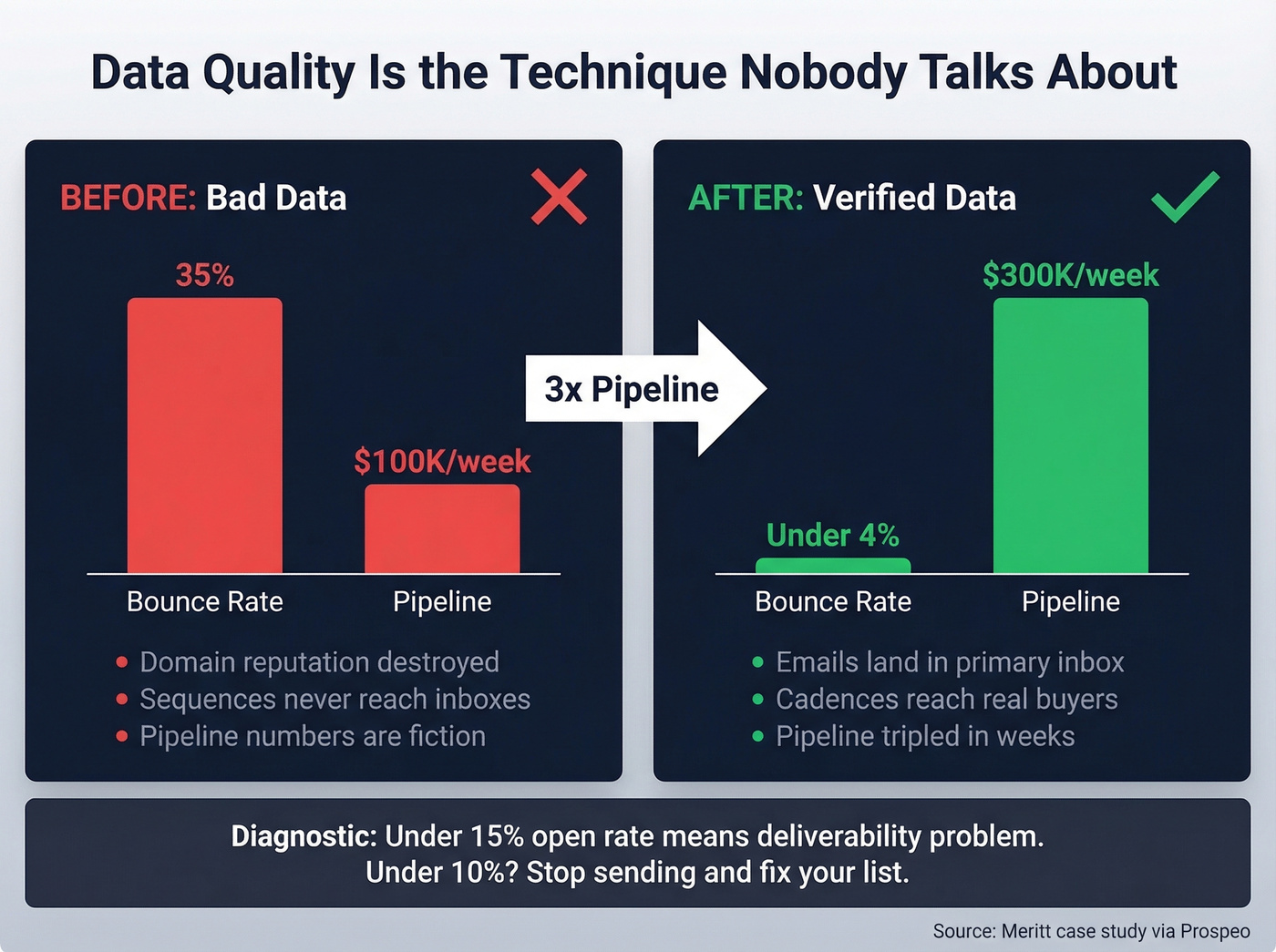
We saw this firsthand with Meritt, a Prospeo customer whose bounce rate dropped from 35% to under 4% after switching to verified data - pipeline tripled from $100K to $300K per week. That's not a technique improvement. That's a data quality improvement. Before you optimize talk tracks or cadence timing, verify your list. Everything else is downstream.
You just read that 35% bounce rates destroy domain reputation and pipeline. Prospeo's 5-step verification and 7-day data refresh cycle keep bounce rates under 4% - the same shift that took Snyk's 50 AEs from 35-40% bounces to under 5% and drove 180% more AE-sourced pipeline.
Replace bad data before it kills your next sequence.
How AI Is Changing Inside Sales in 2026
Gartner projected that 35% of CROs would have GenAI operations on their team by 2026, and the shift is well underway. Reps who effectively partner with AI are 3.7x more likely to meet quota.
Outreach analyzed 33M weekly interactions across 6,000+ customers and found their deal health scores hit 81% accuracy by tracking stakeholder involvement, communication patterns, and close-date shifts. The coaching angle is where it gets interesting: "In minute 18 of your last call, you missed the CFO's concern about implementation timeline. Next call, ask about timeline expectations before diving into features." That's actionable. Generic advice like "improve your discovery questioning" isn't. The transparency insight matters most - reps ignore opaque scores but act on specific signal explanations.
Let's be honest: AI won't replace good reps. But reps who use AI to prep calls, score deals, and prioritize accounts will outperform those who don't. The gap is already widening.
FAQ
What's the difference between inside sales and outside sales?
Inside sales is remote - phone, email, video - at roughly $50 per interaction versus $308 per field visit. Inside reps handle 40-60 touches per day and work best for deals under $50K ACV; outside earns its cost on six-figure deals requiring in-person relationship building. It's consultative selling done remotely, not telemarketing.
How many follow-ups should an inside sales rep send?
At minimum five. 80% of sales require 5+ follow-ups, but 48% of reps never send a second message. SMB cadences need 5-8 touches over 2-3 weeks; enterprise needs 10-14 over 30+ days. Skip this advice if you're running inbound-only - your follow-up cadence should be shorter and faster since the prospect already raised their hand.
What improves cold email reply rates the most?
Average cold email reply rate is 3.43%; the top 10% hit 10.7%+. Keep emails under 80 words with one CTA and send on Tuesday or Wednesday. Most importantly, verify your list first - a 98% email accuracy rate keeps bounce rates under 4%, so your copy actually reaches inboxes instead of spam folders.