

The Complete Inside Sales Training Guide for 2026
Most inside sales training is a lie. As one r/sales poster put it, it's "just a string of recorded product demonstrations made by marketing," a two-day offsite everyone forgets by Friday, and a Slack message that says "shadow Jamie for a week." Meanwhile, only 18% of buyers think salespeople are actually well-prepared for conversations. That gap between what companies call training and what reps actually need is where quota attainment goes to die.
Here's the thing: the methodology you pick matters maybe 20%. The other 80% is whether managers reinforce it weekly and whether reps have accurate data to practice on. If budget is tight, combine a $500/rep online program with weekly coaching sessions. Scaling a team? Invest in a cohort program ($1,500-$4,000/rep) plus an AI coaching tool.
What Inside Sales Actually Means
Inside sales means selling remotely - phone, video, email, chat. It's not telemarketing. Telemarketing is scripted, low-context, and product-ignorant. Inside sales reps run discovery calls, navigate multi-stakeholder deals, and manage pipelines of 40-60 active prospects daily.
The deals typically land between $5K and $50K with 2-8 week cycles. That's a fundamentally different motion than outside sales, where deals run $50K+ and cycles stretch for months. The training needs to match.
Inside sales now represents the majority of the sales workforce - roughly 53.7% inside vs 46.3% outside across U.S. sales roles. Remote-first buying behavior is accelerating that shift. If your training program was designed for road warriors doing steak dinners, it doesn't translate.
Why Training Matters More in 2026
An Accenture analysis found 353% ROI from sales training - roughly $4.53 returned for every $1 invested. The global sales training market was valued at $10.32B in 2024 and is projected to reach ~$19B by 2032. Lepaya's State of Skills 2026 report showed a 27% increase in commercial training investment hours year over year.
The skills driving that investment have shifted. In 2026, the emphasis is on emotional intelligence, data storytelling, social selling, and virtual selling etiquette - not just phone technique. Buyers now complete 70% of their journey independently before engaging sales. By the time your SDR gets someone on the phone, that prospect has already read your case studies, compared your pricing page to three competitors, and formed an opinion. Reps who can't add value beyond what's on the website get ghosted.
The alternative to training is hiring, and hiring is brutal. 78% of CSOs say it's difficult to attract high-quality sales candidates. It costs $10K-$15K to hire a single sales rep - before onboarding, before ramp, before they close a single deal. The average company spends $2,020 per rep on training annually. That's a fraction of a bad hire.
Core Skills Every Program Must Cover
A good program isn't a grab bag of motivational videos. It's a structured curriculum that builds competency across seven areas.
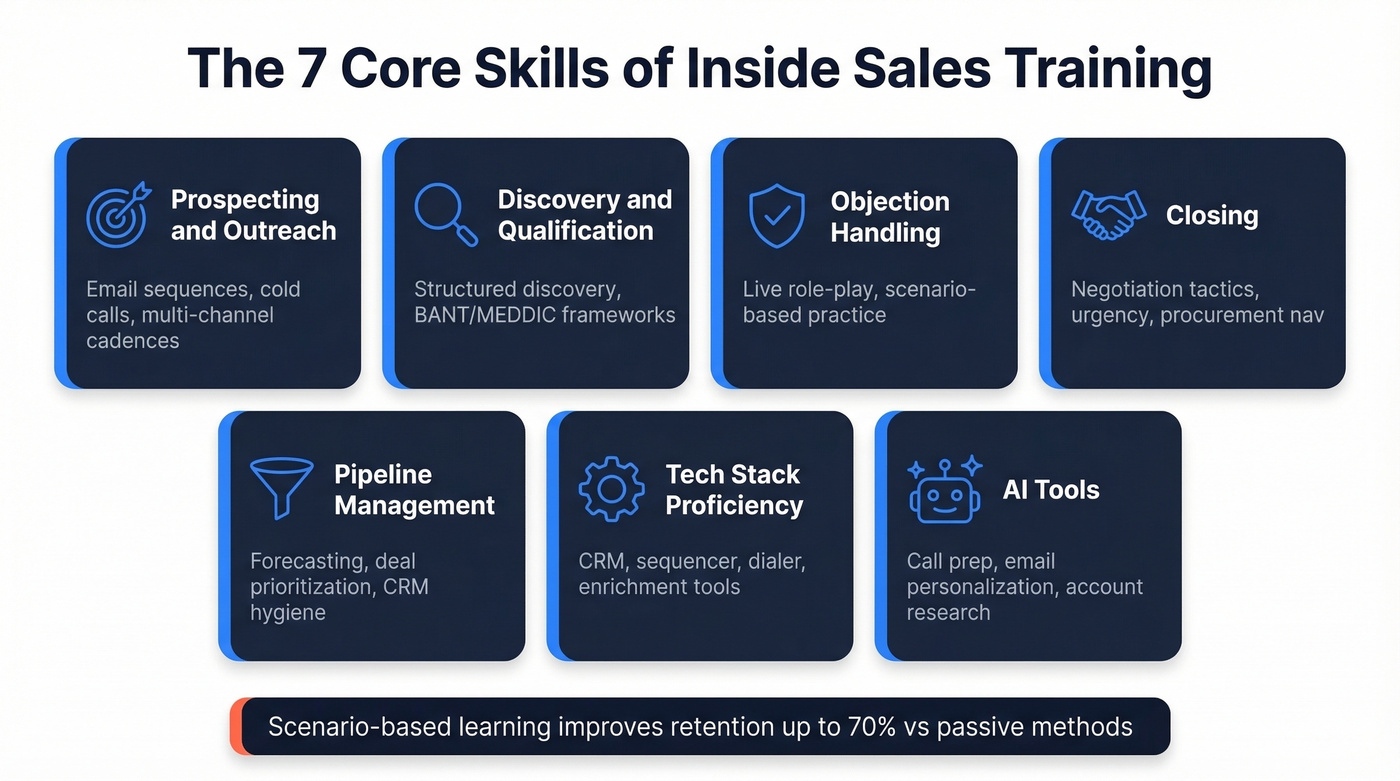
Prospecting and outreach comes first because nothing else matters if reps can't fill the top of their pipeline. This means email sequencing, cold call frameworks, multi-channel cadences, and - critically - data hygiene. Training reps on cold-call technique is pointless when 35% of their phone numbers are disconnected. We've seen teams pair a solid training program with Prospeo's verified contact data (98% email accuracy, 125M+ verified mobiles on a 7-day refresh cycle) and watch connect rates jump almost immediately. The free tier gives reps 75 verified emails per month to start practicing on real, reachable contacts.
Discovery and qualification is where deals are won or lost. Reps need to run structured discovery - BANT, MEDDIC , whatever framework you choose - and know when to disqualify. The best programs use recorded call reviews to teach this, not slides. Give reps a concrete call structure: open with a relevant hook tied to the prospect's situation, transition into 3-4 discovery questions that uncover pain and decision process, deliver a value statement connecting your solution to their specific problem, then lock a clear next step before hanging up. That four-stage flow - opener, discovery, value, next step - is the skeleton every methodology hangs on.
Objection handling requires live practice. Role-play with feedback beats lecture-based training by a wide margin - scenario-based learning improves retention up to 70% compared to passive methods.
The remaining four skills are easier to teach but still essential:
- Closing - Strong discovery makes closing a natural outcome. Still, reps need negotiation tactics, urgency creation, and procurement navigation.
- Pipeline management - Accurate forecasting, deal prioritization by likelihood and value, and CRM hygiene without being nagged. This is the unsexy skill that separates quota-crushers from quota-missers.
- Tech stack proficiency - Reps should use the tools they're given - CRM, sequencer, dialer, enrichment platform - without fumbling. Teams invest tens of thousands in tools and then watch reps use 20% of the functionality.
- AI tools - Reps who use AI for call prep, email personalization, and account research save 2+ hours per day on manual tasks. That's not a nice-to-have anymore.
Let's be honest: if your average contract value sits below $8K, you probably don't need a $4,000/rep training program. A solid $500 online course, weekly manager coaching, and clean contact data will get you 80% of the way there. Save the enterprise training budget for when your deal complexity justifies it.
How Much Does Training Cost?
Nearly every training vendor hides pricing behind a "request a quote" form. Factor 8's pricing page, for instance, has literally zero prices on it. So here's what training actually costs, based on format and scale.
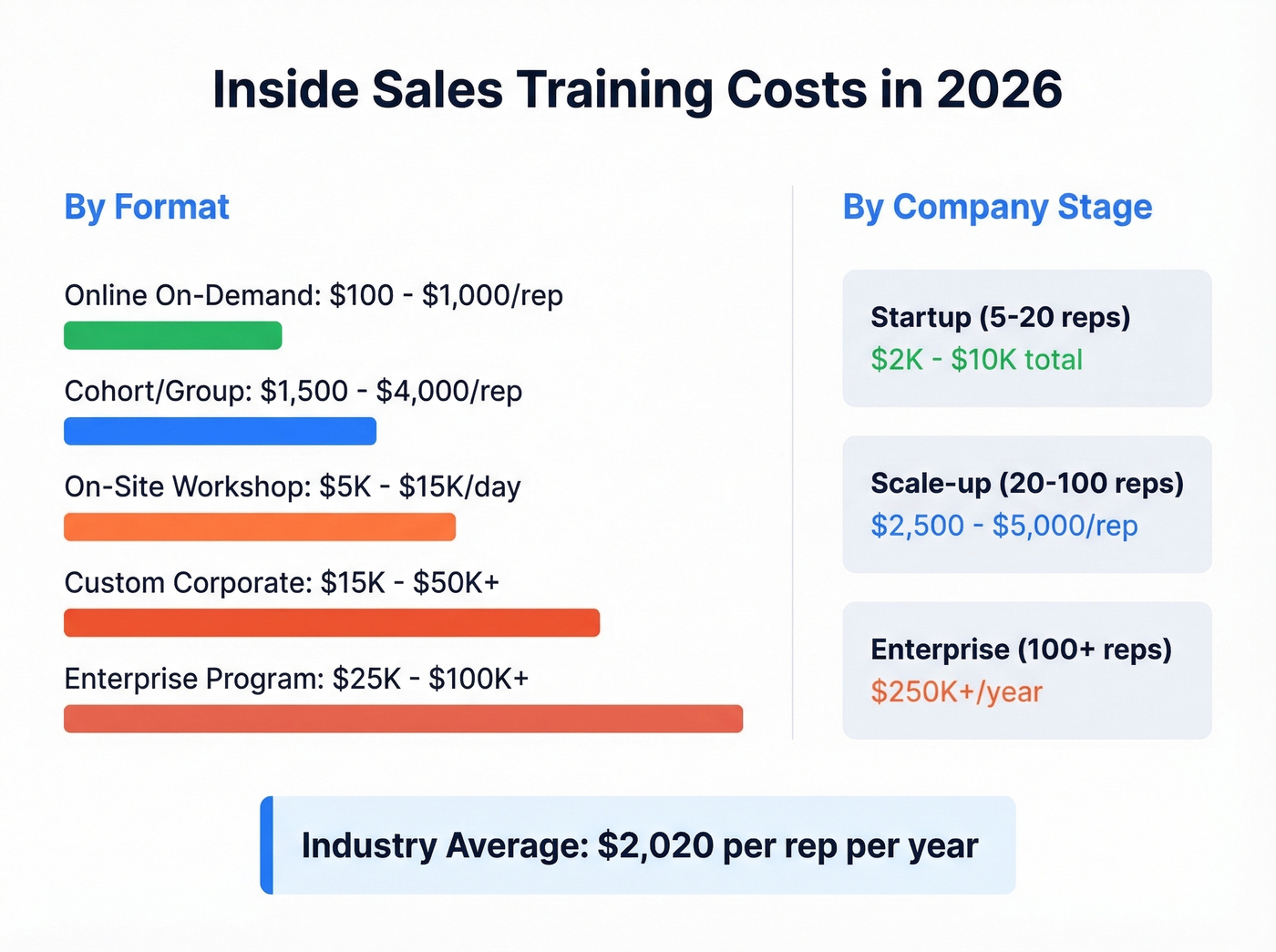
| Format | Cost Range | Best For |
|---|---|---|
| Online on-demand | $100-$1,000/rep | Budget-conscious, self-paced |
| Cohort/group | $1,500-$4,000/rep | Mid-market teams, structured |
| On-site workshop | $5K-$15K/day | Intensive skill-building |
| Custom corporate | $15K-$50K+ | Tailored methodology |
| Enterprise program | $25K-$100K+ | Full enablement rollout |
And by company size:
| Company Stage | Typical Budget |
|---|---|
| Startup (5-20 reps) | $2K-$10K total |
| Scale-up (20-100 reps) | $2,500-$5,000/rep |
| Enterprise (100+) | $250K+/year |
The average across all companies lands around $2,020 per rep per year. If you're spending less than that, you're underinvesting. Spending significantly more? Make sure you're measuring the return.
Top Methodologies Compared
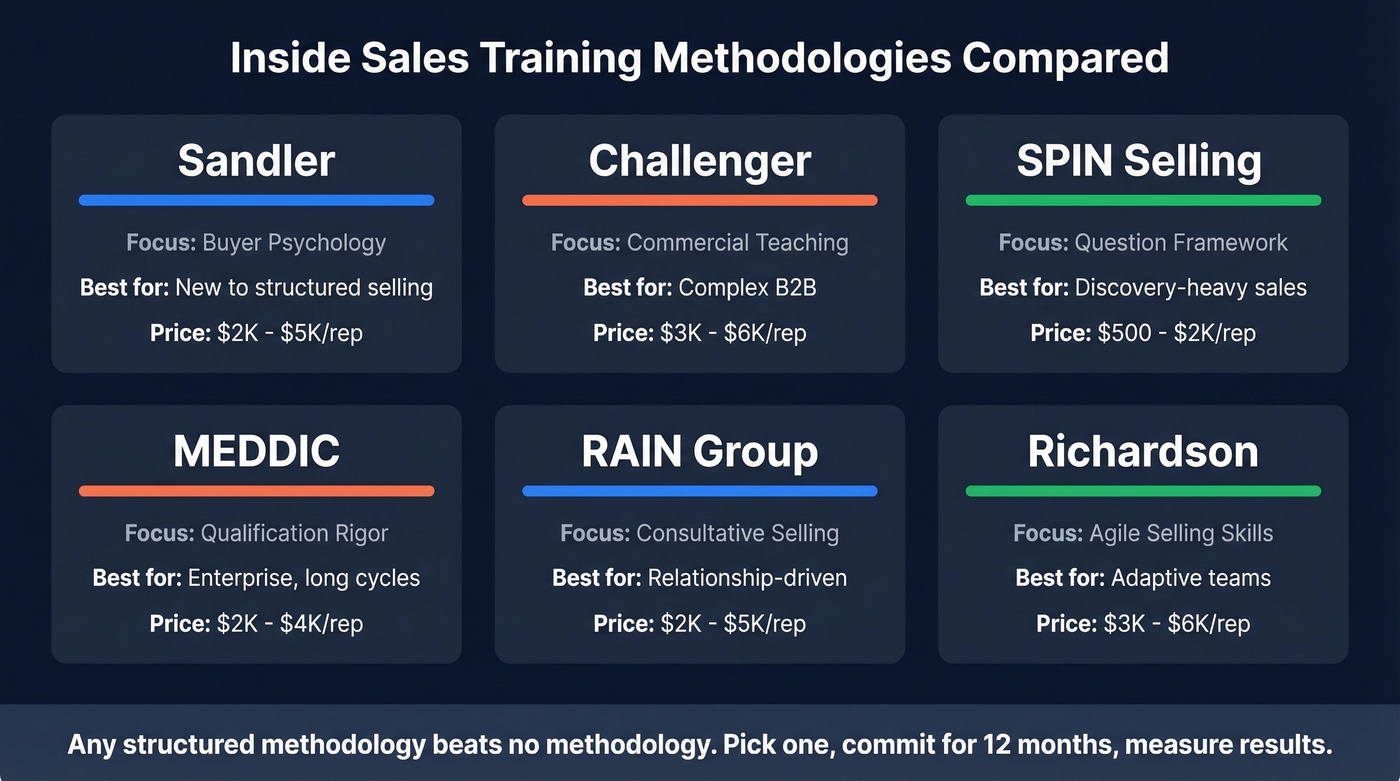
Picking a methodology feels high-stakes, but here's the truth: any structured methodology beats no methodology. The differences between them matter less than whether your managers actually reinforce the framework after the initial sessions.
| Methodology | Focus | Best For | Price Range |
|---|---|---|---|
| Sandler | Buyer psychology | New to structured selling | $2K-$5K/rep |
| Challenger | Commercial teaching | Complex B2B | $3K-$6K/rep |
| SPIN Selling | Question framework | Discovery-heavy sales | $500-$2K/rep |
| MEDDIC | Qualification rigor | Enterprise, long cycles | $2K-$4K/rep |
| RAIN Group | Consultative selling | Relationship-driven | $2K-$5K/rep |
| Richardson | Agile selling skills | Adaptive teams | $3K-$6K/rep |
For teams new to structured selling, start with Sandler or RAIN Group - both emphasize repeatable process and have strong coaching components. Scaling an enterprise motion? Challenger or MEDDIC give reps a framework for navigating complex buying committees. For teams that just need phone-specific skills fast, Factor 8 or SalesBuzz are narrower but get reps producing quickly.
The methodology wars are mostly marketing. Pick one that aligns with your sales motion, commit to it for 12 months, and measure the results. Switching methodologies every year is worse than picking the "wrong" one and sticking with it.

The best inside sales training falls flat when reps dial disconnected numbers and bounce emails. Prospeo gives your team 125M+ verified mobiles with a 30% pickup rate and 98% email accuracy - refreshed every 7 days. Your reps practice on real, reachable contacts from day one.
Stop training reps on dead data. Start with 75 free verified emails.
AI Coaching Tools and Costs
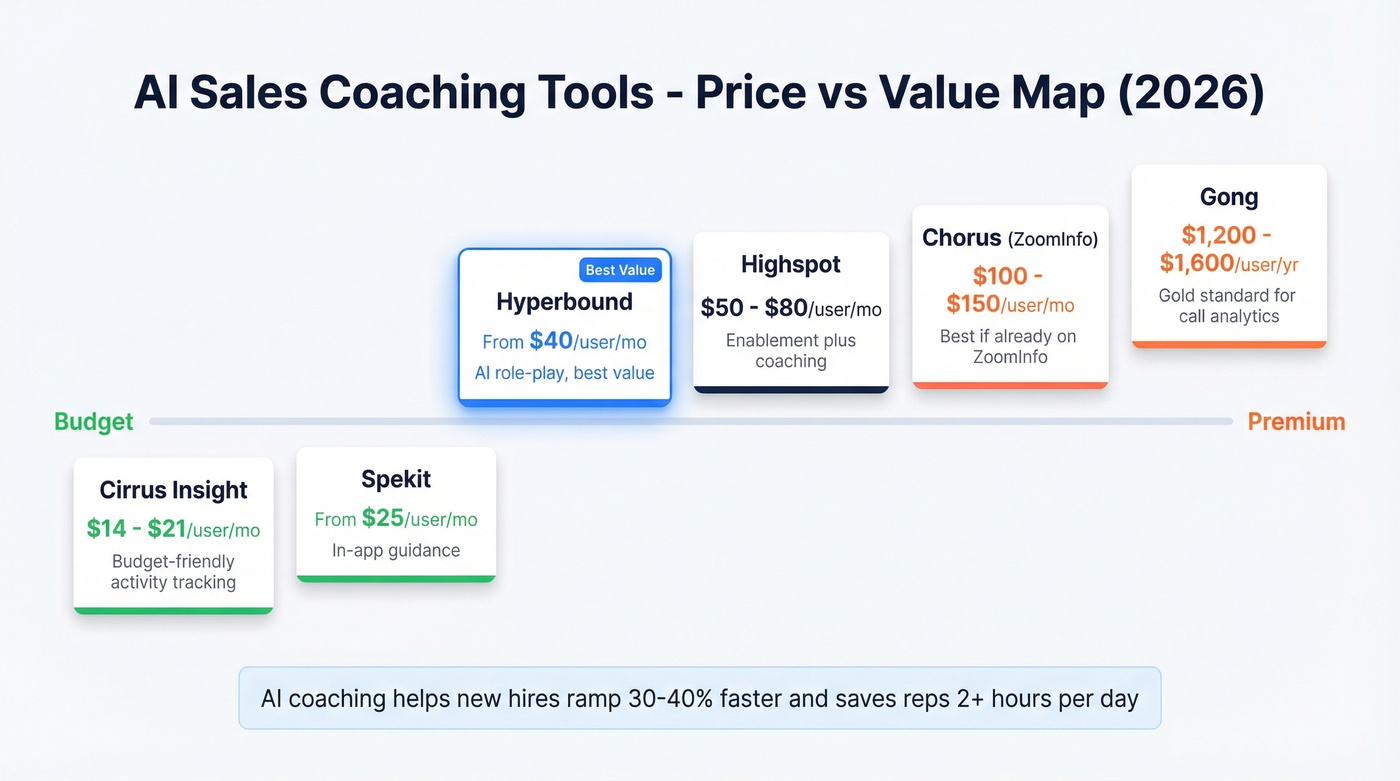
AI coaching has moved from novelty to necessity. The best tools analyze real calls, surface coaching moments, and let reps practice against AI-simulated buyers. Early data shows AI coaching can help new hires ramp 30-40% faster, and sales pros save 2+ hours per day by offloading manual tasks to AI - time that goes straight back into selling.
| Tool | Starting Price | Best For |
|---|---|---|
| Gong | ~$1,200-$1,600/user/yr | Gold standard for call analytics |
| Chorus (ZoomInfo) | ~$100-$150/user/mo | ZoomInfo customers |
| Highspot | ~$50-$80/user/mo | Enablement + coaching |
| Hyperbound | From ~$40/user/mo | AI role-play, best value |
| Spekit | From ~$25/user/mo | In-app guidance |
| Cirrus Insight | ~$14-$21/user/mo | Budget-friendly activity tracking |
Gong is the gold standard but expensive - at ~$1,200-$1,600/user/year, 20 seats runs $24K-$32K/year plus a platform fee. If you're already on ZoomInfo, Chorus is a natural fit. For pure AI role-play at a reasonable price, Hyperbound is the best value we've seen. If you're a startup watching every dollar, Cirrus Insight gives you basic activity intelligence for less than a team lunch.
The Lepaya report put it well: "AI works best as a scalpel, not a sledgehammer - automate busywork and protect the parts of selling only humans can do." Use AI to handle call scoring, surface coaching moments, and run practice simulations. Don't use it to replace the 1:1 coaching conversation between a manager and a rep. That human moment is where behavior actually changes.
How to Make Training Stick
Here's the stat that should terrify every sales leader who just wrote a six-figure check for training: without systematic reinforcement, 84% of what reps learn is lost within 90 days. Half of it's gone within five weeks.
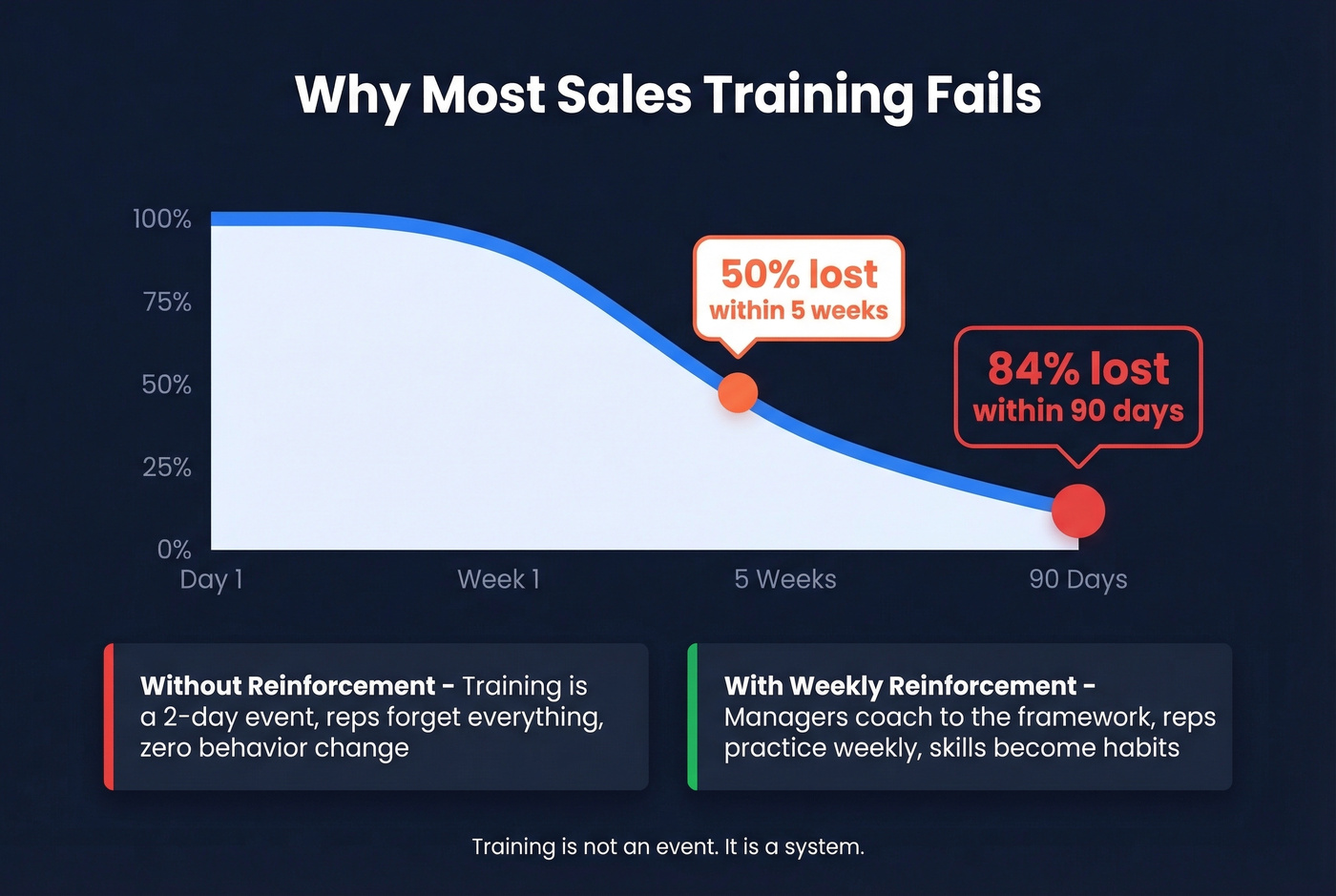
Training isn't an event. It's a process. The single biggest lever for making it stick is manager coaching - Wilson Learning found that training alone lifts performance 43%, but add consistent manager coaching and that number jumps to 67%. Yet only 26% of reps receive weekly coaching.
Five tactics that work:
- Weekly coaching - 30 minutes per rep, focused on one skill at a time. Weekly coaching is linked to 25% higher quota attainment.
- Call reviews - Score calls against whatever framework you trained on. Make the language consistent across the team.
- Peer role-play - Removes performance-review anxiety and increases repetitions. Scenario-based practice drives retention up to 70%.
- Structured onboarding - Companies with formal onboarding reduce ramp time by 34% and retain 50% more new hires.
- Microlearning - Five-minute refreshers on specific skills, delivered in the flow of work. This combats the decay curve without pulling reps off the phones.
One more thing worth considering: adapt delivery to your team's demographics. Gen Z reps respond better to short-form video and interactive simulations. Experienced reps want peer discussion and real scenario analysis, not beginner-level modules. A one-size-fits-all format guarantees you'll lose half the room.
Training Ideas That Go Beyond the Playbook
The best teams supplement structured programs with creative reinforcement. In our experience, these exercises keep skills sharp between formal sessions better than any LMS module:
Live call blitzes. Set a 60-minute window where the entire team prospects simultaneously, then debrief wins and losses together. The energy is contagious and the peer learning is immediate. One team we talked to runs these every Thursday at 2pm and credits them with a 15% lift in connect rates over two quarters.
Deal teardowns. Pick one closed-won and one closed-lost deal each week. Walk through the entire timeline as a team, identifying where specific skills made or broke the deal. This is where reps internalize the methodology - not in a classroom, but in the wreckage of a real deal they care about.
Competitive battlecard quizzes. Turn competitive intelligence into a quick-fire quiz during team standups. Reps who can articulate differentiation on the spot close more deals.
Reverse role-play. Have reps play the buyer while a manager or peer sells to them. Experiencing the buyer's perspective sharpens discovery and objection handling faster than any slide deck.
How to Measure Training ROI
Only 25% of sales organizations measure leading-indicator sales behaviors. The rest wait for revenue to move - which means they can't tell if training is working until it's too late to adjust.
Split your metrics into two categories:
Leading indicators (measure weekly):
- Executive meetings booked per rep
- Discovery question quality scored from call reviews
- Follow-up speed and consistency
- Call-to-meeting conversion rate
- CRM data hygiene scores
Lagging indicators (measure quarterly):
- Revenue per rep
- Win rate
- Sales cycle length
- Average deal size
- Quota attainment
- Rep retention rate
The most actionable metric is time-to-competence. If you can reduce ramp time by even 10%, that's weeks of earlier productivity from every new hire. Track it against a control cohort - reps who went through the old process versus the new one.
Common Mistakes That Kill ROI
Treating training as a one-time event. A two-day workshop without follow-up is a team-building exercise, not training. Build a 90-day reinforcement plan before you book the workshop.
Training reps but not managers. If managers can't coach the methodology, reps won't use it. Train managers first. Hold them accountable for weekly coaching sessions.
One-size-fits-all curriculum. A 10-year veteran and a new hire don't need the same program. Skip this mistake by assessing skill levels upfront and creating differentiated tracks.
Ignoring data quality. You just spent $2,020 per rep on training. Now they're dialing disconnected numbers and sending emails that bounce. Tools like Prospeo cost ~$0.01 per verified email. Compare that to the training investment and ask which has the faster payback.
Measuring satisfaction instead of behavior. "Did you enjoy the training?" isn't a useful metric. "Did your call-to-meeting conversion rate improve?" is. Define behavioral KPIs before training starts, then measure them at 30, 60, and 90 days.
You're investing $2,000+ per rep on training. Don't let bad data erase that ROI. Teams using Prospeo's verified contact data book 26% more meetings than ZoomInfo users - at $0.01 per email with no contracts. Clean pipeline data is the force multiplier your training program is missing.
Make every trained rep dangerous. Give them data that actually connects.
FAQ
How long does inside sales training take to show results?
Expect 4-6 weeks for reps to begin applying new skills consistently. Measurable KPI shifts - improved call-to-meeting rates, shorter cycles, higher win rates - typically appear within one quarter, but only if managers reinforce weekly. Without reinforcement, most gains evaporate within 90 days.
Is online sales training as effective as in-person?
Blended formats perform best. Combine self-paced modules for knowledge transfer with live sessions for practice and 1:1 coaching for reinforcement. Pure in-person isn't necessary, but pure on-demand rarely drives lasting behavior change on its own.
What's the biggest ROI lever in sales training?
Manager coaching. Training alone lifts performance 43%; add weekly manager coaching and it jumps to 67%. Yet three-quarters of reps don't receive weekly coaching. If you can only change one thing about your program, make it this.
How do you fix bad data undermining trained reps?
Layer a verified data source into your prospecting workflow before reps start dialing. Clean data turns trained skills into actual conversations - without it, even the best-trained rep is shouting into the void.