

Inside Sales vs Direct Sales: What's Actually Different?
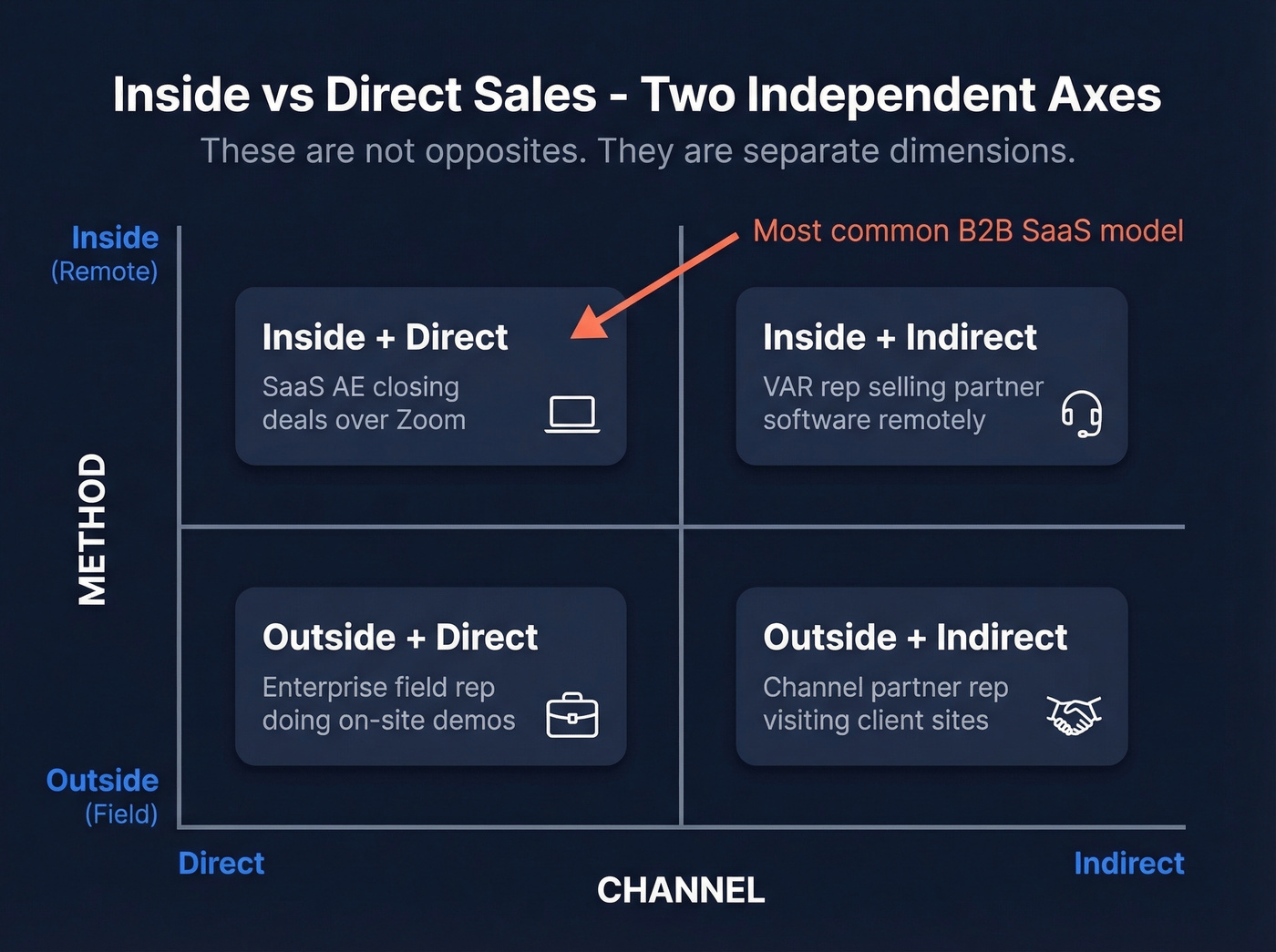
The sales industry constantly confuses two independent variables. Inside sales vs direct sales isn't a spectrum - it's two separate axes. Inside vs outside describes the method (remote or in-person). Direct vs indirect describes the channel (your own team or through partners and resellers). Conflating them leads to bad career decisions and worse go-to-market strategies.
The Quick Version
- Inside sales = selling remotely via phone, email, and video. It's a method, not a channel.
- Direct sales = selling to the buyer without intermediaries. It's a channel, not a method.
- Inside sales can be direct or indirect. Direct sales can happen inside or in the field. They're independent variables.
- For most B2B professionals weighing career paths, inside sales is the safer, more scalable bet.
What Is Inside Sales?
Inside sales means selling remotely - phone, email, video calls, sequencing tools. The rep never leaves the office (or the home office). Over 80% of B2B organizations now use inside sales as their primary strategy, and Gartner reports that 80% of B2B sales interactions happen digitally.
A typical inside sales rep makes 50-80 calls per day, runs multiple demos per week, and manages a pipeline entirely through a CRM. The cost structure is lean. Customer acquisition cost for SMB deals runs $200-$800, compared to $1,000-$5,000+ for field reps who need flights, hotels, and steak dinners. Those field costs are accelerating too - B2B customer acquisition costs have risen roughly 200% over the past eight to nine years.
Inside sales isn't inherently "direct." An inside rep at a SaaS company selling through their own pipeline? That's direct. An inside rep at a VAR selling someone else's product? That's indirect. Same method, different channel.
What Is Direct Sales?
"Direct sales" means at least three different things depending on who's talking. Let's break them apart.
B2B Direct Sales
In B2B, direct sales means the company's own team engages the buyer - no channel partners, resellers, or distributors in between. Most SaaS companies start with a direct sales motion before layering in channel. And that channel layer matters: B2B SaaS companies now derive 20%+ of revenue from channel sales, which is exactly why the direct-vs-indirect distinction deserves its own axis. The reps can work remotely or in the field; what makes it "direct" is the absence of intermediaries.
B2C Direct Selling
In the consumer world, direct sales is its own industry. Zendesk breaks it into three models: direct-to-consumer (DTC), single-level marketing, and multi-level marketing (MLM). Think Avon, Herbalife, Tupperware.
This is a $237 billion global market projected to reach $407.8 billion by 2033, with 102.9 million sellers worldwide. In the U.S. alone, 6.1 million direct sellers generated $36.7 billion - services (33.7%) and wellness (32.4%) dominate the category mix.
The MLM Reality Check
Most MLM participants earn less than $5,000 per year after expenses. If the comp plan rewards signing people up more than moving product, walk away. That's not sales - it's recruitment with extra steps.

Inside sales reps make 50-80 calls a day - but stale data turns those dials into dead ends. Prospeo delivers 98% email accuracy and 125M+ verified mobile numbers on a 7-day refresh cycle, so every touchpoint reaches a real buyer. When Snyk deployed it across 50 AEs, bounce rates dropped from 35% to under 5%.
Stop burning sequences on bad data. Start connecting.
Key Differences at a Glance
| Dimension | Inside Sales | Direct Sales |
|---|---|---|
| Definition | Remote selling via digital channels | Selling without intermediaries |
| Axis | Method (how you sell) | Channel (who sells) |
| Setting | Always remote | Varies (remote or field) |
| Channel | Direct or indirect | Always direct |
| Typical deal size | SMB to mid-market | SMB to enterprise ($5K-$500K+) |
| Sales cycle | Days to weeks | Weeks to months |
| Scalability | High (no travel) | Lower (relationship-heavy) |
| CAC | $200-$800 (SMB) | $1,000-$5,000+ |
| Core tools | CRM, sequencer, data | CRM, travel, demos |
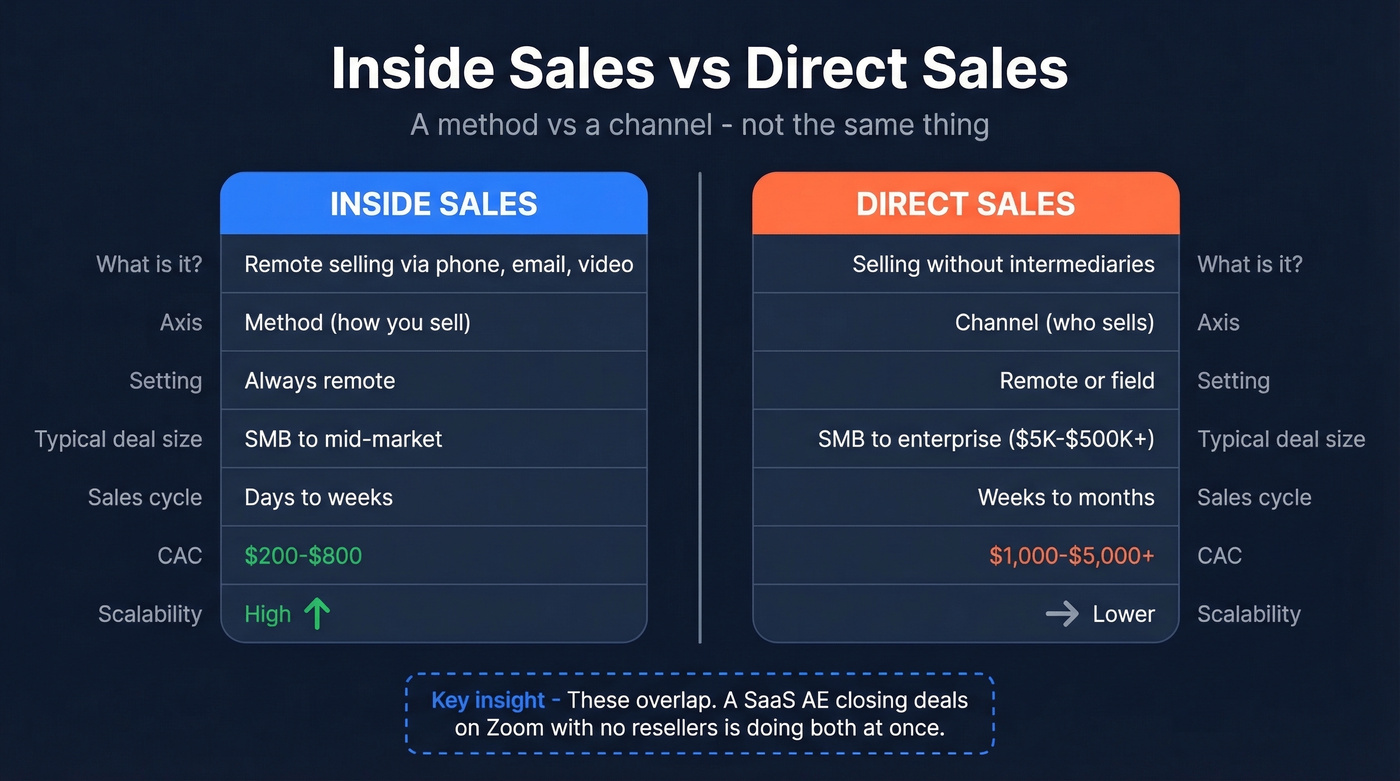
Here's what the table doesn't show: inside sales can be direct sales. A SaaS AE closing deals over Zoom without channel partners is doing both simultaneously. These axes are independent - you can occupy any quadrant of the matrix.
Compensation Breakdown
| Role | OTE Range |
|---|---|
| SDR/BDR (inside) | $70K-$100K |
| Inside Sales Rep | $90K-$110K |
| Mid-Market AE | $140K-$200K |
| Enterprise AE | $220K-$320K |
| Direct Sales (Glassdoor, mixed sample) | $153K median ($20K-$299K) |
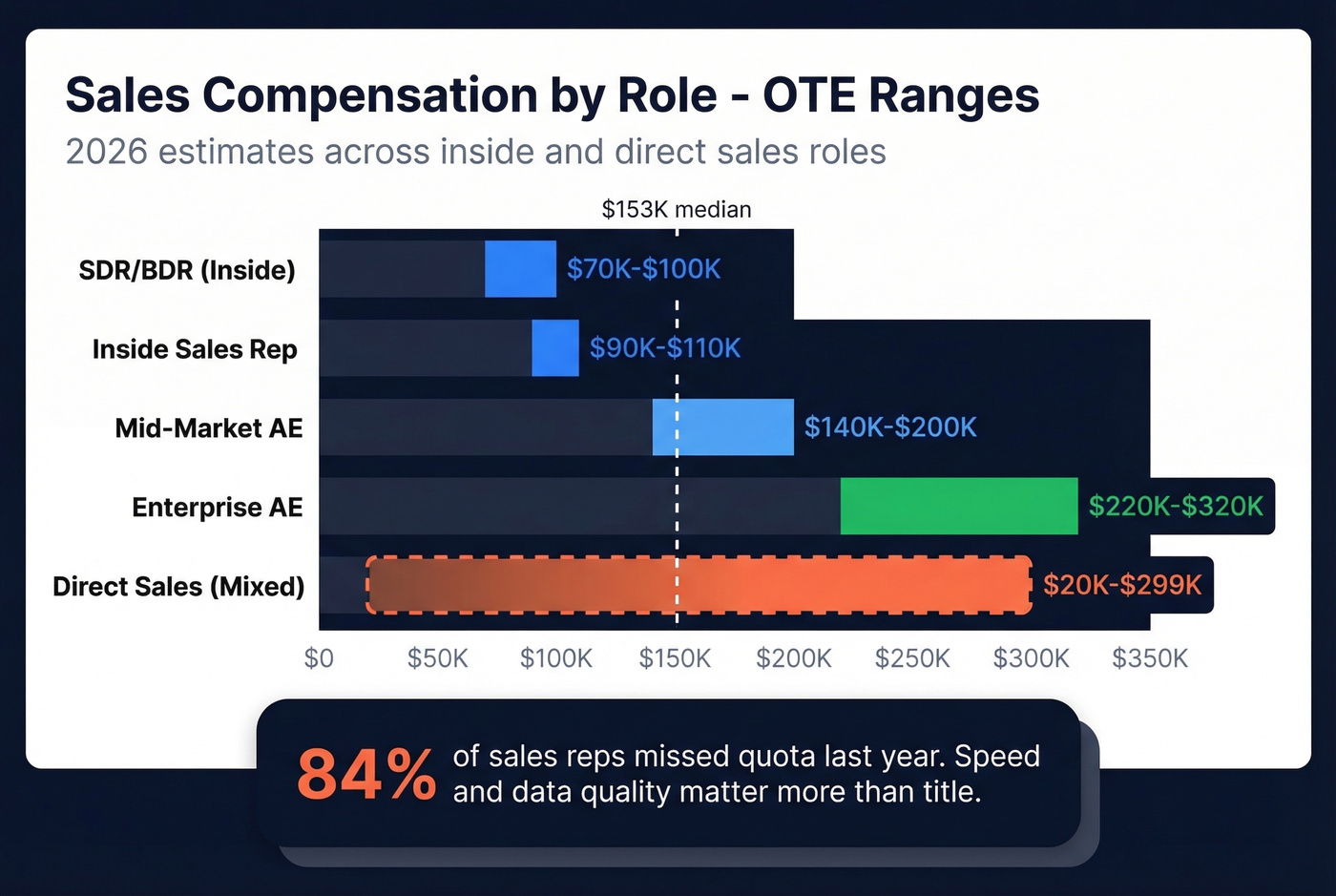
The Glassdoor figure blends B2B enterprise reps with MLM participants - treat it as directional, not definitive.
The inside sales ladder is well-defined: SDR to AE to enterprise, with clear OTE bands at each step. Direct sales compensation works differently. That $153K median masks enormous variance. B2B direct sales professionals at the top end earn $250K+, while MLM participants cluster near zero after expenses.
Here's the uncomfortable truth: 84% of sales reps missed quota last year. Deals closed within 50 days carry a 47% win rate; after that threshold, it drops to 20% or lower. Speed and pipeline quality determine earnings more than title or channel.
The Inside Sales Tech Stack
Inside sales runs on three layers: a CRM like Salesforce or HubSpot, a sales engagement platform for sequencing outreach like Outreach or Salesloft, and a prospecting/data layer for finding the right people.
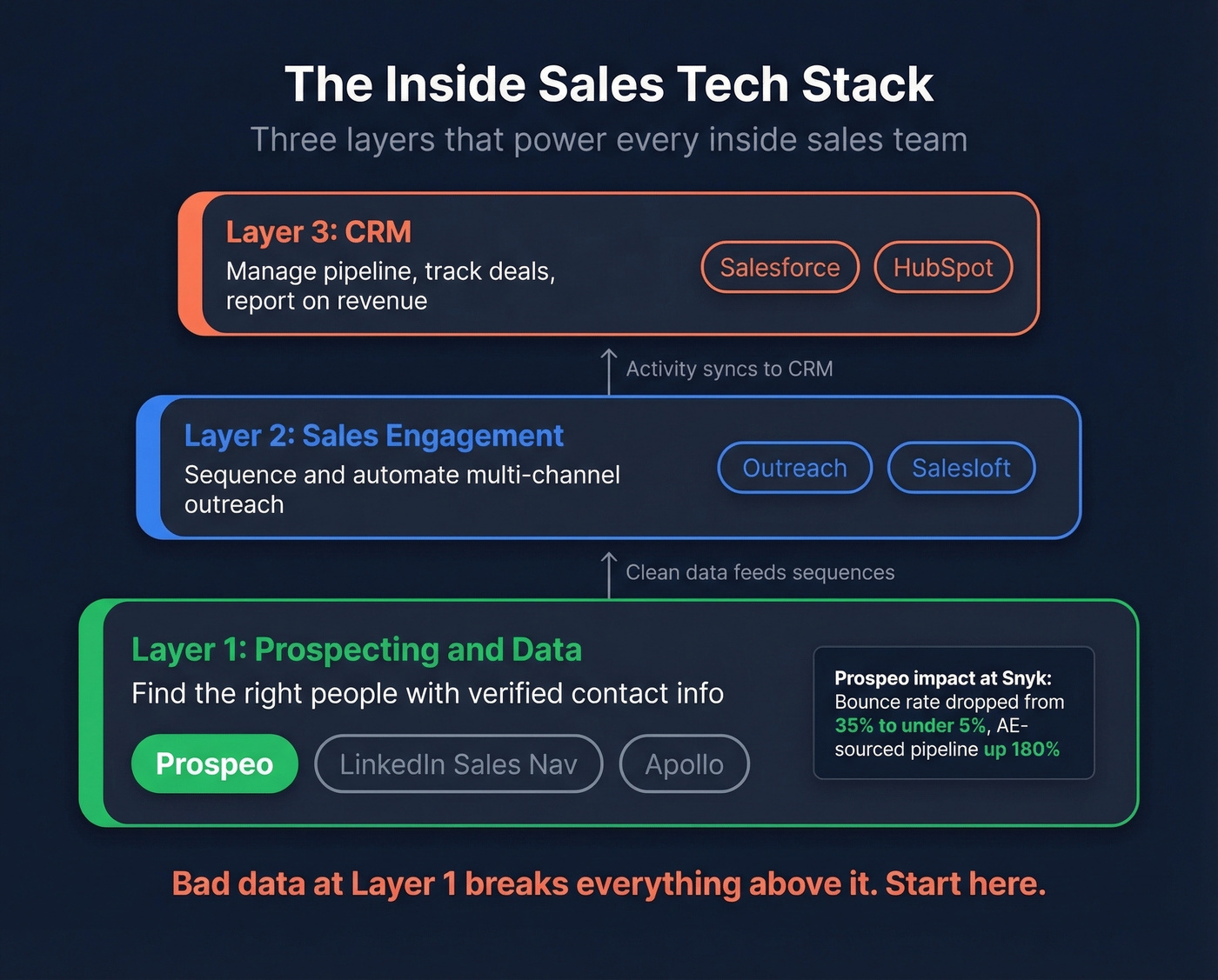
That data layer is the foundation. Bad contact data turns 50 calls into 50 wrong numbers and 100 emails into 100 bounces. We've seen teams burn through entire sequences before realizing their list was stale - weeks of effort, zero pipeline to show for it. Prospeo sits in this layer with 98% email accuracy, verified mobile numbers, and a 7-day refresh cycle. When Snyk rolled it out across 50 AEs, their bounce rate dropped from 35-40% to under 5%, and AE-sourced pipeline jumped 180%.
When to Choose Each Model
If your average contract value is under $15K, you almost certainly don't need a field sales motion. The math just doesn't work - a single field rep's travel budget can fund two inside reps who collectively close more revenue.
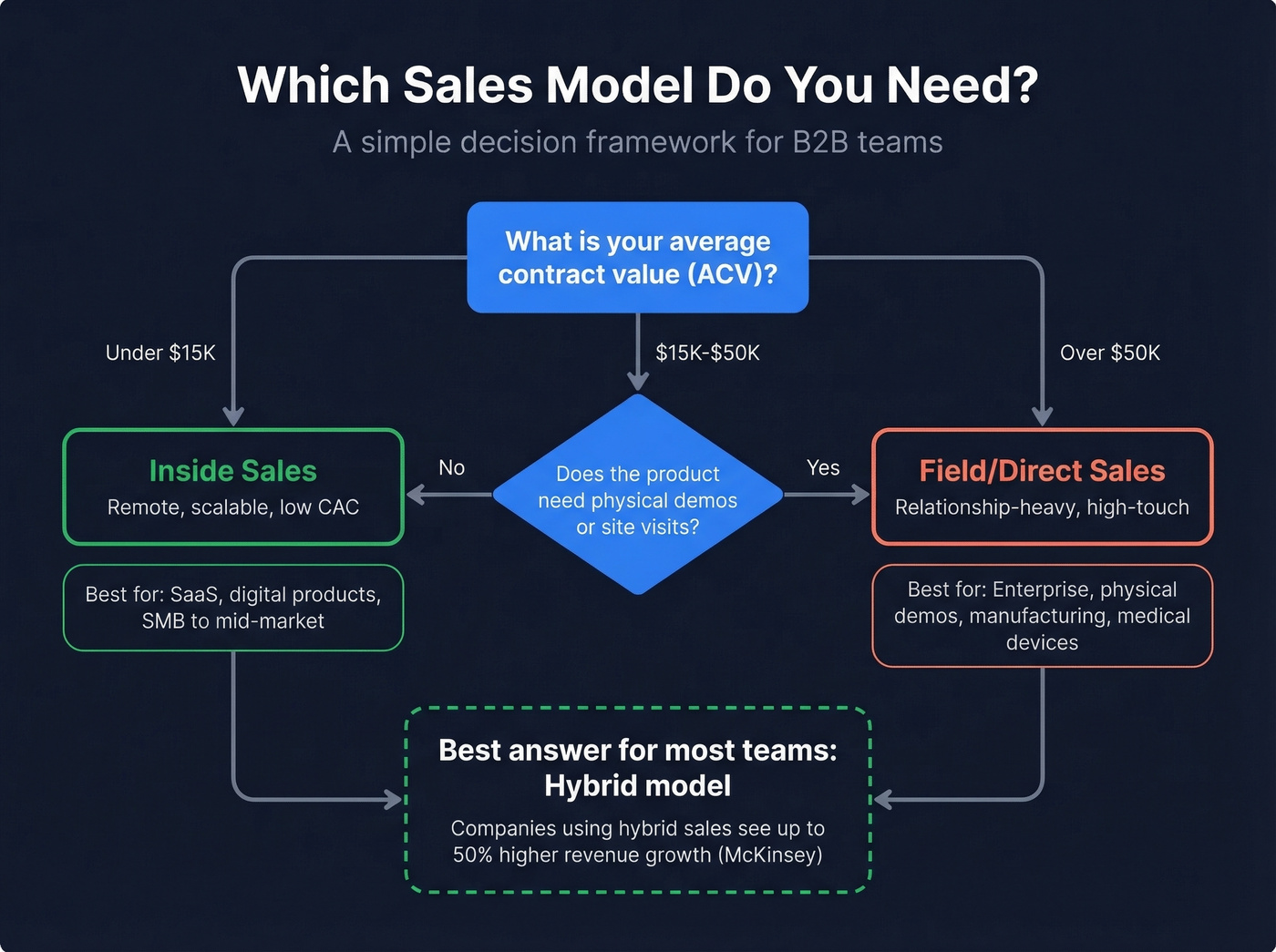
Inside sales makes sense for SaaS and digital products, SMB to mid-market deal sizes, and any team that needs to scale rep output without scaling travel budgets. Buyers now use 10 interaction channels on average, up from 5 in 2016, and most of those channels are digital.
Direct or field sales earns its keep when products require physical demos or site visits, enterprise ACV exceeds $50K, or the industry is relationship-driven - manufacturing, medical devices, construction. Skip the field motion if your product is self-serve or your deal size can't absorb the travel overhead.
Most companies end up hybrid. McKinsey found that companies using hybrid sales models see up to 50% higher revenue growth than single-channel organizations. One poster on r/sales captured the reality well: they hold an "Outside Sales" title at a $1B+ precision manufacturing company but travel twice a month and run mostly virtual calls. In our experience working with sales teams across industries, the labels are increasingly meaningless - what matters is matching the motion to the deal.
Whether you run inside sales, direct sales, or both - your CAC depends on data quality. At $0.01 per email, Prospeo costs 90% less than ZoomInfo while delivering higher accuracy. Teams using Prospeo book 26% more meetings and cut list-building from hours to minutes.
Cut your CAC without cutting your pipeline. That's the trade-off that isn't one.
FAQ
Is direct sales the same as outside sales?
No. Direct vs indirect describes the channel - company-to-buyer versus through resellers. Inside vs outside describes the method - remote vs in-person. A direct sales rep can work entirely from a laptop; an outside rep can sell through channel partners. They're independent axes.
Can you do direct sales remotely?
Yes, and most B2B direct sales reps already do. Gartner reports 80% of B2B interactions happen digitally. Remote direct selling is simply inside sales through a direct channel, and it's the dominant model for SaaS companies with deal sizes under $50K.
What tools do inside sales reps need?
At minimum: a CRM like Salesforce or HubSpot, a sequencing platform like Outreach or Salesloft, and a prospecting tool with verified contact data. That data layer is where most teams either win or waste money - stale emails and wrong numbers kill pipeline before it starts.