

Intent Based Marketing: What Works, What Doesn't, and What It Actually Costs
Up to 70% of the B2B buyer journey happens where you can't see it. Buyers run an average of 12 online searches before they ever visit a specific brand's website. They're reading competitor reviews, downloading whitepapers, lurking in communities - and you have zero visibility until they fill out a form. That invisible research is the dark funnel, and intent based marketing exists to surface it.
The B2B buyer intent data market sits at roughly $4.5B in 2026, growing at 15.9% CAGR. The industry believes in this approach. The problem? Most teams buy an intent tool, get a dashboard full of "surging" accounts, and still can't book a meeting.
The Short Version
Intent data works - but only when you act within 48 hours, reach the right person (not just the account), and pair signals with verified contact data. Enterprise tools like Bombora, 6sense, and Demandbase typically cost $25K-$300K+/year. Self-serve alternatives exist for teams under that threshold. Start with your own first-party signals for free, then layer third-party intent from a platform that bundles intent topics with verified emails and direct dials.
What Is Intent Based Marketing?
Intent based marketing uses behavioral signals - what people research, read, download, and engage with - to identify accounts and individuals actively considering a purchase. Instead of spraying outbound at a static ICP list, you focus demand generation resources on the companies already in-market for what you sell.
The signals break into three categories. Understanding the differences matters more than most guides admit.
| Type | How It Works | Pros | Cons | Cost |
|---|---|---|---|---|
| First-party | Your site, content, events | Highest accuracy | Limited scale | Free |
| Third-party | Co-op/bidstream data | Broad reach | Noisier, delayed | $7K-$150K+/yr |
| Derived | AI-aggregated signals | Contextual depth | Newer, less proven | Varies |
First-party intent is what happens on your own properties - page visits, content downloads, webinar attendance, pricing page views. It's the most reliable signal you have, and it costs nothing beyond the analytics tools you already run.
Third-party intent comes from data cooperatives like Bombora, which operates a co-op of roughly 5,000 B2B sites, bidstream-sourced platforms like Demandbase spanning around 3M sites, and review platforms like G2. These signals tell you which companies are researching topics related to your solution, even if they've never visited your site. The tradeoff: they're noisier, often delayed 7-14 days, and most third-party intent is account-level rather than contact-level.
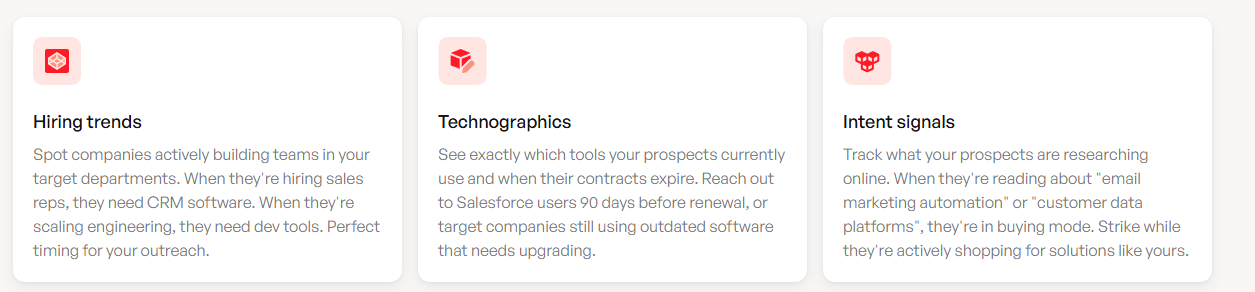
Derived intent is the newest category - AI models that aggregate signals across forums, job postings, tech stack changes, and public conversations to infer buying readiness. Promising, but less battle-tested.
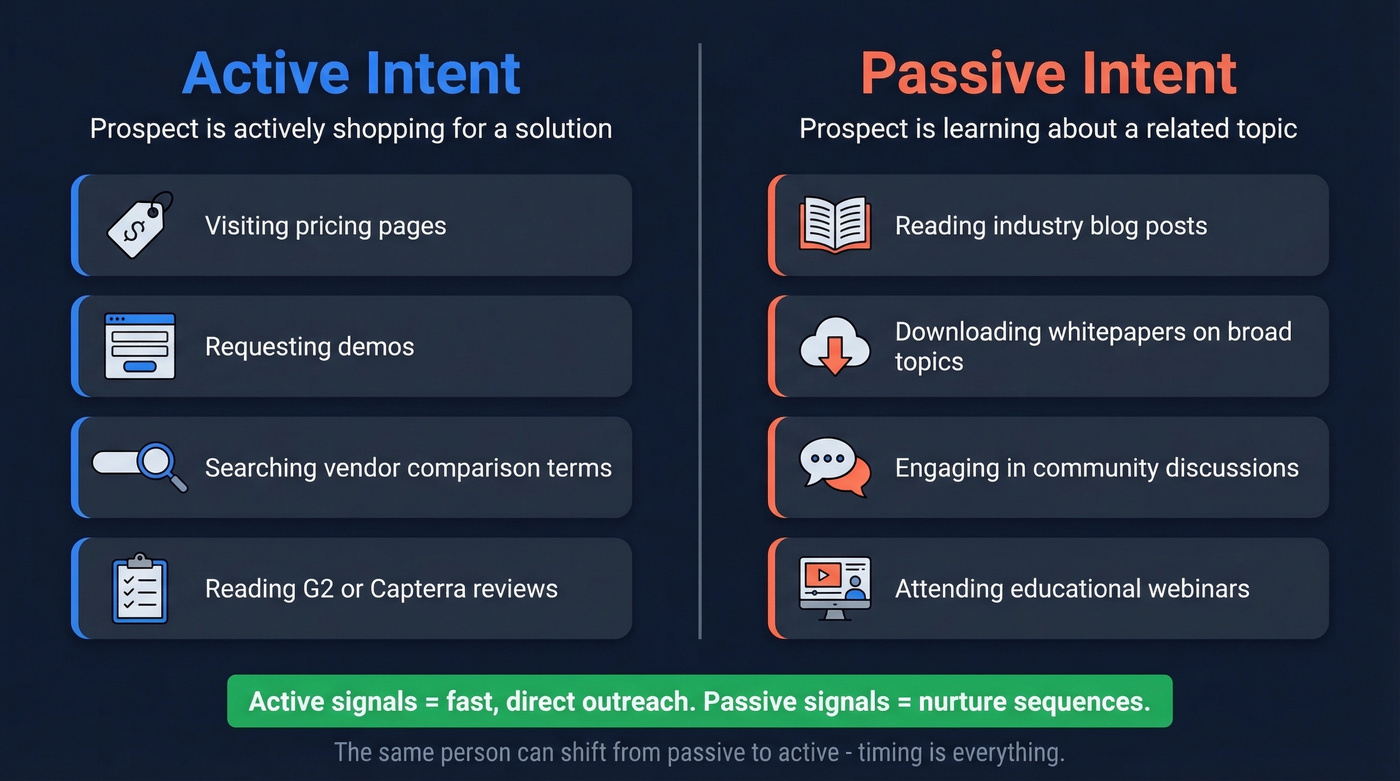
One distinction most guides skip: active vs. passive intent. Active intent means the prospect is directly searching for solutions - visiting pricing pages, requesting demos, comparing vendors by name. Passive intent means they're consuming content around a related topic without explicitly shopping. A VP reading three articles about "email deliverability best practices" shows passive intent. That same VP searching "email deliverability tool pricing" shows active intent. Active signals deserve faster, more direct outreach. Passive signals belong in nurture sequences.
Here's the caveat that matters most: browsing isn't buying. A junior analyst researching "ABM platforms" for a blog post generates the same third-party intent signal as a VP evaluating vendors for a $200K purchase. The signal tells you something is happening. It doesn't tell you what.
Does It Actually Work?
The headline stats are impressive. Industry roundups cite 93% conversion rate improvements and 220% higher click-through rates for intent-powered campaigns. Only about 25% of companies use intent data tools - though 99% of large corporations use it in some form - which means early adopters at the mid-market level still have a real edge.
But there's a gap between the stats and the field reports.
One practitioner on r/LeadGeneration with 15+ years in marketing and sales engineering tested multiple intent suppliers - 6sense, ZoomInfo, Bombora - and described being "mostly disappointed with the quality of data," wanting "more context and coherence" than vendor dashboards provided. After building an in-house approach, they reported monthly closed deal value jumping from $200K to nearly $600K in 30 days. That's a single self-reported data point, but the frustration is representative.
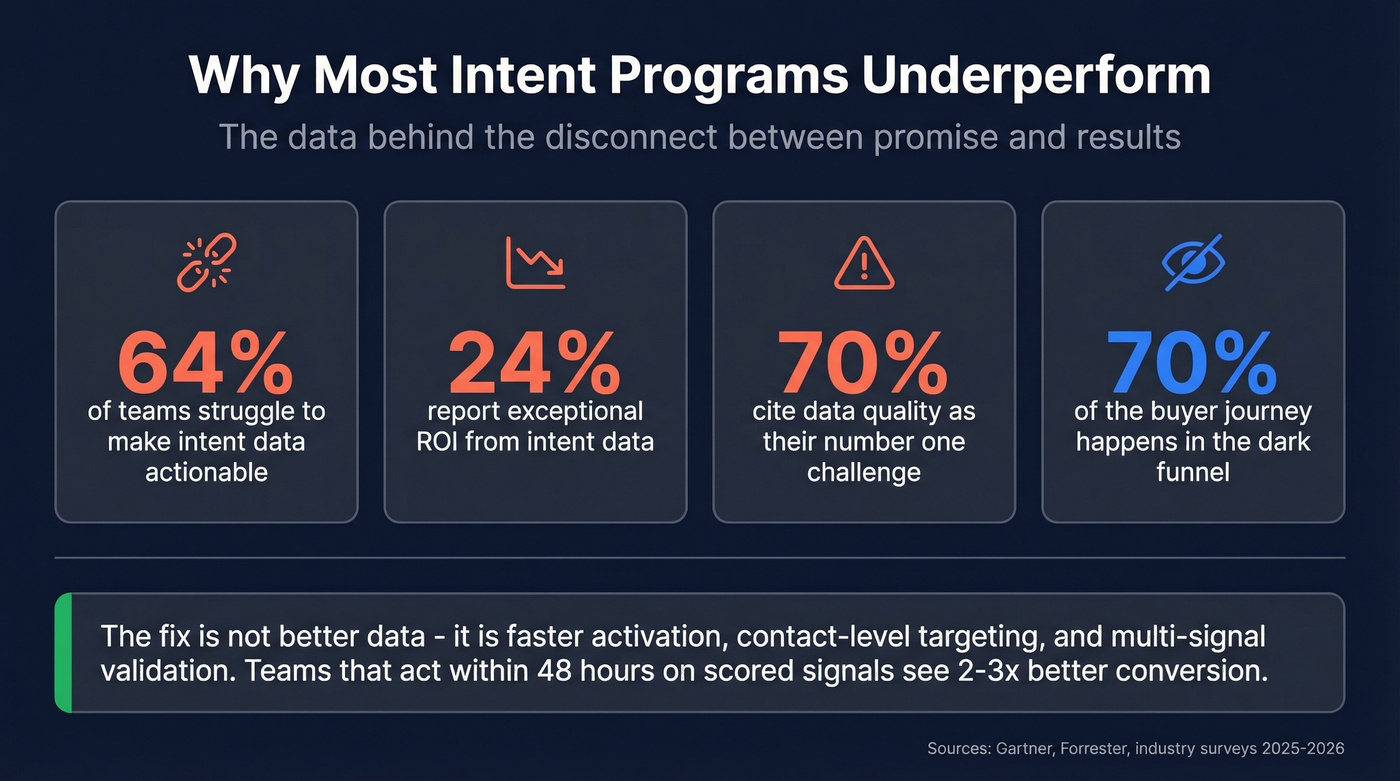
The numbers back up the disconnect: 64% of teams struggle to make intent data actionable. Only 24% report exceptional ROI. And 70% cite data quality as their number-one challenge.
Let's be honest: intent data doesn't fail because the data is bad. It fails because teams treat it like a magic list instead of a timing signal. When you hand a rep a list of "high-intent accounts" and say "go call these," you've skipped every step that makes intent useful. You haven't validated the signal, identified the right contact, or crafted messaging that reflects where the buyer actually is in their journey.
The teams that win with intent driven marketing use it to prioritize and time their outreach, not to replace their prospecting strategy. That distinction is everything.
The Activation Playbook
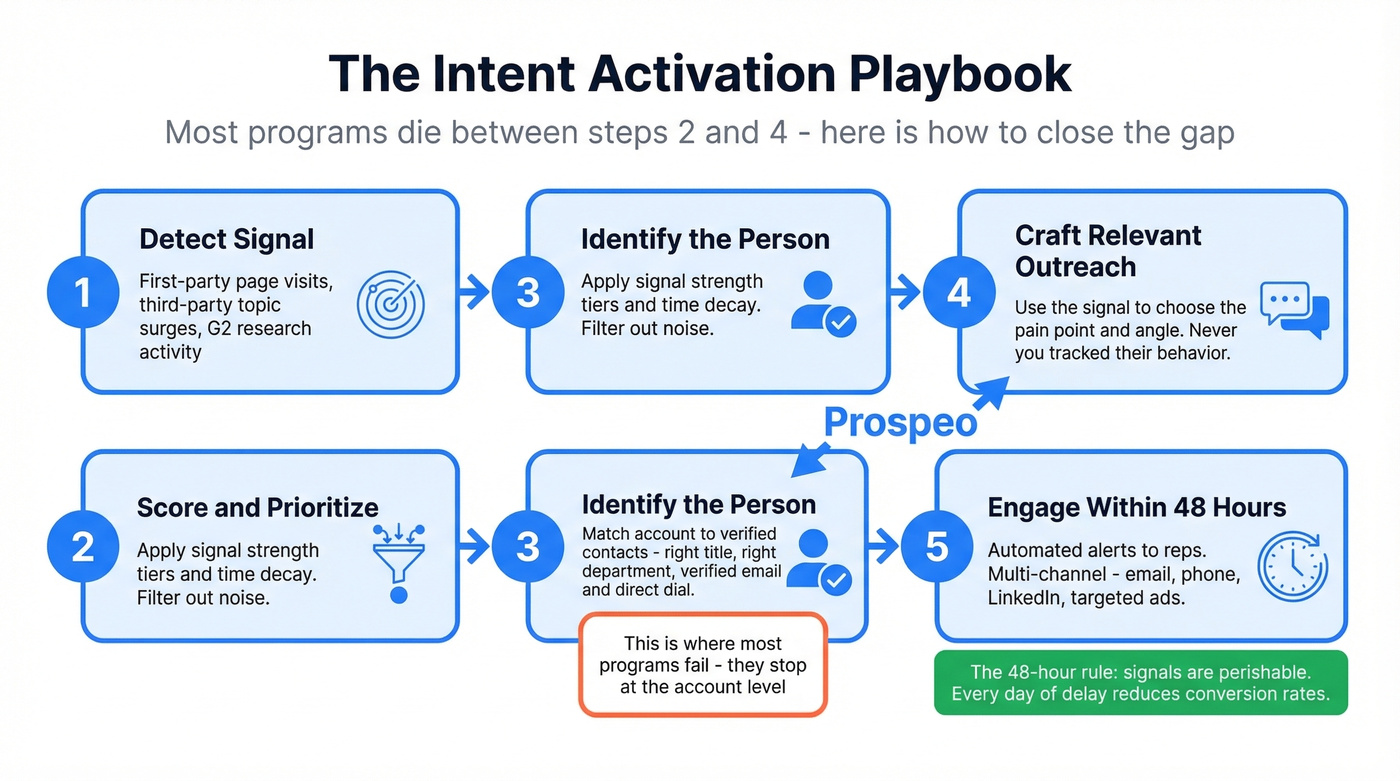
Knowing which accounts are in-market is step one. Getting a meeting is step five. Most intent programs die somewhere between steps two and four.
Build a Signal Scoring Model
Not all intent signals carry equal weight. A pricing page visit from a director-level contact at a target account is worth ten times more than a generic topic surge from an unknown company.
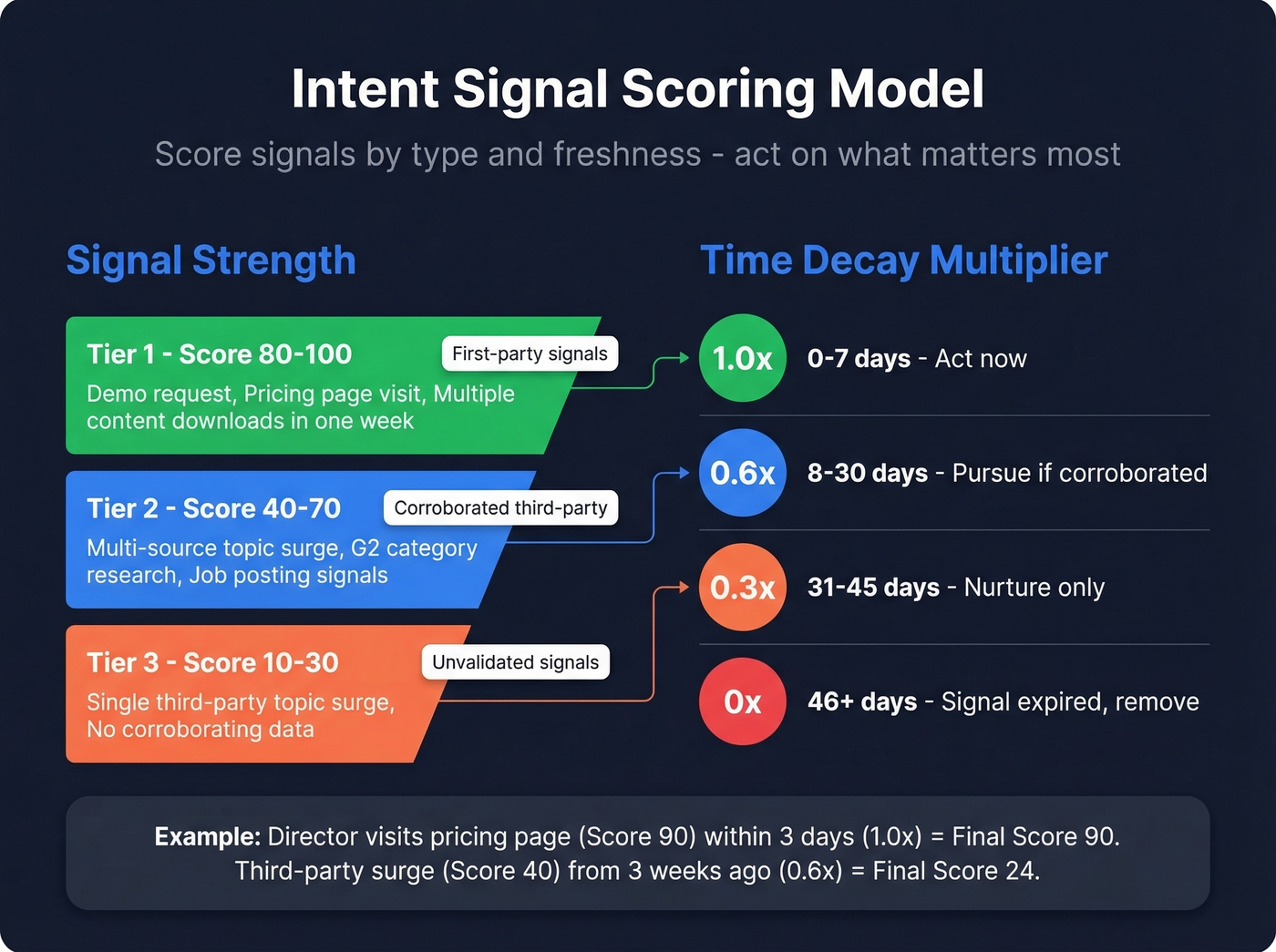
Tier your signals by strength. First-party signals like demo requests, pricing page visits, and multiple content downloads in a week sit at the top. Third-party topic surges from multiple sources rank in the middle. A single third-party signal with no corroborating data goes to the bottom.
Then apply time decay - signals lose value fast:
- 0-7 days: High priority. Act immediately.
- 8-30 days: Moderate. Worth pursuing if corroborated.
- 31-45 days: Cooling. Nurture only.
- 46+ days: Expired. Remove from active lists.
Weight your scoring model accordingly. A first-party pricing page visit within the last 3 days might score 90. A third-party topic surge from 3 weeks ago scores 25. The specific numbers matter less than the hierarchy - just make sure your team agrees on what "high intent" actually means before you start routing leads.
One warning: layering too many data sources without proper weighting creates signal dilution, where noise drowns out the signals that actually matter.
Act Within 48 Hours
This rule isn't negotiable. Intent signals are perishable. A company researching "sales engagement platforms" this week might sign a contract with your competitor next week.
We've watched teams build elaborate scoring models and routing workflows that add 5-7 days of latency before a rep even sees the signal. By then, it's noise.
Set up automated alerts - Slack notifications, CRM tasks, whatever your team actually checks - that fire within hours of a high-priority signal. Gartner research shows effective personalization can increase purchase likelihood by 12%, but missing the mark can decrease it by up to 15%. Reaching the right person with the right message is the whole game. Reaching the wrong person at the right company is almost as bad as reaching nobody.
One tactic worth stealing from the account-based marketing playbook: contact-level advertising. Instead of just waiting for intent signals, run targeted ads to known buying committee members at high-intent accounts. This generates first-party engagement data you can act on immediately, turning passive third-party signals into active first-party ones.
Bridge the Activation Gap
This is where most intent programs break down. Your intent platform tells you which accounts are in-market. It doesn't tell you who to call, and it definitely doesn't give you a verified email or direct dial.
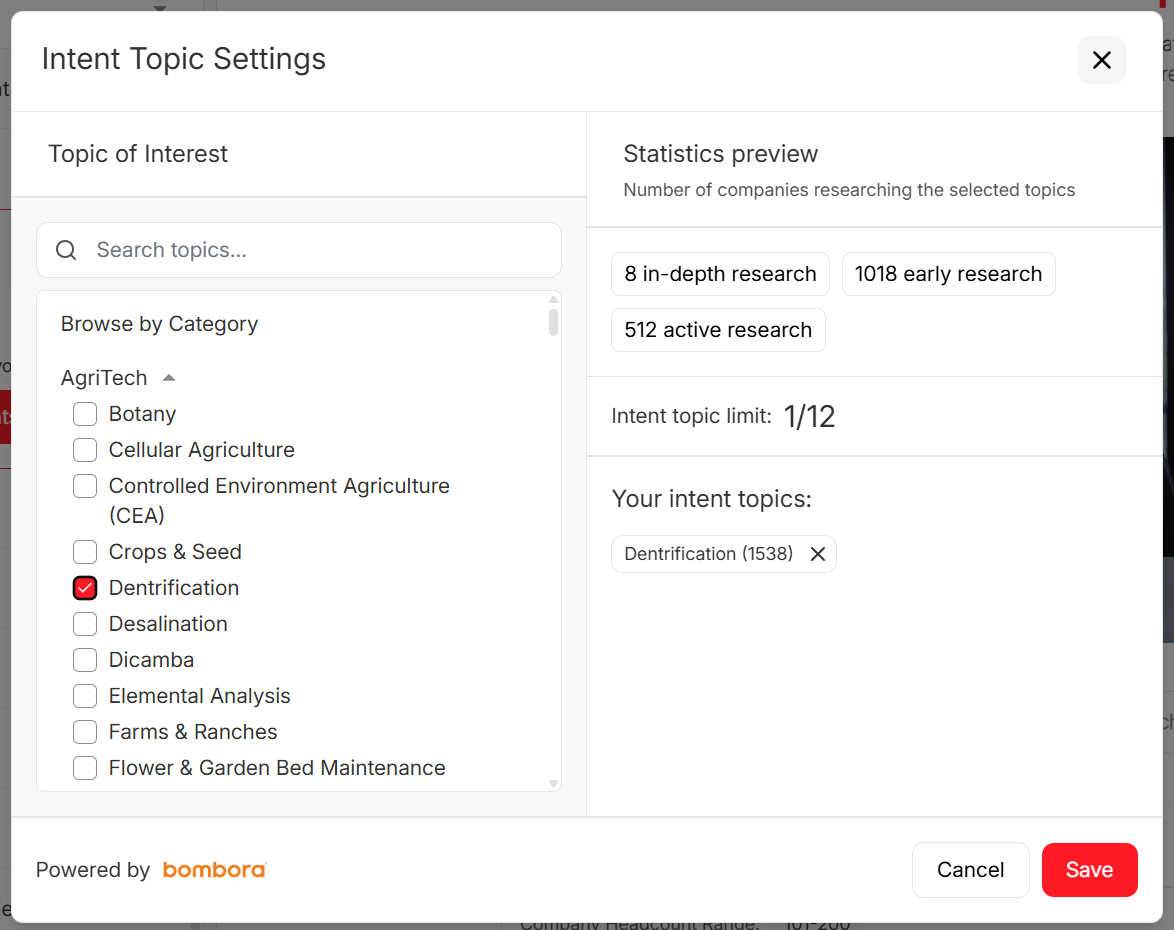
That gap between "this company is surging on your topic" and "here's the VP of Marketing's verified mobile number" is where deals die. You need to close it fast - filter by intent topic, layer on job title and company size, and export verified contacts ready for outreach. No separate enrichment step, no waiting for a data team to append contacts. Prospeo handles this in a single workflow: 15,000 intent topics powered by Bombora, 98% email accuracy, 7-day data refresh, self-serve from day one.
What does this look like in practice? When Snyk's 50 AEs paired intent signals with verified contact data and fast activation, their bounce rates dropped from 35-40% to under 5%, AE-sourced pipeline jumped 180%, and they generated over 200 new opportunities per month. That's the difference between knowing an account is in-market and actually reaching the right person there.
Don't Be Creepy
Never reference the intent signal in your outreach. "I noticed your company has been researching sales engagement platforms" sounds like surveillance, not helpfulness. DemandZen's guidance on this is spot-on: use intent signals to choose the pain point and message, not to reveal that you're tracking their browsing behavior.
62% of buyers expect marketing programs to adapt based on their actions and behavior. They want relevance - they don't want to feel watched. If a company is surging on "email deliverability," lead with a message about deliverability challenges and how you solve them. The signal informed your angle. The prospect never needs to know it exists.

Intent signals expire fast - you just read why 48 hours matters. Prospeo tracks 15,000 Bombora intent topics and pairs surging accounts with 98% accurate emails and 125M+ verified mobile numbers. No more "high-intent account" lists with no way to reach the buyer.
Turn intent surges into conversations before the signal decays.
Why Most Intent Programs Fail
Five failure modes account for the vast majority of intent disappointments.
1. False positives. Reps contact "high-intent" accounts and get confusion or disinterest. The account was surging because an intern was researching a blog post, not because the buying committee was evaluating vendors. ISP masking and VPN usage make this worse by undermining geolocation-based signals. Fix this with multi-signal validation - don't act on a single surge. Require corroborating signals like a topic surge plus a job posting plus a tech stack change before routing to sales.
2. Account-level haystack. You know the company but not the person. A 10,000-person enterprise might have 50 people who could be your buyer. Reaching the wrong one wastes the signal entirely. Map the buying committee: identify 3-5 stakeholders per account and multi-thread your outreach across all of them.
3. Slow activation. In our experience, this kills more intent programs than bad data ever will. Marketing qualifies the account, sends it to an SDR manager, who assigns it to a rep, who adds it to next week's call block. A week passes. The signal is cold. The prospect signed with a competitor on Tuesday. Enforce a 48-hour SLA with automated alerts. If a high-priority signal isn't acted on within two business days, it escalates.
4. No sales-marketing alignment. Marketing buys the tool, builds the dashboards, and sends "intent-qualified" accounts to sales. Sales ignores the dashboard because they don't trust the data and nobody explained what the scores mean.
Here's what this actually looks like: marketing celebrates a 40% increase in "intent-qualified accounts." Sales reports zero pipeline impact. Both teams blame each other. The fix is a shared scoring model built jointly, with agreed-upon SLAs for follow-up and feedback loops on signal quality. If sales says the signals are garbage, marketing needs to hear that and adjust - not defend the dashboard.
5. Pricing shock and vendor sameness. A $35K license becomes $40K-$44K after implementation, topic configuration, CRM integration, and training. And as one Reddit thread bluntly put it, "every vendor reports the same keyword surges" - which raises the question of whether you're paying $50K for a signal your competitor is getting from the same data co-op. Another user joked they'd get "better leads reading tarot cards." Budget 15-25% above the license fee for year-one costs, and seriously consider self-serve alternatives before signing an enterprise contract.
What Intent Tools Cost in 2026
The pricing opacity in this market is absurd. One agency owner on r/ABM captured it perfectly - frustrated that none of the options provide pricing info, and that you have to "sit through every demo just to hear we have to spend $20K."
Here's what the tools actually cost.
| Tool | Annual Cost | Model | What You Get |
|---|---|---|---|
| Bombora | $25K-$80K | Annual contract | Co-op intent, 14,000+ topics |
| 6sense | $35K-$150K+ | Annual contract | Predictive AI + intent |
| Demandbase | $18K-$300K+ | Tiered annual | ABM + bidstream intent, up to 575K+ topics |
| ZoomInfo | $7.2K-$36K | Annual contract | Bundled contact + intent |
| G2 Intent | $10K-$87K+ | Add-on | Review-site signals |
| Databar | From $39/mo | Consumption | API-first, waterfall |
| Prospeo | Free tier; ~$0.01/email | Self-serve, no contract | Intent + verified emails & mobiles |
Budget 15-25% above the license fee for implementation, CRM integration, topic configuration, and training. A $35K tool becomes a $40K-$44K year-one investment. 6sense implementations typically take 3-6 months before you see value. Demandbase onboarding alone runs around $29K. Note that Demandbase's $18K entry point is the Basic tier - the full ABM+intent product starts significantly higher.
HG Insights acquired TrustRadius in June 2025, continuing the consolidation trend in intent data. Review-site intent signals like TrustRadius buyer activity are increasingly bundled into larger platforms - fewer standalone options, more vendor lock-in.
Skip the six-figure platform if your average deal size is under $15K. Start with first-party signals and a self-serve tool that pairs intent with verified contacts. Save the enterprise contract for when you've proven the workflow.
In-House vs. Vendor
The interest in building intent capabilities internally is real. On r/b2bmarketing, practitioners are exploring how to track job changes, engagement signals, buying intent, and competitor monitoring without committing to a $35K+ vendor contract.
Build in-house if you have data engineering resources and want to control signal definitions without vendor lock-in. The signals - job changes, tech stack shifts, funding rounds, content engagement, competitor mentions - are increasingly available through APIs and public data.
Go with a vendor if you don't want to solve the refresh problem yourself. A signal that's two weeks stale is worse than no signal at all, and most teams underestimate the maintenance burden.
The practical framework: start with first-party signals. They're free, they're the most accurate, and they force you to build the operational muscle - scoring, routing, activation - before you spend money. Once you've proven the workflow works with first-party data, layer in third-party intent to expand your reach. Don't buy a $50K tool before you've proven you can act on the signals you already have.
Intent Data and Paid Channels
Intent data doesn't just power outbound sales - it transforms how you allocate paid media budgets. Using behavioral signals to inform which accounts see your ads, which keywords you bid on, and how aggressively you retarget is where intent driven digital marketing shines.
Instead of broad audience targeting, you concentrate spend on accounts already showing research activity around your solution category. The result is higher click-through rates, lower cost per acquisition, and ad budgets that reinforce signals your sales team is already acting on.
Privacy and Compliance in 2026
Google didn't deprecate third-party cookies in Chrome - the Privacy Sandbox initiative is effectively dead. But tracking isn't getting easier. The regulatory focus has shifted to profiling, automated decision-making, and using behavioral data to infer sensitive characteristics. That's exactly what intent data does.
Over 20 US states now have privacy statutes affecting tracking, targeted advertising, and data sharing. You need a CMP (Consent Management Platform) with region-specific notices - opt-in for EU, opt-out for most US states - and you need auditable consent records. "We had a banner" doesn't cut it anymore. Honor Global Privacy Control signals where required by law, and make sure opt-out actually stops tracking. Regulators are auditing this.
GDPR scrutiny on profiling is intensifying. If you're targeting EMEA accounts with behavioral inference, get legal review. The "don't be creepy" principle from the activation section isn't just etiquette - it's increasingly a compliance requirement.
Most intent tools cost $25K-$300K/year and still give you account-level data with no contact info. Prospeo bundles buyer intent across 15,000 topics with verified direct dials and emails at $0.01/lead - 90% cheaper than enterprise alternatives.
Stop paying six figures for signals you can't act on.
FAQ
What is intent-based marketing?
It's a strategy that uses behavioral signals - search activity, content consumption, review site visits, and topic research - to identify accounts actively in-market for a solution. Rather than relying on static lists alone, you prioritize outreach toward buyers already researching problems you solve, improving both timing and relevance.
Does it actually deliver ROI?
Yes, when paired with fast activation under 48 hours, verified contact data, and multi-signal validation. Industry benchmarks cite 93% conversion improvement. Teams that treat intent as a timing signal - not a magic list - see the strongest returns. The 24% who report exceptional ROI all share one trait: operational discipline.
What's the minimum budget?
Free if you start with first-party signals like website behavior and content engagement. Third-party intent starts at $39/month with consumption-based tools like Databar, or free via self-serve platforms that include intent topics alongside verified contact data.
How quickly do intent signals expire?
High-priority signals from the last 0-7 days demand immediate action. After 30 days, signals are cooling and should shift to nurture workflows. Beyond 45 days, treat them as expired. The 48-hour activation rule applies to the strongest signals - that's when your odds of a meaningful conversation are highest.
Should I prioritize account-level or contact-level data?
Contact-level, without question. Account-level tells you which company is researching but not who to reach. Missing the right person can decrease purchase likelihood by 15%. Map the buying committee and multi-thread outreach across 3-5 stakeholders per account.