

Is Cold Email Dead? Not If You Fix the Right Problem
Your SDR rewrites the sequence for the third time this quarter. Open rates look fine. Reply rates keep sliding, and nobody's asking the obvious question: why is the bounce rate sitting at 11%?
Is cold email dead? Not even close. Your data is.
What You Need (Quick Version)
Cold email works in 2026 - the average reply rate is 3.43%, and top performers hit 10.7%+. The bottleneck isn't your copy; it's your data and sending infrastructure. Fix your bounce rate first, then worry about subject lines.
What the 2026 Data Says
Two major datasets tell the same story - Instantly's analysis of billions of cold email interactions and Mailshake's survey of 508 outbound sales professionals.
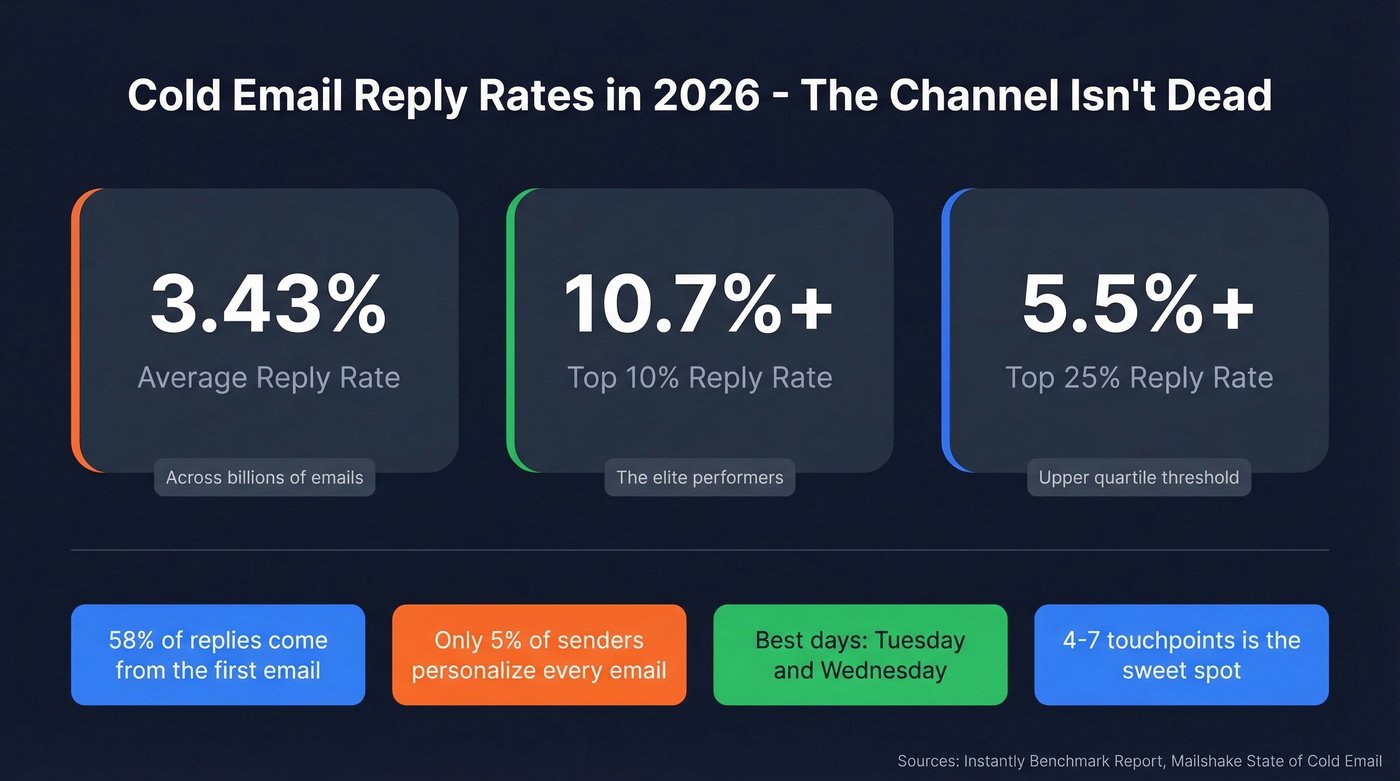
| Metric | Number | Source |
|---|---|---|
| Avg reply rate | 3.43% | Instantly |
| Top 10% reply rate | 10.7%+ | Instantly |
| Top 25% reply rate | 5.5%+ | Instantly |
| Survey avg reply rate | 1-4% | Mailshake |
| Replies from first email | 58% | Instantly |
| Senders who personalize every email | 5% | Mailshake |
| Best-performing send days | Tuesday-Wednesday | Instantly |
| Optimal sequence length | 4-7 touchpoints | Instantly |
A 3.43% average reply rate across billions of interactions isn't a dead channel. It's a channel where most people are doing it badly. Only 5% of senders personalize every email, and those who do see 2-3x better results. The gap between average and elite is enormous, and it's almost entirely execution - not channel viability.
What Actually Changed in 2026
The rules shifted hard, and most outbound teams still haven't caught up. These aren't cosmetic changes. They're structural.
- Authentication is mandatory. Gmail and Yahoo now require SPF, DKIM, and DMARC for bulk senders. Miss any and your emails get rejected - Gmail returns specific error codes (e.g., 4.7.27) telling you exactly what's wrong.
- Spam complaints have a hard ceiling. Stay under 0.3% complaint rate or face throttling. Gmail recommends below 0.10%.
- One-click unsubscribe within 2 days is required via List-Unsubscribe header and RFC 8058.
- CAN-SPAM applies to B2B. No exemption. Penalties run up to $53,088 per email.
- AI-written emails are fine - until they're detected. 67% of decision-makers don't mind if GenAI wrote the email. But 47% of B2B professionals say they're less likely to reply if they detect it's AI-written. The problem isn't using AI. It's using it badly enough that people notice.

Your bounce rate is the reason cold email feels broken. Prospeo's 5-step verification - with catch-all handling, spam-trap removal, and honeypot filtering - delivers 98% email accuracy on a 7-day refresh cycle. Meritt dropped bounces from 35% to under 4% and tripled their pipeline.
Stop blaming the channel. Fix the list for $0.01 per email.
The Real Reason Outreach Feels Broken
Here's the thing: practitioners on r/coldemail aren't complaining about open rates or subject lines. They're complaining about bounces, contacts who left the company six months ago, and results that swing wildly week to week despite relevant copy. One practitioner documented their open rates crashing from 45-50% to 19% after Google's filter changes - then recovering only after overhauling their sender reputation and deliverability setup. Nearly half of senders don't even track bounce rates.
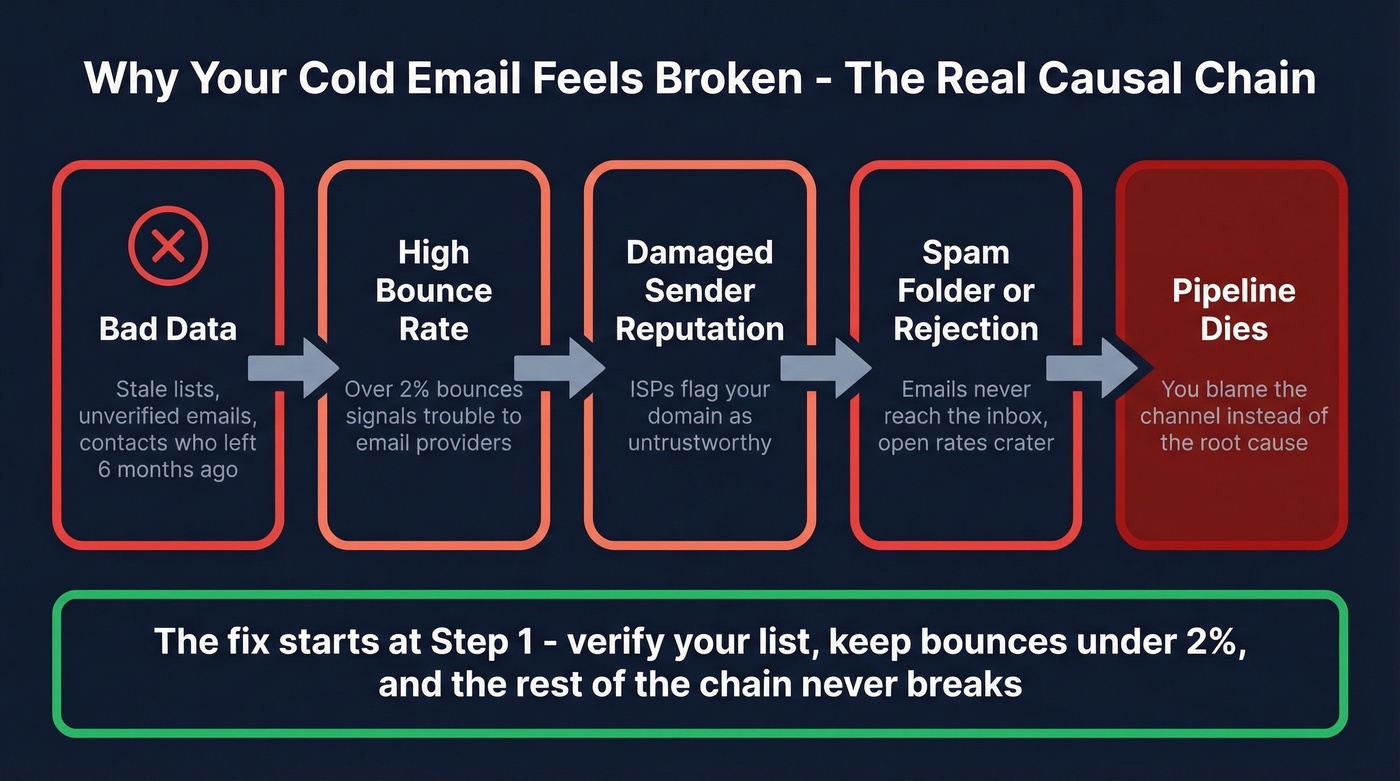
The causal chain is straightforward. Bad data produces bounces. High bounce rates damage sender reputation. Spam complaints pile on. Once your domain reputation is cooked, deliverability drops and outreach grinds to a halt - at least from that domain.
The real problem was the list you loaded on day one.
We've seen this pattern across dozens of outbound campaigns. Prospeo's 5-step email verification - including catch-all handling, spam-trap removal, and honeypot filtering - delivers 98% email accuracy with data refreshed every 7 days versus the 6-week industry average. That means you're not emailing people who changed jobs last month. Meritt, for example, saw bounce rates drop from 35% to under 4% after switching, and their pipeline tripled.

The 2026 Infrastructure Playbook
Let's be honest: if your deal sizes are above $5k and you're not running cold outreach in 2026, you're leaving the cheapest pipeline channel on the table. The teams who declare the channel dead are the ones sending 200 emails a day from one Gmail account with a purchased list from 2024.
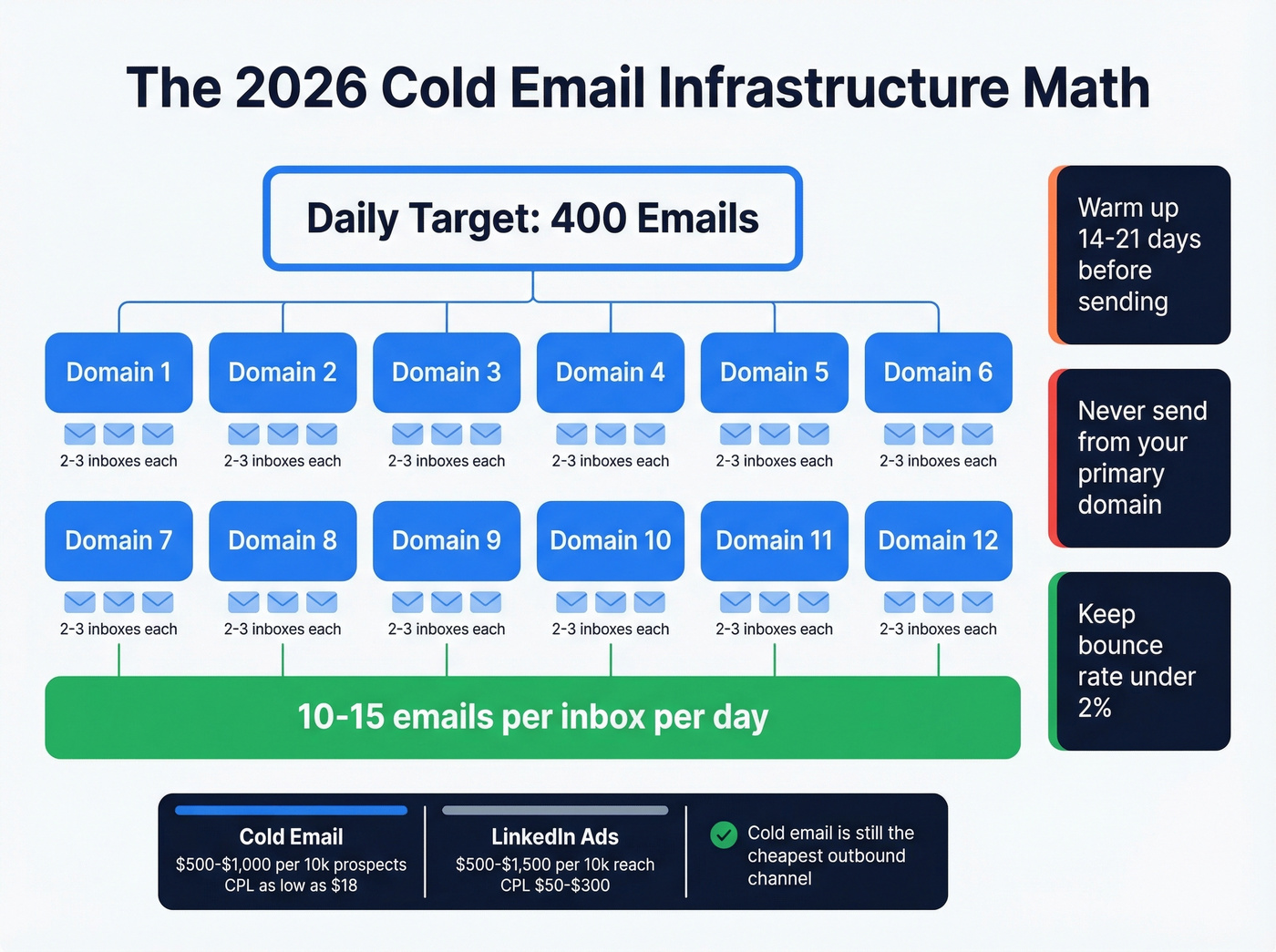
The domain and inbox math for horizontal sending distributes volume across many domains to protect sender reputation. Run 2-3 inboxes per domain, 10-15 emails per day per inbox. To send 400 emails daily, you need roughly 10-12 dedicated domains. Warm each for 14-21 days before scaling cold volume. Never send from your primary business domain.
One Reddit practitioner on r/Entrepreneur documented their entire recovery: reply rates went from 3% to 6% over 62 days. They expanded from 3 domains to 7, capped each at 26 emails/day, and dropped their bounce rate from 11% to under 2%. They cut email length from 141 words to under 56. Total stack cost: ~$420/month. The result was 16 qualified leads per month from email alone. Another practitioner reported 11 booked calls in 5 weeks and 2 closed deals using a similar infrastructure-first approach.
For context, cold email runs $500-$1,000 to reach 10,000 prospects. LinkedIn Ads cost $500-$1,500 for the same reach, and LinkedIn CPLs often land in the $50-$300 range in B2B. In Woodpecker's example math, cost per lead can be as low as ~$18. Cold email isn't just alive - it's still one of the cheapest outbound channels available.
What to Do Right Now
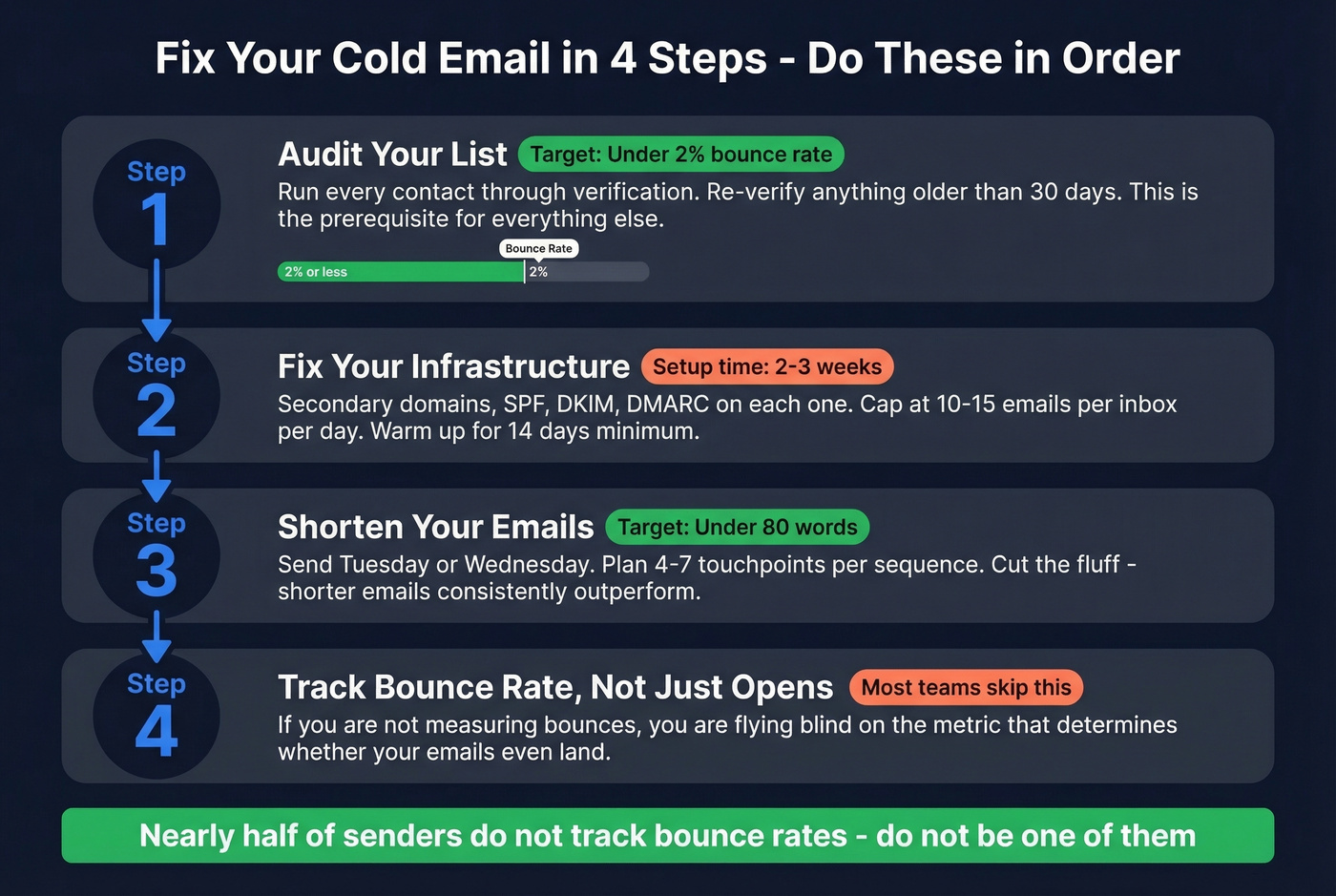
- Audit your list. Run it through a verification tool and get your bounce rate below 2%. That's the prerequisite for stable deliverability. Any list older than 30 days should be re-verified.
- Fix your infrastructure. Set up secondary domains, configure SPF/DKIM/DMARC on every one, cap volume at 10-15 emails per inbox per day, and warm up for at least 14 days.
- Shorten your emails. Under 80 words. The best-performing campaigns all share this trait. Send Tuesday-Wednesday, and plan for 4-7 touchpoints per B2B cold email sequence.
- Track bounce rate, not just open rate. If you aren't measuring bounces, you're flying blind on the metric that actually determines whether your emails land.
You just mapped out the infrastructure playbook - domains, warm-up, volume caps. None of it matters if 11% of your list bounces on day one. Prospeo refreshes 300M+ profiles every 7 days, not every 6 weeks. That's why teams using Prospeo keep bounce rates under 4% at scale.
Start with clean data. 75 free verified emails, no contract required.
So, Is Cold Email Dead or Not?
No. People who claim the channel is finished are confusing a broken process with a broken medium. A channel generating a 3.43% average reply rate - with top performers tripling that - isn't dead. It's punishing laziness harder than it used to. Fix your data, fix your infrastructure, and cold email remains one of the highest-ROI outbound channels in 2026.
FAQ
What's a good reply rate in 2026?
The average across billions of interactions is 3.43%. Top 10% of campaigns hit 10.7%+, and anything above 5.5% puts you in the top quartile. If you're below 1%, audit your data quality and sending infrastructure before rewriting a single word of copy.
How many domains do I need for outbound email?
Plan for 2-3 inboxes per domain at 10-15 sends per day per inbox. To send 400 emails daily, you need roughly 10-12 dedicated domains. Warm each for 14-21 days before scaling volume. Never use your primary business domain for cold outreach.
How do I fix a high bounce rate?
Start with your data source. If your provider doesn't verify emails in real time, switch to one that does - Prospeo's 5-step verification and 7-day refresh cycle keeps bounce rates under 3% for teams like Stack Optimize, who maintain 94%+ deliverability across all clients. Remove role-based addresses (info@, sales@) and re-verify any list older than 30 days.