

Jordan Belfort Sales Pitch: The Straight Line System in 2026
You watched Wolf of Wall Street, went looking for the Jordan Belfort sales pitch, and found a dozen YouTube clips of him selling pens at conferences. Entertaining, sure. But not useful. Every clip shows what he does without breaking down why it works into steps you can actually repeat on Monday morning. This is the structured breakdown that replaces reading Way of the Wolf.
The "Real" Stratton Oakmont Script
That viral "actual Stratton Oakmont sales script" floating around the internet? It's not the closing pitch. A Hacker News thread breaks this down well - what people share as the legendary script is actually a canvassing and qualification call. Entry-level callers used it to book interest, then a closer delivered the real pitch later.
It's the same SDR-to-AE handoff every B2B sales team runs today. Stratton Oakmont didn't invent cold calling - they just codified a boiler-room version of a process that already existed.
The Straight Line System Explained
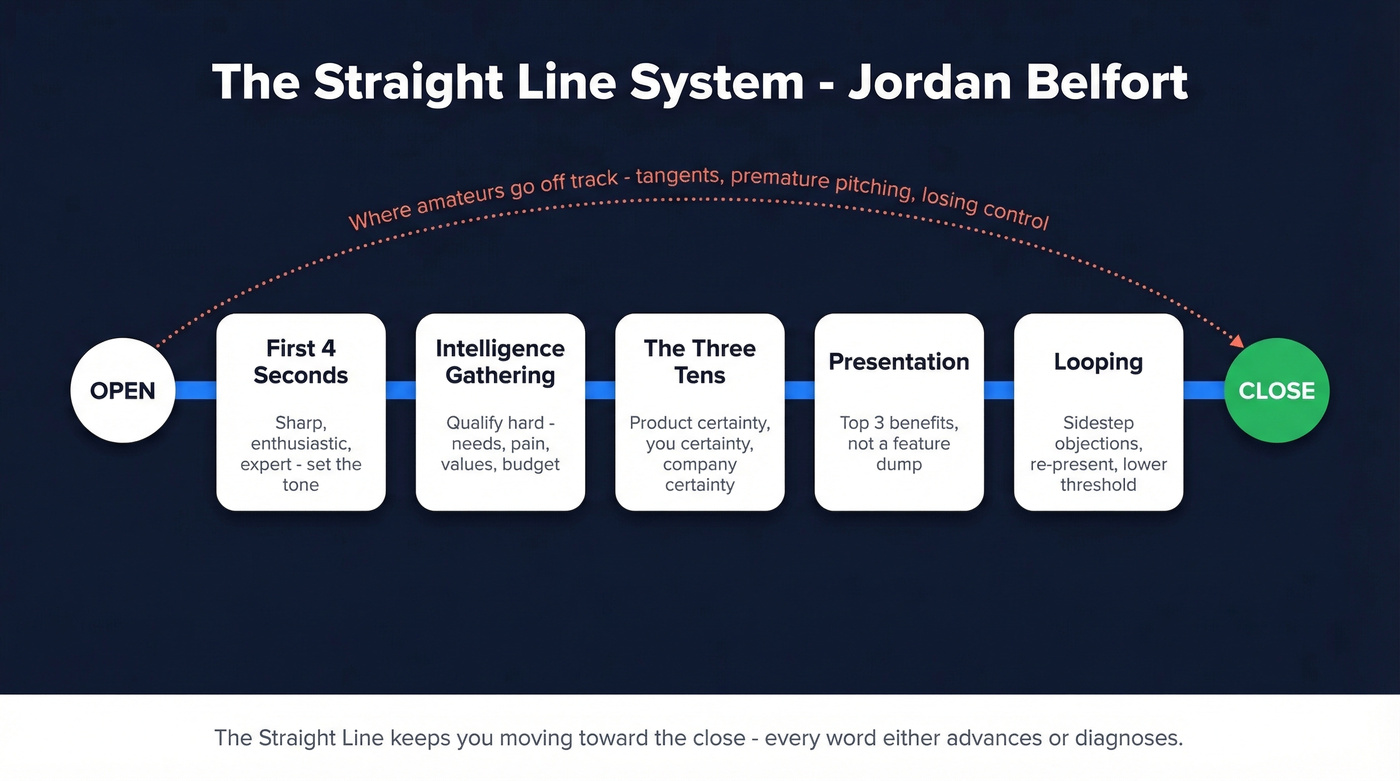
Belfort's methodology isn't a script. It's a system of scripting, tonality, and objection handling designed so you never run out of intelligent things to say - and so you can diagnose exactly where deals stall.
The First Four Seconds
You have four seconds to establish control. That's it. Belfort's triad: project that you're sharp as a tack, enthusiastic as hell, and an expert in your field. This isn't about what you say - it's tone, cadence, and body language. He also teaches state management before the call, anchoring your own certainty, clarity, confidence, and courage. That's NLP territory, but the first-impression piece is pure sales mechanics.
Here's what we've done with our own team: model your top performers' greetings and standardize them. Record the first ten seconds of your best rep's calls, then have everyone else mirror the pacing and energy. The difference shows up in connect-to-conversation rates within a week.
Intelligence Gathering
This is where most reps skip ahead and lose. Belfort's question categories move from least invasive to most: needs, core beliefs, past experiences, values, financial standards, pain points, financial availability. The rule is simple - don't present to unqualified prospects. If they're not a fit, stop pitching.
The modern bottleneck, though, isn't the pitch itself. It's reaching someone worth pitching to. If your opener lands in a dead inbox or hits a gatekeeper's voicemail, the Straight Line never gets a chance to work. That's where data quality matters more than script quality.
The Three Tens
Every prospect holds three certainty scores on a 1-10 scale: how much they trust the product, how much they trust you, and how much they trust the company. Your job is to move all three toward 10.
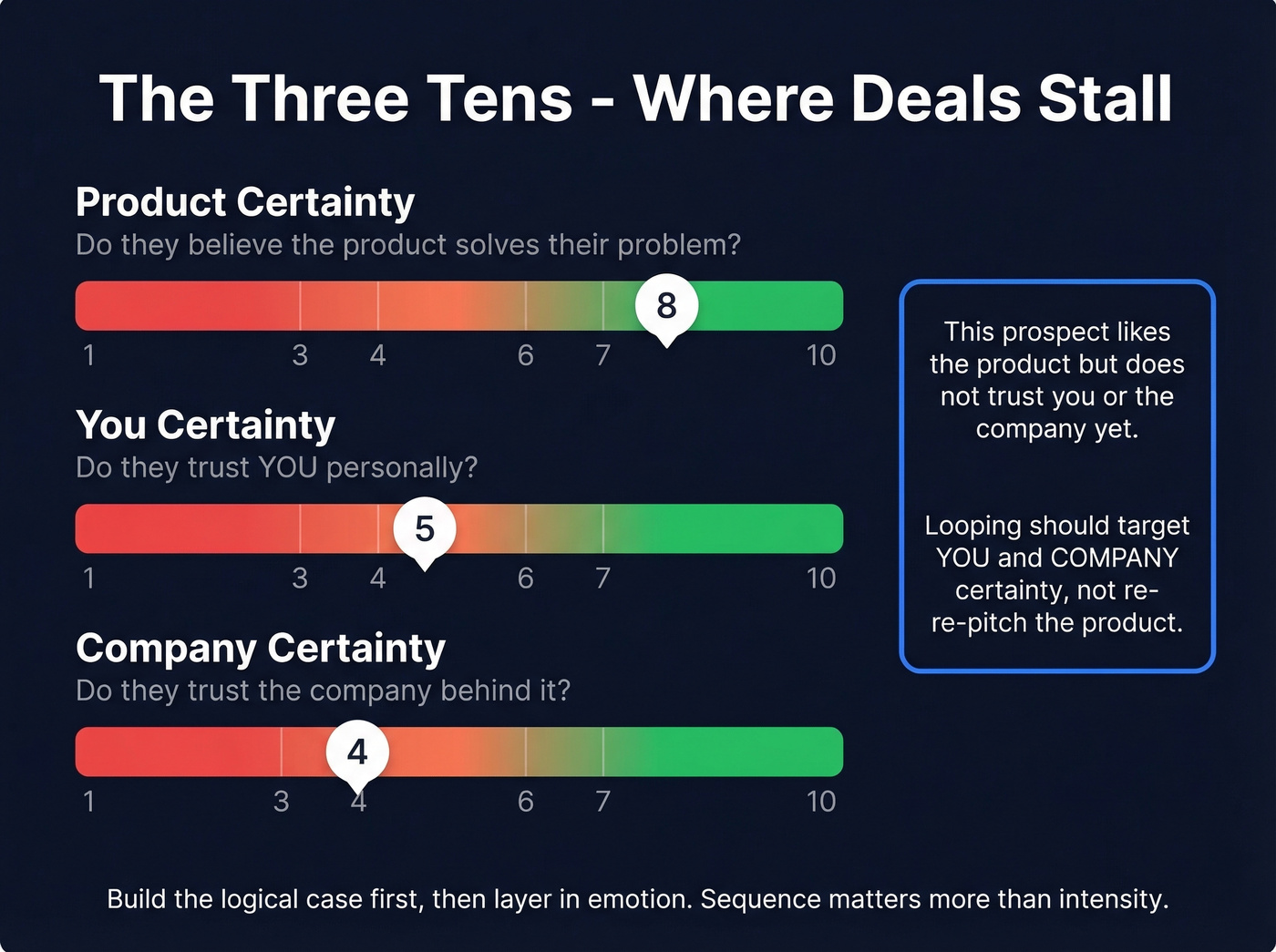
Build the logical case first - people's bullshit detectors fire on pure emotion. Once the logical foundation holds, layer in the emotional case. Both matter, but sequence matters more.
The Presentation
Transition with "based on everything you told me..." This phrase signals you listened, not just waited to talk. Present your top three benefits (not a feature dump), then close with a scarcity-to-certainty-to-reasonable pattern. Keep extra features in your back pocket for looping.
Looping (Objection Handling)
This is the only truly unique thing in Belfort's system.
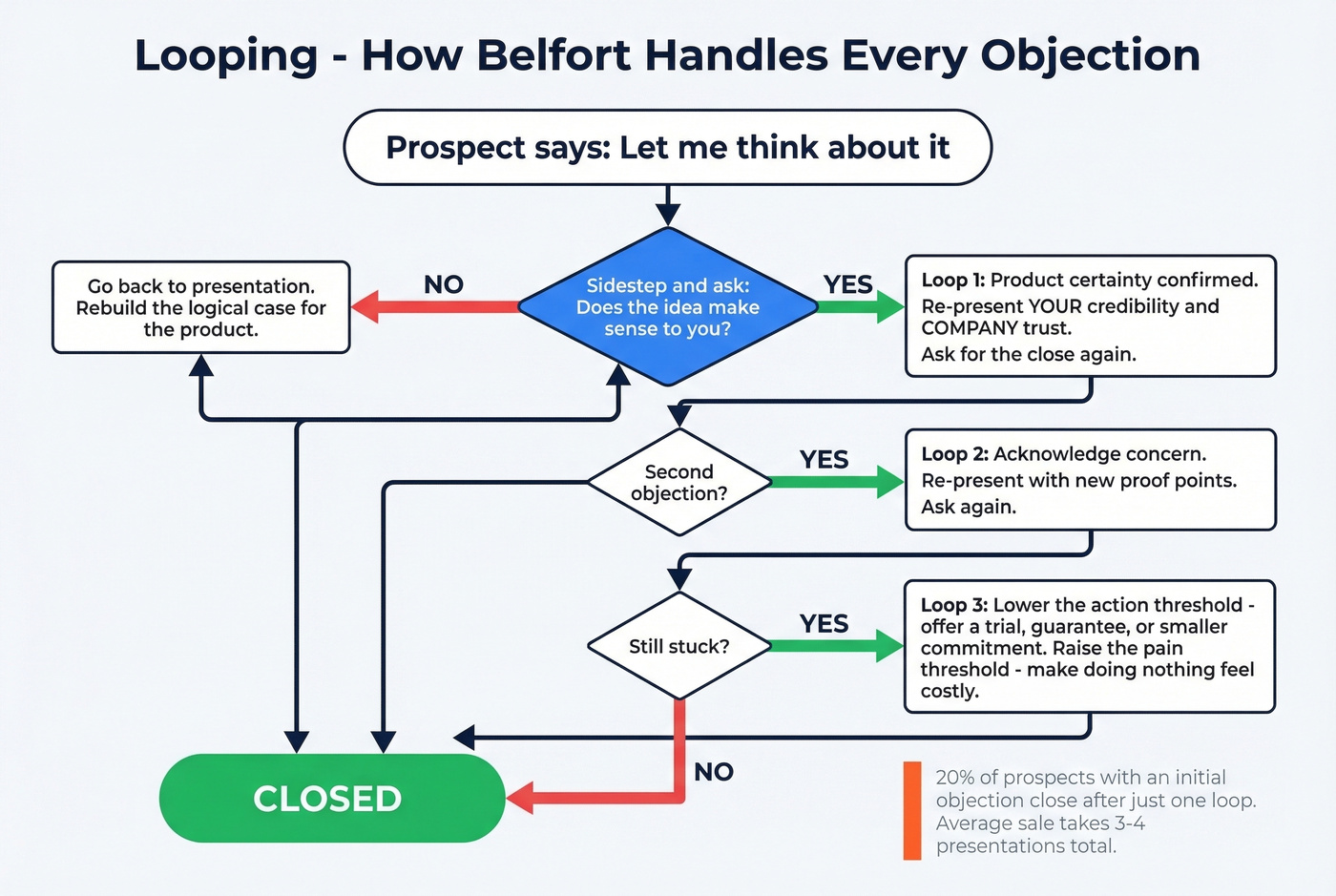
Objections are smokescreens. When someone says "let me think about it," they're not uncertain about timing - they're uncertain about the product, you, or the company. Your job is to figure out which one.
First objection: sidestep and backtrack. "I hear what you're saying, but does the idea make sense to you? Do you like the idea?" If yes, you've confirmed product certainty. Re-present the case for you and the company, then ask again.
Second objection: acknowledge, re-present, ask again.
Third: lower the action threshold with guarantees, trials, or smaller commitments. If they're still stuck, raise the pain threshold - make the cost of doing nothing feel visceral.
Around 20% of prospects with an initial objection close after just one loop. The average sale takes three to four presentations total.
Let's be honest about the limitation here: looping is a live-conversation technique. We've watched reps try to replicate it in cold email sequences, and it doesn't translate. In email, your "loop" is a different follow-up angle, not a re-presentation of the same pitch. The right approach depends entirely on your sales cycle length.

Belfort's intelligence gathering phase only works when you're talking to the right person. Prospeo gives you 300M+ verified profiles with 30+ filters - buyer intent, job changes, technographics - so you qualify before you ever pick up the phone. 98% email accuracy means your pitch reaches real inboxes, not dead ends.
Stop perfecting your script and start reaching decision-makers who pick up.
"Sell Me This Pen" - What It Actually Means
The movie got this wrong. In the film, the "right" answer is a supply-and-demand gimmick - create artificial scarcity. Clever but useless in any real selling situation.
Belfort's actual answer, from a 2015 Piers Morgan interview, is to ask questions: "How long have you been in the market for a pen?" "What type of pens do you usually use?" The lesson isn't about the pen. It's about qualifying before you pitch. If the person doesn't need a pen, stop selling them one.
Belfort's Key Tonality Patterns
Most sales training obsesses over what to say. Belfort's tonality framework is about how to say it. Five patterns that matter most:
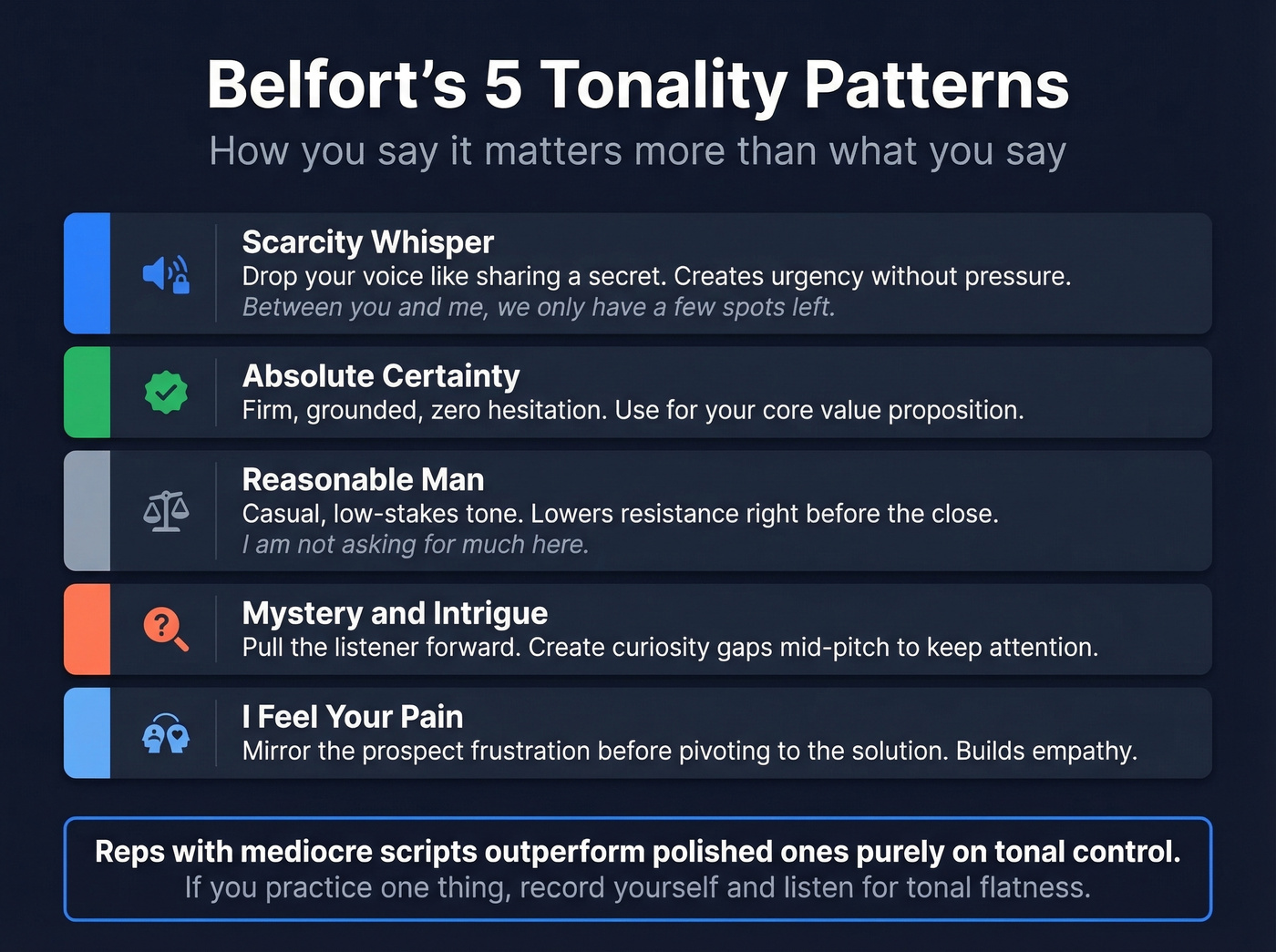
- Scarcity whisper - drop your voice like you're sharing a secret: "Between you and me, we only have a few spots left."
- Absolute certainty - firm, grounded, zero hesitation. Use this when stating your core value proposition.
- Reasonable man - "I'm not asking for much here" - lowers resistance right before the close.
- Mystery/intrigue - pulling the listener forward, creating curiosity gaps mid-pitch.
- "I feel your pain" - mirroring the prospect's frustration before you pivot to the solution.
The tonality patterns are the most underrated part of the entire system. In our experience, reps with mediocre scripts outperform polished ones purely on tonal control - and it's not close. If you're only going to practice one thing from this article, practice recording yourself and listening back for tonal flatness.
Where This Works (and Doesn't)
Use this for high-velocity transactional sales - phone sales, SMB deals, short cycles where one person makes the decision. Belfort built this system for exactly that environment.
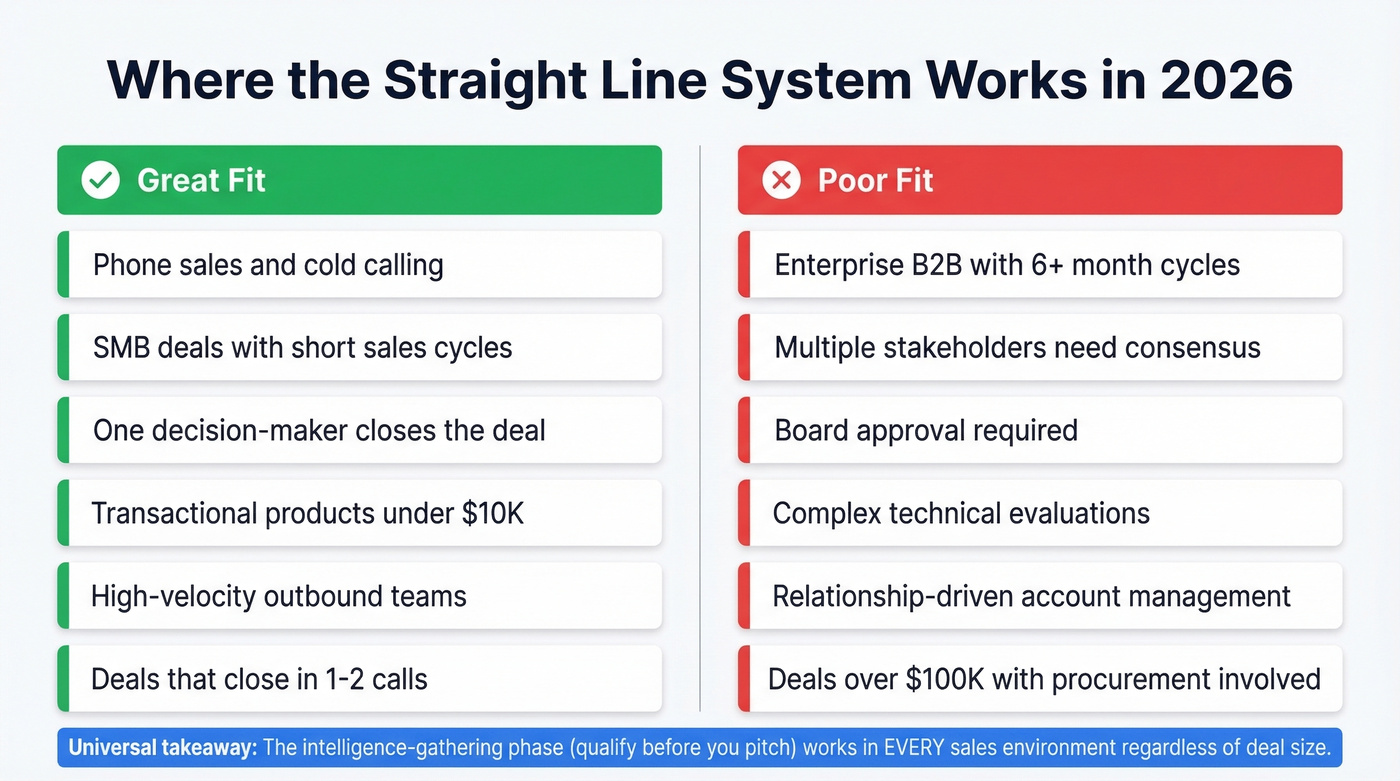
Skip this for enterprise B2B with multiple stakeholders and six-plus-month cycles. Looping three times with a VP who needs board approval doesn't build certainty - it burns the relationship. I've seen reps torpedo a $200K deal by treating a CFO like a penny-stock buyer. Don't be that person.
Here's the thing: if your average deal closes in under two calls, the Straight Line System is still the best phone sales framework available in 2026. Nothing else gives you a repeatable structure for live objection handling. But when you're closing on the first ask every time, you're leaving money on the table by not pitching harder prospects.
If you take one thing from Belfort's approach, make it the intelligence-gathering phase. Qualifying hard before you pitch is universally good advice, regardless of deal size. And qualifying hard starts with reaching the right person - which means your prospect data needs to be accurate before you ever pick up the phone. Prospeo's 98% email accuracy and 125M+ verified mobiles help make sure your Straight Line opener reaches a real decision-maker, not a bounced inbox.
You just learned the best live objection-handling framework in sales. But looping is worthless if your dial list is full of wrong numbers and bounced emails. Prospeo's 125M+ verified mobile numbers hit a 30% pickup rate - that's 3x the industry average. Your Straight Line needs a straight path to the prospect first.
Get direct dials that actually connect - starting at $0.01 per lead.
FAQ
Is the Straight Line System the same as the Wolf of Wall Street script?
No. The viral "Stratton Oakmont script" online is a canvassing call, not the closing pitch. The Straight Line System is Belfort's full methodology - scripting, tonality, objection handling, and looping - taught in Way of the Wolf. Think of the script as the SDR opener; the system is the entire AE playbook.
Does Belfort's pitch framework work in B2B?
The core principles - qualify first, build certainty across three dimensions, handle objections with looping - translate to any sales environment. High-pressure looping works best in transactional, short-cycle deals. For enterprise B2B with multiple stakeholders, adapt the framework but dial back the repetition to avoid burning relationships.
What's the real "Sell Me This Pen" answer?
Belfort's real answer is to ask qualifying questions - "How long have you been looking for a pen?" - not to create artificial scarcity like the movie suggests. The lesson: discover needs before pitching. If the buyer doesn't need what you're selling, move on.
How do I reach the right prospects before pitching?
The best pitch fails if it hits the wrong person. Building targeted lists with buyer intent signals, technographic filters, and verified contact data means your Straight Line opener reaches a qualified decision-maker, not a gatekeeper. That's the unsexy work that makes the sexy framework actually produce revenue.