

LAER Objection Handling: Data-Backed Scripts for Every Objection
You taught your team LAER in onboarding. Three months later, every rep jumps straight to their pitch deck the moment a prospect pushes back. The framework isn't the problem - the execution is. An analysis of 300M+ cold calls by Gong found the top five objections account for 74% of all pushback, which means drilling LAER on a small set of scenarios covers the vast majority of what your reps actually face.
What Is LAER?
LAER stands for Listen, Acknowledge, Explore, Respond - pronounced "lay-er." Jack Carew created it in 1976, and Carew International still teaches it today. The beauty of this model is that it's one process for all objections, not 20 memorized rebuttals. As Chris Voss puts it: "We are willing to be influenced by those we feel understood by." That single idea powers every step.
The step most reps skip is Explore, and it's the one that wins deals. Top performers pause 5X longer after hearing an objection than average reps. That pause is the move, not the mistake.
The Four Steps
Listen
Across 67,149 analyzed sales calls, successful reps pause 5X longer after a customer's objection than their less-successful peers. That silence signals you're actually processing what the prospect said instead of loading your next rebuttal.
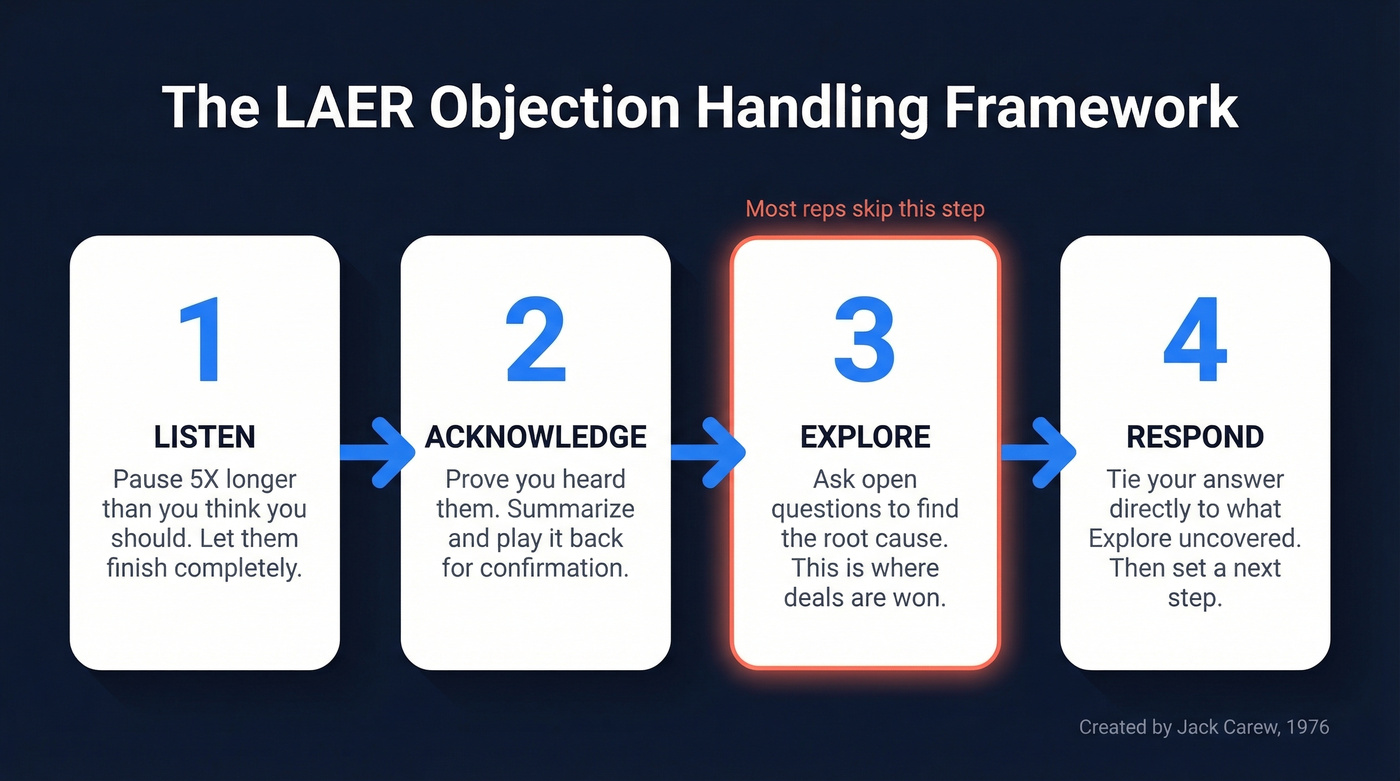
The discipline is simple but brutal: let them finish. Don't interrupt. If you catch yourself cutting in, call yourself out - Brooke Freedman at Drift recommends literally saying "Sorry, I jumped in there. Please finish your thought." That kind of vulnerability on a discovery call script builds more trust than any polished response ever will.
Acknowledge
Acknowledgment isn't agreement. You're not saying "you're right, our product is too expensive." You're proving you heard them.
Two techniques land consistently. First, the empathy statement: "I get it - you've already got a solution that works for you." Second, the summary playback: "So if I can play that back - you're concerned that implementation would pull your team off a Q3 priority. Did I get that right?" The playback is stronger because it forces the prospect to confirm or correct, keeping the conversation moving forward. What you don't do: argue or pivot to features.
Explore
This is where deals are won or lost. Sales managers consistently report that Explore is where new reps freeze up - the temptation to jump into solution mode is overwhelming, but doing so shuts down the conversation and puts you on opposite sides of the table.
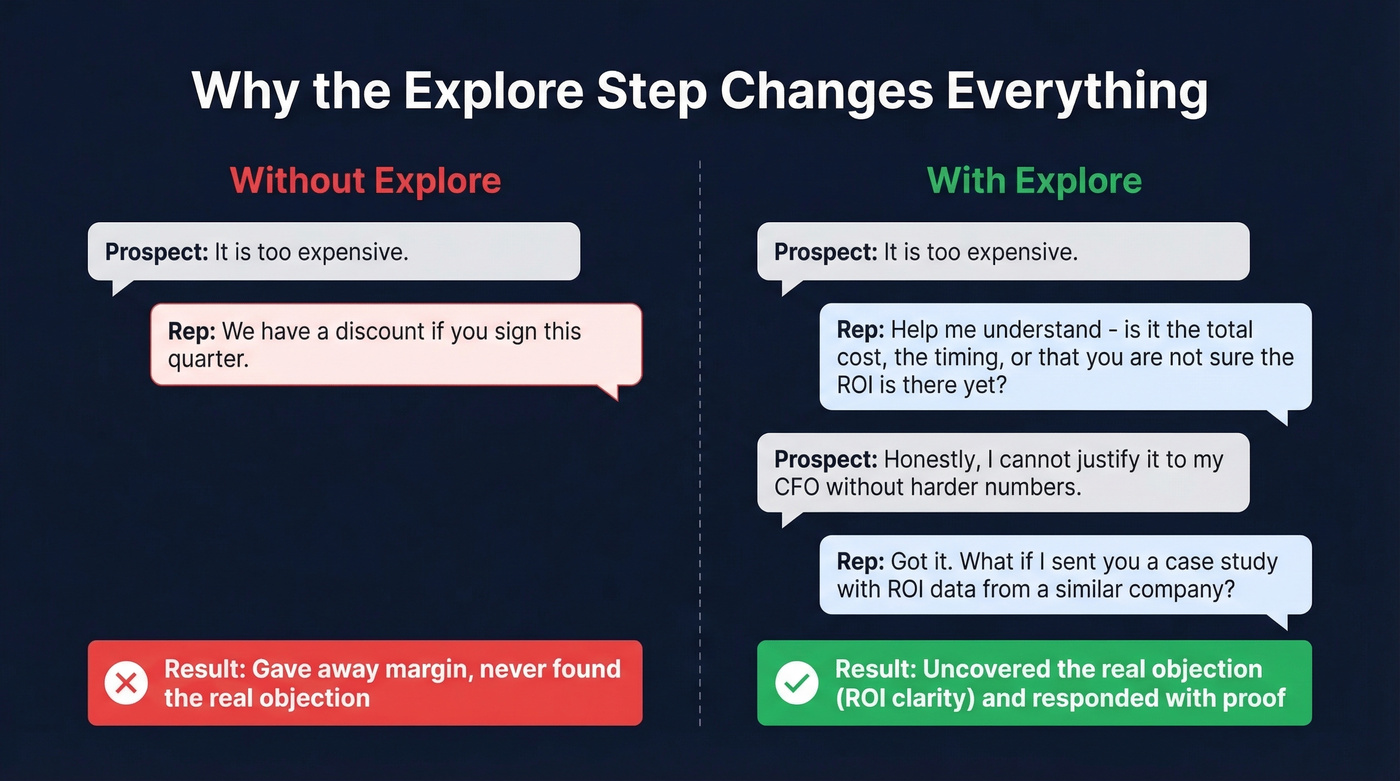
We've seen the difference play out hundreds of times. Here's what skipping Explore looks like versus doing it right:
Without Explore: Prospect: "It's too expensive." Rep: "We actually have a discount if you sign this quarter."
With Explore: Prospect: "It's too expensive." Rep: "Help me understand - is it the total cost, the timing, or that you're not sure the ROI is there yet?" Prospect: "Honestly, I can't justify it to my CFO without harder numbers."
The first rep gave away margin for nothing. The second uncovered the real objection - ROI clarity - and can now respond with a case study instead of a discount.
When a prospect says "too expensive," they typically mean one of three things: ROI isn't clear, priority is low, or they're comparing you to a competitor. Your job is to figure out which one. Start open: "Can you tell me more about that?" Then narrow: "Which aspect of pricing concerns you most - the total cost or the timing?" or "What were you hoping to see that you're not seeing here?" This reframes the dynamic from adversarial to consultative, where both of you tackle the objection together.
Respond
By the time you respond, the hard work is done. This step should get the least training time, not the most.
Your response ties directly to whatever Explore uncovered - not to a generic rebuttal you memorized. If Explore revealed a competitor comparison on a specific feature, demo that feature live with a proof point. If it revealed budget timing, propose a phased rollout or pilot. Then close with a next step: "Based on what you've shared, does it make sense to schedule a technical review with your team next Tuesday?"
The LAERC Extension
Once your team has the core four steps down cold, add a fifth: Confirm. LAERC ensures the prospect actually accepts your response before you move on: "Before we continue, does the ROI math we walked through change how you're thinking about the investment?"
You'll see LAER attributed to HubSpot in some guides - they popularized it but didn't create it. Jack Carew expanded on the framework in his 1990 book You'll Never Get No for an Answer. Don't introduce Confirm until the base four steps are muscle memory.

Your reps just uncovered the real objection with Explore - now they need to reach the right person to close the deal. Prospeo gives you 98% verified emails and 125M+ direct dials so every LAER conversation happens with an actual decision-maker, not a gatekeeper.
Stop perfecting your objection handling on prospects who can't buy.
Scripts by Objection Type
| Objection | Listen / Acknowledge | Explore Question | Respond |
|---|---|---|---|
| Situational (Price) | "I hear you - budget matters." | "Would you choose this if price weren't a factor?" | Show cost-per-lead math or propose a 90-day pilot. |
| Timing | "Makes sense - timing is real." | "What changes between now and next quarter?" | Propose a pilot or calendar hold with a specific date. |
| Authority | "Totally fair - you need buy-in." | "What questions will your team throw at you?" | Arm them with a one-pager or join the call. |
| Competitor | "Good - [Competitor] is solid for [X]." | "How are you handling [gap] today?" | Demo the specific feature gap live. |
| Dismissive | "I can definitely send that over." | "What one thing in that email would make a call worth your time?" | Send a targeted follow-up with a calendar link. |
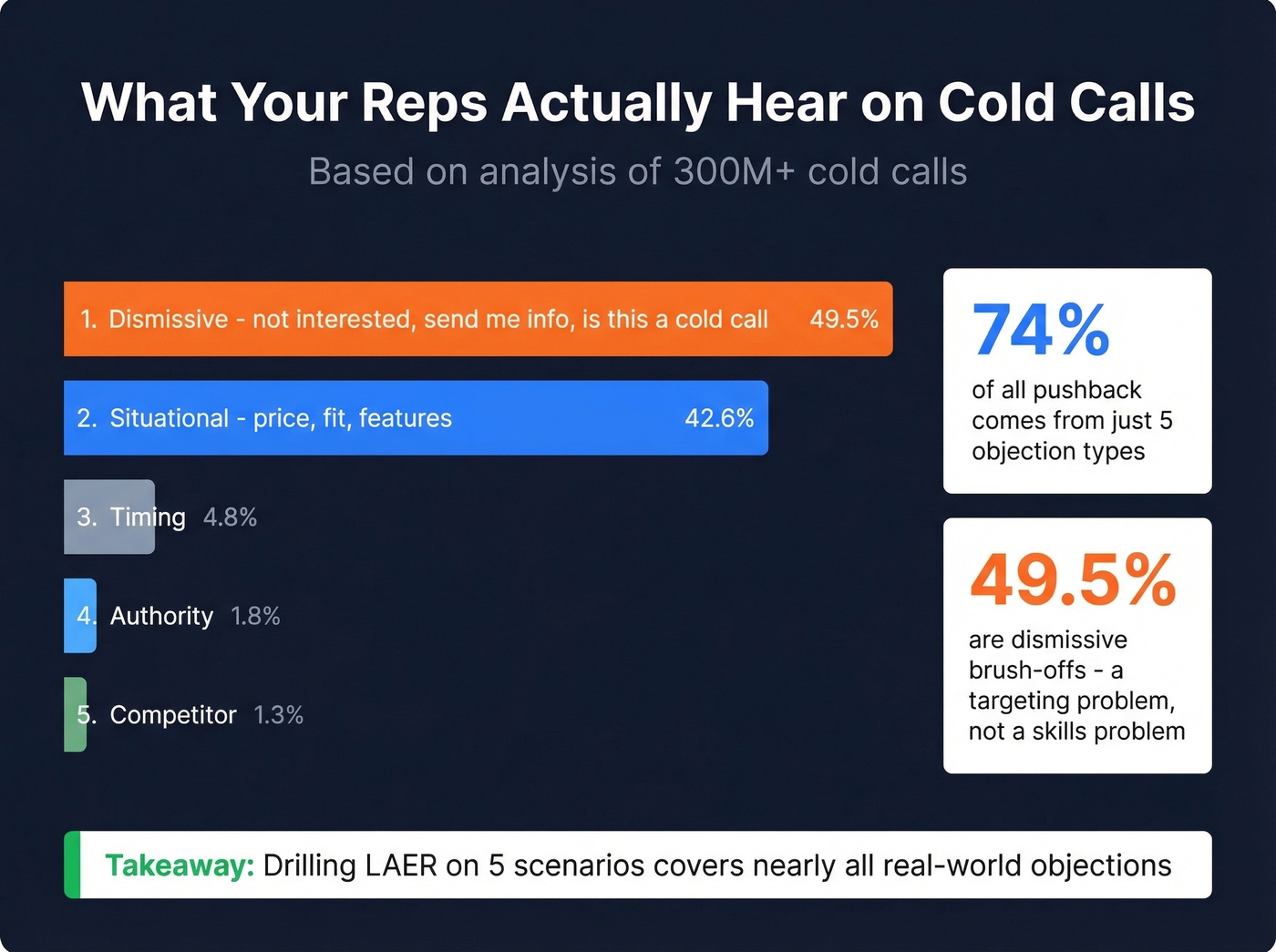
Dismissive objections - "not interested," "send me info," "is this a cold call?" - make up nearly half of all objections (49.5%), while situational objections like price and fit account for 42.6%. The consensus on r/salestechniques is that responding to "send me an email" with a genuine question - not a guilt trip - keeps the conversation alive far more often than a scripted pivot.
How to Practice This Week
Use the TAPA framework - Theory, Application, Practice, Assessment:
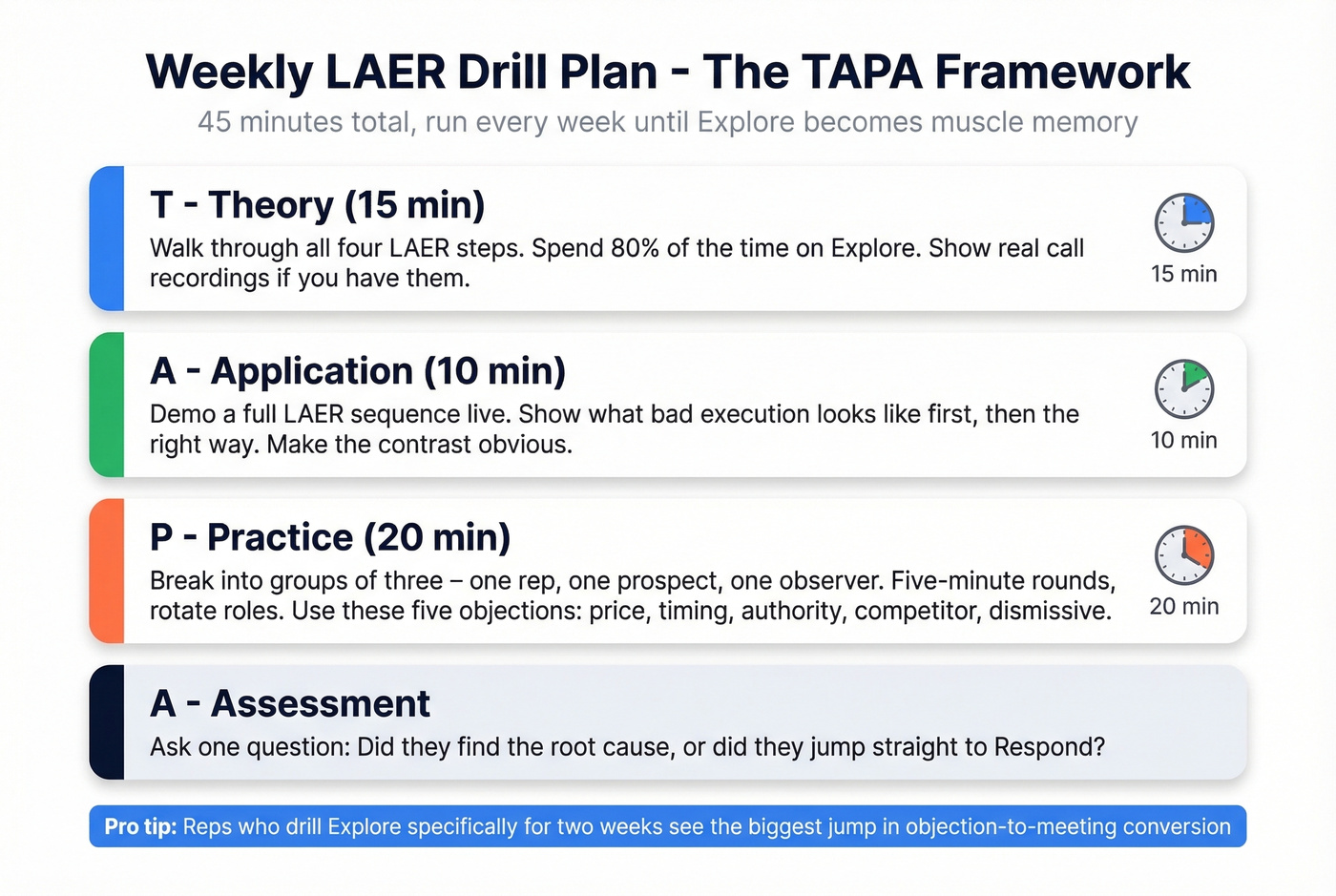
- Theory (15 min): Walk through the four steps. Spend 80% of the time on Explore.
- Application (10 min): Demo a full LAER sequence live, including what bad execution looks like.
- Practice (20 min): Break into pairs. One rep, one prospect, one observer. Five-minute rounds, rotate roles. Use the five objection types from the table above. Focus on active listening and talk-to-listen ratio.
- Assessment: One question - "Did they find the root cause, or did they jump to Respond?"
Reps who drill Explore specifically for two weeks see the biggest jump in objection-to-meeting conversion. The framework rewards patience. It's the hardest step and the one that separates reps who handle objections from reps who just survive them.
Fewer Objections Start With Better Data
Here's the thing: half the objections your team faces shouldn't exist. When 49.5% of all objections are dismissive brush-offs, that's a targeting problem, not a skills problem. Your reps are reaching the wrong person with irrelevant messaging.
We've seen teams cut brush-off rates dramatically by fixing their prospect data before fixing their scripts. Prospeo's 98% email accuracy and 7-day data refresh cycle mean reps waste fewer touches on bounced emails and stale contacts. Layer in intent data tracking 15,000 topics, and your team reaches prospects who are actually in-market - cutting "not interested" before it happens.

The ROI case study your rep needs for that Respond step? It starts with accurate data. Prospeo's 7-day refresh cycle means you're never pitching stale contacts - so when you nail the Explore question, you're talking to someone who's still in-seat and in-market.
Handle objections with buyers who are actually reachable - starting at $0.01 per email.
FAQ
How is LAER different from Feel-Felt-Found?
Feel-Felt-Found validates emotion but skips diagnosis entirely. LAER adds an Explore step that forces you to uncover the root cause before responding, making it better suited for complex B2B sales with multiple stakeholders and longer deal cycles.
When does LAER not work?
When the prospect has genuinely disqualified themselves - no budget authority, no problem to solve, or repeated looping on the same objection after two Explore attempts. Disqualify gracefully and move on rather than forcing the framework.
Can better data reduce objections before calls?
Yes. Nearly half of cold call objections are dismissive brush-offs caused by reaching the wrong person. When your reps start conversations with verified contacts who match your ICP and show buying intent, those "wrong person" and "not interested" objections drop off before the call even happens.