

Lead Generation Funnels: The Data-Driven Guide for 2026
96% of visitors aren't ready to buy when they first hit your site. That's not a traffic problem - it's a funnel problem. The lead generation software market has ballooned to $7.4B and is projected to hit $16.2B by 2034, which tells you something: every team is trying to build lead generation funnels that work, and most are overcomplicating it.
The difference between a funnel that prints pipeline and one that leaks money comes down to a handful of decisions - your benchmarks, your nurture cadence, your data quality, and your speed-to-lead.
The Short Version
Your lead gen funnel has five stages, each with a benchmark conversion rate you should measure against. Most funnels don't fail at awareness - they fail at follow-up. Define your ICP, build one lead magnet, set up a 4-week nurture sequence, verify your contact data before sending, and respond to every lead within 5 minutes. The rest of this guide gives you the numbers to make each step work.
What Is a Lead Gen Funnel?
A lead generation funnel is the system that turns strangers into qualified leads your sales team can work. It covers everything from the first touchpoint - a blog post, an ad, a webinar - through to the moment a lead is ready for a sales conversation.
People confuse this with two related concepts. A sales funnel picks up where the lead gen funnel ends, taking qualified leads through evaluation, negotiation, and close. A sales pipeline is the CRM view of active deals at each stage. They're connected, but they're not the same thing.
87% of marketers create content tied to different journey stages, so most teams already think in funnel terms - they just don't measure each stage independently.
| Concept | Owned By | Starts At | Ends At |
|---|---|---|---|
| Lead gen funnel | Marketing | First touch | MQL/SQL handoff |
| Sales funnel | Sales | SQL handoff | Closed won/lost |
| Sales pipeline | Sales/RevOps | Active deal | Revenue |
Funnel Stages and Benchmarks
TOFU / MOFU / BOFU Breakdown
Every funnel guide throws around "top of funnel" and "bottom of funnel" without telling you what good actually looks like at each stage.
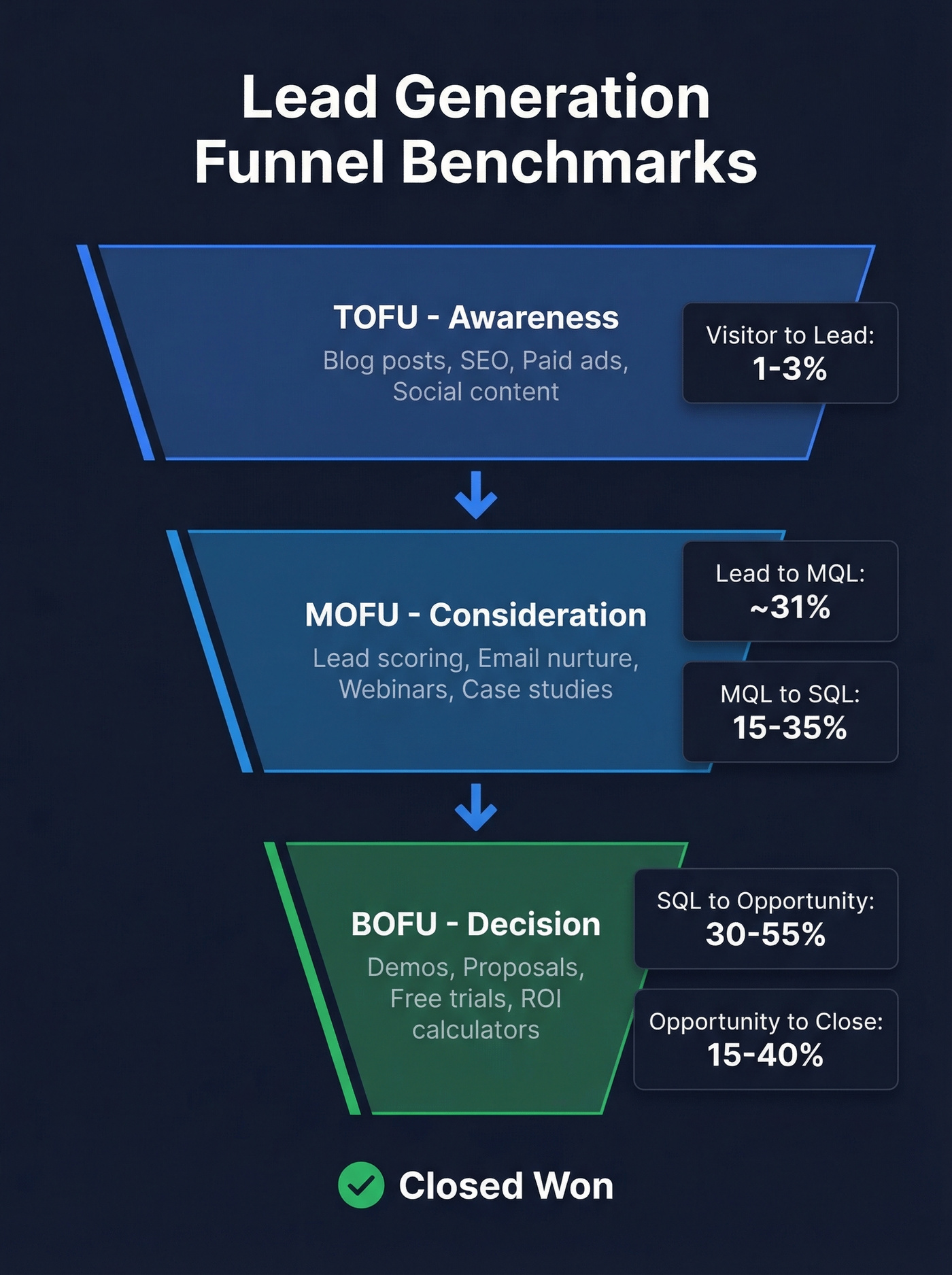
Top of Funnel (TOFU) is about awareness. Blog posts, social content, SEO, paid ads. The goal is traffic and initial engagement, and visitor-to-lead conversion rates are lower than most people expect.
Middle of Funnel (MOFU) is where leads get qualified. Lead scoring, email nurture, webinars, case studies - you're separating the curious from the serious. The key metrics here are lead-to-MQL and MQL-to-SQL conversion rates.
Bottom of Funnel (BOFU) is decision time. Demos, proposals, free trials, ROI calculators. Your metrics are SQL-to-opportunity and opportunity-to-close rates.
The stage-by-stage benchmarks tell a clear story:
| Stage | Benchmark Range |
|---|---|
| Visitor → Lead | 1-3% |
| Lead → MQL | ~31% |
| MQL → SQL | 15-35% |
| SQL → Opportunity | 30-55% |
| Opportunity → Close | 15-40% |
One stat that rarely gets cited: the median qualified-to-booked-meeting rate is 62%, with top-performing teams hitting 78%+. If your SDRs are booking meetings on fewer than half their qualified leads, the problem is almost certainly speed or messaging - not lead quality.
Those stage ranges vary dramatically by industry. Visitor-to-lead rates for B2B SaaS run about 1.1%, while legal services hit 7.4% and manufacturing lands around 2.2%.
| Industry | Lead→MQL | MQL→SQL | SQL→Opp | SQL→Close |
|---|---|---|---|---|
| B2B SaaS | 39% | 38% | 42% | 37% |
| Cybersecurity | 24% | 40% | 43% | 46% |
| eCommerce | 23% | 58% | 66% | 60% |
If your numbers fall below these ranges, don't panic - make sure your stage definitions are clean first. We've seen teams "fix" their funnel by simply aligning marketing and sales on what counts as an MQL.
A Real Funnel in Action
Let's make these benchmarks concrete. A mid-market B2B SaaS team drives 20,000 monthly visitors through SEO and paid search. At a 1.5% visitor-to-lead rate, that's 300 leads. Applying the B2B SaaS benchmarks: 117 MQLs (39%), 44 SQLs (38%), 19 opportunities (42%), and 7 closed deals (37%). At a $30K ACV, that's $210K in monthly new revenue from a single funnel.
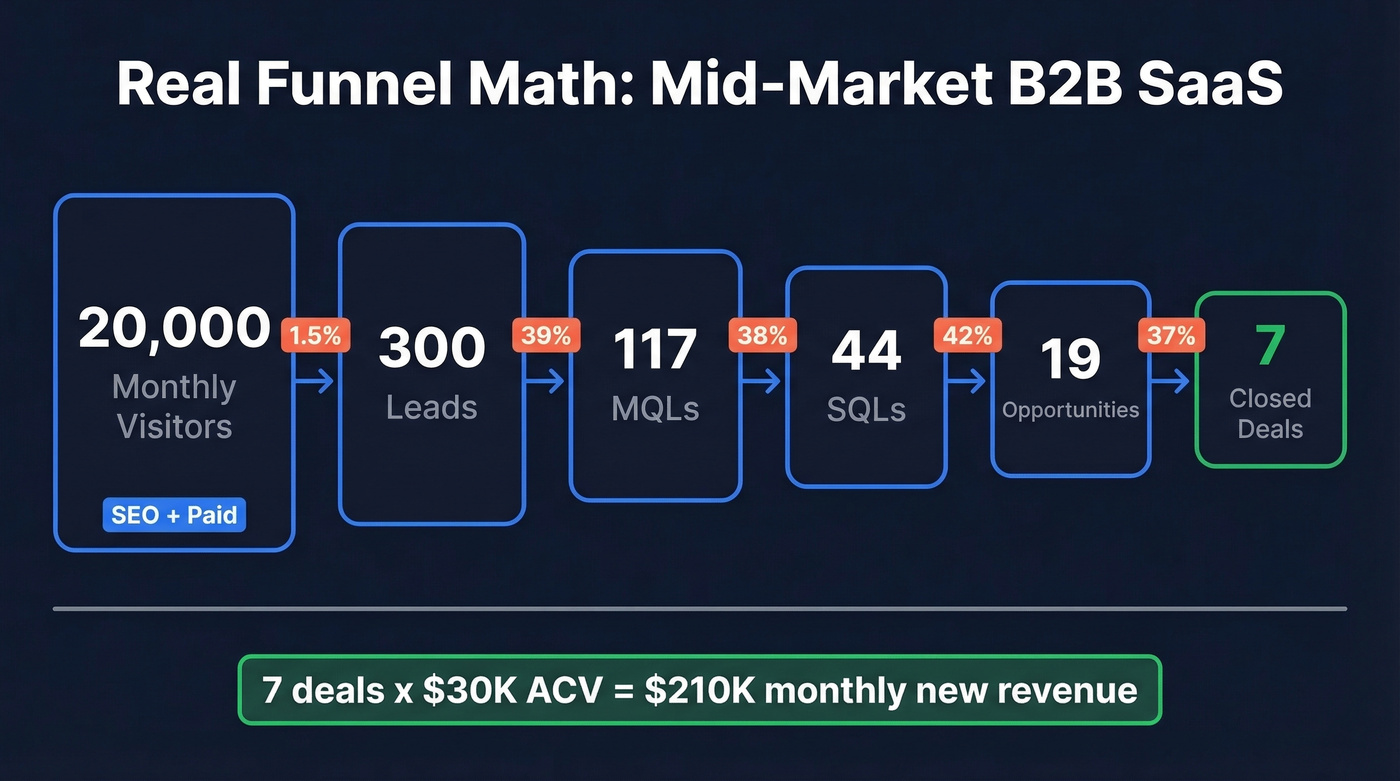
The team that built this didn't start here. They launched with a single landing page, a 4-email nurture sequence, and verified contact data. Three months of iteration - testing subject lines, adjusting their MQL threshold, and cutting their response time from 4 hours to under 10 minutes - got them to these numbers. Start lean, measure every stage, fix the biggest leak first.
Modern Funnels Aren't Linear
The neat TOFU → MOFU → BOFU diagram is a useful mental model, but it doesn't reflect how B2B buyers actually behave. Gartner's research maps the buying journey across six non-linear stages: Problem Identification, Solution Exploration, Requirements Building, Supplier Selection, Validation, and Consensus Creation. Buyers loop back, skip stages, and involve different stakeholders at different points.
77% of B2B buyers describe their last purchase as "very complex," and 74.6% take at least four months to close - with nearly half stretching past seven months. Your funnel needs to account for this messiness with multi-touch nurture sequences, content for every stage, and patience.
The #1 Reason Funnels Fail
It's not traffic. It's not your landing page design. It's follow-up.
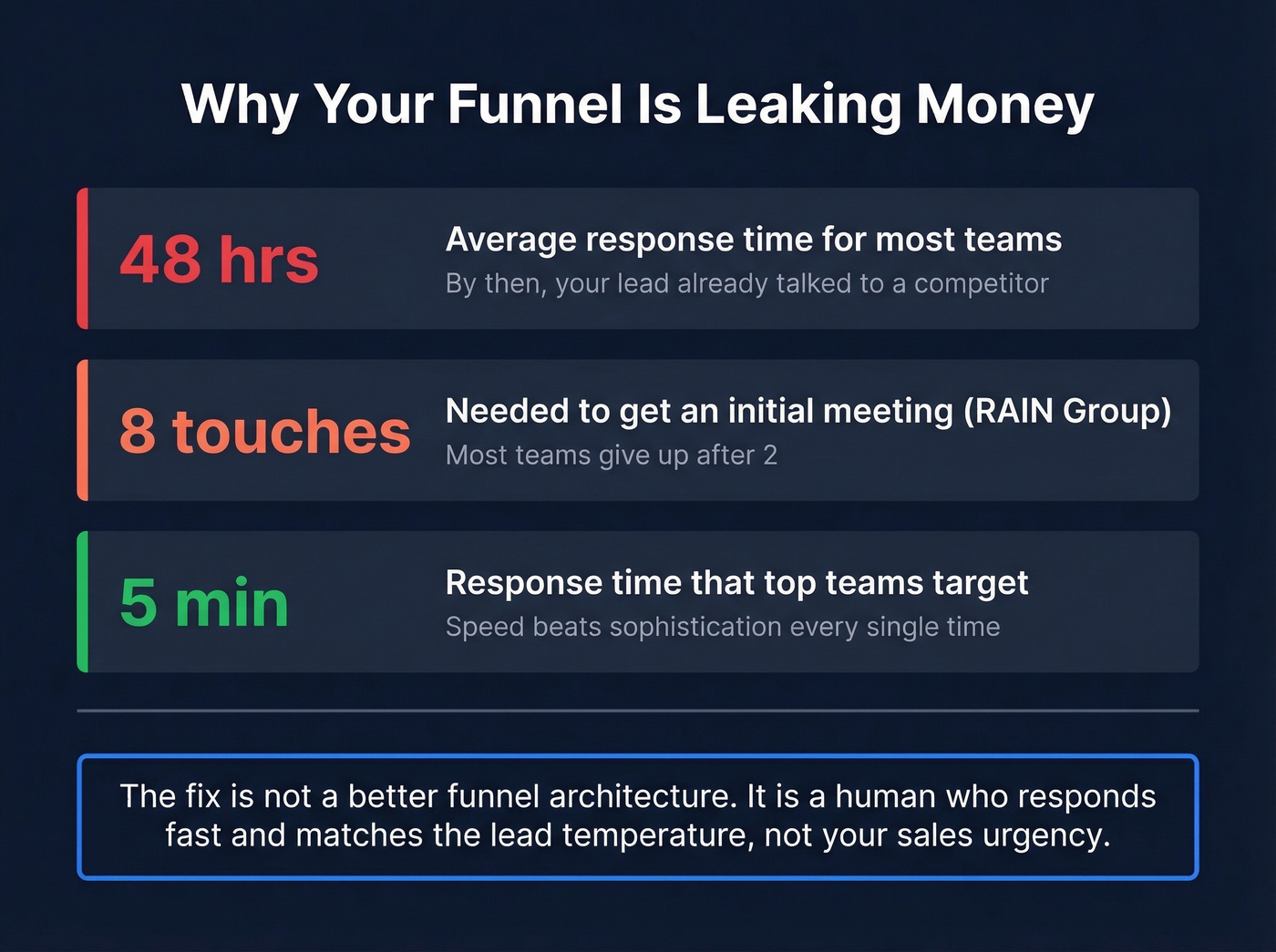
The consensus on r/digital_marketing is blunt: "Funnels don't break because of low traffic. They break because leads get ignored." The pattern is painfully common - a team runs ads, gets form fills, then responds 48 hours later with a generic copy-paste email. By then, the lead has already talked to a competitor or lost interest entirely.
RAIN Group's research puts the average at 8 touches to get an initial meeting. Most teams give up after two. And speed-to-lead is even more damning: the faster you respond, the more leads you actually reach and convert.
The other killer? Treating every lead like a hot buyer. Most people who download your whitepaper are curious, not ready to sign a contract. Hitting them with a "ready for a demo?" email on day one kills trust fast. Your funnel needs to match the lead's temperature, not your sales team's urgency.
Here's the thing: if your deal size is under $15K, you probably don't need a complex multi-stage funnel at all. A strong landing page, a 3-email nurture, and a human who responds in under 5 minutes will outperform most enterprise funnel architectures. Complexity is the enemy of speed, and speed is what closes deals at this price point.
How to Build a Lead Funnel
Define Your ICP and Buyer Stages
Start with who you're targeting and what stage they enter your funnel at. An ICP isn't just "VP of Marketing at mid-market SaaS companies." It's that person plus their buying triggers - they just got budget approval, they're replacing a competitor, they hired three new SDRs and need data.
Map out what triggers movement between stages. A lead who visits your pricing page twice in a week is signaling something different than one who read a blog post once. Nearly 60% of B2B buyers make purchasing decisions before engaging a salesperson, so your funnel content needs to do the selling before your reps ever get involved.
Create Your Lead Magnet and Landing Page
Your lead magnet should match the funnel stage you're targeting. TOFU magnets are educational - templates, benchmarks, industry reports. MOFU magnets are comparative - buyer's guides, ROI calculators, vendor comparisons. BOFU magnets are proof-driven - case studies, free trials, live demos.
The median landing page conversion rate sits around 6.6%. If you're below 3%, your offer-to-page match is off. Tools like Leadpages (around $40+/mo) or Unbounce (around $100+/mo) make it easy to test variations without involving your dev team. One detail teams overlook: include a clear privacy policy on every landing page. It's a legal requirement if you collect personal information.
Set Up Lead Scoring
Lead scoring isn't advanced anymore - it's table stakes. Build a simple point-based model. Positive signals: pricing page visits (+10), content downloads (+5), webinar attendance (+15), repeat visits within a week (+10). Negative signals: unsubscribes (-20), wrong industry (-30), generic email domain (-5).
The threshold for MQL should be calibrated to your sales team's capacity. If they can handle 50 leads a week, set the score cutoff so roughly 50 leads per week cross it. Adjust monthly based on feedback.
Drive Traffic to the Top
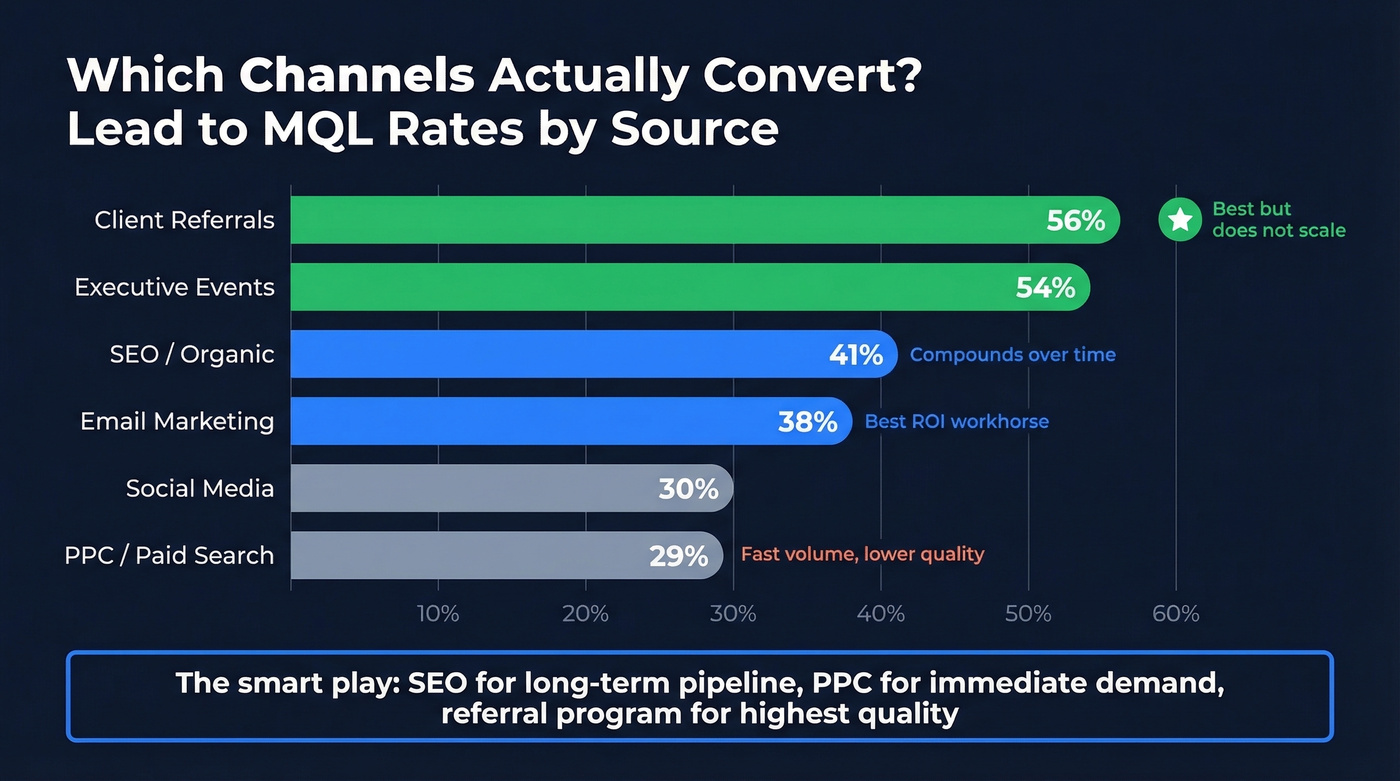
Not all traffic sources convert equally. Different channels show dramatically different lead-to-MQL conversion rates:
| Channel | Lead→MQL Rate |
|---|---|
| Client referrals | 56% |
| Executive events | 54% |
| SEO / organic | 41% |
| Email marketing | 38% |
| Social media | 30% |
| PPC / paid search | 29% |
Referrals crush everything else, but they don't scale. SEO and email are the workhorses for most B2B teams - high conversion rates with compounding returns over time. PPC gets you volume fast but at lower quality. The smart play is a mix: SEO for long-term pipeline, PPC for immediate demand, and a referral program to capture your highest-converting channel.
Build Your Data Foundation
Before you send a single nurture email, verify your list. This is the step most teams skip, and it's the one that tanks everything downstream.
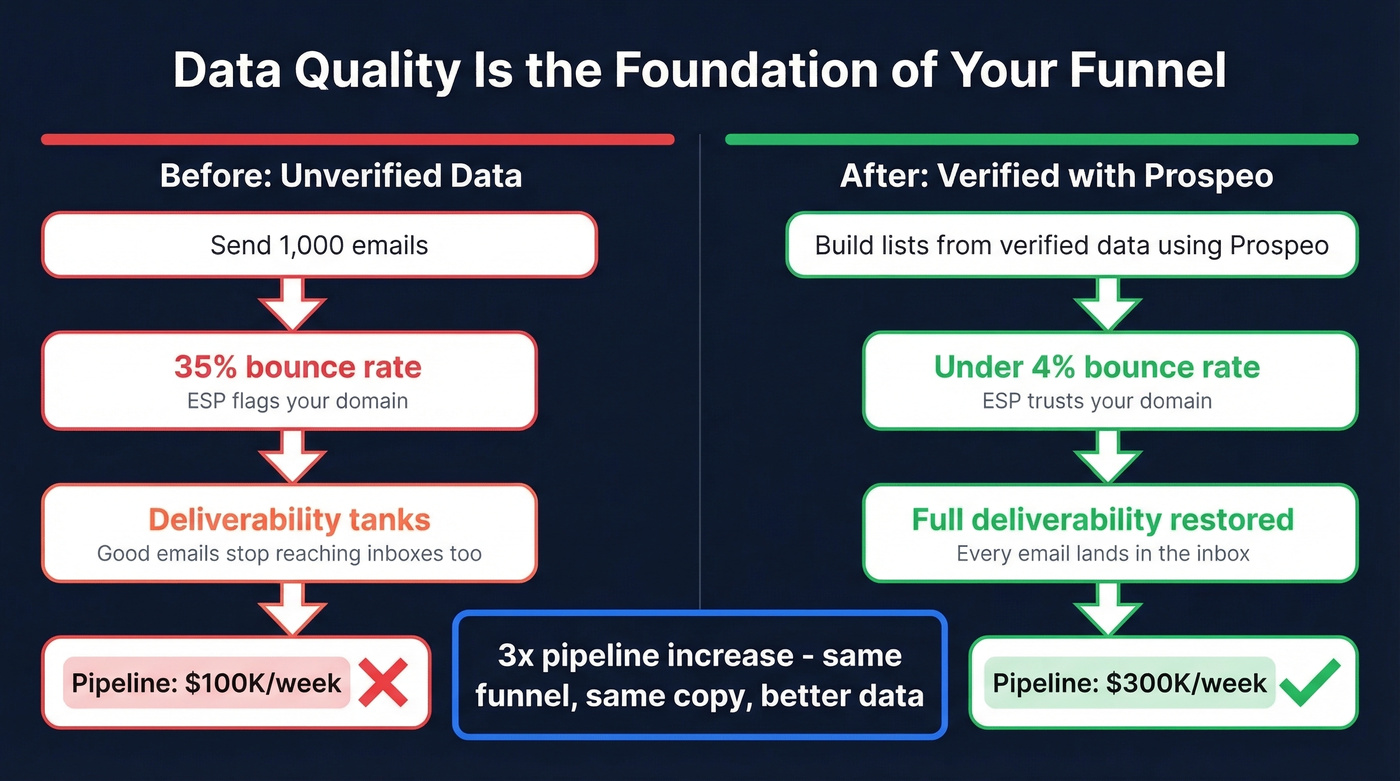
A bounce rate above 5% isn't a messaging problem - it's a data problem. Your email service provider sees those bounces and starts throttling your deliverability, which means even your good emails stop landing in inboxes. We've seen this play out repeatedly: one team using Prospeo cut their bounce rate from 35% to under 4% and tripled their pipeline from $100K to $300K per week. The fix wasn't better copy or a new funnel architecture - it was building lists from verified data rather than cleaning up bad data after the fact.

Launch Checklist
Before you go live, run through this list. Skip a step and you'll spend weeks debugging a problem that takes minutes to prevent.
- ICP documented with buying triggers, not just firmographics
- Lead magnet created and matched to a specific funnel stage
- Landing page live with privacy policy and a single, clear CTA
- Lead scoring model built and MQL threshold set
- Email nurture sequence written (minimum 4 emails over 4 weeks)
- Contact list verified - bounce rate confirmed under 5%
- CRM or tracking sheet configured with stage definitions
- Speed-to-lead process defined - who responds, within how many minutes
- Analytics tracking installed on landing page and email links
- Sales-marketing handoff criteria agreed on in writing

Bad data is the silent funnel killer. If 35% of your emails bounce, your MQL→SQL conversion collapses before sales even gets a shot. Prospeo's 5-step verification delivers 98% email accuracy - teams using it cut bounce rates from 35%+ to under 4% and tripled their pipeline.
Stop feeding your funnel dead emails. Verify every contact before it enters your sequence.
The Email Nurture Playbook
4-Week Nurture Cadence
Only 3% of your market is actively buying at any given time. Another 40% is poised to buy but needs nurturing. The companies that excel at this generate 50% more sales-ready leads at 33% lower cost, and their nurtured leads make 47% larger purchases.
Here's a 4-week cadence we've seen work across multiple B2B teams:
| Day | Email Type | Goal |
|---|---|---|
| Day 1 | Thank-you + delivery | Deliver the lead magnet |
| Day 3 | Related resource | Add value, build trust |
| Day 7 | Webinar/demo invite | Gauge buying intent |
| Day 14 | Insight or data share | Position as expert |
| Day 21 | Case study | Provide social proof |
| Day 28 | Direct CTA | Ask for the meeting |
Measure against these KPI targets:
| Metric | Target Range |
|---|---|
| Open rate | 20-30% |
| Click-through rate | 2-5% |
| Response rate | 3-10% |
| Conversion rate | 5-15% |
If your open rates are below 20%, test your subject lines and sender name. Opens fine but CTR low? Your content isn't matching the lead's stage. CTR fine but conversions are low? Your CTA is either too aggressive or too vague. For context, the average cold email reply rate sits around 3.4% - AI-personalized sequences consistently beat that.
What to Write at Each Stage
Awareness emails should be purely educational. Share frameworks, benchmarks, and industry insights. No product pitches. You're earning the right to their attention.
Consideration emails shift to comparative content. How does your approach compare to alternatives? What are the tradeoffs? Buyer's guides and ROI frameworks work well here - map each feature to a benefit and the objection it preempts, then address the objection before the lead raises it.
Decision emails are proof and urgency. Case studies with specific numbers, limited-time offers, direct demo invitations. Include a path to conversion in every email - even the educational ones - because you never know when a prospect will be ready.

Your nurture sequence is only as good as your data. A 35% bounce rate tanks your domain reputation faster than any bad subject line. Run your list through a verification tool before sending - it takes minutes and saves months of deliverability recovery.
B2B vs B2C Funnel Design
The stages look similar on paper, but the mechanics are completely different.
| Dimension | B2B | B2C |
|---|---|---|
| Cycle length | 4-12+ months | Minutes to weeks |
| Decision makers | 3-10 stakeholders | Usually 1-2 |
| Content types | Case studies, whitepapers | Reviews, influencer content |
| Key metrics | MQL, SQL, pipeline velocity | CTR, AOV, repeat purchase |
| Primary driver | ROI / scalability | Emotion / convenience |
B2B funnels need more content at more stages because you're selling to a committee, not an individual. Every stakeholder has different concerns - the VP cares about ROI, the end user cares about ease of use, procurement cares about compliance. Your funnel content needs to address all of them.
B2C funnels can be shorter and more emotional, but they live and die on reviews. 95% of customers consult online reviews before purchasing, and 58% will pay a premium for products with positive feedback. For B2C teams, your funnel should push buyers toward reviews and social proof as early as possible.
One dimension both B2B and B2C teams underinvest in: post-sale. Your funnel shouldn't end at "closed won." Retention and advocacy - turning customers into referrers - feeds the highest-converting channel back at the top of your funnel. The best funnels are loops, not lines.
Tool Stack by Funnel Stage
You don't need a $50K tech stack to run a lead gen funnel. Here's what actually matters at each stage, with real pricing:
| Stage | Category | Tool | Price |
|---|---|---|---|
| Awareness | SEO / Content | Ahrefs, Semrush | ~$100-$250/mo |
| Capture | Landing Pages | Leadpages, Unbounce | ~$40-$150/mo |
| Capture | Funnel Builders | GetResponse, ClickFunnels | $59/mo+; ~$100-$300/mo |
| Nurture | Email Automation | ActiveCampaign, GetResponse | ~$30-$200/mo |
| Data | Prospect Data | Prospeo | Free-~$0.01/email |
| CRM | Pipeline Mgmt | HubSpot, Salesforce | Free-$550/user/mo |
| Intent | Buyer Signals | 6sense | ~$55K/yr |
| Chat | Conversational AI | Intercom | $29/mo + $0.99/res |
| Analytics | Tracking | Google Analytics, Hotjar | Free-~$50/mo |
The pricing contrast in the data layer is stark. ZoomInfo starts at $14,995/year and enterprise plans run $40K+. For a Series A team building their first outbound funnel, that's the difference between a rounding error and a board-level budget conversation. Self-serve tools with transparent, credit-based pricing let you test and iterate without committing to an annual contract before you've even validated your funnel.
AI and Automation in Funnels
83% of sales teams using AI saw revenue growth, compared to 66% without it. The gap is widening. McKinsey estimates generative AI will unlock $0.8-$1.2T in productivity across sales and marketing.
The practical use cases actually working right now:
- AI lead scoring that adapts based on conversion patterns, not static point rules. Platforms like Salesforce's Agentforce layer autonomous agents on top of your CRM data to surface the leads most likely to convert.
- Conversational AI that qualifies leads 24/7. Intercom and Drift (now part of Salesloft) handle initial qualification so your SDRs focus on warm conversations instead of cold discovery.
- AI-generated email sequences that personalize at scale. Instead of writing 15 variants of the same email, AI tools generate contextual openers based on the prospect's company news, tech stack, or recent funding.
- Predictive analytics that forecast pipeline based on funnel velocity, not gut feel. This is where intent data becomes powerful - knowing which accounts are actively researching your category before they ever fill out a form.
The teams getting the most from AI aren't replacing their funnel - they're accelerating each stage. The fundamentals still matter. AI just makes them faster.
Funnel Economics
Your funnel is only worth building if the math works. The core equation: your customer acquisition cost (CAC) should be less than one-third of your first-year annual contract value (ACV). If you want a deeper breakdown, see our guide to CAC.
| ACV Band | Typical CAC |
|---|---|
| SMB ($5K-$25K) | $1K-$4K |
| Mid-market ($25K-$100K) | $4K-$15K |
| Enterprise ($100K-$500K) | $15K-$50K |
| Enterprise+ ($500K+) | $50K-$150K |
If you're spending $8K to acquire a customer worth $15K/year, you're in healthy territory. Spending $8K to acquire a $10K customer? Your funnel has a unit economics problem - not a conversion problem.
For product-led growth funnels, the benchmarks shift. Freemium-to-paid conversion averages 3.4%, while free trial-to-paid runs around 29%. If you're running a PLG motion, your TOFU is essentially your product - and your "nurture" is the in-app experience that drives activation.
FAQ
How long does it take to build a lead generation funnel?
A basic funnel - landing page, lead magnet, 4-email nurture - can launch in 1-2 weeks. Expect 2-3 months of testing before conversion rates stabilize. Launch lean and iterate rather than perfecting every element upfront.
What's a good funnel conversion rate?
Overall visitor-to-customer typically falls between 3-10%, but that number hides where problems live. Measure each stage independently - a 2% visitor-to-lead rate with a 40% lead-to-MQL rate tells a very different story than the reverse.
Do I need a CRM to manage leads?
For your first 50-100 leads, a spreadsheet works fine. Beyond that, a CRM prevents leads from falling through the cracks. HubSpot's free tier handles pipeline tracking, contact management, and basic automation - enough for most early-stage teams.
What's the difference between a lead gen funnel and a sales funnel?
A lead gen funnel turns strangers into qualified leads (marketing-owned). A sales funnel takes those qualified leads through evaluation, negotiation, and close (sales-owned). They overlap at the MQL-to-SQL handoff point.
How do I keep email deliverability high?
Start with verified contact data - a bounce rate above 5% damages your sender reputation fast. Beyond data quality, warm up your domain gradually and authenticate with SPF, DKIM, and DMARC.
Speed-to-lead wins deals, but you can't be fast if you're manually hunting for contact data. Prospeo gives you 300M+ profiles with 30+ filters - buyer intent, job changes, headcount growth - so your funnel starts with the right people, not just more people.
Build your ICP list in minutes, not hours. Start at $0.01 per verified email.
The best lead generation funnels are the ones you actually build, measure, and iterate on. Start with clean data, follow up fast, and fix the biggest leak first - the compounding returns will follow.