

The 10 Best Lead Routing Software Tools for 2026
Your VP of Sales just Slacked you. That Stripe lead - the one worth six figures - sat unassigned for three days. By the time a rep called, the prospect had already signed with a competitor.
This is why lead routing software exists.
The data backs up the panic. Leads contacted within five minutes are 21x more likely to enter the sales process than those left for 30 minutes. One practitioner on r/AskMarketing ran a 60-day split test and reported a +127% conversion lift just by getting response time under a minute. Speed-to-lead isn't a buzzword - it's the single highest-leverage fix most sales orgs can make. A dedicated routing tool is how you automate it.
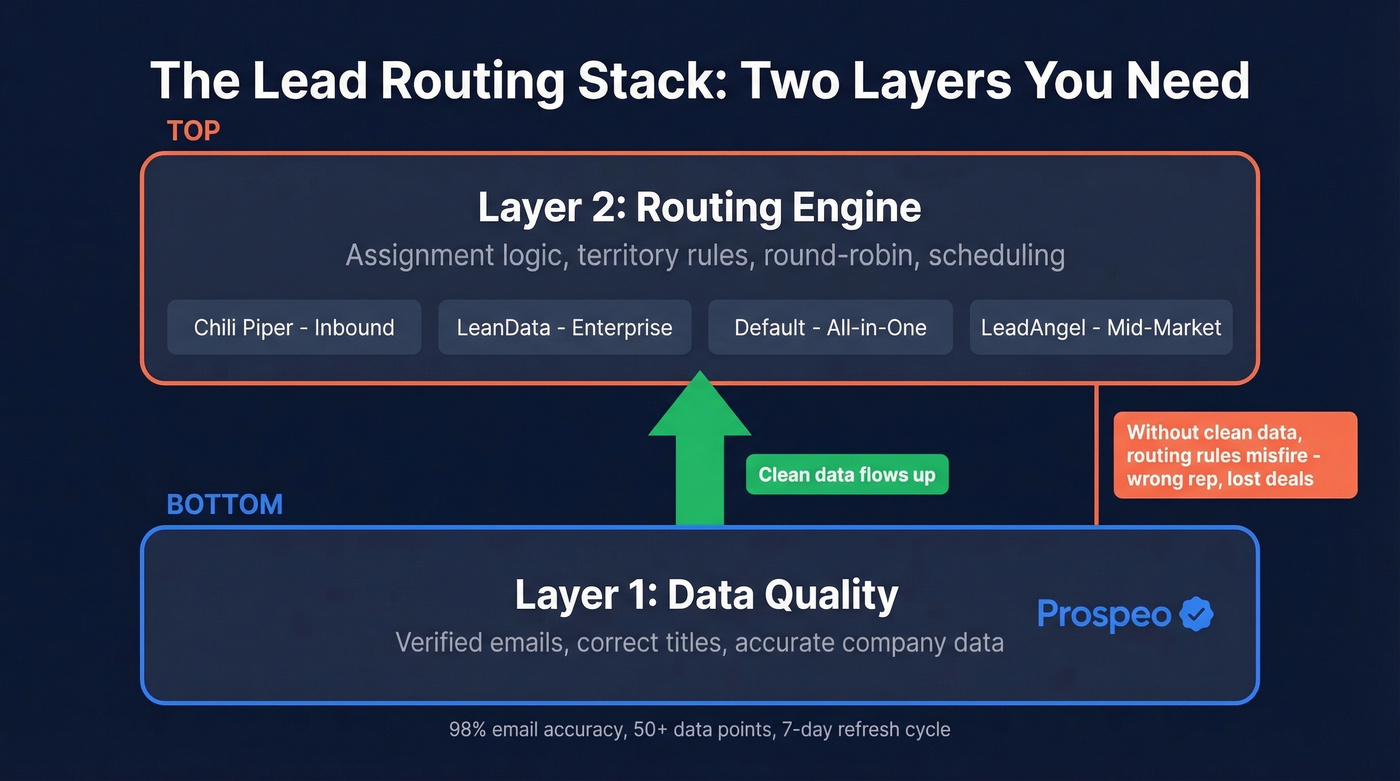
But here's the thing: routing tools only work when the data flowing into them is clean. A misspelled company name, a stale email, a wrong title - any of those can send a $200k deal to the wrong rep or into a black hole. You need both the routing layer and the data quality layer underneath it.
Our Top Picks
| Use Case | Tool | Why |
|---|---|---|
| Clean data before routing | Prospeo | 98% email accuracy, 50+ enrichment data points - routing only works with clean data |
| Best for inbound routing | Chili Piper | Form-to-meeting in seconds, strongest inbound workflow |
| Enterprise Salesforce shops | LeanData | Gold standard for complex territory logic at scale |
| All-in-one workflow canvas | Default | Routing + enrichment + scheduling in one platform |
10 Best Lead Routing Tools Compared
Prospeo - Best for Data Quality Before Routing
Use this if you want every lead hitting your router to have a verified email, correct title, and accurate company data before assignment logic even fires.
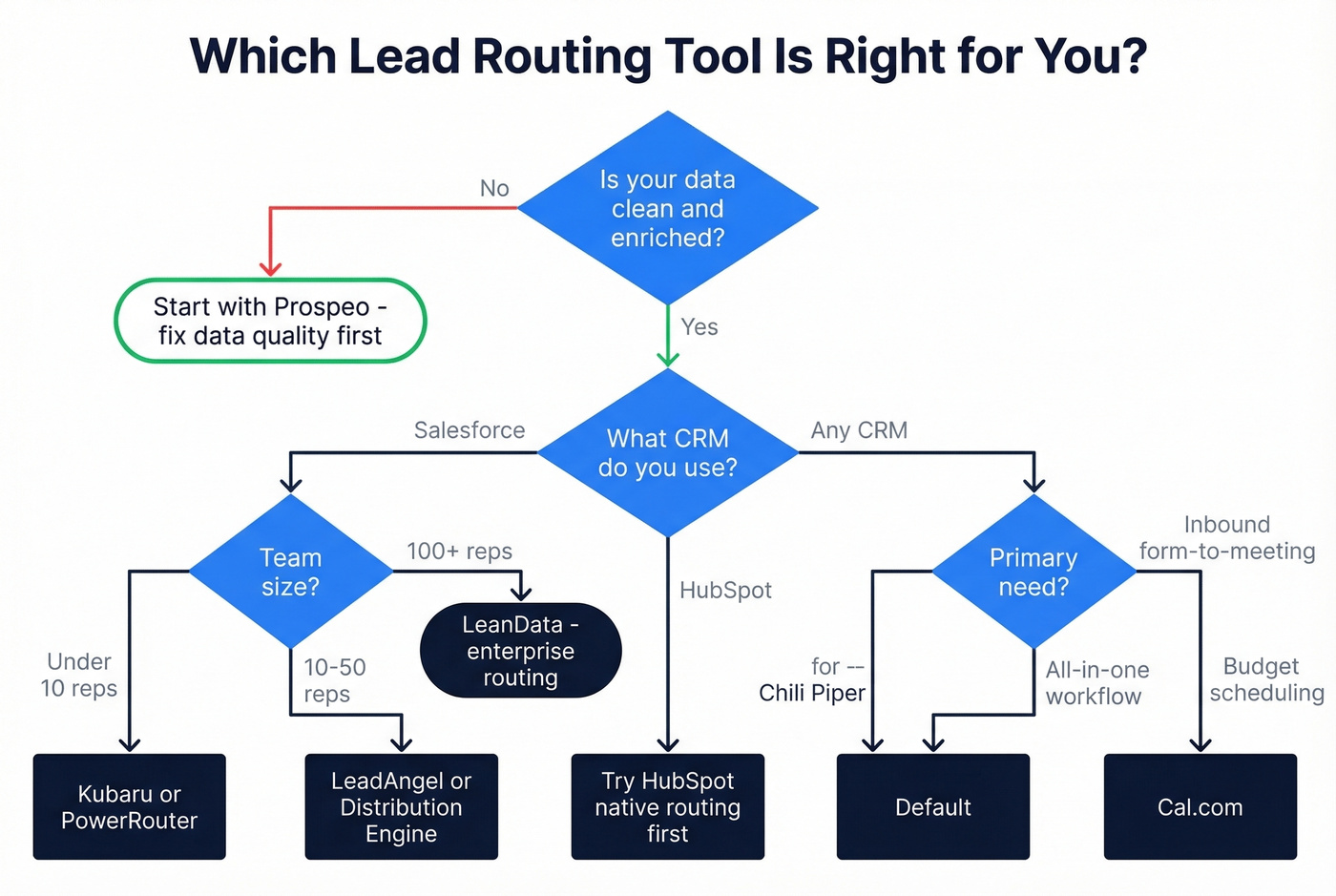
Pair this with a dedicated routing engine - Prospeo handles the data quality layer, not the assignment logic itself.
Prospeo's database covers 300M+ professional profiles with 143M+ verified emails and 125M+ verified mobile numbers. CRM enrichment returns 50+ data points per contact at a 92% API match rate, and everything refreshes on a 7-day cycle compared to the 6-week industry average. Native Salesforce and HubSpot integrations mean enriched data flows directly into whatever routing tool you're running downstream.
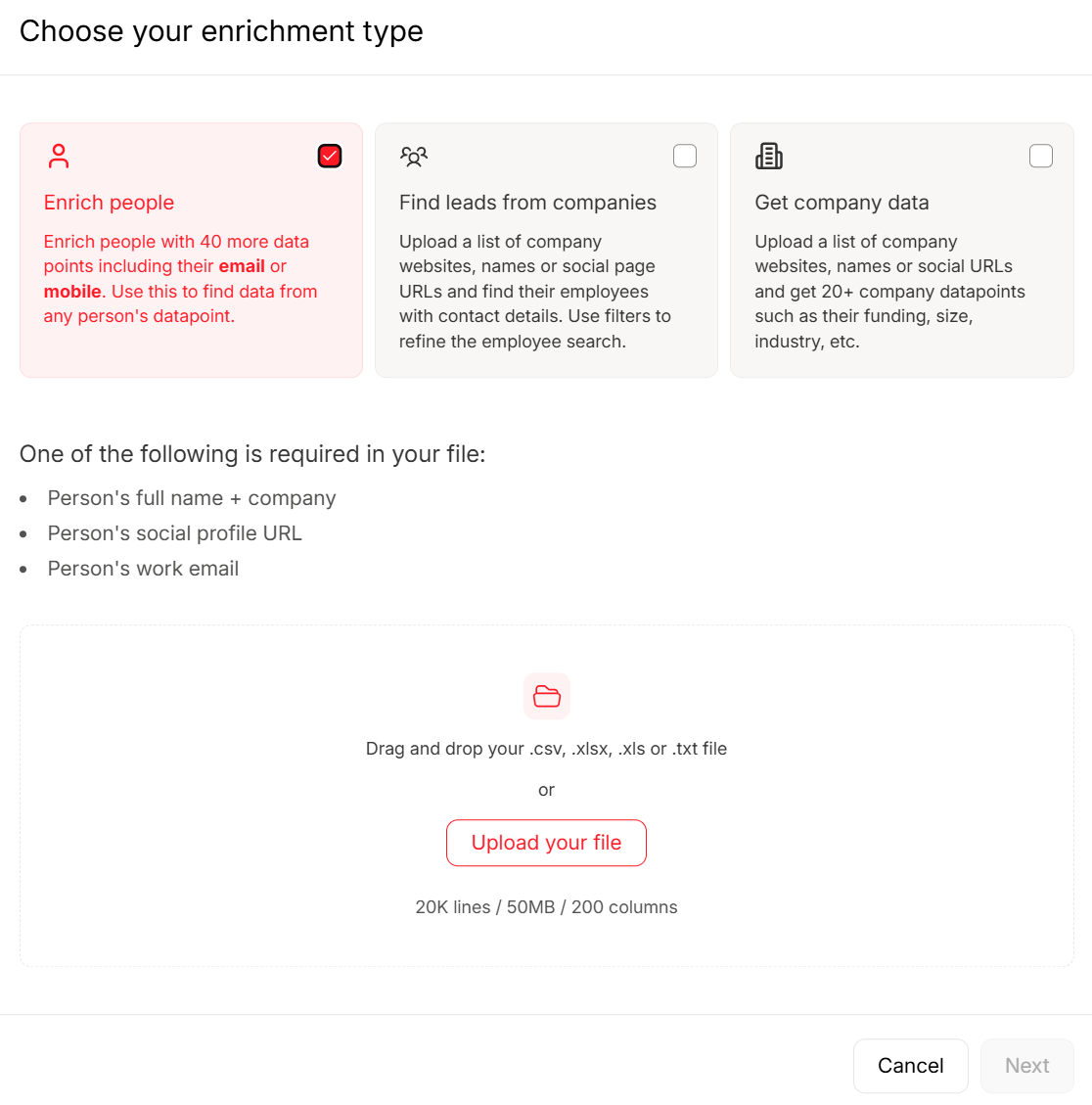
Your $40k routing tool assigning leads to the wrong rep because the company name is misspelled or the industry field is blank? That's a $40k waste. Fix the data first. Prospeo starts free with 75 verified emails/month, with credit-based pricing at roughly $0.01/email after that. No contracts, no sales calls required.
Chili Piper - Best Inbound Routing
Use this if your primary challenge is converting inbound form fills into booked meetings before the lead goes cold.
Skip this if you need complex multi-object routing across territories, accounts, and custom Salesforce objects.
Chili Piper is the best inbound lead routing option, period. But it's a scheduling product that learned routing - not a routing product that learned scheduling. The form-to-meeting workflow is genuinely best-in-class: a lead fills out your demo request form, Chili Piper qualifies and routes them in real time, and they're booking a meeting before they've even closed the tab.

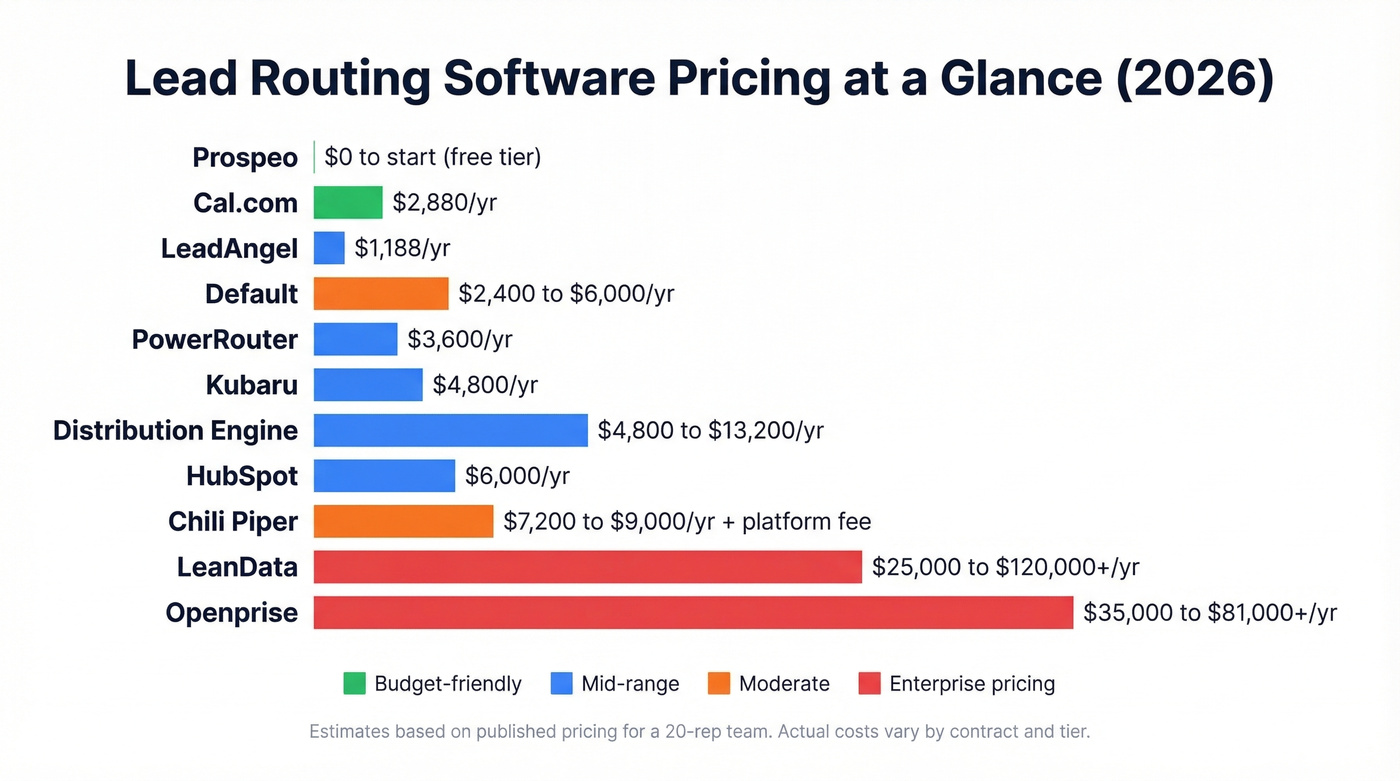
Pricing starts at roughly $22.50-$30/user/month depending on the plan, plus a $150/month platform fee. Lower-tier plans are scheduling-only - you need the higher plans for actual routing logic. For a 10-rep team, expect to pay roughly $375-$450/month all-in. That's reasonable for the conversion lift you'll get on inbound, but it adds up fast if you're also buying a separate tool for outbound territory routing.
LeanData - Best for Enterprise Salesforce
We've seen teams spend six months implementing LeanData - and then watched it become the single most valuable piece of their Salesforce stack. That's the LeanData tradeoff in a nutshell.
LeanData is the enterprise gold standard for CRM-based routing, lead-to-account matching, and complex assignment logic. It holds a 4.6/5 on G2 across 1,004 reviews in the Lead-to-Account Matching and Routing category, and the visual flow builder handles routing logic across leads, contacts, accounts, and custom objects that would break native Salesforce assignment rules. Veracode hit 900+ routing rules that caused Apex CPU limit errors - LeanData is built for exactly that level of complexity.

Estimated pricing runs $25k-$40k+/year for Standard, $40k-$70k/year for Advanced, and $75k-$120k/year for Premium. Enterprise is custom. That works out to roughly $39/$49/$59 per user/month depending on tier, but minimum user counts often start at 50-100, and implementation is billed separately.
Let's be honest: if you're a 15-person sales team, spending $40k+/year on routing is insane. LeanData earns its price at 100+ reps with complex territories, multi-object routing, and ABM workflows. Below that threshold, you're paying enterprise tax for mid-market problems.
Default - Best All-in-One Workflow
Default combines routing, enrichment, and scheduling into a single workflow canvas. It was built for modern revenue operations workflows, and the UX shows it - the visual builder is intuitive, editor seats are free, and the platform handles the full inbound flow from form submission to booked meeting without needing three separate tools. One standout feature: AI fuzzy matching that catches misspelled company names and domain variants before they break your routing rules.
Pricing follows a platform fee plus per-user license structure. Expect $200-$500/month for small teams, scaling up from there. Worth evaluating if you want one platform instead of three, especially if you're tired of duct-taping Chili Piper to a separate enrichment tool to a separate routing engine.
LeadAngel - Best for Mid-Market
LeadAngel hits a sweet spot for mid-market teams that need lead-to-account matching and ABM-aware routing without LeanData's price tag. The availability-aware routing checks rep calendars before assignment, which cuts down on leads sitting in someone's queue while they're on PTO. Starting at $99/company/month with a six-month free trial, LeadAngel is unusually generous on the try-before-you-buy front.
For teams with 10-50 reps running territory-based routing in Salesforce, it's the value pick.
Distribution Engine - Salesforce-Native Alternative
Distribution Engine is the reliable Salesforce-native option for teams that want solid CRM-based lead distribution without platform fees or enterprise contracts. It handles round-robin, weighted, and load-balanced distribution across any Salesforce object - leads, contacts, opportunities, and custom objects alike.
Starter runs $20/user/month, Advanced $35/user/month, Unlimited $55/user/month. For a 20-rep team, that's $400-$1,100/month - a fraction of LeanData. If your routing needs are straightforward and you live in Salesforce, Distribution Engine gets the job done without drama.
Other Notable Options
Kubaru - Budget Salesforce-native routing at $20/user/month flat. Handles basic round-robin and weighted assignment. Good for small Salesforce teams that need something better than native assignment rules but don't want to spend four figures monthly.
Openprise - Enterprise data orchestration platform that happens to do routing. 400+ pre-built connectors and 250k+ records per bot run make it a powerhouse for data operations. Professional starts at $35k/year, and the median buyer pays ~$81k/year per Vendr data. Only makes sense if data orchestration - deduplication, normalization, segmentation - is your primary need and routing is secondary.
PowerRouter - SMB visual routing starting at $15/user/month. Drag-and-drop logic builder that's easy to set up without a Salesforce admin. Good for small teams wanting simple territory or round-robin rules.
HubSpot (Native Routing) - If you're already on HubSpot, the built-in routing handles basics: round-robin assignment, simple rules-based distribution. The free CRM includes basic lead assignment; Sales Hub Starter at $25/user/month unlocks more. Don't buy a separate routing platform until you've outgrown what HubSpot gives you natively.
Cal.com - Open-source scheduling with routing capabilities baked in. The free tier covers basic round-robin, and paid plans start at $12/user/month. Worth a look if your routing needs are simple and you want meeting booking tightly integrated without Chili Piper's price tag.

Lead routing software can't fix bad data. A misspelled company name or wrong job title sends six-figure deals to the wrong rep - or nowhere at all. Prospeo enriches every lead with 50+ verified data points at a 92% match rate, refreshed every 7 days, so your routing rules actually fire correctly.
Clean data in, clean routing out. Start free with 75 verified emails.
Pricing Comparison
| Tool | Starting Price | Model | Best For |
|---|---|---|---|
| Prospeo | Free (75 verified emails/mo) | ~$0.01/email | Data quality layer |
| Chili Piper | ~$22.50-$30/user/mo + $150/mo | Per user + platform | Inbound routing |
| LeanData | ~$25k-$40k+/yr | Annual contract | Enterprise Salesforce |
| Default | ~$200-$500/mo | Platform + per user | All-in-one workflow |
| LeadAngel | $99/company/mo | Per company | Mid-market ABM |
| Distribution Engine | $20/user/mo | Per user | Salesforce-native |
| Kubaru | $20/user/mo | Per user | Budget Salesforce |
| Openprise | $35k/yr+ | Annual contract | Data orchestration |
| PowerRouter | $15/user/mo | Per user | SMB visual routing |
| HubSpot | Free-$25/user/mo | Per user | HubSpot-native |
| Cal.com | Free-$12/user/mo | Per user | Open-source scheduling |
5 Routing Mistakes That Kill Pipeline
1. Over-engineering your logic. Veracode ended up with 900+ routing rules that caused Salesforce CPU limit errors. Start with 5-10 rules. Add complexity only when you have evidence a simpler rule is misrouting leads.
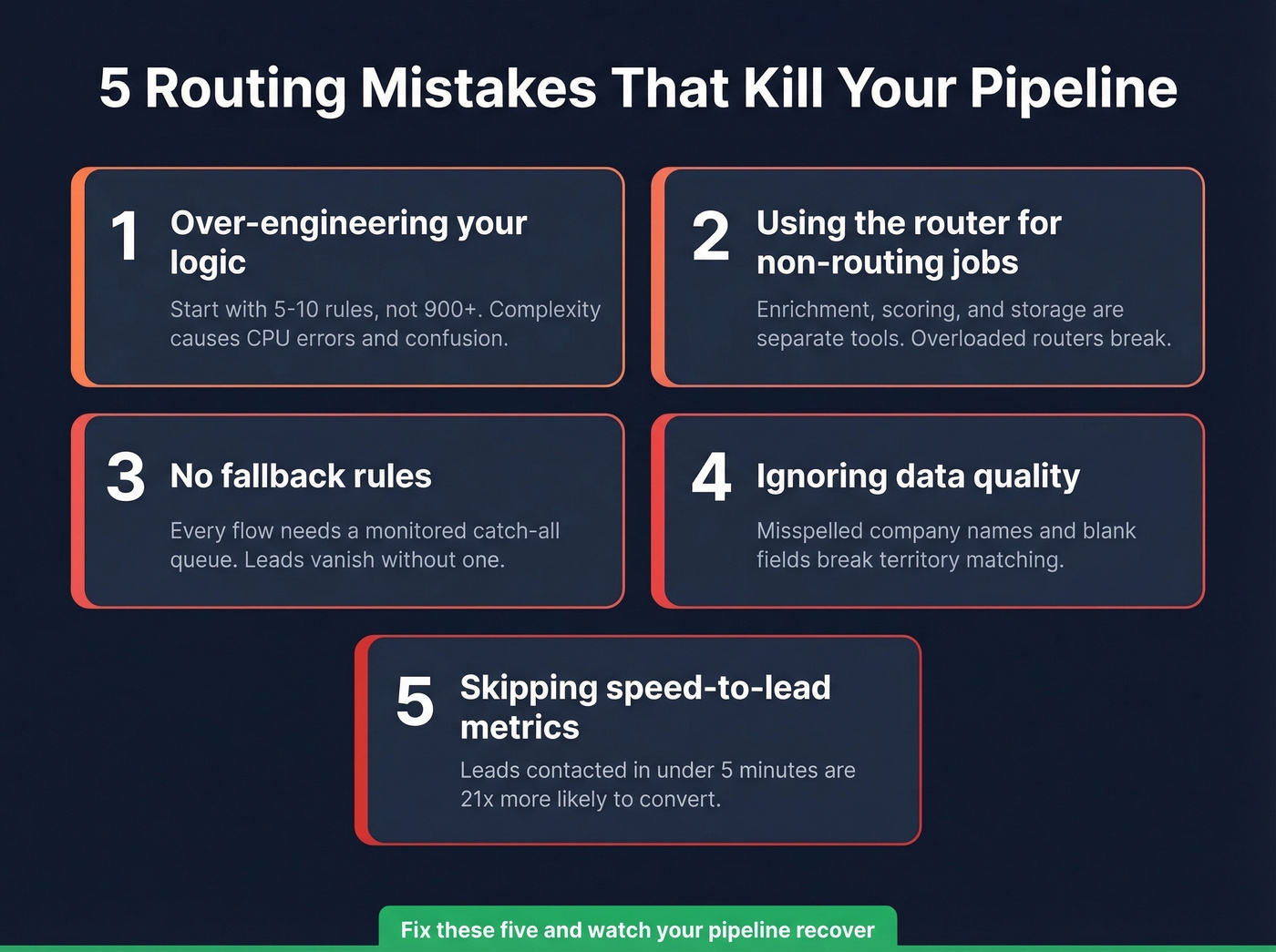
2. Using the router for non-routing jobs. Your routing tool shouldn't be doing enrichment, scoring, or data storage. Those are separate functions. When you overload a router, it becomes brittle and impossible to debug.
3. No fallback rules. Every routing flow needs a monitored catch-all queue. If no rule matches, the lead has to go somewhere visible - not into a void. We've seen teams lose hundreds of leads per quarter to this one mistake alone.
4. Ignoring data quality. Junk in, junk out. If the company name field says "Gogle" instead of "Google," your territory rules won't match. If the title field is blank, your role-based routing breaks. Enrich lead data before it hits the router - clean company names, accurate titles, and verified emails make every downstream rule more reliable.

5. Losing fairness and transparency. If reps don't trust the routing logic, they'll game it or ignore it. Publish your rules. Show reps how leads are assigned. Audit distribution monthly to catch imbalances before they become morale problems.
You just read that leads contacted within 5 minutes convert 21x better. But speed means nothing if your router assigns a lead based on a blank industry field or stale job title. Prospeo's CRM enrichment fills in the gaps - 300M+ profiles, 98% email accuracy, $0.01 per email - so every lead lands with the right rep instantly.
Stop routing blind. Give your assignment rules data they can trust.
How to Choose by Team Size
Startup (under 10 reps): Don't overthink this. Use Salesforce or HubSpot native assignment rules and move on. You don't need a $25k routing platform when you have eight reps.
Mid-market (10-100 reps): This is where dedicated lead routing software earns its keep. Chili Piper for inbound-heavy teams, LeadAngel or Distribution Engine for territory-based Salesforce routing. If you're evaluating multi-object routing - assigning not just leads but contacts, opportunities, and custom objects - make sure your tool handles all of them natively rather than forcing workarounds.
Enterprise (100+ reps): LeanData or Openprise, depending on whether your primary need is routing or broader data orchestration. Budget $40k-$120k/year and plan for a real implementation cycle. Revenue operations teams at this scale should also evaluate whether their routing tool integrates with their enrichment and intent data stack, or if they're building yet another point-to-point integration.
Here's our hot take: the biggest routing failure isn't choosing the wrong tool. It's spending six months evaluating while leads rot in an unassigned queue. If your average deal size is under $15k, you almost certainly don't need enterprise-grade routing - HubSpot native or PowerRouter will get you 80% of the way there at 5% of the cost. Pick something, ship it in two weeks, and iterate.
FAQ
What is lead routing software?
Lead routing software is the logic layer that assigns incoming leads to the right sales rep based on predefined rules - territory, round-robin, account matching, deal size, or any combination. It replaces manual assignment and ensures leads get worked fast by the right person. Most tools integrate directly with Salesforce or HubSpot.
How much does lead routing software cost?
Most mid-market tools run $20-$100/user/month, while enterprise platforms like LeanData start at $25k+/year. HubSpot and Cal.com offer free tiers for basic round-robin. Budget $5k-$15k/year for a 20-rep team on a mid-tier tool like LeadAngel or Distribution Engine.
What's the difference between lead routing and lead distribution?
Distribution is the overall process of assigning leads to reps or teams. Routing is the specific logic and rules that determine who gets which lead and why. Think of distribution as the "what" and routing is the "how." Most modern platforms handle both.
Do I need a dedicated tool or can I use Salesforce assignment rules?
Salesforce native rules work until you hit complex territories, multi-object routing, or 50+ reps. Once you're debugging assignment rules at 2 AM because a lead went to the wrong region, it's time for a dedicated tool like LeanData or Distribution Engine.
How do I prevent leads from being misrouted?
Start with data quality - verify and enrich lead data before it hits your routing engine. Then keep routing rules simple, add fallback queues, and audit monthly. Blank titles and misspelled company names are the most common culprits we see breaking territory rules.