


ManyReach Review 2026: Pricing, Pros, Cons, and the Hidden Credit Math
You buy a 100,000-credit pack from ManyReach. $199. Feels like a steal. Then warmup kicks in across your mailboxes, and credits start vanishing before a single prospect gets an email. The credit model is clever - until you don't understand where the credits actually go.
We've spent time digging through ManyReach's pricing page, cross-referencing G2 and Trustpilot reviews, and running the credit math that most reviews skip over. Here's what we found.
30-Second Verdict
ManyReach is a smart pick for agencies running dozens of mailboxes who want to dodge per-seat pricing. The credit model can look cheaper for bursty senders who don't want another monthly subscription - but warmup eats credits, support is a recurring complaint, and deliverability feedback is mixed. If you're sending at scale across many accounts, it's worth testing. If you need reliable support or multichannel sequences, Instantly or Smartlead are better bets.
ManyReach Pricing Breakdown
Back in 2019, Larry Kim needed to reach 5 million local businesses per year - roughly 25,000 emails per day across 500+ senders. Per-sender pricing would've cost around $250,000/year. So his team built their own tool, which became ManyReach. They claim to have invented sender rotation, and 11,500+ teams now use the platform.
The core model: 1 credit = 1 campaign email.
| Credit Pack | Price | Per Credit |
|---|---|---|
| 250 (Free) | $0 | - |
| 10,000 | $99 | $0.0099 |
| 100,000 | $199 | $0.0019 |
| 300,000 (promo) | $299 | $0.0010 |
| 600,000 | $699 | $0.0012 |
| 1,000,000 | $999 | $0.0010 |
At the 100k tier, you're paying under $0.002 per email. Genuinely cheap. But here's where it gets tricky.
The Warmup Credit Burn
Warmup isn't free on pay-as-you-go plans. ManyReach's pricing page spells it out: 1 credit = 10 warmup emails.
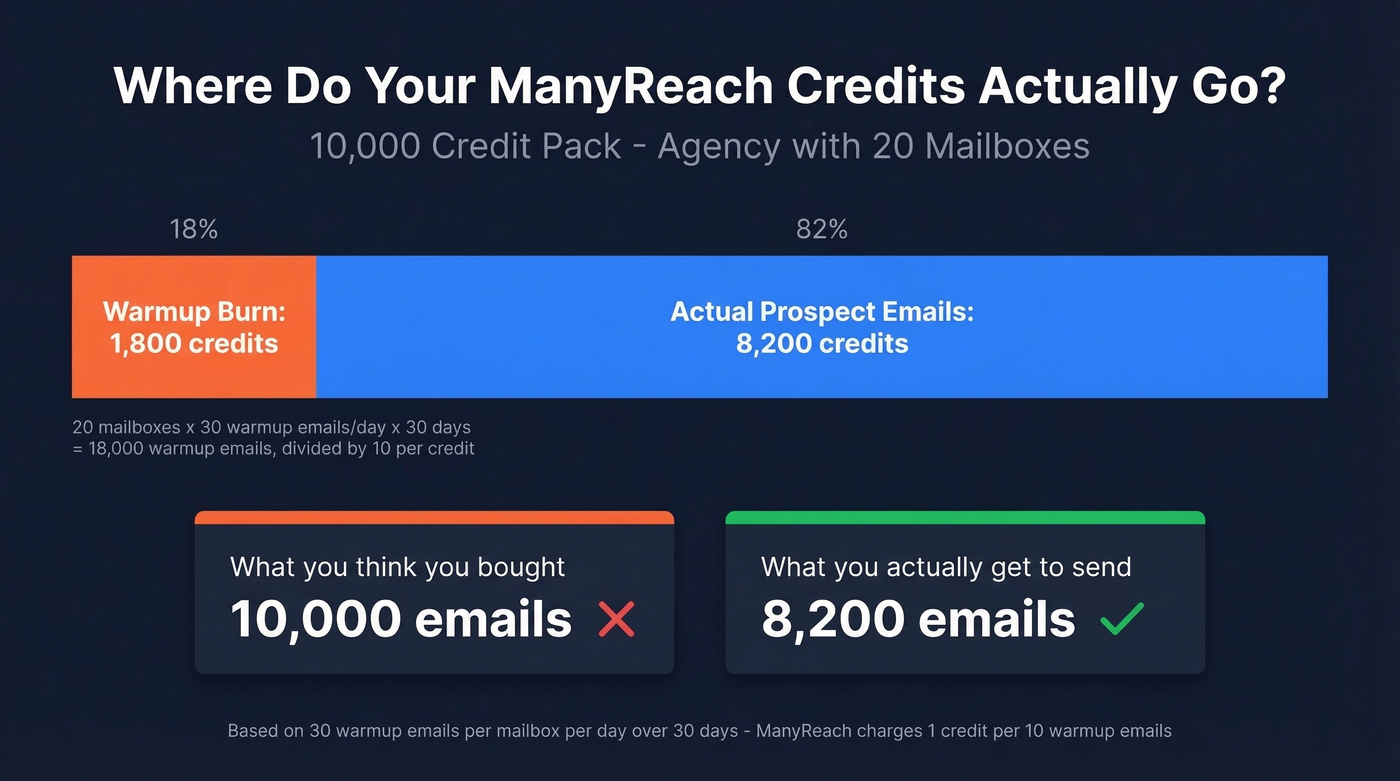
Let's run the math on a typical agency setup - 20 mailboxes, 30 warmup emails per day each, over 30 days:
- 20 x 30 x 30 = 18,000 warmup emails
- 18,000 warmups / 10 per credit = 1,800 credits burned
On the 10,000-credit pack, that's 18% of your credits gone into warmup before a single prospect hears from you.
ManyReach also offers Power Mode for unlimited warmup, but the price isn't published. Expect roughly $10-$30/month based on comparable warmup add-ons across the market (see unlimited warmup options).
Pricing Contradictions Worth Knowing
ManyReach's pricing page says "credits never expire." But the FAQ includes a line about credits resetting monthly on certain lifetime plans, where unused credits get swapped for a new monthly allotment. Those two messages don't line up.
There's also a mismatch on ManyReach's own Instantly comparison page: it lists 10,000 credits at $39, while the pricing page lists 10,000 credits at $99. We couldn't find an explanation for the discrepancy.
ManyReach vs Instantly vs Smartlead
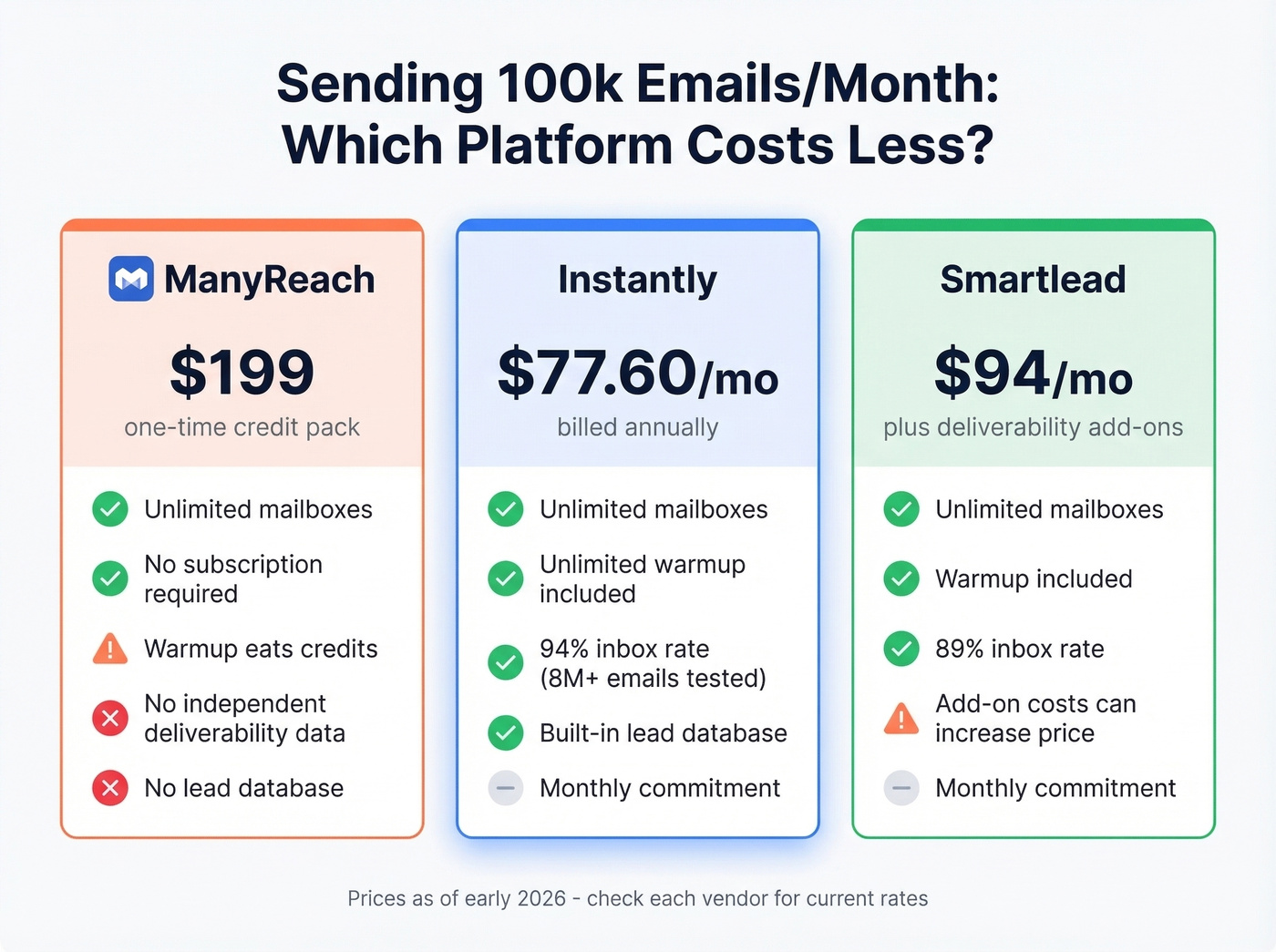
Here's what 100,000 emails per month looks like across the three main cold email platforms.
| Factor | ManyReach | Instantly | Smartlead |
|---|---|---|---|
| 100k emails cost | $199 in credits | $97/mo ($77.60/mo annual) | $94/mo + deliverability add-ons |
| Pricing model | Credit packs | Monthly subscription | Monthly subscription |
| Unlimited mailboxes | Yes | Yes | Yes |
| Built-in warmup | Yes (uses credits unless on unlimited warmup mode) | Yes (unlimited) | Yes (included; deliverability add-ons available) |
| Deliverability data | No independent benchmark | 94% inbox (8M+ emails) | 89% inbox |
ManyReach can be great value if you don't want a recurring subscription and your sending is bursty. But if you're truly sending 100k every month, Instantly's Hypergrowth plan is the cleanest all-in number at $97/month ($77.60/month billed annually).
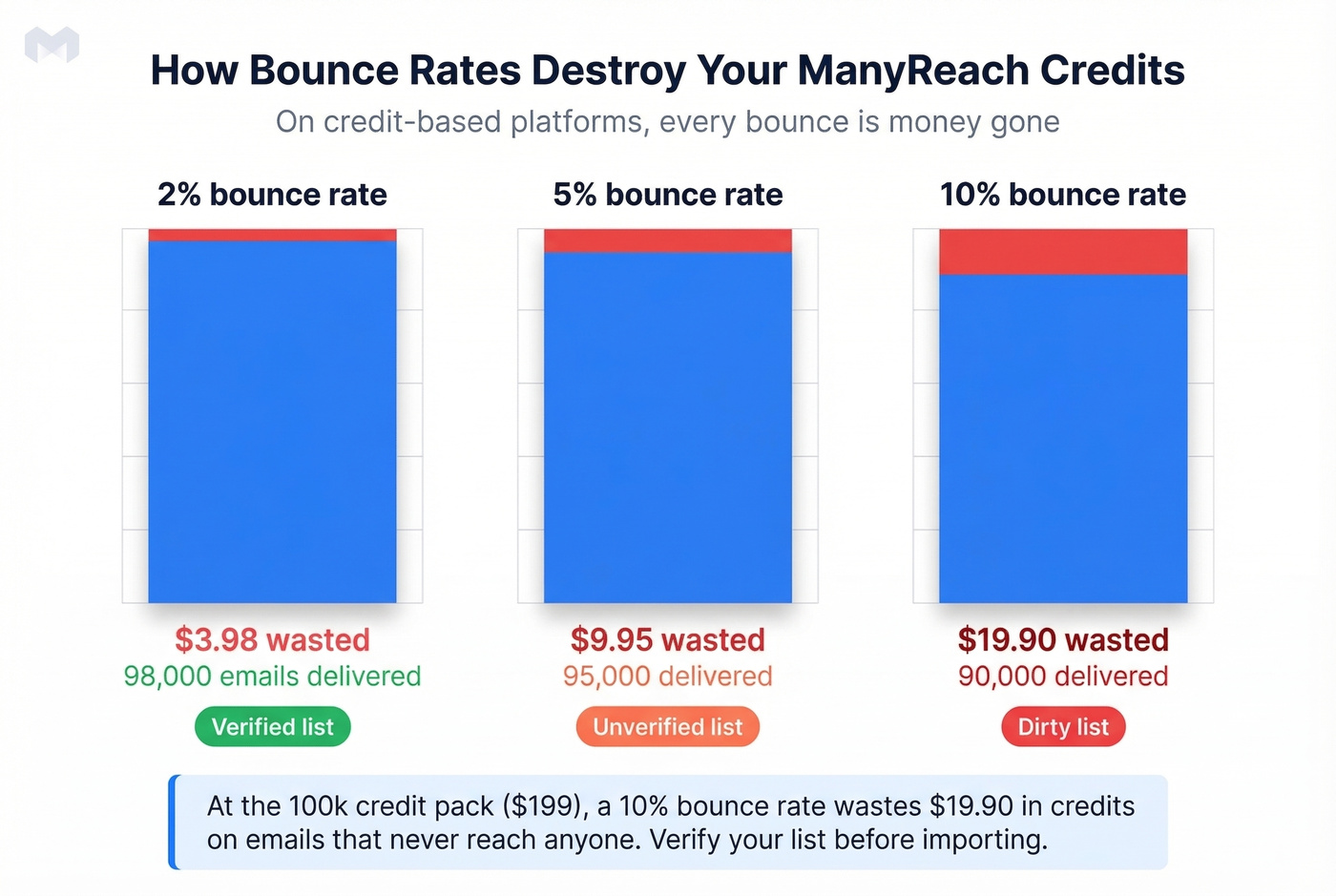
Here's the thing: there's no widely cited independent deliverability benchmark for ManyReach. They advertise "99% inbox delivery" on their marketing page, but that's a vendor number without third-party validation. And credit-based models punish bad data harder than subscriptions do - every bounce is money gone (track your email bounce rate closely).

Credit-based platforms punish bad data harder than subscriptions. Every bounce is money gone. Prospeo's 98% email accuracy and 5-step verification mean you import clean lists - so your ManyReach credits go to real prospects, not dead addresses.
Stop burning credits on bounces. Verify before you send.
Pros and Cons of ManyReach
What Users Like
ManyReach holds a 4.4/5 on G2 (33 reviews) and a 4.3/5 on Trustpilot (26 reviews).
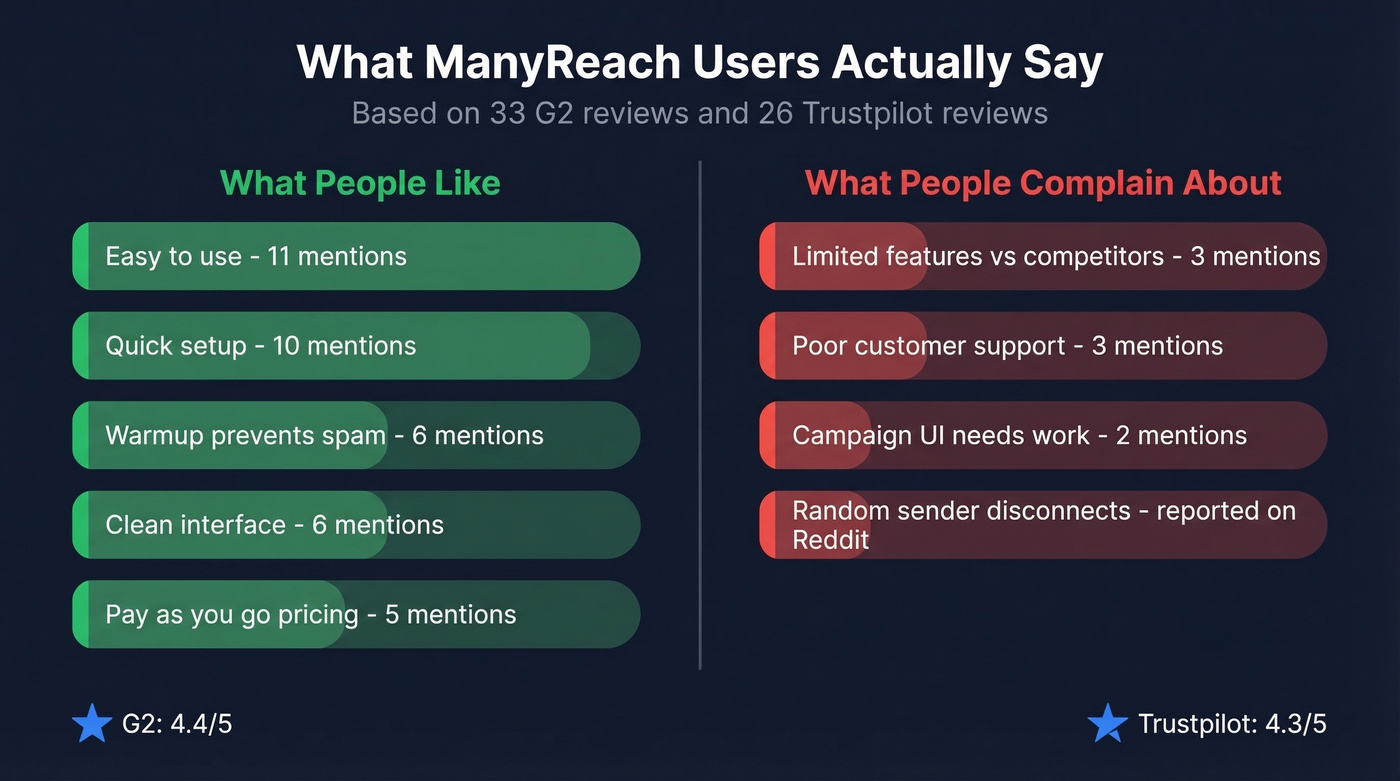
On G2, the consistent praise centers on ease of use (11 mentions), quick setup (10 mentions), warmup preventing spam (6 mentions), a clean interface (6 mentions), and pay-as-you-go pricing (5 mentions). Unlimited mailboxes without per-seat pricing is the headline feature, and Trustpilot reviews often highlight the unified inbox and agency-friendly setup.
What Users Don't Like
On G2's pros and cons view, three recurring issues stand out: limited features compared to competitors (3 mentions), poor customer support (3 mentions), and a campaign UI/UX that needs work (2 mentions).
A user on r/coldemail who bought a lifetime deal described random sender disconnects, a laggy web app, and poor deliverability despite following best practices. One Trustpilot review flags a serious security concern: SMTP passwords allegedly appearing unencrypted in the settings UI. The company did reply to that review, but the fact it happened at all is concerning.
Who Should Use ManyReach
Use it if you're an agency managing 20+ mailboxes and want to avoid per-seat pricing, or a burst sender who runs campaigns quarterly. Credits sitting idle don't cost you anything.
Skip it if you need reliable customer support, multichannel outreach beyond email, a built-in lead database, or a polished UI. Instantly and Smartlead are both ahead on interface quality, and the consensus on r/coldemail leans toward those two for teams that need more than just sending infrastructure (see SDR tools that cover more channels).
Stop Wasting Credits on Bad Data
A 5% bounce rate on 100,000 emails means 5,000 wasted credits - credits you paid for and got zero value from. On a credit-based platform like ManyReach, list hygiene isn't optional. It's the difference between the credit model working for you and working against you (use an email deliverability guide to diagnose issues upstream).

ManyReach sends emails. It doesn't find them. Prospeo gives you 143M+ verified emails at $0.01 each - with 98% accuracy and a 7-day refresh cycle. Build your list clean, then send it anywhere.
Pay per credit? Make every single one count.
FAQ
Do ManyReach credits expire?
ManyReach's pricing page says credits never expire, but the FAQ includes language about credits resetting monthly on certain lifetime plans - unused credits get swapped for a new monthly allotment. Check which plan type you're on before buying a large pack.
Is ManyReach good for agencies?
Yes - unlimited mailboxes and no per-seat pricing make it one of the most agency-friendly cold email tools available. The main risk at scale is support quality. G2 reviewers flag customer support as a recurring issue, so plan for self-service troubleshooting.
How do I avoid wasting credits on bounces?
Verify every list before importing. A 5% bounce rate on a 100k send wastes 5,000 credits. Run your CSV through an email verification tool, remove invalids, then import clean contacts into ManyReach.
What's a good alternative to ManyReach?
Instantly ($77.60/mo annual) is the strongest alternative for high-volume monthly senders - unlimited warmup included, no credit math. Smartlead suits teams wanting deliverability add-ons. For the data side, Prospeo's B2B database fills the lead database gap ManyReach lacks, with 300M+ profiles and 30+ search filters.