

How to Run a March Madness Sales Contest That Doesn't Fizzle After Round 1
Your VP just Slacked the team: "Let's do a March Madness bracket!" Everyone's hyped for about 48 hours. Then your top two reps dominate the first round, three people get eliminated, and half the floor stops trying. One manager on r/sales described exactly this - hard workers knocked out early, effort cratering the moment reps hit elimination. The contest that was supposed to energize the team became a spectator sport for 70% of it.
Here's how to design a bracket tournament that actually works for all 12 (or 16, or 8) of your reps - not just the closers who were going to crush quota anyway.
Do Bracket-Style Sales Contests Actually Work?
Contests work when they're designed for the middle 60% of your team, not the top 20%. That's the whole game.
Gamified incentive structures boost sales performance up to 20% according to McKinsey research, and 90% of employees report feeling more motivated when gamification is involved. The gamification market is projected to hit roughly $30.7B by 2026, which tells you something about how seriously companies are taking this.
Here's the real reason March timing works: deals closed within 50 days carry a 47% win rate versus 20% or lower after that window. A 3-4 week sales bracket tournament compresses activity and shoves early-stage pipeline forward before it goes stale. We've seen teams go from never sending personalized video in ten years to sending 126 in a single day after adding gamification mechanics. The lift is real - it's just temporary, so you need to capture the pipeline it creates.
Step-by-Step Setup
Pick Your Metric
Percentage-to-quota is the only fair choice. It normalizes for territory size, quota differences, and tenure, so a newer rep carrying a $200K target competes on equal footing with a veteran at $800K. Raw revenue brackets just crown the same person who'd have won anyway. That's not a contest; it's a foregone conclusion.
Here's the thing: if you're incentivizing the exact same metric reps are already comped on, you're not running a contest - you're just paying extra for performance you were already going to get. Pick a secondary behavior you want to accelerate. Run a quick brainstorm with your reps to surface which behaviors matter most. They know where effort is being left on the table better than anyone in the room.
Set Your Bracket Scoring
Stop copying the NCAA's 64-team format. Your team has 12 reps. Design for that.
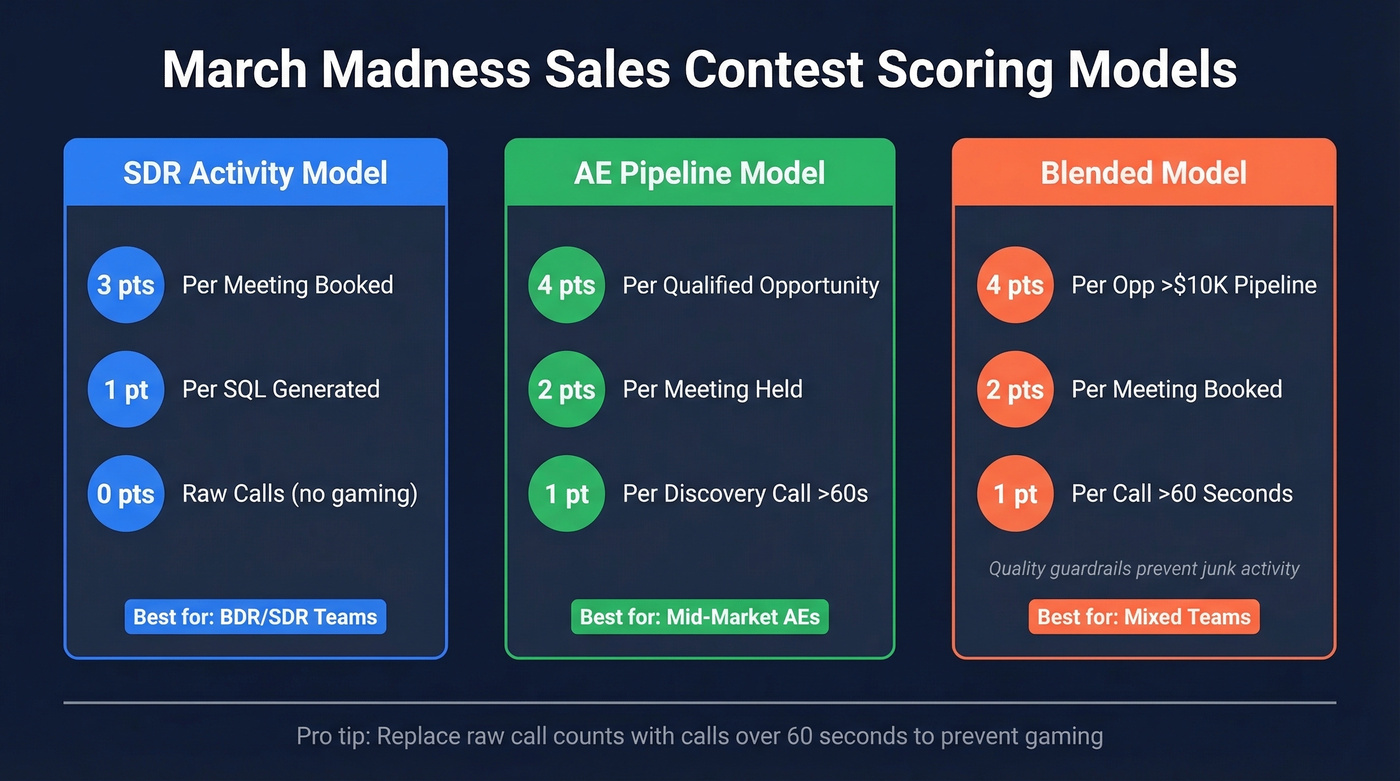
For 8 reps, run single-elimination with a consolation bracket. For 12-16, use seeded matchups and split into two regions. Headcount doesn't fit a clean power of two? Add a play-in round for the lowest seeds - keep it under 3 hours. Publish point values before day one. No ambiguity.
| Model | Points | Best For |
|---|---|---|
| SDR Activity | 3 pts/meeting, 1 pt/SQL | BDR/SDR teams |
| AE Pipeline | 4 pts/qualified opp, 2 pts/meeting | Mid-market AEs |
| Blended | 1 pt/call >60s, 2 pts/meeting, 4 pts/opp >$10K | Mixed teams |
The anti-gaming details matter. Replace "calls made" with "calls over 60 seconds." Replace "opportunities created" with "opportunities over $10K in pipeline value." Per Ambition's framework, these quality guardrails prevent reps from flooding the board with junk activity.
Match Round Length to Metric Type
| Metric Type | Round Length | Why |
|---|---|---|
| Burst activity (calls) | 1-8 hours | Fast feedback loop |
| Balanced (meetings) | 1-3 days | Enough time to book |
| Revenue/pipeline | 1-2 weeks | Deals need time to close |
The whole tournament runs 2-4 weeks. Play-in rounds should be short - 3 hours max.
Build Anti-Dropout Mechanics
This is the part everyone skips, and it's the reason most brackets fail.
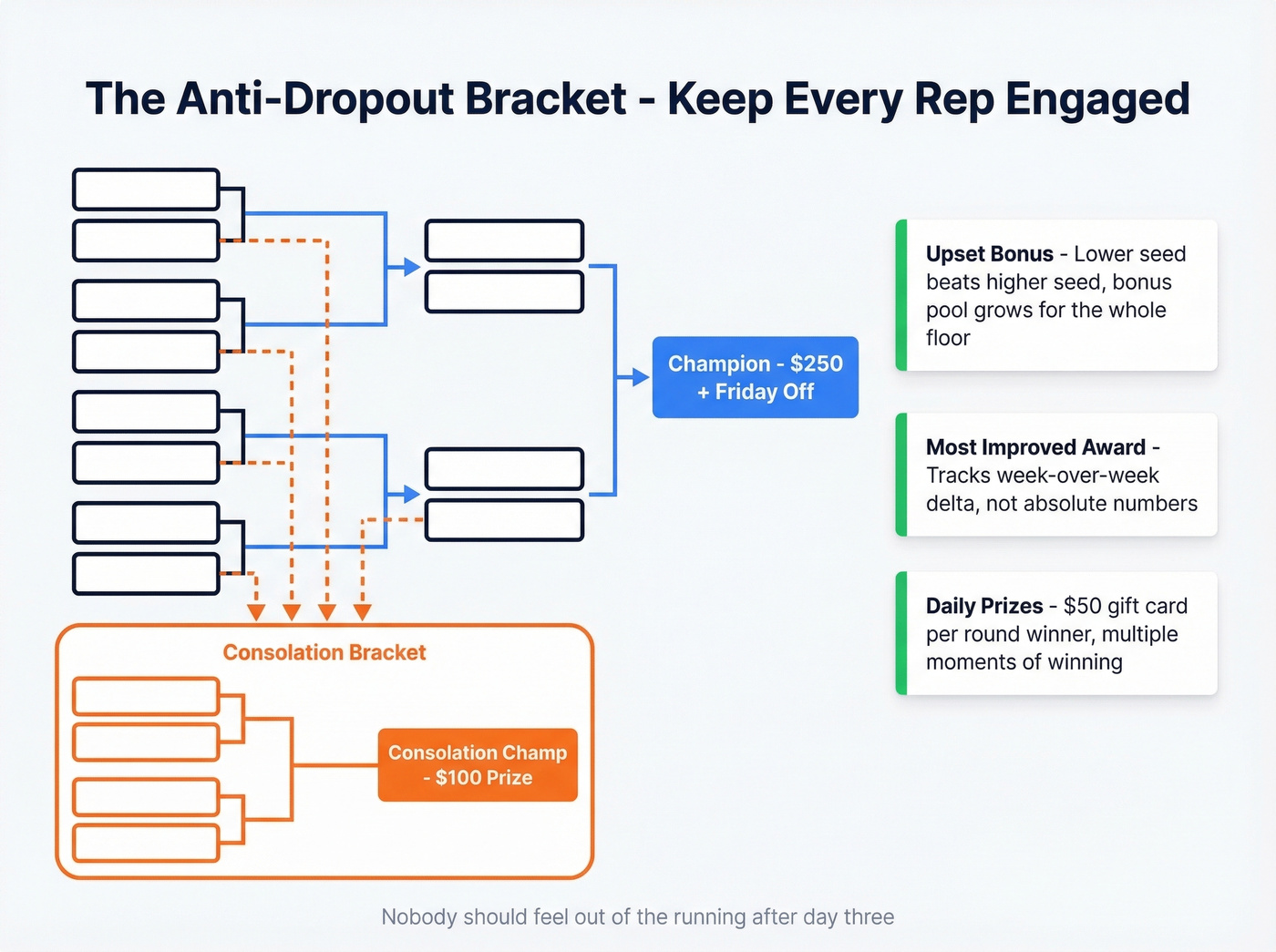
Run a parallel consolation bracket for first-round losers. Add an "upset bonus" - when a lower seed beats a higher seed, bump the bonus pool for the whole floor. Create a "most improved" award tracking week-over-week delta, not absolute numbers.
If brackets aren't your style, Cognism's SDR team runs "Day at the Races" where mixed teams earn points that move a horse to the finish line, and Bingo formats as alternatives. You could also try a fantasy sales competition where managers draft mixed-skill teams and compete on combined output. It keeps everyone accountable because no one wants to be the weak link on someone else's roster. Both formats keep eliminated reps engaged because they're team-based rather than head-to-head.
Nobody should feel out of the running after day three.
Prize Budget That Works
You don't need a massive budget. You need multiple moments of winning.
| Tier | Prize | When |
|---|---|---|
| Daily | $50 gift card | Each round winner |
| Weekly | $100 card or UberEats | Milestone hits |
| Champion | $250+ or Friday off | Bracket winner |
| 4-day week | Hit goals by Thursday, Friday off | Weekly milestone |
Cognism's SDR team allocates roughly L100 per monthly grand prize - a bottle of whisky, a chef's knife, whatever the rep actually wants. That personal touch outperforms a generic Amazon card every time. On the other end, Rocket Mortgage runs luxury trip prizes that drive 12+ hour days and their highest-producing month of the year. Scale the prize to your budget, but always create multiple tiers so more than one person walks away with something.

A sales contest only works if reps have enough pipeline to compete. Prospeo gives your team 300M+ verified contacts with 30+ filters - so every rep enters the bracket with a full pipeline, not an empty CRM.
Don't let bad data decide who wins your bracket.
Five Mistakes That Kill Your Contest
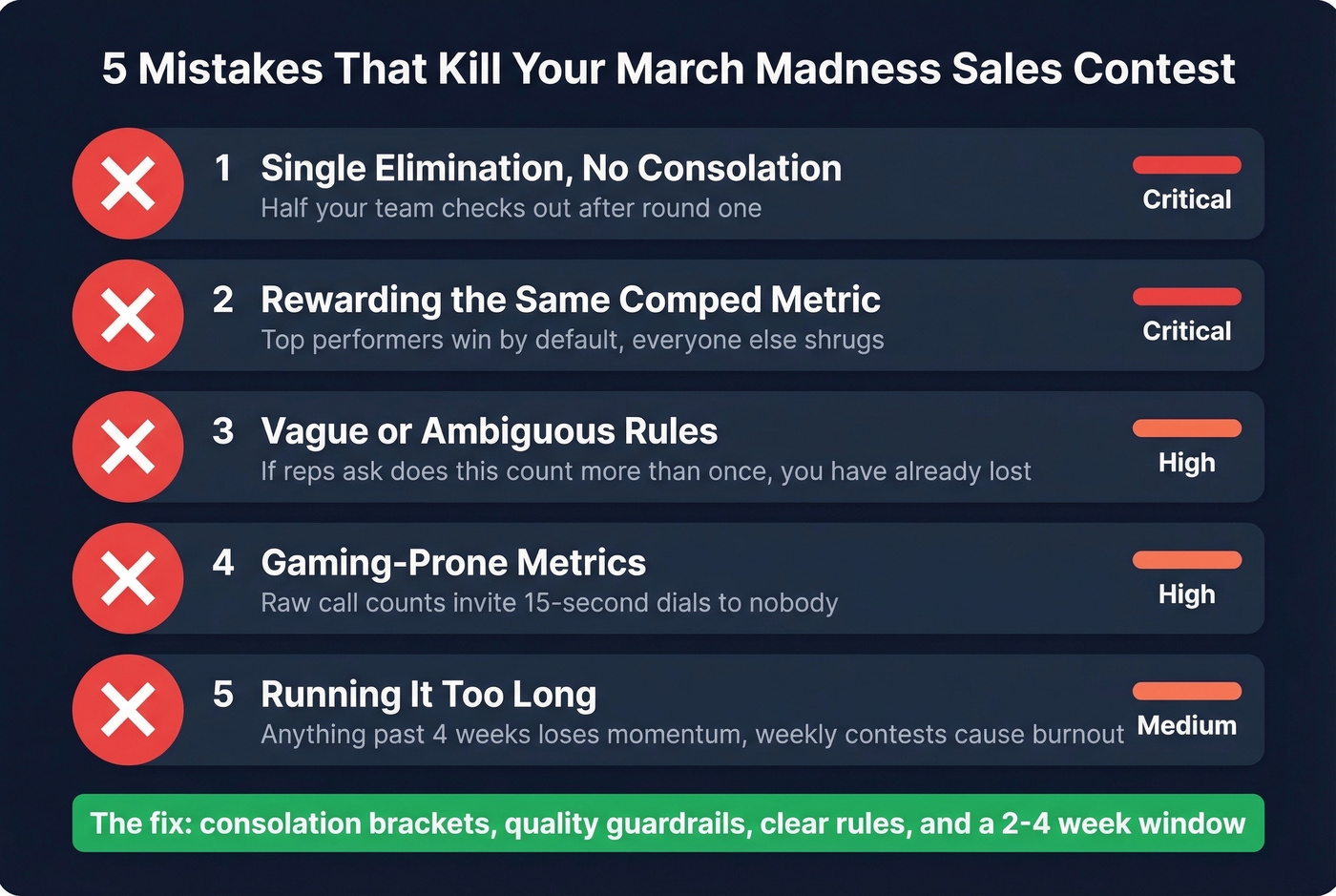
- Single elimination with no consolation bracket - half your team checks out after round one.
- Rewarding the same metric reps are already comped on - top performers win by default, everyone else shrugs.
- Vague rules - if reps ask "does this count?" more than once, you've already lost.
- Gaming-prone metrics - raw call counts invite 15-second dials to nobody. We've watched it happen.
- Running it too long - anything past 4 weeks loses momentum, and weekly contests cause burnout.
Running It Remote or Hybrid
Remote teams need visibility and instant gratification. Post standings in a dedicated Slack channel at least twice a week - a leaderboard screenshot plus a one-line callout of the biggest upset. On r/sales, SDR managers consistently recommend UberEats vouchers over "lunch on the manager" when your team spans three time zones. For SDR teams, 75-100 calls/day is a common activity benchmark to build contests around.
For distributed teams, pair the bracket challenge with a virtual happy hour at the end of each round - a 30-minute Zoom toast where you announce winners, replay the best upset, and let eliminated reps trash-talk their way into the consolation bracket. It keeps energy high even when people aren't in the same office.
Launch message template:
"Contest Name" kicks off [Date]. Metric: % to quota. Rounds: 3 days each. Prize: $250 + Friday off for the champion, $50 per round winner. Full bracket and rules: [link]
Standings update (twice weekly):
Round 2 standings are live. Biggest upset: [Rep A] over [Rep B] by 12 points. Next round closes Thursday 5pm.
Software vs. Spreadsheets
Let's be honest: Google Sheets plus Slack works perfectly fine for teams under 30 reps. We've seen elaborate software setups that took longer to configure than the contest itself ran. Save the platform investment for when you're running contests quarterly across multiple offices.
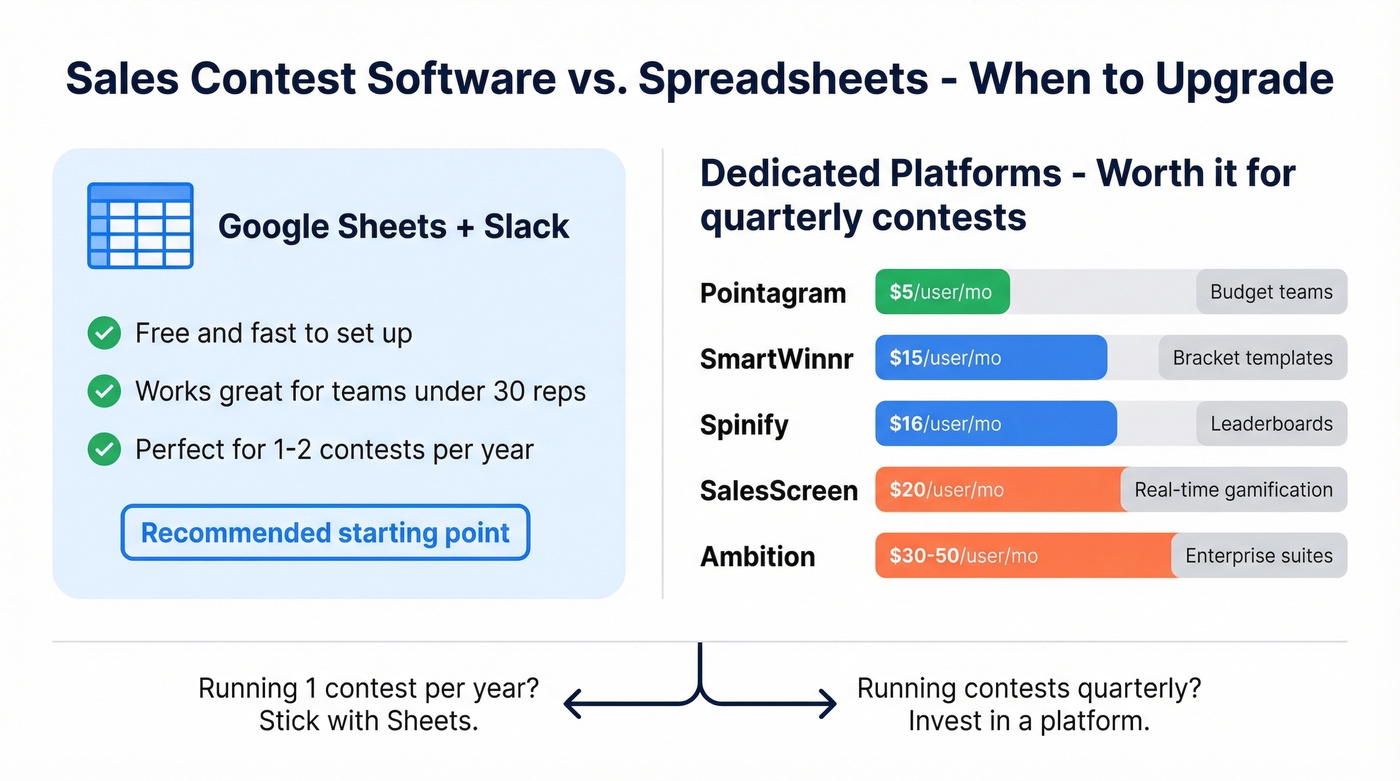
If you do want dedicated software:
| Tool | Starting Price | Best For |
|---|---|---|
| Pointagram | $5/user/mo | Budget teams |
| SmartWinnr | $15/user/mo | Bracket templates |
| Spinify | $16/user/mo | Leaderboards |
| SalesScreen | $20/user/mo | Real-time gamification |
| Ambition | ~$30-50/user/mo | Enterprise suites |
Skip the paid tools if you're running one contest per year. They're worth it when gamification becomes a recurring part of your sales culture, not a one-off March experiment.
Don't Let the Pipeline Die on the Vine
The contest generates pipeline. Make sure it converts. Activity bursts produce a surge of new contacts, and a lot of them will have stale or unverified data sitting in your CRM from months ago. Before reps start hammering sequences, run those contacts through Prospeo's email verification - at 98% email accuracy with a 7-day data refresh cycle, you're not wasting momentum on bounced addresses that tank your domain reputation.
If you want to tighten the rest of the system, pair the contest with better sales activities, a clearer lead generation workflow, and a simple pipeline health check so the surge doesn't disappear into the CRM.
Your reps are dialing hard during the contest - don't waste that energy on bounced emails and wrong numbers. Prospeo delivers 98% email accuracy and 125M+ verified mobiles with a 30% pickup rate, starting at $0.01 per email.
Turn contest energy into booked meetings, not bounced emails.
FAQ
How long should a March Madness sales contest last?
Two to four weeks total. Use 1-3 day rounds for activity metrics like calls and meetings, or 1-2 week rounds for revenue. Keep play-in rounds under 3 hours so they don't drag before the real competition starts.
What's the best metric for a sales bracket contest?
Percentage-to-quota. It normalizes for territory size and quota differences, so a newer rep with a smaller number can realistically compete against a tenured closer. Raw revenue brackets almost always crown the same person - that's not a contest, it's a coronation.
How do I keep eliminated reps engaged?
Run a parallel consolation bracket, add upset bonuses that reward the whole floor, and track a "most improved" award based on week-over-week delta. Team-based side competitions like Cognism's "Day at the Races" format or a fantasy draft where managers pick blended rosters also keep energy high for reps who lost their head-to-head matchup.
How do I handle bad contact data from the activity surge?
Contest-driven outreach often surfaces stale emails and disconnected numbers. Verify contacts before sequencing them - Prospeo's free tier includes 75 email verifications per month, enough to spot-check your hottest leads and avoid bounce-rate spikes that damage domain reputation.