

The 15 Best Market Intelligence Tools in 2026
Your VP just asked why the team spent $35,000 on a data platform last year - and reps are still bouncing 30% of their outbound emails. Meanwhile, product marketing can't tell you what the top competitor changed on their pricing page last Tuesday. That's not a tools problem. It's an intelligence stack problem, and most companies are solving it with one overpriced monolith instead of the right combination of purpose-built market intelligence tools.
68% of deals now involve a direct competitor. The teams winning those deals run real-time competitive monitoring, verified contact data, and digital intelligence as separate, integrated layers. Here are the 15 tools that actually matter, what they cost, and how to assemble a stack that doesn't waste half your budget on features nobody touches.
Our Picks (TL;DR)
| Category | Pick | Why | Starting Price |
|---|---|---|---|
| B2B contact data & accuracy | Prospeo | 98% email accuracy, 7-day refresh, $0.01/lead | Free (75 verified emails/mo) |
| Competitive enablement | Crayon | Broad monitoring, battlecard automation | ~$12,450/yr |
| Digital/SEO intelligence | Semrush | Deepest keyword + traffic + ad intelligence | $129.95/mo |
| All-in-one (big budget) | ZoomInfo | Largest B2B database + intent signals | ~$15,000/yr |
| Financial research | AlphaSense | 10,000+ sources, NLP search, expert calls | ~$44,754/yr |
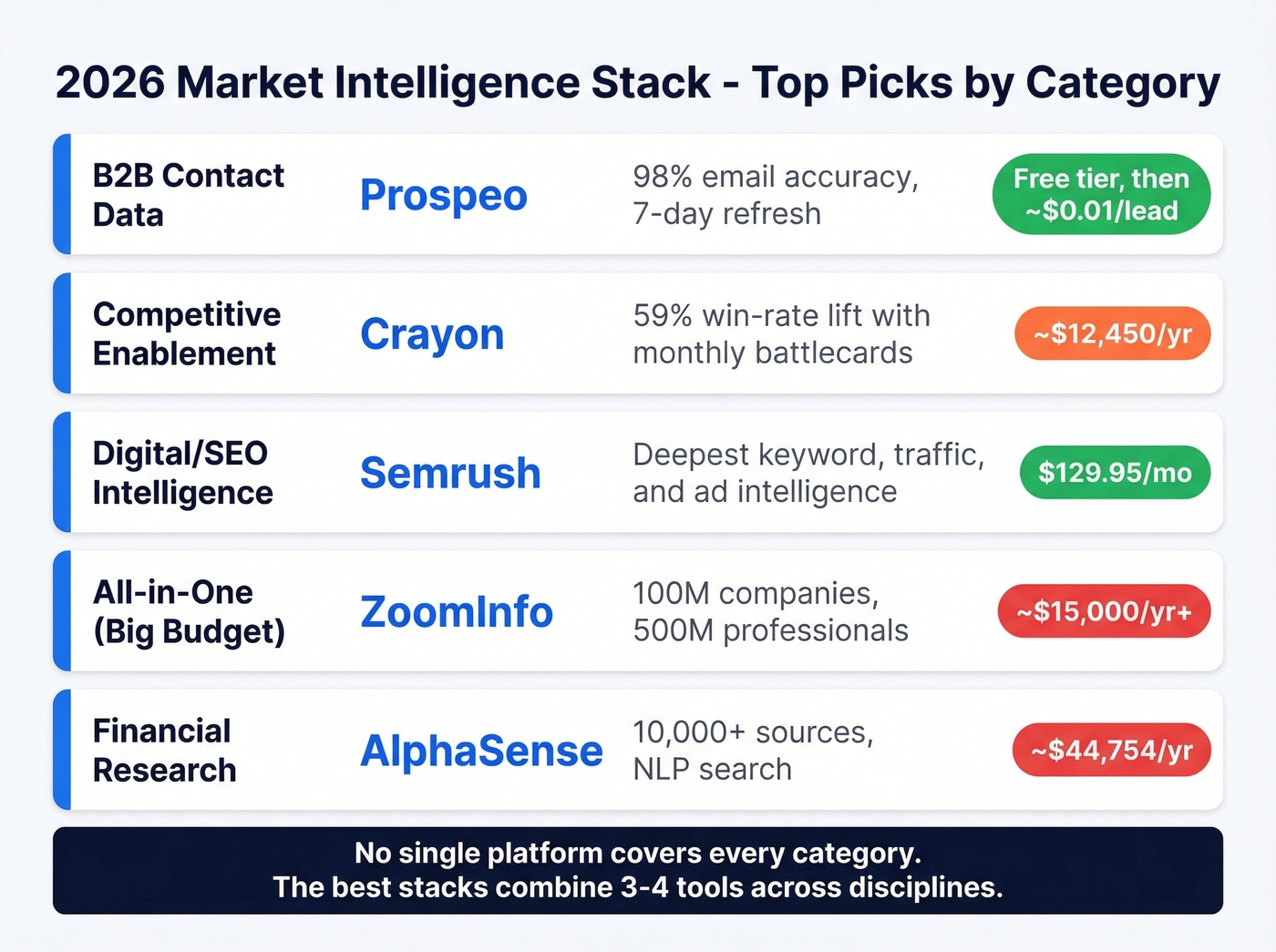
No single platform covers every category. The best stacks combine 3-4 of these across disciplines.
What Is Market Intelligence?
Market intelligence gets conflated with competitive intelligence, market research, and business intelligence constantly. They're related but distinct, and buying the wrong category of tool is one of the most expensive mistakes teams make.
Market intelligence is the broadest of the four - the ongoing collection and analysis of external data about your entire market: trends, segments, macro shifts, and category dynamics. Competitive intelligence is a subset focused specifically on tracking what rival companies are doing. Market research is point-in-time primary research (surveys, focus groups, interviews) aimed at a specific audience question. Business intelligence looks inward at your own operational data.
The CI tools market alone is projected to reach $1.46B by 2030, reflecting how these categories are converging: modern platforms increasingly blend competitive tracking with market monitoring and buyer intent signals.
How MI Flows Through Your Org
Most frameworks treat market intelligence as a research function. It's not. MI is an operational loop with three stages, and each stage maps to a different tool category:
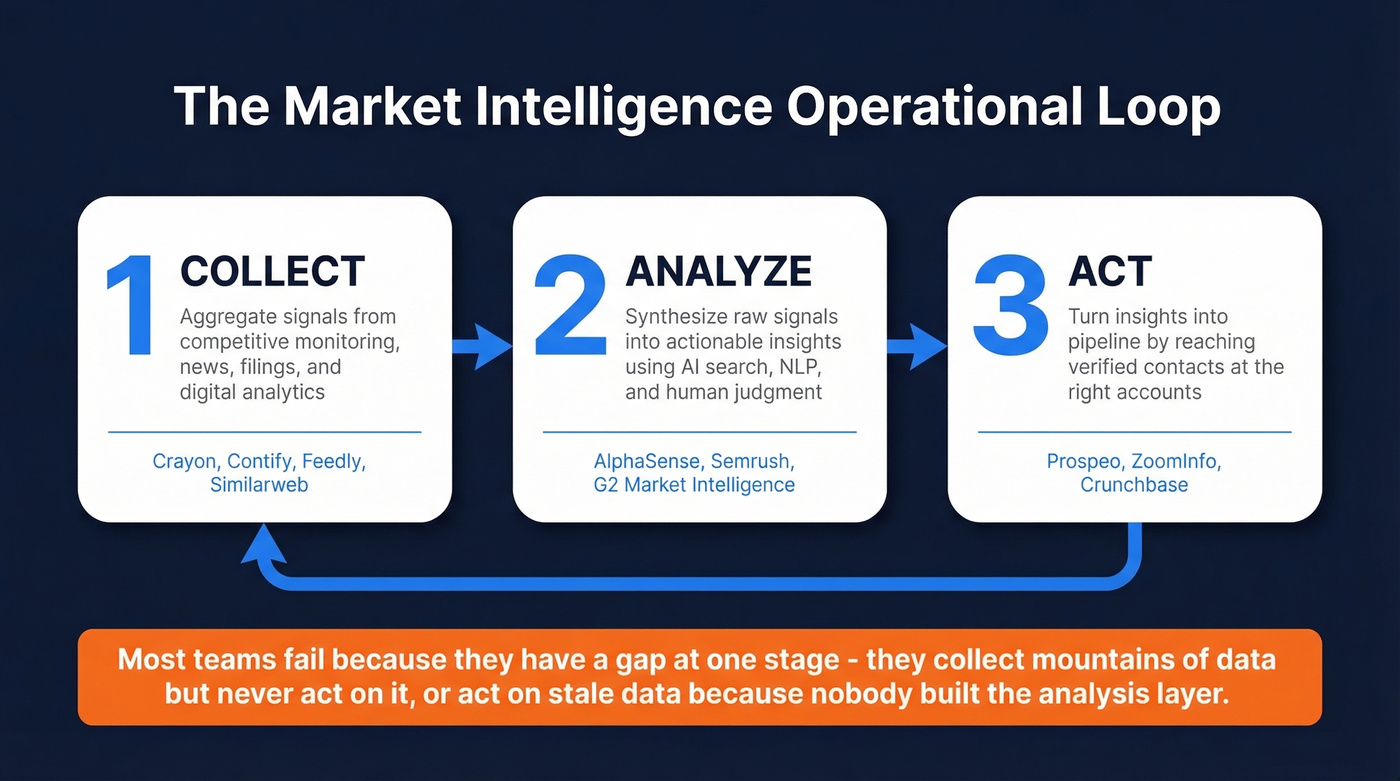
- Collect - Aggregate signals from competitive monitoring, news feeds, financial filings, and digital analytics. Tools: Crayon, Contify, Feedly, Similarweb.
- Analyze - Synthesize raw signals into actionable insights using AI search, NLP, and human judgment. Tools: AlphaSense, Semrush, G2 Market Intelligence.
- Act - Turn insights into pipeline by reaching verified contacts at the right accounts. Tools: Prospeo, ZoomInfo, Crunchbase.
The teams that struggle with MI almost always have a gap at one stage. They collect mountains of competitive data but never act on it, or they act on stale data because nobody built the analysis layer. Match your software to the stage you're weakest at.
| Type | Focus | Scope | Example |
|---|---|---|---|
| Market Intelligence | External market trends | Ongoing, broad | Category dynamics for market entry |
| Competitive Intelligence | Rival tracking | Ongoing, focused | Battlecards for sales |
| Market Research | Audience insights | Point-in-time | Buyer preference survey |
| Business Intelligence | Internal data | Ongoing, internal | Pipeline conversion analysis |
A team buying AlphaSense when they really need Crayon is burning $40K+ on the wrong problem.
15 Top Tools Compared for 2026
B2B Sales Intelligence & Contact Data
Prospeo
Every insight from your competitive monitoring, intent signals, and market analysis eventually needs to reach a real person at a real company. That's where most stacks fall apart - the "last mile" of intelligence is contact data, and bad data tanks everything downstream.
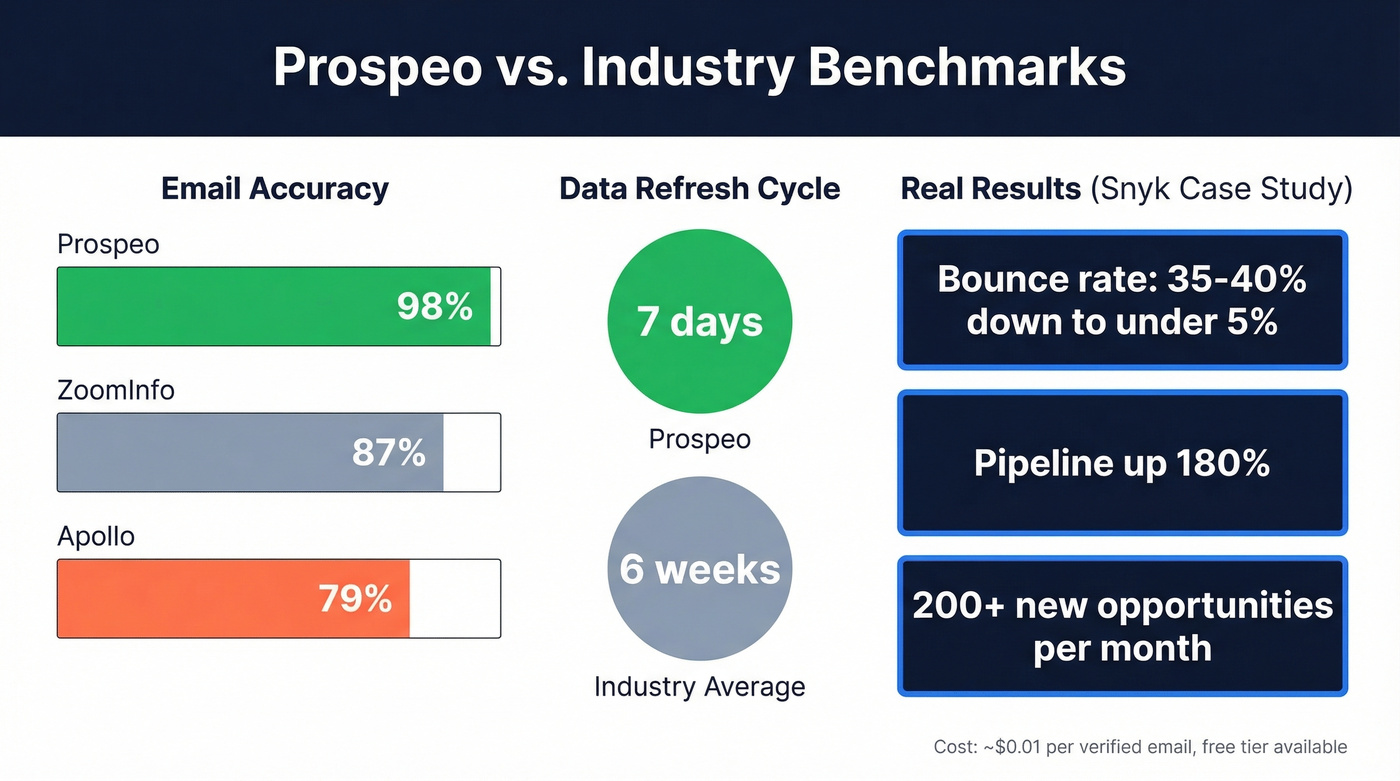
Prospeo's database covers 300M+ professional profiles and 143M+ verified emails with 98% accuracy, compared to 87% at ZoomInfo and 79% at Apollo. The 125M+ verified mobile numbers hit a 30% pickup rate, roughly 2.5x what enterprise providers deliver. Data refreshes every 7 days versus the 6-week industry average, and 30+ search filters cover buyer intent powered by 15,000 Bombora topics, technographics, job changes, headcount growth, and funding signals. Native integrations with Salesforce, HubSpot, Clay, and Zapier mean the data flows straight into existing workflows, and the Chrome extension (40K+ users) lets reps prospect from any website in one click.
The proof is in production results. Snyk's 50-person AE team went from a 35-40% bounce rate to under 5% after switching, with AE-sourced pipeline up 180% and 200+ new opportunities per month.
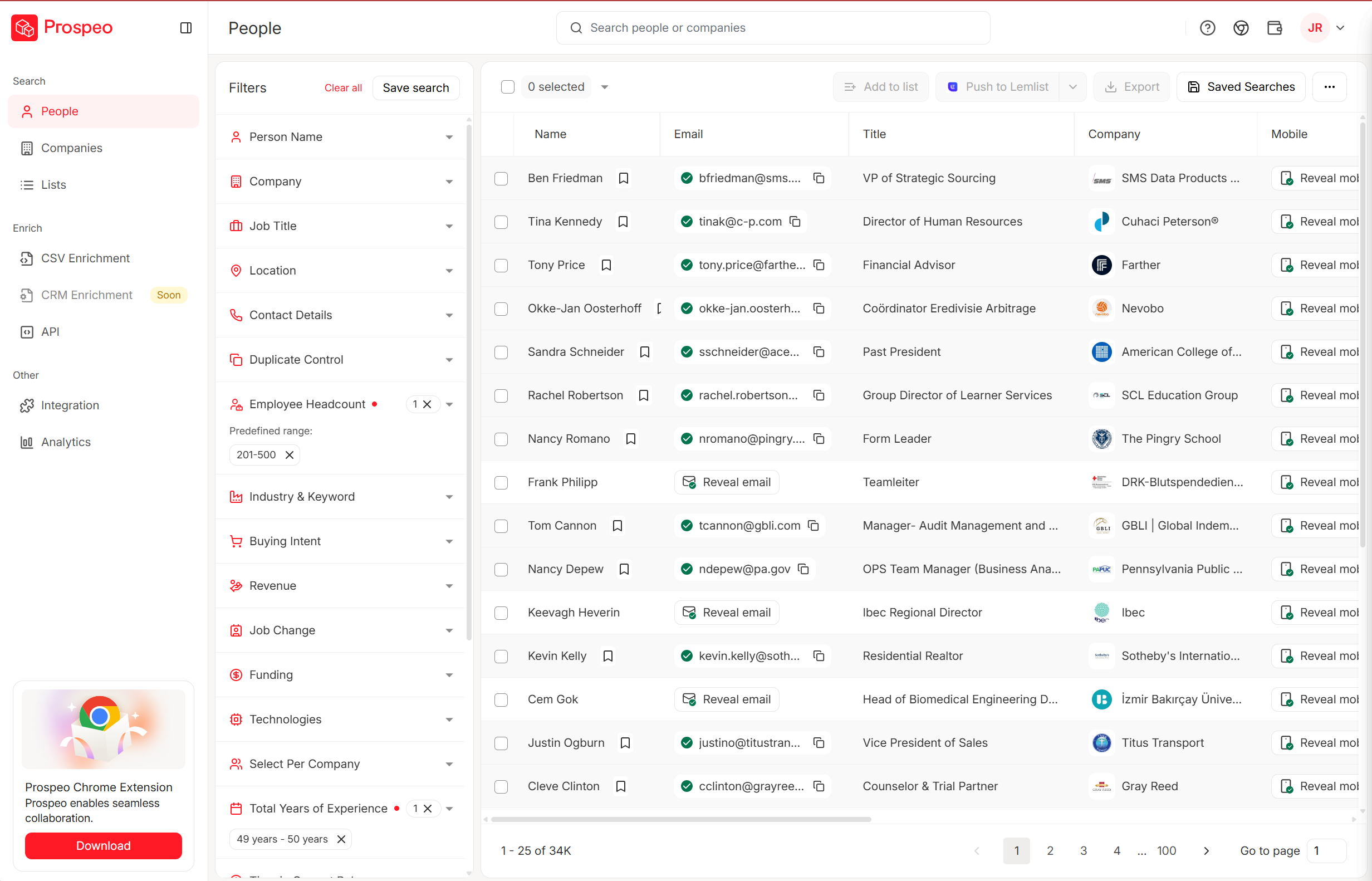
Price: Free tier (75 verified emails + 100 Chrome extension credits/month), ~$0.01/email, no contracts. Paid plans start around $39/mo.
ZoomInfo
ZoomInfo is the 800-pound gorilla of B2B intelligence - and the platform most teams overpay for. Its database spans 100M companies, 500M professionals, and tracks 1.5M personnel changes daily alongside 1B market signals. The platform combines contact data with intent signals, org charts, and technographics in a way no other single vendor matches.
Here's the thing: a 10-seat ZoomInfo contract with intent data and advanced features can run $35,000-$45,000+ per year. The most common complaint across sales communities is price - specifically, paying for modules that never get activated. The consensus on r/sales is pretty consistent: great data, brutal contracts. Renewal uplifts of 10-20% are standard, credit overages add up, and seat expansion can trigger a full re-quote.
If your average deal size is under $15K, you're almost certainly better off with purpose-built tools at a fraction of the cost.
Price: Professional $15,000-$18,000/yr, Advanced $22,000-$28,000/yr, Elite $35,000-$45,000+/yr. Annual contracts only.
Competitive Intelligence Platforms
Crayon
Crayon is one of the broadest competitive monitoring platforms in the CI category. It tracks competitor changes across websites, pricing pages, job postings, review sites, and social - then feeds that intelligence into automated battlecards your sales team can actually use.
The ROI case is strong: 71% of businesses using battlecards report higher win rates, and Crayon's own data shows up to a 59% win-rate lift when battlecards are updated monthly. The question is whether your team will actually consume the intelligence. We've seen organizations buy Crayon, generate beautiful battlecards, and watch them collect dust because nobody built the distribution workflow.

Use this if: Product marketing or a dedicated CI team needs automated monitoring plus battlecard delivery to sales.
Skip this if: You only need basic competitor tracking - Google Alerts and a shared doc might genuinely suffice.
Price: Median $28,750/yr based on Vendr contract data, range $12,450-$47,100. Add-ons can push costs 15-30% higher.
Klue
Pick Klue over Crayon if your sales team lives in Salesforce. Klue's integration depth with Salesforce, Slack, Gong, and Highspot is unmatched in the CI space - reps get battlecards surfaced inside the tools they already use, not in a separate platform they'll forget to check. That integration loop is the entire value proposition, and it delivers.
Klue holds a 4.7/5 on G2 across 443 reviews, with consistent praise for ease of capturing and distributing competitive intel. The main friction point is implementation - G2 reviewers report about 2 months to get fully operational, and some teams find the initial setup complex. Once it's running, though, the Salesforce/Slack delivery loop works exactly as advertised.
Price: ~$20,000-$40,000/yr, quote-based.
Financial & Strategic Research
AlphaSense vs. PitchBook
These two tools get compared constantly, but they solve fundamentally different problems.
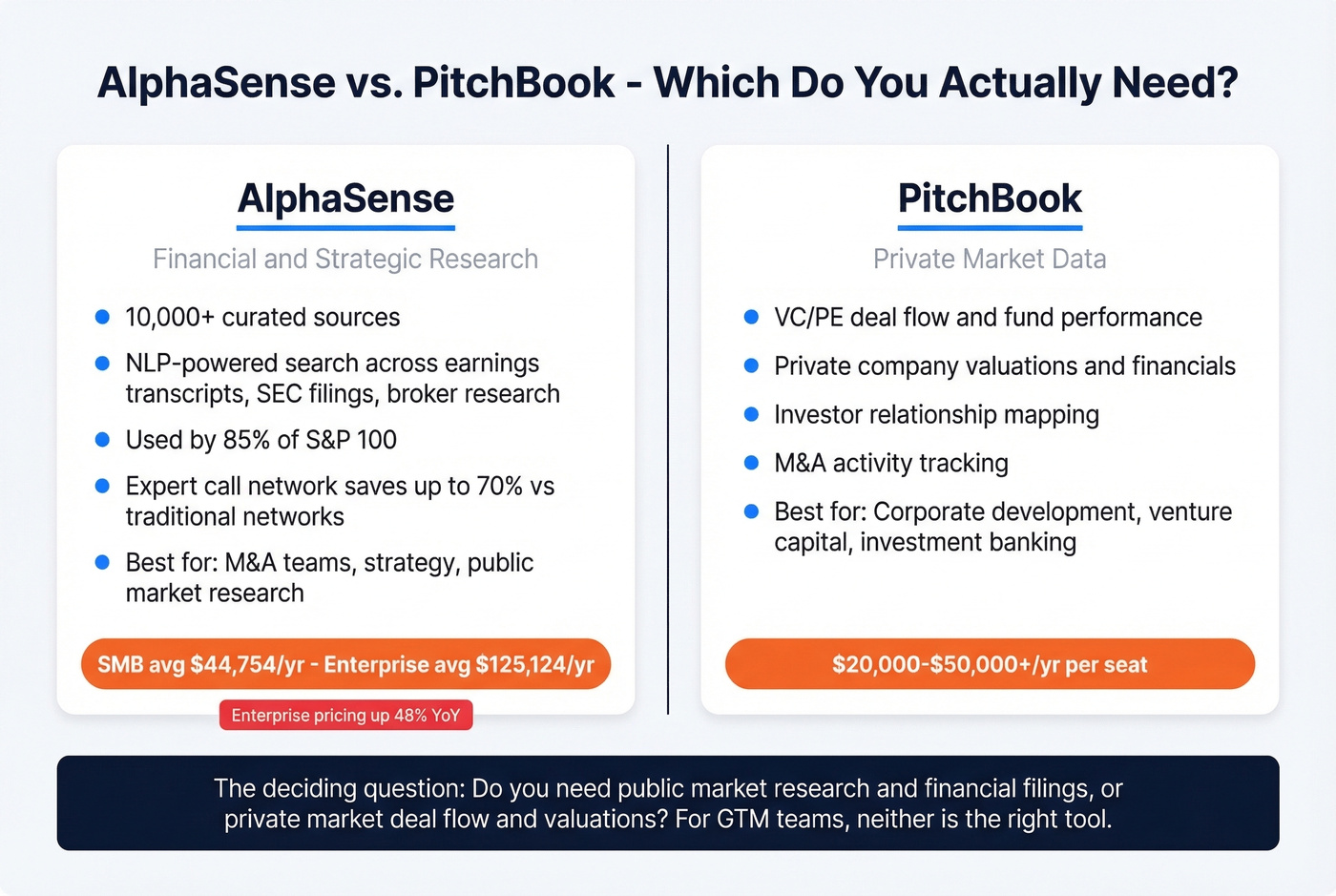
AlphaSense is exceptional for financial and strategic research - 10,000+ curated sources, NLP-powered search across earnings transcripts, broker research, SEC filings, and news. It's used by 85% of the S&P 100 and 70% of the top 50 hedge funds. The expert call network saves up to 70% versus traditional expert networks, which alone can justify the spend for M&A and strategy teams.
The pricing trajectory is aggressive. Data from 160 customers shows SMB contracts averaging $44,754/yr and enterprise averaging $125,124/yr. Enterprise pricing jumped 48.36% year-over-year, and SMB pricing rose 17.81%. AlphaSense knows it has pricing power in its niche, and it's using it.
PitchBook dominates private market data - VC/PE deal flow, company valuations, fund performance, and M&A activity. If you're in corporate development, venture capital, or investment banking, it's likely already on your desk. The dataset is unmatched for private company financials and investor relationships. Pricing runs $20,000-$50,000+/yr per seat.
The deciding question: Do you need public market research and financial filings, or private market deal flow and valuations? For GTM teams, neither is the right tool - this is financial intelligence, not sales intelligence.
Digital & SEO Intelligence
Semrush vs. Similarweb
These two platforms overlap enough to cause confusion, but the distinction is clear once you know what you need.
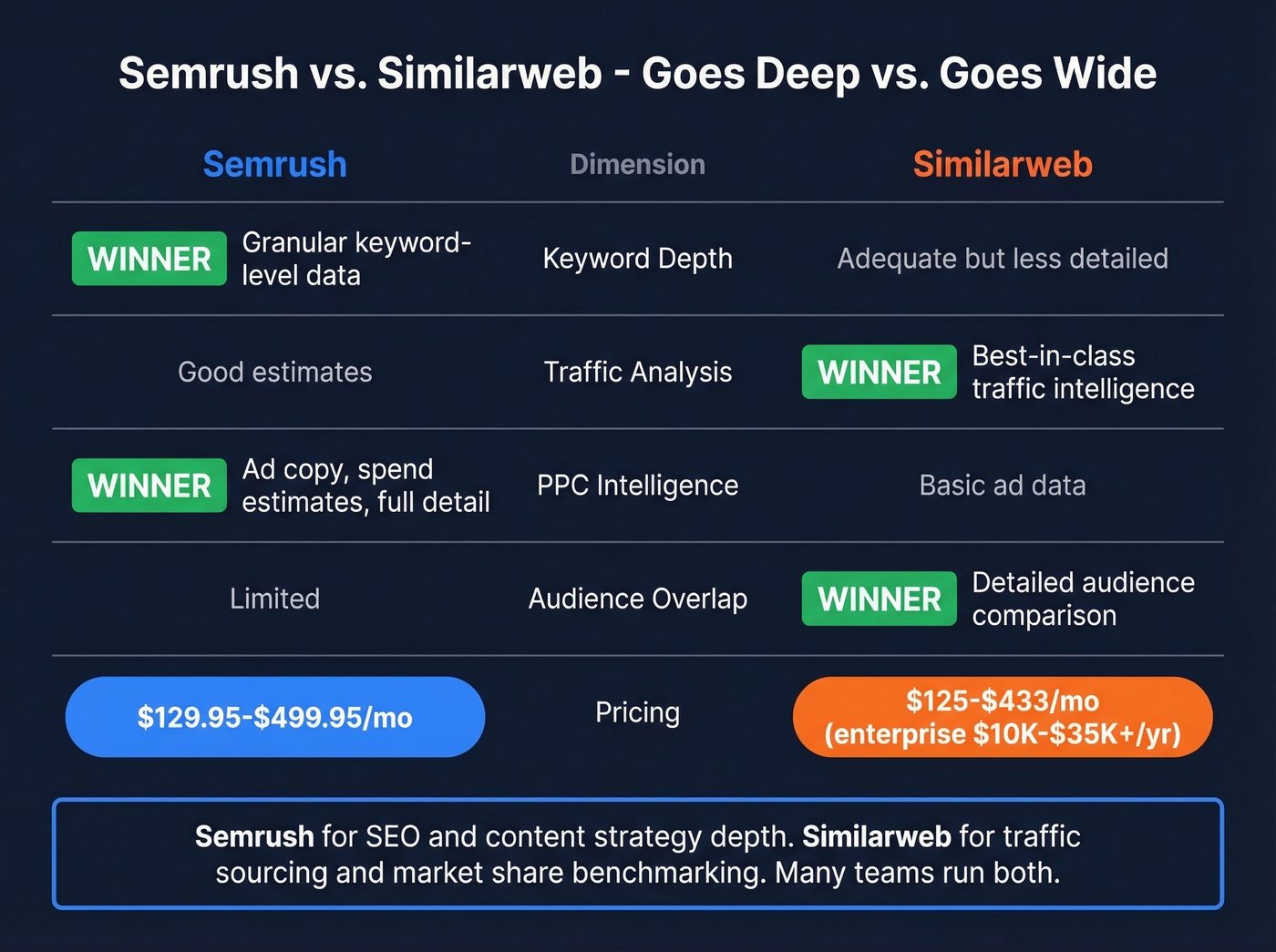
Semrush is the deeper tool for keyword research, backlink analysis, PPC intelligence, content gap analysis, and competitive positioning - all with granularity no broader MI solution can match. You can see exactly which keywords a competitor ranks for, what ads they're running, and how their content strategy has shifted quarter over quarter.
Similarweb goes wide where Semrush goes deep. Traffic sources, audience overlap, engagement metrics, and industry benchmarking - it answers "where is our competitor's traffic actually coming from?" and "how does our digital market share compare?" at a level Semrush doesn't attempt.
| Dimension | Semrush | Similarweb |
|---|---|---|
| Keyword depth | Winner - granular keyword-level data | Adequate but less detailed |
| Traffic analysis | Good estimates | Winner - best-in-class traffic intelligence |
| PPC intelligence | Winner - ad copy, spend estimates | Basic ad data |
| Audience overlap | Limited | Winner - detailed audience comparison |
| Price | $129.95-$499.95/mo | $125-$433/mo (enterprise $10K-$35K+/yr) |
Our recommendation: if you're a content or SEO team, Semrush. For strategy teams benchmarking digital market share, Similarweb. If budget allows, both - they complement more than they compete.
SpyFu
The budget option for PPC and SEO competitor research. $9/mo for the basic plan, $49/mo for Professional. Best for small teams that need competitor keyword and ad intelligence without Semrush-level investment. Don't expect the same depth, but for early-stage teams, it's a smart starting point.
Market Monitoring & News
Contify
An AI-powered news and market monitoring platform with custom taxonomy for organizing unstructured data. Particularly strong in regulated industries where tracking regulatory changes, competitor announcements, and market shifts across thousands of sources matters. The custom taxonomy feature lets you build intelligence categories that match your specific market structure - something most general-purpose tools can't do well. Pricing runs ~$1,000-$3,000/mo, custom-quoted.
Feedly MI
Feedly's MI product builds on its popular RSS platform with Leo, an AI assistant that filters signal from noise across your monitored sources. Custom-priced, it adds team collaboration, priority intelligence feeds, and integration capabilities. A solid starting point for teams building their first monitoring workflow before committing to Contify or Crayon-level spend.
BuzzSumo
Content and social listening intelligence starting at ~$199/mo. Best for tracking trending topics, competitor content performance, and influencer activity. Not a full MI platform, but a useful layer for content marketing teams that need to understand what's resonating in their market.
Visualping
Website change monitoring that tracks competitor pricing pages, product updates, and content changes automatically. Set it up once and get alerts when anything shifts. Paid team plans are available alongside entry-level monitoring - a lightweight complement to full CI platforms like Crayon, especially useful if you only need to watch 10-20 specific pages rather than an entire competitive set.
Company & Category Intelligence
Crunchbase
The accessible starting point for company, funding, and acquisition intelligence. The free tier gives you basic company profiles, Pro runs around $49/mo per user for advanced search and export, and enterprise pricing is custom. For startup and tech intelligence - who raised, who acquired whom, which companies are growing - it's the default first stop. It won't replace PitchBook for deep financial analysis, but for GTM teams tracking the startup ecosystem, the value is hard to beat. Crunchbase also doubles as a lightweight total addressable market tool, helping teams size opportunity by filtering companies across industry, funding stage, and headcount.
G2 Market Intelligence
G2's MI product turns review activity into buyer intent signals - you can see which companies are actively researching your category and your competitors. Custom enterprise pricing typically runs $15,000-$50,000+/yr. The unique angle is category-level intelligence: understanding where prospects are in their evaluation cycle based on actual review site behavior. Niche but powerful, especially for product marketing teams tracking competitive positioning.

Market intelligence without verified contacts is just expensive reading. Prospeo closes the gap between insight and action with 300M+ profiles, 98% email accuracy, and a 7-day refresh cycle - so your team acts on fresh signals, not stale data.
Stop bouncing 30% of your outbound. Fix the last mile.
Snyk's 50 AEs cut bounce rates from 35% to under 5% and generated 200+ new opportunities per month. The difference wasn't more intelligence - it was contact data accurate enough to act on it. Prospeo starts free at $0.01/email with no contracts.
Turn market intelligence into pipeline that actually connects.
What MI Software Actually Costs
Enterprise MI pricing is rising fast. AlphaSense's enterprise contracts jumped 48.36% year-over-year, and SMB pricing rose 17.81%. ZoomInfo's renewal uplifts of 10-20% are well-documented. The fact that most of these platforms won't publish pricing makes budgeting nearly impossible without running a full sales cycle.
| Tool | Category | Best For | Starting Price | Pricing Model |
|---|---|---|---|---|
| Prospeo | Contact data | Email/mobile accuracy | Free (75/mo) | Per-credit, low risk |
| ZoomInfo | All-in-one B2B | Enterprise GTM | ~$15,000/yr | Annual contract, high risk |
| Crayon | Competitive intel | Battlecard automation | ~$12,450/yr | Annual contract, medium risk |
| Klue | Competitive intel | CRM-integrated CI | ~$20,000/yr | Annual contract, medium risk |
| AlphaSense | Financial research | M&A/strategy | ~$44,754/yr | Subscription, high risk (rising) |
| PitchBook | Financial research | Private markets | ~$20,000/yr | Per-seat annual, medium risk |
| Semrush | Digital/SEO intel | Marketing teams | $129.95/mo | Monthly/annual, low risk |
| Similarweb | Digital/SEO intel | Traffic analysis | $125/mo | Monthly/annual, low risk |
| SpyFu | Digital/SEO intel | Budget PPC/SEO | $9/mo | Monthly, low risk |
| Contify | Market monitoring | Regulated industries | ~$1,000/mo | Custom, medium risk |
| Feedly MI | Market monitoring | Entry-level monitoring | Custom | Monthly/custom, low risk |
| BuzzSumo | Content intel | Content marketing | ~$199/mo | Monthly, low risk |
| Visualping | Change monitoring | Price/page tracking | Paid plans available | Monthly, low risk |
| Crunchbase | Company intel | Startup ecosystem | Free tier | Per-user/custom, low risk |
| G2 MI | Category intel | Buyer intent signals | ~$15,000/yr | Annual contract, medium risk |
How to Choose the Right Platform
Don't buy a monolith. Build a stack.
The most effective MI programs we've seen combine 3-4 purpose-built tools across categories rather than forcing one platform to do everything poorly. Let's break down what to look for.
Selection Checklist
Before you evaluate any solution, run it through these criteria:
- Diverse data sources - not just web scraping, but verified databases, filings, and proprietary signals
- AI/NLP search capabilities - manual keyword search doesn't scale
- Usability - if it requires a dedicated admin, adoption will crater
- Native integrations with your CRM and workflow tools
- Methodology transparency - if a vendor won't explain where their data comes from or how it's verified, walk away
- Data governance - how does the vendor handle data quality monitoring, compliance, and opt-outs?
- Post-purchase support - check whether you get analyst or CSM access, not just a help center
A Starter Stack Under $40K/Year
For most B2B teams, three tools cover the core MI categories: a contact data layer for execution, a competitive intelligence layer for sales enablement, and a digital intelligence layer for marketing. Pair those with Crunchbase's free tier for company and funding intelligence, and you've got a complete foundation without the six-figure contract.
The specialist-vs-generalist question matters here. A common buying mistake is choosing a generalist platform when you need deep expertise in one category. AlphaSense is exceptional for financial research but useless for competitive enablement. Crayon is brilliant for battlecards but won't give you contact data. The best market intelligence tools buyers choose are the ones that solve a specific gap, not the ones with the longest feature list.
Mistakes That Waste Your MI Budget
Buying before defining goals. "We need market intelligence" isn't a goal. "Reduce competitor research time from 10 hours to 2 hours per week" is. 56% of businesses experience performance issues after choosing the wrong software - usually because they never defined what "right" meant.
Rushing implementation. Klue takes about 2 months to implement properly. Crayon needs competitor profiles configured. Skipping setup means your team gets mediocre results and blames the tool instead of the rollout.
Chasing shiny features. Intent data, AI summaries, predictive scoring - these are powerful when you have the workflow to act on them. Most teams don't, at least not initially. Start with the core use case and expand.
Using a generalist when you need a specialist. ZoomInfo is great for contact data but mediocre for competitive monitoring. AlphaSense is exceptional for financial research but wrong for sales enablement. Category fit matters more than brand recognition.
Ignoring methodology transparency. Look, if a vendor won't tell you how they source, verify, and refresh their data, assume the worst. The vendors who publish accuracy rates, refresh cycles, and verification processes are the ones confident in their data. Everyone else is hoping you won't ask. There's no excuse for opacity in 2026.
FAQ
What's the difference between market intelligence and competitive intelligence?
Market intelligence covers trends, segments, and macro shifts across your entire market. Competitive intelligence is a subset focused on tracking rival companies' products, pricing, hiring, and messaging. Most teams need both - MI for strategic planning, CI for tactical sales enablement.
How much do market intelligence tools cost?
Ranges from free (Google Alerts, Crunchbase's free tier) to $125,000+/year for enterprise platforms like AlphaSense. Most mid-market teams spend $15,000-$50,000/year on their primary MI tool, with total stack costs running $25,000-$75,000 across multiple categories.
Do I need more than one tool?
Almost always yes. No single platform covers all five MI categories: competitive, financial, digital, contact data, and market monitoring. The most effective stacks combine 3-4 tools. A contact data platform plus a CI tool plus a digital intelligence platform covers core needs for most B2B teams at under $40K/year.
What's the ROI of market intelligence?
71% of businesses using battlecards report higher win rates, B2B reps save 8-12 hours/month on competitor research, and enterprises see roughly 110% return over three years from CI investments. ROI compounds when intelligence feeds directly into outreach - verified contact data turns insights into pipeline.
How do I evaluate data quality?
Ask for accuracy rates, data refresh cycles, and verification methodology. Look for published numbers, not vague claims about "industry-leading quality." Check how data is sourced, how often it's verified, and what happens when records go stale. Vendors willing to share these metrics are the ones worth your budget.