

MEDDICC: What It Is, How to Use It, and Why Most Teams Get It Wrong
It's Thursday afternoon. Your CRO pulls up the pipeline review and asks why a $180K deal slipped out of the quarter - again. The rep says the champion went dark. The VP of Sales says legal held things up. Nobody can explain who actually signs the contract.
This is the deal MEDDICC was built to save. It's also the one that exposes every team treating it like a CRM checkbox instead of a qualification discipline.
54% of sales professionals say closing is harder than five years ago. Decision committees have ballooned to 8-12 stakeholders, and buyers complete nearly 80% of their research before taking a call. The teams that win consistently aren't the ones with the best pitch decks - they're the ones that qualify ruthlessly.
The Quick Version
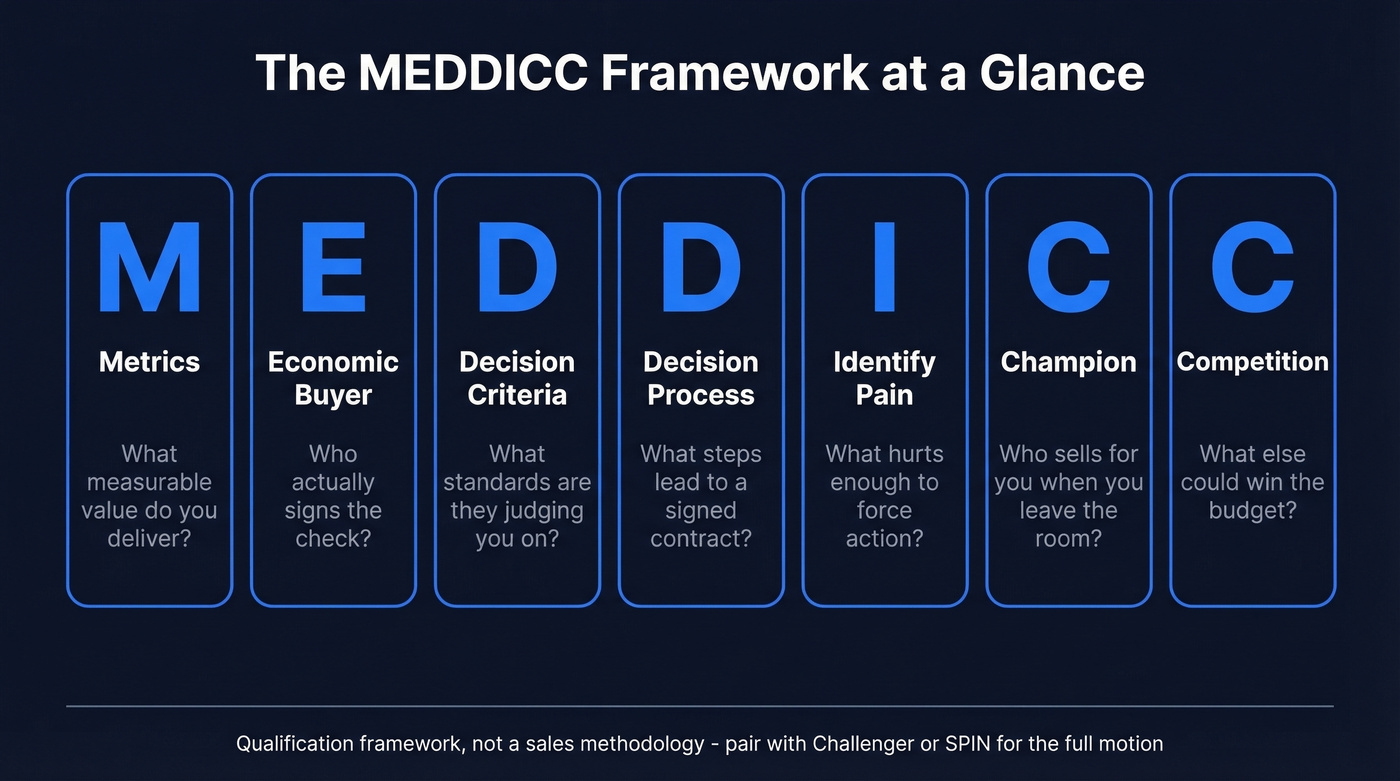
MEDDICC is a deal qualification framework with seven letters: Metrics, Economic Buyer, Decision Criteria, Decision Process, Identify Pain, Champion, Competition. The acronym gives your team a shared language for inspecting every enterprise deal before committing resources. If your sales cycle exceeds three months or involves five-plus stakeholders, you need MEDDPICC, which adds Paper Process. You can learn the letters fast. Building the discipline to use it on every deal? That takes months.
What Is MEDDICC, Really?
Let's be clear about something: this is a qualification framework, not a sales methodology in the traditional sense. It doesn't tell you how to sell. It tells you whether a deal is real and what's missing. Pair it with Challenger or SPIN for the full selling motion.
The framework traces back to qualification techniques developed at PTC in the early 1990s, shaped by a broader sales leadership team that included Jack Napoli, John McMahon, and Dick Dunkel. It's credited with driving PTC past a billion dollars in revenue. Today, roughly 73% of SaaS companies selling solutions above $100K ARR use some version of MEDDIC or MEDDPICC.
| Letter | Stands For | Core Question |
|---|---|---|
| M | Metrics | What's the measurable ROI? |
| E | Economic Buyer | Who signs the check? |
| D | Decision Criteria | What are they evaluating? |
| D | Decision Process | How do they decide? |
| I | Identify Pain | What hurts enough to act? |
| C | Champion | Who sells for you internally? |
| C | Competition | Who/what else are they considering? |
Metrics
Metrics are the quantifiable measures of value your solution delivers - not your marketing ROI calculator, but the buyer's numbers in their language. Think "above the line" metrics like revenue, profit, and time-to-market that get executive attention, alongside "below the line" metrics like cost savings and FTE reductions that get mid-management buy-in. You need both.
In practice, a strong deal looks like this: your champion can tell their CFO that your solution saves 2,400 engineering hours per year and cuts infrastructure costs by 18%.
Discovery questions: What metrics does leadership use to evaluate projects like this? How do you measure ROI for similar investments today? What are the financial implications of not solving this in the next two quarters?
Economic Buyer
Your champion just told you the deal is "basically done." Then a VP you've never met kills it in a budget review. That's what happens when you haven't identified the Economic Buyer - the person with discretionary access to funds who can say yes when everyone else says no, or kill a deal everyone else supports.
Here's the thing: if you don't meet the Economic Buyer or get their explicit approval, your chance of closing drops below 50%. That's a coin flip on a deal you've invested months in. We've watched reps burn entire quarters on deals where they never once confirmed who actually controlled the budget, and it's one of the most frustrating patterns in enterprise sales.
Discovery questions: Who holds the ultimate budget authority for this initiative? If we come to an agreement, is there anybody else who'd need to approve? Has this budget already been earmarked, or does it need to be created?
Decision Criteria
Decision Criteria are the formal and informal standards the buyer uses to evaluate solutions - technical criteria like integrations, security, and scalability, plus business criteria like ROI timeline, vendor stability, and support model. Your job isn't just to understand them. It's to shape them before the RFP gets written.
Discovery questions: What are the most critical factors in your evaluation? Are there non-negotiable requirements? How do you prioritize cost, quality, and speed of implementation? Who defined these criteria, and can they change?
Decision Process
Reps constantly map the technical evaluation but completely miss the business approval chain. Decision Process covers both - the steps between "we like this" and "contract signed," including the timeline, approval chain, security review, and procurement workflow. Separate the technical decision from the business decision. They often run in parallel with different owners.
Discovery questions: Walk me through the steps from today to a signed contract. Who's involved at each stage? What's your target go-live date, and what drives that timeline? Have you purchased a solution in this category before - what did that process look like?
Identify Pain
Pain is the engine of every deal. But "what keeps you up at night?" is lazy discovery. In MEDDPICC, the "I" actually stands for "Implications of Pain" - a deliberate upgrade that forces you to quantify the business impact, not just name the problem. A feature gap isn't pain. Losing $2M in revenue because of a feature gap? That's pain.
The best reps quantify it and tie it directly to the metrics the Economic Buyer cares about.
Discovery questions: What happens if this problem doesn't get solved in the next 6 months? How is this issue affecting your team's ability to hit targets? What's the cost of the current workaround - in time, money, or risk?
Champion
Your Champion is your internal seller - the person who advocates for your solution when you're not in the room. This isn't a coach. A coach gives you information. A Champion has power, influence, and personal motivation to see your deal close.
The test is simple: will this person sell for you when you're not in the room? If the answer is "maybe," you don't have a Champion. You have a friendly contact.
Discovery questions: Who on your team has the most to gain from solving this problem? Has this person championed a purchase like this before? Can they get us access to the Economic Buyer?
Competition
Competition isn't just the other vendors in your space. It's the status quo, an internal build, or a completely different budget priority. The most dangerous competitor is often inertia - the prospect deciding the pain isn't bad enough to act.
Discovery questions: What other solutions are you evaluating, including building internally? What happens if you stay with your current approach? Is there a competing initiative that could absorb this budget?
MEDDIC vs MEDDICC vs MEDDPICC
| Variant | Letters | Paper Process? | Competition? |
|---|---|---|---|
| MEDDIC | 6 | No | No |
| MEDDICC | 7 | No | Yes |
| MEDDPICC | 8 | Yes | Yes |
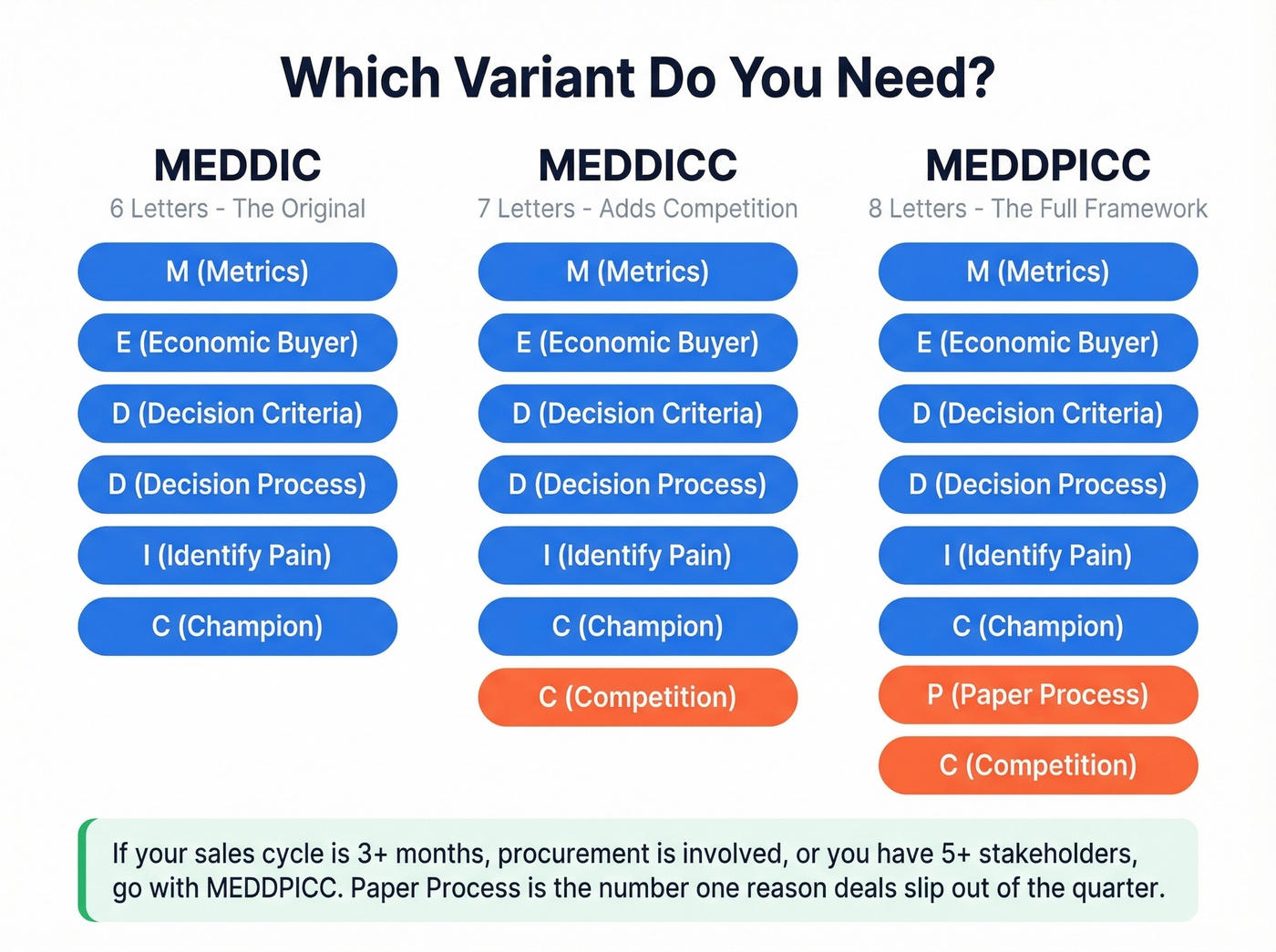
Paper Process covers the legal, procurement, and administrative steps required to get a contract signed - security reviews, vendor onboarding, redlines, purchase orders. It's the #1 reason deals slip out of a quarter, and the letter most teams ignore until it's too late.
You probably need MEDDPICC, not MEDDIC. If your average sales cycle exceeds three months, if procurement is involved, if there are five-plus stakeholders - you need Paper Process. Skipping it is how $200K deals die in legal review while your CRO stares at a forecast that's 30% fiction.
When the Framework Fails
This framework fails all the time. Not because it's broken, but because implementation is.
A common complaint on r/sales is that it becomes a "CRM exercise disguised as a sales methodology." Reps fill out fields to make managers happy. Managers check boxes in pipeline reviews. Nobody actually uses the data to decide the state of a deal. There's also a broader sentiment on Reddit that all sales methodologies reduce to the same fundamentals: need, budget, stakeholders, timeline. Honestly? That's not entirely wrong. The value isn't magic - it's shared language and a structured inspection cadence. Without those, you're having vibes-based pipeline reviews.
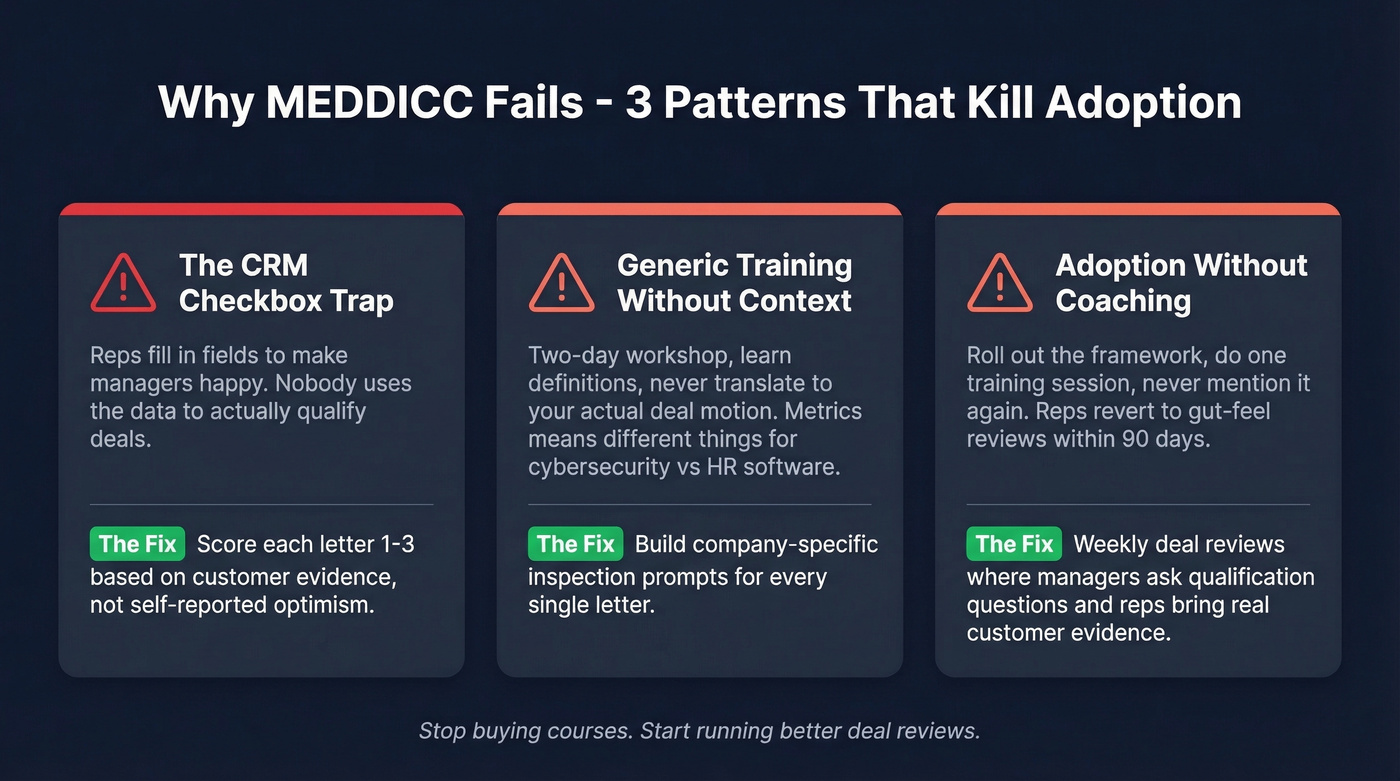
We see three failure modes repeatedly:
The CRM checkbox trap. Reps treat qualification fields like compliance, not qualification. They fill in "Champion: Sarah" without testing whether Sarah will actually sell for them internally. The fix: score each letter on a 1-3 scale anchored to customer evidence, not self-reported optimism.
Generic training without company-specific application. A two-day workshop where reps learn definitions but never translate them into their deal motion. "Metrics" means something different selling cybersecurity vs. HR software. The fix: build company-specific inspection prompts for each letter.
Adoption without coaching cadence. You roll out the framework, do a training, and never mention it again. The fix: weekly deal reviews where managers ask qualification-anchored questions and reps bring customer evidence, not gut feelings. Stop buying courses. Start running better deal reviews.

You just mapped the Economic Buyer, Champion, and Decision Process. Now you need to actually reach them. Prospeo gives you 98% accurate emails and 125M+ verified mobile numbers for the exact stakeholders your MEDDICC framework identified.
Stop qualifying deals you can't even get in front of.
How to Implement It
Some vendors sell a three-step adoption path. In practice, the three things that matter are specificity, plays, and accountability - not a branded maturity model.
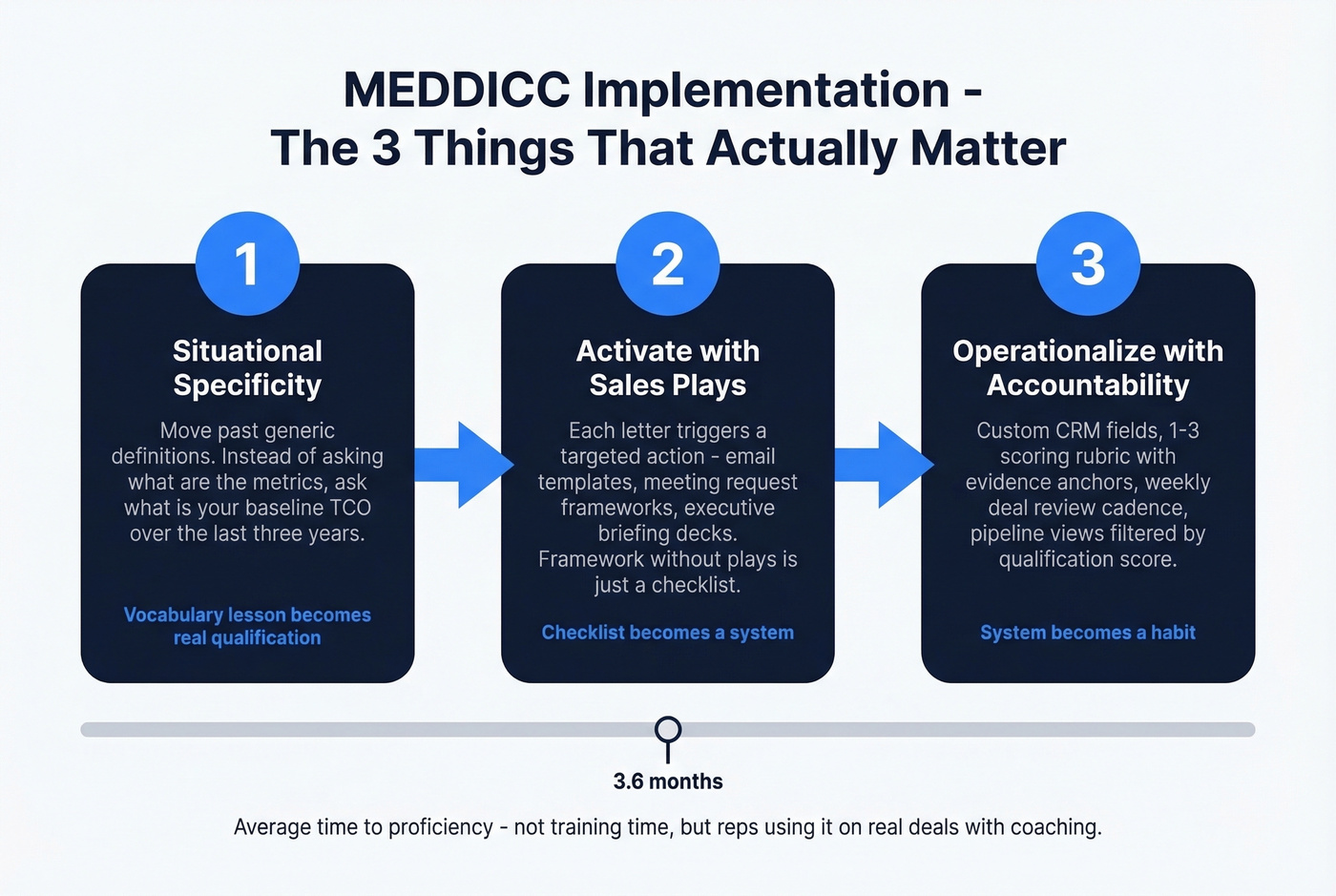
Move from generic awareness to situational specificity. Don't just teach reps "Metrics means quantifiable value." Instead of "what are the metrics?" your reps should ask "what's your baseline TCO over the last three years?" Specificity separates a qualification framework from a vocabulary lesson.
Activate with sales plays. Each letter should trigger targeted actions. When a rep identifies the Economic Buyer, there should be a play: a specific email template, a meeting request framework, an executive briefing deck. The framework without plays is a checklist. With plays, it's a system.
Operationalize with accountability. Set up custom CRM fields for each letter. Build a scoring rubric where 1 = unknown, 2 = identified, 3 = validated with evidence. Create pipeline views that surface deals with low qualification scores. Teams often waste $50K on certification only to have reps revert to gut-feel pipeline reviews within 90 days - accountability is what prevents that.
Quick implementation checklist:
- Custom CRM fields for each letter
- 1-3 scoring rubric with evidence anchors
- Weekly deal review cadence
- Company-specific inspection prompts
- Pipeline view filtered by qualification score
Expect about 3.6 months to proficiency. That's not training time - it's reps using the framework on real deals, getting coached, and building muscle memory.
Does It Actually Work?
Teams using formal qualification frameworks report 28% higher win rates. Full adoption correlates with 18% higher win rates and 24% larger deal sizes compared to simplified approaches.
Remember that $180K deal from the intro? With MEDDICC properly operationalized, the rep would have known weeks earlier that they hadn't validated the Economic Buyer - and either fixed it or killed the deal before it wrecked the forecast.
The most compelling case study comes from Deel. After reinforcing the framework in real time with AI-assisted tooling, they saw a 33% win rate improvement. CRM fill rates jumped from 1.1% to 73%, and adoption increased 31% across the team.
The real takeaway: it doesn't work because the letters are special. It works because it forces inspection rigor. When a rep has to prove they've met the Economic Buyer - not just claim it - deals get qualified faster and bad ones get killed earlier. That's where the win rate lift comes from.
Skip this if your deals are small. If your average deal size is under $10K, you probably don't need this level of qualification overhead. BANT or a simple three-question framework is enough. MEDDICC earns its keep on complex deals where the cost of a bad forecast is measured in hundreds of thousands. Applying it to every deal in your pipeline - including the $3K self-serve upsells - is how you create the CRM exercise problem Reddit keeps complaining about.
MEDDICC vs Other Frameworks
| Framework | Best For | Complexity | Key Strength | Limitation |
|---|---|---|---|---|
| MEDDPICC | Enterprise, 5+ stakeholders | High | Deal inspection rigor | Overhead for simple deals |
| BANT | Transactional, <60 days | Low | Speed, simplicity | Too shallow for enterprise |
| SPIN Selling | Discovery-heavy cycles | Medium | Question methodology | Doesn't qualify deals |
| Challenger | Insight-led selling | Medium | Teaching-based approach | Requires deep expertise |
| Sandler | Buyer psychology | Medium | Pain-focused qualification | Less structured inspection |
BANT, developed at IBM in the 1950s, works fine for transactional deals with one or two decision-makers and a sub-60-day cycle. For enterprise B2B sales - deals above $50K with multiple stakeholders and procurement involvement - MEDDICC is the best qualification approach available. Period.
SPIN, developed by Rackham from 35,000+ sales calls, is excellent for discovery but doesn't qualify deals. Challenger is powerful for positioning but doesn't give you a deal inspection structure. The smart move: use SPIN or Challenger for your selling motion, MEDDPICC for qualification and deal inspection. They're complementary, not competing.
Tools That Make It Work
The framework is a discipline, not a software category. But three tool categories make the difference between theory and practice.
A CRM with custom qualification fields. Salesforce and HubSpot both support custom fields, scoring rubrics, and pipeline views that surface under-qualified deals. If your CRM can't score each letter on a 1-3 scale and filter pipeline by score, you're flying blind. This is the baseline. (If you're evaluating platforms, start with a few examples of a CRM to compare.)
A contact data platform to actually reach the people your qualification uncovers. This is where most teams leak value. Your framework identifies the VP of Engineering as your Economic Buyer. Now you need a verified email and a direct dial - not a bounced message and a disconnected number. Prospeo covers 143M+ verified emails with 98% accuracy and 125M+ verified mobile numbers that hit a 30% pickup rate. The 7-day data refresh cycle means you're not emailing someone who changed jobs six weeks ago. The free tier gives you 75 emails per month plus 100 Chrome extension credits, and paid plans run about $0.01 per email with no contracts. (If you're building a stack, see our ranked list of SDR tools.)
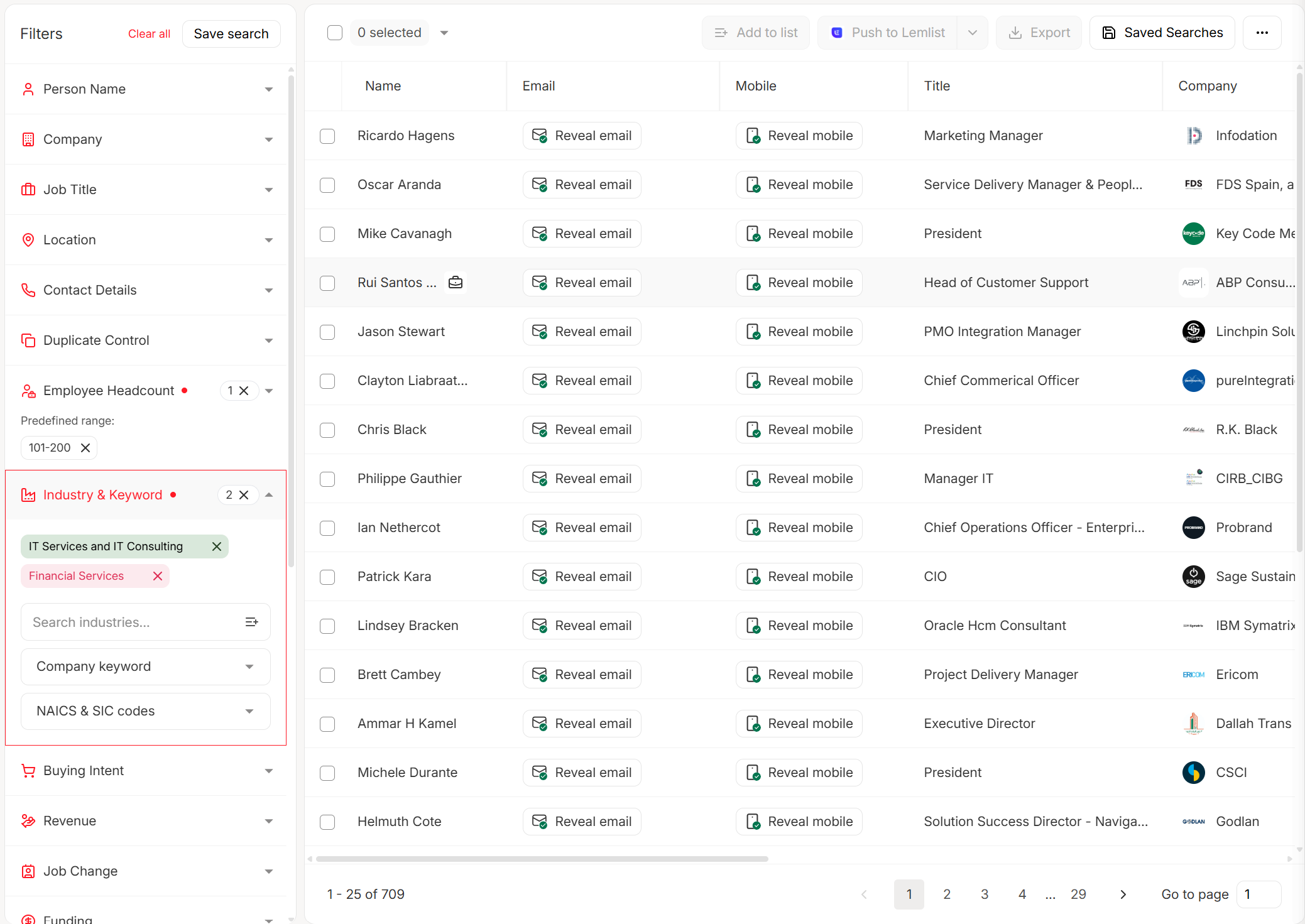
Don't blow $50K on enablement workshops right away. In our experience, that money is better spent on CRM operationalization and coaching cadence first. Once your reps are actually using the framework in deal reviews, then consider formal training to sharpen execution. (For manager-led reinforcement, borrow a few QBR questions to ask and adapt them to MEDDICC.)
MEDDICC falls apart when your champion goes dark because you emailed a bad address. Prospeo's 7-day data refresh and 5-step verification mean the contact data you pull today is still accurate next quarter - when that $180K deal is on the line.
Verified contacts at $0.01 each so no deal slips because of bad data.
FAQ
What does the MEDDICC acronym stand for?
Metrics, Economic Buyer, Decision Criteria, Decision Process, Identify Pain, Champion, and Competition. MEDDPICC adds Paper Process as an eighth element. The framework was developed at PTC in the early 1990s and is now used by roughly 73% of SaaS companies selling above $100K ARR.
Is MEDDICC a methodology or a framework?
It's a qualification framework - it tells you whether a deal is real, not how to sell. Many teams call it a methodology because it shapes how reps run their entire deal cycle. Pair it with Challenger, SPIN, or Sandler for the complete selling motion.
What's the difference between MEDDIC and MEDDPICC?
MEDDIC has six letters. MEDDICC adds Competition. MEDDPICC adds both Paper Process and Competition. If your deals involve procurement, legal review, or five-plus stakeholders, use MEDDPICC - Paper Process is the #1 reason enterprise deals slip quarters.
How do I find and reach the Economic Buyer?
Map the org chart during discovery and ask your Champion who holds budget authority. The qualifying question: "If we agree, is there anyone else who'd need to approve?" Once you've identified them, use a verified data platform like Prospeo to get their contact details - a bounced message to the EB can stall an entire deal.