

MEDDPICC: The Guide That Goes Beyond Definitions
It's the last week of the quarter. Your VP pulls up the pipeline review. Every deal has MEDDPICC fields filled in - champion identified, economic buyer named, decision criteria documented. Looks clean. Then three "commit" deals slip. The champion never responded to the last two emails. The economic buyer left the company in January. The paper process timeline was a guess. The fields were full, but the deals were empty.
That's the problem nobody talks about. The framework itself is arguably the best deal qualification tool in enterprise sales. But the gap between knowing the eight letters and actually using them to win deals is where most teams stall. The consensus on r/sales is blunt: MEDDIC becomes "a CRM exercise disguised as a sales methodology" when reps fill fields to make managers happy and managers check boxes to survive pipeline reviews.
This guide fixes that. Not another acronym explainer - a practitioner's playbook for making the framework drive deal decisions, forecasting accuracy, and revenue.
What Is MEDDPICC? (Quick Version)
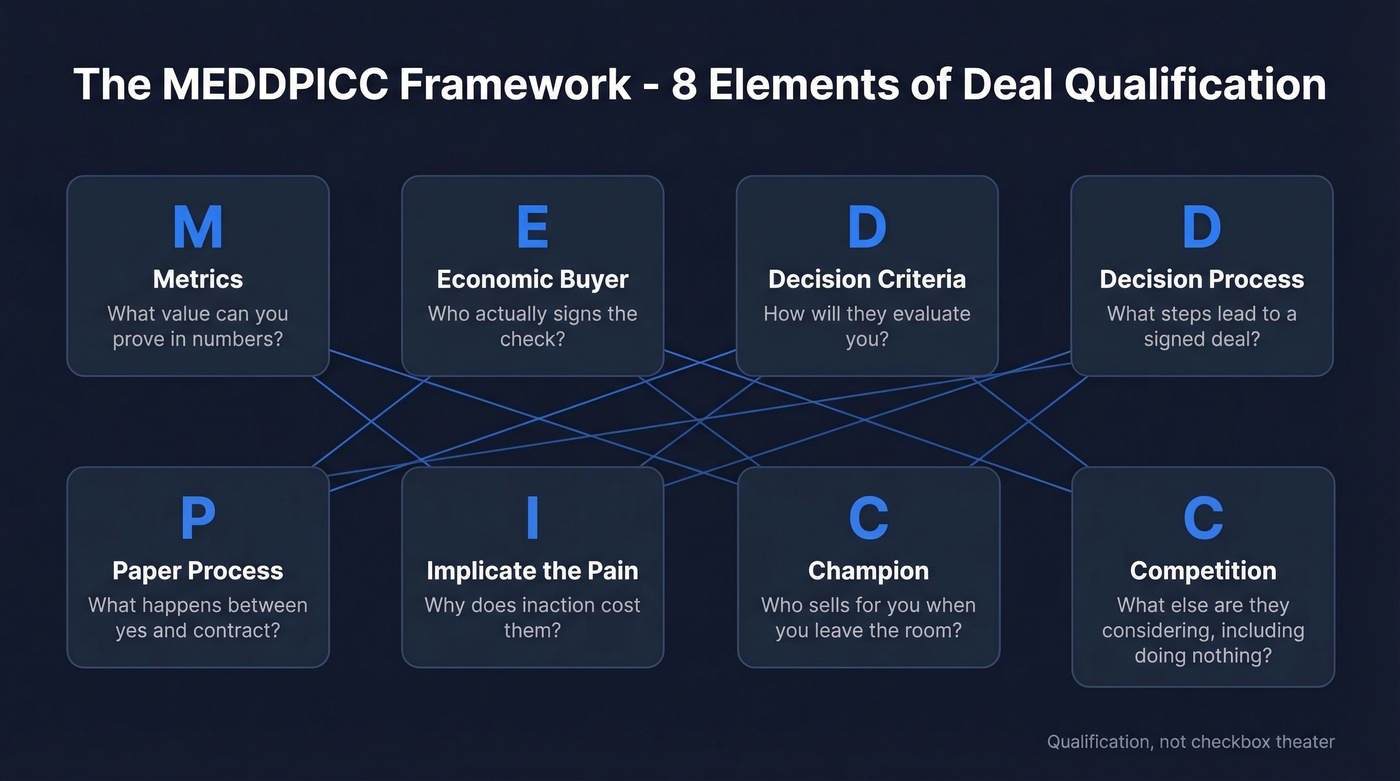
It's an eight-element deal qualification and coaching framework that tells you whether an enterprise deal is real, what's missing, and where it'll stall.
So what does MEDDPICC stand for?
- Metrics - Quantifiable value your solution delivers
- Economic Buyer - The person who can approve (or kill) the deal
- Decision Criteria - How the buyer will evaluate solutions
- Decision Process - Steps, stakeholders, and timeline to a signed contract
- Paper Process - Procurement, legal, security, and compliance hurdles
- Implicate the Pain - The business problem tied to inaction
- Champion - Your internal advocate who sells when you're not in the room
- Competition - Every alternative, including doing nothing
The single biggest implementation mistake is checkbox theater - reps filling CRM fields for compliance, not for deal decisions. The fix is tying each element to specific next steps, risk calls, and disqualification triggers. If knowing your champion's name doesn't change how you run the deal, you're doing paperwork, not qualification.
Use this framework when you're selling $100K+ deals with multiple stakeholders, procurement processes, and 6-9 month cycles. Skip it for transactional deals with one decision-maker and a 30-day close. BANT will serve you better there, and SPICED is often a stronger fit for consultative mid-market deals driven by a critical event.
Every Element, Explained
Metrics
Metrics are the quantifiable measures of value your solution delivers - revenue gained, costs reduced, time saved, risk eliminated. They're the foundation of every business case your champion builds internally.
What "good" looks like: you can articulate the buyer's current state in numbers and project the future state with your solution. "Reduce churn by two points, saving $3.6M annually" beats "improve customer retention." The mistake most reps make is stopping at company-level metrics and never connecting to what the individual stakeholder cares about. Personal impact questions - career goals, promotion criteria, bonus structures - uncover motivation that business metrics alone miss.
Economic Buyer
Most reps think they've identified the economic buyer. They haven't. They've identified the person who said "my boss will approve it" - which is a hope, not a confirmed buyer.
The economic buyer is the person with the authority and budget to approve the purchase or kill it. In enterprise deals, that's typically a VP or C-level executive who controls the budget line your deal sits on. You need a direct conversation with them, or at minimum, confirmed criteria through your champion. If you haven't spoken to them, you don't have this element covered.
Decision Criteria
Decision criteria are the specific requirements the buyer uses to evaluate and compare solutions: technical requirements, integration needs, compliance standards, ROI thresholds, and vendor qualifications.
What "good" looks like: you've documented the buyer's evaluation criteria and can map your strengths to each one. Better yet, you've helped shape those criteria before the formal evaluation begins. Update criteria every time a new stakeholder enters the evaluation - a CTO might add a security requirement in week six that wasn't on the original list.
Decision Process
Here's a quick test: can you draw the decision process on a whiteboard - every stakeholder, every gate, every potential delay - and have your champion confirm it's accurate? If not, you don't know the decision process.
The decision process maps every step between "we're interested" and "contract signed." It includes who's involved at each stage, what approvals are needed, and the realistic timeline. Don't confuse this with the paper process. Decision process is about who decides and how. Paper process is about what happens after the decision is made. Conflating them leads to wildly optimistic close dates.
Paper Process
This is where committed deals die in Q4.
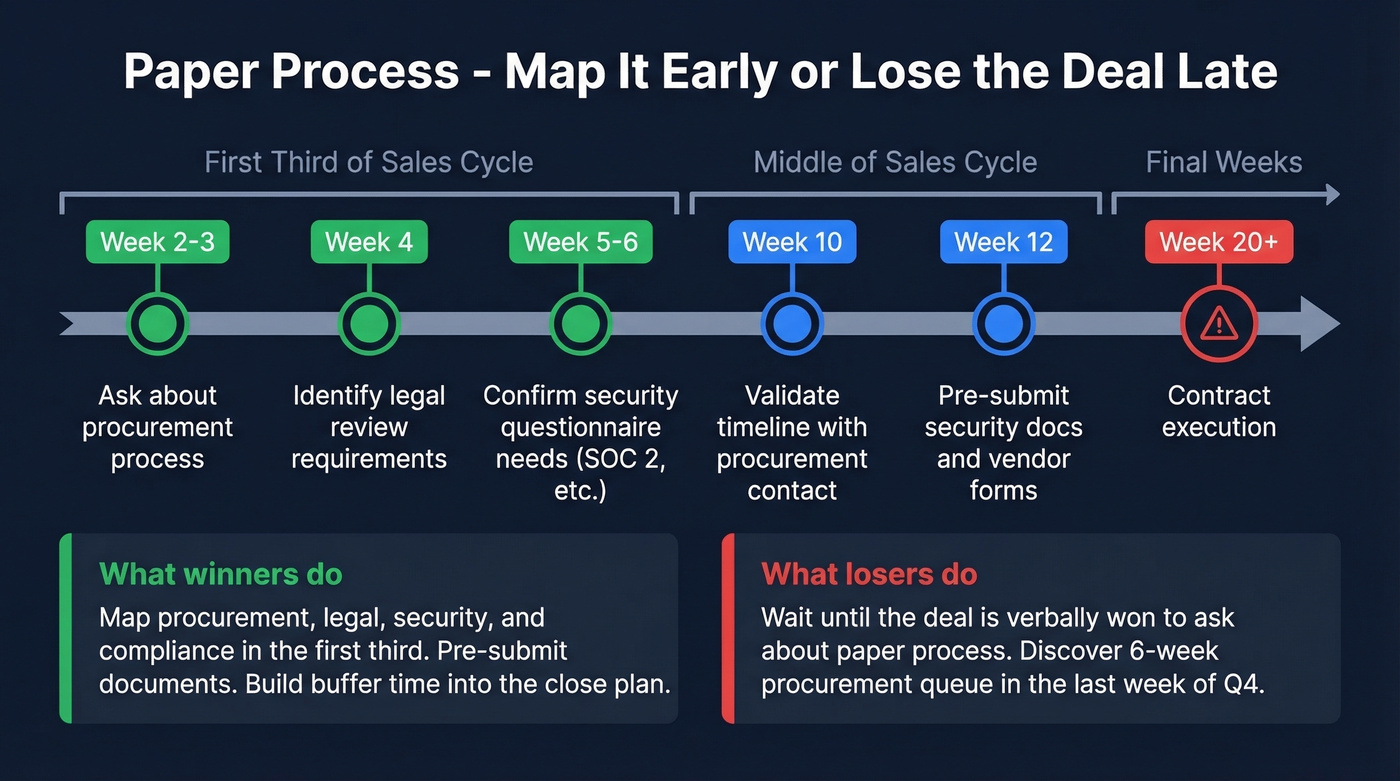
Paper process covers everything between "yes, we want to buy" and "contract executed" - procurement reviews, legal redlines, security questionnaires, compliance checks, and vendor onboarding. The fatal mistake is waiting until the deal is "won" to ask about it. By then, you're learning that procurement needs six weeks, legal is backed up, and the security review requires a SOC 2 Type II report you don't have. Map this in the first third of the sales cycle, not the last week.
Implicate the Pain
"Yeah, it's a problem" isn't implicated pain - it's acknowledgment. Implicating the pain means connecting the buyer's business problem to real consequences - financial, operational, competitive, or personal - and making the cost of inaction feel urgent.
What "good" looks like: the buyer articulates the pain in their own words, quantifies the impact, and connects it to a timeline. "We're losing $200K per quarter to manual processes, and the board wants this fixed before the next operating review" is implicated pain. If the pain isn't urgent enough to drive action, the deal will stall regardless of how well you've covered every other element.
Champion
This is the most misidentified element, and it's the one that burns reps the hardest.
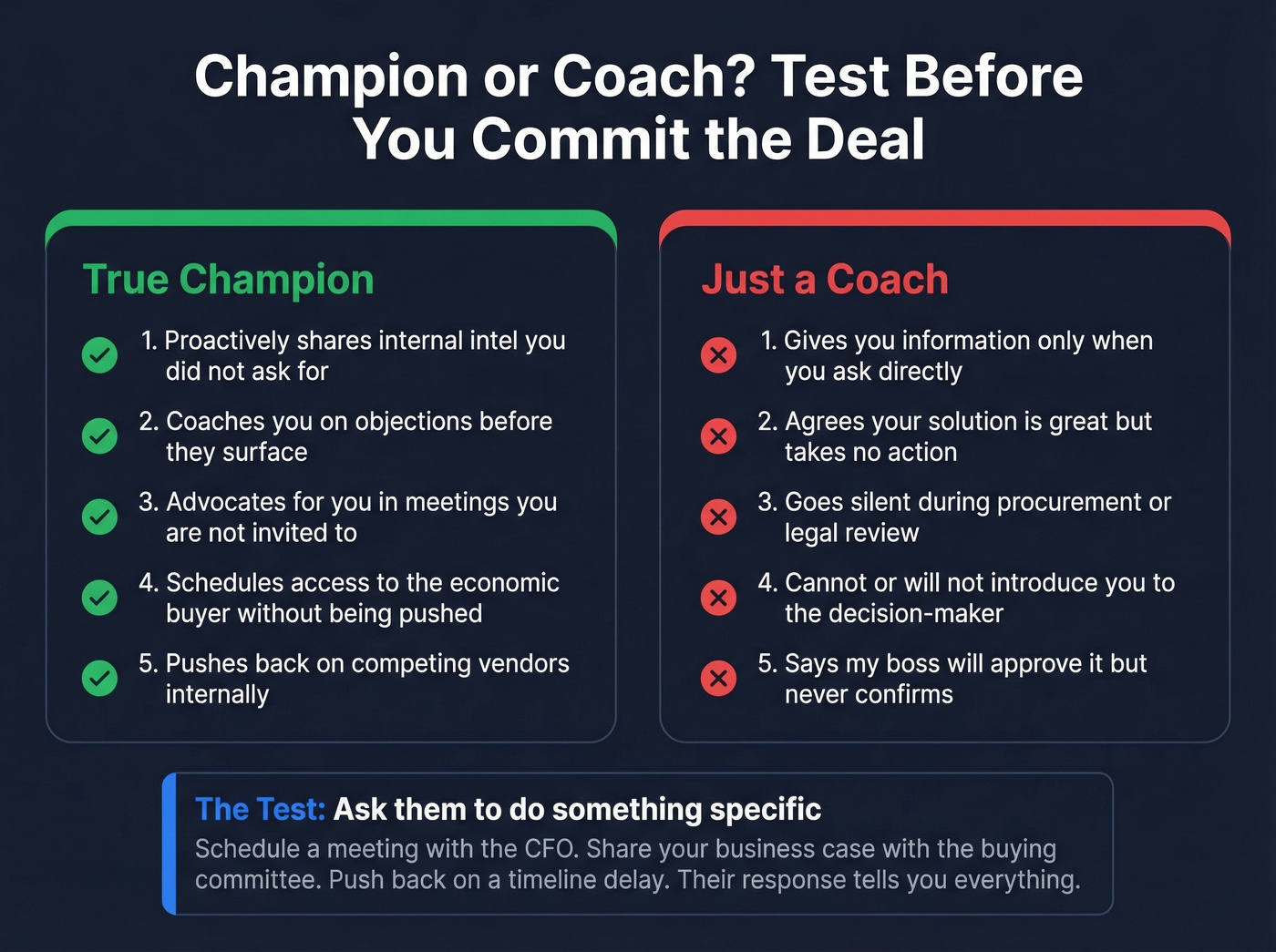
The distinction between a champion and a coach is everything. A coach gives you information. A champion takes action - proactively sharing internal intel, coaching you on objections before they surface, and advocating in meetings you're not invited to. Test your champion by asking them to do something: schedule a meeting with the CFO, share your business case internally, push back on a competing vendor. Their response tells you everything.
If they go silent during procurement, they were never a champion.
Competition
Competition isn't just other vendors - it's every alternative the buyer is considering, including doing nothing, building in-house, or reallocating budget to a different initiative entirely.
Here's the thing: "no decision" kills more enterprise deals than any named competitor. The real threat in enterprise sales is often inertia - the buyer decides the pain isn't urgent enough to justify the procurement headache. If you haven't addressed the "do nothing" scenario, you haven't fully covered competition. Know every alternative being evaluated, understand the buyer's perception of each, and differentiate on the criteria that matter most to the economic buyer, not just the criteria where you look best.
The History
MEDDIC originated at PTC (Parametric Technology Corporation) in 1996, developed by Dick Dunkel, Jack Napoli, and the broader PTC sales leadership team. It wasn't an academic exercise - it was an internal checklist built to qualify complex enterprise deals in a company that was scaling fast. A widely cited result: PTC grew from $300M to $1B in revenue over four years.
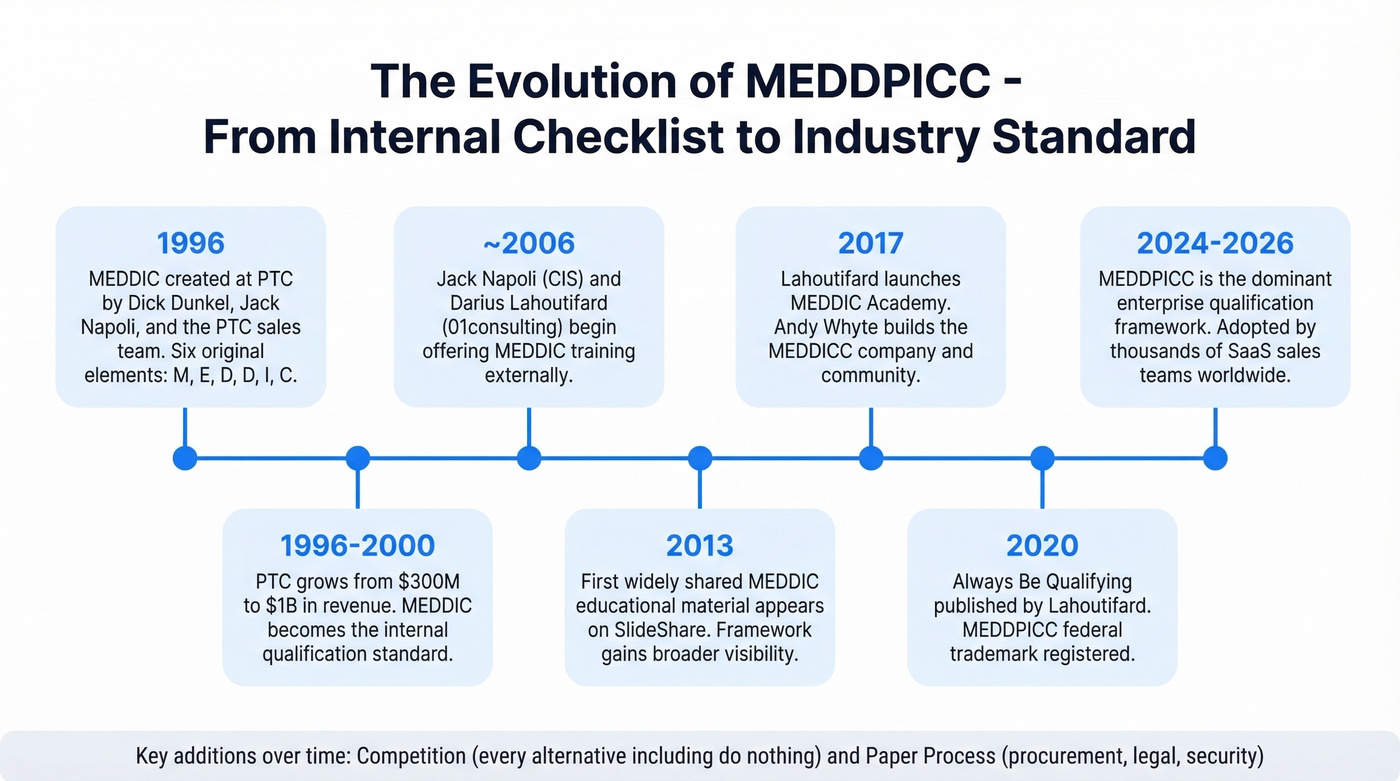
The original framework had six elements: Metrics, Economic Buyer, Decision Criteria, Decision Process, Identify Pain, and Champion. Over time, practitioners added two more. Competition reflects the reality that enterprise deals always involve alternatives, including "do nothing." Paper Process was added because procurement, legal, and security reviews kill deals that are otherwise "won." The first publicly branded educational material appeared on SlideShare in 2013.
The commercialization timeline gets contested. Jack Napoli's CIS began offering MEDDIC training around 2006. Darius Lahoutifard's 01consulting was also offering training from that same period. Lahoutifard, who now holds the MEDDPICC federal trademark, launched MEDDIC Academy in 2017 and published Always Be Qualifying in 2020. Andy Whyte built the MEDDICC company and community around the framework as well. There are competing claims about who formalized what, but the practical reality is that MEDDIC was a team creation at PTC, and multiple people have since built businesses around teaching it. The framework itself is what matters.
MEDDPICC vs Other Frameworks
Let's be direct about when to use what. This framework isn't always the right tool, and using it on the wrong deals creates unnecessary overhead.
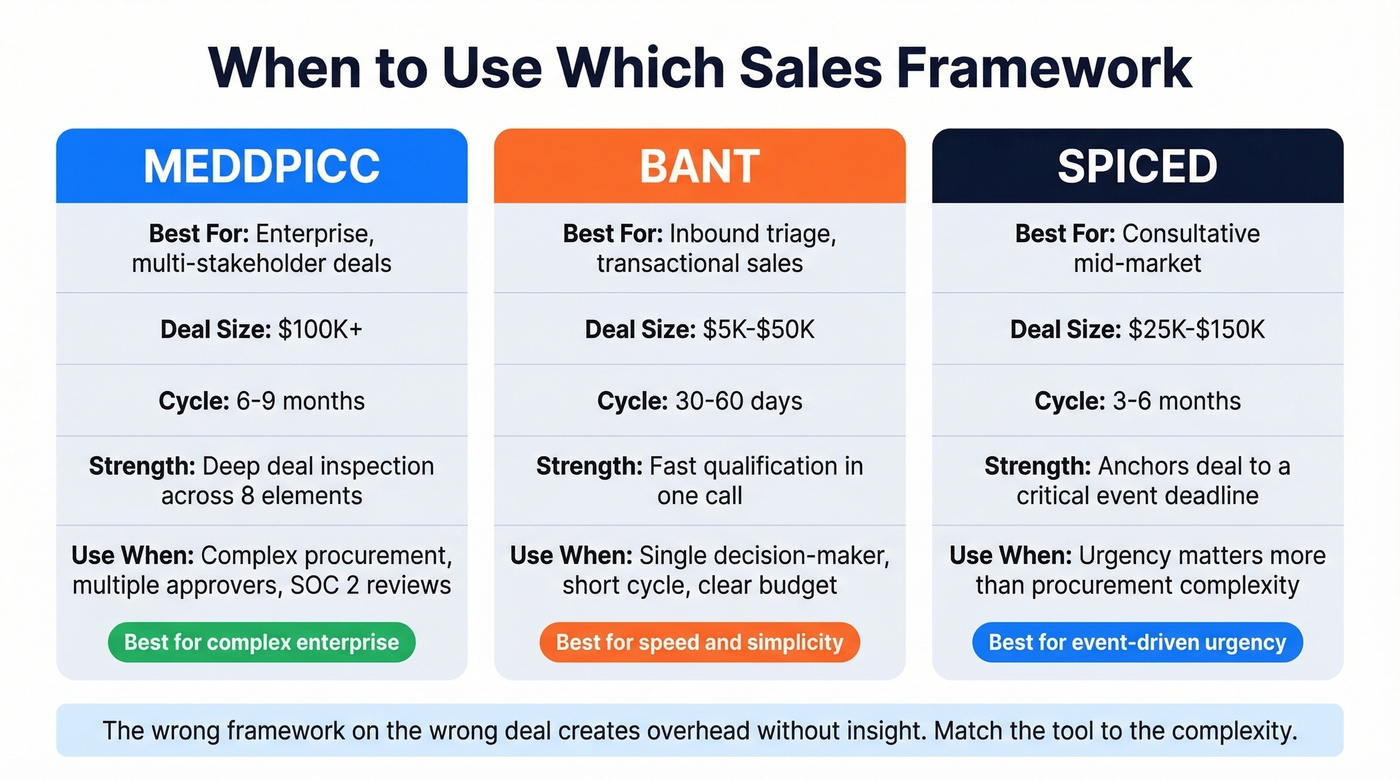
| Framework | Best For | Deal Size | Cycle Length | Key Strength |
|---|---|---|---|---|
| MEDDPICC | Enterprise, multi-stakeholder | $100K+ | 6-9 months | Deal inspection depth |
| BANT | Inbound triage, transactional | $5K-$50K | 30-60 days | Speed of qualification |
| SPICED | Consultative mid-market | $25K-$150K | 3-6 months | Critical event urgency |
| SPIN Selling | Discovery-heavy conversations | Any | Any | Question framework depth |
| Challenger | Insight-led, teaching sales | $50K+ | 3-9 months | Reframes buyer thinking |
| Sandler | Pain-focused, mutual qualification | $25K+ | 2-6 months | Disqualification discipline |
Here's how this plays out in practice. A SaaS company selling a $150K platform deal with a 7-month cycle, SOC 2 requirements, and a CFO who needs to see ROI within 12 months - that's MEDDPICC territory. You need to map the decision process, paper process, and economic buyer or you'll lose the deal in procurement.
An inbound lead requesting a demo of your $15K/year tool with a 30-day trial? BANT. Qualify budget, authority, need, and timeline in the first call. Applying an eight-element qualification framework here is like bringing a 20-page checklist to a coffee meeting.
SPICED shines when there's a critical event driving urgency - a board review date, a compliance deadline, a contract renewal. The "Critical Event" element in SPICED does something the eight-letter framework doesn't explicitly address: it forces you to anchor the deal to a specific external deadline. For mid-market companies where urgency matters more than procurement complexity, SPICED is the better fit.
Sandler works best when your sales culture values mutual qualification - the rep and the buyer deciding together whether there's a fit. It's excellent for teams that struggle with "happy ears" and need a framework that encourages disqualification. The cultural fit requirement is real, though; Sandler's upfront contract approach doesn't land in every industry.
SPIN Selling and Challenger aren't qualification frameworks - they're conversation and teaching methodologies. They complement deal qualification rather than replace it. Use SPIN's question structure during discovery calls, use Challenger's insight-led approach to reframe buyer thinking, and use your qualification framework to track whether the deal is actually progressing.
Does It Actually Work?
You'll find articles claiming the methodology delivers "41% higher win rates and 26% shorter sales cycles." That stat floats around the internet without a single cited study behind it. It's marketing-grade data at best.
Here's what we can say directionally. The PTC $300M-to-$1B growth story is widely cited in MEDDIC write-ups. Salesmotion puts adoption at 73% of SaaS companies selling above $100K ARR, and says adoption doubled from 11% to 21% among B2B sales organizations between 2021 and 2022.
In our experience, teams that operationalize the framework properly see a 15-20% improvement in win rates and meaningfully better forecast accuracy. The key word is "operationalize." Defining the eight elements in a training deck doesn't move numbers. Building them into pipeline reviews, coaching cadences, and deal decisions does.
The framework doesn't close deals. It exposes which deals are real and which are wishful thinking. That's its actual value - not a magic win-rate multiplier, but a systematic way to stop wasting time on deals that were never going to close. The teams that benefit most are the ones willing to disqualify aggressively based on what qualification reveals.

Your MEDDPICC fields are only as good as the contact data behind them. If your economic buyer's email bounces or your champion's phone goes to voicemail, the framework fails. Prospeo gives you 98% verified emails and 125M+ mobile numbers with a 30% pickup rate - refreshed every 7 days so you're never chasing someone who left the company in January.
Stop filling MEDDPICC fields with dead contact data.
Five Anti-Patterns That Kill It
Checkbox Theater
This is the #1 failure mode. Reps fill fields to make managers happy. Managers check boxes to survive pipeline reviews. Nobody uses the data to actually decide the state of a deal. The CRM looks clean, the pipeline looks healthy, and then Q4 falls apart. If your reps can fill in every field but can't articulate why the deal will close this quarter, you have a compliance problem, not a qualification system.
Scorecard Misfit
The eight elements are validated across multiple conversations over weeks or months, not checked off in one discovery call. The Gong community is vocal about this - use deal boards and trackers instead of static scorecards. A scorecard captures a snapshot. A deal board tracks progression. Treating qualification as a single-call scorecard fundamentally misunderstands the framework.
Definition Without Application
Generic training teaches reps what "Economic Buyer" means. It doesn't teach them how to identify the economic buyer at their target accounts, in their industry, with their deal dynamics. The fix is translating each element into company-specific inspection points - not "identify the economic buyer" but "confirm the VP of Finance has budget authority for purchases over $75K and has reviewed the business case."
No Manager Buy-In
The framework lives in CRM fields but never shows up in coaching conversations. If managers don't reference it in 1:1s, pipeline reviews, and forecast calls, reps learn that filling in the fields is busywork. It has to be the language of deal inspection, not just the structure of the opportunity record.
Stale Data Foundation
Qualification is only as good as the pipeline it inspects. If your champion's email bounces or your economic buyer left the company three months ago, the framework is irrelevant before it starts. We've seen teams run careful qualification processes on pipelines built from outdated contact data - every element "validated" against people who've moved on. Your contacts need to be current, or the qualification is fiction.
How to Implement MEDDPICC
CRM Setup (HubSpot)
Start by creating deal properties for each element - eight single-line text or dropdown fields on the deal object. The critical step is setting these as mandatory in conditional deal stages. Don't let reps move a deal to "Discovery Complete" without filling in Metrics and Pain. Don't let them move to "Proposal" without Economic Buyer and Decision Criteria confirmed. Stage gates enforce the framework without requiring constant manager oversight.
For champion and economic buyer tracking, HubSpot's native deal-to-contact association is limited. The workaround: create association labels for roles (Champion, Economic Buyer, Technical Evaluator), then build a deal workflow that auto-sets corresponding deal checkboxes when a contact with the right label is associated. Making those checkboxes view-only requires at least one Enterprise subscription.
CRM Setup (Salesforce)
On the Opportunity object, create custom fields for each element. Use picklists or text fields depending on how structured you want the data.
Add a simple score field - a formula or weighted score - that gives managers a quick health indicator. Build validation rules to enforce completion at stage gates: a deal can't move to "Negotiation" unless Economic Buyer, Decision Process, and Paper Process fields are populated. For reporting, create a dashboard showing field completeness by rep, by stage, and by deal size. In our experience, the reps with consistently incomplete fields at late stages are the ones whose deals slip most often. The data proves it within one quarter.
Coaching Cadences
Implementation fails when the framework lives in the CRM but not in conversations. Build gaps into every 1:1 agenda. Instead of "how's the Acme deal going?" ask "who's your champion at Acme, and when did they last take action on your behalf?"
Anchor forecasting to customer evidence, not gut feelings. A deal in "commit" should have confirmed metrics, an identified economic buyer who's engaged, a documented decision process with timeline, and a paper process mapped with realistic dates. If any of those are missing, it's "best case" at most.
Use deal boards in your pipeline reviews - visual trackers that show which elements are validated for each deal. Tie the framework to specific sales plays: if Champion is weak, the play is "schedule a joint call with your contact and their VP." If Paper Process is unknown, the play is "ask procurement for their standard vendor timeline."
AI Tools That Accelerate It
Call intelligence platforms like Gong and Otter.ai can track qualification elements in recorded conversations and flag gaps - surfacing that you never discussed paper process or that the economic buyer hasn't been mentioned in three calls. These tools turn hours of manual deal inspection into searchable moments and structured coaching prompts. They don't replace coaching, but they make coaching conversations far more specific.
Cross-Functional Alignment
The framework works best when it's not just an AE tool. Customer Success teams who inherit deals benefit from seeing the original pain, metrics, and champion data - it shapes onboarding and expansion conversations. RevOps can use field completeness as a pipeline health metric across the entire funnel. When qualification becomes a shared language across sales, CS, and RevOps, deal handoffs stop losing context and expansion revenue grows.
Discovery Questions That Work
A caveat before the questions: don't read these off a script. The worst thing you can do with a 137-question bank is turn a discovery call into an interrogation. Understand the concept behind each element, use these as inspiration, and adapt to the conversation.
Quick-Start 12
These twelve questions cover all eight elements and work as a starting framework for any enterprise discovery call:
- "What's the dollar value of this problem over 12 months?"
- "What personal KPIs are tied to solving this?"
- "Who ultimately signs off on a purchase of this size?"
- "What are the three non-negotiable requirements for this solution?"
- "Walk me through how a purchase like this gets approved."
- "What does your procurement process look like - legal, security, compliance?"
- "What happens if you don't solve this in the next 6 months?"
- "On a scale of 1-10, how painful is this problem today?"
- "Who would be willing to champion this internally?"
- "Can you walk me through what the internal conversation looks like when I'm not on the call?"
- "What other solutions are you evaluating?"
- "What would cause your team to decide to do nothing?"
Going Deeper
A few questions that surface what the Quick-Start 12 misses:
Metrics: "What ROI threshold does your finance team need to see before approving?" Economic Buyer: "What would make the budget holder deprioritize this initiative?" Decision Process: "What's the most recent enterprise purchase you made, and how long did it take from first meeting to signature?" Paper Process: "What's the realistic timeline from verbal yes to signed contract - not the optimistic one?" Champion: "Would you be comfortable presenting our business case to the executive team?" Competition: "Is there an internal build option being considered?"
A Deal Walkthrough, Start to Close
Let's walk through a $150K enterprise SaaS deal from first meeting to close, showing how each element gets validated across the cycle - not in one call.
Week 1-2: Discovery. Your SDR books a meeting with the Director of Customer Success at a mid-market SaaS company. In the first two calls, you uncover the pain: customer churn is running 8% quarterly, costing roughly $3.6M annually. The director is frustrated - she's been flagging this to leadership for six months. You've got Metrics and Pain partially validated.
Week 3-4: Stakeholder mapping. The director introduces you to the VP of Revenue, who confirms budget exists but says the CFO needs to approve anything over $100K. Now you know the Economic Buyer is the CFO - someone you haven't met yet. You need to multi-thread into the CFO's office. Your AE pulls the CFO's verified direct dial and reaches out with a concise value summary anchored to the $3.6M churn number.
Week 5-8: Evaluation. The CFO agrees to a 30-minute call. Decision Criteria emerge: SOC 2 compliance, ROI within 12 months, integration with their existing tech stack. You learn the Decision Process involves a three-person evaluation committee with a recommendation to the CFO. Competition surfaces - they're also evaluating one other vendor and exploring a build option.
Week 9-12: Champion testing. Your Director of CS contact has been your champion - sharing internal docs, coaching you on objections, advocating in meetings. Then she goes silent for two weeks during procurement. This is the moment of truth. A real champion comes back with intel: "Legal flagged your data processing terms - here's what they need changed." A false champion just disappears. Yours comes back. She's real.
Week 13-16: Paper Process. The verbal "yes" comes in week 13. Procurement needs a vendor assessment, legal needs to redline the MSA, and security needs the SOC 2 report reviewed. Total Paper Process: 6 weeks. You mapped this in week 6, so it's not a surprise - it's a managed timeline.
Week 18: Signed. Every element was validated across the cycle. The deal closed on time because the paper process was mapped early and the champion was tested under pressure.
The Data Foundation Nobody Talks About
Every qualification guide focuses on the framework. Almost none address the prerequisite: can you actually reach the people you're qualifying?
Here's a scenario we've seen repeatedly. An SDR books 15 meetings in a quarter. Eight of those contacts have bounced emails. Three of the "economic buyers" left the company months ago. The champion's phone number goes to a general line. The fields are filled in beautifully - against contacts who don't exist anymore.
This is a data quality problem, and it's solvable. Prospeo provides 98% email accuracy across 143M+ verified emails and 125M+ verified mobile numbers drawn from 300M+ professional profiles. The part that matters most for deal qualification: a 7-day data refresh cycle, compared to the 6-week industry average. When your economic buyer changes roles or your champion moves companies, you know within days, not months.

One proof point that sticks with us: Snyk's sales team of 50 AEs was running bounce rates of 35-40% before overhauling their data foundation. Bounces dropped under 5%, and AE-sourced pipeline jumped 180% - generating 200+ new opportunities per month. That's not a framework improvement. That's a data quality improvement that made rigorous qualification possible in the first place.
Testing your champion means reaching the economic buyer directly. Prospeo's 30+ search filters - including job changes, department headcount, and org hierarchy - help you map the entire decision process and find every stakeholder's verified contact. At $0.01 per email, validating your deal's buying committee costs less than a coffee.
Map the buying committee with contacts that actually connect.
Scorecard Template
Use this scoring rubric across the full sales cycle - not as a one-call assessment. Score each element after every meaningful interaction and track progression over time.
| Element | 1 - Not Identified | 2 - Partially Validated | 3 - Fully Confirmed |
|---|---|---|---|
| Metrics | No quantified value | Directional numbers discussed | Buyer-confirmed ROI/impact |
| Economic Buyer | Unknown or assumed | Named but not engaged | Direct conversation held |
| Decision Criteria | Not discussed | Informal criteria shared | Documented evaluation scorecard |
| Decision Process | Unknown | General steps outlined | Full process with timeline mapped |
| Paper Process | Not explored | Procurement mentioned | Legal/security/timeline confirmed |
| Pain | Surface acknowledgment | Problem quantified | Urgency + consequences articulated |
| Champion | Friendly contact only | Advocate who shares info | Takes action, coaches, sells internally |
| Competition | Unknown | Named competitors identified | Full landscape including "do nothing" |
Deal health thresholds:
- 18-24 (Commit): All elements validated with evidence. This deal belongs in your forecast.
- 12-17 (Best Case): Most elements covered, but gaps remain. Identify the weakest element and build a plan to close it this week.
- Below 12 (Pipeline): Too many unknowns for a forecast. This deal needs work before it deserves management attention.
A deal that scores 8 in week two isn't a bad deal - it's an early-stage deal. A deal that scores 12 in week fourteen is a problem.
FAQ
What does MEDDPICC stand for?
MEDDPICC stands for Metrics, Economic Buyer, Decision Criteria, Decision Process, Paper Process, Implicate the Pain, Champion, and Competition. Each letter represents a qualification element that enterprise sales teams validate to determine whether a complex deal will close and where it'll stall.
Is MEDDPICC a methodology or a framework?
It's a deal qualification and coaching framework, not a full sales methodology - it tells you whether a deal is real but doesn't prescribe how to sell. Pair it with Challenger or SPIN for the complete picture. Think of it as the diagnostic tool and the methodology as the treatment plan.
When should you NOT use it?
Skip it for transactional deals under $50K with one decision-maker and a 30-day cycle - BANT qualifies those faster. The framework earns its complexity in enterprise deals with multiple stakeholders, procurement gates, and 6-9 month timelines where a single unvalidated element can kill the deal.
How do you avoid checkbox theater?
Tie each element to deal decisions, not CRM compliance - if a rep can't articulate the paper process timeline or name their champion's last action, that's a coaching conversation. Build qualification into pipeline reviews and forecasting cadences so the data drives decisions rather than decorating opportunity records.
What tools help operationalize it?
Your CRM handles field tracking and stage gates. Gong or Otter.ai surface qualification gaps in recorded conversations. For the data foundation - reaching verified economic buyers and champions - tools like Prospeo provide 98% accurate emails and verified mobile numbers refreshed every 7 days, so you're qualifying against contacts who actually exist.