

MEDDPICC Sales Methodology: Stop Checking Boxes, Start Scoring Deals
Your VP just rolled out MEDDPICC. The enablement deck landed in Slack on Monday. By Wednesday, half the team is quietly furious - they see eight more CRM fields standing between them and actually selling. The other half nodded along in training while planning to ignore it entirely.
They're both reacting to a real problem. Most MEDDPICC rollouts fail not because the framework is wrong, but because leadership implements it as a compliance exercise instead of a deal-scoring system. 73% of SaaS companies selling above $100K ARR use some version of this qualification approach, and the ones doing it well see deals that are 6.3x more likely to close and close 21.6% faster. The ones doing it badly just created expensive paperwork.
Quick Version
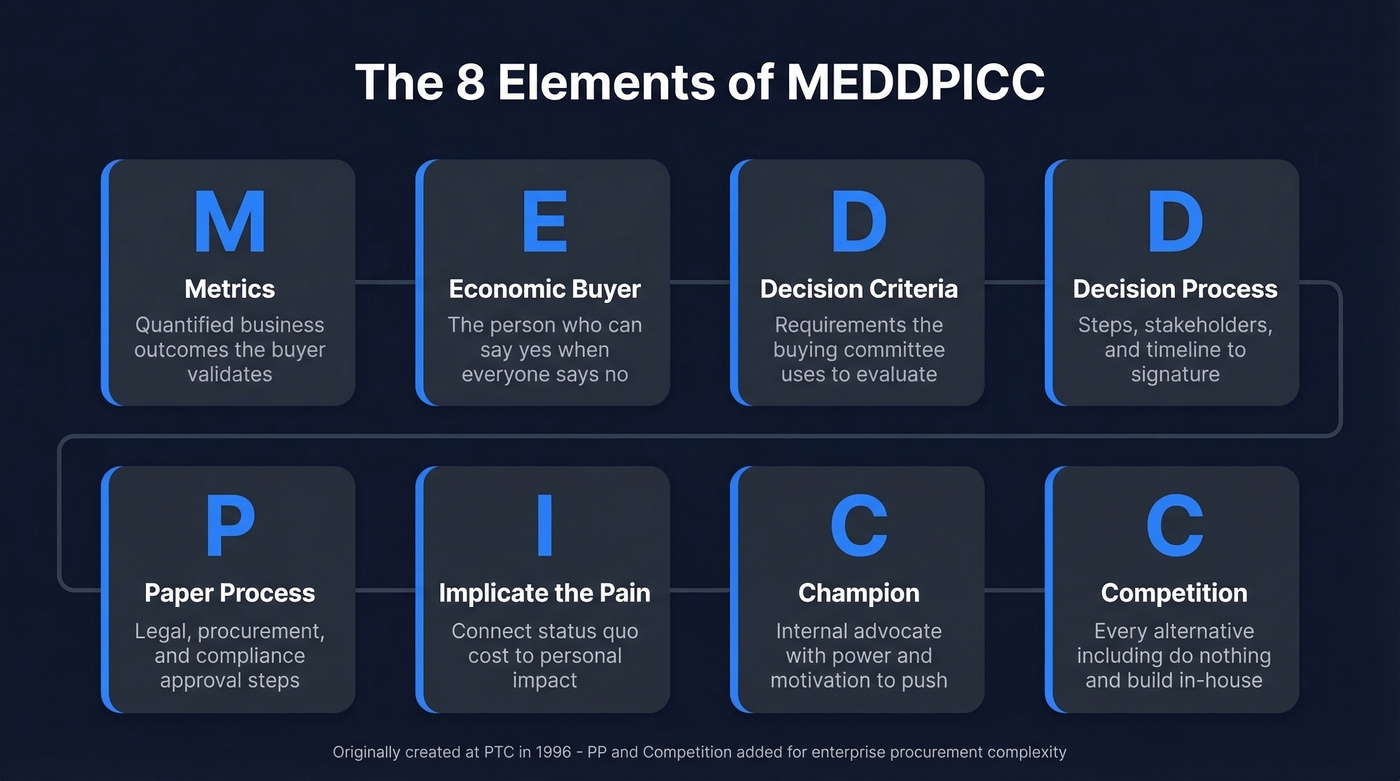
MEDDPICC is an eight-element sales qualification framework for complex B2B deals: Metrics, Economic Buyer, Decision Criteria, Decision Process, Paper Process, Implicate the Pain, Champion, Competition.
The core thesis isn't "fill out eight fields." It's "score each element 1-4, multiply by deal value, and get a forecast you can actually trust." If you only read three sections, make them these:
- The 8 components - what each letter actually means, with discovery questions baked in
- The handicap scoring model - how to turn the framework into a weighted forecast
- The framework comparison - when MEDDPICC is overkill and what to use instead
What Is MEDDPICC?
MEDDPICC originated at PTC in the mid-1990s. Dick Dunkel created MEDDIC inside PTC in 1996, and sales leaders including Jack Napoli later popularized it. The results were hard to argue with: PTC is credited with growing sales from $300 million to $1 billion in four years using the framework.
The original six letters - Metrics, Economic Buyer, Decision Criteria, Decision Process, Implicate the Pain, Champion - covered the core of complex deal qualification. MEDDPICC adds two more: Paper Process (the legal, procurement, and compliance steps that kill deals after verbal commitments) and Competition (every alternative the buyer is considering, including doing nothing).
MEDDPICC is a federally registered trademark of Darius Lahoutifard. MEDDIC Academy formalized the training and certification ecosystem and offers official certification.
The distinction between MEDDIC and MEDDPICC matters. If you're selling into organizations with formal procurement, security reviews, or legal redlining - and in 2026, that's most enterprise B2B sales deals - the two extra letters aren't optional. They're where deals go to die.
The 8 MEDDPICC Components
Metrics
Metrics are the quantified business outcomes your buyer expects. Not "improve efficiency" - actual numbers. Revenue gained, costs reduced, time saved, expressed in dollars or percentages the buyer has validated.
A critical distinction: buyer-stated metrics ("we think we'll save $1M") are weaker than independently validated ones ("finance confirmed the $2.4M churn cost"). Treat unvalidated numbers as hypotheses, not facts.
Ask: What does success look like in numbers? How are you measuring the cost of the current problem today?
Economic Buyer
The Economic Buyer can say yes when everyone else says no. They control the budget, they can override consensus, and they can kill a deal with a single email. In most enterprise orgs, this isn't your day-to-day contact.
A hard gating rule we've seen work: no proposal goes out without a confirmed EB. Ask: Who signs off on unbudgeted spend of this size? Who breaks the tie if the committee is split?
Decision Criteria
These are the technical, business, and cultural requirements the buying committee uses to evaluate options. They're rarely written down early, which means your job is to help shape them before the RFP drops.
You're in strong shape when you can list the top five criteria in priority order and know which ones favor you. Ask: What are the must-haves vs. nice-to-haves? How will you weight security against time-to-value?
Decision Process
Decision Process maps the steps, stakeholders, and timeline from "we're evaluating" to "signature on contract." It's the sequence - who reviews what, in what order, with what approval gates.
The signal you want: a documented timeline with named stakeholders at each stage, confirmed by your Champion. Ask: Walk me through what happens between a verbal yes and a signed contract.
Paper Process
28% of deals fail when buyers can't secure internal approval. That makes Paper Process the most underrated letter in the framework.
Here's the mistake everyone makes: treating Paper Process as a Stage 5 activity. Start mapping it in Stage 2. You need the procurement team's name, their standard review timeline, and whether security or legal review is required. Ask: What does your procurement process look like for a purchase of this size? How long did your last software purchase in this range take to close?
Implicate the Pain
Implicating the pain goes beyond identifying the business problem. It connects the status quo cost to personal impact - how this problem affects the specific person you're talking to, their team, their career, their quarterly targets.
Your champion should be able to articulate the personal cost of inaction, not just the business case. Ask: How is this problem affecting your team's ability to hit targets this quarter? What happens to your roadmap if this doesn't get solved in the next six months?
Champion
Here's the most common Champion mistake: confusing a friendly contact with an internal advocate. A Champion isn't someone who likes you. A Champion has power, influence, and personal motivation to push your deal through. They sell when you're not in the room.
The validation test is simple. Has your Champion taken concrete action? Forwarded your materials to the EB, scheduled an internal meeting, made an executive introduction? If the answer is "not yet," you don't have a Champion. You have a contact.
Competition
What's the most likely reason this initiative stalls?
Lead with that question, because competition isn't just the other vendors in the evaluation. It's every alternative - including doing nothing, building in-house, or reallocating the budget to a different initiative entirely. "Do nothing" wins more deals than any named competitor. You need to name every alternative being considered and articulate why the buyer would choose each one over you.
Scoring Deals With the Handicap Model
Stop treating MEDDPICC as eight checkboxes. Start treating it as eight scores.
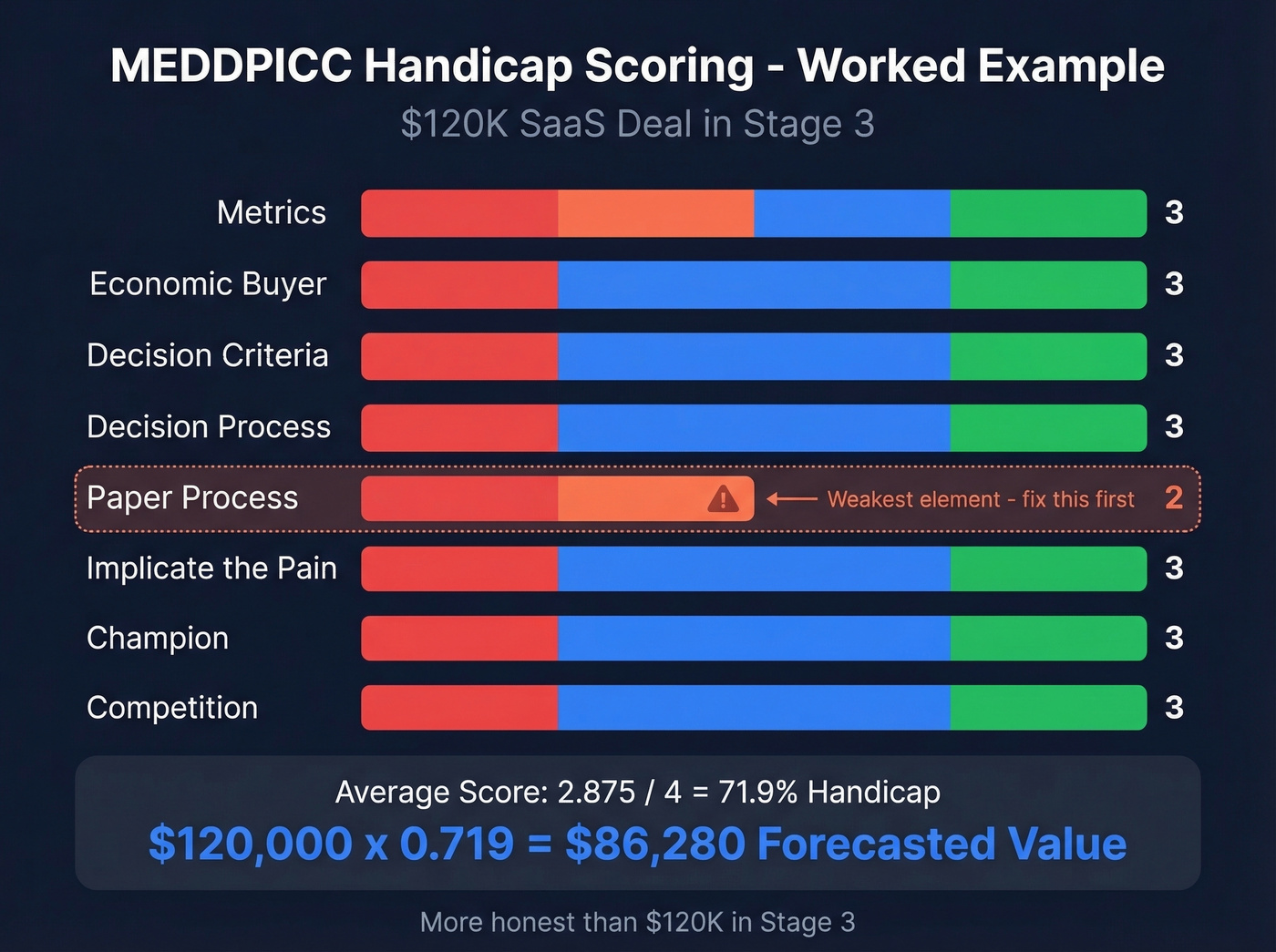
The Kalungi handicap model replaces binary yes/no fields with a 1-4 scoring rubric per element:
| Score | Level | What It Means |
|---|---|---|
| 1 | Not Met | Missing or based on assumptions |
| 2 | Partially Met | Some signals, not validated |
| 3 | Strongly Met | Clear, buyer-validated evidence |
| 4 | Outstanding | CFO/GC-grade proof, execution-ready |
The formula: Deal Value x MEDDPICC Handicap x Deal Health Multipliers = Forecasted $ Value.
Let's walk through a worked example. A $120K SaaS deal in Stage 3:
| Element | Score | Rationale |
|---|---|---|
| Metrics | 3 | Buyer confirmed $1.8M cost of churn, validated by finance |
| Economic Buyer | 3 | Identified, direct meeting completed |
| Decision Criteria | 3 | Top five criteria documented, three favor us |
| Decision Process | 3 | Timeline mapped with Champion, two approval gates confirmed |
| Paper Process | 2 | Procurement exists, but timeline unknown |
| Implicate the Pain | 3 | Champion articulated personal impact clearly |
| Champion | 3 | Forwarded deck to EB, scheduled internal review |
| Competition | 3 | Mapped two competitors and "do nothing" risk |
Average score: 2.875 out of 4 = 71.9% handicap. Applied to the deal: $120K x 0.719 = $86,280 forecasted value. That's a more honest number than "$120K in Stage 3" - and it tells you exactly where to focus. The Paper Process score is dragging the deal down. Fix that one element, and your forecast accuracy improves immediately.
Gating rules make this actionable: no proposal without a confirmed EB (score of 3 or higher), no deal moves to Stage 4 without a direct EB meeting. These aren't suggestions - they're pipeline hygiene.
Use AI to Pressure-Test Scores
Here's a 2026-specific advantage most teams are sleeping on. Paste your deal notes into ChatGPT and run these prompts:
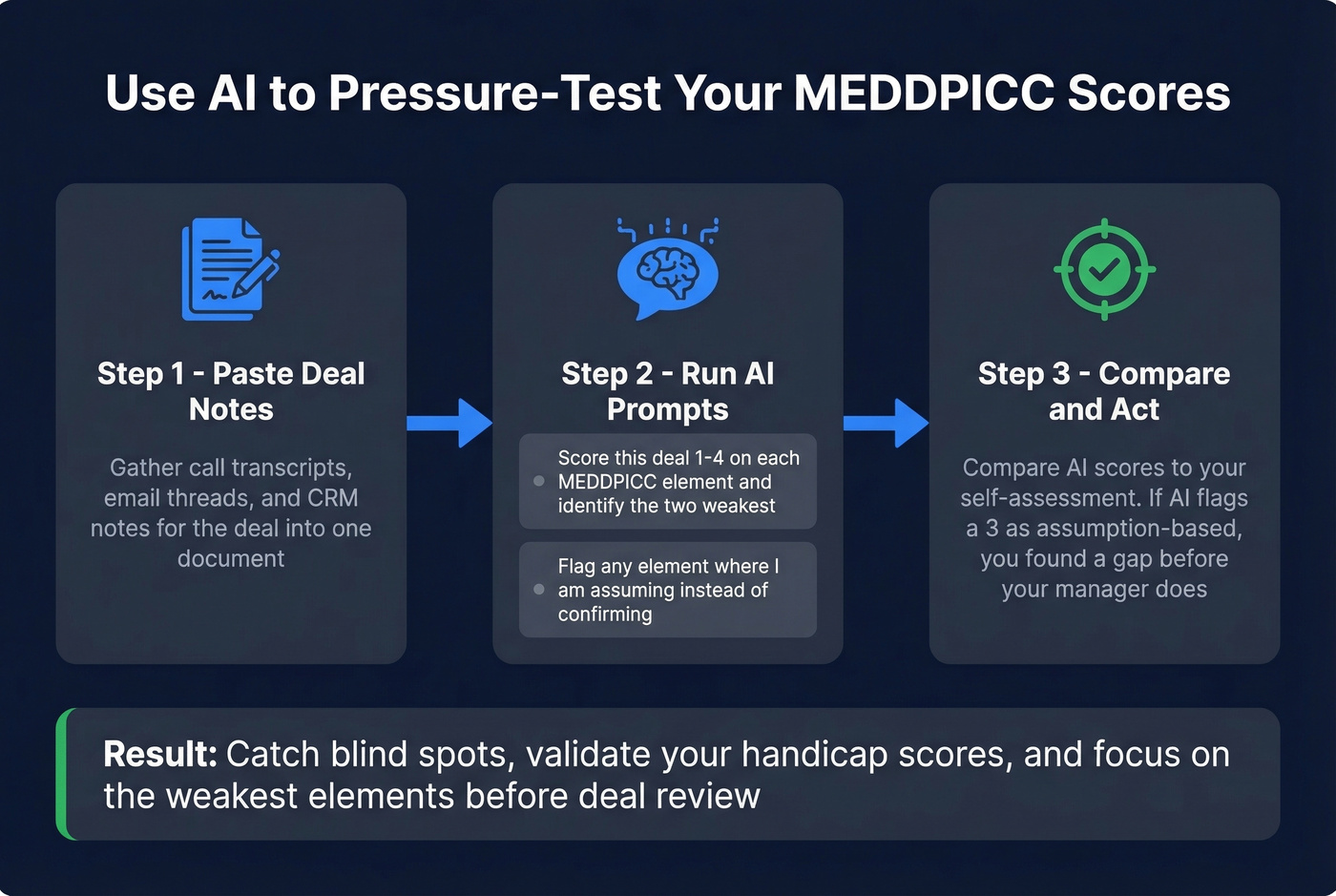
"Score this deal on each MEDDPICC element 1-4 based on the notes below. Identify the two weakest elements and suggest one specific action to improve each."
"Based on these call notes, which MEDDPICC elements have no supporting evidence? Flag any element where I'm assuming instead of confirming."
Tie the AI output back to your handicap scores. If ChatGPT flags your Champion score as assumption-based and you scored it a 3, you've found a gap before your manager does.

Your MEDDPICC scorecard says the deal is a 4. Then your outreach bounces because the Economic Buyer's email is stale. Prospeo refreshes 300M+ profiles every 7 days - not every 6 weeks - so the contacts you map to each MEDDPICC element are real, verified, and reachable.
Score your deals with confidence. Reach every stakeholder on the first try.
MEDDPICC vs. BANT vs. MEDDIC vs. SPICED
Let's be honest: if your average deal has fewer than three stakeholders and closes in under 60 days, MEDDPICC is overkill. Most teams would be better served by MEDDIC or even BANT. The framework should match the complexity of the sale, not the ambition of the enablement team.
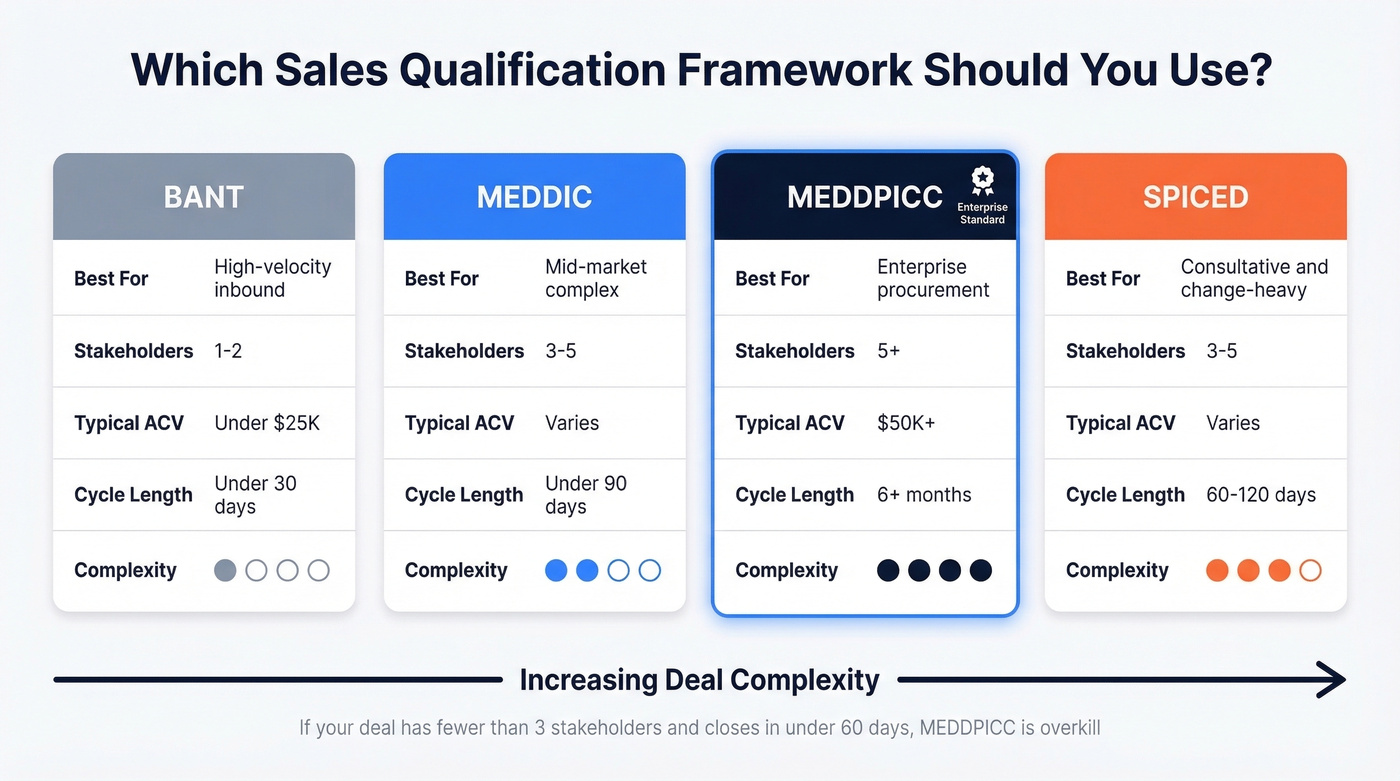
| Framework | Best For | Stakeholders | Typical ACV | Cycle Length |
|---|---|---|---|---|
| BANT | High-velocity inbound | 1-2 | <$25K | <30 days |
| MEDDIC | Mid-market complex | 3-5 | Varies | <90 days |
| MEDDPICC | Enterprise procurement | 5+ | $50K+ | 6+ months |
| SPICED | Consultative/change-heavy | 3-5 | Varies | 60-120 days |
Take a $60K SaaS deal with four stakeholders and a 75-day cycle. BANT tells you there's budget. MEDDIC tells you who controls it and how they'll decide. MEDDPICC adds whether legal will stall the signature and who else is in the running.
BANT works as an inbound screening tool. It's fast, simple, and tells you whether a lead is worth pursuing. But it falls apart the moment you're dealing with a buying committee, because "authority" isn't one person - it's a process.
MEDDIC covers the multi-stakeholder gap without the procurement overhead. For deals closing in under 90 days with three to five stakeholders, it gives you most of the value without the extra weight of Paper Process and Competition tracking.
SPICED shines in consultative sales where you're selling change, not just software. It's particularly strong when the buyer doesn't fully understand their own problem yet.
The hybrid workflow we've seen work best: BANT as the initial inbound qualifier, then MEDDPICC for anything that enters the enterprise pipeline. Organizations that fully adopt MEDDPICC report 18% higher win rates and 24% larger deal sizes - but only when it's applied to deals complex enough to warrant it. Skip it for your $12K self-serve deals. You'll just slow things down.
Why MEDDPICC Fails (And How to Fix It)
If your reps treat the framework like a form, you've already lost.
The Checkbox Trap
The #1 complaint about MEDDPICC on r/sales? It becomes "a CRM exercise, not a sales methodology." Reps fill fields to survive pipeline reviews. Managers check boxes instead of coaching deals. The framework devolves into bureaucracy. Reddit threads consistently describe this as the default failure mode - not a rare edge case.
The fix: scoring over checkboxes. When every element has a 1-4 score, the pipeline review conversation changes from "did you fill this out?" to "why is your Champion score a 2 - what action have they taken this week?" That's coaching. That's useful.
Stale CRM Data
Your MEDDPICC fields say the Economic Buyer is Sarah Chen, VP of Operations. But Sarah changed roles three weeks ago. Now your Champion is selling internally to someone who doesn't exist in that seat anymore, and nobody on your team knows.
Methodology breaks when the data underneath it goes stale. CRM records that haven't been refreshed in six weeks are a liability, not an asset. Prospeo's 7-day data refresh cycle keeps contact records current - so when your qualification fields say "EB: Sarah Chen," you can trust that Sarah is still in that role and her email actually works.
Over-Qualification Paralysis
We've watched teams apply full MEDDPICC rigor to $15K deals with two-week sales cycles. The result: reps spend more time qualifying than selling, and competitors close while you're still mapping the decision process. A related trap is over-indexing on late-stage qualification - cramming all eight elements into Stage 4 instead of progressively building the picture from Stage 1 onward.
Match framework depth to deal complexity. Use the comparison table above. If the deal doesn't warrant all eight elements, score the five or six that matter and move on.
20 Discovery Questions by Element
These questions should feel like a natural conversation, not an interrogation. The best practitioners run the framework so the buyer doesn't know they're doing it.
Metrics
- What does success look like in numbers for this initiative?
- How are you measuring the cost of the current problem today?
Economic Buyer 3. Who has final sign-off on unbudgeted spend of this size? 4. If the evaluation committee is split, who breaks the tie?
Decision Criteria 5. What are the three non-negotiable requirements for any solution? 6. How will you weight security and compliance against speed of deployment?
Decision Process 7. Walk me through what happens between a verbal yes and a signed contract. 8. How many people need to approve before procurement gets involved? 9. What's the latest this decision can be made to hit your timeline?
Paper Process 10. What does your procurement review look like for purchases in this range? 11. Is there a security or legal review required? How long does that typically take?
Implicate the Pain 12. How is this problem affecting your team's ability to hit targets this quarter? 13. What happens to your roadmap if this doesn't get solved in the next six months? 14. How does this impact you personally - your goals, your bandwidth, your credibility internally?
Champion 15. Who internally is most motivated to see this solved, and why? 16. Would you be comfortable presenting the business case to your leadership team? 17. What would make you confident enough to advocate for this internally?
Competition 18. What other approaches - including building in-house or doing nothing - are on the table? 19. If you had to bet, what's the most likely reason this initiative stalls? 20. What would "good enough" look like if you decided to keep the current process?
Copy these into your call prep doc. Then throw away the ones that don't fit your deal and add ones that do. The framework is a compass, not a script.
Operationalize MEDDPICC in Your CRM
Getting the methodology into your CRM isn't a one-afternoon project, but it's not a six-month initiative either. And none of this matters if qualified leads aren't routed to the right rep in the first place - fix your assignment rules before you fix your qualification fields.
Custom fields by pipeline stage. In Stages 1-2, add text and score fields for Metrics, Pain, and Competition. At Stage 3, layer in Economic Buyer (name, title, score), Decision Criteria (text, score), and Champion (name, actions log, score). Stage 4 and beyond gets Decision Process (mapped steps, score) and Paper Process (procurement contact, timeline, score). Progressive qualification - not a Stage 4 data dump.
Conversation intelligence integration. Tools like Gong or Chorus can auto-tag MEDDPICC elements from call recordings. This reduces manual data entry and catches gaps reps miss.
Mutual Action Plan. Build a shared document template that maps Decision Process and Paper Process steps with dates and owners. Share it with your Champion. It becomes the deal's operating system.
Here's where most implementations quietly break down: you've identified the Economic Buyer by name and title, mapped the decision process, built the mutual action plan - and then the EB's email bounces and their direct number is disconnected. Your qualification is pristine, but you can't reach the people it identified.

Tools like Prospeo solve this upstream problem. Search by title, company, and seniority using 30+ filters, verify in real time, and push directly to HubSpot or Salesforce. With 98% email accuracy and a 7-day refresh cycle, the contacts in your CRM fields are actually reachable. The methodology is only as good as the data underneath it.
Identifying your Champion and Economic Buyer is step one. Actually reaching them is step two. Prospeo gives you 98% accurate emails and 125M+ verified mobile numbers with a 30% pickup rate - so your multi-threaded outreach matches your multi-stakeholder qualification.
Stop qualifying deals you can't contact. Start with accurate data.
Training and Certification Options
If you're rolling this out across a team, you've got options at every price point.
| Provider | Offering | Price |
|---|---|---|
| MEDDIC Academy | Intro to MEDDPICC | Free |
| MEDDIC Academy | Full MEDDPICC | $297 |
| MEDDIC Academy | Advanced MEDDPICC | $597 |
| MEDDIC Academy | For Managers | $1,173 |
| MEDDIC Academy | Infinite Sales Leadership | $1,970 |
| MEDDIC Academy | For Trainers | $3,970 |
| Force Management | Enterprise rollout | $50K-$150K+ |
| MEDDICC (meddicc.com) | Team membership | $10K-$30K+ |
| Inspir'em | Mid-market training | $10K-$40K |
For individual reps, the $297 Full MEDDPICC course from MEDDIC Academy is the obvious starting point - it's the official certification path.
Timeline expectations: 3-4 weeks to configure CRM fields, train the team, and run the first scored pipeline review. Three to six months before the methodology is fully embedded in how your org forecasts and coaches deals. Don't expect overnight transformation - but do expect faster, more honest pipeline conversations within the first month.
FAQ
What does MEDDPICC stand for?
Metrics, Economic Buyer, Decision Criteria, Decision Process, Paper Process, Implicate the Pain, Champion, and Competition. These eight elements form a qualification framework for complex B2B enterprise deals with multiple stakeholders and formal procurement processes.
What's the difference between MEDDIC and MEDDPICC?
MEDDIC covers six qualification elements; MEDDPICC adds Paper Process and Competition. Paper Process maps procurement, legal, and compliance steps that kill deals after verbal commitments. Competition captures every alternative including "do nothing." For enterprise deals with formal buying processes in 2026, those two additions aren't optional.
What deal size warrants full MEDDPICC?
MEDDPICC works best for deals above $50K ACV with five or more stakeholders and sales cycles longer than six months. For deals under $25K closing in under 30 days, BANT provides adequate qualification. Applying all eight elements to a quick, low-stakeholder deal creates more friction than value.
How long does implementation take?
Expect 3-4 weeks to configure CRM fields, build scoring rubrics, and train the team. Full adoption - where scoring is embedded in pipeline reviews, forecasting, and deal coaching - typically takes 3-6 months. The biggest variable is management commitment to using scores, not checkboxes, in weekly reviews.
How do you keep qualification data accurate?
Stale contacts are the fastest way to invalidate your qualification work. A 7-day data refresh cycle ensures Economic Buyers, Champions, and procurement contacts stay reachable - with verified emails and direct dials pushed directly into Salesforce or HubSpot. Your CRM fields should reflect reality, not last quarter's org chart.