

The Miller Heiman Blue Sheet: A Practitioner's Field Guide for 2026
Your CRO came back from a Korn Ferry workshop last quarter. Now every deal over $50K needs a Miller Heiman Blue Sheet. You nodded along in the team meeting, opened the template, and stared at six pages of empty fields with zero idea where to start.
You're not alone - and most of the "guides" online are either gated behind Scribd or broken links. Here's the actual template, explained field by field, with a filled-out example you can steal.
The Short Version
- The Blue Sheet is a 6-section deal planner built for complex B2B sales with multiple stakeholders. Think of it as mission control for any deal worth mapping.
- Start with three sections, not six. Buying Influences, Red Flags/Strengths, and Action Plan. If you can't complete those in 30 minutes, you don't know the deal well enough.
- It pairs with other frameworks, not against them. MEDDIC handles qualification. Challenger handles messaging. The Blue Sheet handles deal architecture.
- Korn Ferry Sell is the official digital Blue Sheet - it typically lands in the mid-five figures to low-six figures annually, so most teams under 50 reps should start with a CRM template or Google Doc.
- Your Blue Sheet is only as good as your stakeholder data. Before mapping buying influences, verify that your contacts are still at the company and reachable. Stale data turns your sheet from strategy into fiction.
What Is the Blue Sheet?
The Blue Sheet is a 6-page opportunity planning document created by Robert B. Miller and Stephen E. Heiman as part of their Strategic Selling methodology. They developed the approach in the late 1970s and formalized it in their 1985 book Strategic Selling, which became a standard deal-planning framework for enterprise sales teams running complex, multi-stakeholder deals.
The name? Pure accident. Legend has it the printer ran out of white paper, so the first batch got printed on blue stock. The name stuck.
The strategic selling blue sheet forces you to answer five questions before you advance a deal:
- Who's involved in the decision?
- What does each person care about?
- Where do you stand competitively?
- What could kill this deal?
- What's your next move?
The urgency for this kind of rigor has only grown. Korn Ferry's 2024 Sales Maturity Survey found that win rates dropped 5% over three years and revenue attainment fell 6%, with 43% of sales leaders citing talent gaps as a top barrier. For deals exceeding $50K with multiple stakeholders and sales cycles stretching months, this framework remains one of the most structured ways to avoid the "happy ears" problem - where reps convince themselves a deal is solid when it isn't.
Today, Korn Ferry (which acquired Miller Heiman Group) positions the Blue Sheet as a cloud-based, AI-enabled engine built into their Sell platform. In 2018, they added the Opportunity Scorecard and Perspective framework - their term for insight-led selling - to modernize the approach. But the underlying framework hasn't fundamentally changed in four decades. That's because the problem it solves hasn't changed either.
Every Section, Explained
All six sections build on each other. Together they create a complete picture of where your deal stands and what needs to happen next.
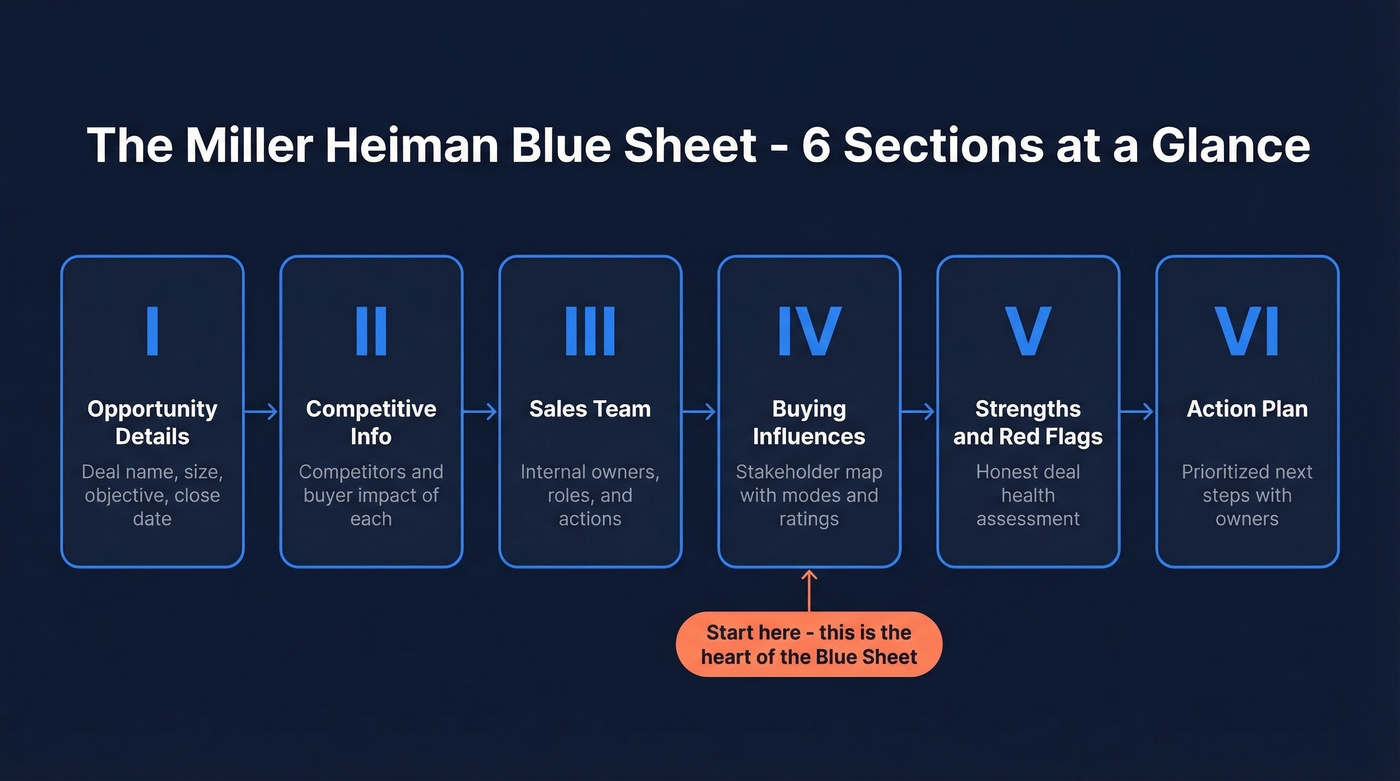
Section I: Opportunity Details
The header. You're capturing the basics: opportunity name, account, deal size, your sales objective, target close date, and primary contact info. Think of this as the deal's birth certificate. One field trips people up: "Sales Objective" isn't your quota target. It's a specific statement of what you're selling - "Enterprise analytics platform, 200 seats, 3-year term."
Section II: Competitive Information
A table where you list every competitor in the deal, their status as incumbent, best few, or new entrant, and two columns that matter more than most reps realize: positives to the customer if they choose the competitor, and negatives to the customer if they choose the competitor. Notice the framing - it's not "why we're better." It's "what happens to the buyer" with each option. That customer-centric lens is the whole point of Strategic Selling.
Section III: Sales Team
Who on your side is working this deal, what's their role, and what specifically do they need to do? This is where you assign internal owners to actions. If your SE needs to run a technical deep-dive with the IT team by March 15, it goes here. Most reps skip this section. Don't - it's how you hold your own team accountable.
Section IV: Buying Influences
This is the heart of the Miller Heiman Blue Sheet. For each stakeholder, you map:
Influence Type - EB (Economic Buyer, signs the check), UB (User Buyer, lives with the product daily), TB (Technical Buyer, screens for compliance and fit), or C (Coach, your internal champion who gives you access and intel).
Level of Buying Influence - Low, Medium, or High. This field gets overlooked, but it tells you where to invest your time. A High-influence Technical Buyer can stall a deal just as effectively as the Economic Buyer.
Mode - Growth (actively seeking change), Trouble (urgent problem, needs a fix now), Even Keel (satisfied with the status quo), or Overconfident (believes they're already ahead).
Rating - A scale from +5 (Enthusiastic Advocate) down to -5 (Antagonistic Anti-Sponsor).
Personal Win - What this person gains personally: promotion, recognition, reduced stress.
Business Results - The organizational outcome they care about: cost savings, revenue growth, compliance.
The mode and rating combination tells you where to focus. An Economic Buyer in Even Keel mode rated at -2 is a deal-killer you need to address immediately. A User Buyer in Trouble mode rated at +3 is your strongest lever - they feel the pain and they're pulling for you.
Section V: Strengths & Red Flags
A snapshot of where you stand right now. Strengths are anything working in your favor: a coach who's a former customer, a successful pilot in a related business unit, executive sponsorship. Red Flags are anything that could derail the deal: no access to the Economic Buyer, a competitor with C-suite relationships, a budget freeze, your champion just changed roles.
The discipline here is honesty. Most reps list five strengths and one red flag. In our experience, the ratio should be closer to even - and if you can't identify at least two red flags, you're not looking hard enough.
Section VI: Action Plan
Every red flag and strength from Section V should generate an action. Brainstorm first, then prioritize. Each action gets an owner, a priority flag, and a due date. This is where the Blue Sheet stops being an analysis document and becomes a working plan. If your action plan doesn't directly address your top red flags, you've wasted the previous five sections.
A Filled-Out Example
Let's make this concrete. You're selling a $180K analytics platform (DataLens Pro) to MidCo, a 500-person mid-market company. The deal has been in pipeline for 6 weeks, and you've met three of the five stakeholders.
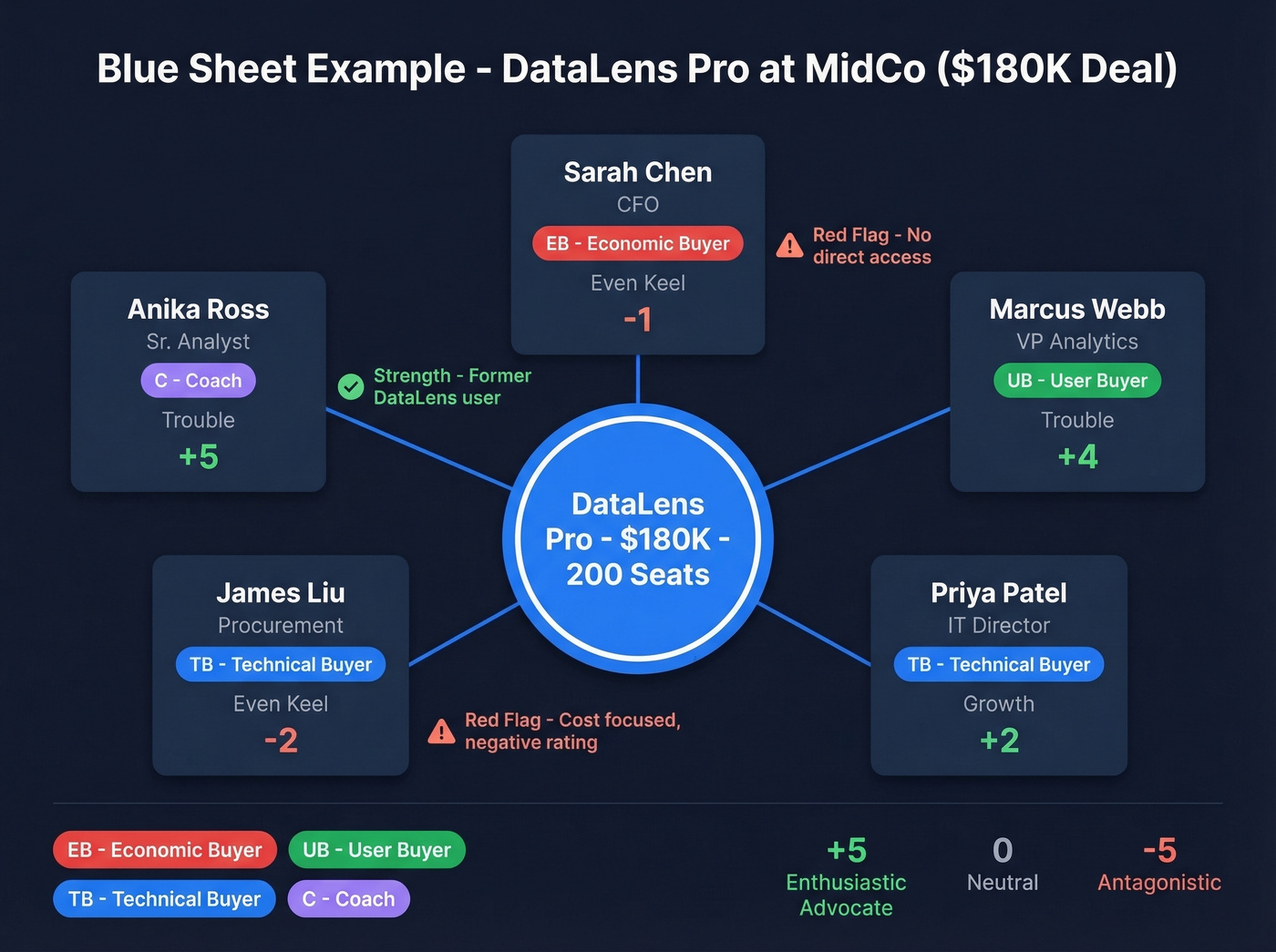
| Name | Role | Type | Mode | Rating |
|---|---|---|---|---|
| Sarah Chen | CFO | EB | Even Keel | -1 |
| Marcus Webb | VP Analytics | UB | Trouble | +4 |
| Priya Patel | IT Director | TB | Growth | +2 |
| James Liu | Procurement | TB | Even Keel | -2 |
| Anika Ross | Sr. Analyst | C | Trouble | +5 |
And the win-results driving each stakeholder:
- Sarah Chen - Personal: board confidence. Business: cut $250K in reporting waste.
- Marcus Webb - Personal: team retention. Business: save 5 hrs/week per analyst.
- Priya Patel - Personal: modernize stack. Business: SOC 2 compliance.
- James Liu - Personal: risk avoidance. Business: stay within budget.
- Anika Ross - Personal: career growth. Business: prove analytics ROI.
Strengths: Anika (Coach) is a former DataLens user from her last company and has internal credibility. Marcus (User Buyer) is in Trouble mode - his team is burning out on manual reporting and he's losing analysts to competitors.
Red Flags: No direct access to Sarah (Economic Buyer) - all communication goes through Marcus. James in Procurement is rated -2 and focused on cost, not value. A competitor (Tableau) has an existing enterprise license.
Action Plan: (1) Ask Anika to arrange a 15-minute intro with Sarah - frame it around the $250K inefficiency number. (2) Build a TCO comparison showing DataLens vs. expanding the Tableau license. (3) Get Priya a sandbox environment before the technical review on March 20.
Here's the thing: before committing stakeholder contact details to your Blue Sheet, run their emails through a verification tool. People change roles constantly. We've seen reps build entire action plans around a champion who left the company two months earlier.

Your Blue Sheet maps buying influences. But if your Economic Buyer left the company two months ago, your entire deal strategy is built on sand. Prospeo refreshes 300M+ profiles every 7 days - not every 6 weeks - so your stakeholder data is current when you fill in Section IV.
Stop planning deals around contacts who've already moved on.
Blue Sheet vs. Green Sheet
They're companions, not competitors.
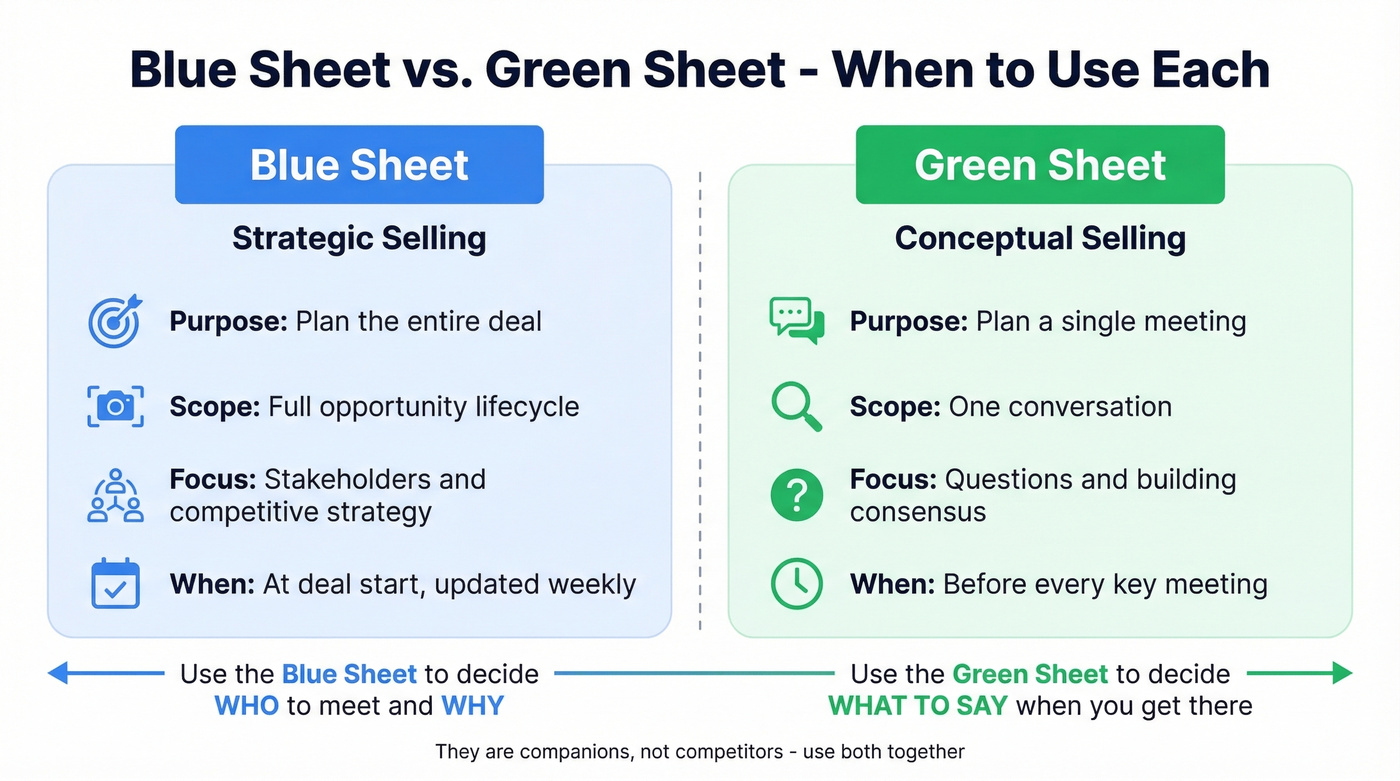
| Blue Sheet | Green Sheet | |
|---|---|---|
| Methodology | Strategic Selling | Conceptual Selling |
| Purpose | Plan the deal | Plan the meeting |
| Scope | Full opportunity | Single conversation |
| Focus | Stakeholders & strategy | Questions & consensus |
The Blue Sheet is your deal-level mission control. The Green Sheet is your meeting-level playbook - it structures individual calls to build consensus around outcomes rather than pitching features. Use the Blue Sheet to decide who to meet and why. Use the Green Sheet to decide what to say when you get there. Korn Ferry's methodology overview covers both in more detail.
Why Blue Sheets Fail
The framework is powerful. It also fails more often than devotees want to admit.
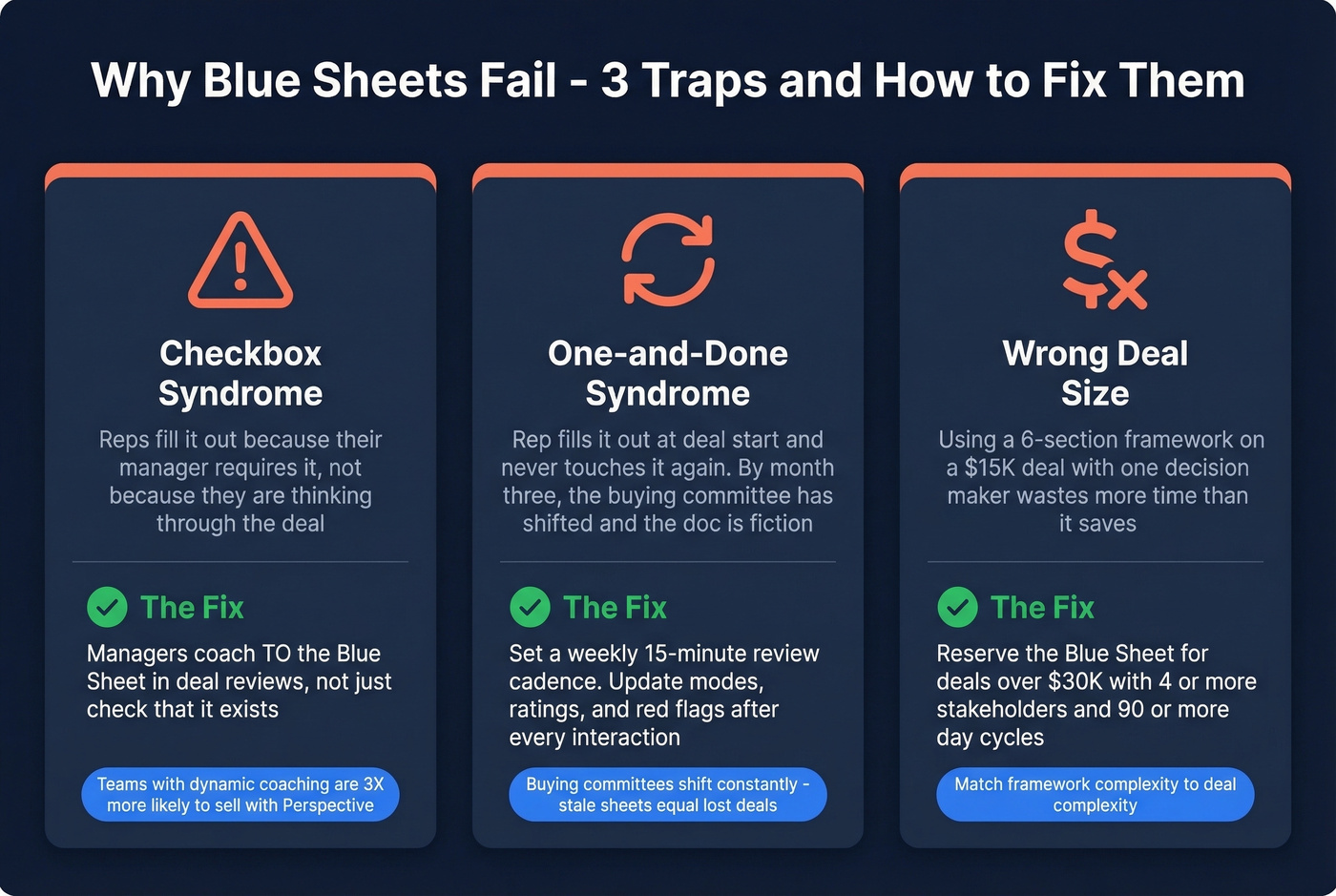
Checkbox syndrome. Reps fill out the template because their manager requires it, not because they're thinking through the deal. Garbage in, garbage out. The Blue Sheet is one leg of a three-legged stool - you also need pipeline analytics and skills coaching. Korn Ferry's own data backs this up: teams with dynamic coaching are 3X more likely to sell with Perspective, and organizations selling with Perspective see +22% win rates and +16% quota attainment. The fix is straightforward: managers need to coach to the Blue Sheet in deal reviews, not just check that it exists.
One-and-done syndrome is the silent killer. A rep fills out the sheet at the start of the deal and never updates it. By month three of a six-month cycle, the buying committee has shifted, budgets have changed, and the document is fiction. Set a weekly 15-minute review cadence. Update modes, ratings, and red flags after every stakeholder interaction.
I'll say something slightly controversial: if your average deal size is under $30K, skip the Blue Sheet entirely. The framework earns its keep on complex deals with 4+ stakeholders and 90+ day cycles. For everything else, a lightweight MEDDIC checklist gets you 80% of the value at 20% of the effort. The worst thing you can do is force this level of deal planning on transactional deals - your reps will resent the process and stop trusting it when it actually matters.
Ignoring red flags is the most frustrating failure mode because it's entirely self-inflicted. Reps list red flags because the template demands it, then build action plans that don't address them. If "no access to Economic Buyer" is your top red flag and your action plan is "send a case study," you've missed the point entirely.
Every red flag in Section V needs an action - and the worst red flag is sending outreach that bounces. Prospeo's 98% email accuracy and 125M+ verified mobile numbers mean your Action Plan actually connects you to the Technical Buyer blocking your deal or the Coach championing it.
Reach every buying influence on your Blue Sheet - emails at $0.01 each.
How to Digitize Your Workflow
Here are your options for moving the Miller Heiman Blue Sheet from paper to platform:
Korn Ferry Sell is the official digital version, integrated into Salesforce and other CRMs with guided workflows, AI-enabled coaching prompts, and analytics. It works if you can afford it - typically mid-five figures to low-six figures annually - and it's built for organizations with 50+ reps. If your CRO is pushing for it, make sure you've got the management discipline to actually coach to it. The software doesn't fix a coaching problem.
Upland Altify is the strongest alternative for relationship mapping and account planning inside Salesforce, running roughly $50-$150/user/month depending on your package and volume. It won't replicate the Blue Sheet exactly, but it covers the buying influence and relationship mapping pieces well.
AI tools are starting to auto-populate fields. Several platforms now extract stakeholder names, roles, and sentiment from call transcripts and CRM activity, reducing the manual data entry that kills adoption. If your team's biggest complaint is "it takes too long to fill out," look into transcript-based auto-population as a middle ground.
Start with a Google Doc or CRM custom fields. Don't buy software until you've proven the discipline. Build the six sections as custom fields in HubSpot or Salesforce, run it for a quarter, and see if your team actually uses it. If they do, invest in purpose-built tooling. If they don't, no amount of software will fix that.
Blue Sheet vs. MEDDIC vs. Challenger vs. SPIN
These aren't competing frameworks. They solve different problems, and the best enterprise sales orgs layer them together.
| Framework | Best For | Blue Sheet Overlap | When to Combine |
|---|---|---|---|
| MEDDIC | Qualification | Buying influences, champion | Use MEDDIC to qualify in/out, Blue Sheet to plan the win |
| Challenger | Messaging & insight | Perspective, reframes | Use Challenger for how you sell, Blue Sheet for who and when |
| SPIN | Discovery calls | Pain identification | Use SPIN in early meetings, Blue Sheet for ongoing strategy |
| Blue Sheet | Deal architecture | - | The connective tissue between frameworks |
MEDDIC is better for qualification. Challenger is better for messaging. The Blue Sheet is better for deal architecture. Stop treating them as competitors. Many enterprise organizations - particularly in complex tech sales - combine these as complementary layers. MEDDIC tells you whether the deal is real. Challenger tells you how to create urgency. The strategic selling framework tells you how to navigate the buying committee and close.
FAQ
How long does it take to fill out a Blue Sheet?
Expect 3-5 hours the first time, including research to map buying influences accurately. Once you're proficient, updates take 60-90 minutes per deal review. New reps typically need 90-120 days to reach proficiency - plan onboarding accordingly.
When is a Blue Sheet overkill?
For deals under $50K, single-stakeholder sales, or cycles under 30 days, it adds overhead without proportional value. Use BANT or a lightweight MEDDIC checklist instead. The framework earns its keep on complex, multi-stakeholder deals where the buying committee itself is a puzzle you need to solve.
Is Miller Heiman training worth the cost?
Strategic Selling workshops typically cost $2,000-$5,000 per participant for 2-3 day sessions. It's worth it if your average deal size exceeds $75K and your managers will coach to the methodology afterward. Training without coaching follow-through is the #1 reason these programs fail - the consensus on r/sales backs this up consistently.
Can I download a free Blue Sheet template?
Korn Ferry doesn't publish an official free download. Most templates online are unofficial corporate-branded variants. We've reproduced the full field structure in this article so you can build your own in Google Docs or CRM custom fields without paying for access.
How do I keep stakeholder data current?
Set a weekly 15-minute review cadence before each deal review to verify contacts are still in their roles. Prospeo's Chrome extension lets you verify emails and find direct dials from any company website in one click - so your opportunity plan reflects the buying committee as it exists today, not three months ago.