

Mutual Action Plan Template: Build One Buyers Actually Use
A RevOps lead we know ran a deal post-mortem last quarter. The #1 reason deals stalled past month three wasn't competitor pressure or budget freezes - it was that nobody on the buying committee knew what was supposed to happen next. That tracks with broader research: 40-60% of deals die to "no decision," not to a competitor. HBR found that (citing Matthew Dixon and Ted McKenna), and it should terrify every AE who's ever watched a "90% likely" deal evaporate in week eight.
A good mutual action plan template is supposed to fix this. But the blunt takeaway in this r/sales thread is: "Most of the time buyers just ignore them." The template itself isn't the hard part. Getting buyers to actually use it - that's the game.
What You Need (Quick Version)
- A MAP is a shared timeline between you and the buyer - not a seller checklist. Co-author it or it dies on arrival.
- Include these phases: Overview, Evaluation, Procurement, Implementation, and post-close.
- Grab the free template in Google Sheets here - or use the filled-out example below as your starting point.
- Turn each milestone into a resource hub: link the security docs, API documentation, and pricing sheets directly so the MAP reduces buyer effort.
- Before sharing, verify every stakeholder's email. A MAP breaks the moment you can't reach someone on it.
What Is a Mutual Action Plan?
A mutual action plan is a shared document - co-owned by seller and buyer - that maps every milestone, owner, and deadline from first evaluation through go-live. You'll also hear it called a Close Plan, Joint Engagement Plan, or Mutual Success Plan. Different names, same idea: get both sides to agree on what happens next, who does it, and by when.
Why does this matter more now than five years ago? Gartner puts the typical B2B buying group at 6-10 decision-makers, each consulting four to five information sources. That's a lot of people pulling in a lot of directions. A MAP is the single artifact that keeps everyone aligned - if it's built right.
Do MAPs Actually Work?
Yes, but only when they're used. Outreach reports that deals where AEs engage buyers with a shared action plan show a 26% higher win rate than deals without one. That's a meaningful lift.
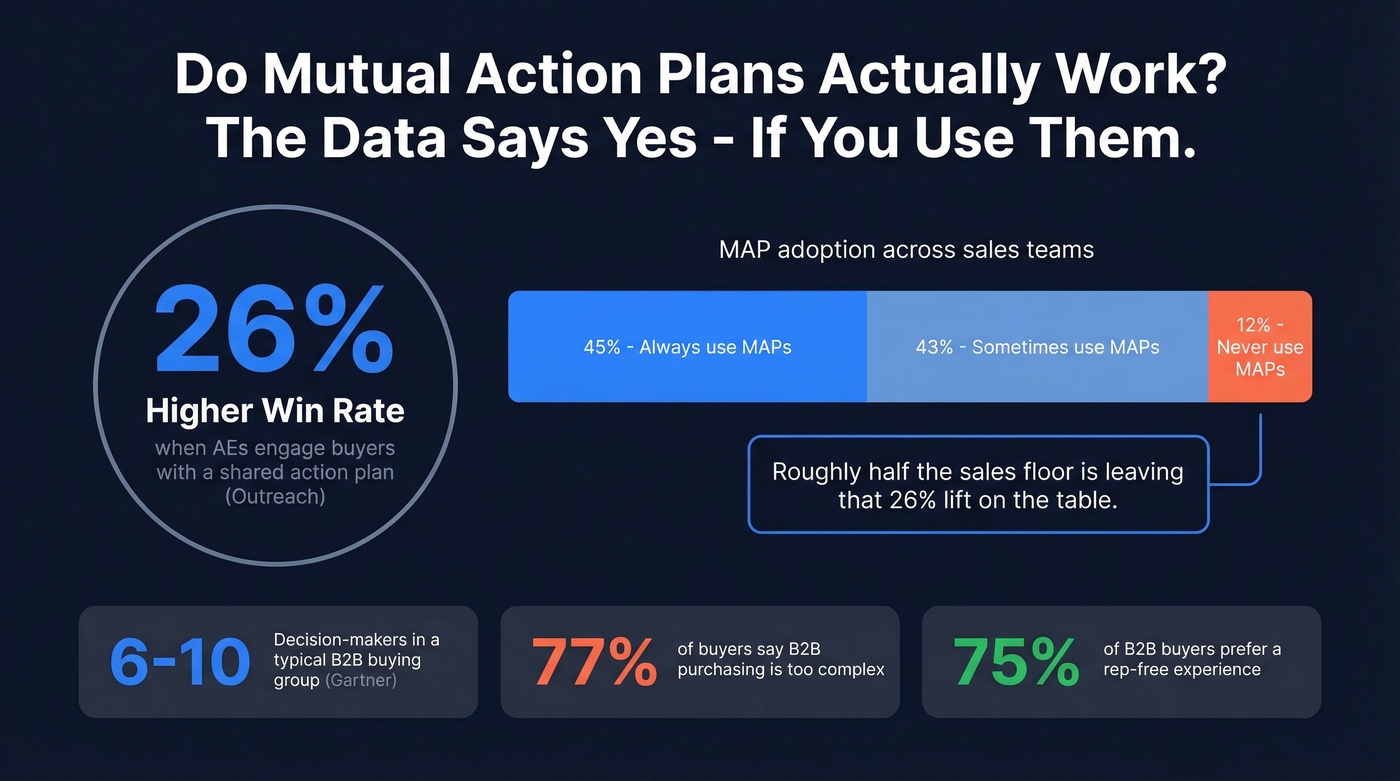
The problem is adoption. The same data shows 45% of sellers consistently use MAPs, 43% use them sometimes, and 12% never bother. Roughly half the sales floor is leaving that 26% on the table.
Gartner found that buyers are 1.8x more likely to complete a high-quality deal when they engage with supplier-provided digital tools alongside a rep - versus going it alone. A well-built MAP is exactly that kind of tool. And with 77% of buyers saying the B2B purchasing process is too complex, anything that simplifies the path forward has an outsized impact.
Here's the stat that should reframe how you think about MAPs entirely: 75% of B2B buyers prefer a rep-free sales experience. That means the MAP is often the only structured touchpoint keeping your deal on track. If the buyer is going to self-serve most of the journey, the plan is your one chance to shape the path they take.
Our take: Most teams don't need a better template. They need to stop treating MAPs like internal forecast trackers and start treating them like the buyer's project plan. If you wouldn't hand it to a project manager and expect them to run with it, it's not a mutual action plan - it's a seller checklist with a nicer name.
Why Most MAPs Fail
Let's be honest about why the r/sales crowd hates MAPs. It's not the concept - it's the execution. Three failure modes kill most plans before they ever gain traction.
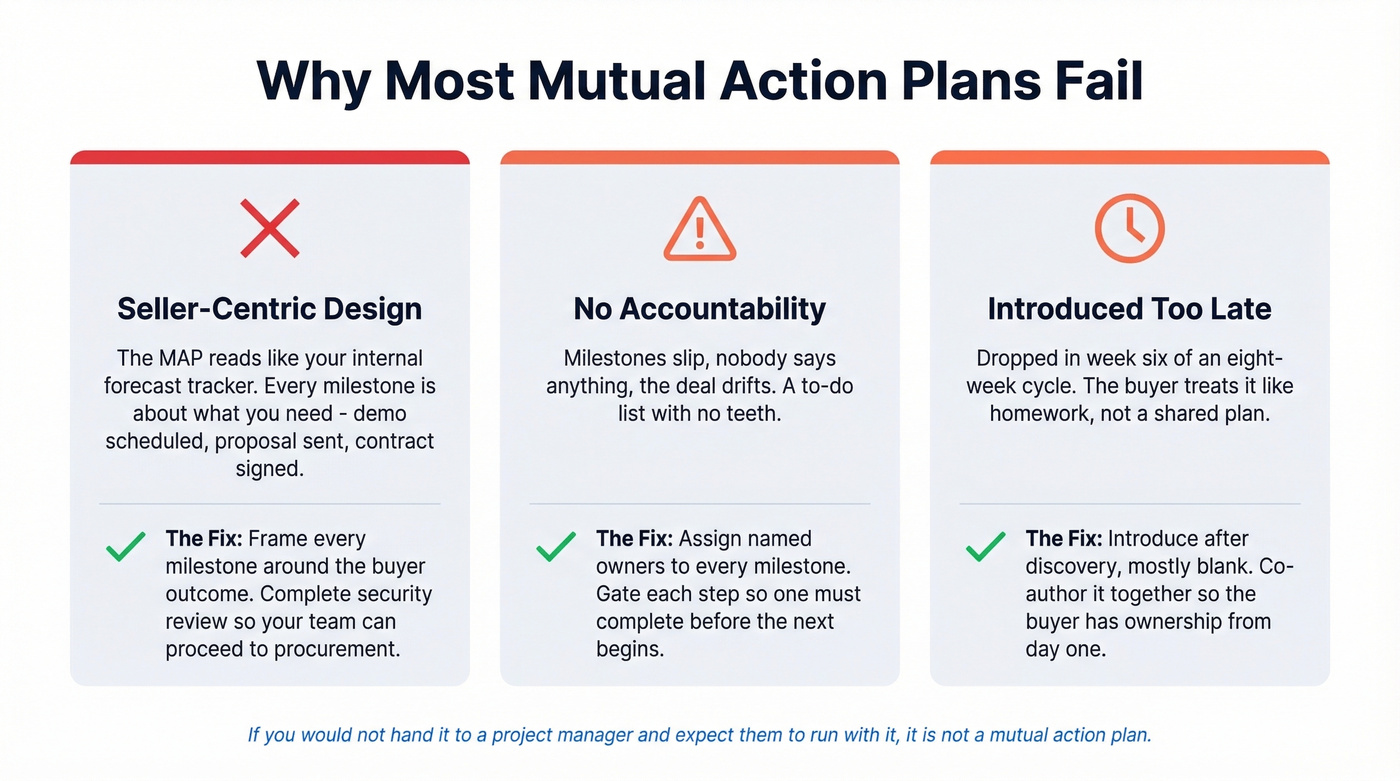
Failure #1: Seller-centric design. The MAP reads like your internal forecast tracker, not a buyer resource. Every milestone is about what you need: demo scheduled, proposal sent, contract signed. Jason Fishkind, AVP of Sales at Cresta, puts it well: "The worst mutual plans are selfish. You need to anchor them to the customer's problem." The fix is to frame every milestone around the buyer's outcome. "Complete security review so your team can proceed to procurement" beats "Send security questionnaire."
Failure #2: No accountability mechanism. The MAP is a to-do list with no teeth. Milestones slip, nobody says anything, and the deal drifts. Assign named owners to every milestone and agree on a cadence for status updates. We'll cover how to add real leverage in the "MAP With Teeth" section below.
Failure #3: Introduced too late. Reps drop a MAP in week six of an eight-week cycle and wonder why the buyer treats it like homework. Introduce it after discovery or first demo, mostly blank, and co-author it together. The best practitioner advice from Reddit is to use the MAP as a resource hub - link each milestone to the exact artifacts the buyer needs so it reduces their effort instead of adding tasks.

A mutual action plan breaks the moment you can't reach the people on it. Prospeo gives you 98% accurate emails and 125M+ verified mobile numbers for every stakeholder on your buying committee - so no milestone stalls because someone didn't get the message.
Verify every contact on your MAP before you share it.
What to Include in Your Template
Dates, Goals, Success Criteria
Start with a value statement - two or three sentences that capture the business outcome the buyer is trying to achieve and why this initiative matters now. This is the first thing an executive sponsor will read, and senior decision-makers have about 30 seconds to review a plan before deciding whether to engage. Design for that skim: keep the overview tight, lead with the outcome, and push granular milestones into the sections below.
Include the target go-live date, key success criteria (the metrics that define a win), and any hard deadlines driving urgency - fiscal year end, contract expiration, board review. Short section, but critical.
Evaluation Milestones
Map out the evaluation milestones: initial demo, technical deep-dive, proof of concept, executive presentation. For each one, link directly to the artifacts the buyer needs - the resource hub approach. Embed your security documentation, API docs, and pricing breakdown right in the MAP rather than burying them in email threads. This reduces buyer effort and increases engagement at the same time.
Procurement: Legal, Security, Contract
Implementation: Kickoff Through Go-Live
If your MAP ends at "Contract Signed," you've told the buyer exactly what you care about. Extend it through kickoff, admin onboarding, training sessions, and go-live. This signals you're invested in their success, not just the signature. It also creates a smoother handoff between sales and customer success - the buyer doesn't have to repeat their goals and requirements to a new team because it's all documented in the plan.
Mutual Action Plan Example: Mid-Market SaaS
Here's a realistic example for a mid-market SaaS deal. Copy the Google Sheets template and adjust the milestones, dates, and owners to fit your sales cycle.
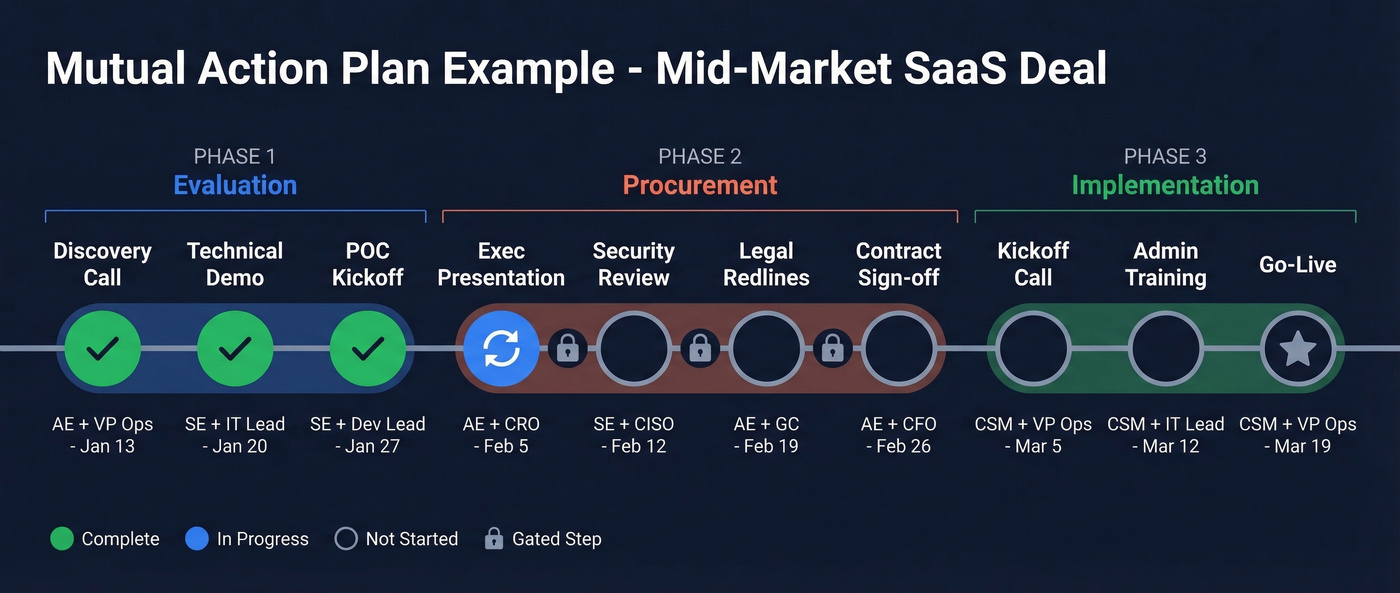
| Milestone | Owner (Role) | Target Date | Status | Resources |
|---|---|---|---|---|
| Discovery call | AE + VP Ops | Jan 13 | ✅ Complete | Meeting notes |
| Technical demo | SE + IT Lead | Jan 20 | ✅ Complete | Demo recording |
| POC kickoff | SE + Dev Lead | Jan 27 | ✅ Complete | POC success criteria |
| Exec presentation | AE + CRO | Feb 5 | 🔄 In progress | ROI deck, case studies |
| Security review | SE + CISO ✓ | Feb 12 | ⬜ Not started | Security docs folder |
| Legal redlines | AE + GC ✓ | Feb 19 | ⬜ Not started | MSA draft, DPA |
| Contract sign-off | AE + CFO ✓ | Feb 26 | ⬜ Not started | Order form, pricing |
| Kickoff call | CSM + VP Ops | Mar 5 | ⬜ Not started | Onboarding checklist |
| Admin training | CSM + IT Lead | Mar 12 | ⬜ Not started | Training materials |
| Go-live | CSM + VP Ops | Mar 19 | ⬜ Not started | Launch plan |
The ✓ next to stakeholder roles in the procurement milestones means their contact data has been verified. Bad data kills deal momentum faster than a missing feature.
A few things to notice. The "Resources" column links directly to the documents each owner needs. The plan extends past contract signature into implementation. And every milestone has a single owner on the buyer side - not a department, not "TBD," but a specific person with a verified way to reach them.
Build a MAP With Teeth
A plan without accountability is just a pretty spreadsheet.
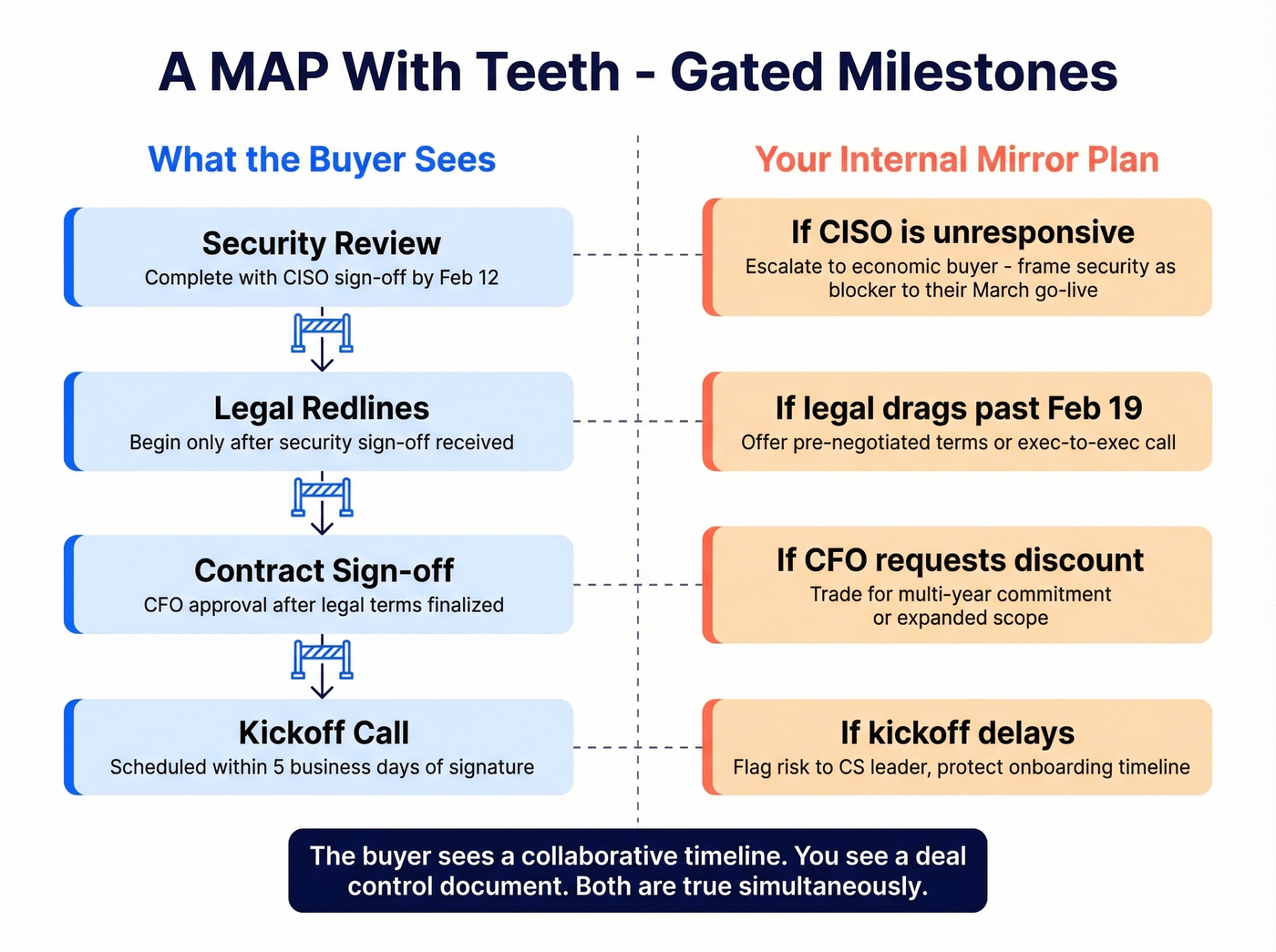
The concept comes from a practitioner playbook on Reddit: for strategic deals, map each milestone to a gated validation step. Instead of "Security review - Feb 12," it becomes "Security review complete with sign-off from CISO before legal redlines begin." One milestone gates the next. Progress becomes sequential, not aspirational.
Internally, maintain a mirror plan with leverage options tied to each milestone. This isn't manipulation - it's preparation. If the buyer asks for a POC extension without giving you access to the executive sponsor, you can frame exec alignment as a requirement for approval.
Here's the scenario we've seen play out dozens of times. It's week six. The CISO hasn't responded to the security questionnaire. The deal is stalling. Without a MAP, you're sending "just checking in" emails into the void. With a gated plan, you escalate to the economic buyer with a simple message: "We're on track for your March go-live, but the security review is two weeks behind. Can you help us get this moving?" That's mutual accountability, not pressure. The MAP gives you the language and the legitimacy to have that conversation.
The mirror plan stays internal. The buyer sees a collaborative timeline. You see a deal control document. Both are true simultaneously. This gated approach is especially critical for enterprise sales, where buying committees are larger, procurement cycles are longer, and a single stalled milestone can push a deal into the next quarter - costing you not just the deal but the comp plan attached to it.
Spreadsheet vs. Software
You don't need dedicated software if you're running a normal mid-market motion and just need a shared plan the buyer will actually open. For most teams, a mutual action plan template in Google Sheets or a Smartsheet template works fine.
| Factor | Spreadsheet | MAP Software |
|---|---|---|
| Cost | Free | ~$30-150/user/mo |
| Setup time | Minutes | Days to weeks |
| Buyer access | Share link, no login | Varies by tool |
| Engagement tracking | None | Who viewed what, when |
| CRM sync | Manual | Automated |
For teams under 15 reps running deals in the $30k-$80k range, the spreadsheet wins. Graduate to software - tools like Dock, GetAccept, or Recapped - when you need engagement analytics showing which stakeholders opened the plan and clicked resources. Skip the enterprise MAP platforms unless you're running 50+ reps; those run on custom pricing with annual contracts in the $30k+ range.
If you're standardizing MAPs across the org, it also helps to document the motion in your sales process and track adoption as part of sales operations metrics.
75% of buyers prefer a rep-free experience. That means your MAP is doing the selling - but only if every stakeholder is reachable. Prospeo's 300M+ profiles with 30+ filters let you identify and verify the entire buying committee in minutes, not hours.
Stop building close plans around email addresses that bounce.
FAQ
What's the difference between a MAP and a close plan?
A close plan is seller-facing - it tracks what the rep needs to get the deal done. A mutual action plan is co-owned with the buyer, making it a shared commitment rather than an internal checklist. You'll also see the terms Joint Engagement Plan and Mutual Success Plan used interchangeably.
When should I introduce a MAP?
After discovery or first demo - never in the final weeks of a deal cycle. Introduce it mostly blank and co-author it with the buyer so it feels mutual, not imposed. The earlier you introduce it, the more natural it becomes as the deal's operating document.
How do I get accurate contact data for MAP stakeholders?
Use a verified B2B data tool to confirm emails and phone numbers before sharing the plan. Prospeo covers 143M+ verified emails at 98% accuracy and 125M+ verified mobile numbers - upload your stakeholder list, verify in bulk, and export clean data in minutes so no milestone stalls over wrong contact info.
Can I use a free template for enterprise deals?
Yes. A Google Sheets template is a perfectly valid starting point even for complex enterprise cycles. What separates a good MAP from a bad one is co-authorship, gated milestones, and verified stakeholder data - not whether you're paying for dedicated software. Start free, and upgrade to a platform only when you need engagement analytics at scale.