

NEAT Selling: The Practitioner's Guide to Qualifying Deals That Actually Close
Lead qualification is the #1 challenge sellers report in 2026, overtaking opportunity management for the first time. 70% of salespeople say they're struggling - an 11% jump year over year. The frameworks meant to fix this keep multiplying, and experienced reps will tell you they all sound the same. They're half right. Most methodologies collapse into the same fundamentals: need, budget, stakeholders, timeline. The difference is which fundamental you lead with and how deep you go.
NEAT selling bets that leading with budget is the wrong move. For mid-market B2B deals, that bet pays off.
Quick version if you're short on time: NEAT stands for Need, Economic Impact, Access to Authority, and Timeline. It replaces budget-first qualification with value-first discovery. Richard Harris created it around 2013 through Harris Consulting Group. It's best suited for consultative B2B deals where the buyer doesn't have a clean budget line item and you need to build the economic case during discovery. If you only read one section, skip to the discovery call script below.
What Is NEAT Selling?
NEAT is a sales qualification and discovery framework built around four pillars: Need, Economic Impact, Access to Authority, and Timeline. It's consultative and buyer-first - you spend more time understanding the prospect's world than pitching your product.
The core break from older frameworks like BANT is simple: NEAT doesn't ask about budget. It asks what the problem is costing the buyer right now and builds the economic case from there. If you're selling something that creates a new category or replaces a manual process, there's often no budget line item to qualify against. Asking "what's your budget?" kills the conversation before you've built the case. This framework was designed for exactly that scenario.
Who Created the Framework?
Richard Harris, founder of Harris Consulting Group (San Francisco, CA, est. 2013), created the methodology after getting fired from a sales role. He turned that into a consulting practice, landing his first two clients and making in sixty days what had taken him six months as an employee. The framework grew out of frustration with existing methodologies - particularly Miller Heiman and ANUM, which were prominent approaches around 2010-2011.
The original acronym was actually N.A.T.E. - Need, Access to Authority, Economic Impact, Timeline. Harris realized he could rearrange it to spell NEAT, and the name stuck. He later published The Seller's Journey: Your Guidebook to Closing More Deals with N.E.A.T Selling, which lays out the full system including templates, scripts, and negotiation tactics.
One of Harris's core beliefs shapes the entire framework: "There's no such thing as a buyer's journey - it's a buyer's experience." That distinction matters. Journeys imply a linear path. Experiences are messy, emotional, and nonlinear - which is exactly how real B2B deals unfold.
The Four Pillars Explained
Each pillar builds on the last. Need uncovers the problem. Economic Impact quantifies it. Access to Authority ensures you're talking to someone who can act on it. Timeline creates urgency.
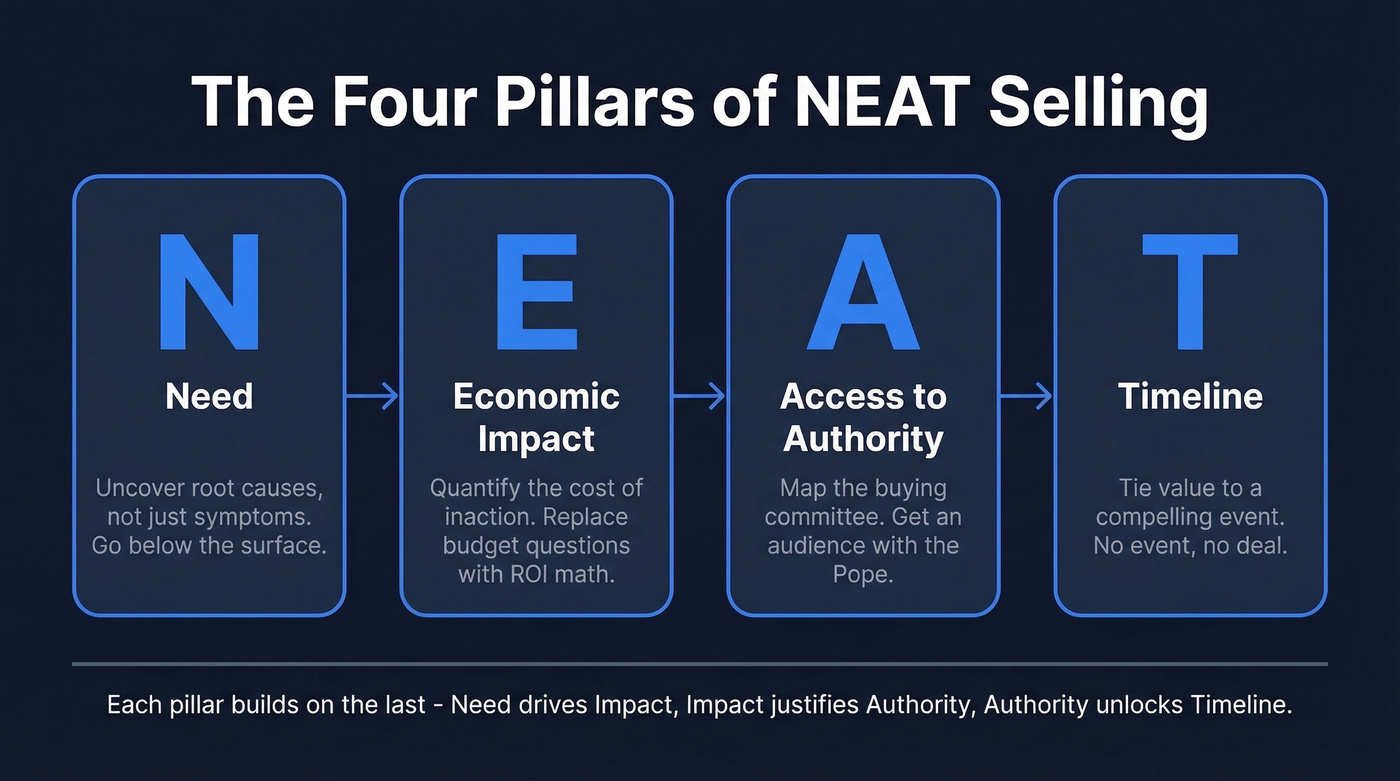
Need - Below the Surface
Harris uses the phrase "below the surface" deliberately. Most reps ask surface-level questions - "What are your biggest challenges?" - and get surface-level answers. NEAT pushes you to distinguish between symptoms and root causes. A prospect saying "our reps aren't hitting quota" is a symptom. The root cause might be bad data, no ICP definition, or a broken handoff between marketing and sales.
The goal is to uncover needs the prospect hasn't fully articulated yet. That's where trust gets built and deals get differentiated from competitors who stayed at the surface.
Discovery questions that go deeper:
- "Walk me through what happens when [problem] occurs - who feels it first?"
- "You mentioned [symptom]. What's driving that, in your view?"
- "If you could fix one thing about how your team handles [process] today, what would it be?"
- "What have you already tried? What worked and what didn't?"
- "How long has this been a problem, and what changed to make it urgent now?"
- "If nothing changes in the next 6 months, what does that look like for your team?"
Economic Impact - Why "Budget" Is the Wrong Question
Here's the thing: Harris's stance is that "budget is no longer an issue in today's SaaS world." That sounds provocative, but the logic is sound. If you're selling a solution that creates a new category or replaces a manual process, there's no existing budget line to qualify against.
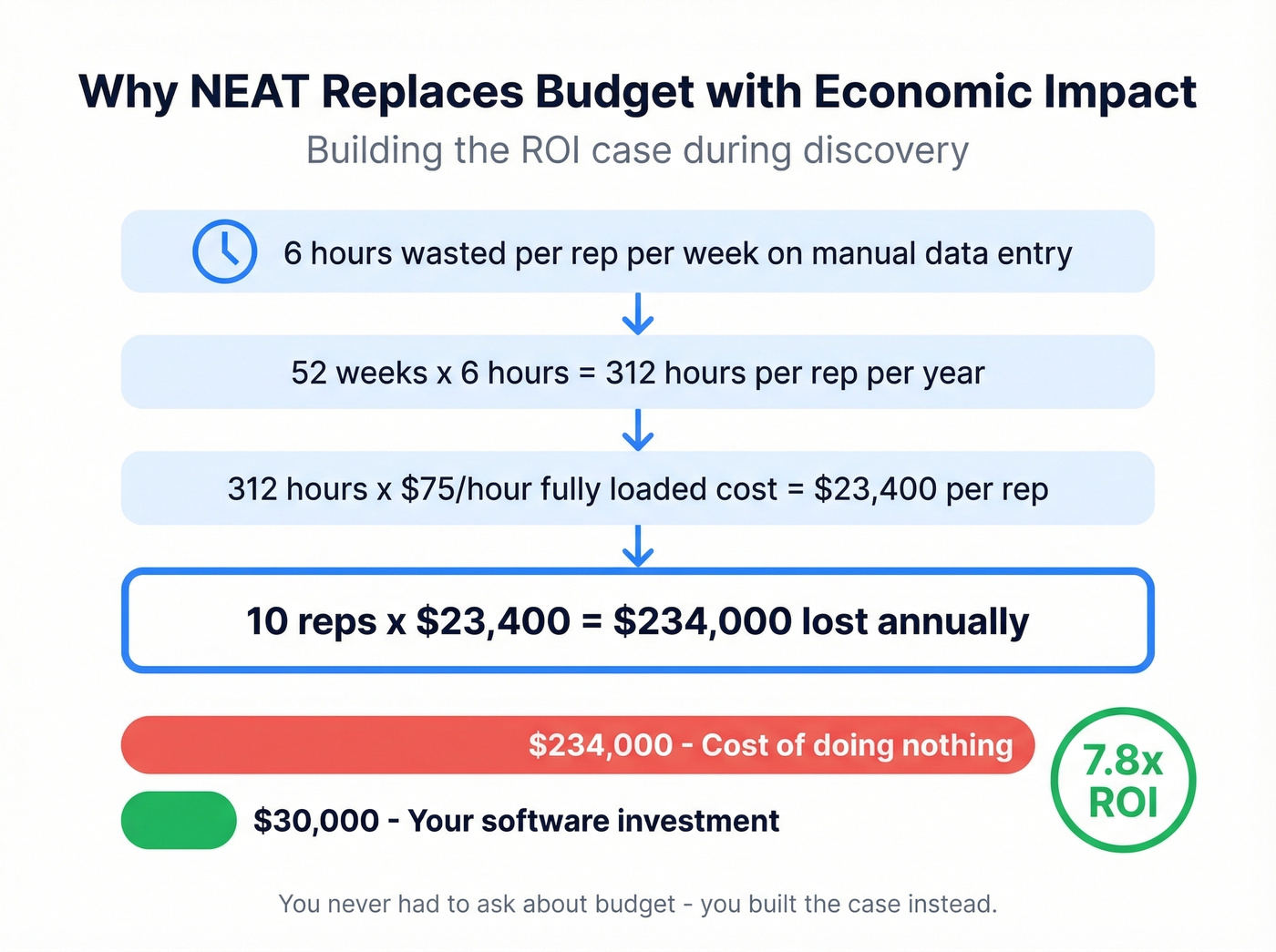
Instead, NEAT focuses on quantifying the cost of inaction. Say a prospect's sales team wastes 6 hours per week per rep on manual data entry. That's 312 hours per rep per year. At a fully loaded cost of $75/hour, that's $23,400 per rep. For a 10-person team, you're looking at $234,000 in lost productivity annually. Now your $30K software price tag looks like a bargain - and you never had to ask about budget.
The approach works. Companies implementing structured qualification frameworks see meaningful lifts - BANT adopters reported a 59% increase in conversion rates, while MEDDIC improved win rates by 25%. NEAT's economic impact pillar gives you the same structural rigor applied specifically to the ROI conversation.
Access to Authority - Getting an Audience with the Pope
This is the pillar most reps get wrong. NEAT doesn't ask "are you the decision-maker?" That question puts your contact on the defensive and rarely gets an honest answer. Instead, it asks whether your contact can get you access to the decision-maker. Harris calls this "getting an audience with the Pope." Your champion doesn't need to be the Pope. They need to know how to get you in the room.
The tactical implication is multi-threading. Don't rely on a single contact. Map the buying committee early: who influences, who signs, who can veto, who controls procurement. Then build relationships across all of them.
Two practical moves that make this pillar work. First, ask your champion directly: "If we build a strong business case together, what does the approval process look like? Who else needs to weigh in?" Second, make sure your contact data actually points to the right people - you can't assess access to authority if your CRM has a generic info@ address. We've found that having verified emails and direct dials for actual decision-makers, not just whoever filled out a form, is what separates reps who multi-thread from reps who just talk about it.
Timeline - No Compelling Event, No Deal
Harris is blunt about this: no deal ever closes without tying value to a compelling event. Without one, your deal sits in pipeline purgatory - technically alive, practically dead.
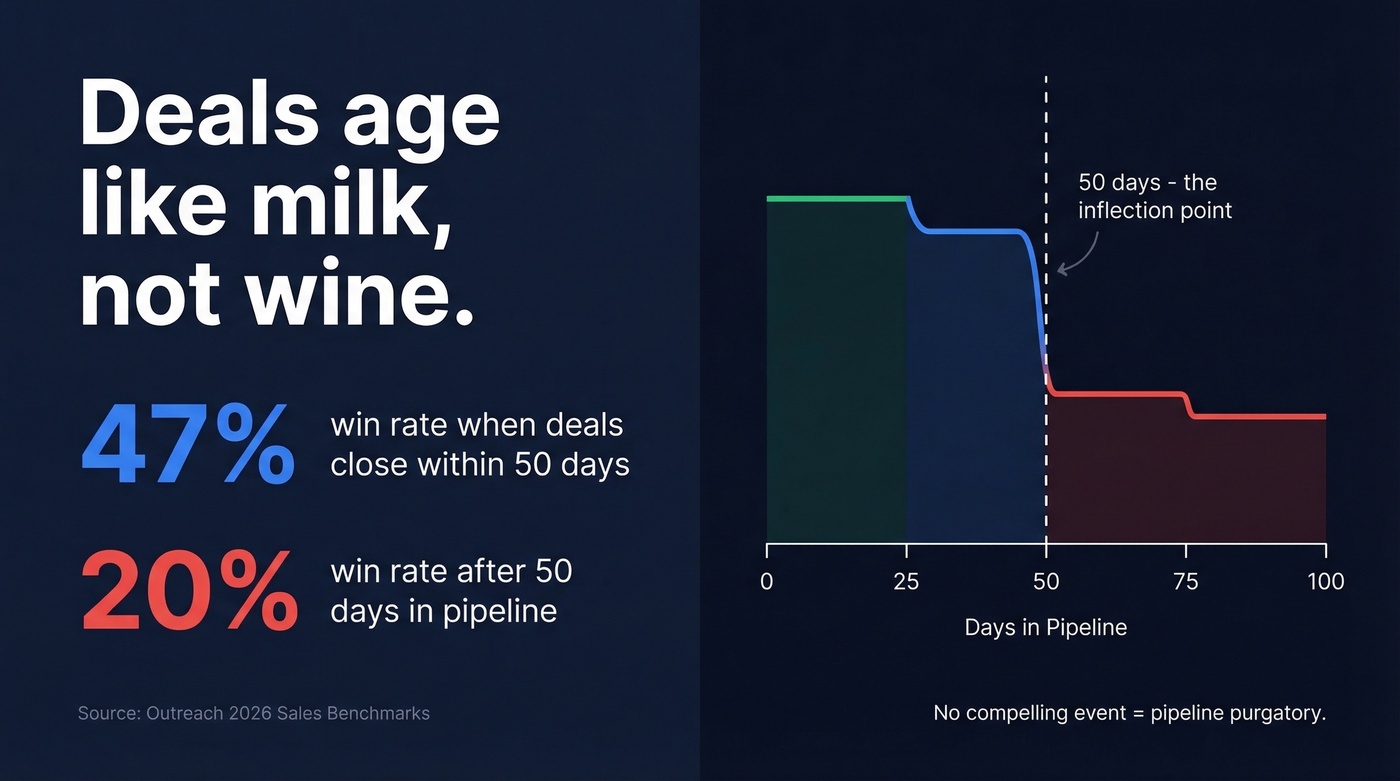
The data backs this up. Outreach's 2026 benchmarks show that opportunities closed within 50 days have a 47% win rate. After 50 days, win rates drop to 20% or lower. Deals don't age like wine. They age like milk.
Compelling events that actually create urgency:
- Contract expiration with an incumbent vendor
- Board mandate to reduce costs or hit a growth target by a specific date
- Regulatory deadline requiring compliance by a fixed date
- New fiscal year budget allocation with use-it-or-lose-it dynamics
- Leadership change - new VP wants to make their mark in the first 90 days
- Competitive pressure - a rival just launched something that changes the market
If you can't identify a compelling event in discovery, you don't have a qualified deal. You have a conversation.
NEAT vs. Other Frameworks
Every framework has a sweet spot. The mistake is treating them as universal.
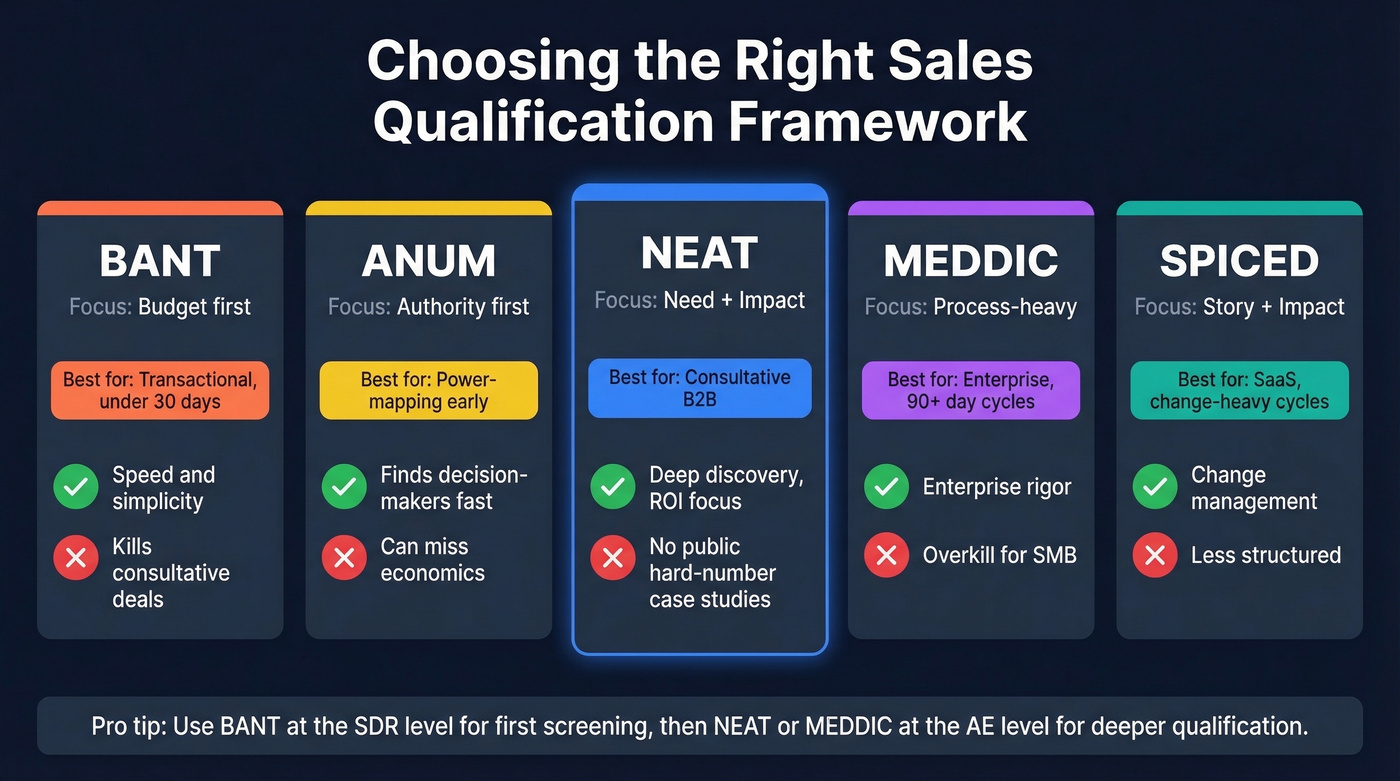
| Framework | Focus | Best Fit | Cycle Length | Key Strength | Key Weakness |
|---|---|---|---|---|---|
| BANT | Budget first | Transactional deals, fast qualification | Under 30 days | Speed, simplicity | Kills consultative deals |
| ANUM | Authority first | When power-mapping early matters | Varies | Finds power early | Can miss economics |
| NEAT | Need + impact | Consultative B2B, building the business case | Varies | Deep discovery, ROI focus | No public case studies with hard numbers |
| MEDDIC | Process-heavy | Enterprise procurement, multi-stakeholder approvals | 90+ days | Enterprise rigor | Overkill for SMB |
| SPICED | Story + impact | SaaS/subscription, change-heavy cycles | Varies | Change management | Less structured |
Let's be honest: don't pick one and force it everywhere. Use BANT as a first screen - can this person buy, and is there a real need? Then deepen with NEAT for consultative deals where you need to quantify impact, or MEDDIC when you're navigating enterprise procurement. We've seen teams run BANT at the SDR level and NEAT at the AE level, and it works well. The frameworks complement each other when you stop treating them as religions.

Stop paying for bounced emails. Prospeo verifies every contact with 98% accuracy, refreshed every 7 days.
Start free and only pay for verified contacts
NEAT Discovery Call Script
A good discovery call runs 8-10 questions. Here's a NEAT-organized script you can adapt.
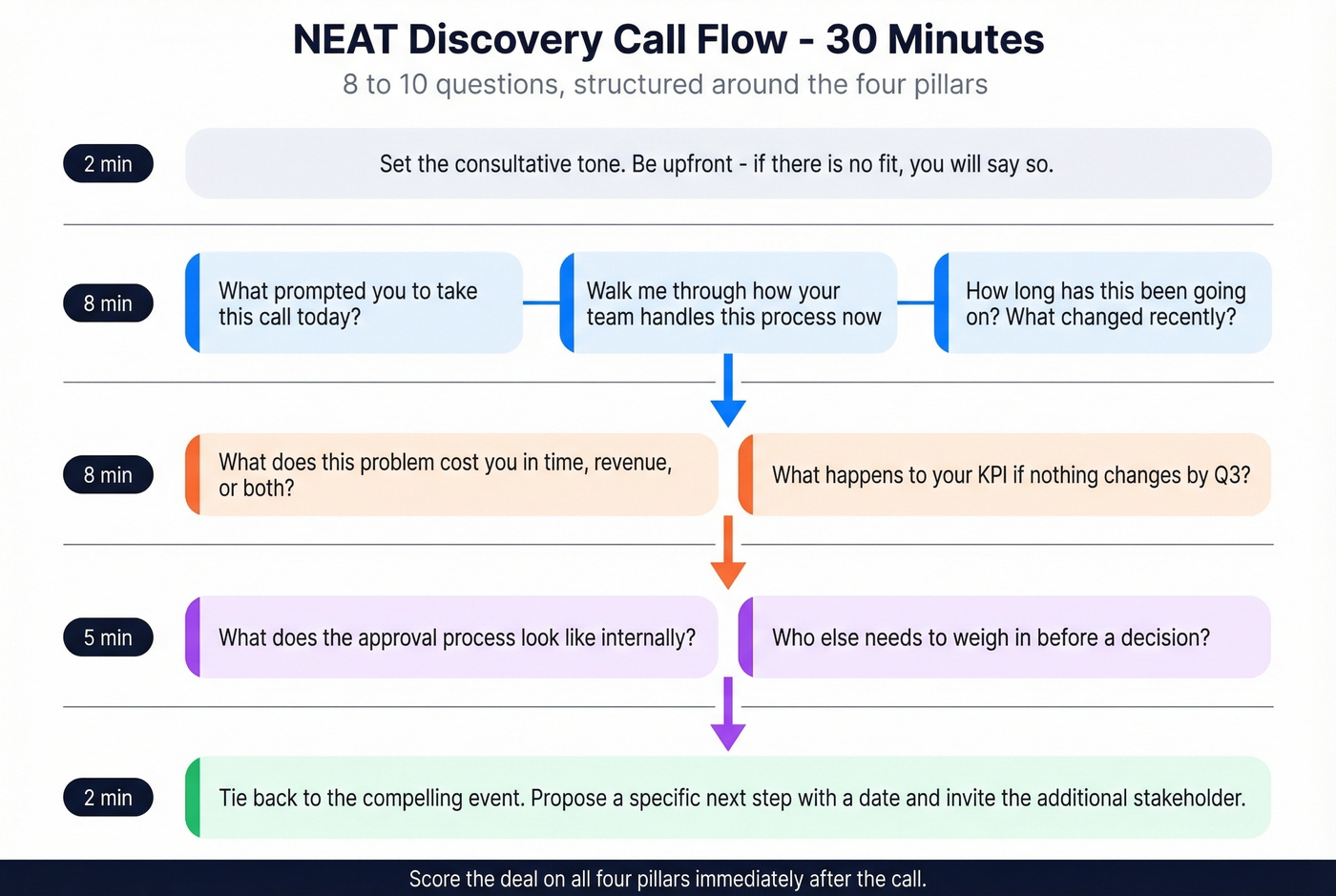
Opening (2 minutes)
Set the consultative tone immediately. "I've done some research on [company], but I'd rather hear from you. My goal for this call is to understand what's going on in your world and see if there's a fit. If there isn't, I'll tell you. Fair?"
Need Questions
- "What prompted you to take this call today?"
- "Walk me through how your team handles [process] right now - what's working and what isn't?"
- "You mentioned [symptom]. How long has that been going on, and what's changed recently?"
Economic Impact Questions
- "When [problem] happens, what does it cost you - in time, revenue, or both?"
- "If you could quantify the impact of fixing this over the next 12 months, what would that number look like?"
- "What happens to your [KPI] if nothing changes by Q3?"
Access to Authority Questions
- "If we build a business case that makes sense, what does the approval process look like internally?"
- "Who else on your team would need to weigh in before a decision gets made?"
Timeline Questions
- "Is there a specific date or event driving the urgency here?"
- "What would need to happen for this to be live by [their stated deadline]?"
Close (2 minutes)
Tie back to the compelling event. "Based on what you've shared, it sounds like [compelling event] is the driver. Let me put together [specific next step] and get it to you by [date]. Does [day/time] work for a follow-up with [additional stakeholder they mentioned]?"
Qualification Scorecard
After every discovery call, score the deal across all four pillars. This takes 60 seconds and prevents wishful thinking from inflating your pipeline.
| Pillar | 1 (Unqualified) | 3 (Partial) | 5 (Fully Qualified) |
|---|---|---|---|
| Need | Vague or surface-level | Clear problem, unclear root cause | Deep pain articulated, tied to business outcomes |
| Economic Impact | No cost quantified | Directional estimate | Specific dollar impact agreed with prospect |
| Access to Authority | Talking to wrong person | Champion identified, no access yet | Champion + decision-maker engaged |
| Timeline | No compelling event | Soft timeline, no hard date | Compelling event with specific deadline |
Scoring guidance:
- 16-20 total: Strong deal. Advance aggressively.
- 10-15 total: Promising but gaps exist. Identify which pillar is weakest and address it next.
- Below 10: Nurture or disqualify. Don't let this deal clog your pipeline.
Build these as custom fields in Salesforce or HubSpot. If the scores don't live in your CRM, they don't exist. A framework that lives in a PDF nobody opens isn't a framework - it's a decoration.
Mistakes That Kill Implementations
No clear ICP. If leadership hasn't defined who you're selling to, reps will pursue wildly different prospects and qualify them against wildly different standards. NEAT can't fix a targeting problem. Define your ICP first, then layer the framework on top.
Forcing the framework before fundamentals. The consensus on r/sales is that orgs push methodologies too early - before reps can even run a basic discovery call. It's like teaching a triple-option offense before someone knows how to tackle. Get the fundamentals right first.
Quantity over quality. NEAT is designed to disqualify bad deals, not justify keeping them. If your org rewards pipeline volume over pipeline quality, reps will score every deal a 4 out of 5 and you'll end up with a bloated forecast that collapses at month-end.
Superficial qualification. Asking the NEAT questions without actually listening to the answers is worse than not asking at all. It creates a false sense of rigor. If your reps are checking boxes instead of having conversations, the framework is theater.
No coaching cadence. NEAT only sticks if managers review deal scores in 1:1s and challenge the ratings. "You scored Access to Authority a 4 - who's the economic buyer and when's the meeting?" Without that accountability loop, adoption fades within weeks.
What's Changed for NEAT Selling in 2026
The selling environment has shifted since Harris created the framework around 2013. 45% of teams now run a hybrid AI-SDR model, which means more meetings are getting booked - but not necessarily with the right people. AI can generate volume. It can't generate qualification depth. That's still a human skill, and it's exactly what NEAT trains.
The data quality prerequisite has also gotten more urgent. You can't qualify prospects you can't reach. If your contact data is stale, your discovery calls don't happen, and the methodology becomes an academic exercise. Prospeo's 7-day data refresh cycle and 98% email accuracy give you the data layer that makes execution possible - stale records from tools refreshing every 4-6 weeks mean your reps are chasing ghosts instead of running the discovery conversations this framework was built for.
Look, 70% of salespeople are struggling. Frameworks alone won't fix that. But a solid qualification methodology paired with accurate prospect data and consistent coaching gets you closer than most teams ever get.
Your outbound is only as good as your data. With 300M+ profiles and verified emails at ~$0.01 each, Prospeo keeps your pipeline full.
Try it free - no credit card required
FAQ
Does NEAT selling actually work?
No public case studies with hard conversion numbers exist for NEAT specifically. Structured qualification frameworks in general improve conversion rates by 25-59% depending on the methodology. NEAT's value is the depth of discovery it forces - teams that ask better questions close more deals regardless of what they call the framework.
NEAT vs. MEDDIC - which should I use?
MEDDIC is built for enterprise deals over $50K with 90+ day cycles and formal procurement. NEAT fits consultative sales where the budget doesn't exist yet and you need to build the economic case. For complex mid-market deals where ROI must be quantified and authority must be earned, NEAT is the better starting point.
Is NEAT only for SaaS sales?
No. It works for any consultative B2B sale where the buyer's problem is complex enough that "what's your budget?" is the wrong opener. Professional services, consulting, technology implementations, and managed services all fit. The key requirement is that value needs to be constructed, not just quoted.
How long does it take to implement?
Expect 2-3 months of coaching, CRM customization, and deal review practice before it becomes muscle memory. The scorecard and CRM fields take a week to set up. The behavioral change takes longer.
What tools support NEAT discovery calls?
A CRM with custom qualification fields (Salesforce, HubSpot) to track scores per deal. A conversation intelligence tool like Gong or Chorus for coaching on discovery quality. And a reliable data platform to ensure you're reaching verified contacts before the call - bad contact data is the silent killer of every qualification framework.