

Needs Assessment in Sales: What 519,000 Recorded Calls Reveal About Discovery That Closes
Only 19% of discovery calls become closed-won deals. That means 81% of your pipeline leaks before a proposal ever gets sent. The problem isn't frameworks - it's that reps show up unprepared, ask too many shallow questions, and leave without a commitment. A strong needs assessment in sales is the difference between a pipeline that converts and one that evaporates.
We've seen this pattern across dozens of pipeline audits: the reps who close aren't better talkers. They're better researchers.
What You Need (Quick Version)
- 15-16 questions correlates with winning deals. Not 20+. More questions correlates with losing.
- Use the Level 1/2/3 model: facts, then impact, then business case. Automate Level 1 with pre-call research.
- MEDDIC for deal structure, SPIN for questioning technique. That covers 90% of B2B.
- Pre-call prep is the #1 differentiator between reps who close and reps who "had a great conversation."
- Always close with a concrete next step - not "I'll follow up next week."
What Is a Sales Needs Assessment?
A needs assessment isn't qualification. Qualification asks "should we be talking?" - budget, authority, timeline. A needs assessment asks "what's actually going on?" - pain, impact, business case, and what happens if they do nothing.
It sits between the initial connect and your proposal. The goal isn't to check boxes. It's to build a shared understanding of the problem that makes your solution feel inevitable.
Two approaches drive how you run it. Consultative selling goes wide, exploring stakeholder dynamics and strategic goals. Solution selling goes narrow, mapping a specific pain to a specific fix. For complex, multi-stakeholder deals, lean consultative. For shorter cycles, solution selling moves faster. Most B2B teams run a hybrid.
What the Data Says
Gong's discovery research draws on 519,000+ recorded calls (source). In that dataset, won deals averaged 15-16 questions, while lost deals averaged around 20. More questions doesn't mean better discovery - it means interrogation. Prospects shut down when they feel processed through a checklist.
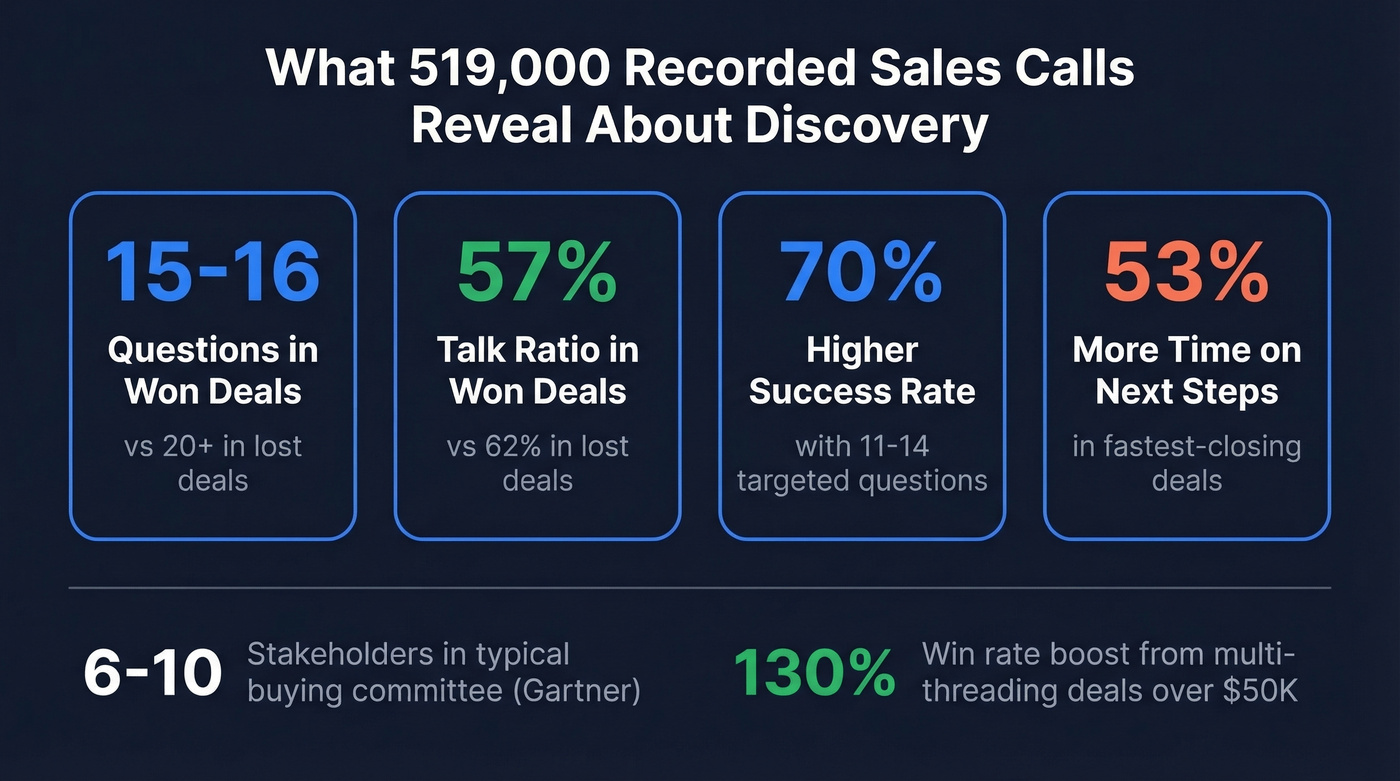
Separate research on 326,000 sales calls found that reps who closed deals talked 57% of the time. Reps who lost? 62%. That five-point gap sounds small, but it's the difference between a conversation and a monologue. Cold call benchmarks also show that reps asking 11-14 targeted questions see 70% higher success rates than those who wing it.
Gartner puts the typical buying committee at [6-10 stakeholders](https://www.gartner.com/en/sales/insights/b2b-buying-journey). Multi-threading - engaging multiple contacts - boosts win rates by 130% for deals over $50K. Your discovery process can't just uncover one person's pain. It needs to map the buying group's priorities.
One more data point worth sitting with: sellers in the fastest-closing deals spent 53% more time discussing next steps in the first meeting. Discovery that closes doesn't end with "great chat." It ends with a commitment.
The 5-Step Needs Assessment Process
Step 1 - Prepare Before You Dial
The biggest discovery mistake isn't asking the wrong questions. It's showing up cold.
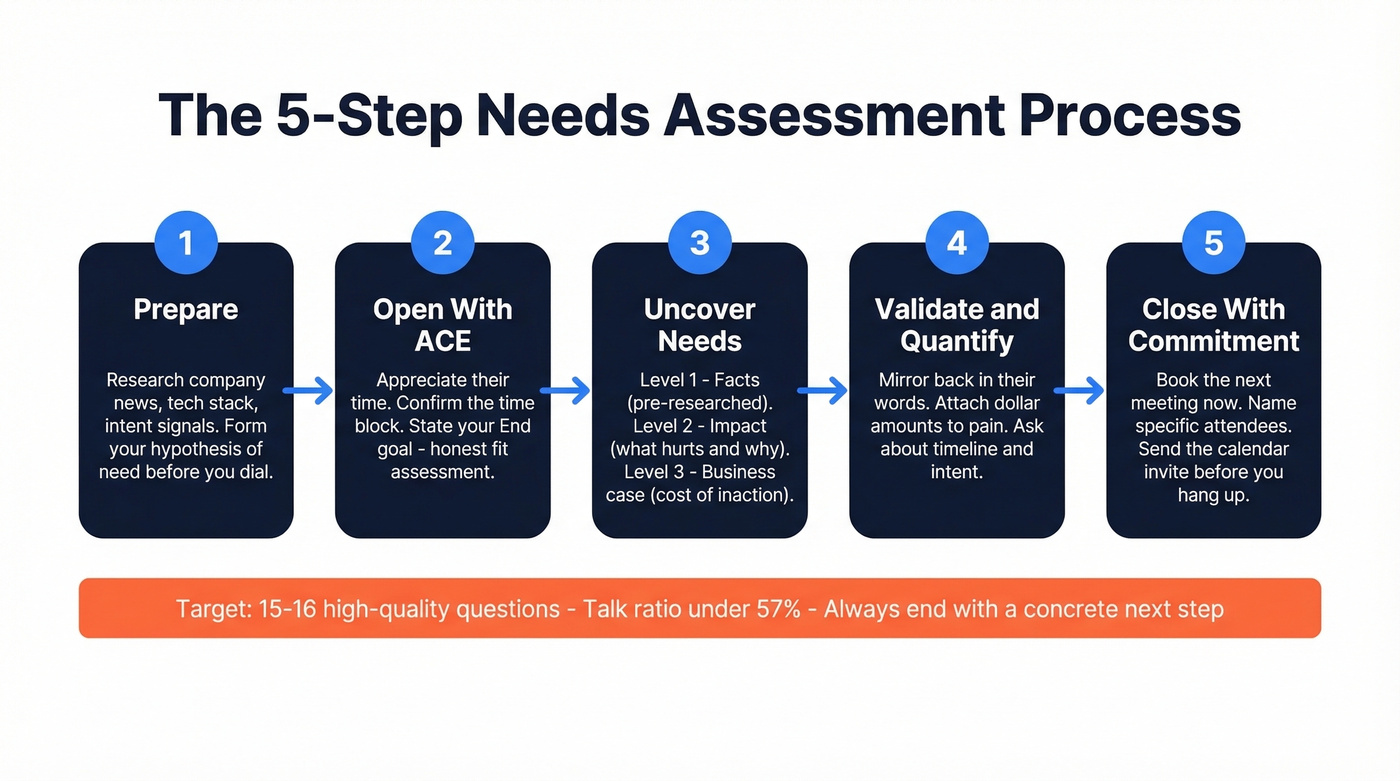
When your first question is "so tell me about your business," you've told the prospect you didn't bother to look. Before every call, gather five things: the company's recent news and growth trajectory, the stakeholder's role and likely priorities, their current tech stack, recent organizational changes, and intent signals showing what they're actively researching. Tools like Prospeo make this fast - 30+ search filters covering buyer intent, technographics, headcount growth, and funding stage, with a 98% email accuracy rate and data refreshed every 7 days.
Pre-call research is also where you form your hypothesis of need - an educated guess about the prospect's core problem based on their industry, tech stack, and recent signals. Walking into a call with a hypothesis lets you ask sharper questions and validate faster, rather than fishing blindly.

Step 2 - Open With ACE
ACE stands for Appreciate, Confirm time, End goal. Sample opener: "Thanks for making time. I've got us blocked for 30 minutes - still work? My goal is to understand what's driving your evaluation so I can tell you honestly whether we're a fit."
Opening a cold call with "Did I catch you at a bad time?" drops meeting-booking chances by 40%. ACE does the opposite - it projects confidence and creates a collaborative frame.
Step 3 - Uncover Needs With Level 1/2/3 Questions
Level 1 - Facts. Company size, current tools, team structure. Answer these before the call through research. If you're asking "how many reps do you have?" on a discovery call, you've already lost credibility.
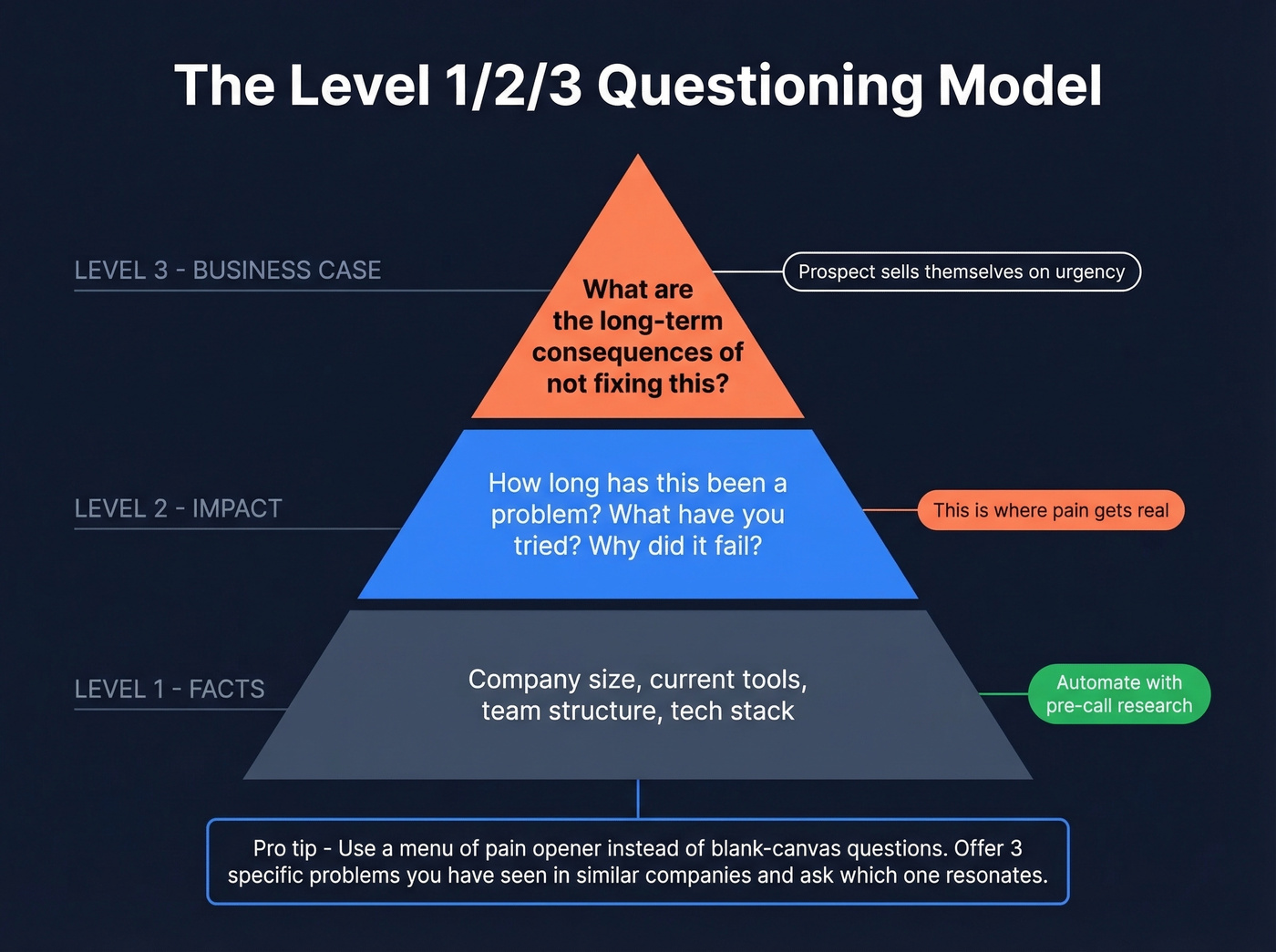
Level 2 - Impact. "How long has this been a problem? What have you tried? Why hasn't it worked?" These follow-up probes force the prospect to articulate pain they haven't fully processed yet.
Level 3 - Business case. "What are the long-term consequences of not addressing this?" This is where you build urgency without being pushy. The prospect sells themselves on the cost of inaction.
One technique that accelerates this: the "menu of pain" opener. Instead of "what challenges are you facing?", offer three specific pains you've seen in similar companies. "Most teams we talk to deal with one of three things: bounce rates killing deliverability, reps wasting hours on manual research, or CRM data decaying faster than they can update it. Which one resonates?"
Multiple-choice questions get faster, more honest answers than blank-canvas ones. So what happens when a prospect goes quiet or gives vague answers? Offer a hypothesis based on your research and let them correct you. People are far more willing to edit a wrong statement than fill a blank page.
Step 4 - Validate and Quantify
Repeat back what you've heard in the prospect's language - not your pitch deck's language. Then quantify: "You mentioned your team spends 6 hours a week on manual list building. Across 10 reps, that's 60 hours. What's that costing you in pipeline?"
Qualify intent with a transparency prompt: "Are you actively solving this now, planning for next quarter, or just exploring?" That question, borrowed from UserGems' discovery framework, saves you from nurturing a deal that was never real.
Step 5 - Close With a Commitment
Won deals don't end with "I'll send some info." They end with: "Let's schedule a 45-minute demo for Thursday with you and your VP of Ops. I'll prep a custom walkthrough based on the CRM data issue you described."
Get a calendar invite sent before you hang up. Get the names of other stakeholders who should attend. Multi-threading starts here, not three calls later.

The data is clear: pre-call research is the #1 differentiator between reps who close and reps who don't. Prospeo gives you 30+ filters - buyer intent, technographics, headcount growth, funding - so you walk into every discovery call with a hypothesis, not a blank page. 98% email accuracy. Data refreshed every 7 days.
Automate Level 1 research and show up ready to close.
Discovery Questions by Stakeholder Role
| C-Suite | VP / Director | End User | Procurement |
|---|---|---|---|
| Strategic impact of solving this? | Which metrics are most affected? | Biggest daily friction? | Evaluation timeline? |
| How does this fit 2026 priorities? | Capacity to implement? | Ideal workflow look like? | Compliance requirements? |
| Budget range? | What's been tried that failed? | Concerns about adopting new tools? | Who else are you evaluating? |
| Who else signs off? | How do you measure success? | Hours lost to this weekly? | Procurement process? |
Most reps ask the same questions regardless of who's on the call. That's why deals stall at the VP level - you built a business case for the end user but never addressed the director's operational concerns. Tailoring your questions by role is one of the most effective ways to identify customer needs across a complex buying committee.
Which Framework Fits?
| Framework | Best For | Research Basis | Strength |
|---|---|---|---|
| BANT | High-velocity inbound, SMB triage | Industry standard | Quick qualification gate |
| SPIN | Any deal requiring deep questioning | 35,000 calls, 20+ countries, 12 years | Best questioning technique |
| MEDDIC | Enterprise SaaS, complex deals | Industry standard | Maps directly to CRM fields |
| Challenger | Teaching-led, insight selling | 6,000 reps; Xerox saw $65M in contract value | Reframes buyer's thinking |
| NEAT | Multi-stakeholder, modern B2B | Harris Consulting | Prioritizes economic impact |
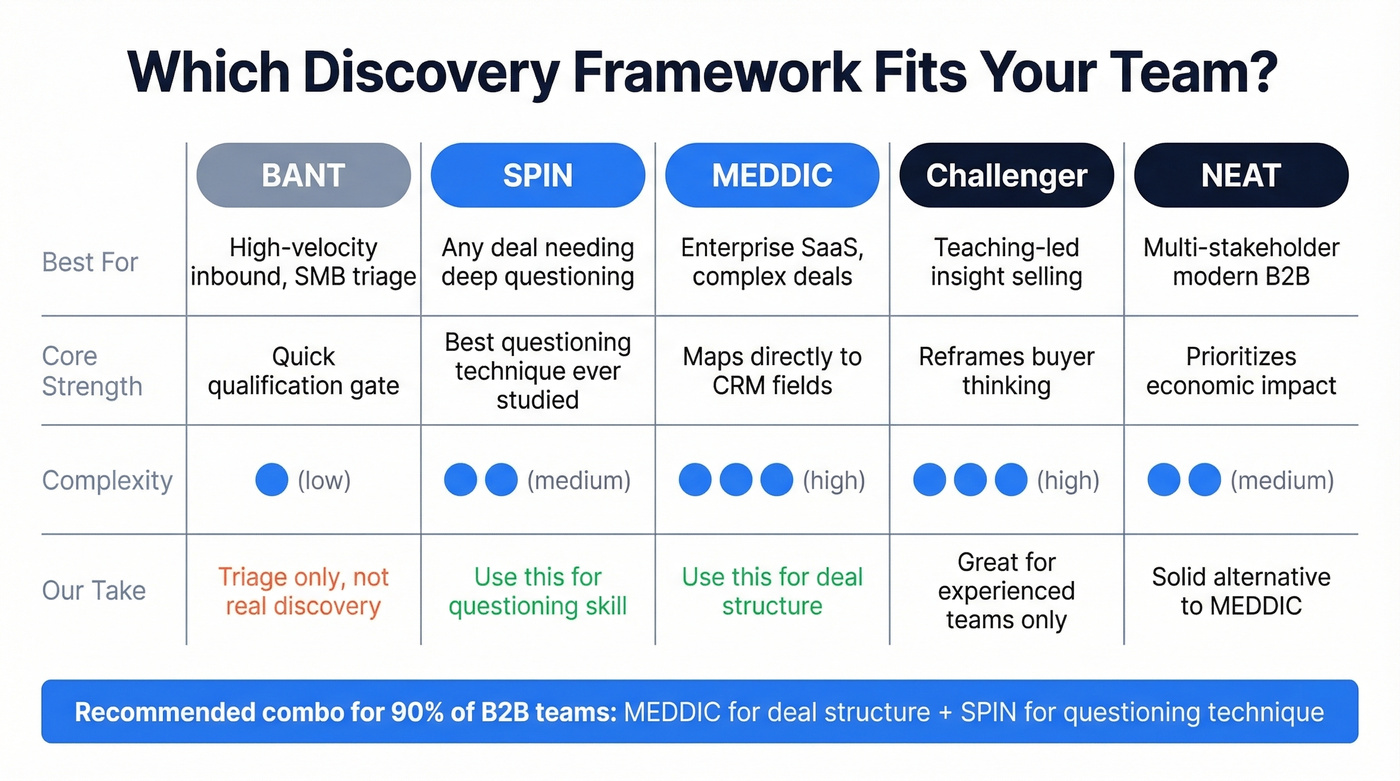
Here's our opinionated take: BANT is triage, not discovery. It tells you whether to keep talking, not what to talk about.
For 90% of B2B teams, the winning combination is MEDDIC for deal structure and SPIN for questioning technique. MEDDIC gives you the CRM-ready fields - Metrics, Economic Buyer, Decision Criteria, Decision Process, Identify Pain, Champion - and it's highly automatable because the elements map cleanly to CRM fields. SPIN gives you the conversational skill to fill those fields without sounding like a robot.
A real tension shows up in inbound call-center scenarios: how deep should discovery go when the inbound caller just needs routing? If your average deal size is under $10K, you probably don't need a 30-minute needs analysis. BANT the inbound, qualify fast, and save deep discovery for deals worth the investment. Challenger is powerful but demands deep industry knowledge from every rep - it's a force multiplier for experienced teams, not a starting point. Skip it if your team is still ramping.
7 Mistakes That Kill Discovery
1. Talking past 57%. The data from 326K calls is unambiguous. Once you cross that threshold, win rates drop. Record yourself. You'll be surprised.
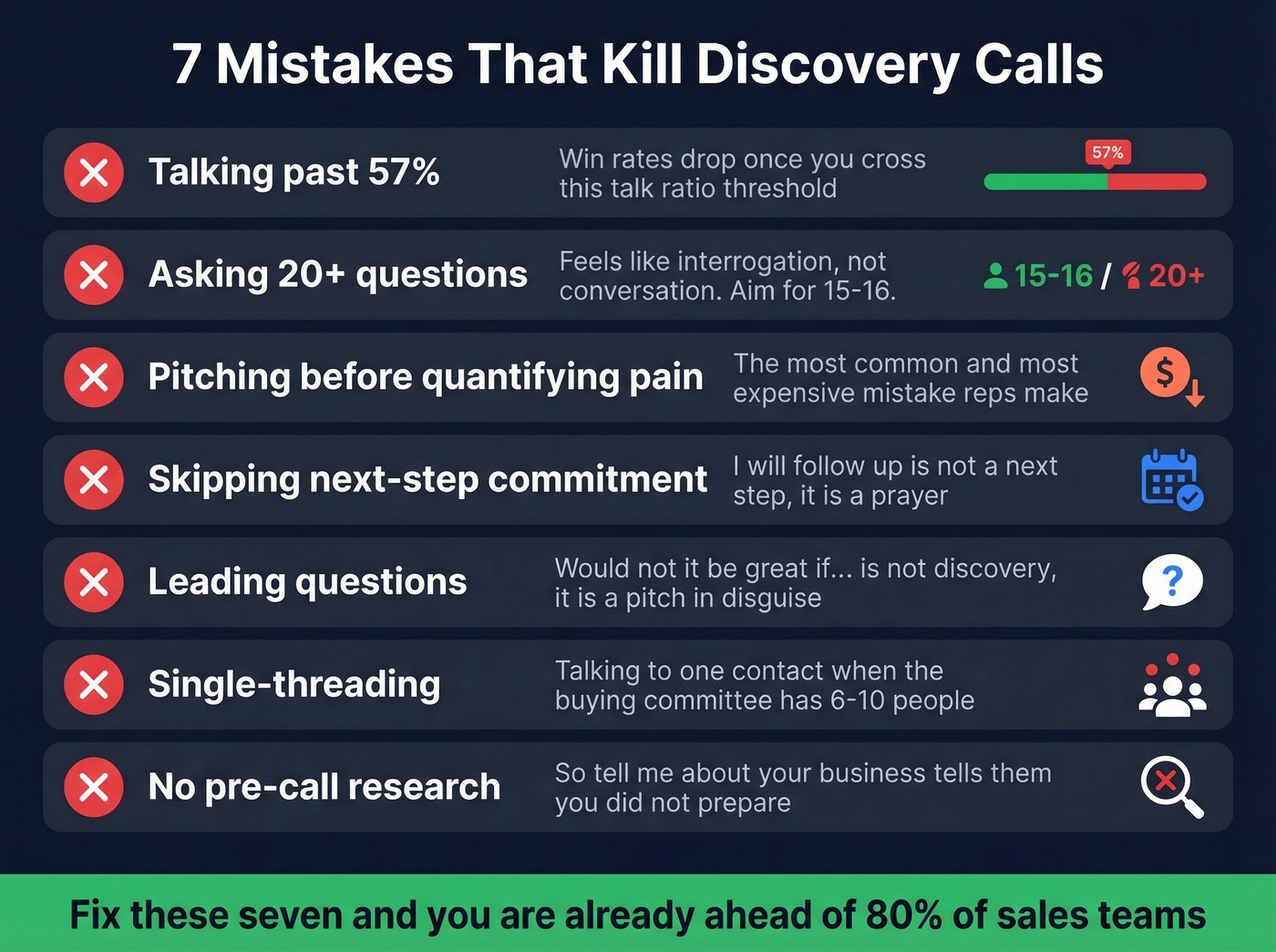
2. Asking 20+ questions. Aim for 15-16 high-quality questions, not a 25-item checklist. The interrogation effect is real.
3. Pitching before quantifying pain. The moment a prospect mentions a problem, most reps jump to "we can solve that." In our experience, this is the single most common mistake - and the most expensive. Dig into the impact first. Unquantified pain doesn't close deals.
4. Skipping next-step commitment. "I'll follow up" isn't a next step. It's a prayer. Book the next meeting before you end the current one. If you need language, use these sales follow-up templates.
5. Leading questions instead of open-ended ones. "Wouldn't it be great if you could automate that?" isn't discovery - it's a pitch disguised as a question. Ask "how are you handling that today?" instead.
6. Getting too technical with C-suite. Diving into feature-level detail with executives who care about strategic outcomes kills deals. Using inaccessible jargon with the wrong audience signals that you don't understand their world. Save the technical deep-dive for end-user evaluations.
7. Showing up with stale data. If your prospect data is on a six-week refresh cycle, you're calling people who've changed roles, left the company, or shifted priorities entirely. We've watched reps burn entire call blocks on contacts who left the company weeks ago - all because their data provider refreshes monthly at best.
Multi-threading boosts win rates by 130%, but only if you can actually reach the buying committee. Prospeo maps 300M+ professional profiles with verified emails and 125M+ direct dials - so your discovery process covers all 6-10 stakeholders, not just the one who replied.
Find every stakeholder's verified contact in seconds, not hours.
Needs Assessment Template
Copy this into your CRM or pre-call doc. Fill Level 1 before the call. Use the call for Level 2 and 3. After the call, share the completed assessment with stakeholders as an alignment artifact - this is how you keep a 6-10 person buying committee on the same page between meetings.
Pre-Call (Level 1 - Research)
- Company name, industry, headcount, funding stage
- Stakeholder name, title, reporting line
- Current tech stack (relevant tools)
- Recent company changes (hiring, layoffs, funding, leadership)
- Intent signals (topics they're actively researching)
During Call (Level 2 - Impact)
- Primary business challenge (open-ended)
- Duration and severity of the problem
- What they've tried and why it didn't work
- Urgency scale: 1-10
- Who else is affected
During Call (Level 3 - Business Case)
- Cost of inaction (quantified)
- Decision-making participants (names + roles)
- Budget range and implementation timeline
- Competing solutions being evaluated
- Success criteria - what does "solved" look like?
- Buying stage: actively solving / planning / exploring
- Agreed next step (demo, technical review, stakeholder intro)
FAQ
How many questions should you ask in a discovery call?
Data from 519K+ recorded calls shows 15-16 questions correlates with winning deals; above 20, win rates drop sharply. The fix isn't fewer questions overall - it's fewer shallow ones. Use the Level 1/2/3 model to eliminate fact-gathering from the call and spend every question on impact and business case.
What's the difference between needs assessment and qualification?
Qualification determines if a prospect fits your ICP - budget, authority, timeline. A needs assessment goes deeper, uncovering pain, quantifying impact, and building the business case for change. Qualification is the gate; the assessment is the conversation that builds the deal. You need both, but they serve different purposes.
How do you identify customer needs before the first call?
Start with pre-call research: review the prospect's company news, tech stack, org changes, and buyer intent signals. Prospeo surfaces intent data across 15,000 topics alongside verified contact details, so you can form a hypothesis of need before you dial - then use the call to validate, not start from scratch.
How do you prepare for a needs assessment call?
Research the prospect's company, role, tech stack, recent changes, and intent signals before the call. Level 1 questions should be answered before you dial. When your opening question demonstrates homework instead of requesting a company overview, you've already separated yourself from 90% of the reps your prospect talks to.
The best discovery calls don't start when you open your mouth. They start when you open your research tool. A needs assessment in sales is only as good as the preparation behind it - and the commitment you walk away with.