

New Hire Sales Training: The 90-Day Playbook Most Companies Get Wrong
A RevOps lead we know hired six SDRs in Q1. By the end of Q2, three had quit and the other three were still missing quota. The onboarding program? A week of slide decks, a Salesforce login, and "shadow Jamie - she's our best rep." That's not new hire sales training. That's an expensive way to burn through $135,708 - roughly $45,236 per departure in direct costs - and that's before you account for the ramp time and pipeline you lose when seats sit empty.
The numbers get worse. Sales rep turnover sits around 35% annually, nearly triple the 13% cross-industry average. For a 20-rep team, that's seven replacements a year and about $316,652 gone before you count a single lost deal.
What You Actually Need
- A phased 90-day plan with milestones at 30, 60, and 90 days - not a one-week crash course. (If you want a template, use a 30, 60, 90-day plan structure.)
- Competency gates at each phase. Certifications beat buddy programs.
- Clean prospecting data from day one. SDRs ramp in about 3.1 months, AEs in 4.9 months. Bad phone numbers and bounced emails stretch those timelines further.
Why Sales Training for New Hires Fails
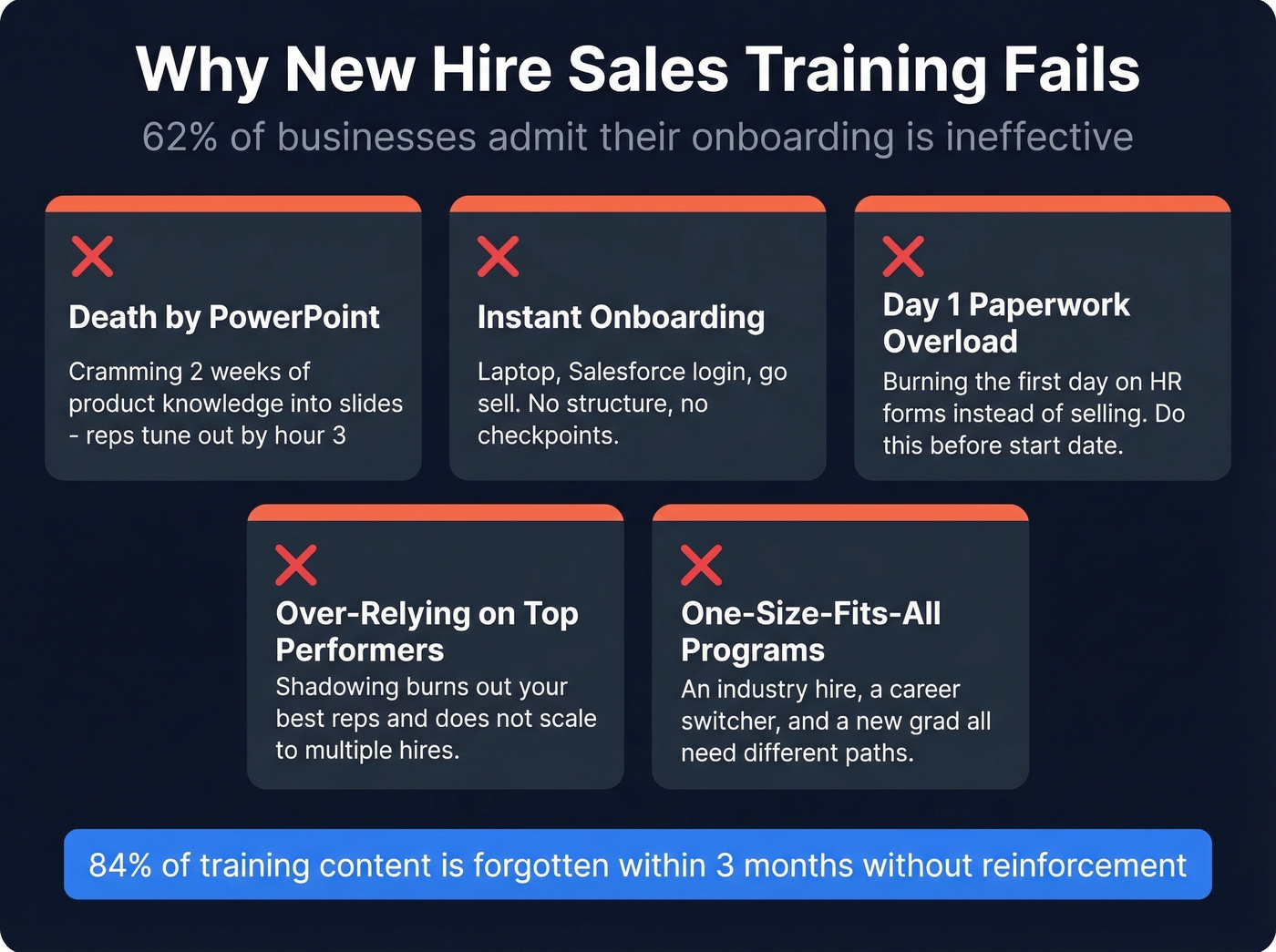
The r/sales subreddit is brutally honest about this. Reps describe "hour-long presentations nobody listens to" and "knowledge bases too disorganized to actually be useful." 62% of businesses admit their onboarding is ineffective, and 84% of training content is forgotten within three months without reinforcement.
Here are the anti-patterns we see over and over:
Death by PowerPoint. Cramming two weeks of product knowledge into slides reps tune out by hour three. We've watched it happen in person - eyes glaze over, phones come out, and by lunch on day two nobody's retaining anything.
The "instant onboarding." Laptop, Salesforce login, go sell. No structure, no checkpoints.
Burning day one on HR paperwork instead of selling. Get logistics done before the start date.
Over-relying on top performers. Shadowing burns out your best reps and doesn't scale. Gong call libraries help, but they can't replace live coaching.
One-size-fits-all programs. An industry hire, a career switcher, and a new grad all need different paths. Effective onboarding accounts for these differences from the start.
The 90-Day Onboarding Framework
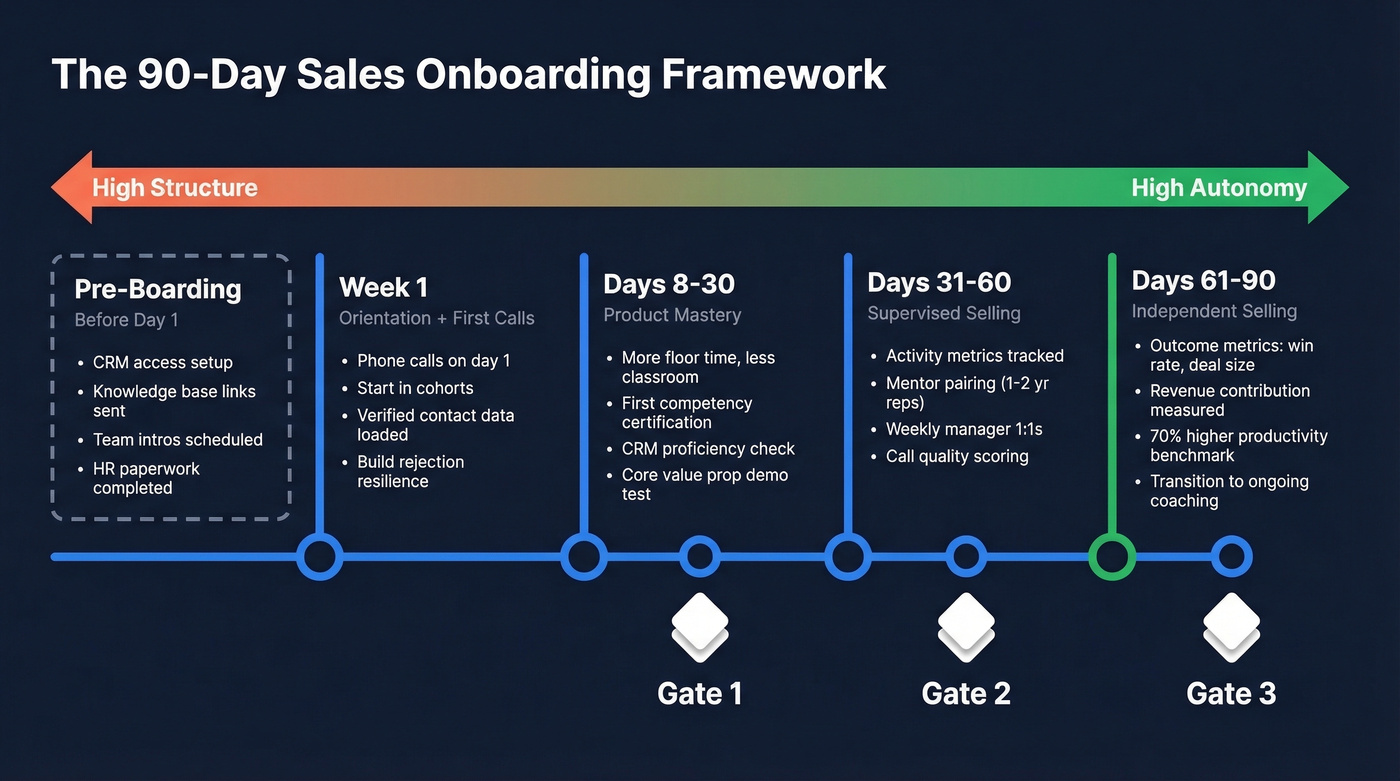
Pre-Boarding (Before Day 1)
Before a new rep walks in, they should already have CRM access, knowledge base links, and team introductions scheduled. Get the admin friction out of the way so day one is about selling. This sounds obvious, but in our experience, about half the companies we talk to still waste the entire first morning on laptop setup and benefits enrollment.
Week 1 - Orientation + First Calls
Get reps on the phone on day one. EngageTech's model starts new hires prospecting immediately - not because they'll be good at it, but because early exposure to rejection builds resilience faster than any classroom session. Start hires in cohorts so you're not repeating the same training six different times. Arm them with verified contact data so their first calls actually reach someone instead of hitting disconnected numbers.
Days 8-30 - Product Mastery
Shift the balance toward more floor time, less classroom. The milestone here is the first competency certification - a product knowledge assessment that gates progression. If a rep can't demo the core value prop cleanly, they're not ready for supervised selling.
CRM proficiency matters too. A rep who can't log activities properly creates downstream data problems that haunt your pipeline reporting for months.
Days 31-60 - Supervised Selling
Activity metrics take center stage: outreach volume, meetings booked, call quality scores. Pair new reps with mentors who have 1-2 years of experience and are consistently hitting targets. Don't assign your top performer - they'll resent it, and their selling style probably isn't replicable. Weekly 1:1s with managers are non-negotiable here; RAIN Group found managers spend less than 8% of their time coaching, which explains a lot about why ramp times drag.
Days 61-90 - Independent Selling
Shift measurement from activity to outcomes: win rate, average deal size, revenue contribution. Structured programs produce 70% higher productivity and 50-60% higher engagement than ad-hoc ones.
Here's the thing: onboarding has an expiration date. By day 90, a rep should be operating independently with coaching support, not still "ramping." If they're not, the problem is the program, not the person. Too many companies blame the hire when the real failure is a training plan that never had clear milestones to begin with.

New reps calling disconnected numbers and bouncing emails don't build confidence - they build resentment. Prospeo gives every new hire 75 verified emails and 100 Chrome extension credits per month free, with 98% email accuracy and a 30% mobile pickup rate. GreyScout cut ramp time in half after switching.
Stop extending ramp time with bad data. Give new reps numbers that actually connect.
How to Train Reps by Role
| Role | Avg. Ramp Time | Day-1 Focus |
|---|---|---|
| SDR | ~3.1 months | Call volume, resilience |
| AE | ~4.9 months | Discovery, deal mechanics |
| SE | Up to 2 years | Technical depth, demos |
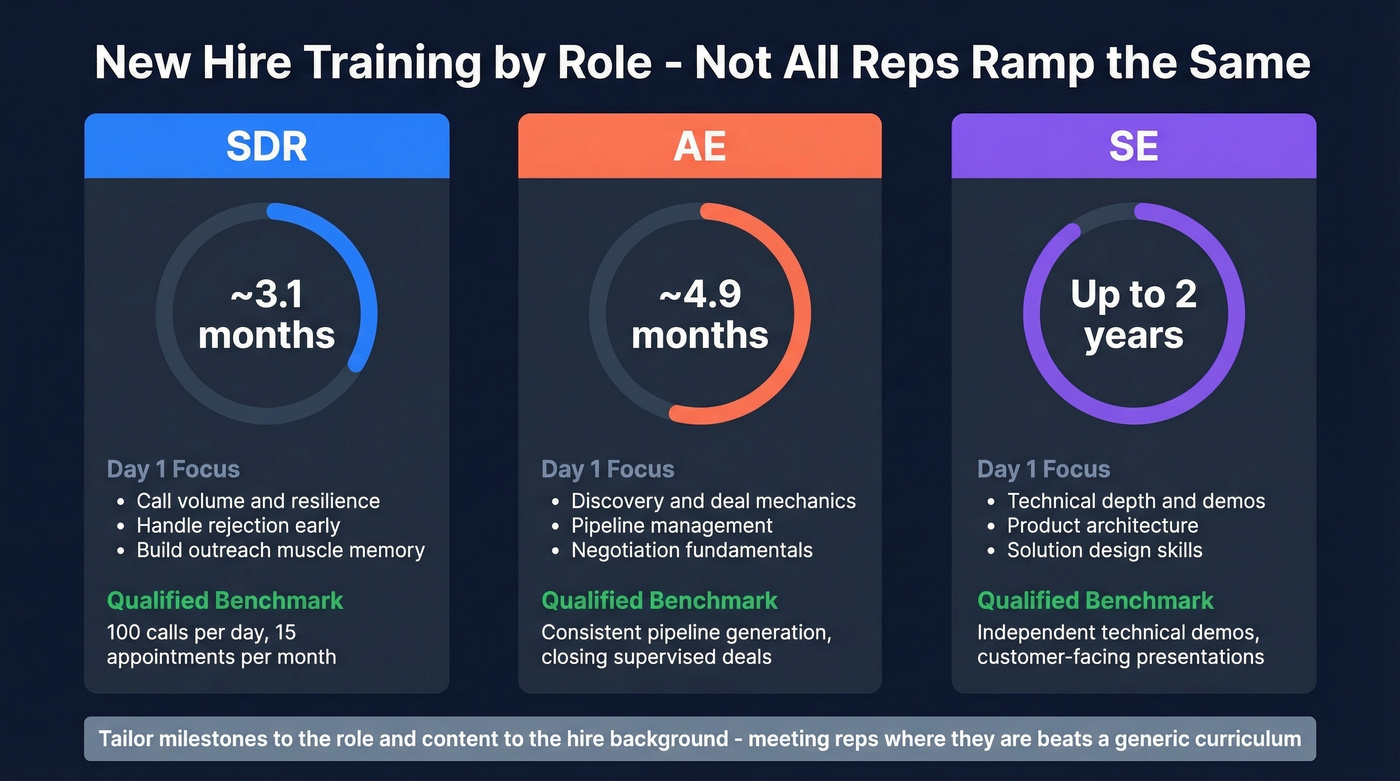
A "qualified" SDR at EngageTech's benchmark means 100 calls per day and 15 appointments per month. Applying that standard to an enterprise AE would be absurd. Tailor milestones to the role and content to the hire's background - meeting reps where they are beats forcing everyone through the same generic curriculum every time.
Tools That Accelerate Ramp Time
You don't need a 12-tool stack on day one. You need three things that work.
CRM. Salesforce plans start around $25/user/month for entry tiers; HubSpot has a free CRM tier that works for smaller teams. Pick one and make sure reps can use it before they start selling.
Call recording. Gong typically costs $100-200/user/month depending on package and volume and has expanded into full revenue enablement in 2026. Expensive but worth it for call coaching at scale. The Seismic-Highspot merger and Showpad-Bigtincan deal are consolidating the enablement category, but Gong remains the call intelligence standard.
Prospecting data. This is where most onboarding silently fails. New reps calling bad numbers and sending emails that bounce extends ramp time by weeks. We've seen it firsthand: the GreyScout team cut rep ramp time from 8-10 weeks to 4 weeks after switching to Prospeo, with bounce rates dropping from 38% to under 4%. The free tier gives new reps 75 verified emails per month from day one plus 100 Chrome extension credits monthly - enough to start prospecting without waiting on procurement approvals or budget sign-off.

Once you're onboarding 5+ reps per quarter, an LMS matters. TalentLMS starts at $119/month; iSpring from $3.58/user/month. For in-app learning, Spekit runs ~$15-30/user/month.
Skip the LMS entirely if you're onboarding fewer than five reps a quarter - a shared Google Drive with recorded Gong calls and a Notion playbook will get you 80% of the way there without the overhead.
Your 90-day onboarding plan is only as good as the data your reps prospect with. Bounce rates above 5% destroy sender reputation and new hire confidence simultaneously. Prospeo's 7-day data refresh cycle means your SDRs never call stale numbers - at roughly $0.01 per email.
Ramp faster with data that's refreshed weekly, not monthly.
Measuring Onboarding Success
Track these metrics pre- and post-training, per Training Industry's framework:
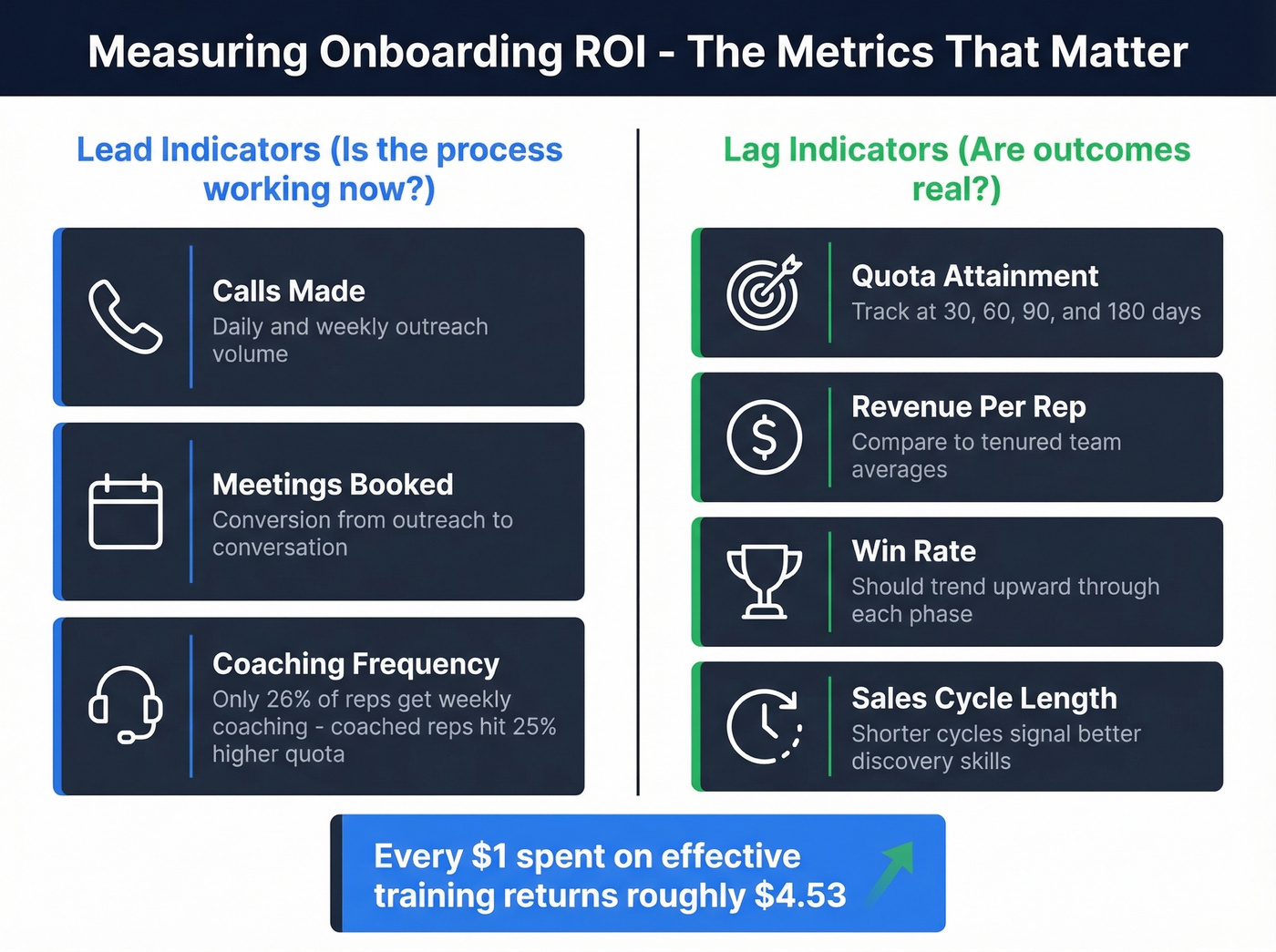
- Quota attainment at 30, 60, 90, and 180 days
- Revenue per rep compared to tenured team averages
- Win rates and average deal size trending upward
- Sales cycle length - shorter cycles signal better discovery skills
- Coaching frequency - only 26% of reps receive weekly coaching, yet coached reps hit 25% higher quota attainment
Let's break this into two buckets. Lead indicators like calls made and meetings booked tell you if the process is working right now. Lag indicators like revenue and win rate tell you if the outcomes are real. Every $1 spent on effective training returns roughly $4.53 - but only if you're measuring the right things and acting on what the data shows you.
AI in Sales Onboarding (2026)
AI adoption among sales teams jumped from 24% to 43% in a single year, and Gartner found that sellers who partner effectively with AI are 3.7x more likely to meet quota. AI role-play tools handle objection practice, automated call scoring replaces manual QA, and personalized learning paths adapt to each rep's weak spots in real time rather than waiting for a manager's weekly review.
Real talk: AI won't fix a broken onboarding program. But layered on top of a solid 90-day framework, it compresses the feedback loop from weekly coaching sessions to real-time correction. When you combine AI-assisted coaching with structured milestones, ramp time shrinks and consistency improves across the entire cohort.
FAQ
How long should new hire sales training last?
Plan for 90 days of structured training with competency gates at 30, 60, and 90 days, then transition to ongoing coaching. SDRs ramp in about 3.1 months; AEs take closer to 4.9 months. The intensive phase should have a clear endpoint - reps still "onboarding" at month six signal a program problem, not a people problem.
What's a realistic ramp time for new sales reps?
SDRs average 3.1 months, AEs 4.9 months, and Sales Engineers up to two years. Structured onboarding with clean data and competency gates can cut these timelines by up to 34%. If your reps consistently take longer, audit the program before blaming the hires.
What tools do new sales reps need on day one?
A CRM, call recording software, and verified prospecting data. That's it. LMS and enablement platforms can wait until week two. Don't overwhelm new hires with a dozen logins before they've made their first call.
How do you measure sales onboarding ROI?
Track quota attainment at 30/60/90/180 days, revenue per rep versus tenured averages, and win-rate trends. Every $1 invested in structured training returns roughly $4.53. Separate lead indicators from lag indicators to diagnose problems early - if activity numbers look good but revenue doesn't follow, you've got a quality problem, not a volume problem.