

Objection Handling in B2B Sales: What the Data Actually Says
You've read ten articles that say "listen actively and show empathy." Great. Now a prospect says "we're happy with our current vendor" and you're staring at the ceiling trying to remember which acronym to use. The problem isn't that you lack frameworks - most advice on objection handling in B2B sales treats symptoms instead of diagnosing the disease.
Here's what actually moves the moment forward, backed by Gong's analysis of 67,149 sales calls and a technique that took one rep from a 19% to a 34% close rate.
Why B2B Objections Hit Different
The buying environment has shifted underneath us. On average, 7.4 decision-makers sit on a typical B2B buying committee. Nearly 70% of the buyer's journey is complete before a rep gets a conversation. And 61% of B2B buyers say they'd prefer a rep-free experience entirely.
By the time you hear an objection, the prospect has already formed opinions based on peer reviews, competitor demos, and internal discussions you weren't part of. You're not overcoming concerns born from ignorance - you're competing against a decision that's already half-made.
One distinction most guides miss: there's a difference between a true objection and a structural blocker. "I'm not sure this solves our problem" is an objection - you can address it in conversation. "Procurement won't approve a new vendor until Q3" is a blocker that requires process changes: multi-threading, parallel legal reviews, executive sponsors. Treating a blocker like an objection is how you waste three months on a dead deal.
The Short Version
- Pause 5x longer after hearing an objection. Gong's analysis of 67,149 sales calls found successful reps pause immediately after a customer's objection for 5x longer than their less-successful peers.
- Make a calm guess about the real concern, then wait. One practitioner went from 19% to 34% close rate this way, with average deal size up 23%.
- Talk less. Top closers speak 43% of the time, not 65%.
The Assumption Technique
A practitioner on r/b2b_sales described the exact moment most reps get it wrong: "I was FIGHTING them. Every objection became a debate." The fix wasn't a new framework. It was a mindset shift - stop debating buyer pushback and start treating it as information.
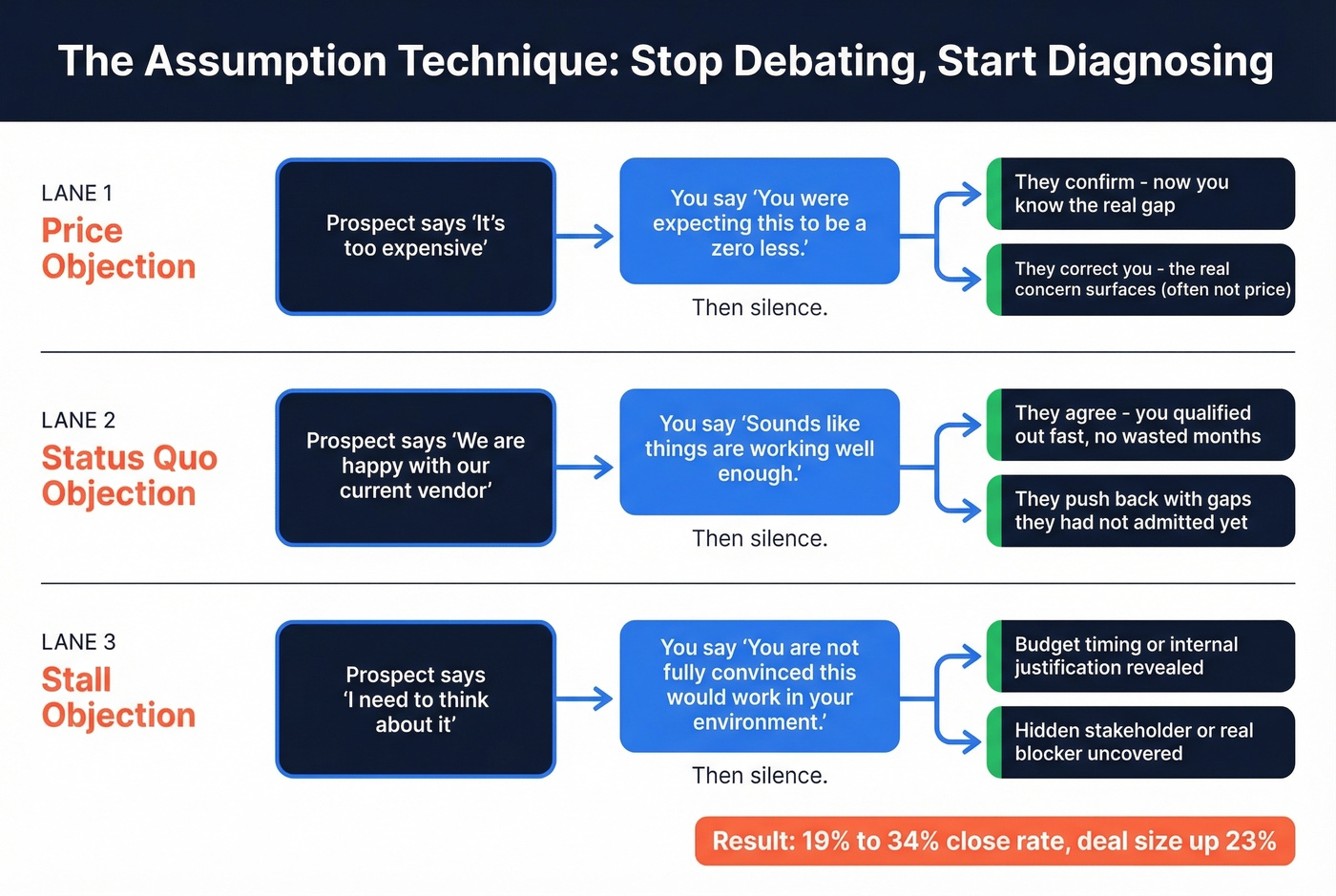
When you hear an objection, make a calm assumption about what's really behind it, then shut up. You're not rebutting. You're diagnosing.
Price objection: "You were expecting this to be a zero less." Then silence. The prospect either confirms - and you know the real gap - or corrects you with the actual concern, which is often not price at all.
Competitor/status quo: "Sounds like things are working well enough." This forces the prospect to either agree (you've qualified out fast) or push back with gaps they haven't admitted yet.
"I need to think about it": "You're not fully convinced this would work in your environment." Now the real issue surfaces - budget timing, internal justification, a stakeholder you haven't met.
The results from that Reddit post: close rate jumped from 19% to 34%, average deal size up 23%, shorter sales cycles, less discounting. The mechanism is sound. When you guess instead of argue, you give the prospect permission to tell you the truth.
What 67,149 Calls Reveal
Gong analyzed 67,149 sales calls to identify what separates top performers during objection moments. The headline finding: successful salespeople pause immediately after a customer's objection for 5x longer than their less-successful peers.
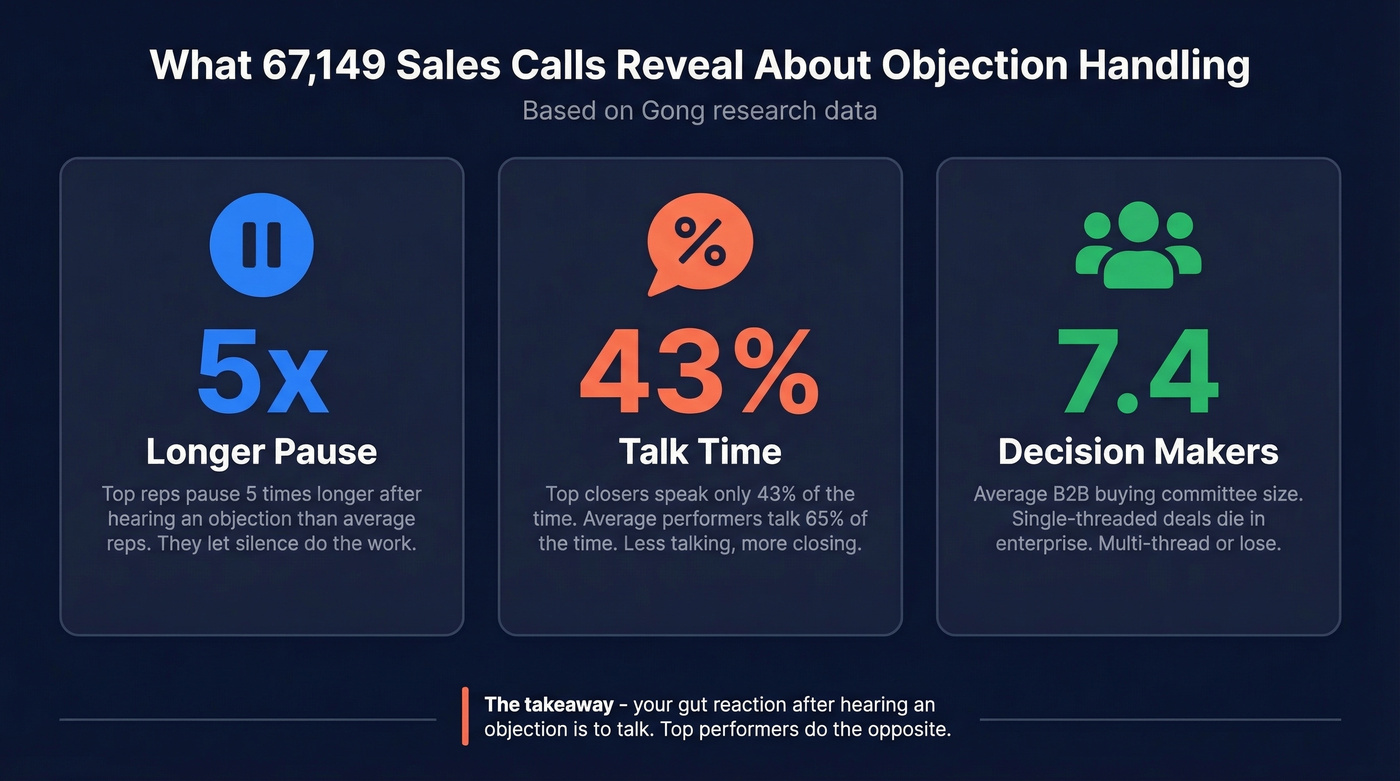
Think about what that means in practice. Your gut reaction after "that's too expensive" is to immediately justify the price. Top closers sit in the silence. They let the prospect fill the gap - and what comes next is almost always more useful than the initial objection.
The talk-to-listen data reinforces this. Top-closing reps speak only 43% of the time. Average performers hit 65%. That's not a small gap - it's the difference between a conversation and a pitch.
Rookies answer the first objection. Veterans isolate it first.
Three Proven Frameworks
LAER: Listen, Acknowledge, Explore, Respond
Best for discovery calls where you need the full picture before reacting. Listen without interrupting. Acknowledge directly: "That makes sense - budget cycles are real." Explore with an open question: "Help me understand - is this a timing issue or a priority issue?"
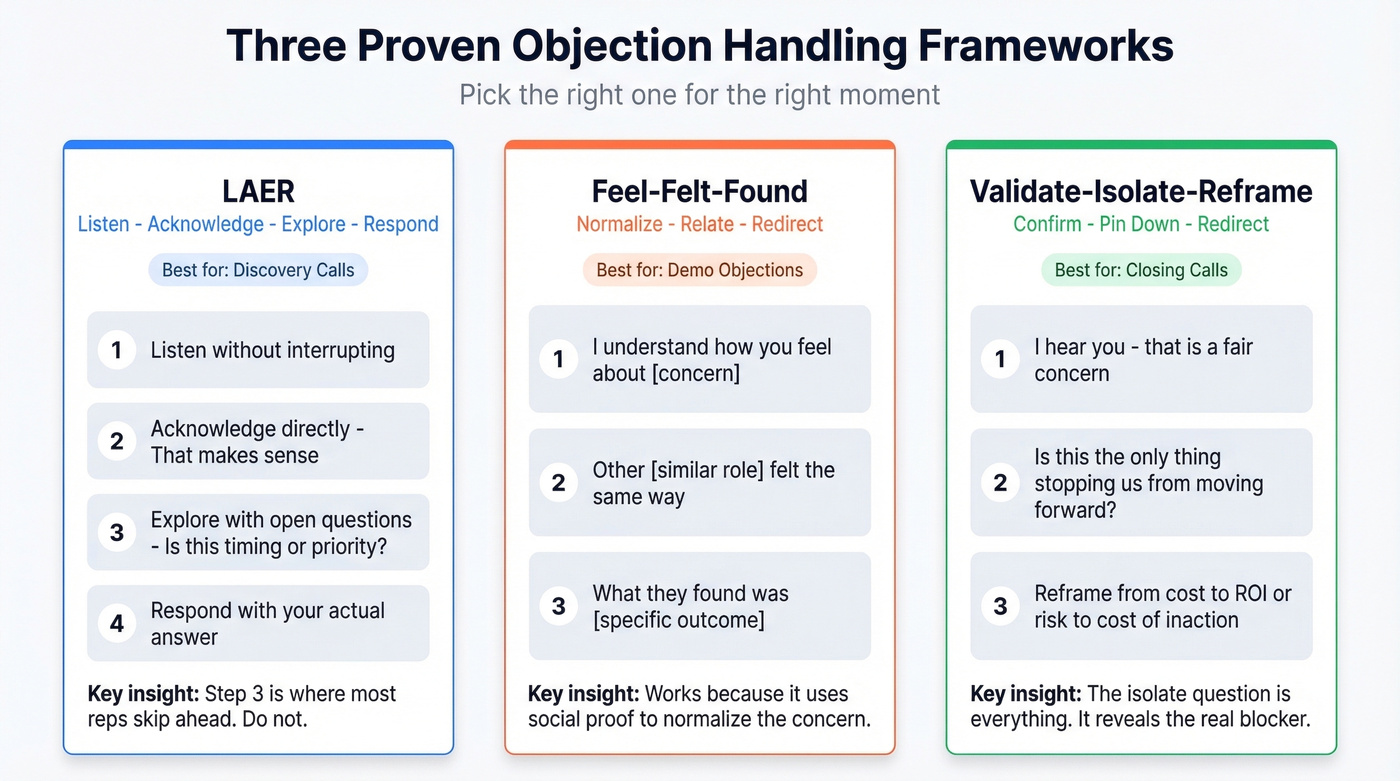
Only then respond with your actual answer. The explore step is where most reps skip ahead. Don't. The information you get there determines whether your response lands or bounces off.
Feel-Felt-Found
Best for demo objections where social proof carries weight. "I understand how you feel about the implementation timeline. Other VPs of Ops felt the same way when they first saw the scope. What they found was that the 30-day onboarding saved them two months of manual work." Simple, almost formulaic - and it works because it normalizes the concern while redirecting to outcomes.
Validate, Isolate, Reframe
Best for closing calls when you need to pin down the real blocker. Validate first: "I hear you - that's a fair concern." Then isolate: "Is this the only thing stopping us from moving forward?"
That question is everything. If they say yes, you have one problem to solve. If they say no, you just uncovered the real objection hiding behind the first one.
Then reframe: shift from cost to ROI, from risk to cost-of-inaction, from timing to competitive urgency. The Verbal Judo principle applies - don't resist force, move with it.

Objection handling only matters if you're in the conversation. With 7.4 stakeholders on every deal, you need verified contact data for every decision-maker - not just the one who answered. Prospeo gives you 98% accurate emails and 125M+ verified mobile numbers so you can multi-thread into the full buying committee.
Stop losing deals to stakeholders you never reached.
Scripts for Every Common Objection
| Objection Type | Core Move | Framework |
|---|---|---|
| Price/Budget | Isolate then ROI reframe | Validate-Isolate-Reframe |
| Bad Timing | Challenge the delay | Assumption technique |
| Authority | Arm the champion | LAER |
| Competitor | Probe the gap | Assumption technique |
| Not Interested | Earn 30 seconds | Question-based |
| Data/Trust | Confident sourcing | Prevention |
| Ghosting | Name the elephant | Assumption technique |
Price and Budget
58% of buyers cite price as the most influential factor - but "too expensive" is rarely the full story. Start with: "If price wasn't an issue, is this the solution you'd choose?" If yes, you've isolated the objection and can reframe around ROI. If no, price was a smokescreen and you just saved yourself from discounting for nothing.
Bad Timing
"What's going to change between now and next quarter?" This question forces the prospect to articulate a concrete reason - or admit there isn't one. If they confirm something bigger is on the plate, schedule a real follow-up with a calendar hold. If they can't name a reason, the timing objection often evaporates.
Need to Check with My Boss
Don't fight the authority objection - arm your champion. "Totally get it. Want me to put together a one-pager with the ROI numbers so you can walk your team through it?" Then: "What questions do you think they'll have?" Now you're prepping your champion for an internal sell, not hoping they'll remember your pitch.
We Already Use a Competitor
Here's the thing: most "we already use X" objections aren't loyalty - they're inertia. The prospect isn't saying your product is worse. They're saying switching costs feel high. So compliment the competitor, then probe the gap: "That's a solid tool - how are you currently handling [specific gap your product addresses]?" If they push back with "things are working well enough," you just opened the door to a real conversation about what "well enough" actually costs them.
Not Interested
For the live brush-off: "Totally fair. If you give me 30 seconds, I'll share why I reached out, and you can tell me if it's worth continuing." For the email brush-off: "Happy to close this out - what's the one thing the email would need to include to justify a five-minute call?"
How'd You Get My Number?
"I researched companies in [their industry] that match the profile of teams we've helped with [specific outcome]. Your name came up as the right person to talk to." Say it confidently - hesitation here kills credibility. We've seen this objection disappear entirely when contact data is clean. Verified direct dials and emails that don't bounce signal professionalism from the first touch.
Ghosting and Stalled Deals
Instead of chasing with "just checking in" emails, name the elephant: "My guess is something came up internally that changed the priority." This gives them an easy on-ramp to re-engage without admitting they ghosted you. In our experience, this single line restarts more stalled conversations than any three-email nurture sequence.
Enterprise Objections Nobody Covers
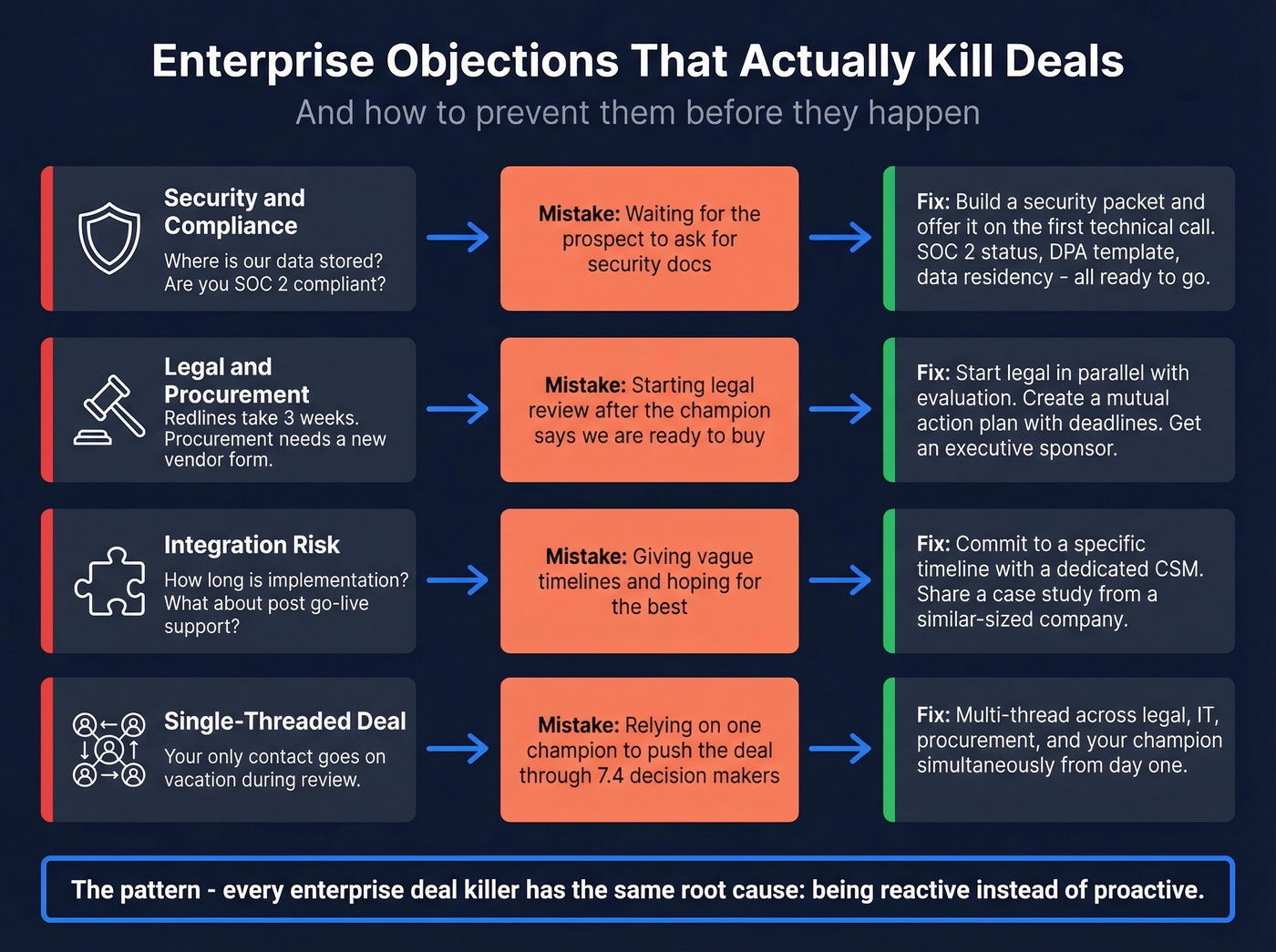
Most content on handling pushback stops at "it's too expensive." Enterprise deals die in procurement, not on price calls.
Security and Compliance
Don't wait for the ask. Build a security packet - SOC 2 status, DPA template, data residency details - and offer it during the first technical call. "We know security review is part of your process. Here's everything your team will need." Proactive beats reactive every time.
Legal and Procurement
Start legal review in parallel with the evaluation, not after. Create a mutual action plan with deadlines for redlines and signature. Get an executive sponsor on the prospect's side to apply internal pressure.
Waiting until the champion says "we're ready to buy" before engaging legal is how deals slip a quarter. We've watched it happen too many times.
Integration Risk
"We'll commit to a 30-day implementation with a dedicated CSM. Here's a case study from a company your size that went live in 22 days." Address post-go-live support directly - prospects worry about maintenance as much as setup.
Multi-Threading
Remember the 7.4 decision-makers stat. Single-threaded deals die in enterprise. Build relationships across legal, IT, procurement, and your champion simultaneously. If your only contact goes on vacation during review, you need someone else pushing internally.
Prevent Objections Upstream
The best objection is one that never happens. Salesforce's P.O.W.E.R.F.U.L. discovery framework maps the questions that surface concerns before they become roadblocks: Pain, Opportunity costs, Wants, Executive-level influence, Resources, Fear of failure, Unequivocal trust, Little things. Ask about "Fear of failure" early: "What happens internally if this doesn't work out?" That question surfaces risk concerns before they ambush you in the close.
Sales-marketing alignment matters here too. Companies are 67% better at closing deals when sales and marketing are aligned on messaging, and aligned teams see 38% higher win rates. When marketing promises one thing and the rep pitches another, every call starts with a trust deficit.
Let's be honest about the most overlooked upstream prevention: data quality. Bounce rates above 5% damage domain reputation and signal to prospects that you haven't done your homework before you ever get on a call. Prospeo's 98% email accuracy and 7-day data refresh cycle eliminate this category of objection entirely - your first impression is clean, professional, and targeted.
Tools That Sharpen Your Approach
| Category | Tool | Starting Price | Use Case |
|---|---|---|---|
| Data Verification | Prospeo | Free tier (75 emails/mo) | Prevent bad-data objections |
| AI Roleplay | Yoodli | $11/mo | Best value for solo reps |
| AI Roleplay | Kendo AI | $55/mo | Team-based scenarios |
| Call Analysis | Gong | Enterprise pricing | Conversation intelligence |
| Sales Coaching | Mindtickle | ~$30-50/user/mo | Structured enablement |
Skip Kendo AI if you're a solo rep - it's built for teams and the price reflects that. Yoodli gives you 90% of the roleplay value at a fraction of the cost.
Five Mistakes That Kill Deals
- Debating instead of diagnosing. The r/b2b_sales consensus is clear: fighting objections makes prospects check out. Make an assumption, then listen.
- Responding to the surface objection. "It's too expensive" usually means something else. Isolate before you respond.
- Discounting too early. The moment you drop price without isolating, you've told the prospect your product isn't worth what you quoted.
- Talking 65% of the time. Top closers talk 43%. If you're doing most of the talking after an objection, you're pitching when you should be listening.
- Skipping discovery. Every objection in the demo that could've been surfaced in qualification is a self-inflicted wound. Run P.O.W.E.R.F.U.L. and prevent them.
The biggest objection killer? Reaching the right person in the first place. Prospeo's 300M+ profiles with 30+ filters - including buyer intent, job changes, and technographics - let you target prospects already in-market. When you show up with relevance, 'not interested' turns into 'tell me more.'
Sell to buyers who are already looking - at $0.01 per lead.
FAQ
What is objection handling in B2B sales?
It's the process of addressing a prospect's concerns during the sales cycle - turning hesitation into forward momentum rather than debating or dismissing. Gong's data shows top closers pause 5x longer after hearing pushback, then diagnose the root cause before responding. Treating objections as diagnostic signals, not attacks, is what separates top performers.
How many objections should you expect per B2B deal?
Expect 3-5 objections per deal on average. Enterprise deals with 7+ stakeholders often surface new concerns at every stage - discovery, demo, procurement, and legal review - so multi-threading is essential.
What's the best framework for cold call objections?
The assumption technique outperforms multi-step frameworks on cold calls. Make a calm guess about the prospect's hesitation, then pause. One rep reported jumping from 19% to 34% close rate using this single approach - it's faster and more natural than LAER or Feel-Felt-Found in a 30-second window.
Can bad contact data cause sales objections?
Absolutely. Calling wrong numbers or emailing bounced addresses signals you haven't done your homework. Clean data from a provider with 98%+ email accuracy prevents trust objections before they happen - while tools with accuracy in the 79-87% range create more of these problems than they solve.
How do you handle an objection you've never heard before?
Default to LAER: Listen fully without interrupting, Acknowledge the concern directly, Explore with an open-ended question, then Respond only after you understand the root issue. When in doubt, asking one more question is always safer than guessing wrong.