

Odoo vs Zoho CRM: Which One Actually Fits Your Business?
Your ops manager just dropped the mandate: "Find one system that handles everything." Now you're staring at the Odoo vs Zoho CRM decision, two platforms that look similar on a comparison page but solve fundamentally different problems. One is an ERP wearing a CRM hat. The other is a CRM that plays nicely with a broader ecosystem. Pick the wrong one and you're looking at six months of pain and a migration nobody wants to manage.
30-Second Verdict
Choose Zoho CRM if you need a dedicated sales platform with AI-powered lead scoring, strong mobile access, and fast time-to-value. Your team sells - that's the job.
Choose Odoo if you need CRM, inventory, accounting, and manufacturing in a single integrated system. You're buying an ERP, not just a CRM.
Stop Comparing Apples to Oranges
Here's the thing: most comparisons between these two are misleading because they treat them as equivalent products. They aren't. Odoo is an open-source ERP suite with 12M+ monthly users that happens to include a CRM module. Zoho CRM is a purpose-built sales platform living inside a broader app ecosystem.
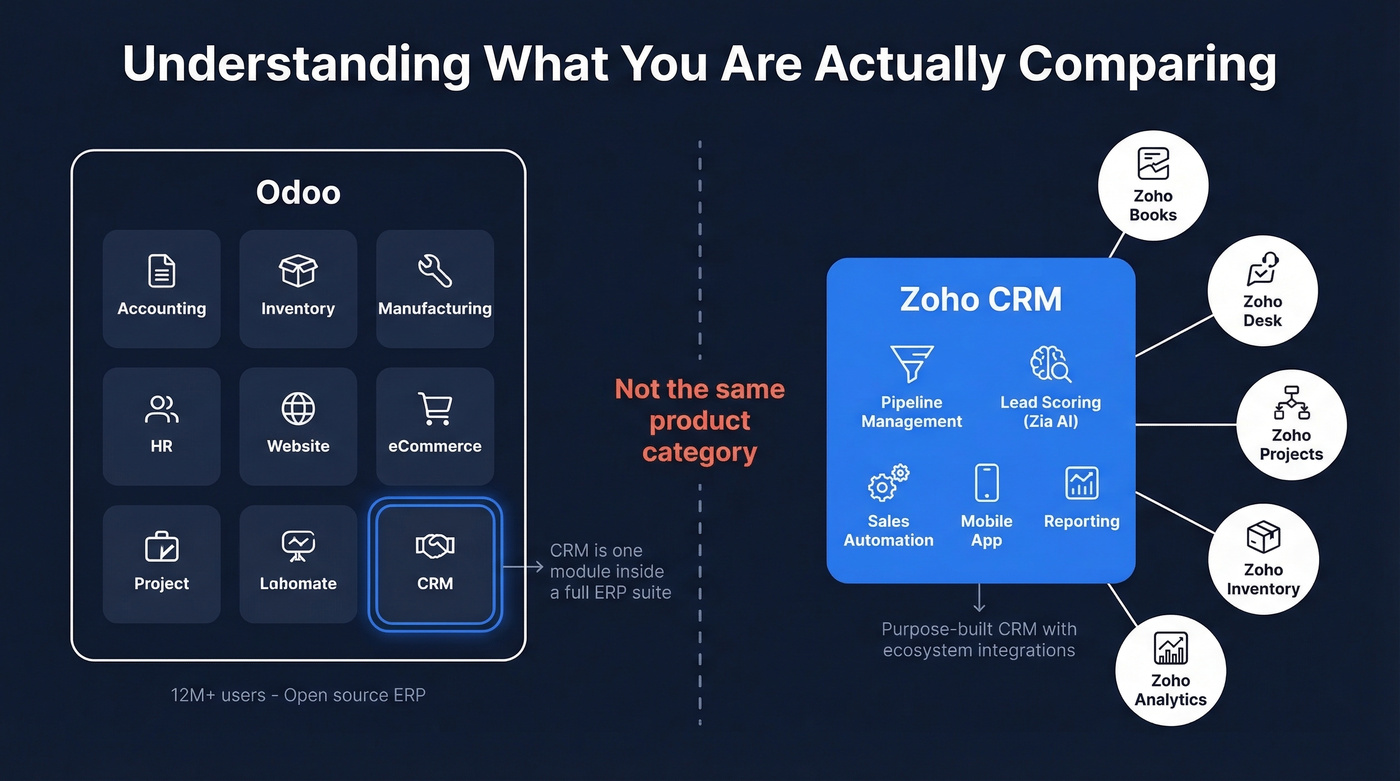
This distinction matters for pricing, implementation, and expectations. When you compare Odoo's CRM module to Zoho CRM, you're comparing a feature inside a larger system to a standalone product built for one job.
For a fair comparison, align tiers. MuchConsulting's analysis uses Odoo Enterprise Custom at roughly EUR 29.90/user/mo as the right benchmark against Zoho CRM Enterprise at $40/user/mo. Comparing Odoo's free single-app tier to Zoho's Enterprise plan produces useless conclusions. We've seen teams make purchasing decisions based on exactly this kind of mismatched comparison, and it never ends well.
Pricing Breakdown
Zoho CRM Pricing
Zoho keeps pricing straightforward with five tiers. Annual billing saves roughly 30% over monthly.
| Plan | Annual (per user/mo) | Monthly (per user/mo) |
|---|---|---|
| Free | $0 (up to 3 users) | $0 |
| Standard | $14 | $20 |
| Professional | $23 | $35 |
| Enterprise | $40 | $50 |
| Ultimate | $52 | $65 |
One cost lever worth knowing: Zoho distinguishes between "Org users" with full CRM access and "Team users" with limited access for marketing, support, or finance staff. Team users can't own records, run reports, access Zia AI, or manage automation - but they can view data, add notes, and use the mobile app. If half your CRM users just need visibility, Team user seats cut your bill significantly. The catch is that Team users and the Teamspaces feature only work in Zoho's "CRM For Everyone" UI, so you'll need to opt into that experience.
Odoo Pricing
Odoo's pricing looks deceptively simple on their site:
| Plan | Price | What You Get |
|---|---|---|
| One App Free | $0 | One app, unlimited users, Odoo Online |
| Standard | ~$31/user/mo | All apps, Odoo Online |
| Custom | ~$31-$61/user/mo | All apps + Studio, multi-company, external API, Odoo.sh/on-premise |
Pricing varies by region and currency, which explains the ranges. The free tier is genuinely useful for testing - one app with unlimited users. But the moment you need a second module (and you will), you're on a paid plan.
What's not included in any plan: Odoo.sh hosting fees, implementation services, in-app purchase credits for SMS, lead enrichment, AI features, plus maintenance of custom code. That exclusion list matters more than the sticker price.
The Real Cost of Odoo
License fees represent about 30% of what you'll actually spend. Here's where the rest goes.
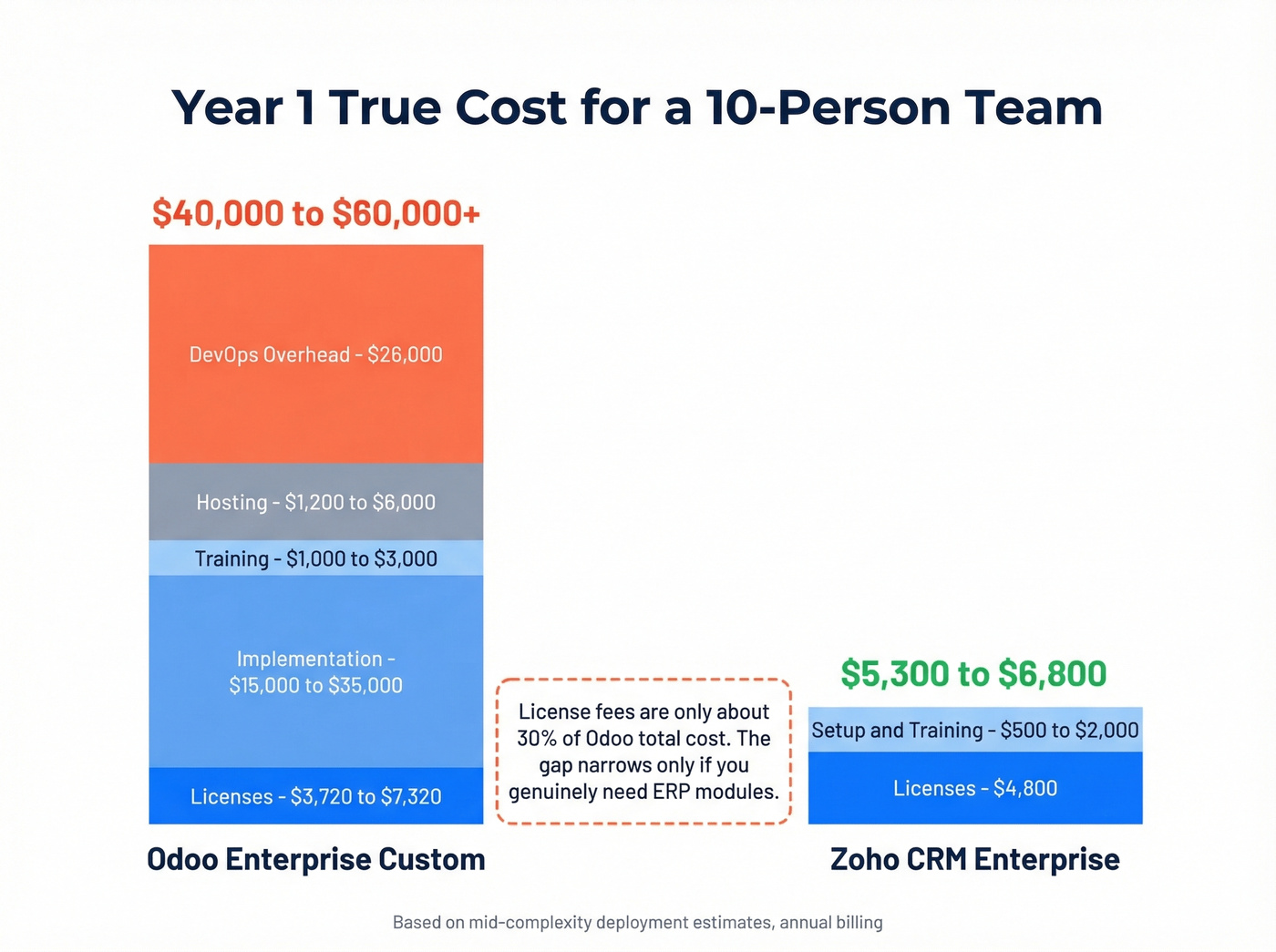
Implementation and customization runs $5,000-$15,000 for simple deployments, $15,000-$35,000 for mid-complexity, and $35,000-$75,000+ for complex multi-module rollouts. Odoo partner rates typically land between $100-$200/hour, and scope creep is common. Training adds $500-$5,000 depending on team size and module count. Hosting ranges from $5/month for a small instance to $500+/month for larger deployments on Odoo.sh or self-hosted infrastructure. And then there's the line item most budgets miss entirely: DevOps overhead. A part-time DevOps resource at $100/hour, five hours per week, adds roughly $26,000/year.
A 10-person team on Odoo Enterprise Custom with a mid-complexity implementation can easily land in the $40,000-$60,000 range in year one once you add licenses, implementation, and ongoing technical overhead. Zoho CRM Enterprise for the same team runs about $4,800/year. The gap narrows if you genuinely need ERP functionality - but if you're only using the CRM module, that's an expensive way to manage a pipeline. We've walked teams through Odoo implementations, and none came in under the original budget.
CRM Features Head-to-Head
| Feature | Zoho CRM | Odoo CRM | Edge |
|---|---|---|---|
| Pipeline management | Kanban + list views | Drag-and-drop stages, native ERP triggers | Odoo (slight) |
| Sales automation | Workflows + Blueprints | Basic automation rules | Zoho |
| AI & lead scoring | Zia: predictive scoring, anomaly detection, best-time-to-contact | Manual scoring/probability only | Zoho |
| Reporting | Dashboards + analytics | Basic; needs add-ons | Zoho |
| Mobile app | Full-featured, offline sync | Functional but limited | Zoho |
| ERP integration | Via Zoho ecosystem | Native, same platform | Odoo |
| Customization | Extensive at higher tiers | Open-source flexibility | Odoo |

Zoho CRM wins the pure sales features battle convincingly. Zia AI provides predictive lead scoring, anomaly detection, and best-time-to-contact suggestions that Odoo simply doesn't match - and Zia gets substantially more powerful at Enterprise tier and above.
Odoo's CRM strength is pipeline visualization and seamless connection to other Odoo modules. When a deal closes, Odoo can trigger downstream ops like invoicing, inventory steps, or project work without stitching together multiple systems. That's real value, but only if you're using those modules.
TechRadar's review highlights Zoho's mobile app as full-featured with offline sync, which matters for field sales teams. Odoo's mobile experience exists but doesn't compete at the same level.
Let's be honest: if you're evaluating these purely as CRM tools - pipeline, automation, lead scoring, reporting - Zoho wins. Odoo's CRM module only makes sense as part of a larger ERP deployment.

Whichever CRM you pick, it's only as good as the data inside it. Prospeo enriches your Odoo or Zoho CRM with 98% accurate emails, verified mobiles, and 50+ data points per contact - at $0.01/email.
Stop debating CRMs and start filling them with data that converts.
Do You Actually Need an ERP?
This is the question that should drive your decision, not feature checklists.
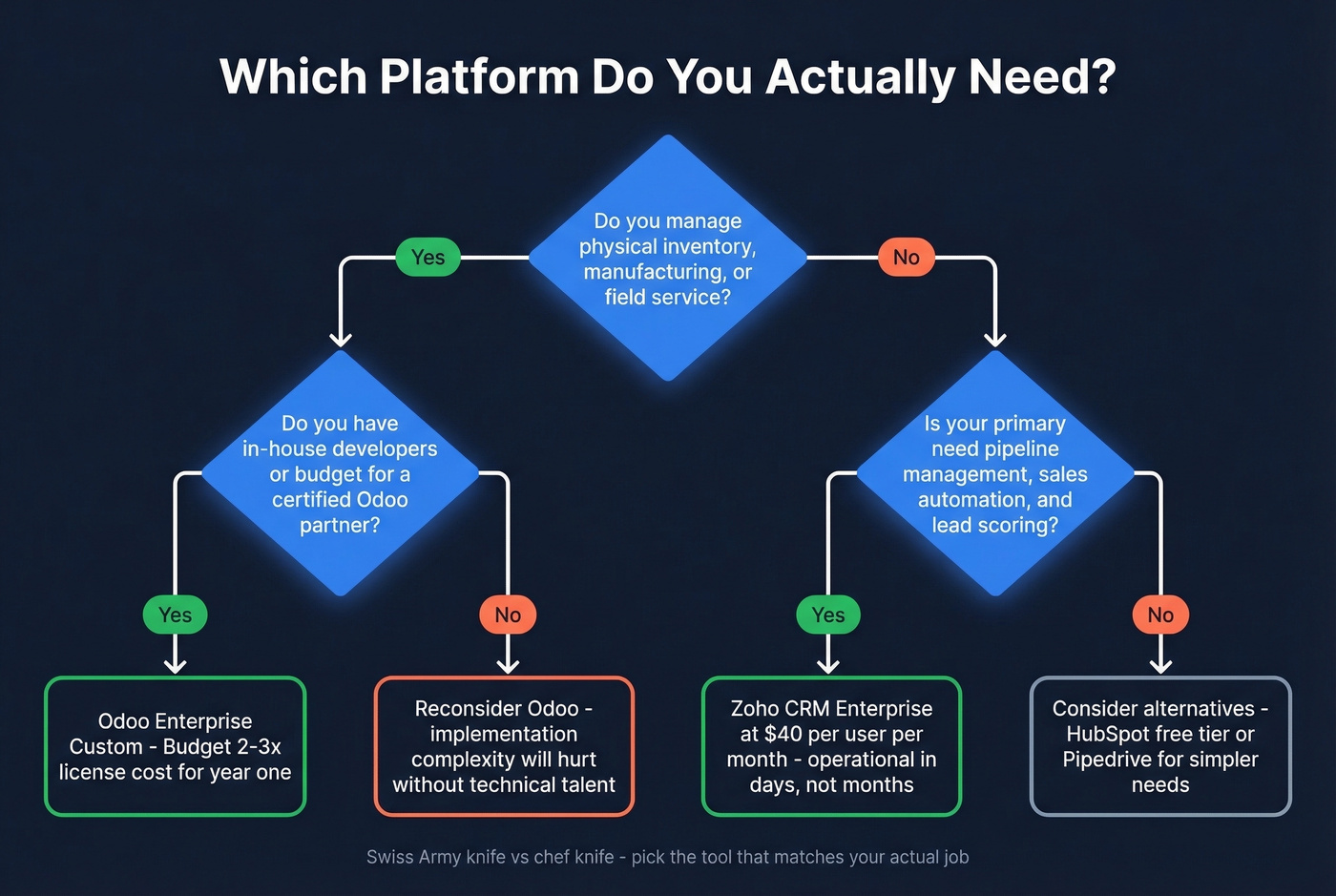
You need Odoo if you manage physical inventory alongside sales, your accounting and invoicing need real-time CRM data, you run manufacturing or field service operations, or you want one database for everything - even if setup takes months.
You need Zoho CRM if your team's primary job is pipeline management and closing deals, you want to be operational in days rather than months, sales automation and AI scoring matter more than inventory tracking, or you'll integrate with separate accounting and invoicing tools.
Think of it as a Swiss Army knife vs a chef's knife. Odoo does everything adequately. Zoho CRM does one thing exceptionally well. My hot take: Odoo's CRM-only value proposition is genuinely weak. If you don't need the ERP modules, you're paying for complexity you won't use.
What Real Users Say
Both platforms carry a 4.1/5 rating on G2, but review volume tells a different story. Zoho CRM has 2,885 reviews. Odoo CRM has 176. Zoho's rating is built on a much broader base of real-world experience.
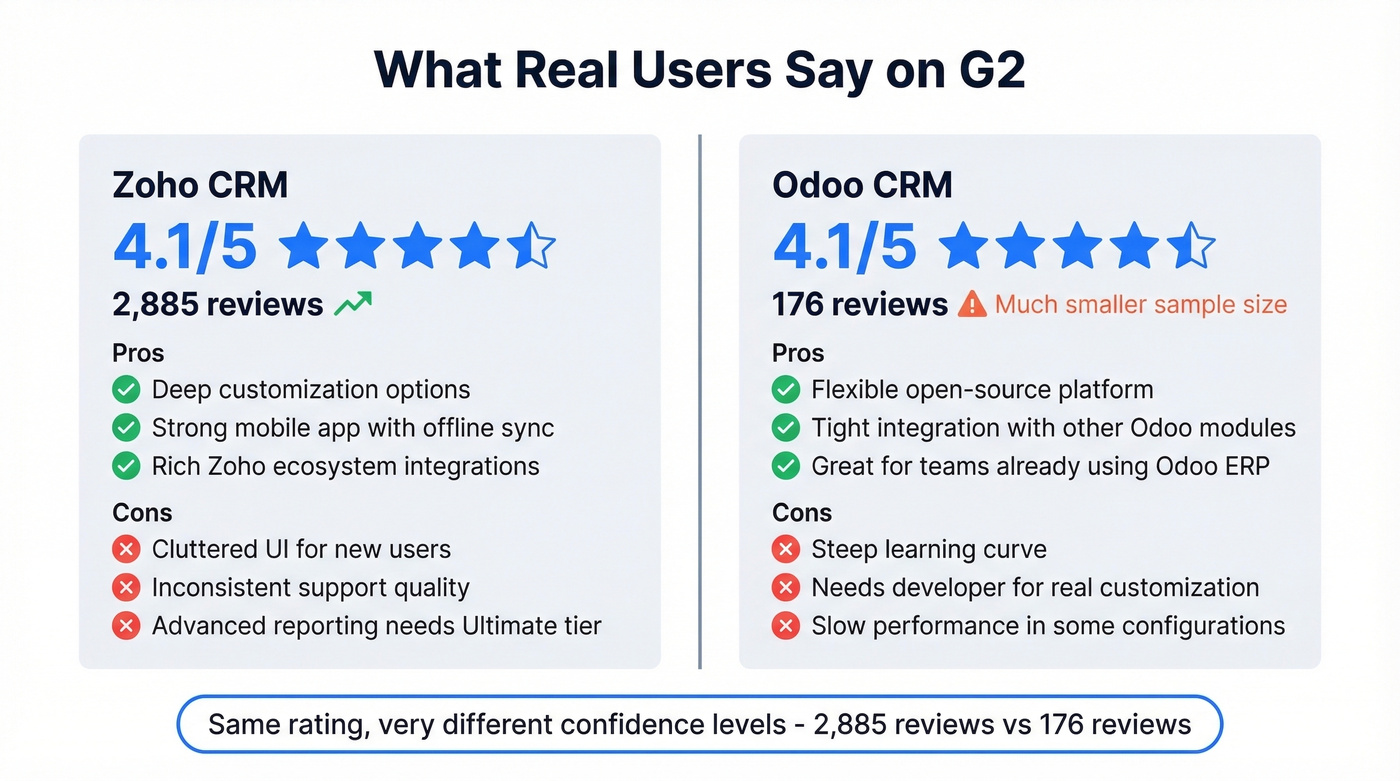
Zoho CRM users consistently praise customization depth, integrations across the Zoho ecosystem, and a genuinely strong mobile app. The frustrations center on a cluttered UI for new users, inconsistent support quality, and advanced reporting that gets cumbersome without upgrading to Ultimate or adding Zoho Analytics.
Odoo CRM users love the flexibility and tight integration with other Odoo modules. For teams already running Odoo for accounting or inventory, adding CRM feels natural. But implementation complexity is the dominant complaint - G2 reviewers flag a steep learning curve, slow performance in some configurations, and the need for technical expertise most sales teams don't have in-house. The consensus on Reddit threads about Odoo mirrors this: it's powerful if you have a developer, frustrating if you don't. Skip Odoo if your team doesn't have in-house technical talent or budget for a certified partner.
The Decision Framework
Teams under 10 people: Zoho CRM Professional at $23/user/mo gives you automation, reporting, and enough customization without enterprise complexity. Odoo only makes sense here if you're already running it for other operations.
Teams of 10-50: Zoho CRM Enterprise at $40/user/mo unlocks advanced automation and a much stronger Zia experience. If you need integrated operations - CRM plus inventory plus accounting - Odoo Enterprise Custom at ~$31-$61/user/mo is worth the investment, but budget 2-3x the license fee for year one.
Teams of 50+: Both platforms work, but the question shifts to technical capacity. Odoo rewards teams with in-house developers who can customize modules. Zoho rewards teams that want admin-driven configuration without writing code.
Technical teams wanting full control: Odoo Community Edition is free and open-source. Pair it with an in-house developer for maximum flexibility at minimal license cost.
For pure CRM needs: Zoho Enterprise. Every time.
For integrated operations: Odoo Enterprise with a certified implementation partner.
If neither feels right: HubSpot CRM's free tier handles basic pipeline management with zero setup friction. Pipedrive at ~$14-$49/user/mo is another strong option for small sales teams that want simplicity over feature depth.
The Data Gap Neither CRM Solves
Here's something that frustrated us when we first tested both platforms: neither Odoo nor Zoho CRM verifies whether your contact data is accurate. Import 10,000 leads and both will happily store 3,000 dead email addresses without flagging a single one. Your sequences bounce, your domain reputation tanks, and you blame the CRM when the real problem is upstream data quality.
Prospeo fills this gap with 98% email accuracy on a 7-day refresh cycle, returning 50+ data points per contact. Connect it to either platform via Zapier or Make, and your CRM stays clean automatically. At roughly $0.01 per verified email, cleaning your entire database costs less than one month of either platform's mid-tier plan. If you're evaluating data enrichment options, it's worth comparing accuracy, refresh cycles, and integrations.

Both Odoo and Zoho leave a gap: neither verifies the contact data your reps depend on. Prospeo's 7-day refresh cycle and 5-step verification keep your pipeline clean - with native HubSpot, Salesforce, and API integrations.
Your CRM choice matters less than the accuracy of what's in it.
FAQ
Is Odoo really free?
One app is free with unlimited users, but a real deployment typically needs a paid plan plus implementation costs of $5,000-$75,000+. Budget 2-3x the license fee for year one total cost of ownership.
Which platform has better AI features?
Zoho CRM, decisively. Zia delivers predictive lead scoring, anomaly detection, and best-time-to-contact suggestions - all improving at Enterprise tier and above. Odoo has no comparable predictive engine in 2026.
Can I use Odoo as a standalone CRM?
Technically yes, but you shouldn't. Its value weakens significantly without ERP integration. For standalone CRM, Zoho CRM or HubSpot's free tier deliver more sales features at lower total cost.
How do I keep CRM data accurate after migration?
Neither platform verifies contact data automatically. Use a data enrichment tool to verify and refresh your database - 98% email accuracy with a 7-day refresh cycle keeps records current without manual cleanup, and tools like Prospeo connect to both platforms via Zapier or Make.
Is Zoho CRM or Odoo better for small businesses?
Zoho CRM Professional at $23/user/mo is the stronger choice for teams under 20 reps. You get automation, AI scoring, and a polished mobile app with minimal setup. Odoo only makes sense for small businesses already running its ERP modules for inventory or accounting.