

OKRs for Sales Teams: The Implementation Guide Nobody Wrote
The VP of Sales announces the company's adopting OKRs. The top AE raises a hand: "So... what happens to my quota?" That question derails more OKR rollouts than the OKR-writing itself.
Most guides on OKRs for sales teams focus on how to write them, not how to actually run them week to week. Here's the short version: OKRs target change, not business as usual - that's what quotas are for. Start with 2 objectives and 2-4 key results each. Run a 30-minute weekly check-in. Without it, OKRs are quarterly paperwork.
OKRs vs. Quotas: Two Different Jobs
Andy Grove built the OKR framework at Intel in the 1970s; John Doerr brought it to Google in 1999. The core idea hasn't changed: OKRs are for change, quotas are for BAU.
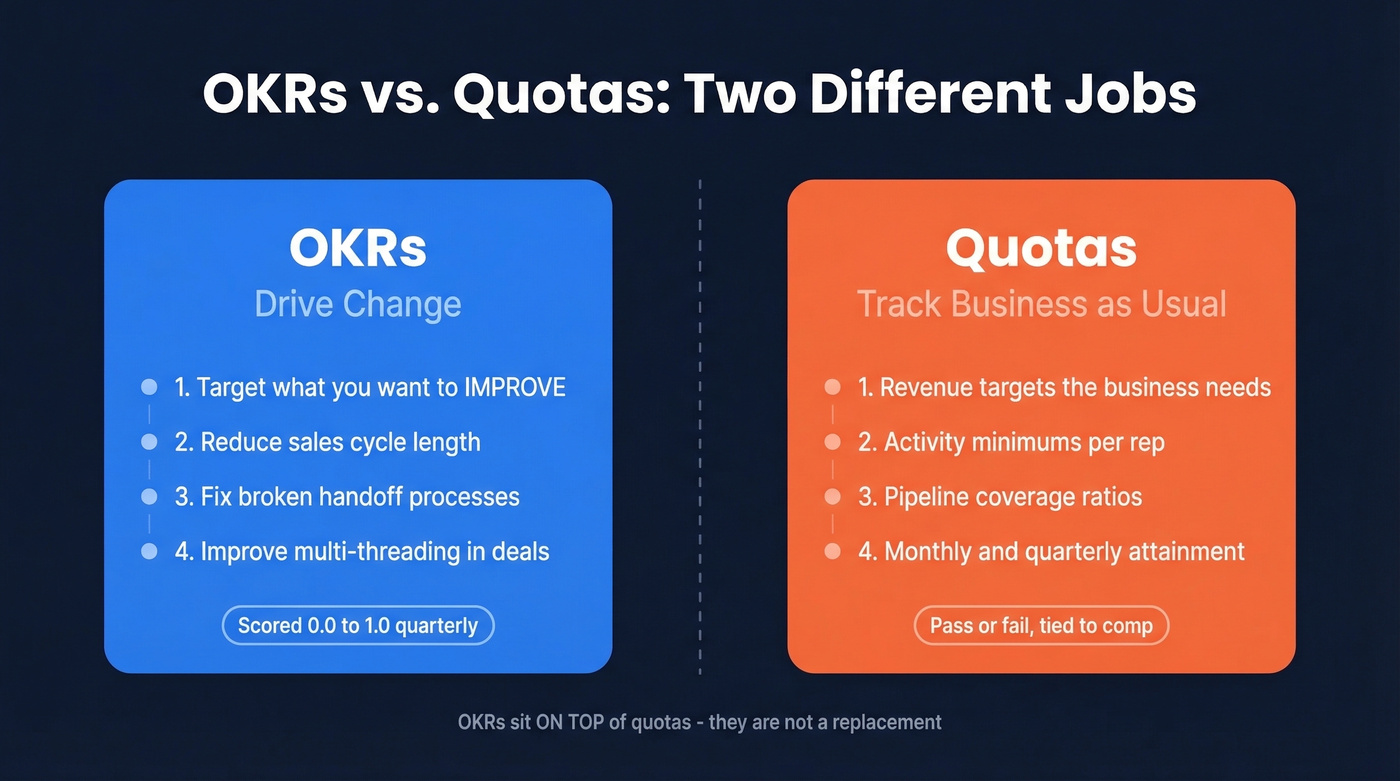
The quota layer tracks what the business needs to survive - revenue targets, activity minimums, pipeline coverage. The OKR layer sits on top and asks: what do we want to improve about how we sell? Reducing sales cycle length, fixing a broken SDR-to-AE handoff, improving multi-threading in enterprise accounts - those are OKR territory.
A useful test from What Matters: "Implement Salesforce company-wide" is a task masquerading as an objective. "Close sales faster" is the actual objective. If you complete the task but the number doesn't move, it wasn't a key result.
Five Mistakes That Kill Sales OKR Programs
1. To-do list key results. "Launch new demo deck" isn't a KR. A KR measures whether the deck worked: "Increase demo-to-opportunity conversion from 22% to 30%." That's a leading indicator that typically moves before revenue does, giving reps time to course-correct.
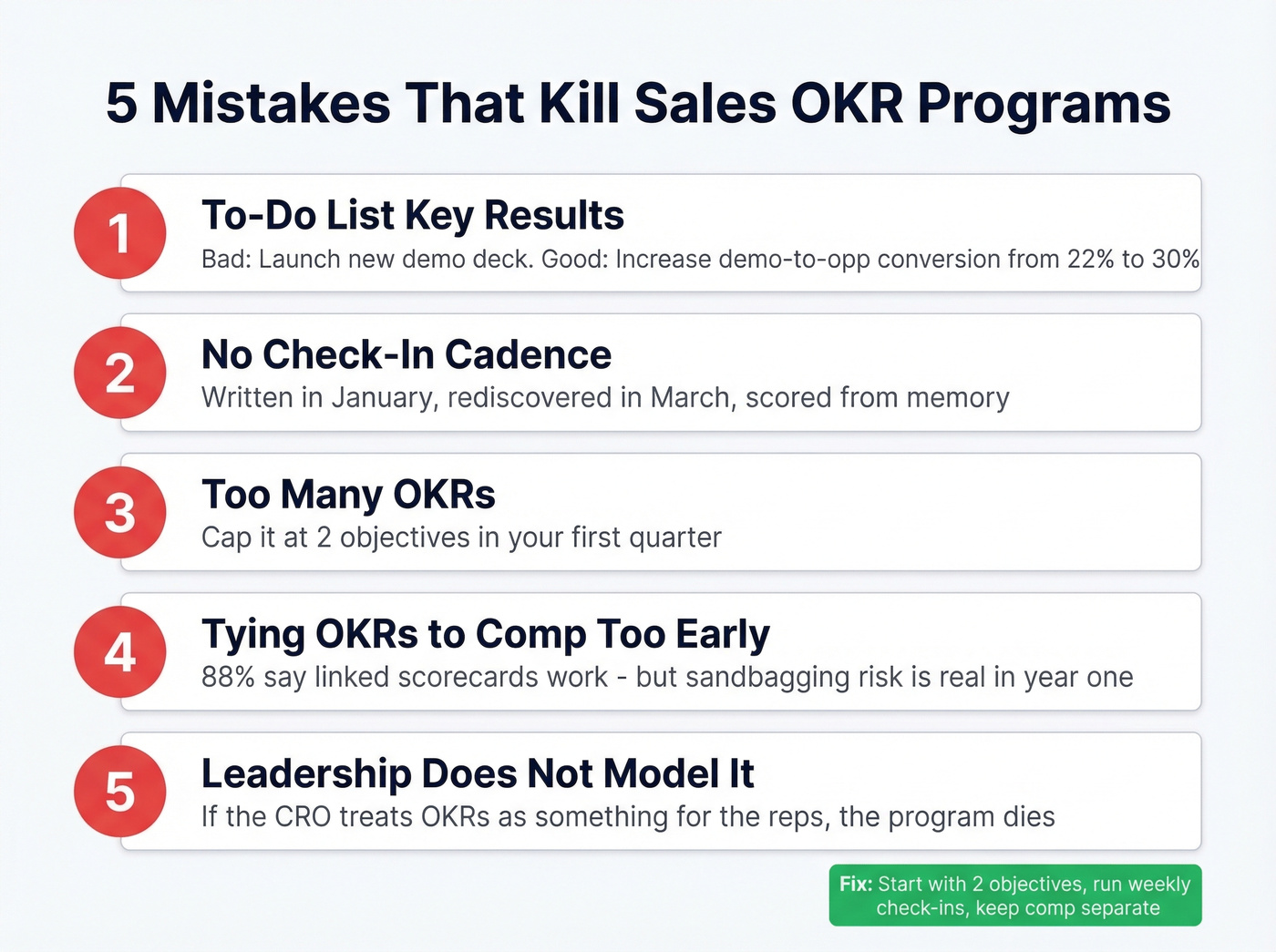
2. No check-in cadence. Teams write OKRs in January, rediscover them in March, and score them from memory. This pattern kills programs fast.
3. Too many OKRs. Cap it at 2 objectives in your first quarter. You can always add complexity once the cadence is running.
4. Tying OKRs to comp too early. A Google sales team in Northern Europe saw reps under-report initial deal sizes so they could claim "upsell" credit later. Linking OKRs to bonuses almost guarantees sandbagging. A Mercer survey of 214 companies found 88% said scorecard measures linked to reward systems are effective - but for teams in their first OKR year, the sandbagging risk outweighs the alignment benefit. Keep them separate until the team trusts the system.
5. Leadership doesn't model it. If the CRO treats OKRs as something "for the reps," the program dies. Full stop.

Your SDR team's pipeline OKR is only as good as the data behind it. Meritt dropped bounce rates from 35% to under 4% and tripled connect rates to 20-25% with Prospeo's verified emails. No OKR survives a 15% bounce rate.
Hit your pipeline KRs with emails that actually land.
Sales OKR Examples by Role
Companies with strong goal alignment see up to 19% faster revenue growth. Adjust the numbers below to your baseline - don't copy them verbatim.
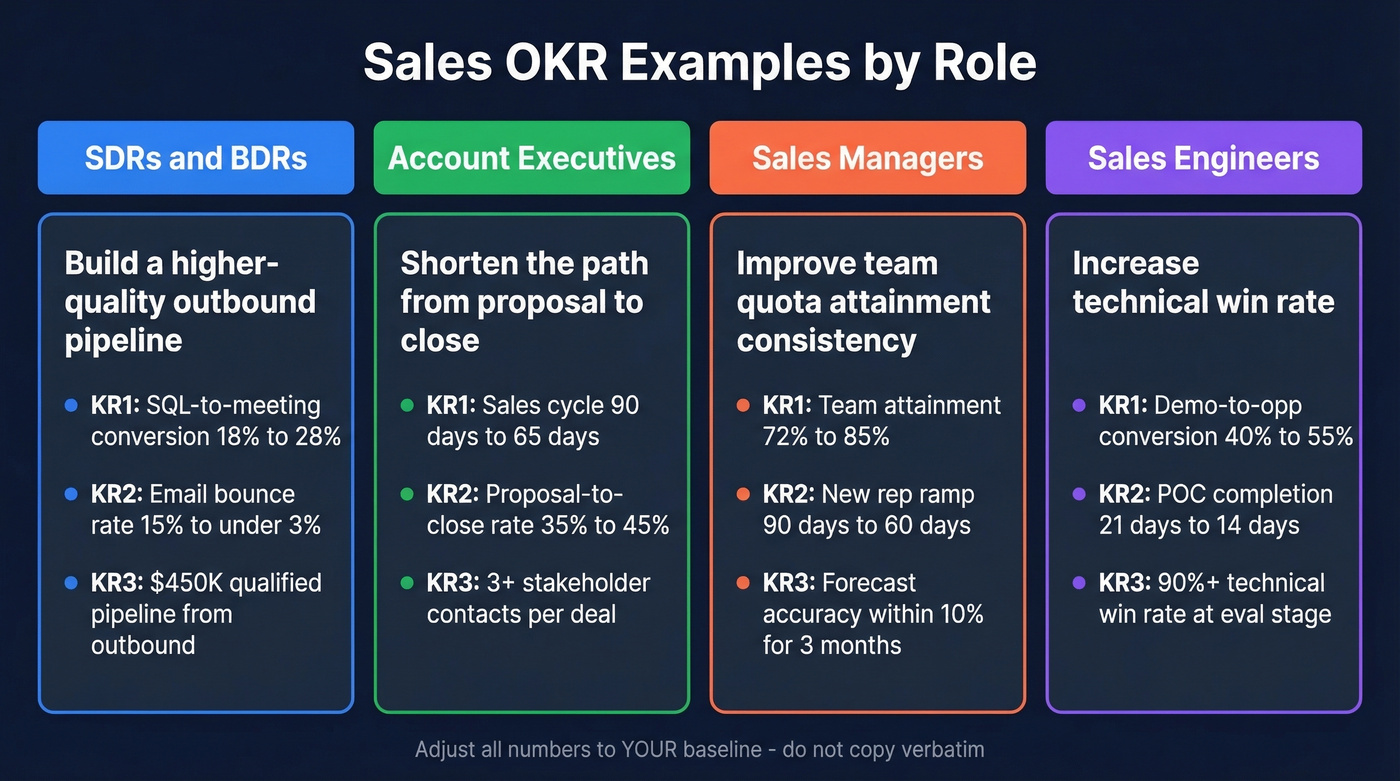
SDRs and BDRs
The most common SDR OKR failure: setting pipeline targets when a third of emails bounce. Fix the data first, then set the objective. Meritt, a mid-market sales team, dropped bounce rates from 35% to under 4% using Prospeo's real-time verification and tripled their connect rate to 20-25%. That's the difference between a pipeline OKR that's achievable and one that's fiction.
Objective: Build a higher-quality outbound pipeline.
- KR1: Increase SQL-to-meeting conversion from 18% to 28%.
- KR2: Reduce email bounce rate from 15% to under 3%.
- KR3: Generate $450K in qualified pipeline from outbound sources.
Account Executives
Most AE OKR sets look identical. Here's what actually matters: pick one objective that targets your team's weakest conversion point. If deals stall at proposal stage, focus there. If deal sizes are shrinking, focus on discovery quality instead.
Enterprise example - Objective: Shorten the path from proposal to close.
- KR1: Reduce average sales cycle from 90 days to 65 days.
- KR2: Increase proposal-to-close rate from 35% to 45%.
- KR3: Average 3+ stakeholder contacts per deal (multi-threading).
SMB example - same objective, different calibration: reduce cycle from 28 to 18 days, increase close rate from 25% to 35%.
Sales Managers
Before (bad OKR): "Improve team performance." That's a wish, not an objective.
After (good OKR): Improve team quota attainment consistency.
- KR1: Move team attainment from 72% to 85%.
- KR2: Reduce new rep ramp time from 90 days to 60 days.
- KR3: Achieve forecast accuracy within +/-10% for 3 consecutive months.
Sales Engineers
SEs have the hardest time with OKRs because they don't control the full sale. The recurring frustration on r/salesengineers is that AEs control negotiation and outcome, making revenue KRs feel unfair. The fix: measure what SEs can control.
Objective: Increase technical win rate.
- KR1: Improve demo-to-opportunity conversion from 40% to 55%.
- KR2: Reduce POC completion time from 21 days to 14 days.
- KR3: Achieve 90%+ "technical win" rate on deals reaching evaluation stage.
Don't grade SEs on closed-won revenue. Grade them on technical influence metrics they can actually move.
How to Score Sales OKRs
Use Google's 0.0-1.0 scale. Score each KR individually, then average for the objective.
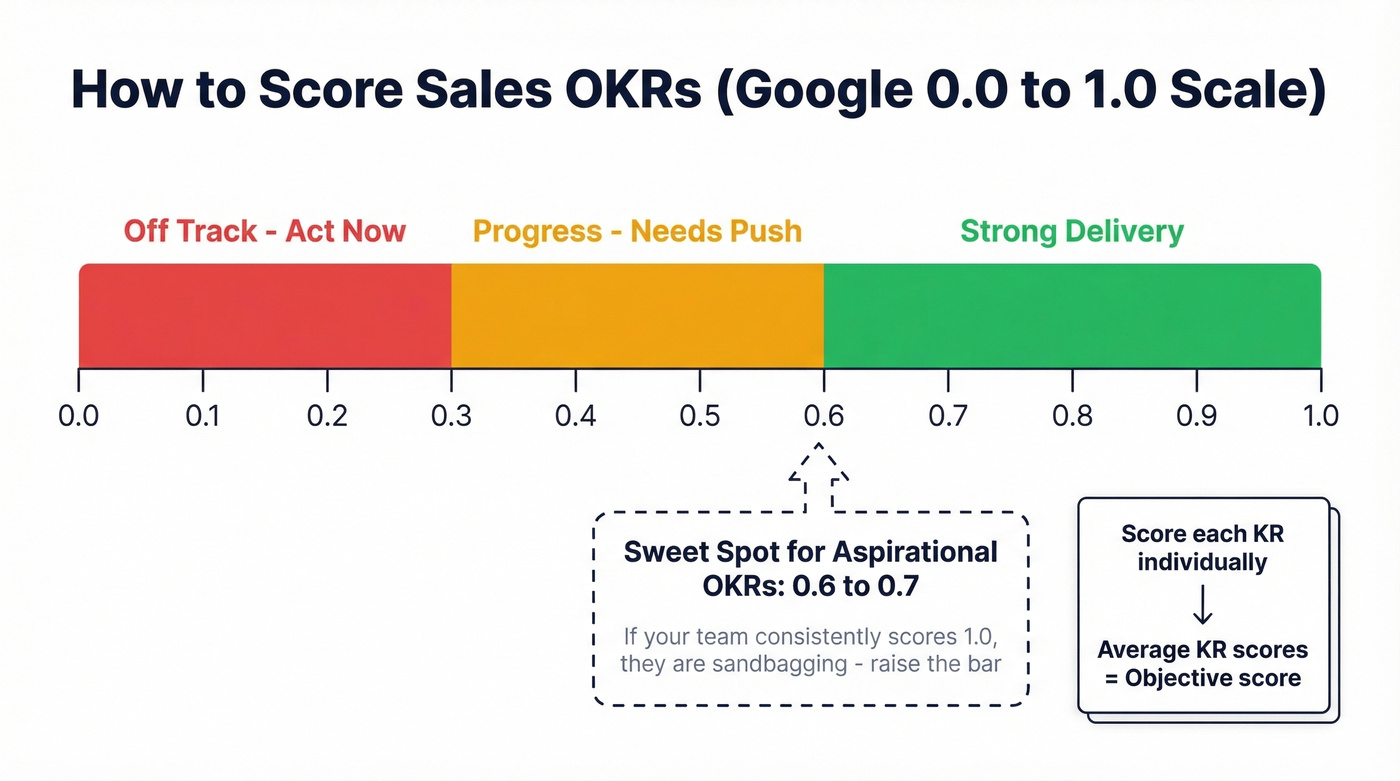
| Score Range | Status | What It Means |
|---|---|---|
| 0.7-1.0 | Green | Strong delivery |
| 0.4-0.6 | Yellow | Progress, needs push |
| 0.0-0.3 | Red | Off track, act now |
The sweet spot for aspirational OKRs is 0.6-0.7. If your team consistently scores 1.0, they're sandbagging - that's a clear signal to raise the bar.
The 30-Minute Weekly Check-In
You don't need OKR software. A shared doc and this 30-minute meeting will beat fancy tooling if your team actually shows up. Budget about 2 hours per month per team including prep.
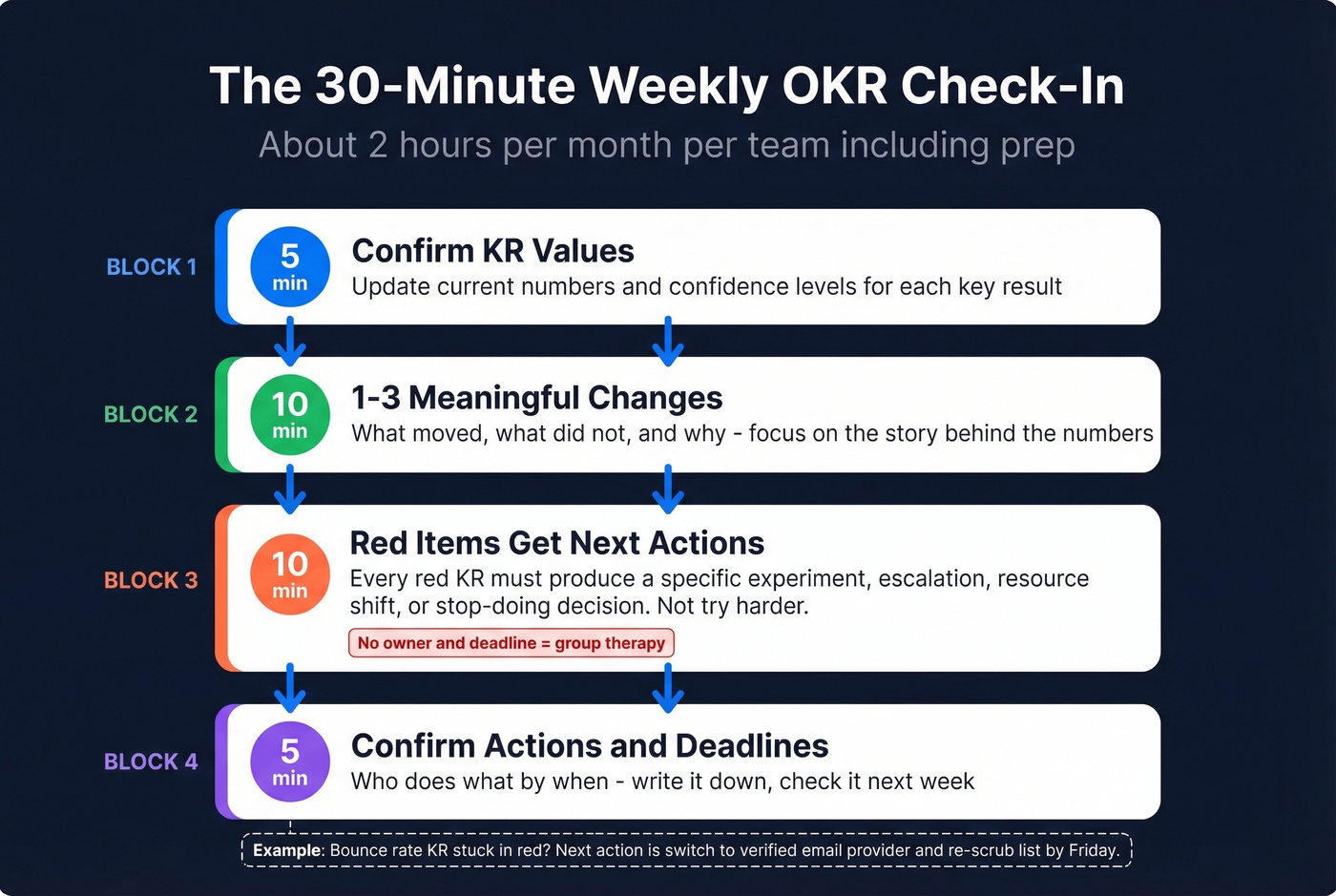
Start with five minutes confirming current KR values and confidence levels. Spend the next ten on one to three meaningful changes since last week - what moved, what didn't, and why. The core of the meeting is the next ten minutes: every red item must produce a specific next action. Not "try harder" - an experiment, an escalation, a resource shift, or a stop-doing decision. We've seen teams that leave this block without concrete owners and deadlines just doing group therapy, and the OKRs die by week six. Close with five minutes confirming actions and deadlines.
Let's make this concrete. Say a bounce-rate KR is stuck in the red. The next action isn't "improve data quality" - it's switching to a verified email provider and re-scrubbing the existing list by Friday. In a week, you check whether the KR moved. If it didn't, you change the approach again. That's the cadence working: small bets, fast feedback.
Hot take: Most sales teams don't need OKRs at all. If your quota attainment is above 80%, your reps are ramping in under 60 days, and your forecast is accurate, OKRs add overhead without value. OKRs are medicine for specific problems. Diagnose the problem first. Skip this framework entirely if you can't name the specific thing that's broken.
Half the sales OKRs we see fail because reps waste cycles on bad contact data - stale emails, wrong numbers, dead leads. Prospeo refreshes 300M+ profiles every 7 days and verifies emails at 98% accuracy. That's how you move KRs from red to green in a single check-in.
Stop diagnosing data problems in your weekly check-in. Eliminate them.
FAQ
How many OKRs should a sales team have?
Start with 2 objectives and 2-4 key results each - that's 4-8 measurable outcomes per quarter. Most first-time teams fail by tracking 15+ KRs and losing focus. Add a third objective only after your weekly check-in cadence runs smoothly for a full quarter.
Should sales OKRs be tied to compensation?
Not in your first year. Linking OKRs to bonuses encourages reps to sandbag targets, and a Mercer study of 214 companies confirms the risk. Keep OKRs and comp separate until the team trusts the system - typically two to three quarters in.
What's the biggest reason sales OKRs fail?
No weekly check-in. Teams write OKRs in January and rediscover them in March. The 30-minute weekly review - with red items assigned concrete next actions - is the single non-negotiable habit that separates working programs from quarterly paperwork.
How do you fix a bounce-rate KR that's stuck in the red?
Re-scrub your contact list with a verified data provider before your next check-in. A 7-day data refresh cycle and 98% email accuracy can drop bounce rates from 30%+ to under 4% within a week - Meritt and Snyk both saw similar results. If the KR still doesn't move, the problem is targeting, not data.