

VP of Sales: Role, Comp, and Career Path in 2026
Average tenure: 2.0 years. CROs and CMOs turn over at 32% annually - roughly one in three, every year. The VP of Sales is the highest-stakes, shortest-shelf-life role in SaaS, and somehow, everyone still wants it.
Whether you're chasing the title, sitting in the seat right now, or trying to hire someone for it, this guide will save you time, money, or both.
What You Need (Quick Version)
Chasing the title? Median base runs $159K-$220K. Average tenure is 2.0 years. Know what you're signing up for.
Already in the role? Benchmark your comp by stage and metro in the salary section below. If you're under-indexed, you have leverage.
Hiring one? Don't hire before $1M ARR. Budget $150K-$190K base at Series A, $220K+ at Series C. Or go fractional for $7K-$12K/month and skip the six-month ramp.
What Does a VP of Sales Do?
The job description says "own the number." The reality involves more internal politics and fewer closed deals than most candidates expect. This role lives at the intersection of strategy, execution, and organizational friction - and the balance shifts daily depending on company stage, board expectations, and whether marketing actually delivered the pipeline they promised.
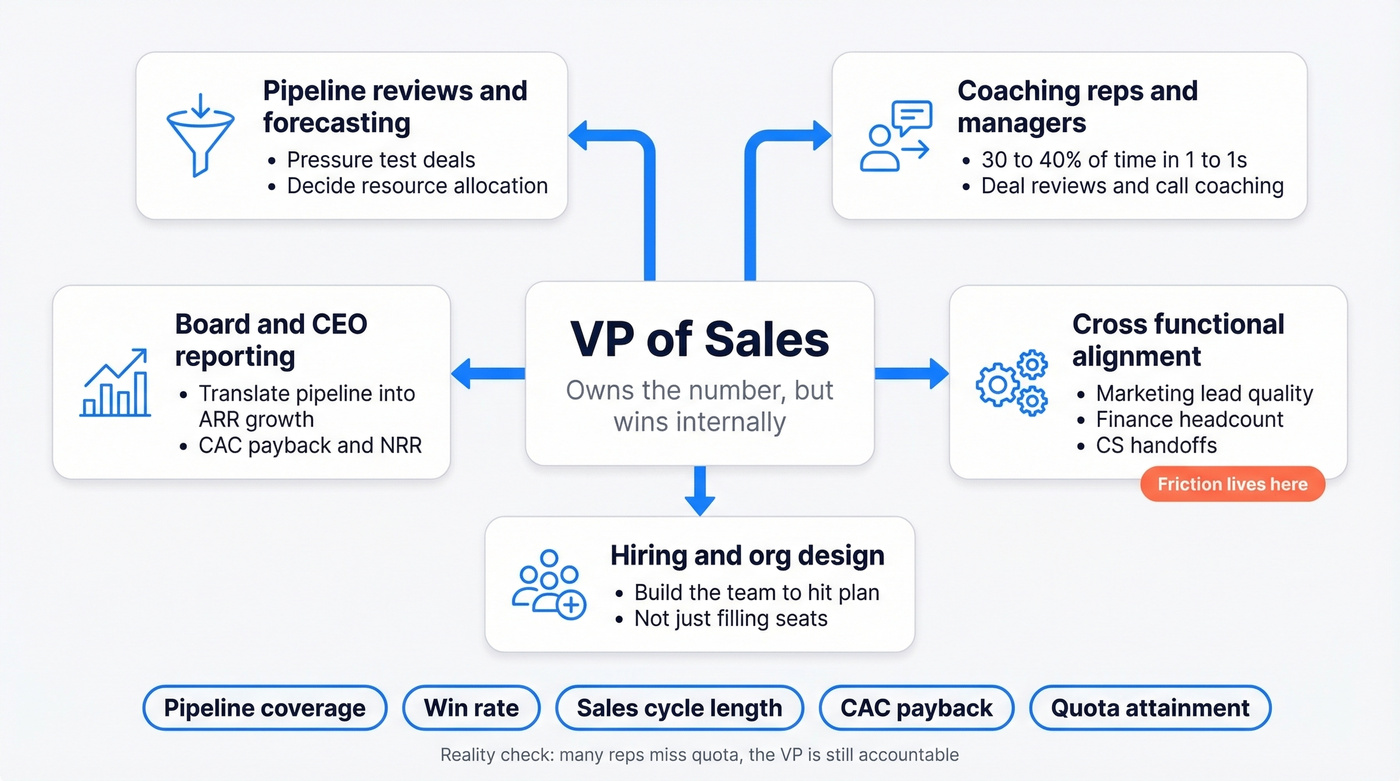
Here's what the role looks like day-to-day:
- Pipeline reviews and forecasting - pressure-testing every deal in the funnel and deciding where to deploy resources
- Coaching reps and managers - the best VPs spend 30-40% of their time in 1:1s, deal reviews, and call coaching
- Board and CEO reporting - translating pipeline into language the board cares about: ARR growth, CAC payback, net revenue retention
- Cross-functional alignment - fighting for headcount with finance, negotiating lead quality with marketing, coordinating handoffs with CS. HubSpot research shows aligned sales and marketing teams see 38% higher win rates, so this isn't optional work.
- Hiring and org design - building the team that can actually hit the plan, not just filling seats
The KPIs a vice president of sales owns tell you everything about the pressure: pipeline coverage ratio, CAC payback period, win rate, average sales cycle length, and quota attainment across the org. That last one is brutal context - RepVue's 2026 data shows only 40.9-51.3% of reps hit quota depending on role level. The VP is accountable for a number that, statistically, more than half the team won't reach individually.
Here's the thing nobody puts in job descriptions: you're selling internally as much as externally. You're selling the board on your hiring plan. You're selling the CEO on why the forecast slipped. You're selling marketing on why MQLs aren't converting. The external selling is almost the easy part.
Salary and Compensation Benchmarks
The CRO Report analyzed 1,349 executive sales postings (704 with disclosed salaries) and published updated data in February 2026. It's the most granular public dataset we've found for this role.
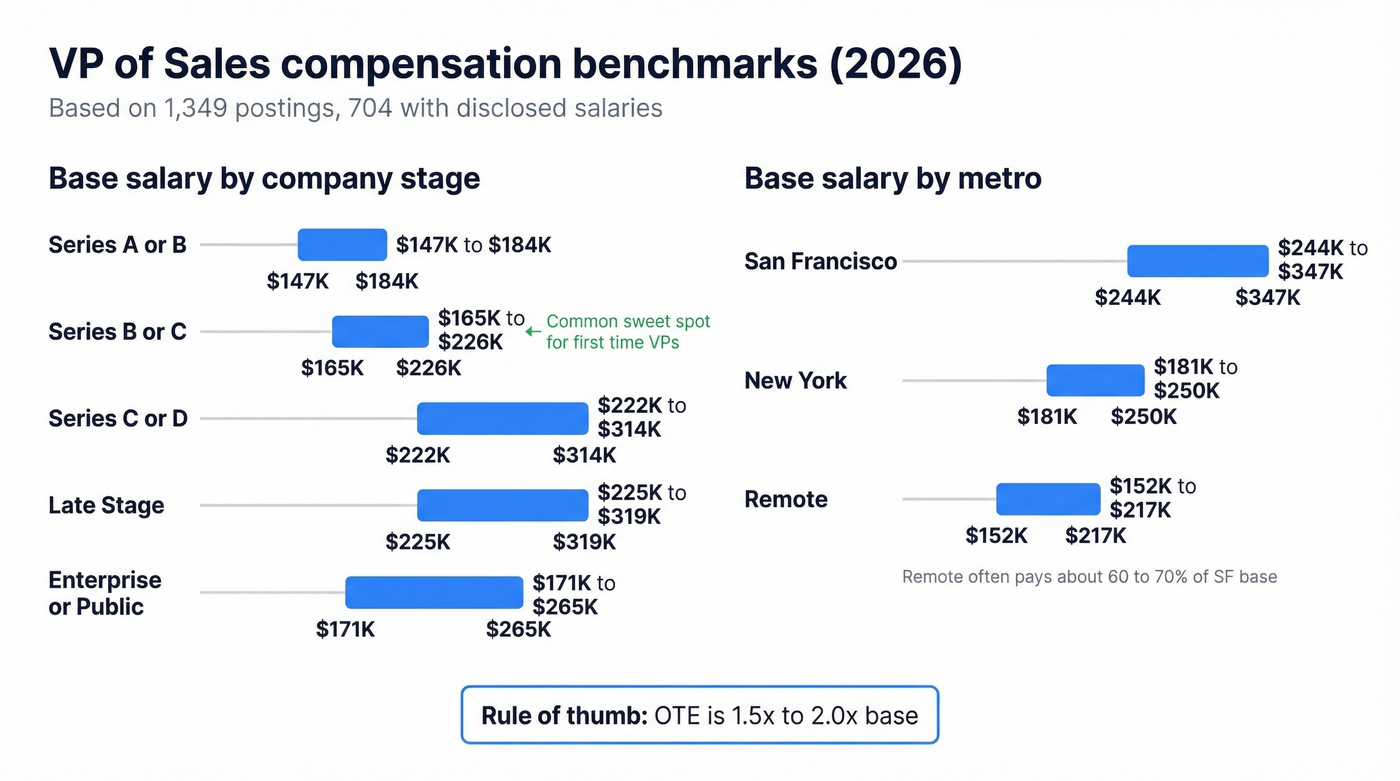
Base Salary by Company Stage
| Company Stage | Avg Base Range | What to Expect |
|---|---|---|
| Series A/B | $147K-$184K | Equity matters more here |
| Series B/C | $165K-$226K | Sweet spot for first VPs |
| Series C/D | $222K-$314K | Base floor jumps hard |
| Late Stage | $225K-$319K | Closer to public-co comp |
| Enterprise/Public | $171K-$265K | Wider range, more variable |
The Enterprise/Public range looks lower than Late Stage, which surprises people. Public companies load more comp into variable and RSUs, so the base number alone doesn't tell the full story at that level.
Base Salary by Metro
| Metro | Avg Base Range |
|---|---|
| San Francisco | $244K-$347K |
| New York | $181K-$250K |
| Remote | $152K-$217K |
San Francisco is still the outlier. A base in SF can exceed what a CRO makes in most other markets. Remote roles pay roughly 60-70% of SF rates - still strong, but the gap is real.
OTE, Variable Comp, and Equity
Base is only part of the picture. At VP+ levels, variable comp typically adds 40% to 100% of base. Someone with a $200K base is looking at $280K-$400K OTE depending on structure and company stage.
A reasonable estimate for total OTE across the market: 1.5x-2.0x base. Comparably pegs the average total comp at $284,259 nationally, with San Jose as a wild outlier at $561,237. At the top end, Rework's executive-level benchmark lists $300K-$450K base and $500K-$800K OTE - but that's late-stage and public company territory, not the norm.
Equity is where the real upside lives, especially at earlier stages:
- Series A: 0.5%-1.5% - meaningful ownership, high risk
- Series B: 0.25%-0.75% - still significant, lower risk
- Series C+: 0.1%-0.3% - smaller slice, but of a bigger pie
Equity at Series A can be worth more than the entire cash comp package if the company hits. But most don't. Evaluate equity like a lottery ticket with better odds - nice to have, not something to bank your mortgage on.
Sales Leadership Hierarchy
Director vs VP vs SVP vs CRO
The CRO Report's hierarchy analysis of 1,448 postings breaks down the comp ladder:
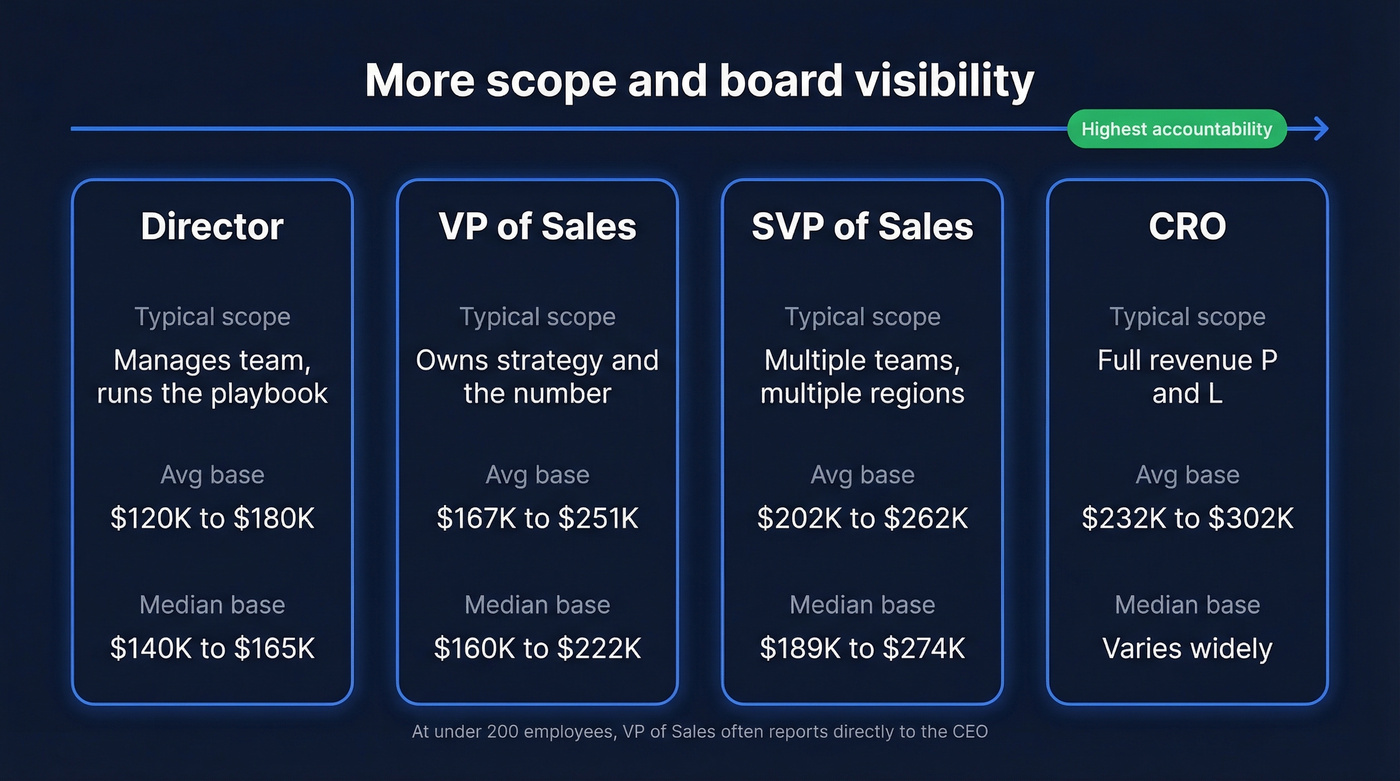
| Title | Avg Base Range | Median Base Range | Typical Scope |
|---|---|---|---|
| Director | $120K-$180K | $140K-$165K | Manages team, runs playbook |
| VP | $167K-$251K | $160K-$222K | Owns strategy + number |
| SVP | $202K-$262K | $189K-$274K | Multi-team, cross-geo |
| CRO | $232K-$302K | Varies widely | Full revenue P&L |
The VP reports to the CRO if one exists, or directly to the CEO. At companies under 200 employees, there's usually no CRO - the VP of Sales is the top revenue leader, which means more scope but also more exposure.
Title Inflation at Startups
Many early-stage "VP of Sales" roles are Director-level jobs with an inflated title. You're managing 3-8 reps, carrying a personal quota, and running the CRM yourself. That's a Director's scope with a VP's business card.
This matters for two reasons. First, comp expectations get skewed - you shouldn't expect $220K base for a role that's really managing five SDRs and closing deals yourself. Second, when you move to a larger company, that title won't transfer. We've seen candidates get downleveled because their "VP" experience was really a player-coach role at a 30-person startup. Check the scope, not the title.

Pipeline coverage is the KPI that keeps every VP of Sales up at night. Prospeo gives your reps 300M+ verified contacts with 98% email accuracy and 125M+ direct dials - so the pipeline they build actually converts instead of bouncing.
Give your sales org the data that makes quota attainable, not aspirational.
Why Most VPs Don't Last
The Pave dataset of 14,000 executives tells a stark story. Average tenure for a VP of Sales: 2.0 years. CRO: 1.8 years. Compare that to CEO at 4.3 years and CTO at 3.7 years. GTM leaders turn over at roughly double the rate of their technical counterparts.
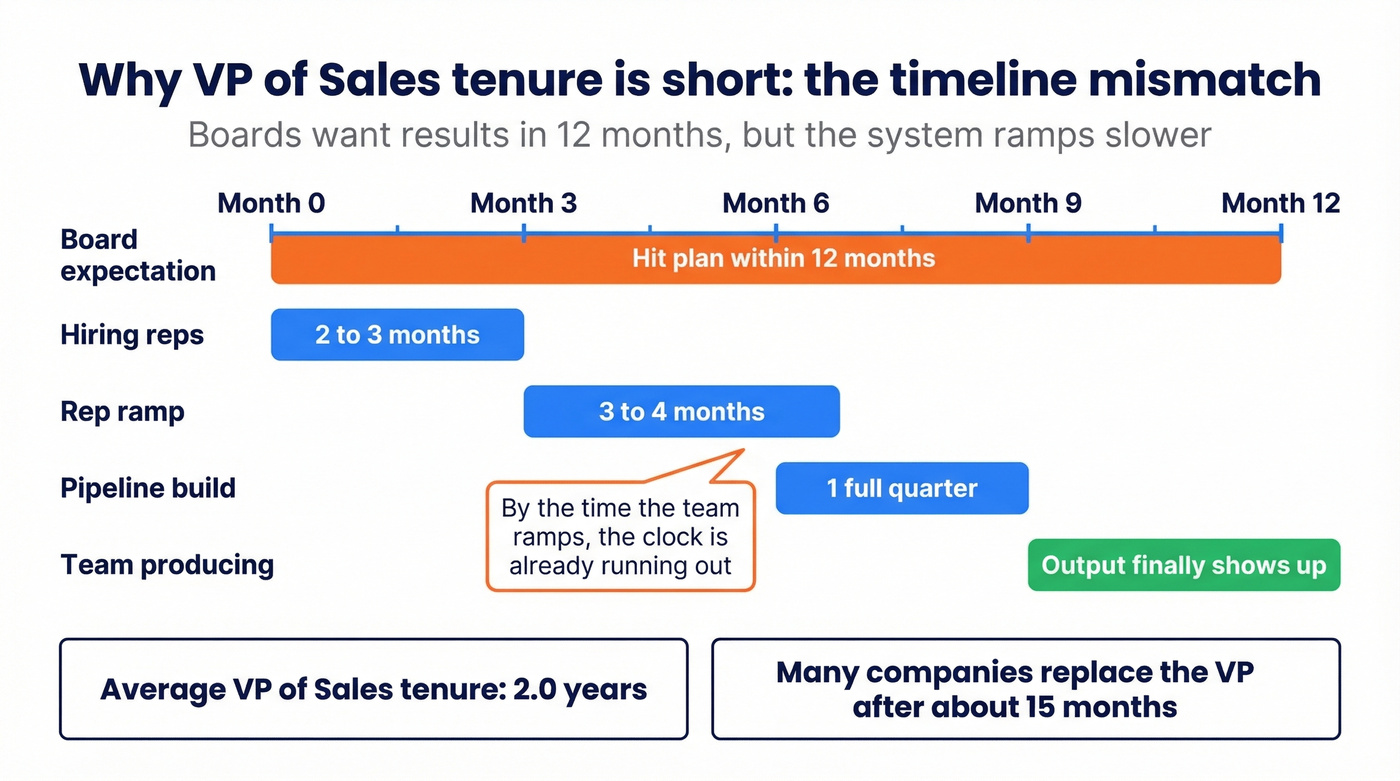
The structural problem is straightforward. The board sets the revenue plan. The CEO agrees to it. The CFO models it. Then it gets handed to the sales leader to execute. If the plan was wrong - if the market shifted, if product-market fit was weaker than assumed, if marketing's pipeline projections were optimistic - the VP still owns the miss. No amount of qualifications can overcome a fundamentally broken plan.
Many companies replace their VP after roughly 15 months when the initial plan doesn't materialize.
The timeline mismatch is the killer. Boards want results in 12 months, but hiring reps takes 2-3 months, ramping them takes another 3-4 (SDR ramp alone takes 3+ months per Bridge Group data, and average SDR tenure is just 1.5 years - meaning the VP is constantly rebuilding the bottom of the funnel), and building pipeline from scratch takes a full quarter after that. By the time a VP's team is actually producing, the clock is already running out. If you're stepping into this role, negotiate your ramp expectations in writing before you sign.
Let's be honest about this, though: it's still the fastest path to CRO and eventually CEO for revenue-minded operators. But if your average deal size is under $15K and your sales cycle is under 30 days, you probably don't need a vice president of sales at all - you need a strong Director and a better marketing engine. The VP title gets over-hired because boards default to it, not because the business always requires it.
How to Succeed as a First-Time VP
You have roughly 90 days to prove you were the right hire. That's not hyperbole - it's the window where the CEO is still patient and the board hasn't started asking pointed questions. Jason Lemkin's advice for first-time VPs is the best playbook we've seen:
Build your 30-60-90 day plan before you start. Not after your first week. Before day one. Get the CEO to agree to it in writing. This is your insurance policy when expectations drift.
Know the product cold. If you can't run a credible demo and handle objections, your reps will smell it immediately. Credibility with the team starts here.
Don't lower the hiring bar. The pressure to fill seats fast is enormous. Resist it. One bad hire at the AE level costs 6-9 months of lost productivity. At the manager level, it's worse - a bad manager will drive out your best reps before you even realize what's happening.
Get the CEO into prospect meetings - roughly 10 per month. This isn't about the CEO closing deals. It's about keeping them connected to market reality so they don't set impossible targets from the boardroom.
Be honest about misses. The fastest way to lose your job isn't missing a quarter. It's missing a quarter the CEO didn't see coming. Flag problems early, bring solutions, and never hide bad news.
Essential Skills
Beyond the tactical playbook, the skills that separate great VPs from short-tenured ones are consistent: forecasting accuracy, the ability to coach without micromanaging, executive communication, and hiring judgment. Technical fluency with your product and market matters too - reps follow leaders who can jump into a deal and add value, not just ask for updates.
The best sales leaders combine analytical rigor with the emotional intelligence to manage a team through quota pressure without burning them out. The consensus on r/sales is that the "spreadsheet jockey" VP who never gets on calls and the "super-closer" VP who can't build process both flame out equally fast. You need both muscles.
The VP of Sales Tech Stack
Every VP inherits a tech stack. Most of them are a mess.
The day-one audit should focus on four pillars: CRM, data, engagement, and forecasting.
CRM is non-negotiable - Salesforce or HubSpot, depending on company stage and complexity. The CRM itself isn't the problem. The data inside it is. We've seen teams where 30-40% of contact records have bounced emails, wrong titles, or contacts who left the company months ago. Your pipeline reporting is only as good as the data underneath it.
Data platform is where most VPs underinvest. Prospeo refreshes its 300M+ professional profiles every 7 days, delivers 98% email accuracy across 143M+ verified emails, and includes 125M+ verified mobile numbers. If your team's bounce rate is above 5%, fix the data before you fix anything else. Bad data doesn't just waste rep time - it tanks your domain reputation and makes every outbound motion less effective.

Engagement tools like Outreach or SalesLoft handle sequencing, cadence management, and rep activity tracking. They sit between your data platform and your CRM, turning verified contacts into structured outbound workflows. If you’re rebuilding your outbound motion, start with proven sales prospecting techniques and a short list of SDR tools that fit your stage.
Forecasting and conversation intelligence round out the stack. Gong for call analysis and coaching, Clari for pipeline forecasting and deal inspection. These tools give you visibility into what's actually happening in deals, not just what reps tell you in pipeline reviews. If you’re evaluating options, compare sales forecasting solutions and the broader set of best sales forecasting tools before you commit. Gartner research shows poor forecasting accuracy can drive 10%+ revenue misses, and McKinsey's data on top-performing sales orgs consistently shows that data-driven pipeline management separates the best from the rest.
The stack doesn't need to be complicated. CRM, clean data, engagement, and forecasting visibility. Everything else is optional until you've nailed those four.
When to Hire a VP of Sales
The most common mistake founders make is hiring too early. Your board starts pushing at $800K ARR. Resist.
The milestone framework that actually works: hire a founding AE around $500K ARR when you need dedicated execution beyond founder-led sales. Hire a VP of Sales around $1M ARR when the sale is repeatable and scaling is the bottleneck - not before.
Readiness signals that matter: you understand your CAC and LTV, you have a repeatable sales motion beyond founder-led heroics, and you have enough pipeline to keep a small team busy. If you can't articulate your ICP and average sales cycle to a candidate in concrete terms, you aren't ready - use an Ideal Customer Profile to make it explicit.
A Series A founder I spoke with hired a VP at $600K ARR and watched them sit idle for four months waiting for pipeline to materialize. The cost was brutal - a VP on a $180K base with two reps and no repeatable playbook burns $300K+ per year while building something the founder should still be figuring out. The cost of hiring too late is different but real: founder burnout, missed revenue windows, and a team that's grown past what one person can manage.
For most companies between $500K and $1.5M ARR, the right answer is a fractional VP.
Fractional VP of Sales
Use this if: You're pre-$1M ARR, need a bridge hire, or have a specific project like building a sales process or hiring your first two reps.
Skip this if: You're past $2M ARR with 10+ reps. At that point, you need someone full-time in the seat.
Typical US retainer ranges:
| Scope | Monthly Retainer | Best For |
|---|---|---|
| Limited (advisory) | $4K-$6K/mo | Early-stage, light touch |
| Hands-on leadership | $7K-$12K/mo | Growth-stage SaaS sweet spot |
| Complex/global | $15K+/mo | Multi-geo, enterprise cycles |
The time-to-impact difference is dramatic: 4-8 weeks for a fractional VP versus 6-9 months for a full-time hire to fully ramp. A fractional engagement at $10K/month for six months costs $60K. A bad full-time hire costs $300K+ when you factor in base, recruiting fees, ramp time, and the revenue you didn't close. If you’re tightening execution, start by fixing sales pipeline challenges and tracking pipeline health consistently.
Average VP tenure is 2.0 years. You don't have time for a 6-week data refresh cycle or 20%+ bounce rates torching your domain. Prospeo refreshes every 7 days, delivers 98% accuracy, and costs $0.01 per email - so your reps connect with real buyers from day one.
Stop losing months to bad data. Start hitting the number this quarter.
FAQ
What does a VP of Sales do day-to-day?
They split time between pipeline reviews, coaching reps, board reporting, and cross-functional alignment with marketing and product. Less personal selling, more leading, forecasting, and building the org that hits the number. At a startup you're a player-coach; at a growth-stage company you're focused on org design and strategy.
How much does a VP of Sales make in 2026?
Median base runs $159K-$220K nationally. Total comp averages $284K per Comparably. San Francisco base alone can exceed $244K. At late-stage companies, OTE reaches $500K-$800K.
What's the difference between a VP and Director of Sales?
Directors manage a team and execute a playbook. VPs own the strategy, the number, and the org design. At startups, many "VP" roles are Director-level scope with 3-8 reps and a personal quota. Check the actual scope, not the business card.
When should a startup hire a VP of Sales?
Around $1M ARR, when the sale is repeatable and scaling is the bottleneck. Before that, a founding AE or fractional VP ($7K-$12K/month) delivers faster time-to-impact at a fraction of the cost.
What tools should a new VP of Sales prioritize?
Start with a CRM (Salesforce or HubSpot), a verified data platform like Prospeo for accurate emails and direct dials, an engagement tool (Outreach or SalesLoft), and forecasting software (Clari or Gong). Clean contact data is the foundation - fix your bounce rate before optimizing anything else.