

One Line Pitch Examples You Can Steal and Adapt
You're at a networking event. Someone asks what your startup does. You fumble for 45 seconds, watch their eyes glaze over, and kick yourself for the next hour.
Microsoft research puts the average attention span at roughly 8 seconds. Your pitch needs to land before that window closes - ideally in 25-50 words. That's not a lot of room, which is exactly why most pitches fail: people try to say everything instead of saying the one thing that makes someone lean in.
Below you'll find 20+ one line pitch examples across four categories, the formulas behind them, and the mistakes that kill most pitches before they start.
Quick Definitions
- Logline: A written one-sentence summary of a story, typically 25-50 words.
- Tagline: A marketing slogan, often under 25 words. "In space, no one can hear you scream" is a tagline, not a pitch.
- Elevator pitch: A spoken networking pitch delivered in about 30 seconds.
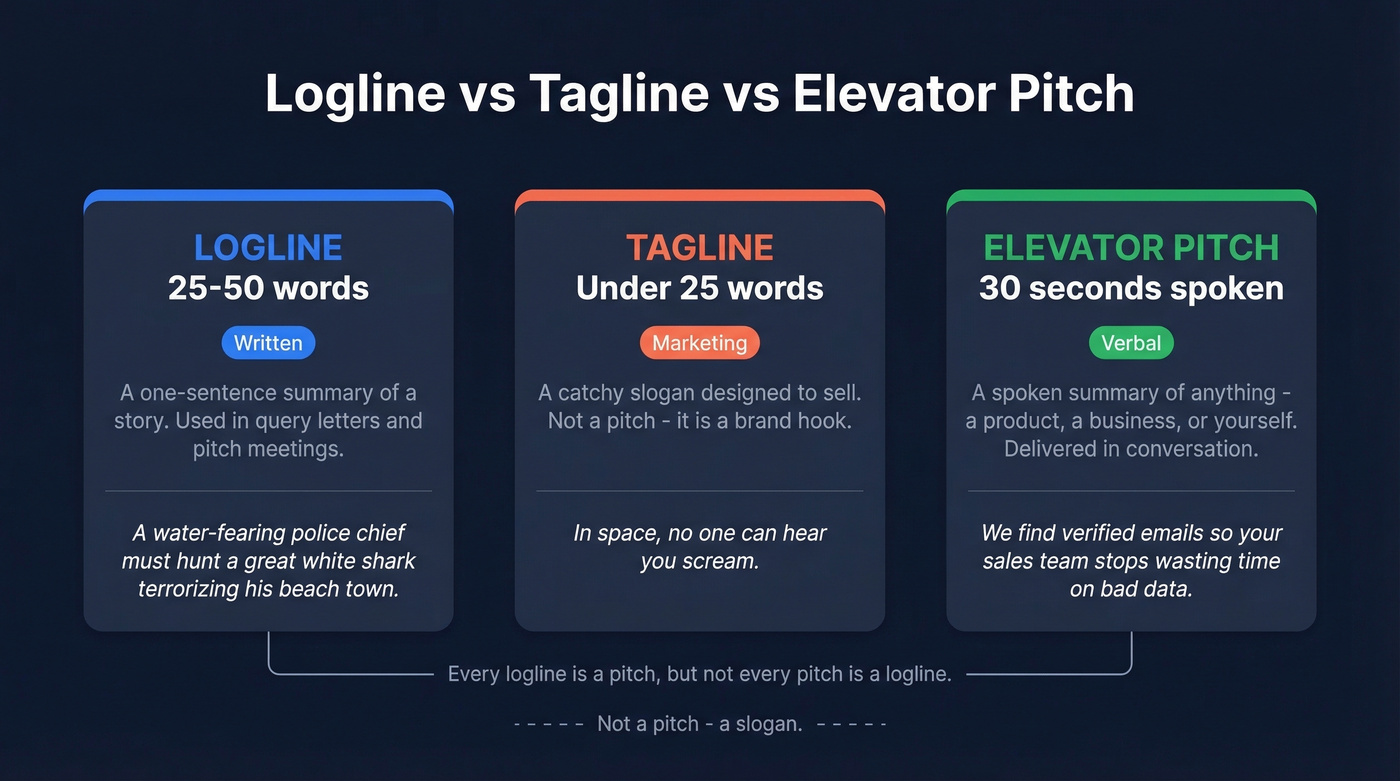
A logline is a type of pitch. An elevator pitch can be about anything - a story, a product, or you.
Pitch Examples by Category
Book & Screenplay Pitches
Hollywood popularized the one-liner decades ago. A good logline isn't a summary - it's a hook that makes someone say "tell me more."
Bad: "A police chief deals with a shark that attacks swimmers at a beach town." Better: "A water-fearing police chief must hunt a great white shark terrorizing his beach town - right before tourist season."
The rewrite adds a character flaw, stakes, and conflict. It leans on irony: the protagonist's weakness is the very thing he must confront. That tension is what makes a reader or producer want to keep going.
Nathan Bransford's logline approach adds a layer: inciting incident, obstacle, quest, stakes. His framework is especially useful for query letters, where a strong one-sentence pitch can do a lot of work fast.
A popular simplified template from the r/PubTips community: "When [catalyst] forces [character] to [action], they [stakes]." Reedsy's 48 book hook examples are worth bookmarking for more inspiration.
Startup & Business Pitches
This is where we've seen the most people struggle, so let's spend some extra time here.
The Founder Institute's fill-in-the-blank template is the gold standard:
"My company, [NAME], is developing [DEFINED OFFERING] to help [DEFINED AUDIENCE] [SOLVE A PROBLEM] with [SECRET SAUCE]."
I've watched founders spend 20 minutes explaining what their company does and still leave the room confused. The problem is almost always the same: they're too clever. Compare these two pitches:
- Too technical: "I work on nanotechnology to deliver medical therapies to targeted cells."
- Clear: "We're using the manufacturing techniques of the computer industry to make better vaccines."
The second version works because your listener doesn't need a PhD to understand it. Three rules: no superlatives, no jargon, and narrow your audience. "We help businesses" is useless. "We help system administrators at mid-size tech companies" is a pitch.
Here's the thing: if you can't compress your idea into one line, the problem isn't your pitch - it's your idea. A one-liner is a diagnostic tool. When the core concept is muddy, no amount of wordsmithing saves it. Fix the clarity first, then the words.
Let's look at a real before/after from our own world. A B2B data company pitching "We aggregate professional contact information from multiple verified sources and provide it through an API and Chrome extension for sales development representatives" could instead say: "We find verified emails and phone numbers so your sales team stops wasting time on bad data." Shorter. Clearer. Done.
Sales & Cold Outreach Pitches
Sales one-liners play by different rules. You're not summarizing - you're starting a conversation. One Reddit poster on r/sales documented 516 sales calls and $200k+ in revenue using single-sentence cold emails:
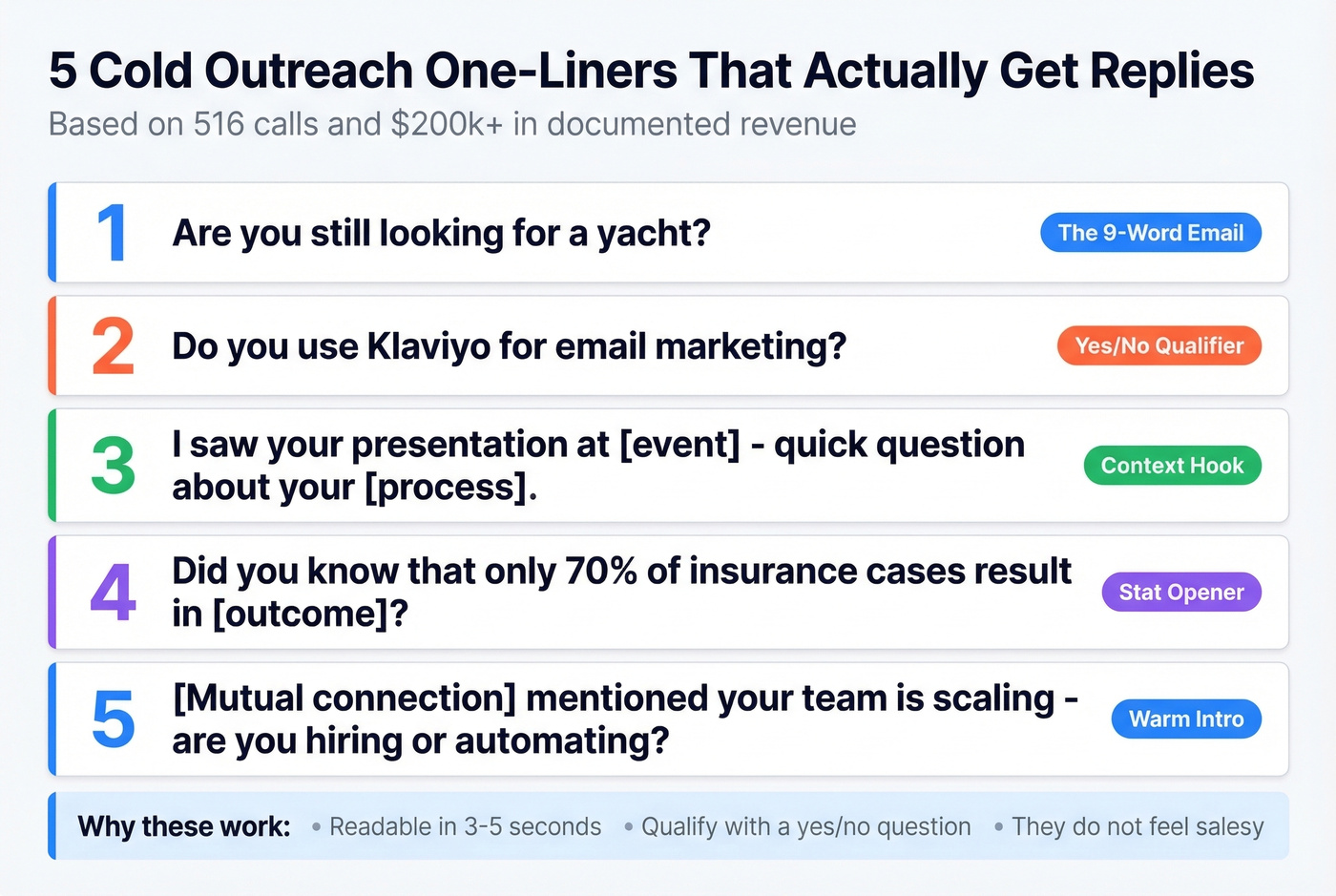
- "Are you still looking for a yacht?" - the classic 9-word email
- "Do you use Klaviyo for email marketing?"
- "I saw your presentation at [event] - quick question about your [process]."
- "Did you know that only 70% of insurance cases result in [outcome]?"
- "[Mutual connection] mentioned your team is scaling - are you hiring or automating?"
These work because they're readable in 3-5 seconds, they qualify with a yes/no question, and they don't feel salesy. In our experience testing cold outreach across thousands of sends, the 9-word email outperforms longer pitches by a wide margin. The goal is a reply, not a close.
Of course, the best one-liner bounces if the email address is wrong. We run every outbound list through Prospeo's email finder before hitting send - 98% accuracy means you're not burning your domain reputation on dead addresses.
Job Interview Pitches
"Tell me about yourself" is really "pitch me in one sentence." Structure it as [Role] + [proof point] + [target outcome]:
- Marketer: "I'm a demand gen marketer who built a $2M pipeline at a Series B fintech - now I want to do it at scale."
- Engineer: "I'm a backend engineer who cut API latency by 40% - now I want to tackle distributed systems problems."
- Sales rep: "I closed $1.2M in my first year selling to mid-market HR teams - now I want to move upmarket."
Each one is short, specific, and gives the interviewer a reason to ask a follow-up. That's the whole point.

A perfect sales one-liner is worthless if it bounces. Prospeo delivers 98% email accuracy with a 7-day data refresh cycle, so your 9-word emails actually land in real inboxes - not dead addresses that torch your domain reputation.
Stop perfecting pitches that never get delivered.
Proven Formulas
Templates are training wheels. Use them to get started, then rewrite until the pitch sounds like something you'd actually say out loud. Run every draft through Asana's "3 C's" test: is it clear, concise, and compelling? If it fails any one of those, rewrite.
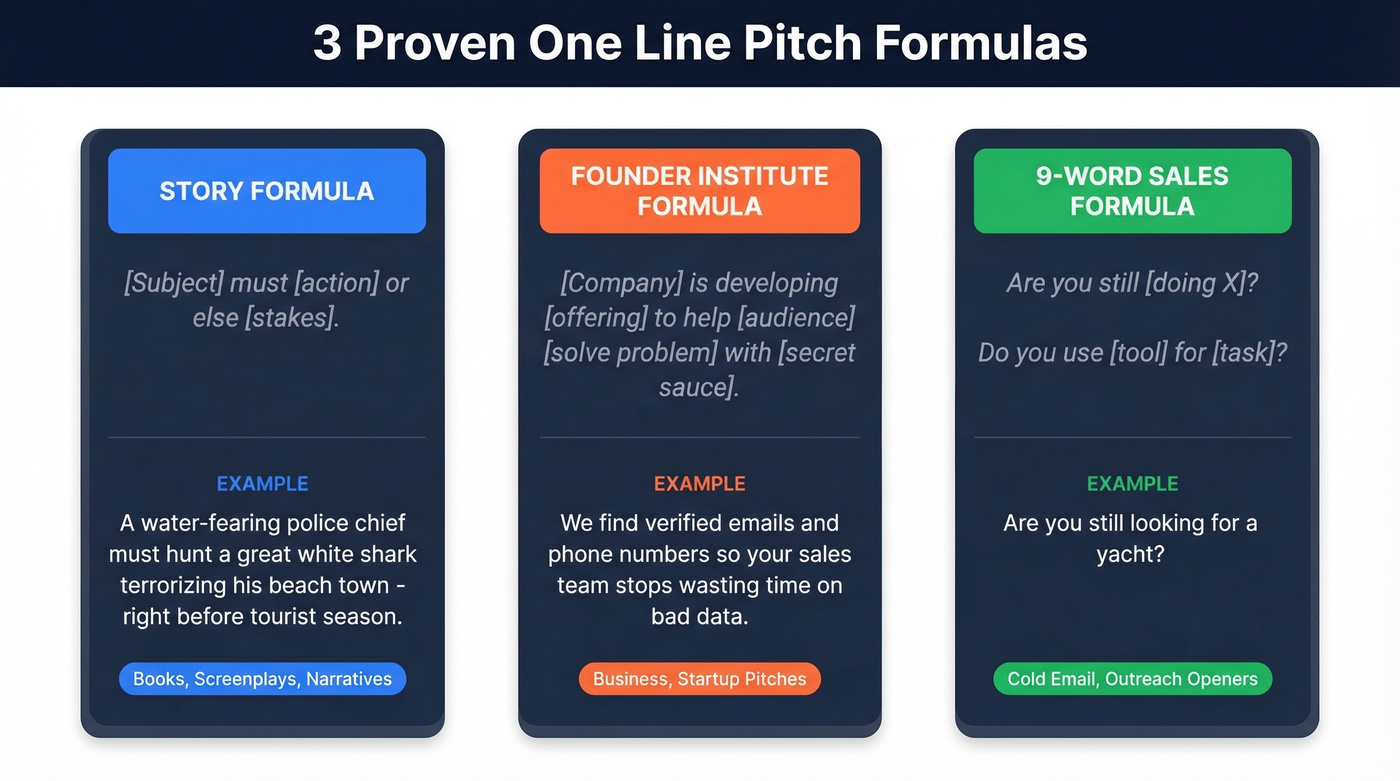
- Story formula: "[Subject] must [action] or else [stakes]." Works for books, screenplays, and startup narratives.
- Founder Institute formula: "[Company] is developing [offering] to help [audience] [solve problem] with [secret sauce]." Works for any business pitch.
- 9-word sales formula: "Are you still [doing X]?" or "Do you use [tool] for [task]?" Works for cold email and outreach openers.
Mistakes That Kill Your Pitch
- Writing a summary instead of a hook. A logline isn't a synopsis. If it doesn't make someone curious, it's not doing its job.
- Jargon and buzzwords. "Nanotechnology to deliver medical therapies to targeted cells" means nothing to 99% of listeners. Translate.
- Cramming too much in. Over 50 words? Cut something. Two ideas max.
- Using superlatives. "The first," "the only," "the best" - these trigger skepticism, not interest. Show, don't claim.
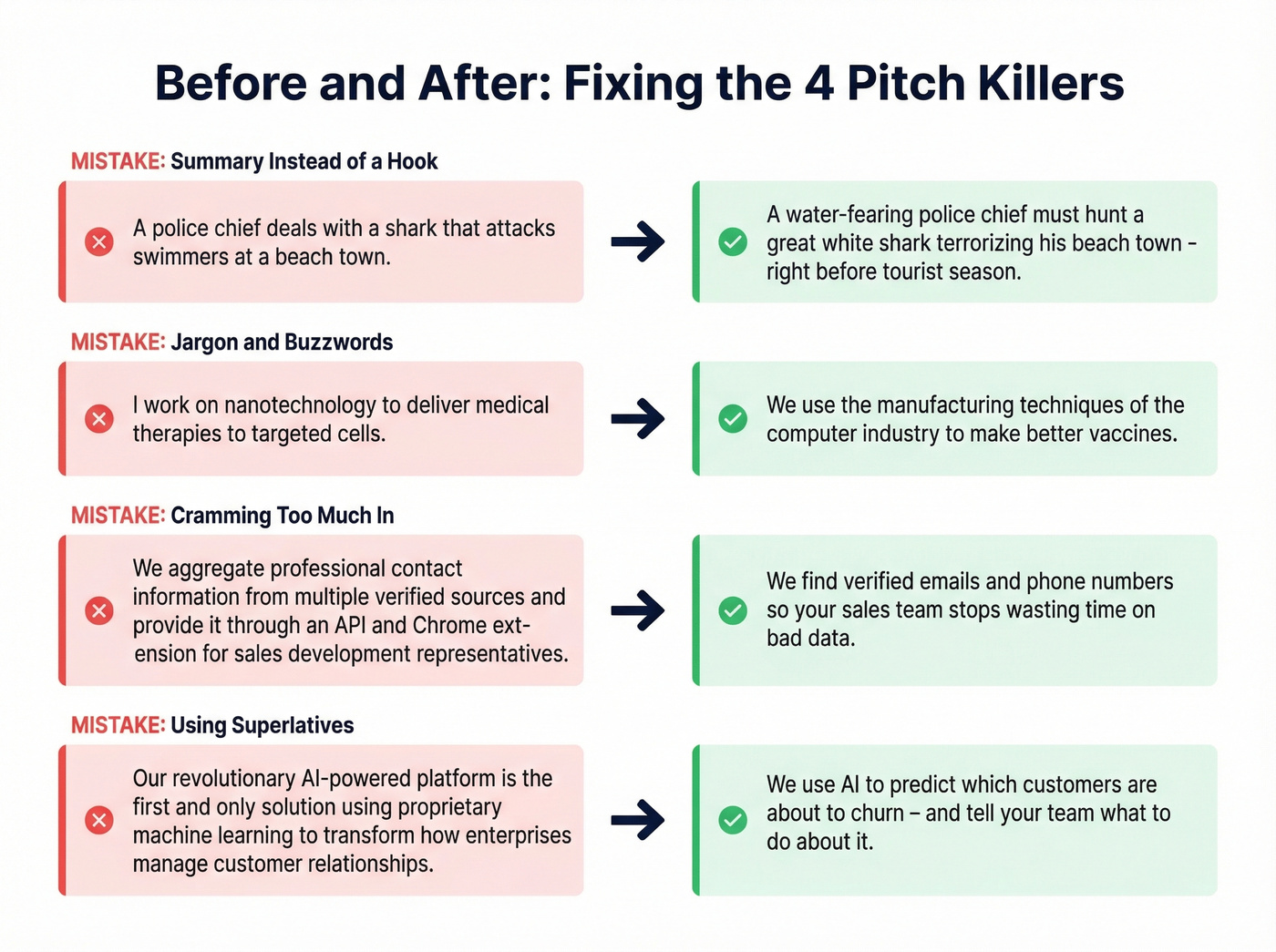
Before: "Our revolutionary AI-powered platform is the first and only solution using proprietary machine learning to transform how enterprises manage customer relationships." After: "We use AI to predict which customers are about to churn - and tell your team what to do about it."
The best pitches are boringly clear. Stop trying to be clever.
You just nailed your one-line pitch. Now you need the right people to send it to. Prospeo's 300M+ verified contacts and 30+ filters let you build laser-targeted lists - so your pitch hits the exact audience you wrote it for.
Great copy deserves great data. Get both for $0.01 per lead.
One Line Pitch FAQ
How long should a one line pitch be?
Aim for 25-50 words. Under 25 is a tagline; over 50 is a synopsis. For cold email openers, the sweet spot is 9-15 words - short enough to read in a single glance and prompt a reply.
What's the difference between a logline and an elevator pitch?
A logline is a written one-sentence summary of a story. An elevator pitch is a spoken 30-second summary of anything - a business, a product, yourself. Every logline is a pitch, but not every pitch is a logline.
How do I test if my pitch actually works?
Say it to someone outside your industry. If they ask "tell me more," it works. If they nod politely and change the subject, rewrite. For cold outreach, A/B test two versions across 100+ emails each and compare reply rates. Just make sure your list is clean first so bounces don't skew the data.
Can I use the same one-liner for email and in-person?
No. Written pitches can be denser because readers re-scan. Spoken pitches need simpler syntax and a conversational rhythm. Write two versions: one for the page, one for the room. Test both separately.
Skip this if...
You're writing a full pitch deck or investor memo. One-liners are openers, not replacements for a complete narrative. If you need a 10-slide deck, a single sentence won't save you - but it should be the first thing on slide one.