

Best Ooma Alternatives for Business and Home in 2026
You just opened your Ooma bill and the math doesn't add up. The "free" home plan somehow costs real money after taxes, or the Office plan that was supposed to simplify your small business phones has turned into a porting nightmare that's eaten three weeks of your life. You're not alone - Ooma sits at a 3.6/5 on Trustpilot across 2,023 reviews, and the complaints cluster around the same handful of issues.
We evaluated each alternative based on pricing transparency, SMS limits, porting experience, and real user sentiment from G2, Trustpilot, and Reddit. Whether you're running a business or just want a reliable home line, here are the replacements actually worth switching to.
Our Picks (TL;DR)
Best for business: Nextiva - $15/user/month on the Core plan, 100 texts/user/month included, and the most complete feature set at this price point.
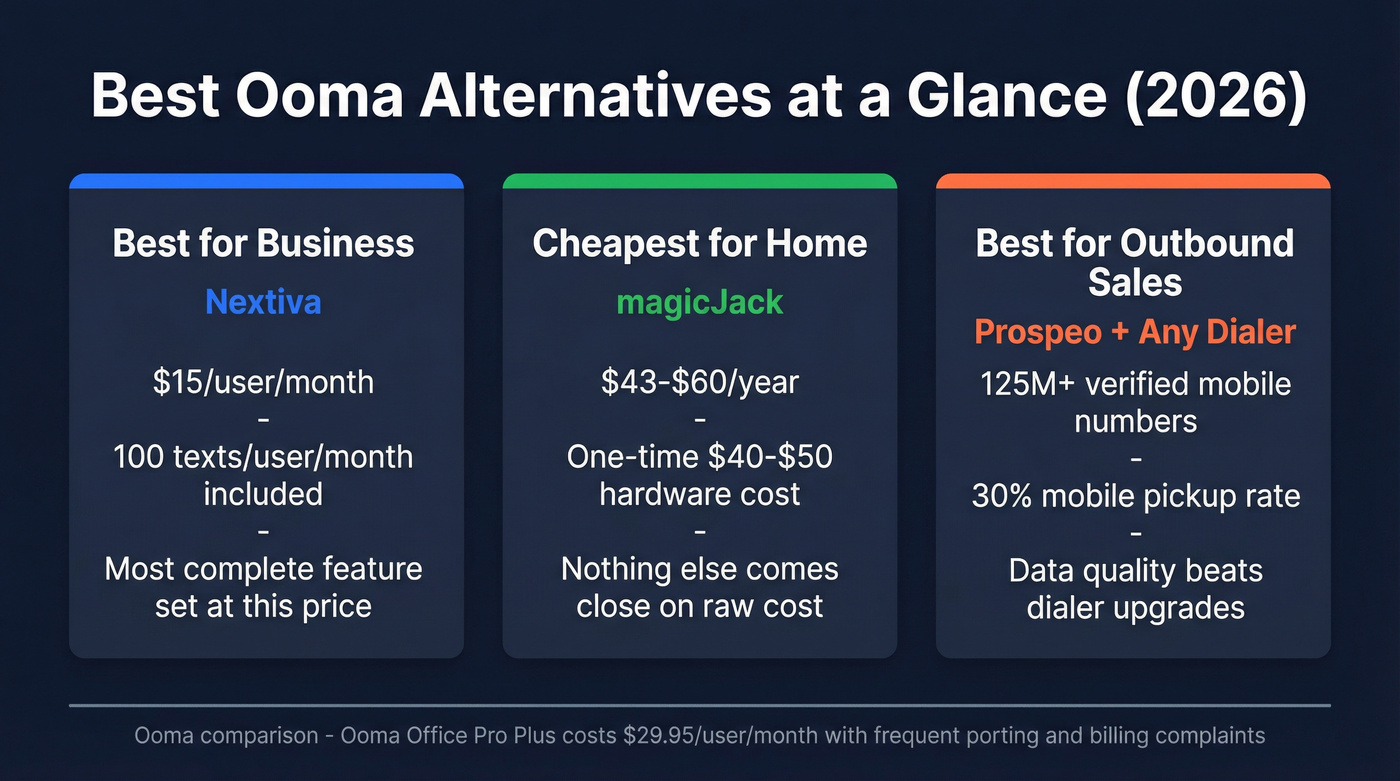
Cheapest for home: magicJack - ~$43-$60/year depending on your term length and promos. Nothing else comes close on raw cost.
Best for outbound sales teams: Pair any phone system with Prospeo's verified mobiles. Connect rates depend more on data quality than your dialer - 125M+ verified mobile numbers with a 30% pickup rate will do more for pipeline than any IVR upgrade.
Why People Leave Ooma in 2026
The #1 complaint on Reddit and review sites isn't any single feature. It's the gap between what Ooma advertises and what you actually experience.
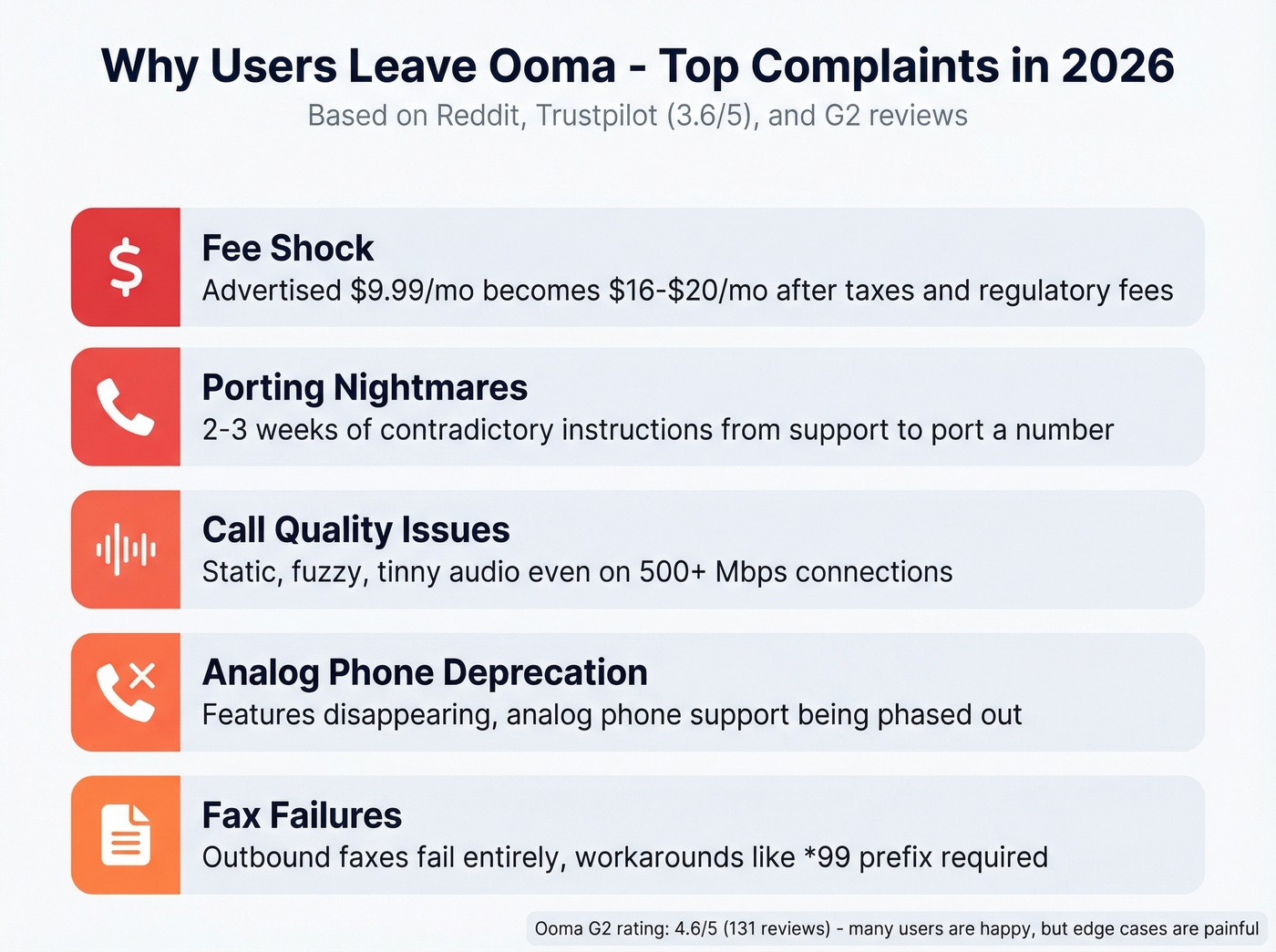
Fee shock. Ooma Premier is marketed at $9.99/month. In real-world use, that "$9.99" often ends up around $16-$20/month after taxes and regulatory fees. That "free" Basic plan? Expect $5-$10/month in taxes and fees on top of the hardware buy-in.
Porting nightmares. Business number ports can take 2-3 weeks, with users describing contradictory instructions from support at every step. One r/ooma poster called it "three weeks of back and forth" with "confusing, contradicting, condescending" support.
Call quality inconsistency. Users switching from Google Voice + Obihai setups report static, fuzzy, and tinny audio - even on connections with 500+ Mbps and 2ms jitter. Support tends to blame the network rather than troubleshoot the product.
Analog phone deprecation. Longtime business users say Ooma "no longer wants to support analog phones," and they've seen features disappearing that are "starting to break" their current setup.
Fax failures. If you still fax - and plenty of law firms and medical offices do - Ooma's fax reliability is a recurring pain point. A common workaround is dialing with a *99 prefix just to get outbound calls to work, and faxes can fail entirely.
Ooma's G2 rating for Office is 4.6/5 across 131 reviews, so plenty of businesses are happy. But the gap between "works fine for basic calling" and "breaks down when you need support, porting, or advanced features" is where the frustration lives.
Best Options for Business
| Tool | Starting Price | SMS Limits | Best For | Key Gotcha |
|---|---|---|---|---|
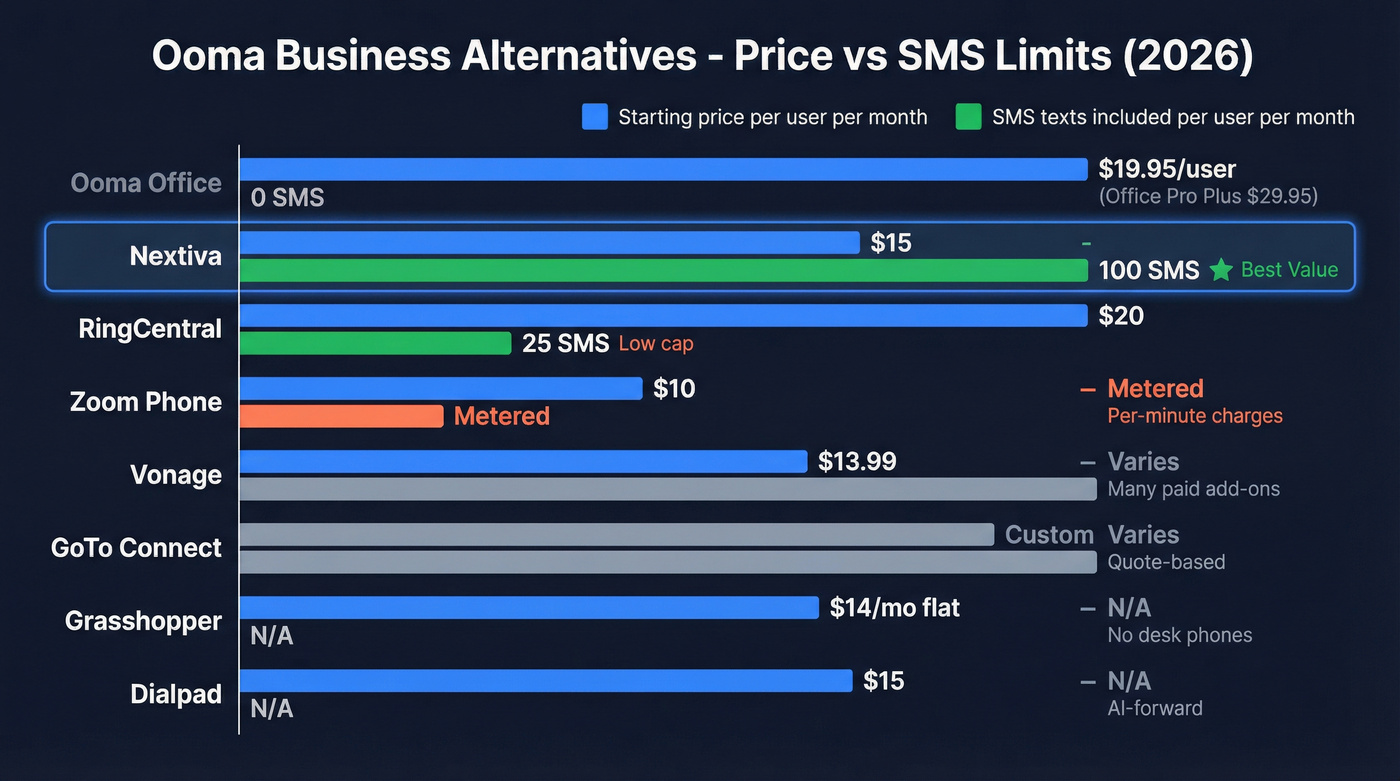
| ⭐ Nextiva | $15/user/mo | 100/user/mo | Best overall value | Annual term for small-business pricing |
| RingCentral | $20/user/mo | 25/user/mo | Feature-rich teams | SMS caps on Core |
| Zoom Phone | $10/user/mo | Metered | Budget teams | Per-minute charges |
| Vonage | $13.99/user/mo | Varies | Reliability-first | Many paid add-ons |
| GoTo Connect | Custom | Varies | Mid-market teams | Quote-based pricing |
| Grasshopper | $14/mo | N/A | Solopreneurs | No desk phones |
| Dialpad | $15/user/mo | N/A | AI-forward teams | Limited integrations |
Nextiva
Use this if you want the best price-to-feature ratio in business VoIP. Nextiva's Core plan at $15/user/month includes 100 texts per user per month, and the XBert AI Receptionist is available as an add-on. The Engage tier at $25/user/month bumps texting to 500 texts/user/month and adds more advanced routing. For a 10-person team, you're looking at $150/month on Core - compared to $299.50/month for 10 users on Ooma Office Pro Plus at $29.95/user/month. That's nearly $1,800/year in savings, and you're getting a better feature set.
Skip this if you need month-to-month flexibility. Nextiva's discounted small-business pricing requires a 12-month term for new customers with 1-100 employees. For teams that know they need phones for the year, though, Nextiva is the obvious pick.

RingCentral
RingCentral is the default "upgrade from Ooma" for teams that need video, messaging, and phone in one platform. RingEX starts at $20/user/month annually ($30 monthly) for Core, $25/$35 for Advanced, and $35/$45 for Ultra.
Watch out for SMS limits. Core only includes 25 texts per user per month - borderline unusable for any team doing outbound. Advanced bumps it to 100, Ultra to 200. And monthly billing runs roughly 33% more than annual: a 10-seat Advanced plan jumps from $250/month to $350/month just by skipping the annual commitment.
Skip this if you're a small team that mostly needs calling. RingCentral's strength is breadth, not simplicity. For under 10 users who just need phones and basic texting, Nextiva delivers more value per dollar.
Zoom Phone
The metered plan at $10/user/month is the cheapest entry point for businesses that make relatively few calls. Regional Unlimited runs $15, Global Select $20.
Here's the catch: metered means per-minute charges for outbound calls, which adds up fast for any team doing real outbound. Zoom Phone works best for inbound-heavy teams that want a single vendor for meetings and calls - not for teams dialing 50+ prospects a day.
Vonage
Vonage has been around for 20+ years, and that longevity means proven reliability. Mobile starts at $13.99/user/month, Premium at $20.99, Advanced at $27.99. The frustration is that features competitors include by default - call recording, visual voicemail, integrations - are paid add-ons on Vonage's lower tiers. You can easily end up paying Advanced-tier prices just to match what Nextiva includes at $15. Vonage is a solid platform if you're already on it, but I wouldn't switch to it in 2026.
GoTo Connect
GoTo Connect is typically sold on custom, quote-based pricing, positioned more for teams that want a polished, all-in-one platform than for bargain per-seat pricing. The appeal over Ooma is straightforward: a clean admin interface, built-in analytics, and a more mature UCaaS feel. Worth getting a quote if you have 25+ seats.
Grasshopper
Built for solopreneurs who need a business number on their cell phone, not a full phone system. True Solo starts at $14/month, Solo Plus $25, Small Business $55 on annual pricing. No desk phone support, no video, no team messaging - and that's by design. If you just need a professional number that rings your mobile, this is the simplest path.
Dialpad
Dialpad's angle is AI: real-time transcription, call summaries, and coaching built into every plan. Standard starts at $15/user/month, Pro at $25. Integrations are limited on Standard, so budget for Pro if you need CRM connections. If you're comparing options in this category, see our Dialpad alternatives.

Your dialer is only as good as the numbers you feed it. Prospeo gives outbound teams 125M+ verified mobile numbers with a 30% pickup rate - that's 3x what ZoomInfo delivers. At $0.10 per mobile, you pay only when a number is found.
Stop dialing dead numbers. Start connecting with real decision-makers.
Making Any Phone System Work for Outbound
Let's be honest: switching phone systems solves maybe half the problem for outbound teams. The other half is data quality. Bad numbers waste more rep time than a clunky IVR ever will.
We've seen teams upgrade their entire phone stack and still hit the same connect rates because they're dialing the same garbage data. The bottleneck is almost never the dialer - it's the numbers you're feeding it. Pair Nextiva or RingCentral with Prospeo's verified mobile numbers and you'll see the difference in the first week. A 30% mobile pickup rate across 125M+ numbers, refreshed every 7 days, is a different universe from the stale CSVs most teams are working off of. The free tier gives you 75 emails and 100 Chrome extension credits per month - enough to test before committing.
If you're building lists from scratch, start with a repeatable lead generation workflow and then layer in enrichment.
Upgrading from Ooma fixes your phone bill. Upgrading your contact data fixes your pipeline. Prospeo's 98% email accuracy and 125M+ verified mobiles mean your reps actually reach prospects - not voicemail boxes tied to outdated numbers.
Your new phone system deserves data that actually connects.
Best Options for Home Use
Residential VoIP runs under $10/month from most providers. A traditional landline costs ~$60/month. That's over $500/year in savings - and the reason VoIP took over home phones a decade ago. The tradeoff: VoIP goes down when your internet does, something to consider if you need a true emergency line.
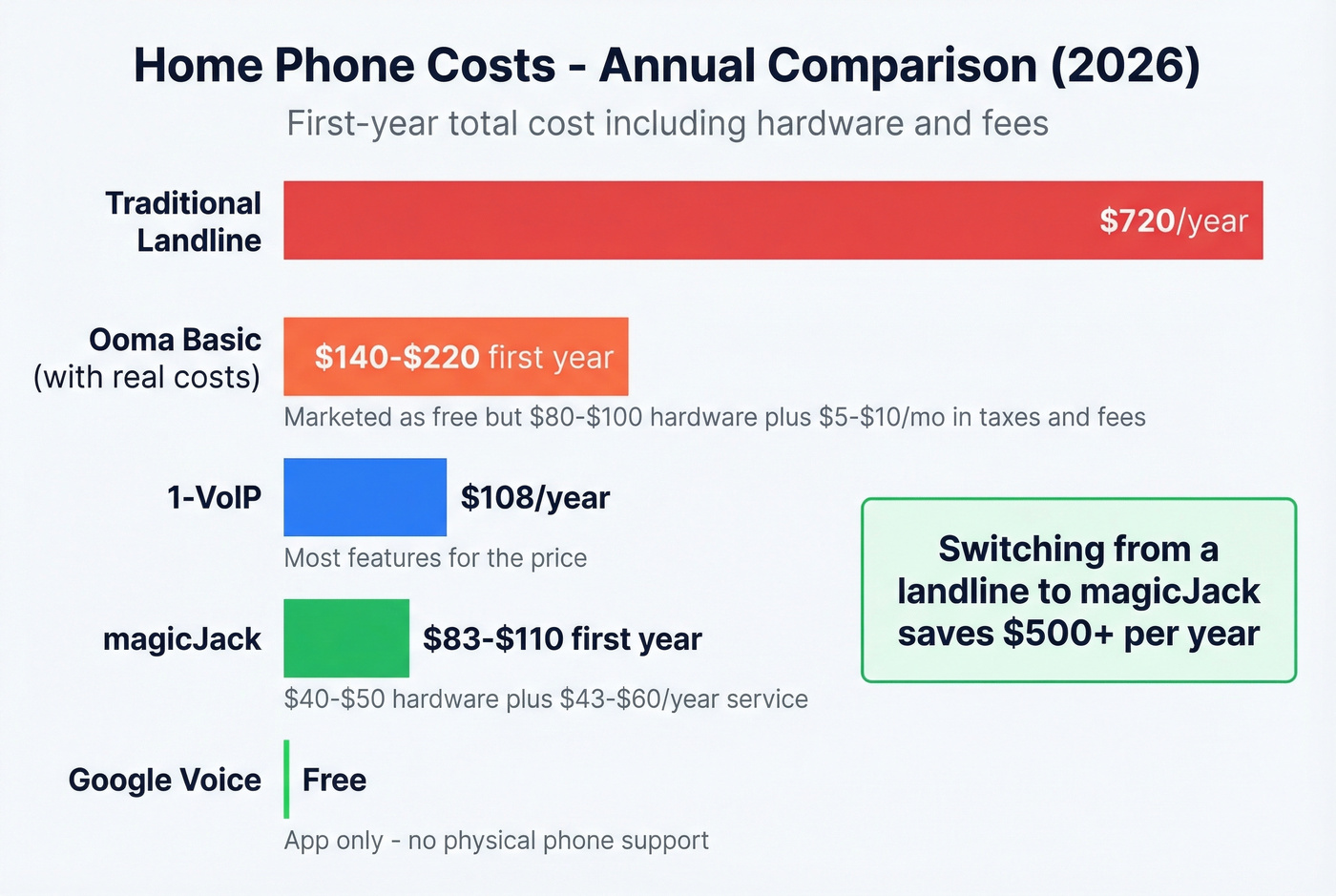
Ooma Basic is marketed as "free," but between the $79.99-$99.99 hardware and $5-$10/month in taxes and fees, your first-year cost is roughly $140-$220. Paid competitors often come out cheaper.
| Tool | Annual Cost | Physical Phone | Best For |
|---|---|---|---|
| magicJack | ~$43-$60/yr | Yes (USB adapter) | Cheapest option |
| Google Voice | Free (personal) | No (app only) | Smartphone users |
| 1-VoIP | ~$108/yr | Yes | Feature-rich budget |
magicJack
Use this if you want the absolute cheapest home phone line. magicJack runs ~$43/year for a one-year plan, with multi-year terms dropping the effective cost further. Hardware is a one-time $40-$50 purchase. One Reddit user on r/Frugal reported saving ~$500/year versus their Verizon landline after switching.
Skip this if you care about call quality or customer support. Audio quality can be inconsistent, customer service is minimal, and you're locked into their hardware. For a secondary line or emergency home phone, it's unbeatable on price. For your primary business line, look elsewhere.
Google Voice
Free for personal use, dead simple to set up, and the voicemail transcription is genuinely useful. Business plans run $10-$30/user/month but require a Google Workspace subscription on top.
The dealbreaker for many: you can't place outgoing calls from a traditional handset. It's app and web only. For anyone who wants a physical phone plugged into the wall, Google Voice isn't a landline replacement - it's a smartphone add-on.
1-VoIP
At $8.97/month on an annual plan, 1-VoIP is the most feature-rich budget home VoIP option. Unlimited US/Canada calling, caller ID, call waiting, and voicemail included. It doesn't get much attention, but it quietly delivers solid value. Other budget options worth checking include Voiply at $7.16/month and AXvoice at $8.25/month.
The "Ditch VoIP Entirely" Option
If you're setting up a phone for an elderly parent or someone who needs the simplest possible experience, consider skipping VoIP altogether. Bluetooth-to-landline converters like the XLink BT HD or Cell2Jack pair a cell phone with a traditional cordless handset - the person picks up the phone and talks, no apps, no internet dependency. One Reddit user explored this specifically for a parent with dementia who needed a familiar "press talk" workflow.
When to Stay with Ooma
In our evaluation, Ooma's basic calling works reliably - the issues surface when you push beyond that. Stay with Ooma if:
- You're a small office with basic inbound/outbound calling needs
- You don't do heavy outbound or need SMS
- You rarely port numbers
- You don't rely on fax
- You're comfortable with the hardware you already own
That 4.6/5 on G2 across 131 reviews reflects real satisfaction from users with straightforward needs. The problem isn't the product itself - it's the gap between what Ooma promises and what it delivers when you need support, try to scale, or attempt anything beyond basic calling.
How to Port Your Number Away
- Sign up with your new provider first. Don't cancel Ooma until the port is complete - if your account closes, you lose the number.
- Request the port through your new provider's onboarding flow. They'll handle the paperwork with Ooma.
- Expect 2-3 weeks for business numbers. Residential ports are sometimes faster, but don't count on it.
- Document every interaction with Ooma support. Users consistently report contradictory instructions from different agents. Screenshots and ticket numbers are your insurance.
- Test your new line before canceling Ooma. Make inbound and outbound calls, check voicemail, verify caller ID. Only cancel once everything works on the new system.
FAQ
Can I keep my phone number when switching from Ooma?
Yes - request a port through your new provider and they'll coordinate with Ooma. Business numbers typically take 2-3 weeks. Keep your Ooma account active until the port completes, or you risk losing the number permanently.
What does Ooma actually cost after fees?
Ooma Basic typically runs $5-$10/month in taxes and regulatory fees despite the "free" marketing. Ooma Office starts at $19.95/user/month, but after taxes and common add-ons, expect $20-$35/user/month in practice.
Is Ooma's call quality really that bad?
G2 reviewers rate Ooma Office 4.6/5, and many users are satisfied. But users switching from Google Voice + OBi setups report noticeably worse audio - static, tinny sound, and dropped quality. Your experience depends heavily on your internet connection and router configuration.
What's the cheapest replacement for an Ooma home phone?
magicJack at ~$43-$60/year is the cheapest option with traditional handset support. Google Voice is free but app-only - no physical phone connection without workarounds.
Do small teams really need a premium phone system?
Probably not. A $10-$15/user plan from Nextiva or Zoom Phone handles 90% of use cases. Where you should invest is data quality - verified numbers and emails that actually connect you with the right people. A $15/month phone plan paired with accurate contact data will outperform a $45/month platform dialing bad numbers every single time.