

The 10 Best Outreach Tools in 2026 - And What They Actually Cost
You send 5,000 cold emails. You get 12 replies. Two are "remove me from your list." The problem isn't your copy, your subject lines, or your sequencer. It's your data. The tool that sends your emails matters far less than the contacts going into it, and most outreach tools lists completely ignore this.
You need two tools, maybe three - not sixteen. Here's the stack that actually works.
Our Picks (TL;DR)
| Tool | Best For | Starting Price | Channels |
|---|---|---|---|
| Prospeo | Verified data & direct dials | Free / ~$0.01/email | Data + verification |
| Instantly.ai | High-volume cold email | $37/mo | |
| Lemlist | Multichannel sequences | $79/user/mo | Email, social, calls |
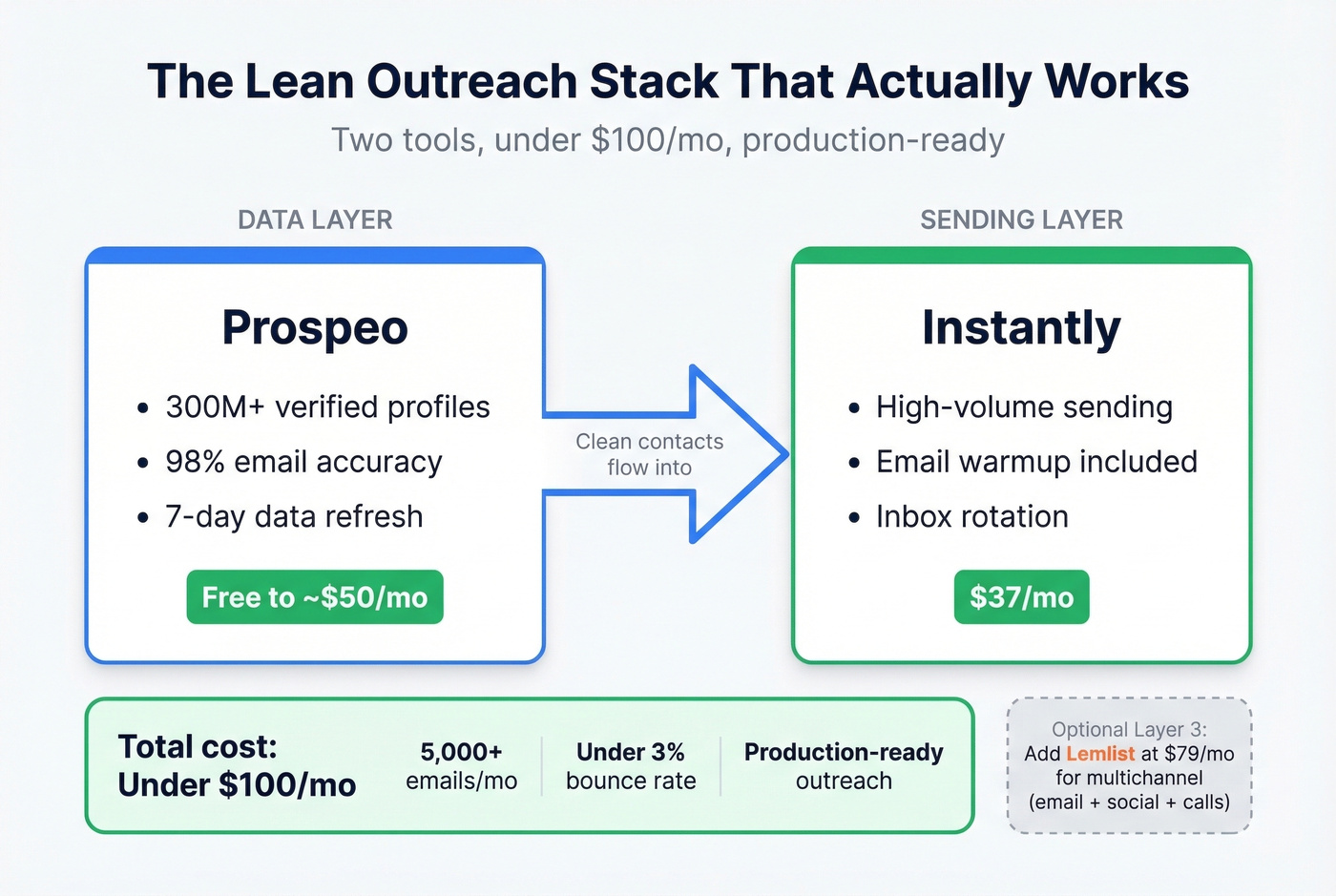
Two tools can start under $100/mo: Prospeo for data, Instantly for sending. That's a production-ready cold outreach engine for less than most teams spend on lunch.
What Good Outreach Actually Looks Like
A [Mailshake survey of 508 outbound professionals] puts the average cold email reply rate at 1-4%. Other sources put the average as high as 5.1%. Either way, that's not a failure - that's the baseline.

Here's what healthy cold email metrics look like in 2026:
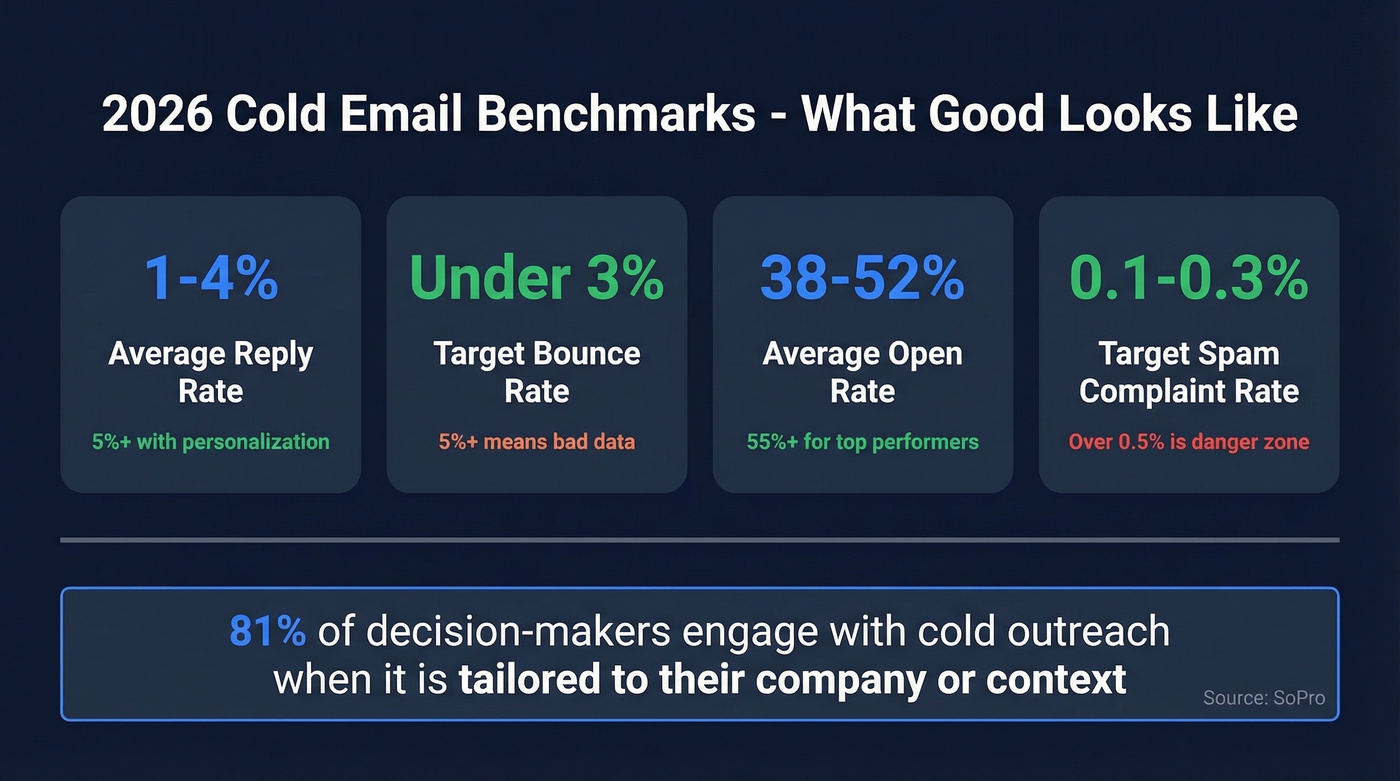
- Reply rate: 1-4% average, 5%+ with deep personalization
- Bounce rate: Under 5% (aim for under 3%)
- Open rate: 38-52% average, 55%+ for top performers
- Spam complaint rate: Under 0.5% (aim for 0.1-0.3%)
One stat worth internalizing: 81% of sales and marketing decision-makers engage with cold outreach when it's tailored to their company or context. The data quality problem and the personalization problem are the same problem.
Where your emails land also depends on the receiving ISP. [Google delivers 89.8% to inbox], while Microsoft only manages 77.4%. That 12-point gap means your Microsoft-hosted prospects are significantly harder to reach - no sequencer can fix that.
Operational rules: keep volume around 20 emails per inbox per day (100/day is the upper ceiling), keep it to around 3 inboxes per domain (5 is the upper ceiling), and set up SPF, DKIM, and DMARC before you send a single message.
The 3 Layers of an Outreach Stack
Most B2B platforms cover one or two layers. Almost none cover all three well.
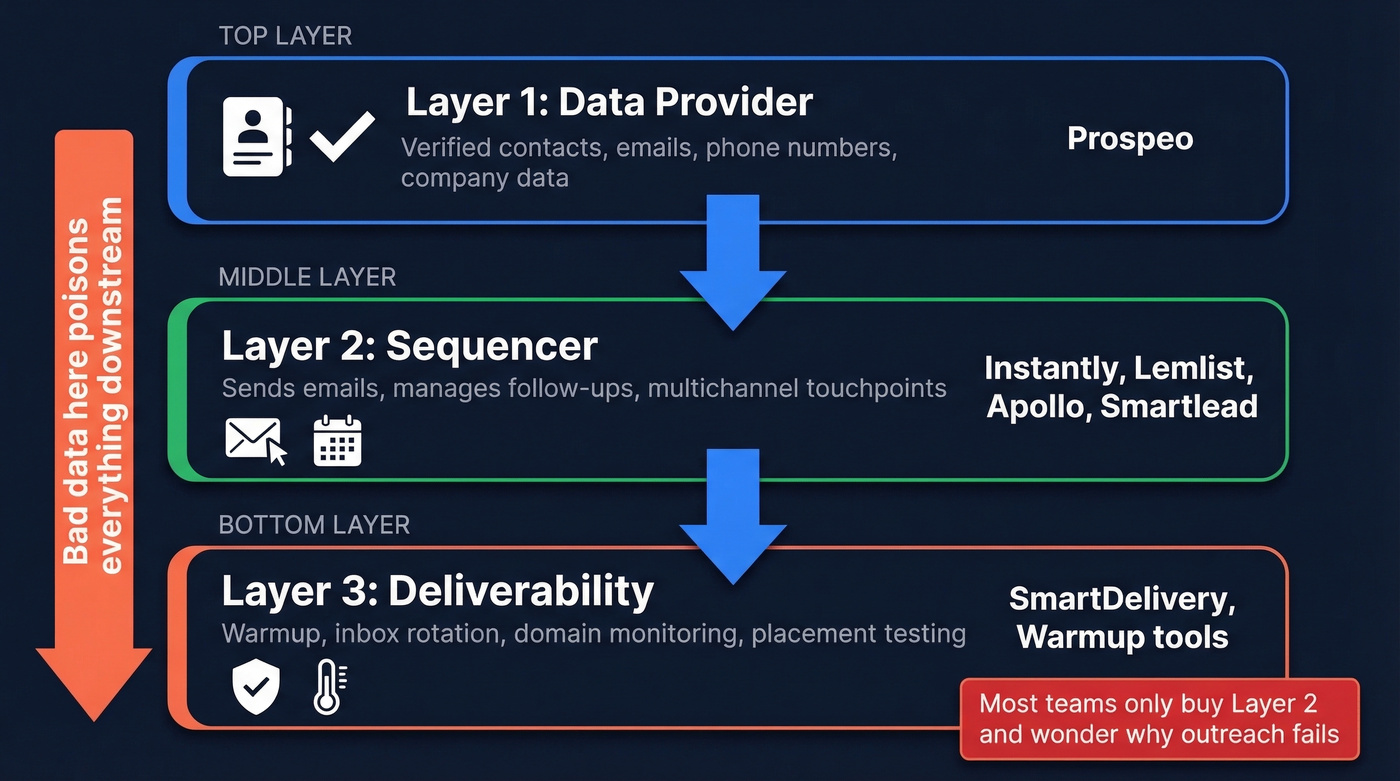
Layer 1: Data provider. Verified contacts - emails, phone numbers, company data. Bad data here poisons everything downstream.
Layer 2: Sequencer. The tool that sends emails, manages follow-ups, and handles multichannel touchpoints. Instantly, Lemlist, Apollo, and Smartlead all live here.
Layer 3: Deliverability. Warmup, inbox rotation, domain monitoring, placement testing. Some sequencers include basic warmup. Serious senders add dedicated tools on top.
Here's the thing: teams buy a sequencer thinking it solves all three layers. It doesn't. Your sequencer is only as good as the data feeding it. And with AI SDR tools like Reply.io's Jason now entering the market, the temptation to skip the data layer entirely is growing - but the fundamentals haven't changed.
The 10 Best Outreach Tools in 2026
Prospeo
Every outreach stack starts with contacts. Prospeo's database covers 300M+ professional profiles with 98% verified email accuracy, 143M+ verified emails, and 125M+ verified mobile numbers that deliver a 30% pickup rate across all regions. The 7-day data refresh cycle is the fastest in the category - the industry average is 6 weeks, which means most providers are feeding you emails for people who changed jobs last month.

The search interface gives you 30+ filters including [buyer intent powered by Bombora] across 15,000 topics, technographics, job changes, headcount growth, and funding signals. The Chrome extension has 40,000+ users - it turns any company website or professional profile into a prospecting surface. And Prospeo integrates natively with Instantly, Lemlist, Smartlead, Salesforce, and HubSpot, so there's no Zapier workaround needed.
Real proof: Meritt saw bounce rates drop from 35% to under 4% after switching, and their pipeline tripled from $100K to $300K per week. That's the difference between burning your domain and booking meetings.
Use this if: You need verified data that won't destroy your sender reputation. Pairs with any sequencer on this list. Skip this if: You already have a clean, recently verified list and just need a sending tool. Pricing: Free tier (75 emails/mo), paid plans at ~$0.01/email. No contracts, no sales calls.
Apollo.io - The All-in-One That Costs More Than You Think
Apollo is the default all-in-one, and the consensus on r/sales is that most teams start here. The appeal is obvious: database, sequencer, email sending, and dialer in one login. But the credit model is where the math gets uncomfortable.
The free plan gives you limited credits and 2 sequences. Basic starts around $59/user/mo, Professional $99/user/mo, and Organization $149/user/mo with a minimum of 3 seats. Credits don't roll over - use them or lose them. Credit consumption varies depending on which data source returns a match, so your actual cost per contact is unpredictable.
Reddit users frequently describe Apollo as feeling "still manual" despite its automation features. The UI assumes you've used a sales engagement platform before. Free and Basic plans are limited to 1 sending inbox, which caps your volume hard. Professional bumps that to 15.
Skip this if: You need predictable costs or high-volume sending from day one. The credit expiration model punishes inconsistent senders.
Instantly.ai
Instantly is the go-to for high-volume cold email at a low entry price. But here's what most lists don't tell you: Instantly is actually three separate products with three separate price tags.
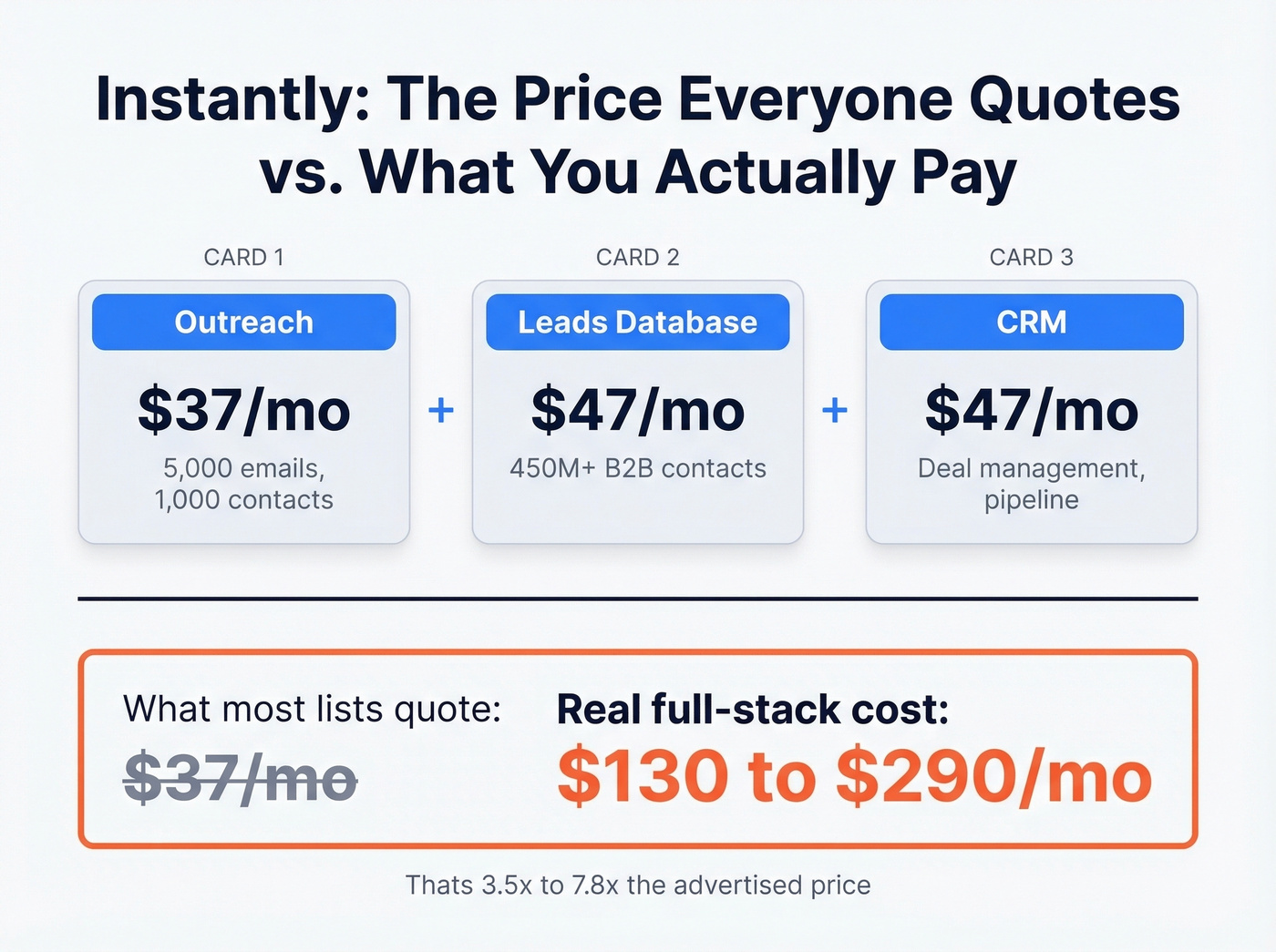
Outreach (the email sender) starts at $37/mo for 5,000 emails and 1,000 contacts. The Leads database - 450M+ B2B contacts - is a separate $47/mo. The CRM is another $47/mo. Want the full Instantly stack? You're looking at $130-$290/mo depending on tier, not the $37 everyone quotes.
Use this if: You're sending high volume and already have a verified data source. Skip this if: You need a built-in database and CRM without paying for three subscriptions.
Lemlist - Multichannel Done Right
Picture this: your prospect gets a personalized email on Monday, a connection request on Wednesday, and a follow-up referencing their latest company announcement on Friday - all from one sequence. That's Lemlist's pitch, and it delivers.
The 600M+ leads database is included on every plan. Email Pro starts at $79/user/mo ($63 on annual billing) with 3 email senders and 200 enrichment credits. Multichannel Expert runs $109/user/mo ($87 annual) and adds social automation, a built-in dialer, and 5 senders. But add-ons inflate the bill quickly: extra senders at $9/mo each, deliverability protection at $20/user/mo, calling numbers at $15/mo. Real monthly cost for a multichannel user is $120+ easily.
Use this if: You run true multichannel sequences and want everything in one workflow. Skip this if: You're email-only. You'll pay for channel capabilities you never use.
Smartlead
Deliverability-obsessed teams love Smartlead. The base plan at $39/mo gets you 2,000 contacts and 6,000 emails with unlimited email accounts and warmup. The real cost lives in add-ons: SmartDelivery for inbox placement testing runs $49-$599/mo, dedicated servers are $39/server/mo, and buying domains and mailboxes through their marketplace adds extra infrastructure costs. Realistic monthly spend for a serious user: $150-$300.
Best for agencies managing multiple client accounts who need granular deliverability control.
Reply.io
Reply.io's big bet is Jason, their AI SDR that handles prospecting autonomously. The Sales Engagement plan runs $59/user/mo for traditional sequences. The AI SDR product is $500/mo - steep, but it's designed to replace a human SDR's initial outreach entirely. For SMBs that can't afford a full-time SDR, it's worth a trial. The traditional sequencer is solid but unremarkable compared to Instantly or Lemlist.
Klenty
Klenty is the pick for teams that split time between cold calling and email. Starter at $50/mo is email-only with 15,000 contacts and 75,000 emails. Growth at $70/user/mo adds multichannel, a dialer, and SMS. Plus at $99/user/mo includes 1,000 calling minutes for US/Canada and AI credits. SOC 2 Type II certified and GDPR compliant - relevant if you're selling into regulated industries.
The $50 Starter plan is a bit of a trap since most teams need the dialer, pushing real cost to $70+.
Saleshandy
The cheapest way to test cold email. $24/mo on annual billing gets you 6,000 emails/month. Email-only, no multichannel, no frills. For teams exploring cold outreach as a channel before investing in a real stack, Saleshandy removes the financial risk entirely. We've seen founders use it for 2-3 months to validate messaging, then graduate to Instantly or Lemlist once they've found what works.
Outreach.io
Enterprise-grade sales engagement with no public pricing. User-reported costs range from $100 to $1,000+ per seat depending on modules. If you're reading this article comparing $37/mo tools, Outreach.io isn't for you. It's built for 100+ seat deployments with revenue intelligence, forecasting, and conversation analytics.
Woodpecker
Small teams and agencies. Starts at $29/mo for 500 contacts with a free plan available. Simple cold email without the complexity of a full sales engagement platform. Does one thing and does it cleanly.

Bad data is why your 5,000 cold emails get 12 replies. Prospeo's 300M+ profiles with 98% email accuracy and 7-day refresh mean every contact in your sequencer is real, current, and deliverable. Meritt dropped bounce rates from 35% to under 4% and tripled their pipeline.
Fix the data layer and every outreach tool on this list works better.
Sticker Price vs. Real Cost
The sticker price is almost never the real price. We've broken down what teams actually pay once add-ons, infrastructure, and data costs are factored in.
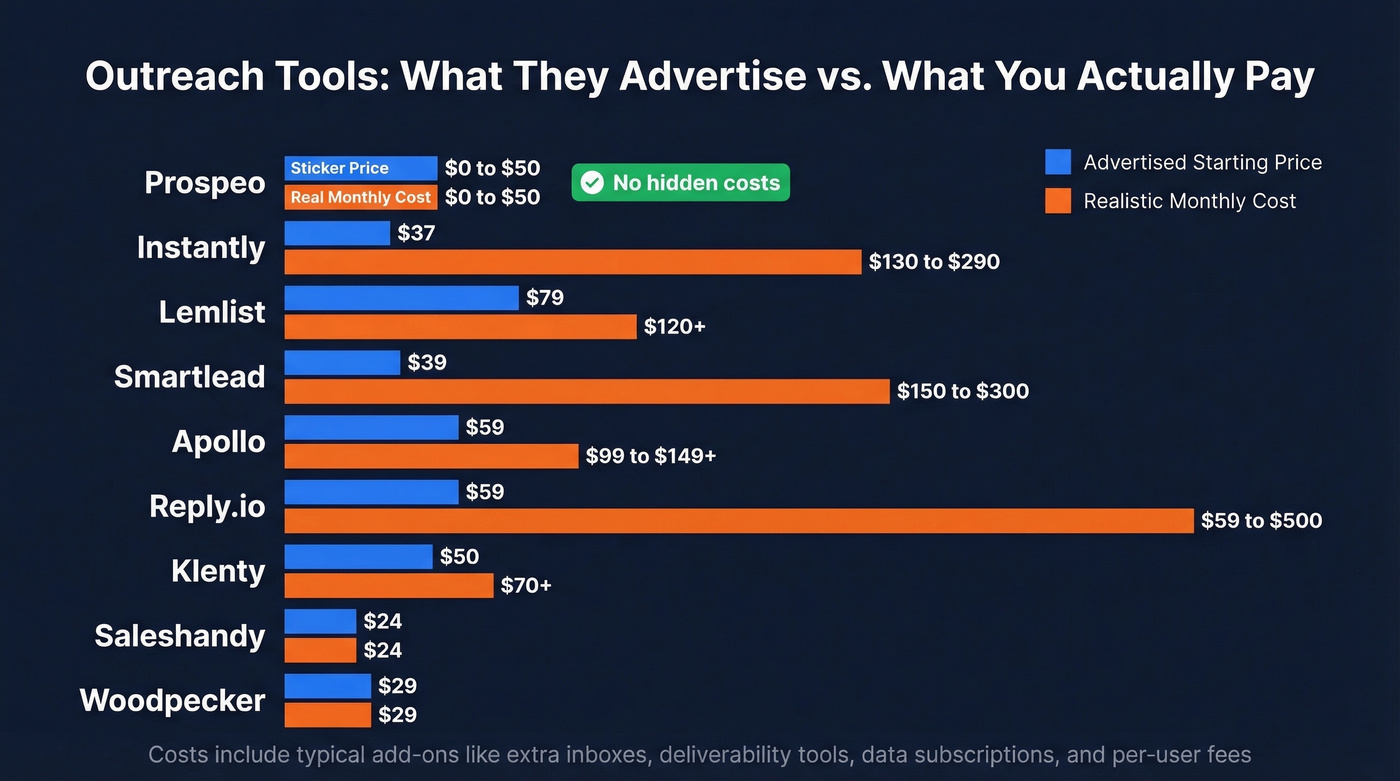
| Tool | Sticker Price | Real Monthly Cost | What's Hidden |
|---|---|---|---|
| Prospeo | Free / ~$0.01/email | $0-$50/mo | Nothing hidden |
| Instantly | $37/mo | $130-$290/mo | Leads DB + CRM separate |
| Lemlist | $79/user/mo | $120+/user/mo | Senders, calling, deliverability |
| Smartlead | $39/mo | $150-$300/mo | Servers, infrastructure, SmartDelivery |
| Apollo | $59/user/mo | Variable | Credits expire, cost varies |
| Klenty | $50/mo | $70+/user/mo | Dialer locked to Growth |
Let's be honest: if your average contract value is in the low five figures, you probably don't need anything beyond the Starter stack below. Teams spending $300+/mo on automation before they've validated their ICP are solving the wrong problem.
Build Your Stack (3 Budgets)
Starter ($100-$150/mo): Prospeo for verified contacts + Instantly Outreach or Saleshandy for sending. This covers Layer 1 and Layer 2 cleanly - verified data and a capable sequencer without complexity.
Growth ($250-$400/mo): Prospeo for data + Lemlist Multichannel or Smartlead Pro for sending and deliverability. Add multichannel sequences or advanced inbox placement testing depending on your outreach style. In our experience, this is where most 2-5 person sales teams land once they've proven their messaging works.
Enterprise ($500+/mo): Apollo Organization or Outreach.io for the all-in-one platform + a dedicated data enrichment layer for verification. Even enterprise platforms benefit from a data quality check - bad emails tank sequences regardless of how sophisticated your platform is.
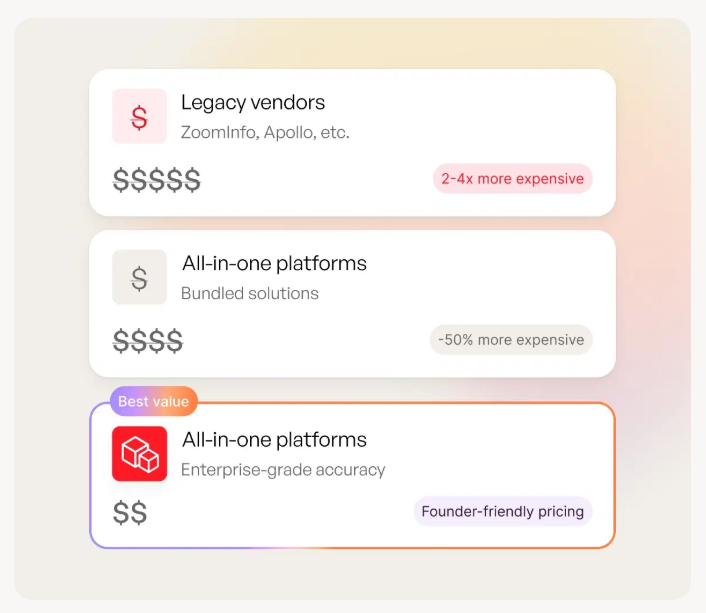
You don't need sixteen tools. Pair Prospeo with Instantly or Lemlist and you have a production-ready outreach stack under $100/mo. Native integrations with Instantly, Lemlist, Smartlead, and HubSpot - no Zapier tax. 125M+ verified mobiles for when email alone isn't enough.
Stop paying $1/lead when $0.01 gets you higher accuracy.
Mistakes That Kill Performance
Five things that wreck campaigns faster than picking the wrong sequencer:
- Sending to unverified data. Run every list through an email verification tool before loading it into your sequencer. A 10% bounce rate will torch your domain reputation in days.
- Skipping email warmup. New inboxes need 2+ weeks of warmup before you send a single cold email. No shortcuts.
- Too many emails per inbox. Cap at 20/day per inbox. Pushing 50+ is how you end up in spam folders permanently.
- No SPF/DKIM/DMARC. These authentication records take 10 minutes to set up. Without them, ISPs treat your emails as suspicious by default.
- Not tracking bounce rates. Nearly half of senders don't track bounce rates. If you can't measure it, you can't fix it.
I'll add one more that doesn't get enough attention: not segmenting by ISP. Your Microsoft-hosted prospects need different volume and timing strategies than your Google-hosted ones, and lumping them together drags down your overall placement.
Outreach Tools FAQ
What's the best free tool to start outbound?
How many tools do I actually need?
Most teams need two: a data source and a sequencer. Add a deliverability layer once you're sending 5,000+ emails/month. More than three systems usually adds busywork - exports, deduping, field mapping - without improving reply rates.
What reply rate should I expect?
A realistic baseline is 1-4% replies, and 5%+ is achievable with tight targeting and real personalization. If you're under 1%, fix list quality and segmentation first, then iterate subject lines and offers.
How do I keep cold email out of spam?
Set up SPF, DKIM, and DMARC, warm inboxes for 2+ weeks, and keep volume around 20 emails per inbox per day. Aim for under 3% bounces and 0.1-0.3% complaints. Once you miss those thresholds, placement drops fast.
Pick Fewer, Better Outreach Tools
Most teams don't have an "automation" problem - they have a list-quality and deliverability problem. Start with verified contacts, add a sequencer that matches your channel mix (Instantly for volume, Lemlist for multichannel), and only then pay for advanced deliverability or AI. That's how you build an outreach stack that actually books meetings instead of burning domains.