

Pain Points: What They Are & How to Find Them
"Pain points" is the most overused phrase in business that nobody can actually define. Ask five people on your team and you'll get five different answers - one says it's a problem, another says it's a feeling, a third just gestures vaguely at the whiteboard. That confusion costs you. It's why your sales notes say "prospect has pain around efficiency" and your product team has no idea what to build next.
Here's the core distinction: pain points aren't problems. They're the experience of living with the problem. Two prospects can share the exact same problem and feel completely different pain. That changes everything about how you sell, build, and prioritize.
What Are Pain Points, Really?
A thread on r/copywriting captures the confusion perfectly. The poster asks: are pain points the specific problems customers face, or are they what customers feel because of those problems? The answer is the second one - and getting this wrong cascades into bad copy, bad product decisions, and bad sales conversations.
Take weight loss. Two people are overweight. Same problem. But a 20-year-old college student's frustration is social anxiety at parties, while a 31-year-old mother's frustration is not having the energy to keep up with her kids. Same problem, completely different emotional experiences. If you're selling a fitness product and you treat "overweight" as the pain point, you'll write generic copy that resonates with nobody.
So what are they in practical terms? A pain point is the friction, frustration, or cost that a person experiences because a problem exists in their world. It's contextual. It's role-dependent. It's emotional. And it's the thing that actually drives behavior change - not the problem itself.
Stop treating identification as a brainstorming exercise. Most teams sit in a room and guess. That's not identification - that's projection.
Pain Points vs. Problems vs. Needs
The cleanest framework here comes from Jobs-to-Be-Done thinking. Understanding the distinction precisely is what separates teams that build the right thing from teams that build the obvious thing.
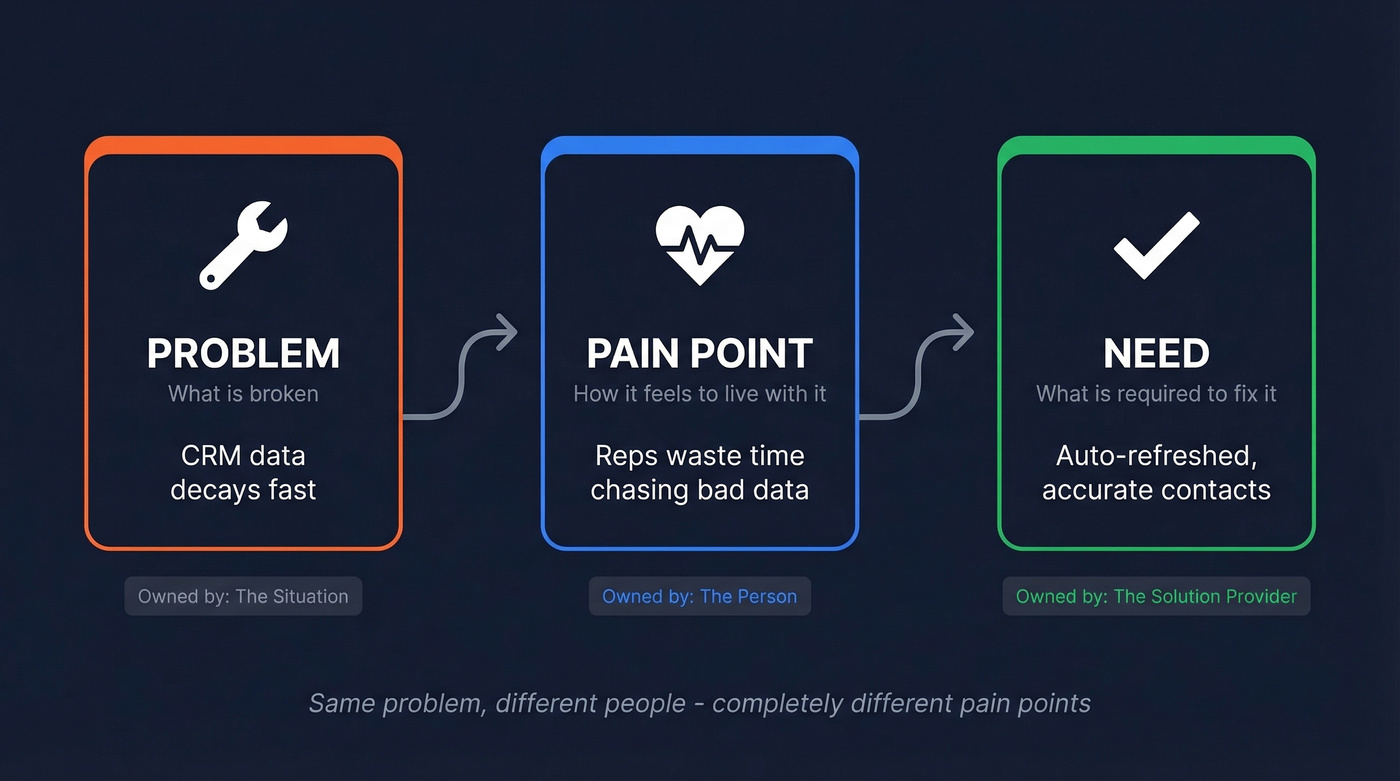
| Problem | Pain Point | Need | |
|---|---|---|---|
| Definition | What's broken | How it feels to live with it | What's required to fix it |
| Example | CRM data decays fast | Reps waste time chasing bad data | Auto-refreshed, accurate contacts |
| Who owns it | The situation | The person in it | The solution provider |
These frustrations can be solution-dependent or job-dependent, and the distinction matters. "Passwords are hard to remember" is a solution-dependent pain point - it only exists because we chose passwords as an authentication method. Job-dependent ones exist regardless of the current solution. When you anchor to solution-dependent issues, you get incremental fixes. When you anchor to the job, you get innovation.
Without the parent job context, you're comparing apples to oranges. A complaint about "slow onboarding" means something completely different for a VP of Sales (lost revenue) versus an IT admin (ticket overload).
The 6 Types of Pain Points
Six categories give you broad diagnostic coverage. Some frameworks use four; we've found six delivers better precision without overcomplicating things.
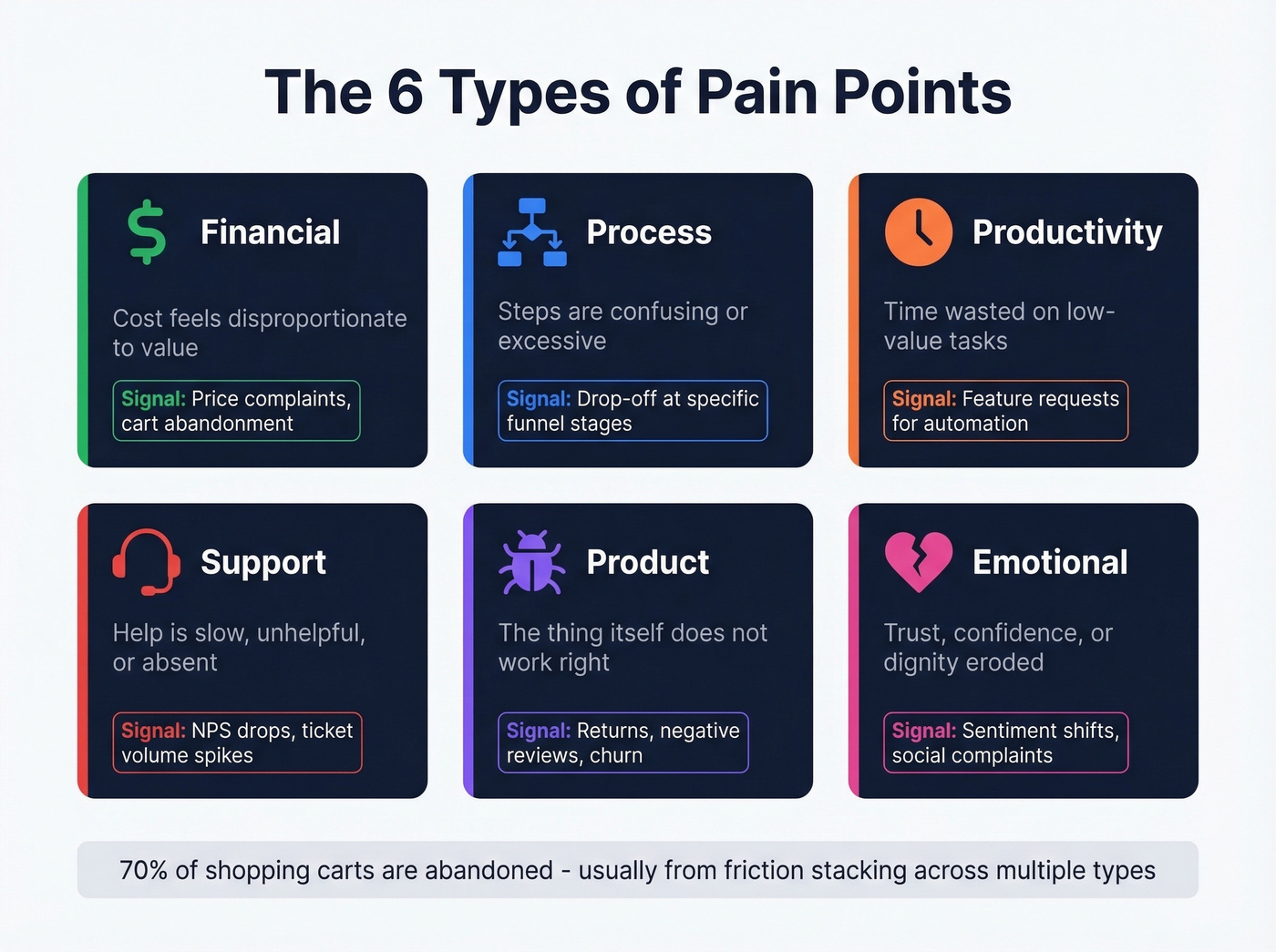
| Type | Definition | Example | Signal to Watch For |
|---|---|---|---|
| Financial | Cost feels disproportionate to value | Ticketmaster hidden fees | Price complaints, cart abandonment |
| Process | Steps are confusing or excessive | Forced account creation | Drop-off at specific funnel stages |
| Productivity | Time wasted on low-value tasks | Manual entry across 3 systems | Feature requests for automation |
| Support | Help is slow, unhelpful, or absent | 30+ min hold times, transfers | NPS drops, support ticket volume |
| Product | The thing itself doesn't work right | BlackBerry Storm touchscreen | Returns, negative reviews, churn |
| Emotional | Trust, confidence, or dignity eroded | Feeling judged during support | Sentiment shifts, social complaints |
Financial and process friction often compound. 70% of shopping carts are abandoned before checkout - and the biggest driver is friction stacking. Hidden shipping costs revealed at the last step. Mandatory account creation. A coupon field that makes you feel like you're overpaying. Each one alone is tolerable. Together, they're a wall.
The BlackBerry Storm is a useful cautionary tale. The hardware shipped with glitchy software and an unresponsive touchscreen, but the real damage was emotional - loyal users felt the brand didn't respect their trust. That's what turned a bad product into a brand-damaging event.
One nuance worth calling out: not all friction is bad. Fraud verification steps, confirmation dialogs, cooling-off periods - these create friction that serves the customer. The distinction is whether the friction protects the customer or protects the company's convenience.
Three Levels Where Pain Points Live
The Nielsen Norman Group's framework is the most useful model we've encountered for this. Each level requires different methods to uncover and different resources to fix.
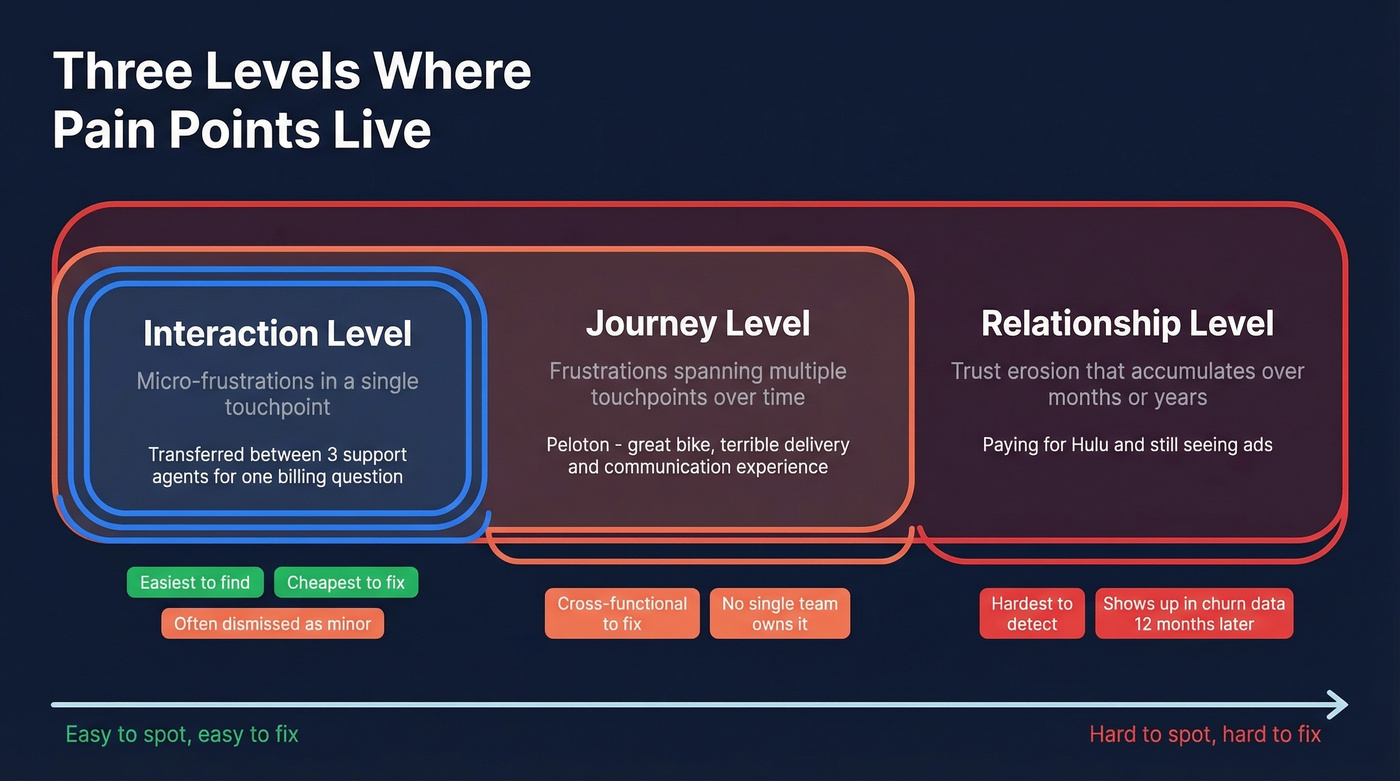
Interaction Level
These are the micro-frustrations. Being transferred between three support agents to resolve a billing question. A search bar that doesn't understand natural language. A mobile checkout flow that resets when you switch apps.
Interaction-level issues are usability problems - the easiest to identify through testing and the cheapest to fix. But they're also the ones teams most often dismiss as "minor." In our experience, these dismissed micro-frustrations drive churn disproportionately because they happen every single time a customer touches the product.
Journey Level
Journey-level frustrations span multiple touchpoints and time. The classic example: Peloton's delivery experience during peak demand. The bike itself was fine. But weeks-long delivery delays, inflexible rescheduling windows, and poor communication between order confirmation and arrival created a journey-level issue that overshadowed the product entirely. These require cross-functional fixes - no single team owns them, which is exactly why they persist.
Relationship Level
Relationship-level issues accumulate over months or years. Paying for Hulu and still seeing ads. A bank that charges overdraft fees while running "we care about you" campaigns.
These are trust erosion problems, and they're the hardest to detect because they don't show up in any single interaction. They show up in churn data, twelve months later, when the customer quietly leaves without telling you why.

You just read about CRM data decay as a pain point. It's real - reps waste hours chasing bad numbers and bounced emails. Prospeo refreshes every record on a 7-day cycle (not the 6-week industry average), so your team stops experiencing the frustration of dead-end outreach.
Kill your team's #1 productivity pain point for $0.01 per verified email.
How to Identify Pain Points
You ran a survey and got 200 responses with 40 issues. Your product team asks which to fix first. You don't have an answer. That's the gap most teams hit - they collect feedback but can't connect it to decisions.
Customer Feedback & Analytics
The best identification systems pull from multiple sources simultaneously. NPS and CSAT scores give you the temperature. Open-ended survey responses give you the language customers actually use. Product analytics - bounce rates, funnel drop-offs, heatmaps - give you the behavior. Social listening and review mining give you the unfiltered truth.
The key is triangulation. A single source lies. A customer says they love your product in a survey, then churns three months later. Analytics show a 40% drop-off at step 3 of onboarding, but nobody complains about it in support tickets. You need all the signals together to see the real picture.
Sales Discovery Calls
Here's the thing: most sales reps are handed a product-centric script and told to "find pain." That's like handing someone a hammer and telling them to find nails. A common theme on r/sales is that reps feel blocked when they don't have ICP context or a structured discovery framework - they end up asking surface-level questions and getting surface-level answers.
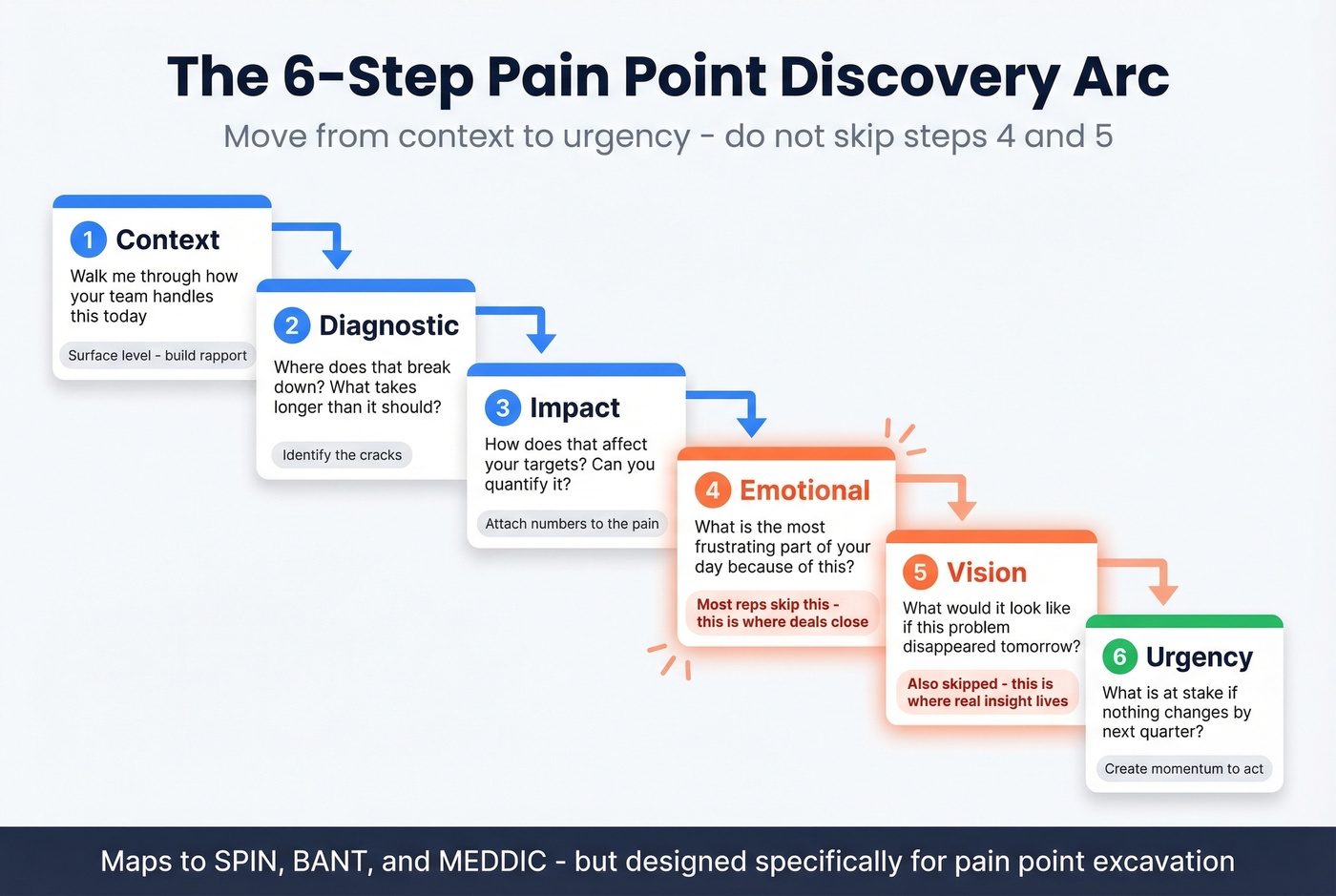
The fix is a six-step question arc that moves from context to urgency:
- Context - "Walk me through how your team handles [process] today."
- Diagnostic - "Where does that break down? What takes longer than it should?"
- Impact - "How does that affect your targets? Can you quantify it in time or money?"
- Emotional - "How has this influenced your day-to-day? What's the most frustrating part?"
- Vision - "What would it look like if this problem disappeared tomorrow?"
- Urgency - "What's at stake if nothing changes by next quarter?"
This arc maps to SPIN, BANT, and MEDDIC frameworks, but it's designed specifically for pain-point excavation rather than qualification. The emotional and vision steps are where most reps skip - and where the real insight lives. We've coached teams through these calls, and the emotional step consistently surfaces the insight that actually closes deals.
But the best discovery framework in the world is useless if your contact data is wrong. When bounce rates hit 35-40%, you're not just losing leads - you're losing the conversations where these frustrations get uncovered. Prospeo's 98% email accuracy and 7-day data refresh cycle mean your discovery calls actually happen.
Journey-Mapping Workshops
Journey mapping is the most underused identification method in B2B. The NN/g workshop format gives you a structured process: assemble a cross-functional team - sales, support, product, and at least one customer-facing role - then pick one actor and one scenario per map. Don't try to map everything at once.
Share existing research as pre-work so the room starts from data, not assumptions. We've facilitated over a dozen of these workshops, and the pre-work step is where most fail - teams skip it and spend the first hour arguing about basics instead of building on what they already know.
From there, map the current state as a hypothesis, evolve it with real customer input, identify and prioritize issues within the journey context, then sketch the future state with the top problems resolved. The workshop format forces specificity. You can't say "customers are frustrated with onboarding" when you're mapping each step. You have to say which step, what happens, and who it affects.
How to Prioritize Pain Points
You've identified 40 issues. You can fix five this quarter. Here's how to pick.
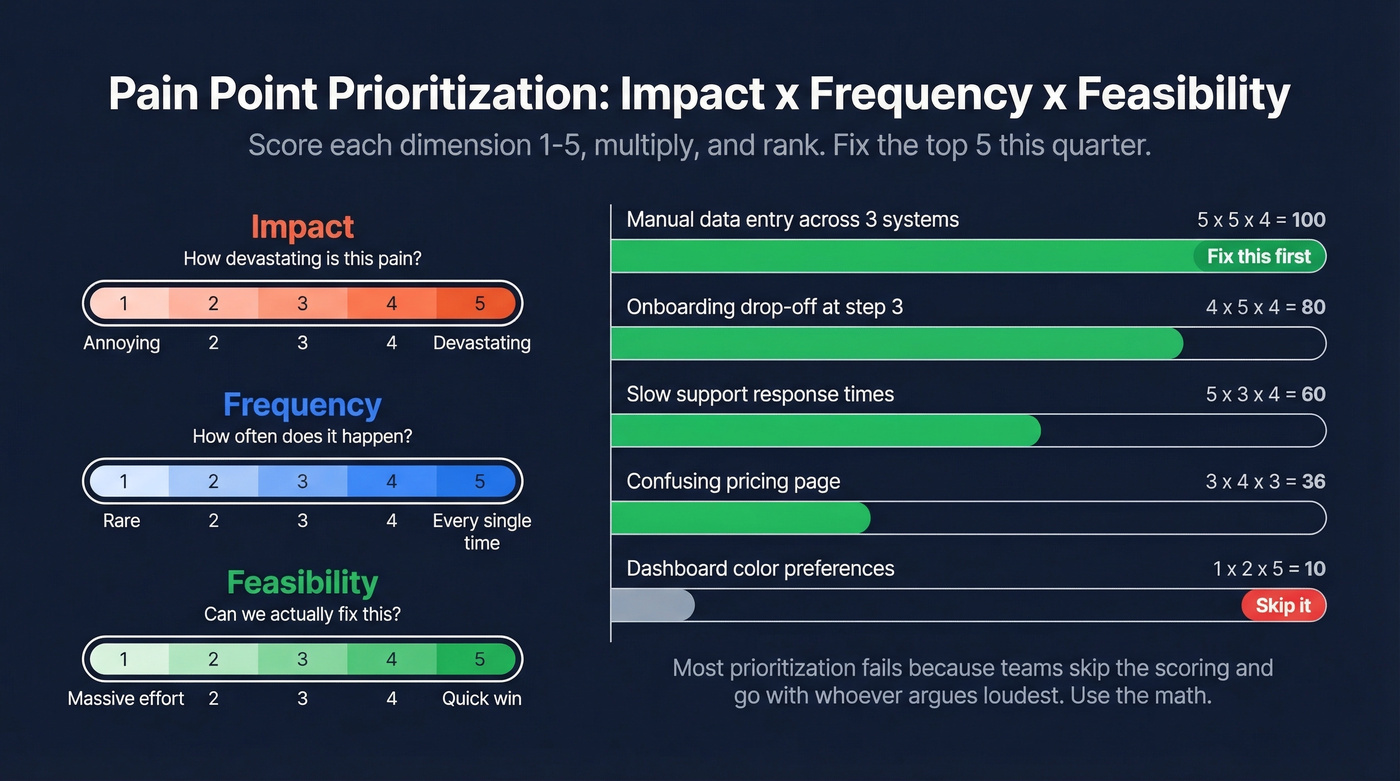
Real talk: most prioritization fails because teams skip the scoring and go with whoever argues loudest. The simplest framework that actually works is Impact x Frequency x Feasibility. Score each dimension 1-5, multiply, and rank. A frustration that's devastating (5) but rare (1) and hard to fix (1) scores 5. One that's moderate (3) but constant (5) and easy to fix (4) scores 60. The math does the arguing for you.
For interaction-level issues, severity combines impact, frequency, and the likelihood of repeat encounters - a confusing checkout flow that every customer hits once is worse than a confusing settings page that 5% of users visit. For journey-level issues, factor in organizational feasibility, since these often require process changes that cross team boundaries and need executive sponsorship to actually ship.
The JTBD lens matters here too. Without the parent job context, you can't meaningfully compare items. "Slow page load" and "unclear pricing" both score high, but if the customer's job is "evaluate vendors quickly," unclear pricing is the bigger blocker. Always prioritize within the context of what the customer is trying to accomplish.
If your average deal size is under $10k, you probably don't need to fix all 40 issues. Fix the three that show up in churn interviews and move on. Perfectionism in resolution kills more roadmaps than bad prioritization does.
The Cost of Ignoring Pain Points
The numbers are brutal. Customer churn costs U.S. businesses $168 billion per year. The average churn rate sits at 21%. And 72% of customers will switch to a competitor after just one bad experience. One.
The flip side: a 5% reduction in churn can boost revenue by 25-95%. New customers spend 67% less than returning customers, so every customer you keep compounds. Teams that systematically identify and resolve frustrations aren't just improving satisfaction scores - they're building a revenue moat.
In B2B specifically, 85% of buyers report frustrations when ordering online. A third of online B2B orders contain errors. And 59% of CMOs say they lack sufficient budget to execute their strategy. Teams are being asked to do more with less while their customers are already frustrated - and the teams that systematically resolve these issues are the ones that survive the squeeze.
Pain Point Examples by Industry
B2B eCommerce
The data here is stark. 81% of B2B buyers experience frustration from wrong stock levels or inaccurate shipping estimates - and 75% of those buyers are willing to switch suppliers over it. 68% have been discouraged from using online ordering platforms entirely due to errors. The issues cluster around data reliability: inconsistent delivery times (31%), inaccurate pricing (29%), and inaccurate stock levels (28%).
B2B Marketing & RevOps
Picture a mid-market marketing team of six people running demand gen, content, events, and ABM - with enterprise expectations and startup resources. That's the reality for 48% of B2B marketing leaders who cite budget and headcount cuts as their top challenge. Nearly 90% of these teams face attribution challenges because their data lives in five different tools that don't talk to each other. And 63% say reaching the right audience is a top challenge - not because the audience doesn't exist, but because fragmented data makes them invisible.
Sales & Outbound
Let's break this down with real numbers. A team of 5 SDRs, each making 80 dials a day. That's 400 dials. With a typical 3% connect rate on unverified data, they get 12 conversations. Half of those are wrong numbers or gatekeepers. The remaining six are cold opens with no context.
The frustrations are structural: generic scripts with no ICP context, contact data that decays faster than teams realize, and low connect rates that turn activity metrics into vanity metrics. The result is a team that's busy but not productive - burning budget and morale simultaneously. Skip this section if your connect rates are already above 15%; you've already solved the data problem. For everyone else, this is where the pipeline actually breaks.
Process friction compounds - you said it yourself. Manual data entry across systems, stale contacts, bounced emails stacking up. Prospeo's 92% enrichment match rate and native integrations with Salesforce, HubSpot, and 8+ tools eliminate the friction that makes reps hate prospecting.
Stop projecting pain points onto your sales team - remove them entirely.
FAQ
What's the difference between a pain point and a problem?
A problem is what's broken; a pain point is how it feels to live with what's broken. A sales rep with an outdated CRM feels the pain of manual data entry, while a VP with the same CRM feels the pain of unreliable forecasts. Same problem, different pain - and each requires a different solution approach.
What are the four main types of pain points?
Financial, process, productivity, and support are the classic four categories. Many frameworks add product and emotional as fifth and sixth types. The right taxonomy depends on your business - what matters is consistent categorization so you can prioritize and assign ownership across teams.
How do you identify pain points in B2B sales?
Use structured discovery calls with a six-step question arc: context, diagnostic, impact, emotional, vision, urgency. Supplement with behavioral data and VOC research from reviews and social listening. Accurate contact data is the prerequisite - if your emails bounce, those discovery calls never happen.
Can pain points be positive?
Some friction is intentional and helpful - fraud verification, confirmation dialogs, cooling-off periods. The key distinction is whether friction serves the customer's interest or the company's convenience. The best products know exactly where to add friction and where to remove it.