

People-Based Marketing: What It Is, Why It Matters, and How to Do It
Your demand gen team just ran a "targeted" campaign. The results: 12% open rate, 28% bounce rate, and the three replies you did get came from people who aren't even on the buying committee. You targeted an account. You didn't target the people who actually sign the check.
That's the gap people-based marketing exists to close. Here's the hot take most vendors won't give you: if your average deal size is under $30k and your CRM bounce rate is above 10%, you don't need a six-figure platform. You need clean data and a process. Everything else is premature optimization.
What Is People-Based Marketing?
People-based marketing (PBM) is the practice of targeting known individuals - real humans with resolved identities - across channels and devices, rather than targeting cookies, device IDs, or anonymous audience segments. Where traditional digital marketing says "show this ad to anyone on a device that visited our pricing page," PBM says "show this ad to Sarah Chen, VP of Engineering at Acme Corp, who visited our pricing page on her laptop and opened our email on her phone."
Cookies and device IDs are proxies. They approximate a person. PBM skips the approximation and works with verified identities.
If your buzzword detector is going off, you're not alone. A practitioner on r/DigitalMarketing called ABM a "buzzword" for what's essentially good segmentation plus tailored content. PBM risks the same fate if you treat it as a label instead of an operating model. The real test is whether you've built the identity infrastructure to resolve and reach individuals - or you're just renaming your existing campaigns.
PBM vs ABM: What's Different
ABM targets accounts. PBM targets the people inside those accounts. Most teams need both, but understanding the distinction changes how you build your stack and measure results.
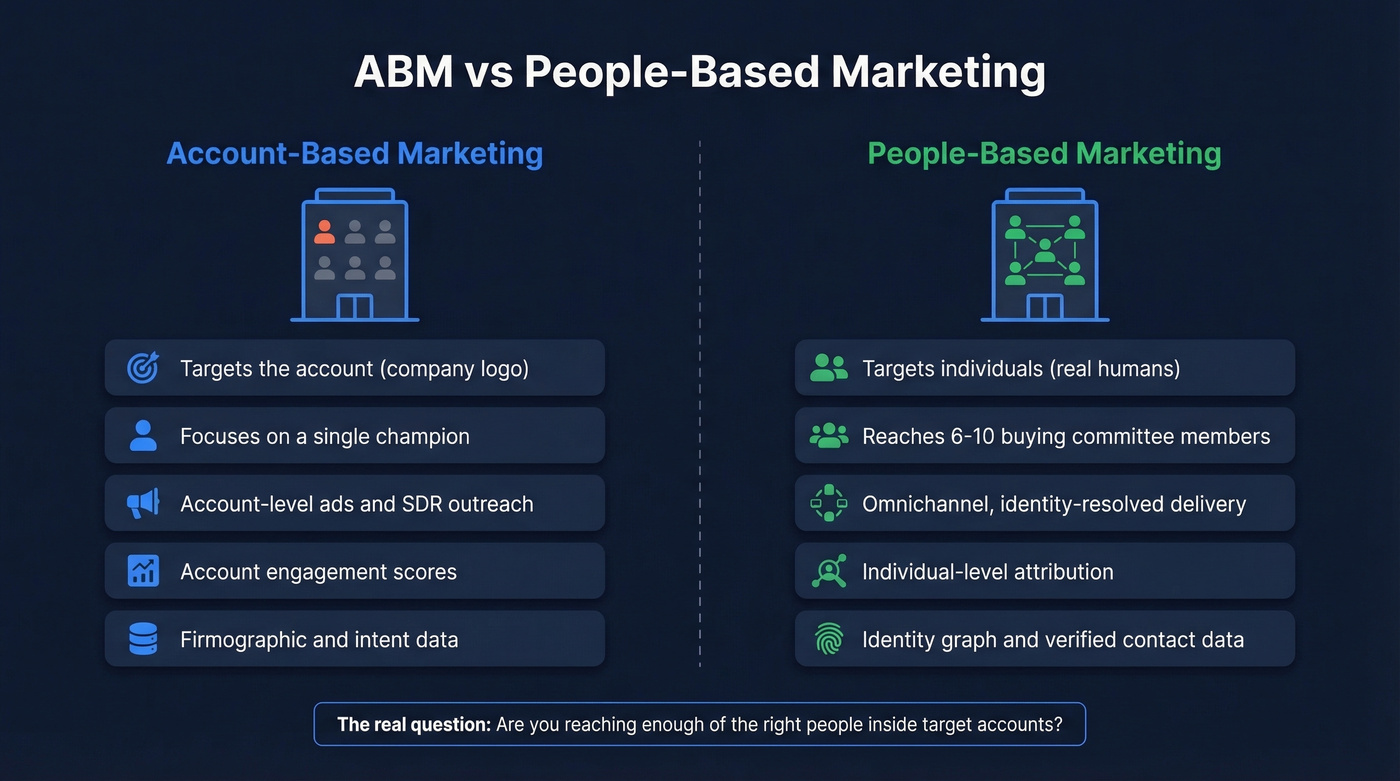
| ABM | PBM | |
|---|---|---|
| Target unit | Account (company) | Individual (person) |
| Typical focus | Single champion | 6-10 buying committee members |
| Channel model | Account-level ads, SDR outreach, events | Omnichannel, identity-resolved |
| Measurement | Account engagement score | Individual-level attribution |
| Data dependency | Firmographic + intent | Identity graph + contact data |
One useful nuance: PBM operates at two levels. At the buying-group level, you're reaching the full committee within a target account. At the individual level, you're running personalized sequences for a single high-value decision-maker. Most B2B teams start with buying-group plays and layer in individual-level orchestration for enterprise deals.
ContactLevel reports that PBM-oriented approaches drive 67% faster deal velocity, 85% higher close rates, and 40% larger deal sizes compared to single-champion ABM. Those are vendor numbers, so treat them as directional - but the logic is obvious. Reaching six decision-makers instead of one improves your odds.
The real question isn't "PBM or ABM?" It's "Am I reaching enough of the right people inside my target accounts?"
Why PBM Matters in 2026
Three forces are stacking up to make identity-resolved marketing a necessity rather than a nice-to-have.
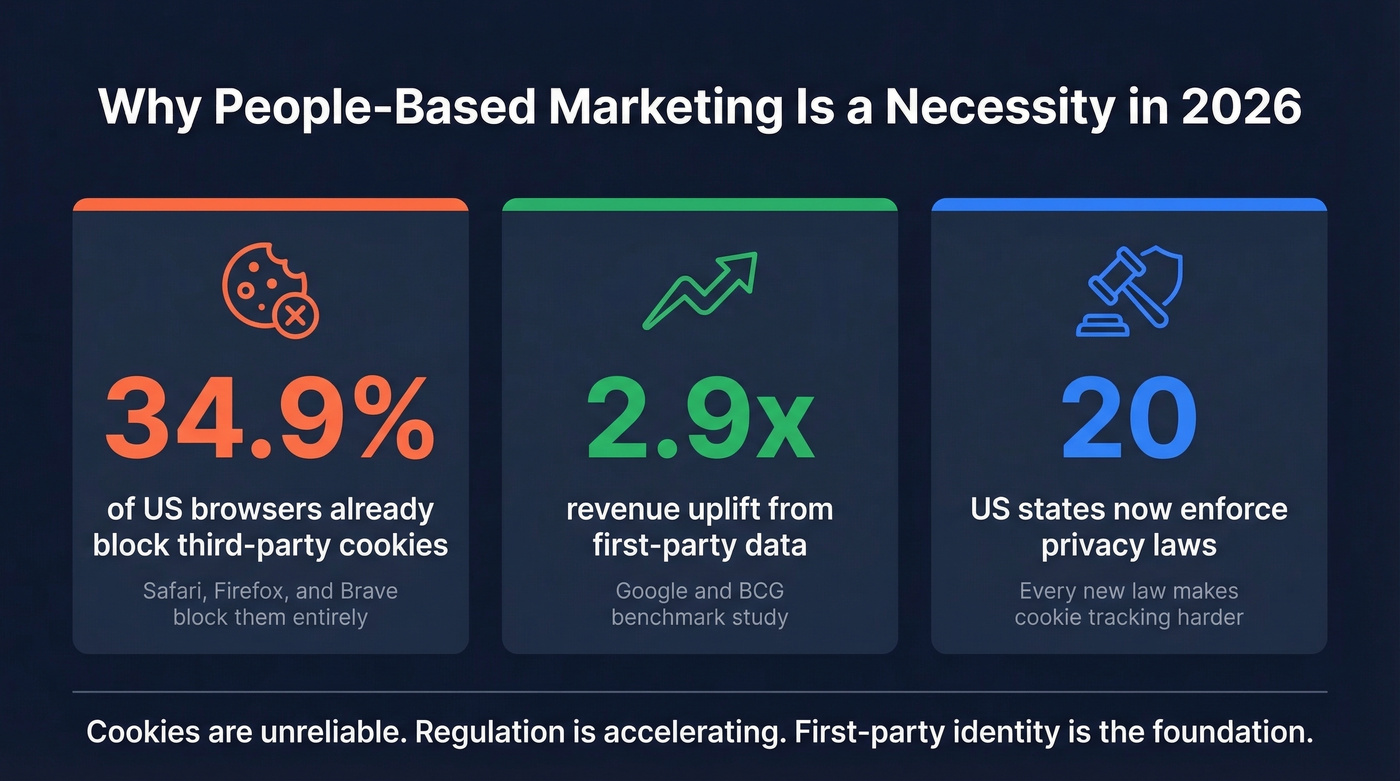
The cookie situation is a mess. Google reversed Chrome's cookie deprecation in April 2025, then scrapped its Privacy Sandbox plans entirely by October 2025. But that doesn't mean cookies are reliable - 34.9% of US browsers already block third-party cookies by default. Safari, Firefox, and Brave block them entirely. If a third of your audience is invisible to cookie-based targeting, that's not a minor gap. That's a structural problem.
Regulation keeps expanding. Twenty US states now enforce privacy laws. GDPR remains the standard in Europe. Every new law makes cookie-based tracking harder and first-party data more valuable.
First-party data delivers measurably better results. A Google/BCG benchmark study found that companies using first-party data across key marketing functions see 2.9x revenue uplift and 1.5x cost savings. A separate BCG 2024 study of 2,000 marketing executives found that AI leaders with an integrated customer view report 60% greater revenue growth than peers. An Econsultancy survey found 62% of brand marketers say first-party data will become more important over the next two years.
PBM isn't a trend. It's the infrastructure that makes marketing work when cookies are unreliable and privacy regulation is accelerating. For B2B teams especially, it represents a shift from broad demand generation - where you cast a wide net and hope the right people self-select - to a model where you know exactly who you're reaching.
How People-Based Marketing Works
The Data Foundation
PBM runs on four layers of data. Zero-party data is what customers explicitly share - preferences, survey responses, stated needs. First-party data comes from your own interactions: purchase history, website behavior, app usage, loyalty programs. Second-party data is another company's first-party data shared through a partnership. Third-party data fills gaps from external providers.
First-party data is the foundation. It's the most accurate, the most compliant, and the most defensible. Acxiom's research shows consumers are 66% more likely to buy from brands that treat them as individuals - and that treatment starts with knowing who they actually are.
Identity Resolution
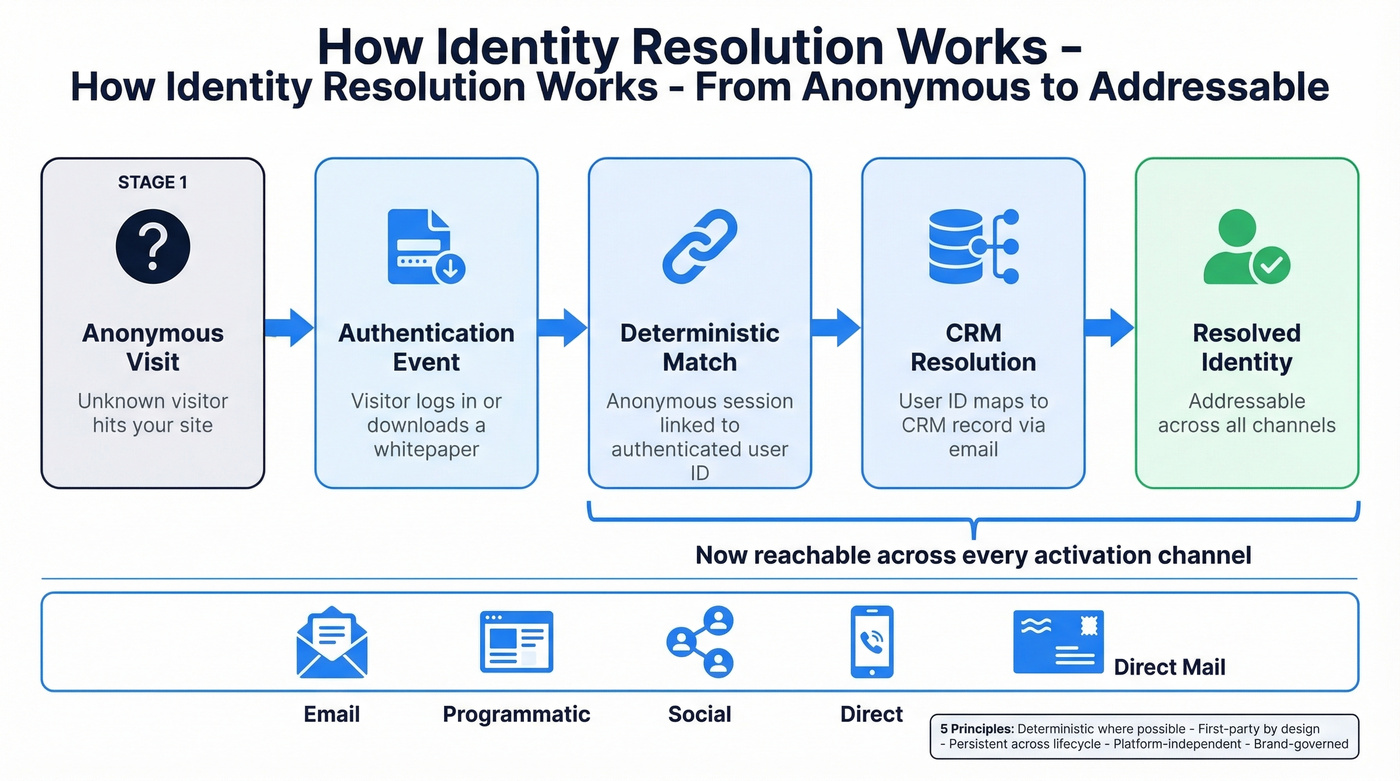
Identity resolution connects scattered data points - an email here, a device ID there, a CRM record somewhere else - into a single, addressable profile. Three methods power this:
Deterministic matching uses exact identifiers like email addresses, phone numbers, or customer IDs. It's the most accurate, hitting up to 90% accuracy. Probabilistic matching uses statistical inference to connect likely-related data points. Heuristic matching applies rules-based logic ranging from strict to loose.
In practice, ID bridging works like this: a visitor hits your site anonymously. They log in to download a whitepaper - now you've linked their anonymous session to an authenticated user ID. That user ID maps to a CRM record via their email. Their hashed email connects to ad platform identifiers. Five minutes ago they were anonymous. Now they're a fully resolved identity you can reach across programmatic, email, social, and direct channels.
Five principles should govern your identity architecture:
- Deterministic where possible
- First-party by design
- Persistent across the customer lifecycle
- Independent from media platforms
- Brand-governed
Activation and Measurement
Once you've built unified profiles, activation follows. You coordinate messaging across programmatic, email, social, and direct channels from a single identity - not from fragmented audience segments. PBM extends beyond digital, too. Matching CRM data to offline touchpoints like in-store purchases, event attendance, or direct mail creates a truly omnichannel view.
The data onboarding workflow starts with CRM data (emails, phone numbers, purchase history) getting matched to digital identifiers (device IDs, browsing behavior, platform logins). PII gets anonymized, and profiles get distributed to media platforms for targeting. Facebook Custom Audiences was one of the earliest PBM implementations - matching CRM emails to Facebook user IDs. The concept has since expanded across every major platform.
Measurement shifts too. Instead of aggregate campaign metrics, you get closed-loop, individual-level attribution. You can trace Sarah Chen's journey from first ad impression through email engagement to closed deal.
One warning worth surfacing early: Global Privacy Control signals create attribution black holes in some states, making certain users invisible to measurement. More on that in the compliance section - but build your models knowing that gap exists from day one.

You can't do people-based marketing with bad contact data. Prospeo gives you 98% verified emails and 125M+ direct dials for every member of the buying committee - not just the single champion you already know.
Resolve real identities with data that actually connects.
How to Implement PBM: A 6-Step Framework
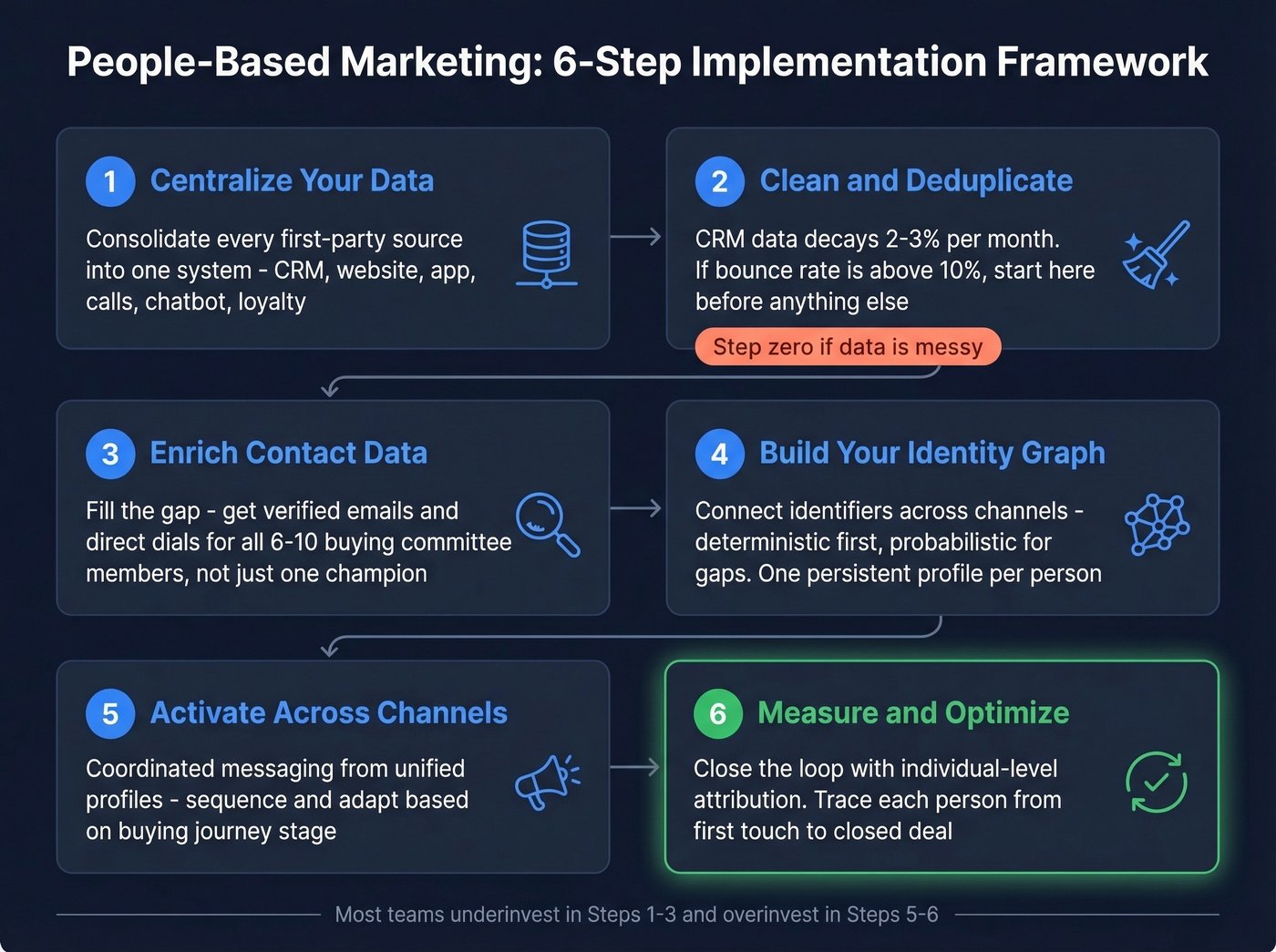
1. Centralize Your Data
Consolidate every first-party data source into a single system - CRM or CDP. Purchase history, website interactions, app behavior, call center logs, chatbot transcripts, loyalty program data. If your data lives in six different tools with no connection between them, you don't have a data foundation. You have a data mess.
2. Clean and Deduplicate
CRM data decays 2-3% per month. Roughly 30% of your database needs cleansing annually. If your email bounce rate is above 10%, this is step zero - before you buy any platform, before you build any identity graph. We've seen teams discover they had three records for the same VP of Sales, each with different (and conflicting) data. Deduplication isn't optional.
3. Enrich Contact Data
Most teams hit the same gap: your CRM has names and titles for target accounts, but it doesn't have verified emails and direct dials for the 6-10 people on the buying committee. You know the account. You don't know how to reach the humans.
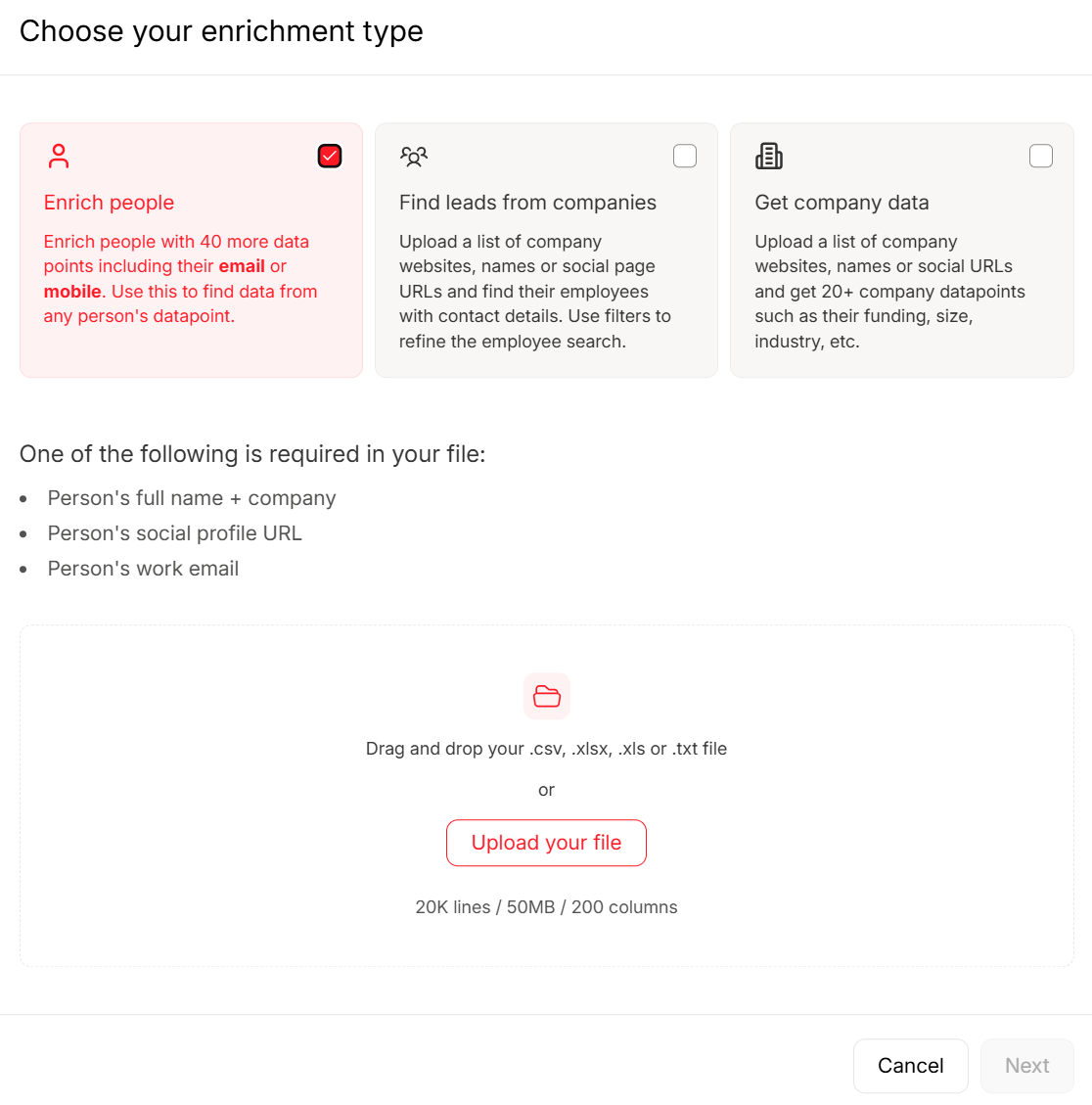
Tools like Prospeo solve this specific problem - 300M+ professional profiles with 98% email accuracy and a 7-day refresh cycle compared to the 6-week industry average. Upload a CSV or connect your CRM, and enrichment returns 50+ data points per contact. For a PBM strategy, the ability to quickly build out a full buying committee with verified contact data is the difference between targeting an account logo and reaching the actual decision-makers.
4. Build Your Identity Graph
Connect identifiers across channels. Start with deterministic linking - match emails to CRM IDs to ad platform identifiers. Layer in probabilistic matching for the gaps. The goal is a persistent, unified profile for each individual that works across every activation channel.
5. Activate Across Channels
Run coordinated messaging from unified profiles across programmatic, email, social, and direct channels. Sarah Chen should see a coherent narrative, not random ads from disconnected campaigns. Let's be honest - most "omnichannel" campaigns are really just the same message copy-pasted into different platforms. Real PBM orchestration means sequencing and adapting the message based on where each person is in their buying journey.
6. Measure and Optimize
Close the loop with individual-level attribution. Track each person's journey from first touch to closed deal. Then feed those signals back into your identity graph to sharpen targeting for the next cycle.
PBM requires reaching 6-10 decision-makers per account with verified contact data. Prospeo's 300M+ profiles, 30+ filters, and 7-day refresh cycle give you the identity infrastructure this article describes - at $0.01 per email.
Stop targeting accounts. Start reaching the people who sign the check.
PBM Tech Stack: What You Need
You don't need every category on day one. Start with CRM + enrichment, then layer in identity resolution and intent data as you scale. Skip the clean room entirely unless you're running enterprise-scale data partnerships - for most mid-market teams, it's overkill.
| Category | Purpose | Example Vendors | Price Range |
|---|---|---|---|
| CRM | Single source of truth | Salesforce, HubSpot | Salesforce: ~$25/user/mo+; HubSpot: Free CRM, paid ~$800/mo+ |
| CDP | Unified customer profiles | Segment, mParticle | ~$1K-$3K/mo to start |
| Identity Resolution | Cross-channel ID matching | LiveRamp, FullContact | LiveRamp: $50K-$200K+/yr; FullContact: $99-$300/mo |
| Data Enrichment | Verified emails + phones | Prospeo, Clearbit | Free tier available - ~$0.01/email |
| Intent Data | In-market buyer signals | Bombora (standalone) | $25K-$50K/yr standalone |
| Clean Room | Privacy-safe data matching | Snowflake, Habu | $50K-$150K+/yr enterprise |
| Activation | Omnichannel orchestration | DV360, The Trade Desk | CPM-based, varies by spend |
A Reddit practitioner moving to PBM flagged that "no one or two partners can do it all, and there is a lot of overlap." That's accurate. Start lean and add layers as your data maturity grows.
Privacy and Compliance
GDPR vs CCPA/CPRA
GDPR requires opt-in consent before processing personal data. CCPA/CPRA uses an opt-out model - you can process data by default, but consumers can tell you to stop. Both carry real penalties. GDPR fines run up to EUR 20M or 4% of global turnover. CCPA penalties hit $7,500 per intentional violation.
CPRA applies if you meet any of these thresholds: $26.625M+ in annual revenue, processing 100K+ California residents' personal information annually, or deriving 50%+ of revenue from selling or sharing personal information. Many teams running PBM at scale qualify.
GPC and Attribution Black Holes
Global Privacy Control is a browser-level signal that functions as a legally binding opt-out in multiple US states. When a user's browser sends a GPC signal, you must treat it as a "do not sell or share" request. These users become invisible to your tracking and attribution - and your optimization signals get distorted because you're working with an incomplete picture.
Your consent management platform needs state-aware rule sets, server-side GPC detection, and IP-based geolocation to trigger the right consent flows. This is the most underrated compliance risk in PBM today, and we haven't seen a single top-ranking guide on this topic even mention it.
Quick Compliance Checklist
- "Do Not Sell or Share My Personal Information" link on your site
- "Limit the Use of My Sensitive Personal Information" option
- Automatic GPC signal recognition and enforcement
- Consent UX audit - no dark patterns
- IP-based geolocation for state-specific consent rules
- Regular data processing inventory updates
Common PBM Mistakes
Starting without clean data. If 30% of your CRM needs cleansing and your bounce rate is above 10%, no platform will save you. Fix the foundation first.
Over-investing in platforms before fixing data quality. We've watched teams spend six figures on a CDP, then discover their underlying data is too dirty to unify. Buy the fancy platform second.
Ignoring GPC and consent infrastructure. Attribution black holes don't announce themselves. By the time you notice distorted metrics, you've been optimizing on bad data for months.
Treating PBM as a campaign tactic. PBM isn't something you "run." It's an operating model - a permanent shift in how you collect, resolve, and activate data.
Expecting one vendor to do it all. No single tool covers CRM, identity resolution, enrichment, activation, and measurement. Build a stack, not a dependency.
People-Based Marketing FAQ
Is people-based marketing only for B2B?
No. PBM originated in B2C - Facebook Custom Audiences was one of the earliest implementations, matching CRM emails to platform user IDs. B2B adopted it for buying committee targeting. Any business with first-party customer data can apply PBM principles.
Do I need a CDP to run PBM?
Not necessarily. A well-maintained CRM with enrichment and identity resolution works for mid-market teams running PBM across a manageable number of channels. CDPs become essential at enterprise scale when you're unifying millions of records across dozens of touchpoints.
What's the minimum budget to start?
You can start with a CRM you already have, a data enrichment tool with a free tier (Prospeo offers 75 emails/month at no cost), and manual identity mapping - effectively $0 in new tooling. Enterprise-grade stacks with CDPs, clean rooms, and identity resolution platforms run $100K+ per year.
Does PBM work without third-party cookies?
Yes - that's the entire point. PBM is built on first-party data and deterministic identity resolution, making it inherently cookieless. The 34.9% of browsers already blocking third-party cookies are invisible to cookie-based targeting but fully reachable through identity-resolved approaches.
How is PBM different from personalization?
Personalization is a tactic - tailoring content, offers, and experiences to an individual. PBM is the data architecture that makes personalization possible across channels and devices by resolving individual identities into unified, addressable profiles. You can't personalize what you can't identify.