

Predictive Analytics for Sales: What Works, What Fails, and What to Fix First
You just pulled up last quarter's forecast. Off by 18%. The board noticed. Your VP of Sales blamed "deal slippage," which is exec-speak for "we guessed wrong." 79% of sales organizations miss their forecast by more than 10%, and 62% of AI initiatives in sales fail. Predictive analytics for sales can fix this - but only if you don't repeat the mistakes everyone else is making.
What You Need (Quick Version)
Before you spend a dollar on predictive analytics software:
- Fix your data first. If your CRM emails bounce at 20%+ and stage definitions are inconsistent, no model will save you. Start with data enrichment and verification before touching any predictive tool.
- Start with CRM-native AI. Fewer than 1,000 historical leads per year? CRM-native scoring is usually the best starting point because it's faster to implement and uses the data you already have.
- Graduate to standalone tools only when you've outgrown native AI. That usually means 5,000+ leads, a dedicated RevOps resource, and executive patience for a 3-6 month implementation cycle.
How Predictive Sales Analytics Works
Predictive sales analytics uses historical data, statistical models, and machine learning to forecast outcomes - which deals will close, which leads will convert, which accounts will churn. It's pattern recognition at scale, not magic.
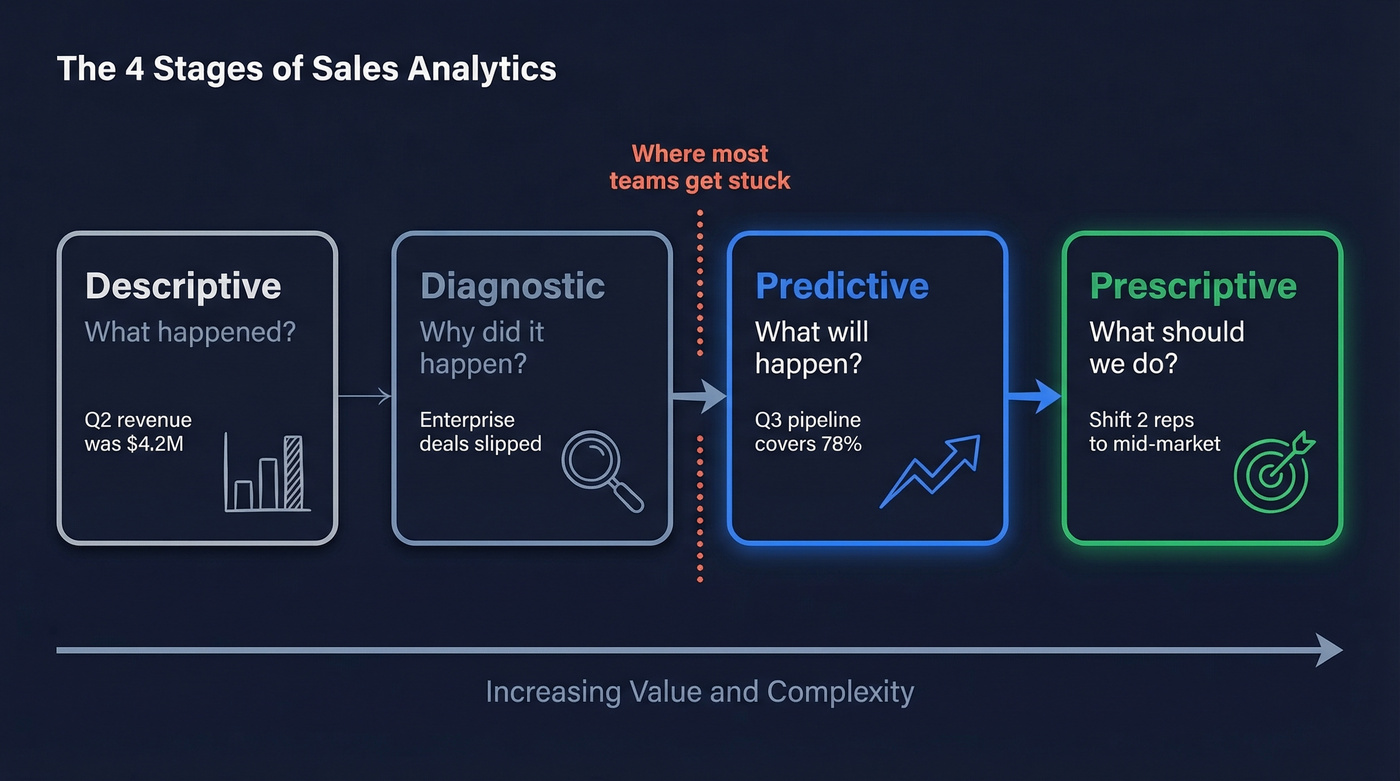
Most teams confuse four distinct analytics stages:
| Type | Question It Answers | Example |
|---|---|---|
| Descriptive | What happened? | Q2 revenue was $4.2M |
| Diagnostic | Why did it happen? | Enterprise deals slipped |
| Predictive | What will happen? | Q3 pipeline covers 78% |
| Prescriptive | What should we do? | Shift 2 reps to mid-market |
The market reflects the momentum. The predictive analytics market hit $22.22B in 2025, up from $18.02B in 2024, with projections reaching $91.92B by 2032. Twilio Segment's 2025 CDP report put Predictive Traits usage up 57% year-over-year. This isn't hype anymore. It's infrastructure.
Use Cases That Move Revenue
Five predictive capabilities consistently deliver. Here's how they play out in practice.
Predictive Lead Scoring
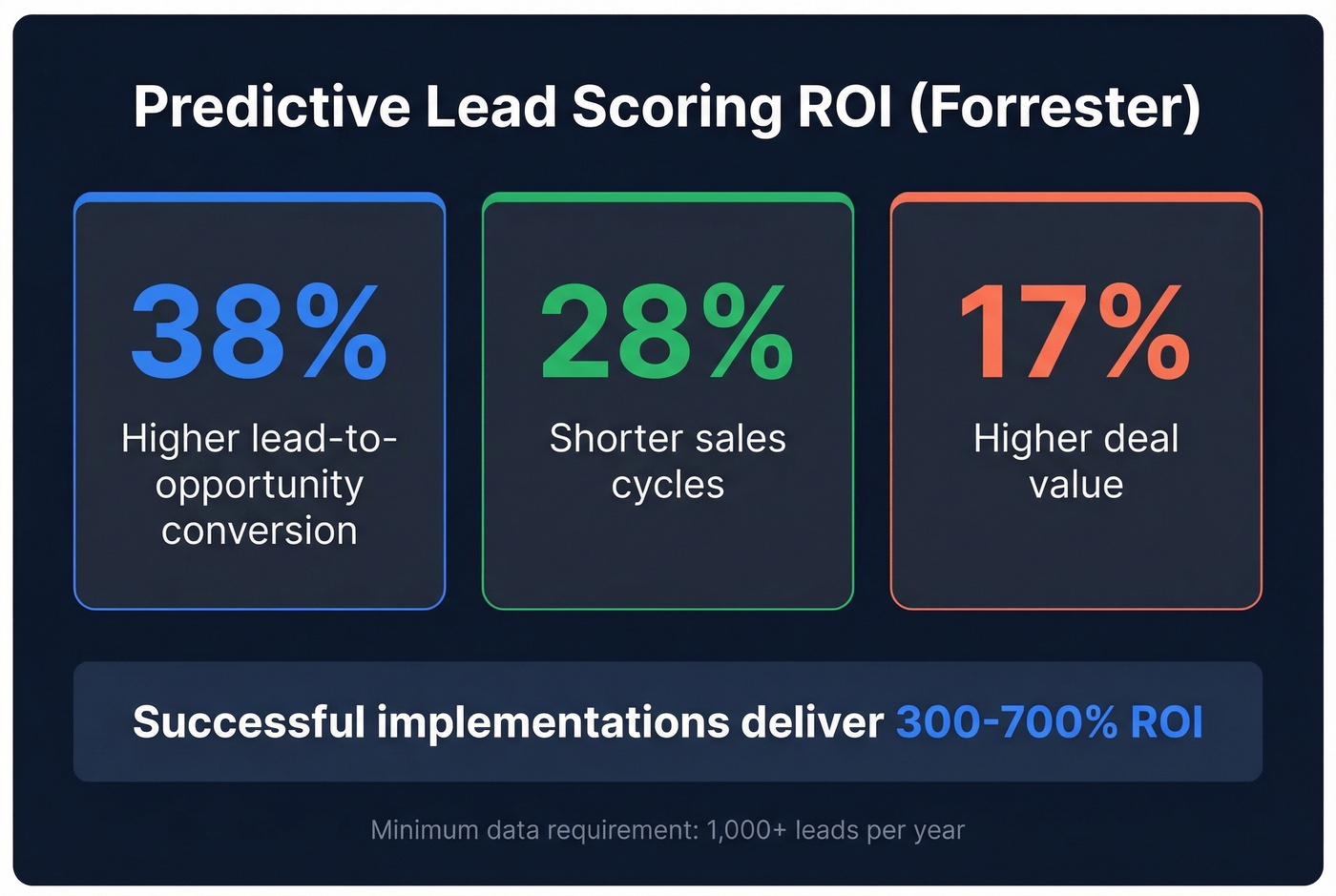
This is the most widely deployed predictive capability in B2B, and the ROI numbers back it up. Forrester's research on mid-sized companies found 38% higher lead-to-opportunity conversion, 28% shorter sales cycles, and 17% higher deal value. Successful implementations deliver 300-700% ROI, which is why it's usually the first thing teams build.
What matters most is clean input data and enough historical volume - 1,000+ leads per year minimum. Below that, you're fitting noise. The right scoring tool can automate this entirely, but only after you've hit that data threshold.
Churn Prediction
Why do churn models consistently outperform acquisition models? They run on first-party product usage data you already own - login frequency, feature adoption, support ticket velocity - with clear linkage to contract renewal dates. You don't need to buy anything new. You need to structure what you have. Models trained on behavioral data you control deliver the most reliable returns in any sales ML deployment, and we've seen teams get meaningful results within a single quarter.
Pipeline Forecasting
Traditional spreadsheet-based forecasting runs about 64% accuracy. ML-powered systems push that to 88%. That 24-point improvement is the difference between a confident board meeting and a scramble to explain the miss.
More than 55% of sales leaders say inaccurate forecasting costs them revenue targets every quarter. This isn't an optimization play. It's survival.
Deal Prioritization: Before and After
Before predictive signals: A rep checks their pipeline on Monday, notices a deal hasn't moved in two weeks, sends a "just checking in" email. The deal is already dead.
After predictive signals: The model flags declining engagement velocity and missing stakeholder activity on Thursday of week one. The rep loops in their champion with a relevant case study. In our experience, teams recover roughly 10% of slipping pipeline just by surfacing these signals earlier - before the deal goes cold and the champion stops returning calls.
Territory and Resource Planning
VTT Technical Research Center of Finland combined AI scoring with CRM data and cut 1,000 hours per year of manual lead qualification. Their SDRs went from reaching less than half of roughly 4,000 annual leads to targeting 100% coverage. That's not a productivity hack - it's a structural redesign of how capacity gets allocated. Deployments like these pay for themselves within a single quarter when aimed at the right bottleneck.
Manual vs AI: The Accuracy Gap
AI doesn't always win. With limited historical data or early-stage products, traditional methods can outperform ML. But once you have volume, the gap widens fast.
| Metric | Manual/Spreadsheet | AI/ML-Powered | Winner |
|---|---|---|---|
| Accuracy | 50-70% | 80-95% | AI (decisively) |
| MAPE | 15-40% | 5-15% | AI |
| Update frequency | Weekly/monthly | Real-time | AI |
| Data requirements | Low | 1,000+ records | Manual (for small teams) |
| Best for | Early-stage, low data | Scale, complex pipelines | - |
World-class sales teams hit 80-95% forecast accuracy. Average B2B teams sit at 50-70%. AI forecasting typically improves accuracy 20-50% over manual methods, but that improvement assumes clean data and enough of it.
Our take: For teams with 1,000+ leads per year and clean CRM data, AI wins decisively. Below that threshold, stick with spreadsheets and invest the software budget in fixing your data instead.

Every predictive model in this article depends on one thing: clean data. Prospeo enriches your CRM with 50+ data points per contact at an 83% match rate, verifies emails at 98% accuracy, and refreshes everything every 7 days - not 6 weeks. Your lead scoring, churn models, and pipeline forecasts finally get inputs they can trust.
Stop feeding garbage into your predictive models. Fix the foundation at $0.01 per email.
Why 62% of AI Sales Initiatives Fail
Gartner's stat is brutal: 62% of AI initiatives in sales fail. Not "underperform." Fail. Here are the patterns we've watched play out repeatedly.
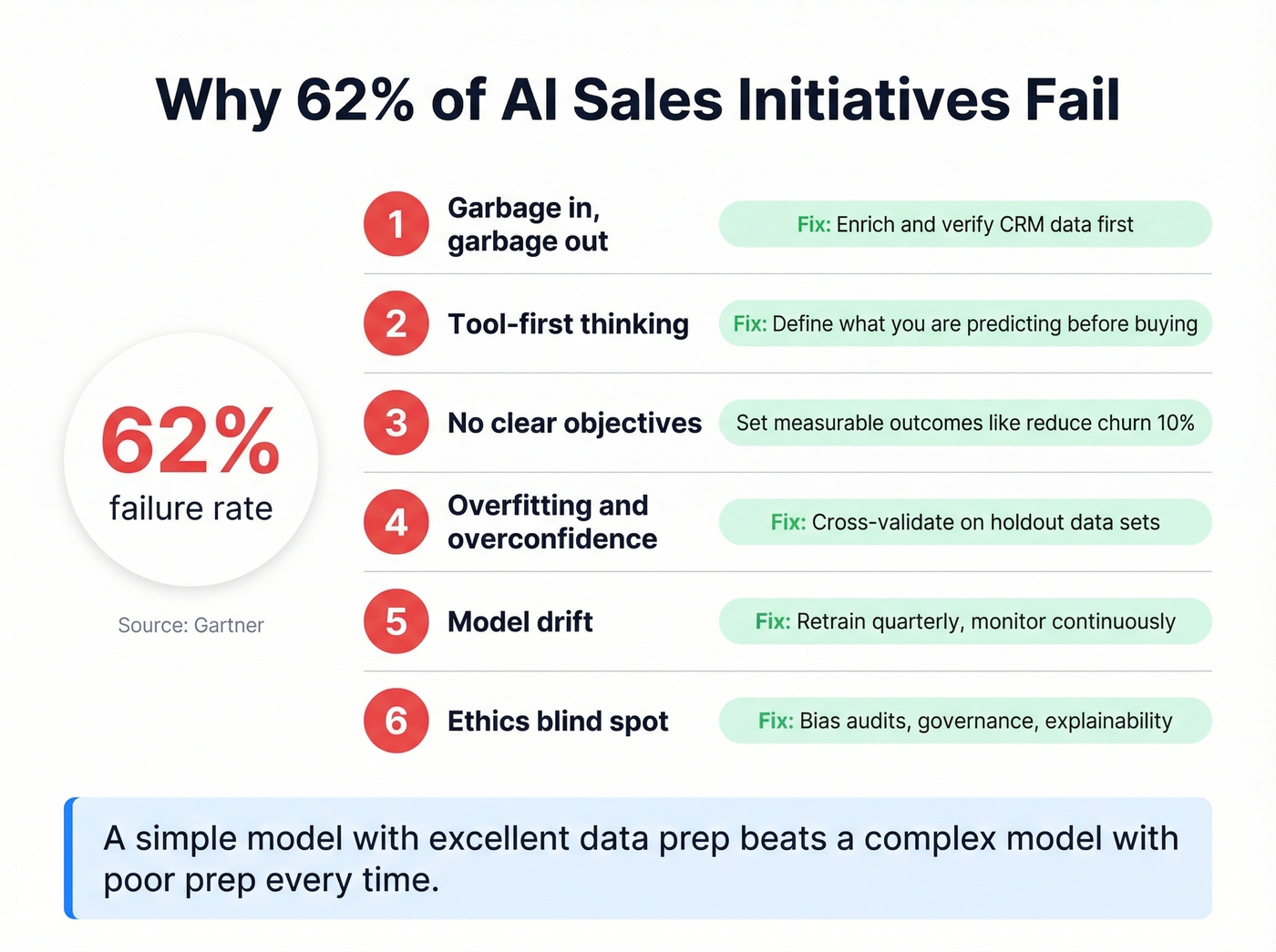
1. Garbage in, garbage out. This is the #1 killer. Disconnected systems, inconsistent data entry, outdated contact records. No algorithm fixes a dirty database. Run your contact database through an enrichment and verification layer before feeding it to any predictive model - Prospeo's enrichment returns 50+ data points per contact at an 83% match rate, with emails verified at 98% accuracy on a 7-day refresh cycle, so your models start with data that's actually current.

2. Tool-first thinking. Teams buy Clari or Gong before defining what they're trying to predict. Six months later, it's shelfware. Strategy before software. Always.
3. No clear objectives. "We want to use AI" isn't a goal. "Reduce churn by 10% in Q3" is. Start with a measurable outcome and work backward.
4. Overfitting and overconfidence. A model that's 99% accurate on training data and 55% accurate on new data is worthless. Cross-validate. Keep models simple unless complexity is justified by real performance gains on holdout sets.
5. Model drift. Markets change. Buyer behavior shifts. Retrain quarterly at minimum, and monitor accuracy, precision, and recall continuously.
6. The ethics blind spot. Target's 2012 incident - where predictive models inferred a teenager's pregnancy before her father knew - remains the cautionary tale. Governance, bias audits, and explainability aren't optional. The EU AI Act now codifies some of these requirements into law.
A simple model with excellent data prep beats a complex model with poor prep every time.
Tools and What They Cost in 2026
Pricing varies wildly by tier. Here's an honest breakdown based on what we've seen in the market.
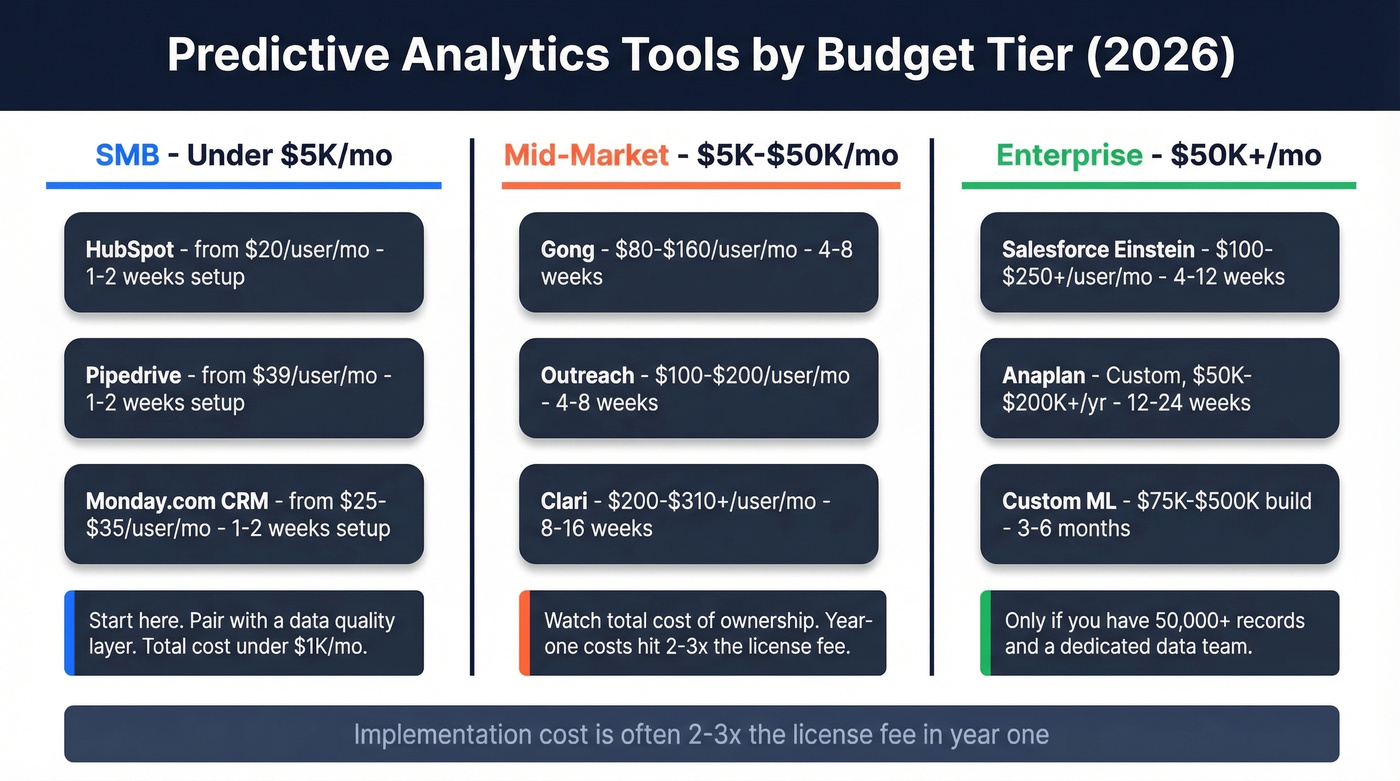
| Tool | Starting Price | Best For | Implementation |
|---|---|---|---|
| HubSpot | $20/user/mo | SMB, CRM-native AI | 1-2 weeks |
| Pipedrive | $39/user/mo | SMB forecasting | 1-2 weeks |
| Monday.com CRM | ~$25-$35/user/mo | Light forecasting | 1-2 weeks |
| Gong | ~$80-$160/user/mo | Conversation + forecast | 4-8 weeks |
| Salesforce Einstein | ~$100-$250+/user/mo | Enterprise CRM-native | 4-12 weeks |
| Outreach | ~$100-$200/user/mo | Execution + forecast | 4-8 weeks |
| Clari | $200-$310+/user/mo | Revenue intelligence | 8-16 weeks |
| Anaplan/Workday Adaptive | Custom, $50K-$200K+/yr | Enterprise planning | 12-24 weeks |
| Custom ML | $75K-$500K build | Unique requirements | 3-6 months |
SMB teams spending under $5K per month should start with HubSpot or Pipedrive's built-in capabilities and pair them with a data quality layer to keep the CRM clean. Total cost for a small team: under $1K/month.
Mid-market teams in the $5K-$50K range can justify Gong, Outreach, or Clari. But watch total cost of ownership - Clari's implementation alone runs $15K-$75K, and year-one costs typically hit 2-3x the license fee once you factor in training and integration work. Here's the thing: Clari is overpriced for teams under 50 reps. Gong is often the better value for smaller orgs, and the r/sales consensus tends to agree.
Enterprise teams above $50K per month look at custom ML builds or platforms like Anaplan and Workday Adaptive Planning. Budget $75K-$500K for custom implementations with 12-24 month ROI timelines. This only makes sense when you have 50,000+ customer records and a dedicated data team.
Are You Ready?
Before you sign anything, run through this checklist. You need at least four of these six to justify an investment. Fewer than four? Stop. Fix the gaps first. Buying a platform now is burning money.
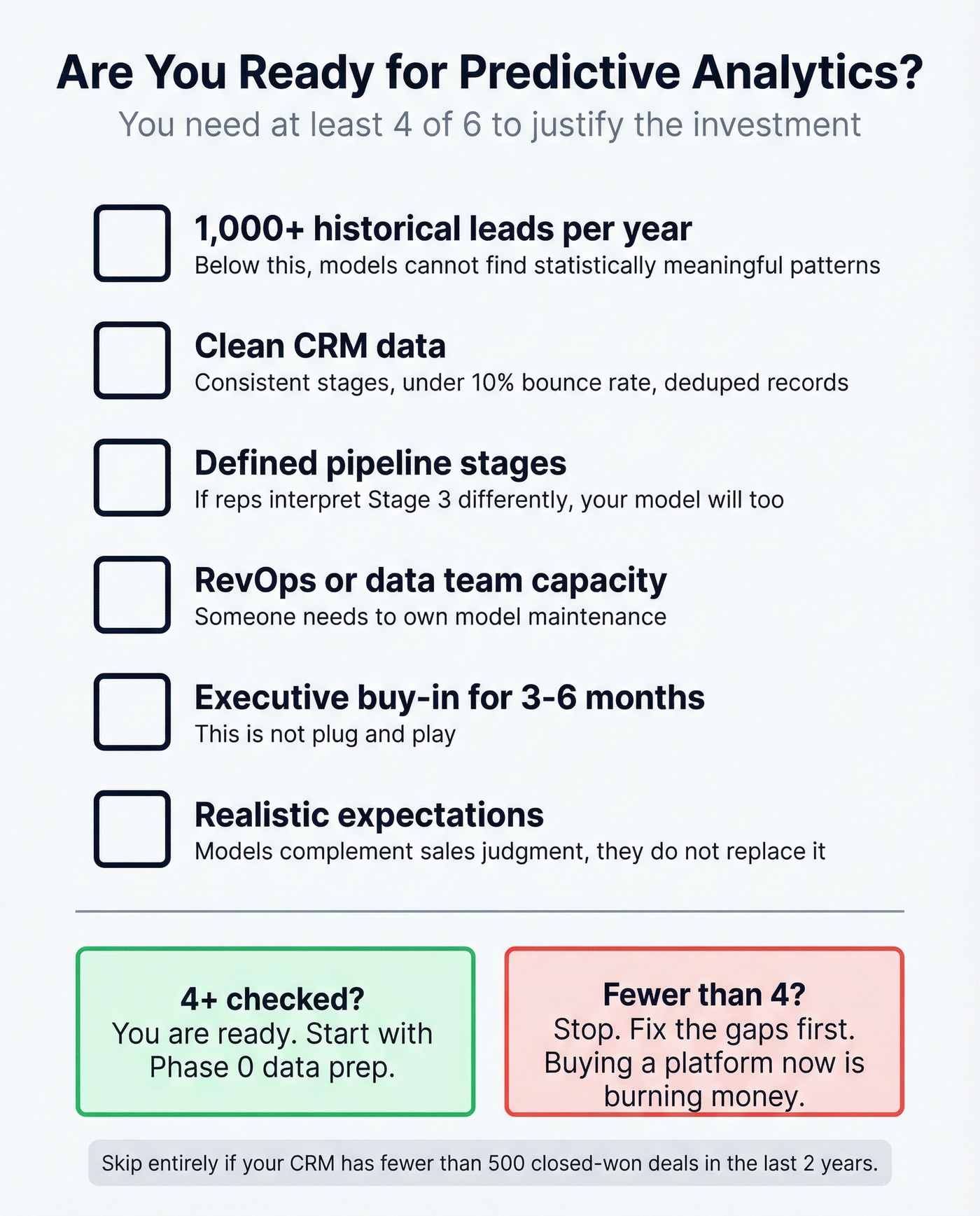
- ☐ 1,000+ historical leads per year - below this, models can't find statistically meaningful patterns
- ☐ Clean CRM data - consistent stage definitions, under 10% email bounce rate, deduped records
- ☐ Defined pipeline stages - if reps interpret "Stage 3" differently, your model will too
- ☐ RevOps or data team capacity - someone needs to own model maintenance
- ☐ Executive buy-in for 3-6 months - this isn't plug-and-play
- ☐ Realistic expectations - these models complement sales judgment, they don't replace it
Skip this investment entirely if your CRM has fewer than 500 closed-won deals in the last two years. You'll get more ROI from hiring another SDR.
How to Implement Predictive Analytics for Sales
Phase 0: Data Preparation (2-4 weeks). Enrich and verify your CRM data before feeding it to any predictive model. Deduplicate records, standardize fields, fill missing firmographic data. We've watched teams skip data prep and regret it within 90 days - one mid-market SaaS company we spoke with burned through $40K in Clari licenses before realizing their CRM bounce rate was 32%. This phase is non-negotiable.
Phase 1: CRM-Native AI (2-4 weeks). Activate HubSpot's predictive scoring, Salesforce Einstein, or Pipedrive's AI features. These are available inside your CRM ecosystem, often in higher tiers or add-ons. We recommend running CRM-native AI for at least one full quarter before deciding you need more. Even at this stage, built-in ML can surface patterns your reps would never catch manually.
Phase 2: Standalone Platform (8-16 weeks). If CRM-native AI hits its ceiling, evaluate Gong, Clari, or Outreach. Run a proper bake-off with your actual data - not demo data, not a sandbox, your real pipeline. Skip custom ML unless you have a dedicated data engineering team of three or more. Everyone else is wasting money. The goal is faster cycles, better conversion, and fewer wasted hours, not complexity for its own sake. Gartner's AI in sales research has solid frameworks for evaluating these tools if you want a second opinion.
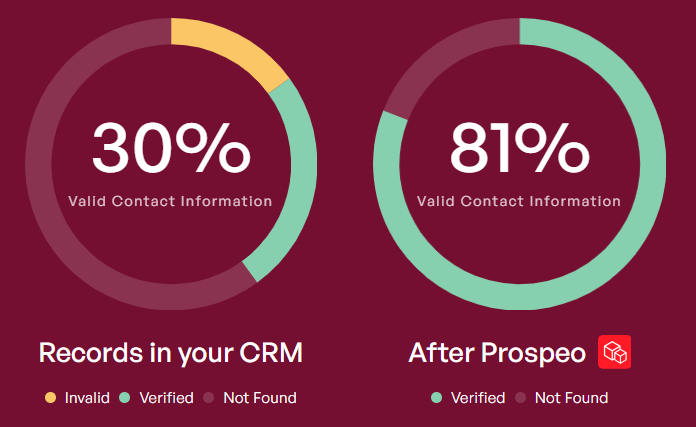
You read it above: 62% of AI sales initiatives fail because of dirty data. Prospeo's 5-step verification with catch-all handling, spam-trap removal, and honeypot filtering means your predictive analytics start with contacts that are real, current, and reachable. Teams using Prospeo cut bounce rates from 35%+ to under 4%.
Kill the #1 reason predictive analytics projects fail - start with verified data.
FAQ
How accurate is predictive analytics for sales?
World-class implementations achieve 80-95% forecast accuracy with 5-15% MAPE. Average B2B teams sit at 50-70%. AI forecasting improves accuracy 20-50% over manual methods, but results depend on data quality and volume - at least 1,000 historical leads per year.
What data do you need for predictive sales analytics?
At minimum: 1,000+ historical leads per year, clean CRM records with consistent stage definitions, and outcome data with timestamps. First-party product usage data strengthens churn models. Enriched contact data with verified emails improves lead scoring significantly.
How much does predictive analytics software cost?
CRM-native AI starts at $20-$39/user/month. Mid-market platforms run $60-$310+/user/month. Custom ML implementations cost $75K-$500K with 12-24 month ROI timelines. Factor in 2-3x the license fee for year-one total cost of ownership.
What's a cost-effective way to improve data quality before deploying predictive models?
Prospeo's free tier includes 75 email verifications per month at 98% accuracy - enough to audit your CRM's data health before committing to a predictive platform. Paid plans start at roughly $0.01 per lead, making it far cheaper than enterprise enrichment vendors.
What's the ROI of predictive lead scoring?
Forrester reports 38% higher lead-to-opportunity conversion, 28% shorter sales cycles, and 17% higher deal value for mid-sized companies. Successful implementations deliver 300-700% ROI, but 62% of AI initiatives in sales fail - usually due to poor data quality, not bad algorithms.