

7 Benefits of Data Enrichment (Backed by Actual Numbers)
Your SDR just launched a 2,000-contact sequence and 340 emails bounced before lunch. That's not a deliverability problem - it's a data problem. Gartner estimates poor data quality costs organizations roughly $12.9M annually, and with business data decaying at about 22% per year, the contacts you verified six months ago are already rotting.
The data enrichment market hit $2.37B in 2023 and is projected to reach $4.58B by 2030. This isn't a niche tactic anymore. Here are the real benefits of data enrichment, with actual numbers attached.
The Quick Version
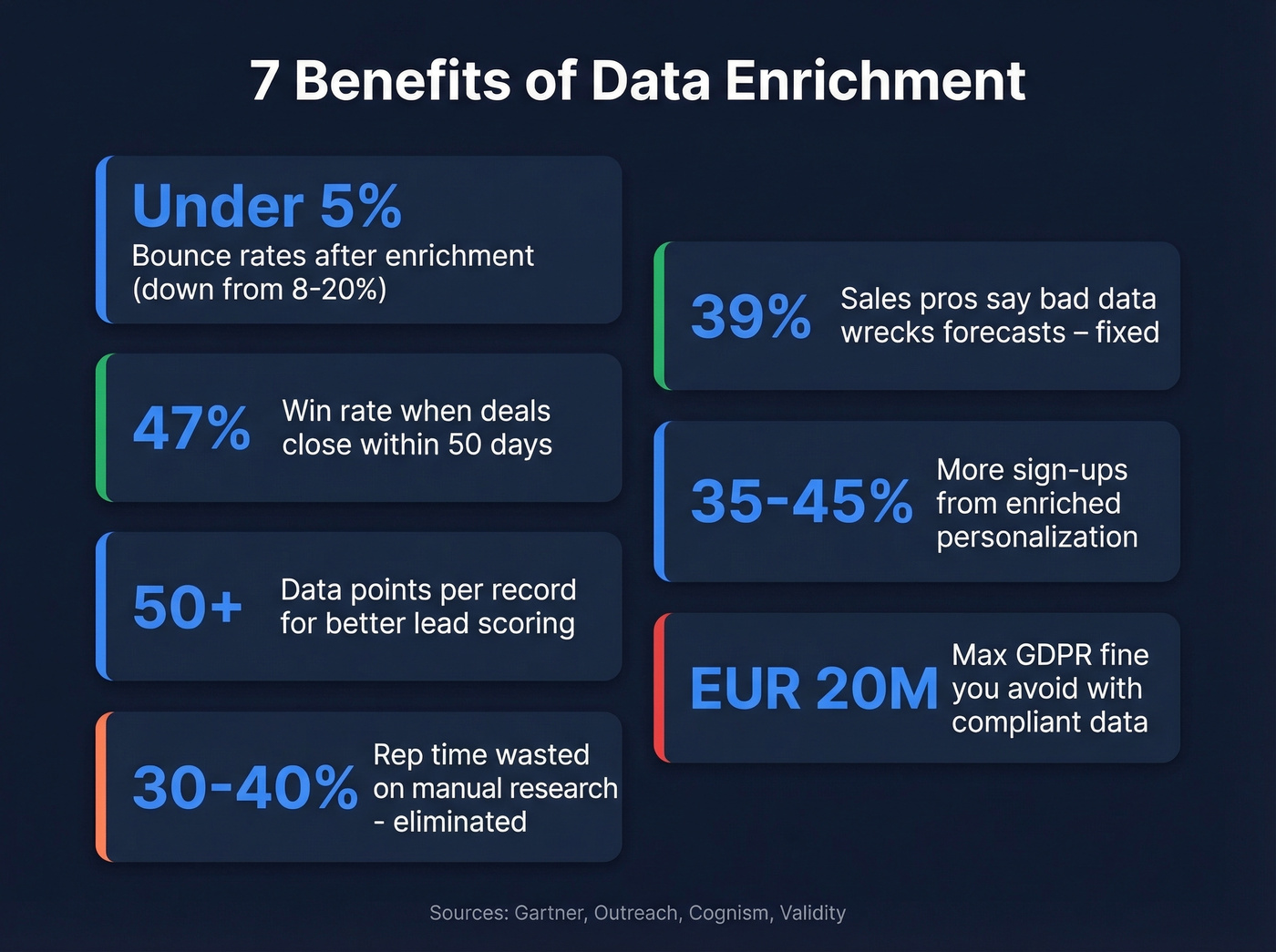
- Lower bounce rates - from 8-20% down to under 5%
- Shorter sales cycles - deals closed within 50 days win at 47%
- Better lead scoring - 50+ data points per record instead of name-and-email
- Time savings - eliminate the 30-40% of their time wasted on manual research
- Accurate forecasting - fix the bad data that 39% of sales pros say wrecks predictions
- Stronger personalization - enriched fields drove 35-45% more sign-ups in a documented case
- Compliance protection - avoid GDPR fines up to EUR 20M or 4% of global turnover
Why Data Enrichment Matters
Lower Bounce Rates
Dirty lists bounce at 8-20%. That's not just wasted sends - it's domain reputation damage that compounds with every campaign. Inbox providers start routing your legitimate messages to spam, and clawing back sender reputation takes weeks.
With proper enrichment and verification, bounce rates drop below 5%. Meritt went from 35% bounce rates to under 4% after switching providers, tripling pipeline from $100K to $300K per week. Hang around any RevOps community long enough and "stale CRM data" surfaces fast as a top complaint - the consensus on r/sales is that most teams underestimate how quickly their lists decay.

Shorter Sales Cycles
Speed kills in sales - in a good way. Outreach's data analysis shows opportunities closed within 50 days hit a 47% win rate. Past that threshold, win rates crater to roughly 20%.
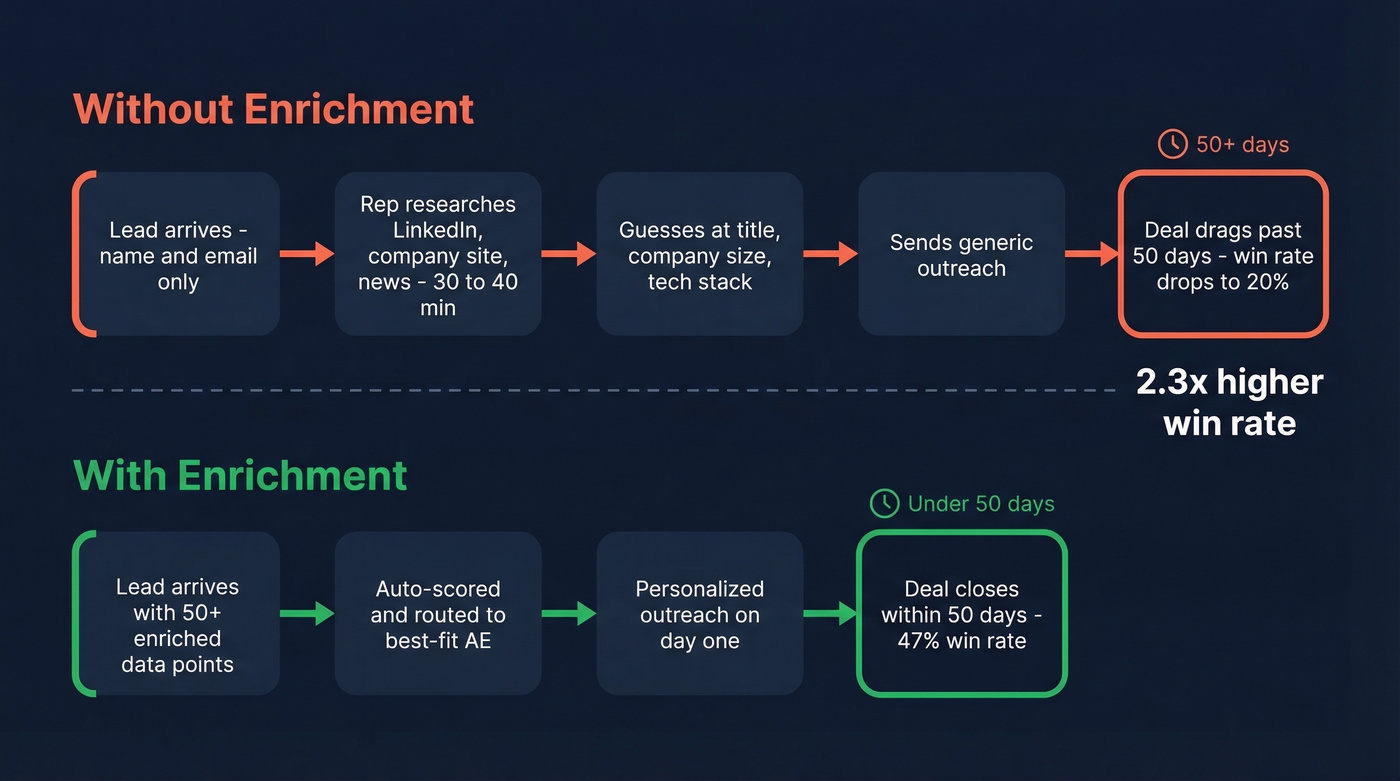
Enrichment compresses cycles by eliminating the research phase. Without it, reps burn 30-40% of their time manually looking up company details, org charts, and contact info - time that should go toward actual selling. Enriched records hand reps everything before the first touchpoint: title, department, tech stack, company size, even intent signals showing what the prospect is actively researching. For any team chasing aggressive pipeline targets, this is one of the clearest data enrichment benefits you can measure.
Better Lead Scoring
A lead with just a name and email is nearly impossible to score. Here's what changes with enrichment:
| Data Layer | What It Adds | Scoring Impact |
|---|---|---|
| Firmographic | Industry, revenue, headcount | Fits your ICP or doesn't |
| Technographic | Tools they use (Salesforce, Snowflake, etc.) | Product-market fit signal |
That's the difference between "marketing lead from webinar" and "VP of Engineering at a 200-person SaaS company using Salesforce, actively researching data integration tools." One gets routed to your best AE. The other sits in nurture forever.
Time Savings for Reps
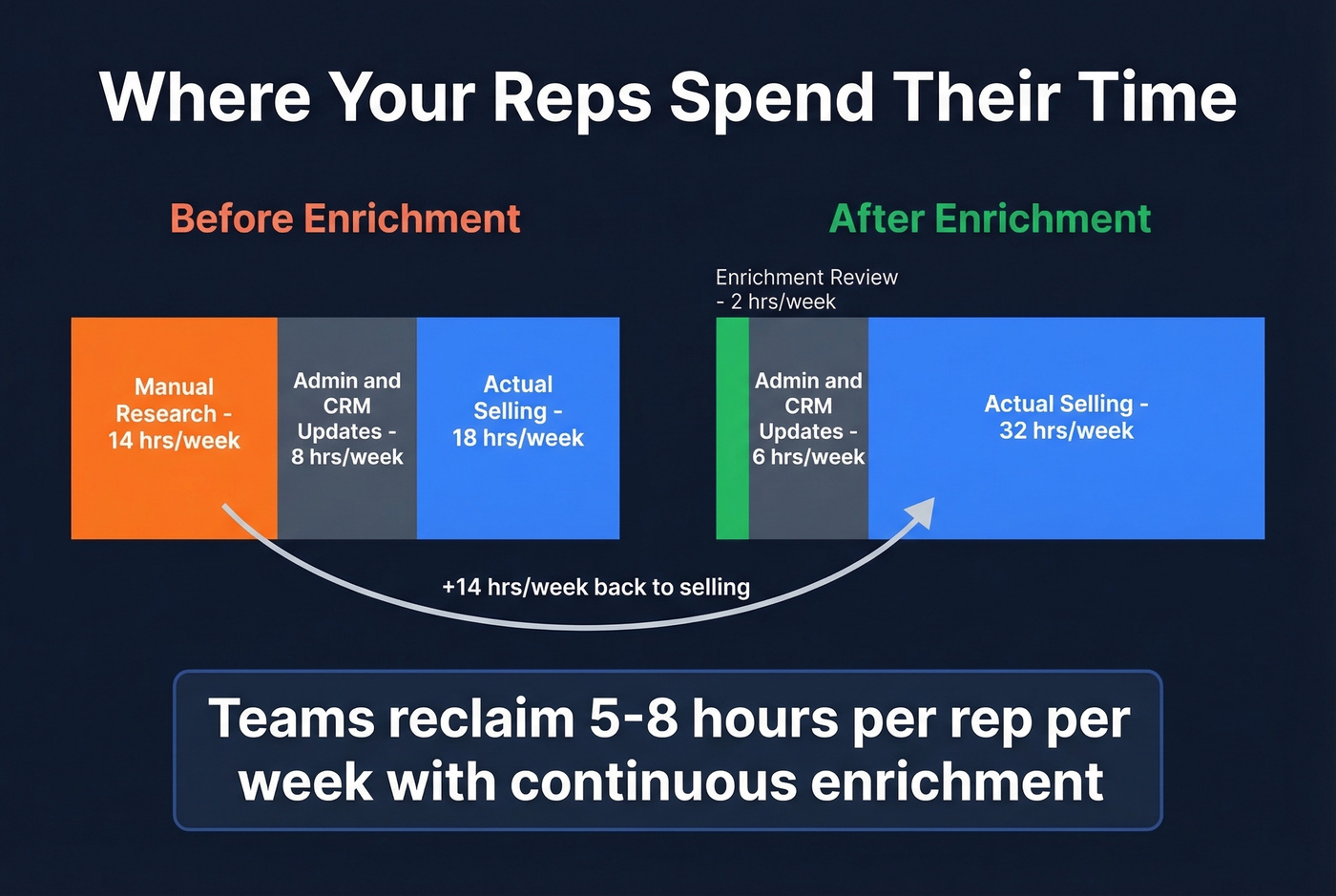
This benefit pays for itself fastest. Validity and SunTec research puts the number at 30-40% of rep time spent on manual research. Outreach's AI analysis found teams can cut research and personalization time by up to 90% when AI tools handle those tasks inside the workflow.
In our experience, the teams that get the most from enrichment aren't the ones with the biggest budgets - they're the ones that enrich continuously rather than treating it as a quarterly cleanup project. We've seen teams reclaim 5-8 hours per rep per week. That's not a productivity hack. It's a structural change in how a sales org operates, and it shows up in pipeline numbers within the first month.
Accurate Forecasting
Your forecast is only as good as your CRM data. Right now, 37% of CRM admins say poor-quality data causes significant revenue loss, while 39% of sales pros say bad data prevents accurate forecasting entirely.
Here's the thing: enrichment fixes this by keeping records current - updated titles, company changes, new phone numbers. When your CRM reflects reality, RevOps stops spending half their forecast calls arguing about data quality and starts making decisions. That shift alone justifies the cost for most mid-market teams.
Stronger Personalization
Generic outreach gets generic results. Enriched fields like industry, tech stack, and intent signals let you write messages that reference something specific. It's the difference between "I'd love to chat about your data needs" and "I noticed your team's evaluating Snowflake - here's how we help companies during that migration."
CEC Marketing saw a 35-45% increase in sign-ups after switching to enriched data. That's not marginal - it's a fundamentally different response curve, and it came from better data, not better copywriting. If you want to systematize this across sequences, AI email personalization can help operationalize the extra fields without adding rep workload.
Compliance and Risk Reduction
GDPR fines can hit EUR 20M or 4% of global turnover - whichever is higher. CCPA penalties run $7,500 per intentional violation. These aren't theoretical risks.
Good enrichment providers handle compliance at the data layer. GDPR operates on an opt-in model; CCPA/CPRA uses opt-out with mandatory "Do Not Sell or Share My Personal Information" mechanisms. Your enrichment tool should enforce both automatically. Prospeo, for instance, is fully GDPR compliant with opt-out enforcement and DPAs available - the kind of baseline you should demand from any vendor you evaluate.

Your reps are wasting 30-40% of their time on manual research while data decays at 22% per year. Prospeo returns 50+ data points per contact with a 92% match rate and refreshes every 7 days - not every 6 weeks. Bounce rates drop below 4%. Pipeline triples. At $0.01 per email, the ROI math isn't even close.
Start with 75 free enrichments and see the difference in your first campaign.
Three Mistakes That Waste Your Budget
No clear ICP definition. Enriching every record in your CRM is expensive and pointless. Define your ideal customer profile first, then enrich only the segments that matter. We've watched teams blow through thousands in credits enriching contacts that would never convert. If you need a tighter process, start with a documented ideal customer profile and build your enrichment rules around it.
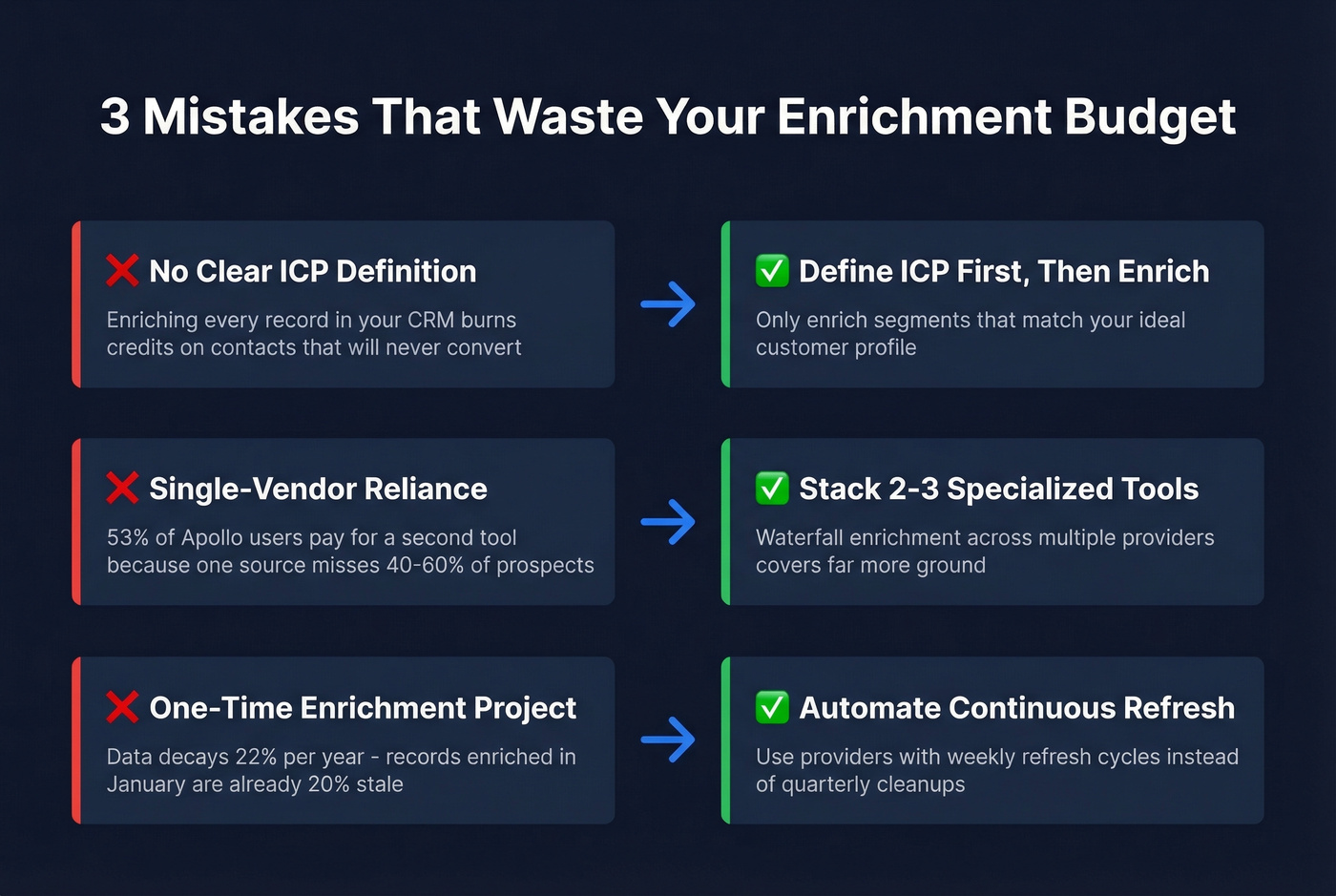
Single-vendor reliance. 53% of Apollo subscribers also pay for another enrichment service. That's not waste - it's waterfall enrichment done right, because one source can leave 40-60% of qualified prospects unreachable. Stack two or three tools and you'll cover far more ground. (If you're comparing options, see our breakdown of the best data enrichment tools.)
Treating enrichment as a one-time project. Data decays at 22% per year. If you enriched your CRM in January and haven't touched it since, a fifth of those records are already stale. Look for providers with automated refresh cycles - Prospeo refreshes every 7 days versus the 6-week industry average. Pairing enrichment with CRM automation software is usually the fastest way to keep records current without adding ops overhead.
What Enrichment Costs
The pricing spread is enormous, and it matters more than most teams realize.
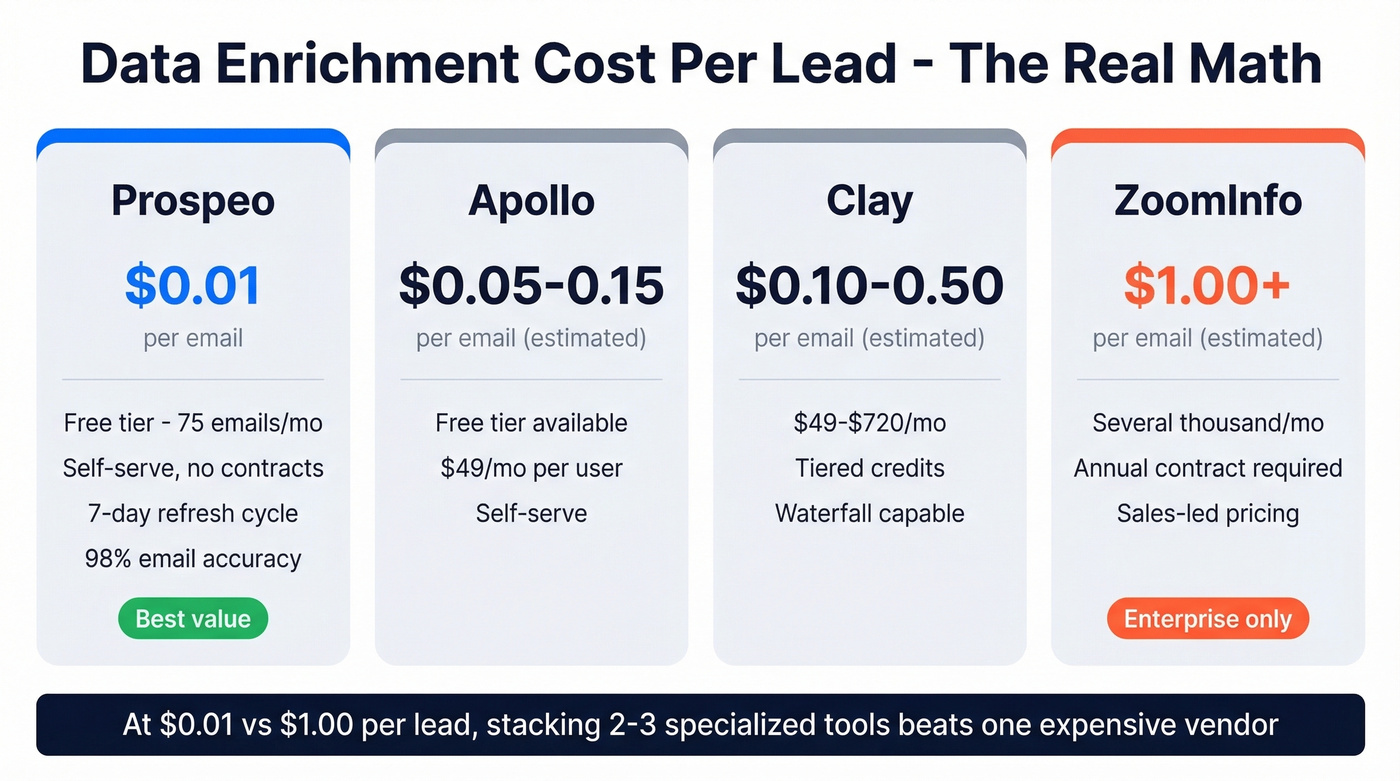
| Tool | Starting Price | Model |
|---|---|---|
| Prospeo | Free (75 emails/mo); ~$0.01/email | Self-serve, no contracts |
| Apollo | Free tier; ~$49/mo/user | Self-serve |
| Clay | $49-$720/mo | Tiered credits |
| ZoomInfo | Several thousand/mo | Annual contract, sales-led |
Let's be honest: enterprise contracts are a relic for most teams under 50 reps. The smart play is stacking two or three specialized tools rather than paying one vendor for everything. At roughly $0.01 per lead versus $1 per lead on ZoomInfo, the math isn't close - and the multi-vendor approach gives you better coverage anyway. Skip the big annual commitment unless your org genuinely needs the full ZoomInfo ecosystem. If you're also sourcing net-new contacts (not just enriching), start with a high-accuracy B2B database or a verified contact database.
Meritt went from 35% bounce rates to under 4% and tripled pipeline to $300K/week. Snyk's 50 AEs grew AE-sourced pipeline 180%. The difference wasn't effort - it was enrichment quality. Prospeo's 5-step verification, 98% email accuracy, and 7-day refresh cycle deliver the data your scoring models, sequences, and forecasts actually need.
Replace stale CRM records with verified contacts - no contracts, no sales calls.
FAQ
What's the difference between data enrichment and data cleansing?
Cleansing removes errors, duplicates, and formatting inconsistencies from existing records. Enrichment adds new data points - job title, tech stack, intent signals, direct dials - on top of clean records. You need both: cleanse first, then enrich.
How often should you re-enrich your CRM data?
Monthly at minimum, continuously if possible. Business data decays at 22% per year, meaning quarterly refreshes still leave significant gaps. The best practice we've seen is automated weekly refreshes, which catches job changes and company updates before they cause bounces.
Can small teams afford data enrichment?
Yes - self-serve tools have eliminated the enterprise-only barrier. Free tiers exist across most platforms, and paid plans at the lower end run roughly $0.01 per email with no contracts or minimums. You don't need a $30K annual commitment to get the benefits of data enrichment that larger teams rely on.
What ROI should you expect from enrichment?
Most B2B teams see measurable impact within 30 days: bounce rates dropping below 5%, reps reclaiming 5-8 hours per week, and pipeline velocity increasing as lead scoring improves. Meritt tripled weekly pipeline from $100K to $300K; Snyk saw AE-sourced pipeline jump 180% with over 200 new opportunities per month.