

Price Objection Rebuttals That Actually Work in 2026
Stop Memorizing Scripts. Start Diagnosing.
You just got off a call where the prospect said "we love it but the price is too high" and you froze. You reached for a canned line, it landed flat, and the deal stalled. The problem wasn't your rebuttal - it was that you grabbed the wrong one because you didn't diagnose the objection first.
Most price objection rebuttals fail for exactly this reason. Gartner found that 48% of B2B deals end in no decision, and a huge share of those stall on pricing conversations that never get properly resolved. Three things to remember: diagnose the objection type before picking a response, ask "What happens if this problem isn't solved in 6 months?", and trade scope - never rate.
Why "Too Expensive" Rarely Means Too Expensive
Corporate Visions research found that only 23% of pricing objections are true budget constraints. The other 77% mask something else entirely: a value gap, a risk concern, a priority misalignment, or a stakeholder who can't say yes.
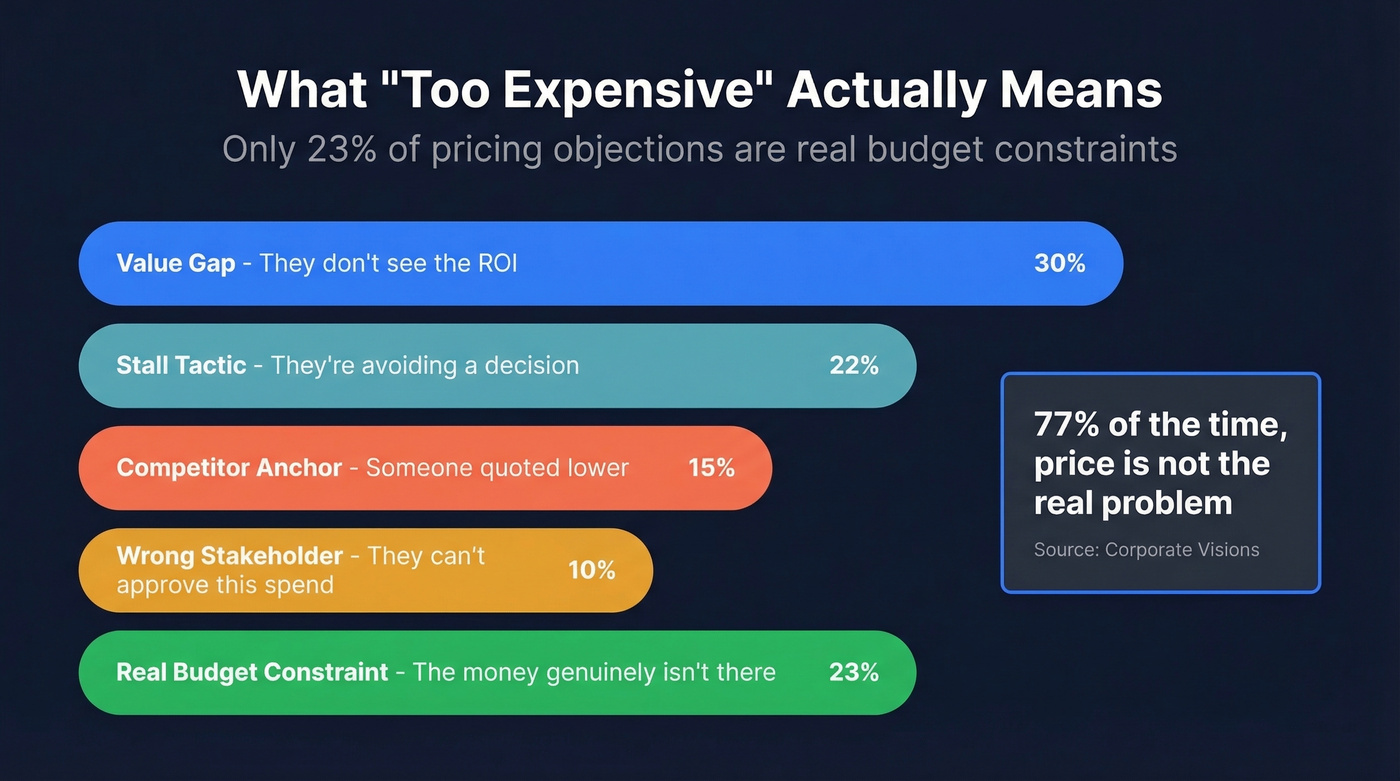
Two psychological forces drive this. Loss aversion makes the money leaving their account feel more painful than the value coming in. Price anchoring means whatever number they saw first - a competitor's quote, an internal budget, a guess - becomes the benchmark your price is measured against.
Most "too expensive" objections fall into one of five categories:
- Value gap - they don't see the ROI
- Real budget constraint - the money genuinely isn't there
- Stall tactic - they're avoiding a decision
- Competitor anchor - someone quoted lower
- Wrong stakeholder - they can't approve this spend
Your job is to figure out which one before you open your mouth.
When to Talk Pricing
Gong's analysis of 25,537 sales calls found the best times to discuss pricing are around 20% and 65% through the conversation. Too early and you get sticker shock. Too late and the prospect feels ambushed.
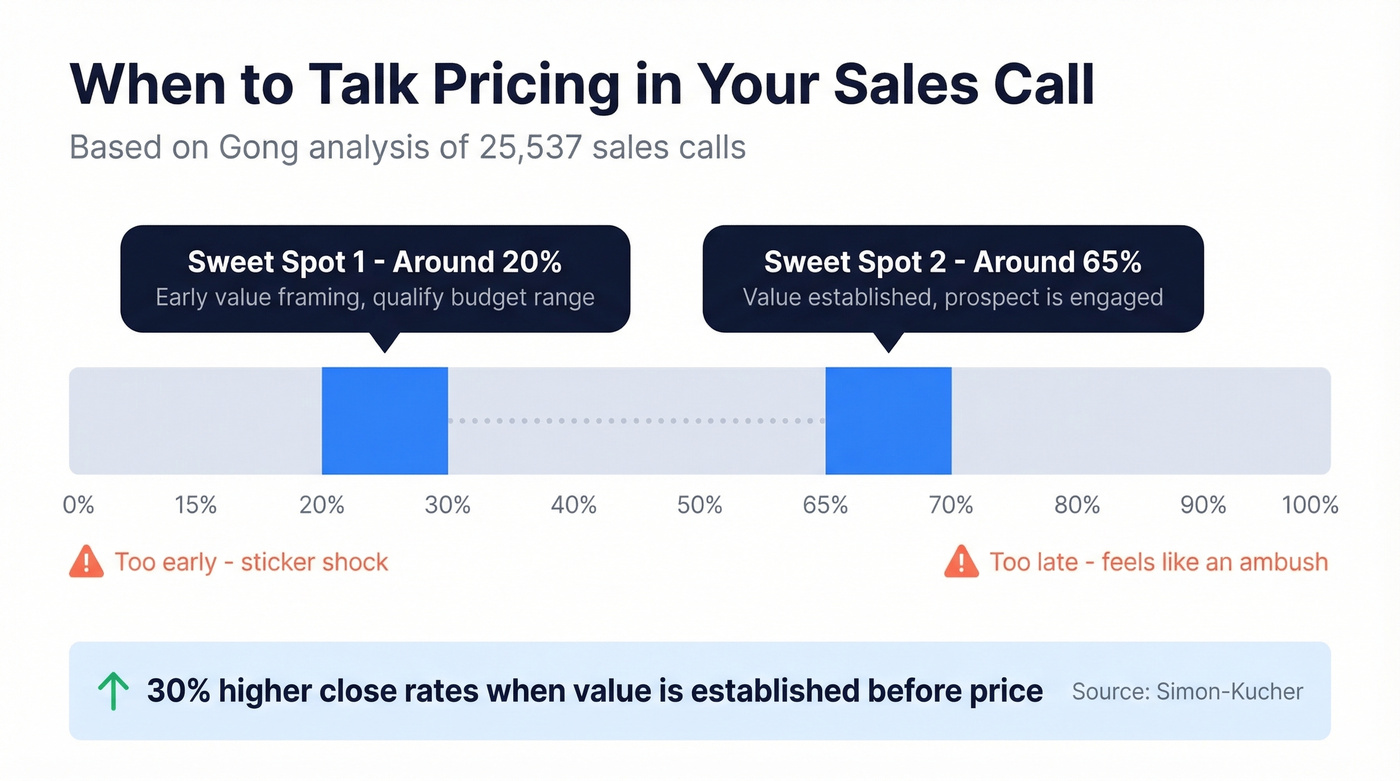
Simon-Kucher's research backs this up: teams that establish value before discussing price see 30% higher close rates. Value first, price second. Every time.
One upstream move that prevents objections entirely: qualify budget range before investing time in solution design. A simple "What budget range are you working with for this?" in early discovery saves everyone's time and keeps you from building a $50K proposal for a $15K budget.

Price objections hit harder when you're pitching the wrong person. Prospeo's 300M+ profile database with 30+ filters - including job title, seniority, and department headcount - gets you to the actual decision-maker before you waste a single demo.
Stop rebutting price objections from people who can't sign the check.
Rebuttals by Objection Type
The right response depends entirely on what's driving the objection. Here are scripts matched to each category.
| Objection Type | Quick Script | Why It Works |
|---|---|---|
| Value gap | "What happens if this isn't solved in 6 months?" | Shifts focus to cost of inaction |
| Budget constraint | "What range are you working with?" | Opens scope conversation |
| Stall tactic | "Does this mean we'll never work together?" | "Never" triggers FOMO |
| Competitor anchor | "Does their quote include [differentiator]?" | Reframes price to total value |
| Wrong stakeholder | "Who else weighs in before this moves forward?" | Gets you to the decision-maker |
Value Gaps
The anchoring reframe hits hard: "This costs $1,500/month. Our average customer sees $10,000 in saved revenue monthly. That's a 6x return." Another diagnostic question we use constantly in deal reviews: "If budget wasn't an issue, would this solution be the right fit?" If they say no, the objection was never about price - and you just saved yourself weeks of chasing a dead deal.
Stall Tactics
Try: "When you say it's too expensive, what do you mean by that?"
Simple, but it forces the prospect to articulate the real concern. Most of the time, it isn't price. We've found that reps who pause and ask this one question instead of launching into a rehearsed pitch recover about twice as many stalled conversations. The silence after the question does most of the work.
Budget Constraints
Go beyond the table: "If I could restructure this to hit $X, keeping [core deliverable] and removing [secondary piece], would that work for your team?" This preserves your rate while giving them a path forward. Never discount. Adjust scope.
Wrong Stakeholders
Follow up with: "Would it help if I put together a one-page business case you could share with [decision-maker]? I've seen that speed up approvals." This gives them a tool instead of leaving them empty-handed.
Responses That Backfire
These five common responses actively hurt your close rate:
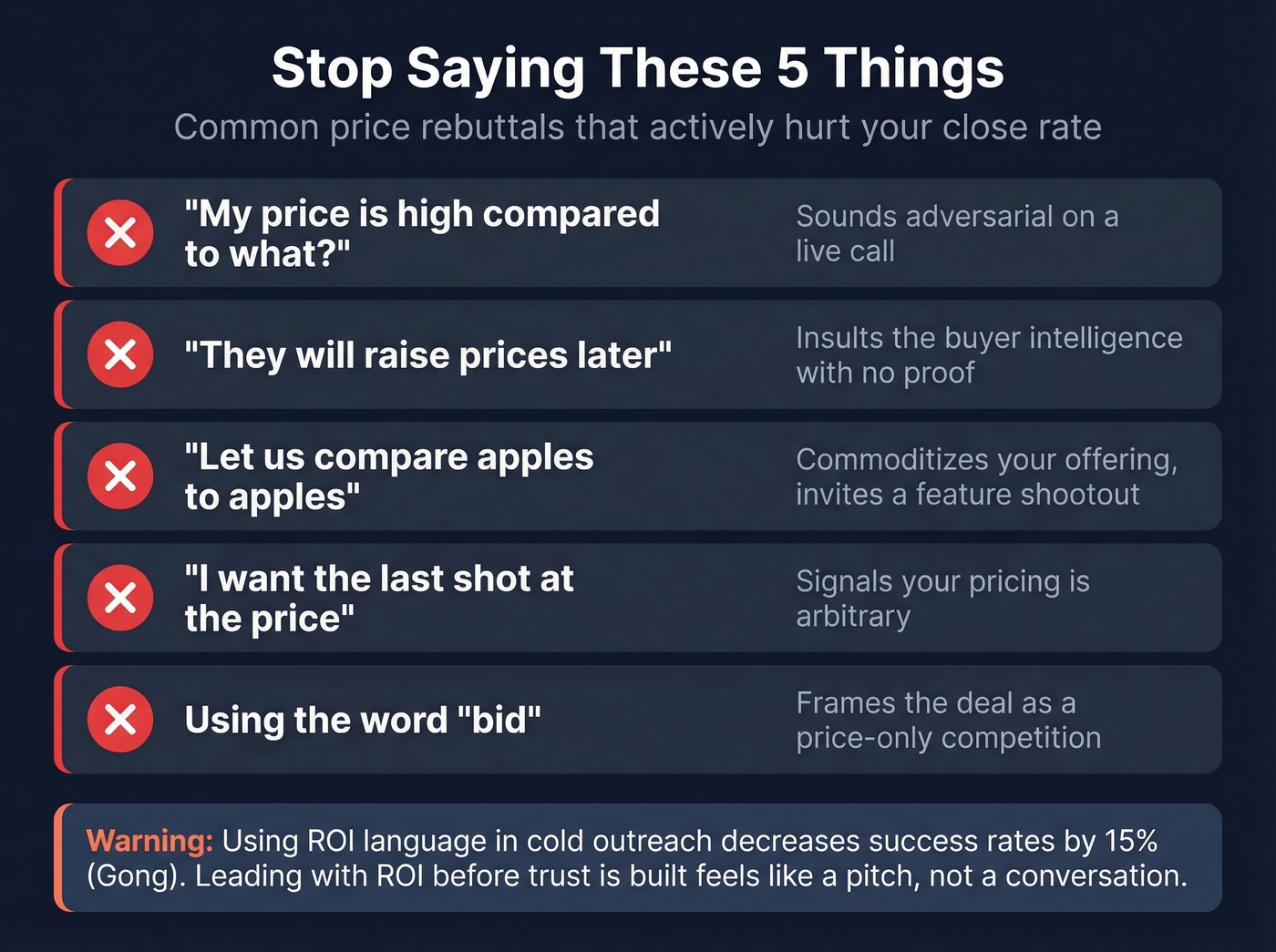
- "My price is high compared to what?" - Sounds clever in training but comes across as adversarial on a live call.
- "They'll raise prices later" - You're insulting the buyer's intelligence with a claim you can't back up.
- "Let's compare apples to apples" - This commoditizes your offering and invites a feature shootout where price becomes the tiebreaker.
- "I want the last shot at the price" - Signals your pricing is arbitrary. You've just told them to push harder.
- Using the word "bid" - Frames the entire deal as a price-only competition.
Here's the thing: Gong found that using ROI language in cold outreach decreases success rates by 15%. The lesson applies to pricing conversations too - leading with ROI calculations before the prospect trusts you feels like a pitch, not a conversation.
The Technique That Moved Numbers
Instead of handling the objection, reflect it back with a calm, slightly inaccurate guess - then shut up.
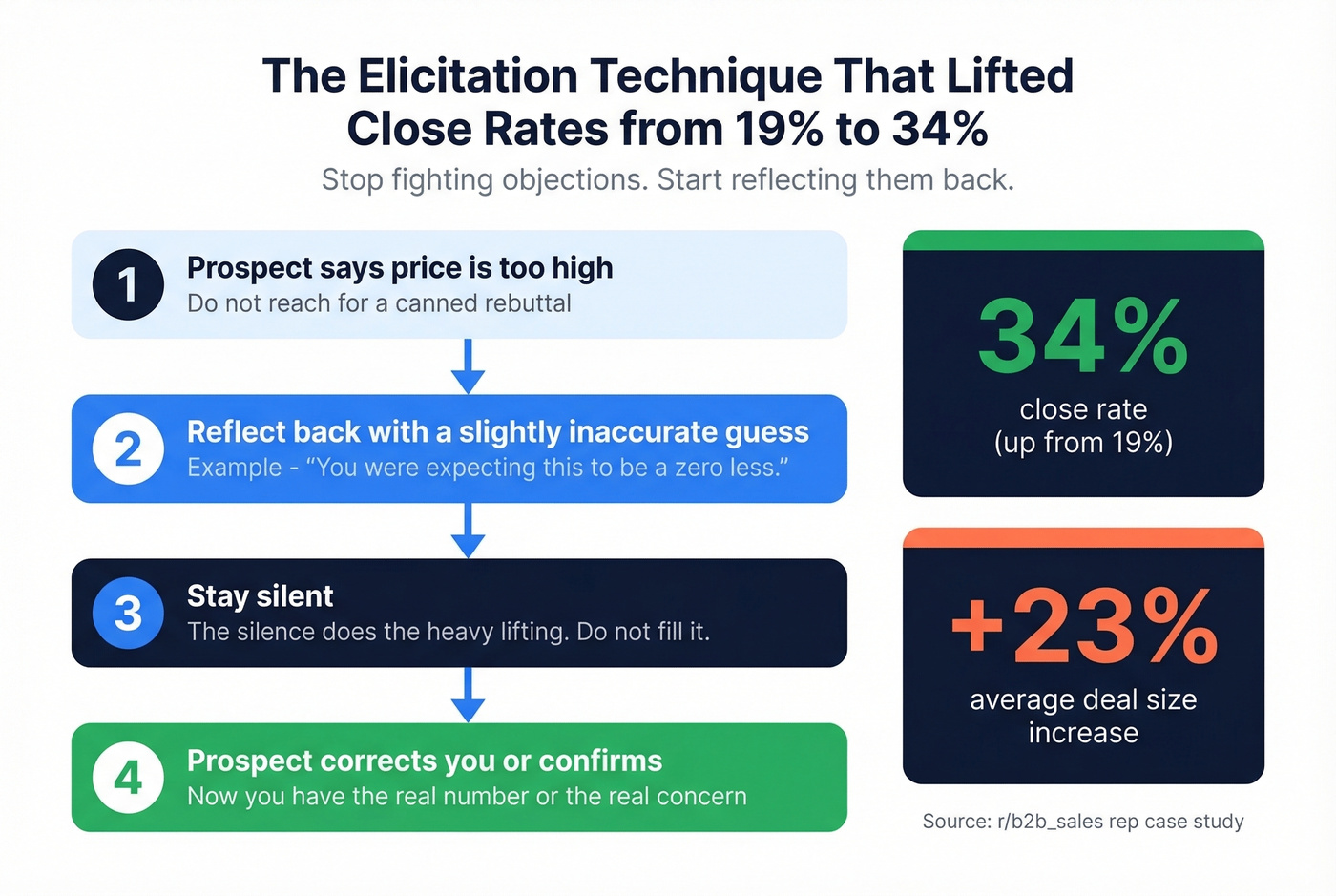
"You were expecting this to be a zero less."
Then silence. The prospect will either correct your guess - revealing the real number or concern - or confirm it, giving you a concrete anchor. This is elicitation: people instinctively correct inaccurate assumptions and fill information gaps.
One rep on r/b2b_sales shared that their close rate went from 19% to 34% and average deal size climbed 23% after switching from canned rebuttals to this approach. When you stop fighting objections and start treating them as information, the whole dynamic shifts. We've watched reps go from robotic to conversational overnight with this one change.
If It Really Is About Budget
Sometimes the money genuinely isn't there. The rule is simple: never lower your rate. Adjust scope instead.
"I can work within that budget. At $X, I'd recommend we focus on [specific deliverable]. You'd get [outcome] without the [removed elements]. Would that work?"
When you're also dealing with a competitor anchor, stay calm: "If they're a better fit for your budget, I completely understand. Before you decide - what's the one thing you'd need from us that they can't offer?" Confident disqualification works because it removes pressure.
Let's be honest about something: a lot of "budget" objections happen because reps are pitching the wrong person. A director who doesn't control the budget will always say "too expensive" - it's the safe answer. The fix is upstream. Tools like Prospeo help you reach the actual decision-maker before the call happens with 98% verified emails and 125M+ verified mobile numbers, so you're not burning cycles on someone who was never going to sign.
Don't let these deals drag, either. Outreach's data shows that deals past 50 days drop to a 20% win rate. Diagnose the objection, fix the upstream problem, and stop memorizing scripts that don't fit.
If you want a tighter system end-to-end, map these conversations to your sales qualification and keep a clear walk away point before you ever send pricing.
The best price objection rebuttal is confidence - and confidence comes from reaching real buyers at verified contacts. Prospeo's 98% email accuracy and 125M+ verified mobiles mean your pipeline is full enough that no single "too expensive" kills your quarter.
Fill your pipeline so one lost deal never breaks your number.
FAQ
What are the best price objection rebuttals?
The best rebuttals match the objection type. For value gaps, ask "What happens if this isn't solved in 6 months?" For real budget constraints, trade scope instead of discounting. Corporate Visions found 77% of pricing objections aren't actually about money - diagnose first, then respond.
How do you handle price objections without discounting?
Adjust deliverables, not rate. Say: "I can work within that budget - at $X, I'd recommend we focus on [specific piece]." This preserves your margins and positions you as a partner who solves problems, not a vendor who caves on price.
When should you bring up pricing in a sales conversation?
Gong's analysis of 25,537 calls points to two windows: around 20% and 65% through the conversation. Teams that establish value before discussing price close 30% more deals. Too early triggers sticker shock; too late feels like an ambush.
How do you avoid price objections in the first place?
Qualify budget range in discovery and make sure you're talking to the actual decision-maker. Skip this step and you'll keep hearing "too expensive" from people who were never authorized to say yes.