

Probing Questions: 70+ Examples & Frameworks (2026)
You're eight minutes into a discovery call. The prospect just said "Yeah, we're looking at a few options." You ask "Can you tell me more about that?" and get back a polite nothing. The call dies.
Here's the thing: every probing questions list on the internet gives you that same "Can you tell me more?" - recycled filler dressed up as technique. You don't need fifty questions memorized. You need three or four great ones, a framework that generates the right question in the moment, and the discipline to actually listen to the answers.
The Short Version
- Learn one framework (TEDW (Talk, Explain, Describe, Walk Me Through) is the easiest) instead of memorizing a list. Frameworks generate the right question on the fly.
- Swap "why" for "what led to..." - it's the single biggest improvement across every domain, from sales to therapy.
- Jump to your section: Sales | Customer Service | Interviews | Education | Therapy
What Are Probing Questions?
A probing question is a follow-up that pushes past a surface-level answer to uncover what's actually going on. It's not the first question you ask - it's the second or third, the one that makes someone pause and think before responding.
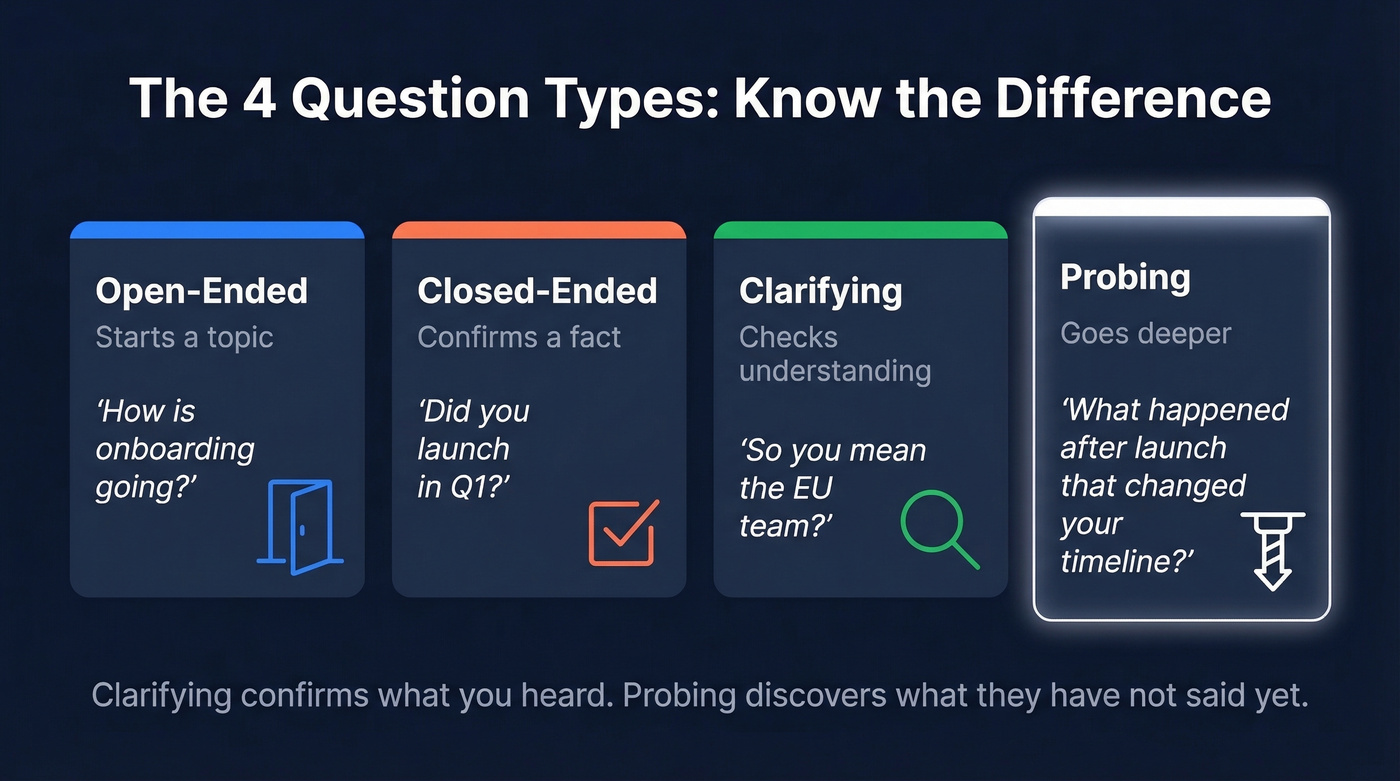
People mix up four question types constantly:
| Type | Purpose | Example |
|---|---|---|
| Open-ended | Start a topic | "How's onboarding going?" |
| Closed-ended | Confirm a fact | "Did you launch in Q1?" |
| Clarifying | Check understanding | "So you mean the EU team?" |
| Probing | Go deeper | "What happened after launch that changed your timeline?" |
The critical distinction: clarifying questions verify what you heard. Probing questions push the other person to examine what they haven't said yet. One confirms. The other discovers.
One warning that applies everywhere: leading questions aren't probing questions. A leading question smuggles your assumption into the conversation ("Don't you think the real issue is budget?"). A genuine probe leaves space for an answer you didn't expect.
Do Probing Questions Actually Work?
There's real experimental evidence here, not just "probing feels good" anecdotes. A peer-reviewed study in the International Journal of Selection and Assessment ran two experiments - one with 404 participants, another with 271 - testing whether follow-up probes improved interview outcomes. Probing improved both performance ratings and candidates' sense that they'd had a fair shot. The second study separated the probing effect from simply giving people more time to talk. Probing still won, even when response time was held constant.
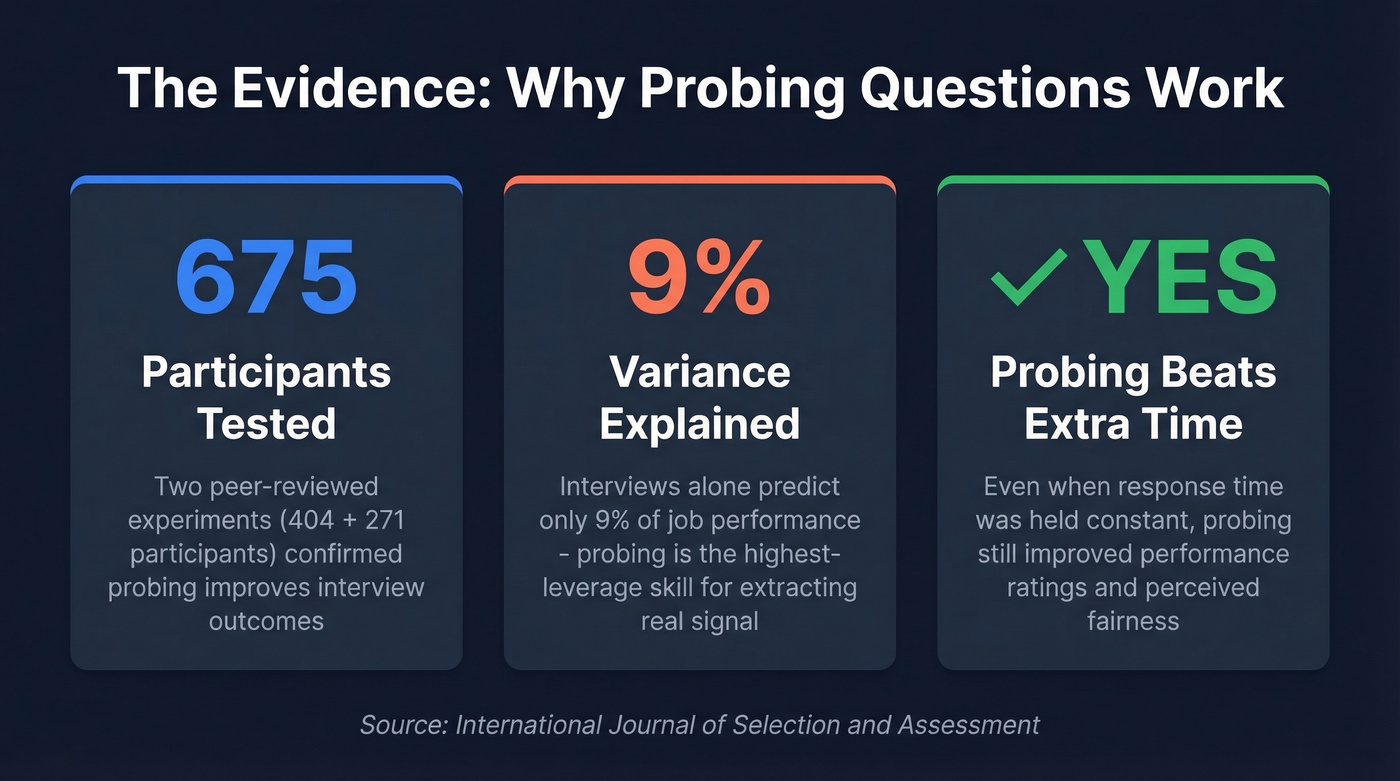
But even with better probing, interviews have fundamental limits. Interviews alone account for only 9% of the variance in predicting job performance. That's a shockingly low number. Probing doesn't fix interviews entirely, but it's the single highest-leverage skill for extracting useful signal from a conversation that's statistically noisy.
The psychology matters too. Open-ended probes reduce the power imbalance in a conversation - the other person stops feeling interrogated and starts collaborating. For frustrated customers, probes act as a release valve for cognitive load. And symptom-description probes ("Walk me through what happened") uncover hidden problems that scripted checklists miss entirely.

Your best probing question falls flat if you're talking to the wrong person. Prospeo gives you 98% accurate emails and 30+ filters - buyer intent, job changes, tech stack - so you walk into every discovery call knowing exactly who you're speaking to and why they should care.
Stop probing blind. Research your prospects in seconds for $0.01 each.
Three Frameworks Worth Learning
Understanding the different types of probing questions - and when to deploy each - matters more than memorizing a giant list. These three frameworks give you a mental model for generating the right probe in the moment.
TEDW (Talk, Explain, Describe, Walk Me Through)
TEDW comes from UX researcher Nikki Anderson and was popularized through dscout's research community. It's the simplest framework and the one we recommend for beginners.
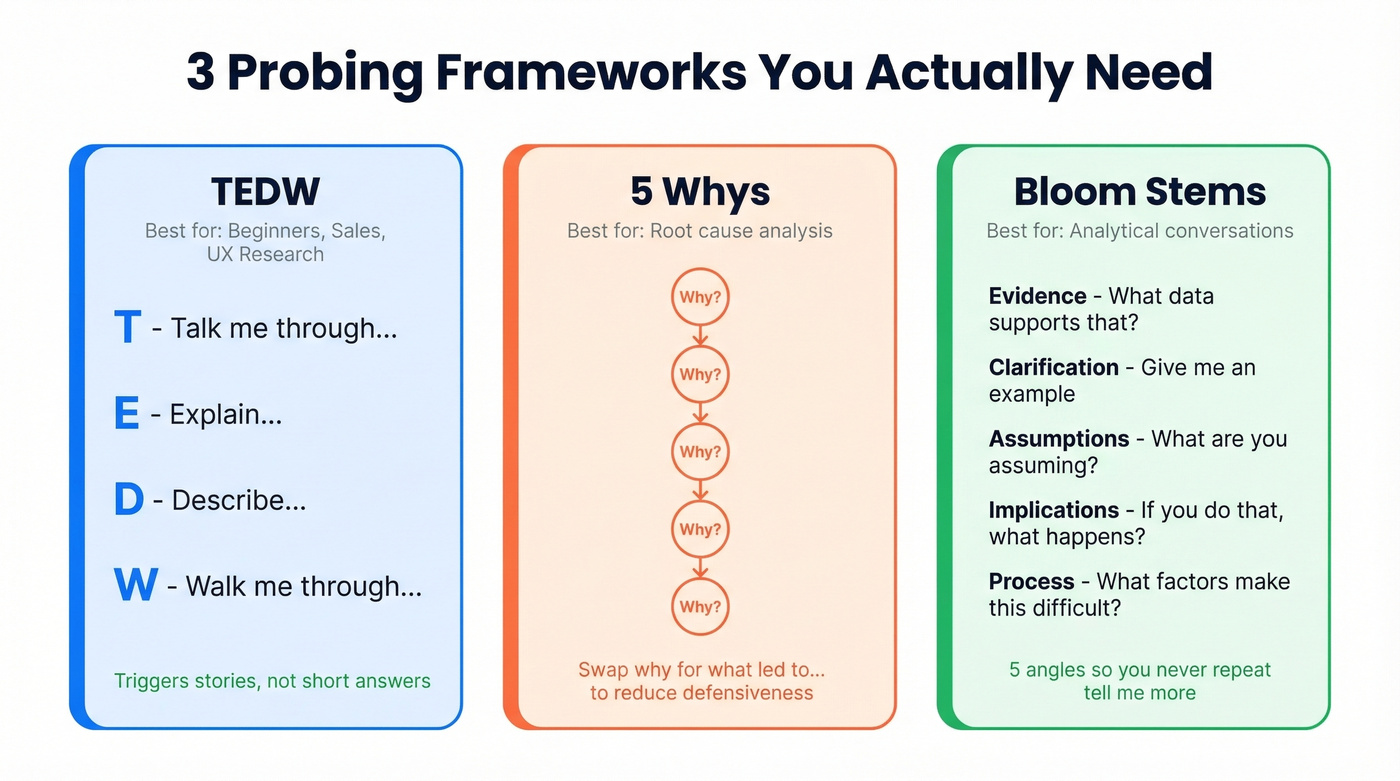
The acronym gives you four stems: Talk me through... Explain... Describe... Walk me through... Each triggers narrative rather than short answers. Compare "When did you last review your tech stack?" (you'll get "Uh, March") with "Talk me through how your team evaluates new tools." The second version generates a story with context, emotions, and details you'd never think to ask about directly. TEDW works across sales, interviews, user research, and networking because it doesn't assume a domain - it just forces open-ended, non-leading phrasing.
The 5 Whys (and When They Fall Short)
The 5 Whys traces back to the Toyota Production System in the 1930s. Keep asking "why" until you move from symptoms to root causes. "Why did the deployment fail?" -> "Because the config was wrong." -> "Why was the config wrong?" -> and so on.
It's a useful instinct. It's also overrated as a standalone technique. IMD's analysis flags three real limitations: it oversimplifies multi-causal problems by forcing a single linear chain, it's vulnerable to bias (teams stop at the convenient answer), and it lacks data validation. Use it as a conversational instinct, not a rigid method. And swap "why" for "what caused" or "what led to" whenever the person across from you might feel defensive.
Bloom-Style Probing Stems
Bloom's Taxonomy isn't just for classrooms. The University of Pittsburgh's teaching resources provide probing stems that work in any analytical conversation: Evidence ("What data supports that?"), Clarification ("Give me an example"), Assumptions ("What are you assuming here?"), Implications ("If you do that, what happens next?"), and Thought process ("What factors make this difficult?"). You don't have to go sequentially - the value is having five distinct angles so you're not just repeating "tell me more" in different words.
70+ Probing Questions Examples by Domain
Sales Discovery Calls
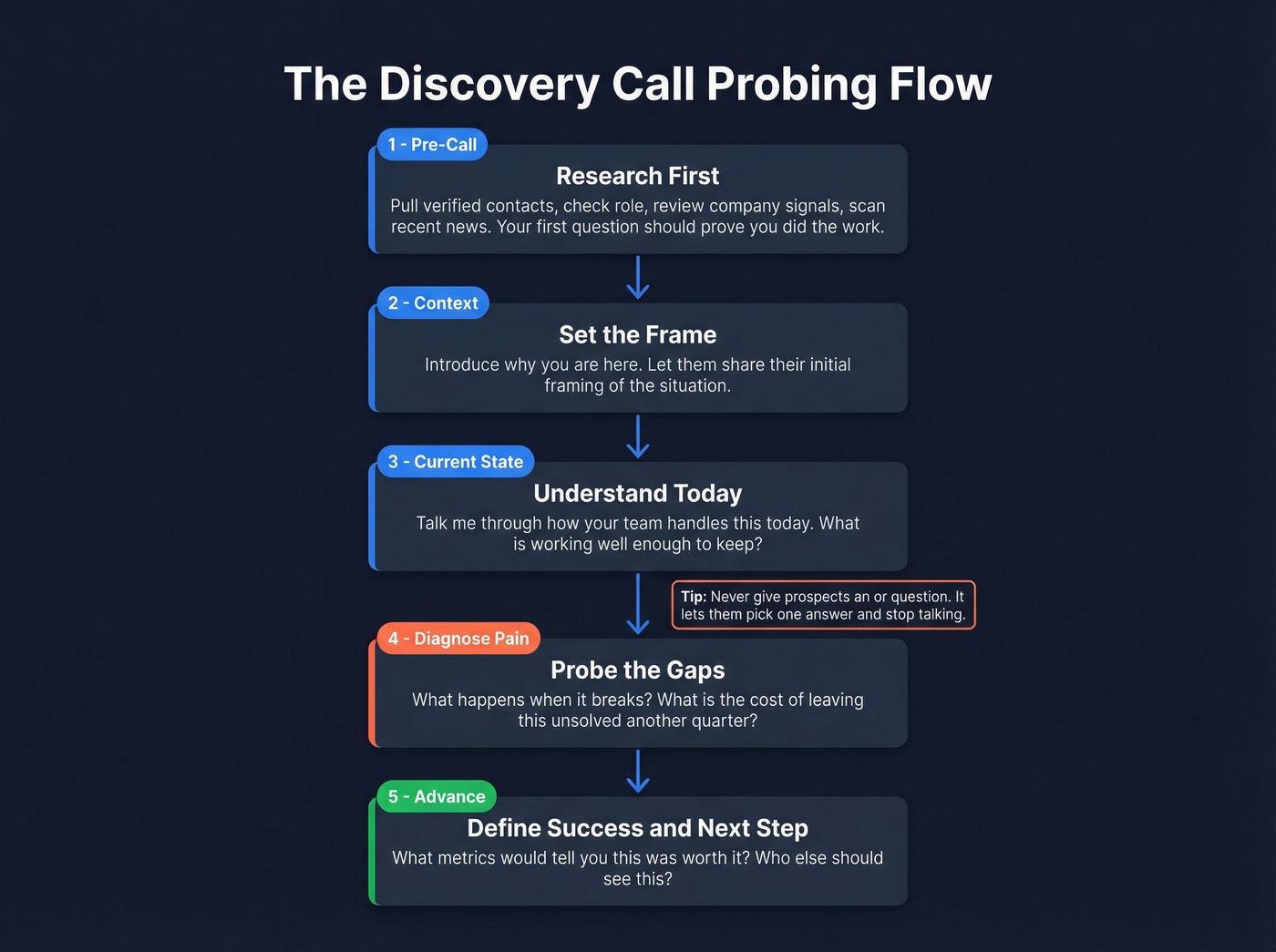
Pre-call research is the difference between probing and interrogating. If your first question reveals you didn't spend five minutes on the prospect's company, every follow-up feels lazy - no matter how well-phrased it is. We've seen reps completely transform their discovery calls just by pulling verified contact data from Prospeo, reviewing the prospect's role and company signals, and checking recent news before dialing. Your first question should prove you've done the work.
A simple discovery flow gives your meeting shape so probing doesn't feel random: introduce context, listen to their initial framing, probe the gaps, then apply what you've learned to a next step.
Understanding the current state:
- "Talk me through how your team handles [process] today."
- "What does a typical week look like for your [role] when it comes to [problem area]?"
- "How long has this process been in place?"
- "What's working well enough that you wouldn't want to change it?"
Diagnosing the pain: 5. "What happens when [process] breaks down?" 6. "How much time does your team spend on [manual task] each week?" 7. "What's the cost of leaving this unsolved for another quarter - in revenue, headcount, or both?" 8. "Walk me through the last time this problem caused a real issue." 9. "Has this gotten worse recently, or has it always been this way?"
Understanding decision dynamics: 10. "Who else is affected by this problem day-to-day?" 11. "What would need to be true for your team to prioritize solving this in the next 90 days?" 12. "What's happened with previous attempts to fix this?" 13. "What methods have you already tried?"
Defining success: 14. "If we solved this perfectly, what would your team's workflow look like six months from now?" 15. "What metrics would tell you this was worth the investment?" 16. "What's your ideal outcome from this conversation?"
Advancing the deal: 17. "Who else would benefit from seeing what we've discussed today?" 18. "What would make this a no-brainer for you to move forward?" 19. "What's your timeline for making a decision on this?"
Avoid giving prospects an "or" - "Is this about cost or timeline?" lets them pick one and stop talking. "What's driving the urgency?" keeps them going.
Avoid interrogation mode. If you're firing three closed-ended questions in a row, the prospect will shut down. After every probe, pause. Let the silence work. The best discovery calls skew toward listening, not talking.
Real talk: If your average deal size is under $10k, you probably don't need a 45-minute discovery call with 18 probing questions. Three or four sharp probes that surface the real pain, then move to a demo. Overprobing a small deal is just as bad as underprobing a large one.
Customer Service
Probing in support isn't about solving faster - it's about solving the right problem the first time. Good probes improve First Contact Resolution rates because they surface the actual issue instead of the symptom the customer reported.
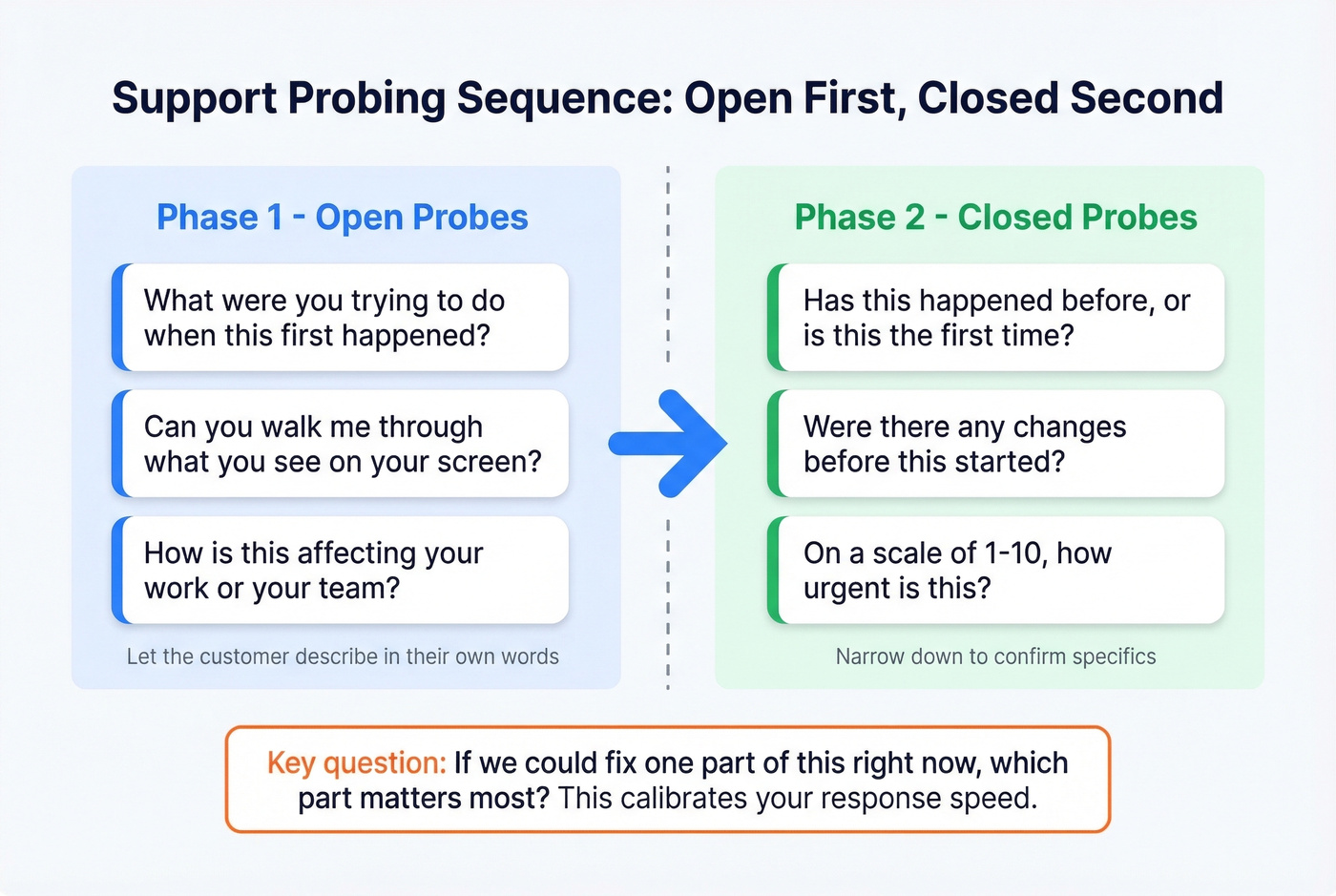
Start with open probes to let the customer describe the situation in their own words. Once you've got the full picture, narrow with closed probes to confirm specifics. Open first, closed second - that sequence matters. Knowing which types of probing questions to use at each stage prevents you from jumping to solutions before the customer has finished explaining.
- "What were you trying to do when this first happened?"
- "Has this happened before, or is this the first time?"
- "When did this situation begin?"
- "What have you already tried to fix it?"
- "What do you want to get out of this call today?"
- "Can you walk me through exactly what you see on your screen right now?"
- "How is this affecting your work or your team?"
- "What would a good resolution look like for you?"
- "Is there anything else going on that might be related?"
- "On a scale of 1-10, how urgent is this for you right now?"
- "Were there any changes to your setup before this started - updates, new users, anything?"
- "If we could fix one part of this right now, which part matters most?"
That last probe is the one worth asking. It calibrates your response speed and forces prioritization when multiple issues are tangled together.
Job Interviews
Here's that sobering number again: interviews account for only 9% of the variance in predicting job performance. The difference between a great interviewer and a mediocre one comes down to follow-up probes that extract real signal from rehearsed answers.
The distinction between prompting and probing matters. A prompting question opens a topic ("Tell me about a time you led a cross-functional project"). A probing question digs into the answer you just got. Most interviewers are decent at prompting. Very few probe well.
Use STAR (Situation, Task, Action, Result) as your probing scaffold. When a candidate gives a vague answer, probe the specific letter they skipped. Most candidates skip Action - they jump from the situation to the result. That's exactly where your probe should land.
| Area | Prompting Question | Probing Follow-Up |
|---|---|---|
| Leadership | "Tell me about leading a cross-functional project." | "You said you 'aligned the team.' Who disagreed, and how did you handle it?" |
| Technical depth | "Describe a complex architecture decision." | "What alternatives did you consider, and why did you reject them?" |
| Pressure decisions | "Tell me about a tough call you made." | "What information did you not have? What would you do differently now?" |
Beyond those three, keep these probes in your back pocket:
- Metrics: "You said the project was successful. How did you measure that? What was the baseline?"
- Failure: "At what point did you realize it was going wrong, and what did you do?"
- Problem-solving: "What factors made this a particularly difficult problem compared to others you've faced?"
- Stakeholders: "Who was the hardest person to get buy-in from? What did you try first, and what actually worked?"
- Self-awareness: "What feedback have you received that genuinely changed how you work?"
- Collaboration: "Describe a time you had to rely on someone else's expertise. How did you evaluate whether their input was sound?"
- Prioritization: "When everything was urgent, how did you decide what to work on first?"
The "why -> what" swap works here too. "Why did you leave your last role?" puts people on defense. "What were you looking for that you weren't finding?" invites honesty.
Education
Bloom's Taxonomy probing stems translate directly into classroom facilitation. The key insight from Pitt's teaching resources is that you don't have to start at the bottom of the taxonomy and work up. You can open a discussion at the evaluation level and probe downward when students need to ground their opinions in evidence.
Here's a sample exchange that shows probing in action:
Student: "I think the author's argument is weak." Instructor: "What specifically makes it weak? Point me to a passage." (evidence) Student: "The data sample is too small." Instructor: "What sample size would change your mind? And what are you assuming about the population?" (assumptions) Student: "I guess I'm assuming it needs to be nationally representative." Instructor: "Does it? What if the author was only claiming something about this region?" (implications)
That three-question sequence moved the student from opinion to analytical reasoning. That's what probing does in education - it doesn't challenge the student's conclusion, it challenges them to show their work.
More examples organized by cognitive level:
- Evidence: "Where does your evidence come from? How reliable is that source?"
- Clarification: "Can you put that in different words? Give me a concrete example from the reading."
- Assumptions: "What if we assumed the opposite? How would that change your conclusion?"
- Implications: "If that interpretation is correct, what should we expect to see in the next decade?"
- Viewpoints: "What would this look like from someone in the opposing camp?"
- Application: "How would you apply that principle to the case study we discussed last week?"
- Synthesis: "How does this connect to what we learned in the previous unit?"
- Evaluation: "Which of the two arguments we've discussed is stronger, and what's your standard for judging?"
Therapy and Coaching
Probing in therapeutic contexts requires a fundamentally different orientation than sales or interviews. The goal isn't to extract information - it's to help the other person discover something about themselves they haven't articulated yet.
The biggest rule: swap "why" for "what." "Why did you react that way?" triggers defensiveness and intellectual rationalization. "What was happening for you in that moment?" invites emotional exploration. This isn't a minor phrasing preference - counseling research shows that when a client is answering a "why" question, they're constructing a logical explanation instead of feeling their way through it.
A good therapeutic probing sequence flows like a conversation, not a checklist. You might start by grounding the client in the present moment - "What's coming up for you right now as we talk about this?" - then follow their answer toward the body, asking where they feel that emotion physically. If they describe tension or heaviness, you probe the narrative underneath it: "When have you felt this way before? What was similar about that situation?" Each question follows the client's lead rather than imposing a structure.
Within that flow, these probes cover the territory most sessions need to explore:
- "Where do your actions feel misaligned with what matters most to you?"
- "What assumptions do you make about what that person is thinking?"
- "What do you do when this feeling gets overwhelming? Does it help?"
- "If this problem were completely resolved, what would your daily life look like?"
- "What would you tell a close friend who described this exact situation to you?"
- "What story are you telling yourself about why this keeps happening?"
- "What would it mean about you if you let go of this?"
- "What are you afraid would happen if you said that out loud to them?"
Safety note: Move slowly with trauma-related probes. If strong emotions surface, pause, ground, and bring the exploration into the therapeutic relationship rather than pushing deeper. Sometimes the most powerful response is silence.
Questions to Avoid (and What to Ask Instead)
Lazy probing is worse than no probing at all. It signals you didn't prepare, and it wastes the other person's time on questions they've answered a hundred times before.
"How's business?" -> Too vague; invites "Fine." Try: "I saw you expanded into APAC last quarter. How's that going?"
"Who is your competition?" -> You should already know this. Try: "I noticed [Competitor X] launched a similar feature. How's that affecting your positioning?"
"What are your goals this year?" -> Generic template energy. Try: "What's the one metric your team is most focused on improving this quarter?"
"Is there anyone else I need to see?" -> Sounds transactional. Try: "Who else on your team would benefit from this conversation?"
"Has your product been successful?" -> Closed-ended and researchable. Try: "Walk me through what adoption looked like in the first 90 days."
"Why did you do that?" -> Feels judgmental. Try: "What led to that decision?"
The pattern across all six rewrites: the better version demonstrates homework, invites narrative, and treats the other person as a collaborator rather than a data source. That's what separates probing from interrogating.
Let's be honest - the "why -> what" swap is the single most universally applicable improvement in this entire article. It works in sales, therapy, education, customer service, and interviews. In our experience, we've watched reps transform their discovery calls just by making this one change. If you remember nothing else, remember that.
Pre-call research is the difference between probing and interrogating. With 300M+ profiles refreshed every 7 days, Prospeo surfaces the role context, company signals, and direct dials you need to ask questions that actually land - before you ever pick up the phone.
Turn every discovery call into a conversation your prospect actually wants to have.
FAQ
What's the difference between probing and clarifying questions?
A clarifying question checks your understanding of what someone already said ("So you mean the EU team?"). A probing question pushes into territory the speaker hasn't explored yet ("What happened with the EU team that changed the timeline?"). Clarifying confirms; probing discovers new information.
How many probing questions should you ask in a row?
Two or three max before pausing to reflect back what you've heard. Stacking more than three probes without acknowledgment feels like an interrogation. The rhythm is probe, listen, reflect, then probe again. Silence between questions is a feature, not a bug.
Can probing questions backfire?
Yes - in therapy, probing trauma too quickly can overwhelm a client; in sales, probing without homework feels insulting; in interviews, rapid-fire probes create anxiety. The fix is always the same: earn the right to probe by listening first and demonstrating genuine curiosity before going deeper.
What's the best probing framework for beginners?
TEDW. It gives you four reliable stems - Talk me through, Explain, Describe, Walk me through - that work in virtually any conversation. Pick one stem and let the other person's answer guide your next probe. No memorization required.
How do you research prospects before asking probing questions?
Verify you're reaching the right decision-maker with accurate contact data, review their role and company signals, and check recent news. Great probes are built on research, not improvised in the moment. Skip this step and even the best-phrased question will fall flat.