

How to Run Productive Sales Meetings (Without Wasting Everyone's Time)
It's Monday at 9 AM. Six reps sit in a conference room - or a Zoom grid - while a manager reads pipeline numbers off a dashboard everyone can already see. Thirty minutes becomes sixty. Nobody leaves with a clear next step. A blunt thread on r/sales says it best: "99% of sales meeting with management is a complete waste of time." An Atlassian survey of 5,000 knowledge workers backs up the broader point: meetings are ineffective 72% of the time.
Your meetings don't have to be in that 72%. Here's how to run productive sales meetings that actually move deals forward and give your team time back to sell.
What You Need (Quick Version)
- A written agenda with time boxes. 79% of workers say agendas make meetings productive, yet only 37% actually use one. That gap is where most meeting time dies.
- A weekly 30-45 minute sync as your default cadence. Fifteen-minute daily standups cost each rep 60 hours a year. Unless you're in a turnaround, weekly is the right call for quota-carrying reps.
- Clean contact data before the pipeline review. Reviewing bounced emails and disconnected numbers is the fastest way to waste a meeting. Verify your list first so you're reviewing real opportunities, not ghosts.
The Real Cost of Bad Meetings
The average employee spends 392 hours per year in meetings. For sales reps, that's devastating - they already spend roughly 70% of their time on non-selling tasks. Only 43.5% of sales professionals hit quota. Those numbers aren't a coincidence.
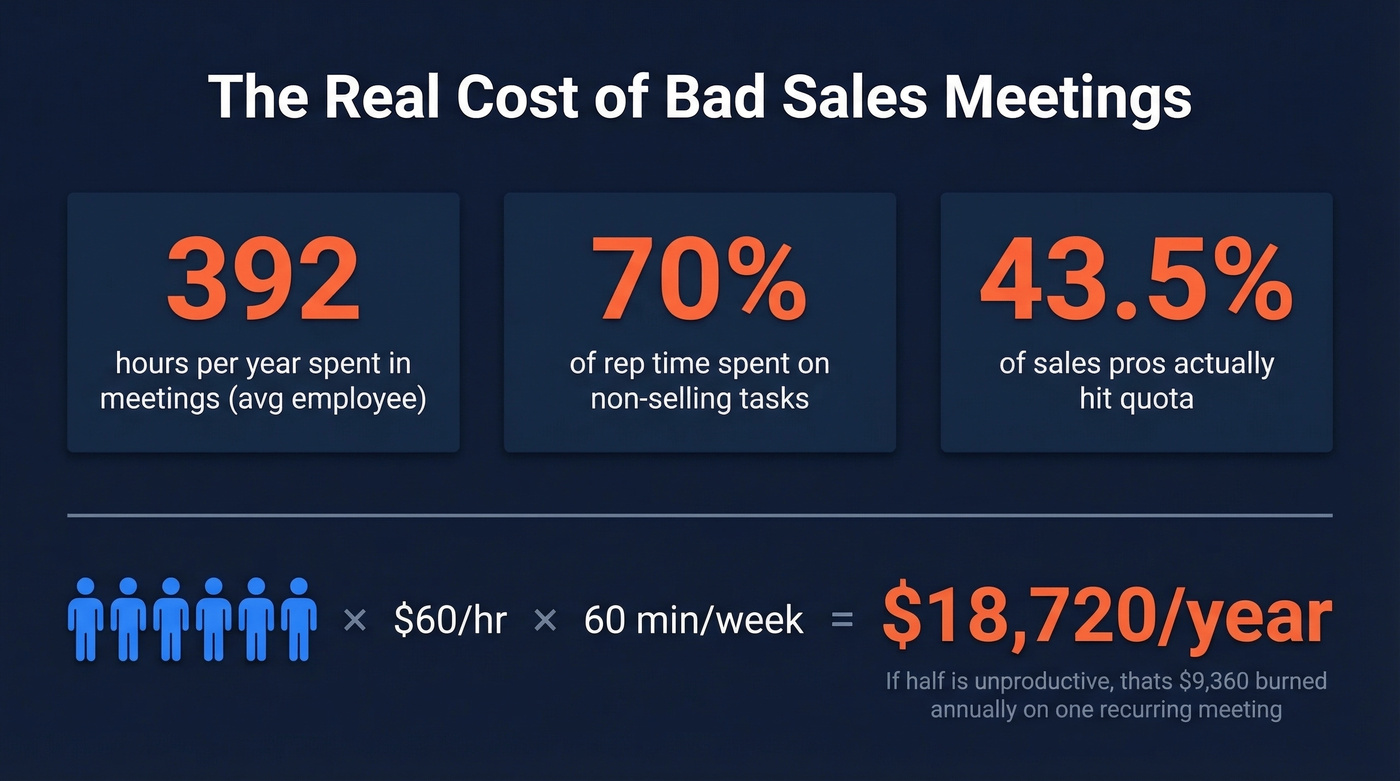
Here's the math: attendees x fully loaded hourly rate x duration x frequency. A six-person team meeting that runs 60 minutes weekly, with reps earning $120k OTE (roughly $60/hr), costs about $18,720 a year. If even half that time is unproductive, you're burning $9,360 annually on a single recurring meeting. Meetings that drive results pay for themselves; the rest are just overhead.
A Framework That Actually Works
Six steps, five minutes of prep:
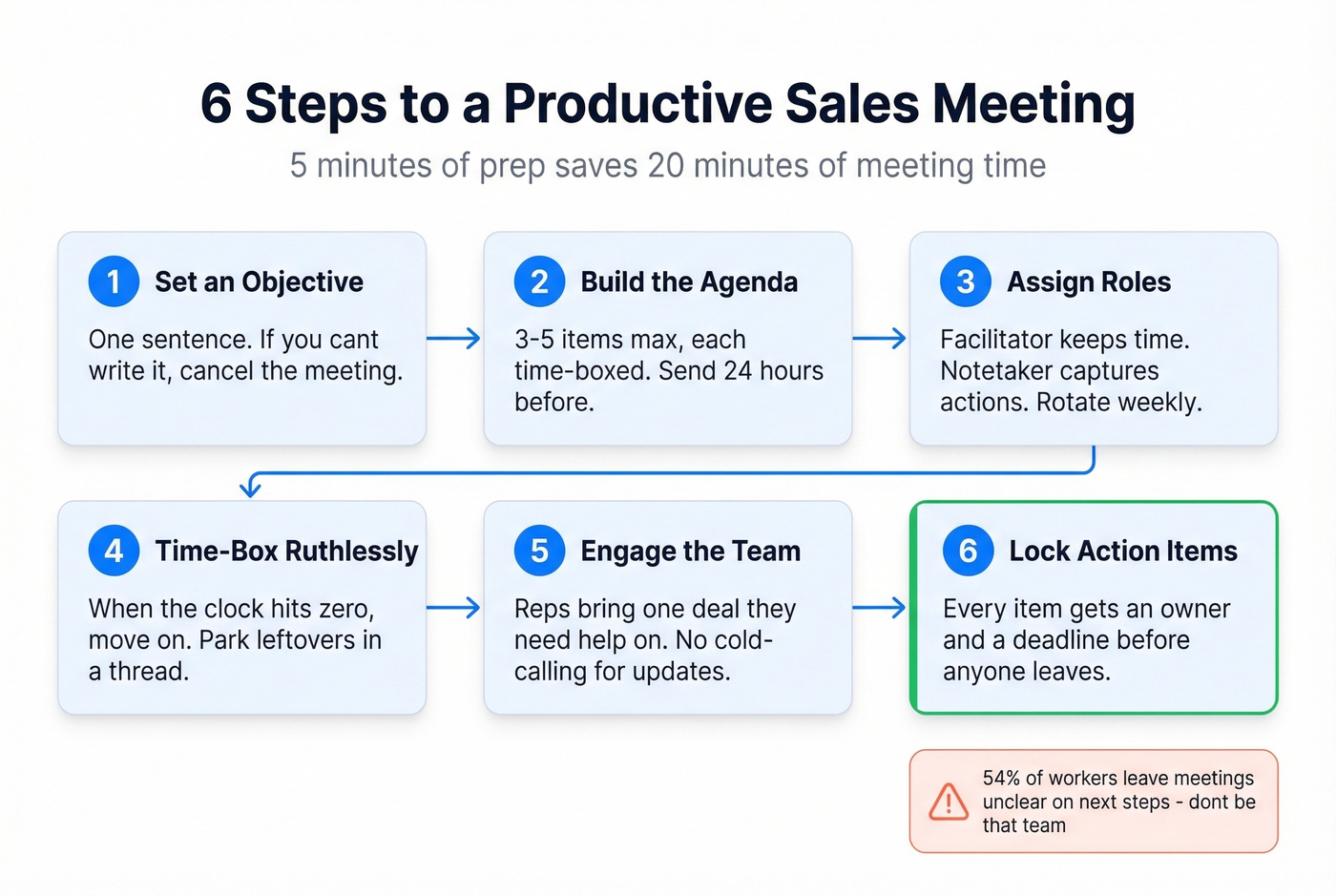
- Set an objective. One sentence. "By the end of this meeting, we'll have next steps on the five deals closest to close." If you can't write the objective, cancel the meeting.
- Build the agenda. Three to five items max, each with a time box. Send it 24 hours before.
- Assign roles. A facilitator keeps time. A notetaker captures action items. Rotate both weekly so nobody gets stuck being the scribe every time.
- Time-box ruthlessly. When the clock hits zero, move on. Park unresolved topics in a follow-up thread.
- Engage the team. Ask reps to bring one deal they need help on. Cold-calling someone to "give an update" produces anxiety, not insight.
- Lock action items. Every item gets an owner and a deadline before anyone leaves. 54% of workers leave meetings unclear on next steps - don't be that team.
As Patrick Lencioni wrote, "Bad meetings almost always lead to bad decisions, which is the best recipe for frustration and mediocrity." The fix isn't making meetings fun. It's making them useful.
Copy-Paste Agenda: 30-Minute Weekly Sync
| Block | Time | Who |
|---|---|---|
| Wins & momentum | 3 min | Round-robin |
| Pipeline movement | 10 min | Reps + manager |
| Skill drill / deal strategy | 10 min | Rotating rep |
| Blockers | 5 min | Open floor |
| Action items + owners | 2 min | Facilitator |
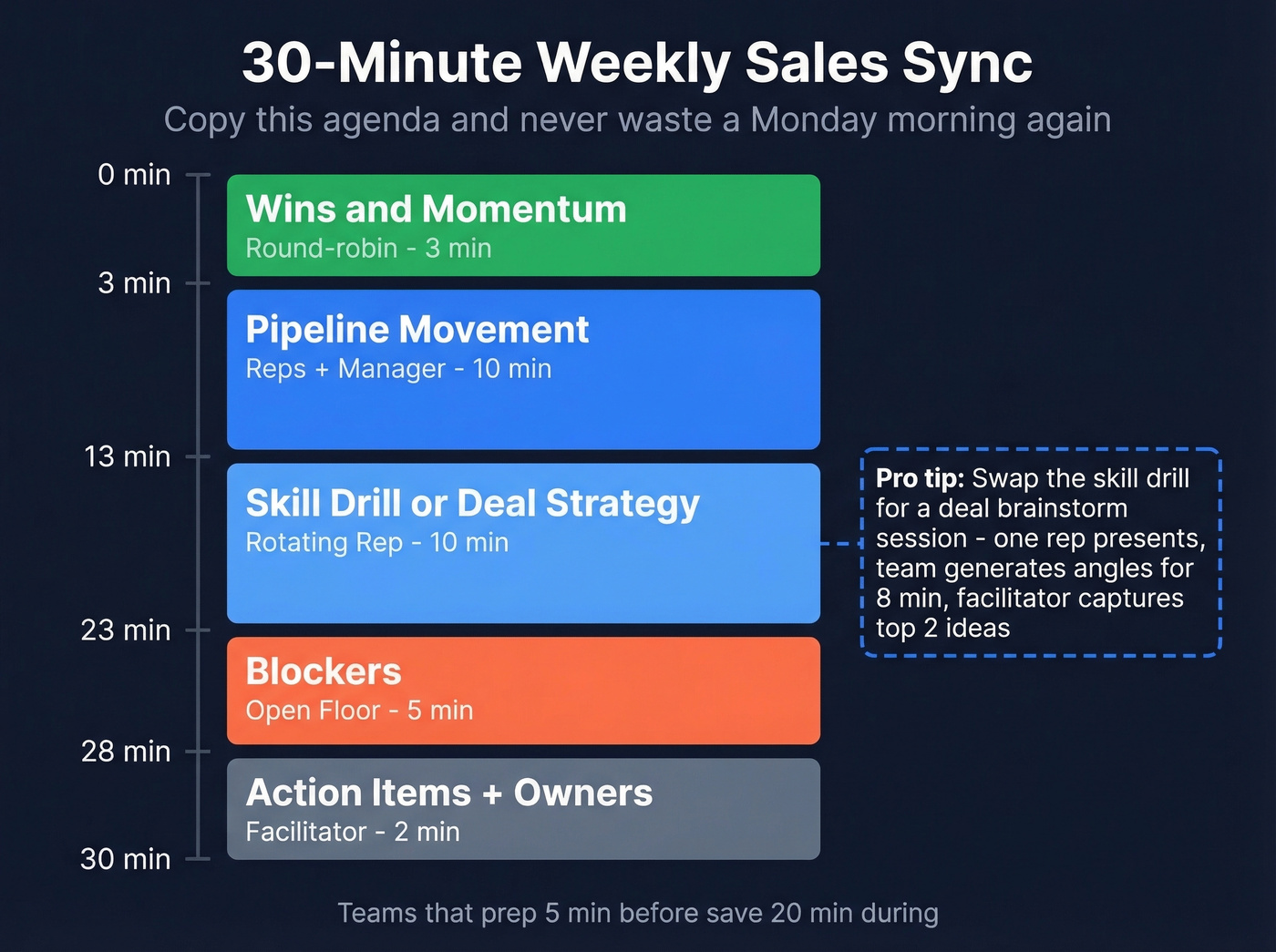
The wins block at the top isn't fluff - it's a three-minute culture lever that sets the tone. Everything after it is operational. In our experience, teams that prep for five minutes before this meeting save twenty minutes during it.
Need more sales meeting ideas? Swap the skill drill block for a brainstorming session where reps workshop a stuck deal together. One rep presents the situation, the team spends eight minutes generating creative angles, and the facilitator captures the top two ideas as action items. It's one of the highest-ROI sales team meeting ideas you can implement without adding a single minute to the agenda.

Half of unproductive pipeline reviews come down to stale data - bounced emails, wrong numbers, contacts who left months ago. Prospeo refreshes every record on a 7-day cycle and verifies emails at 98% accuracy, so your team reviews real opportunities, not ghosts.
Make every minute of your pipeline review count.
Sales Meeting Topics to Rotate Weekly
Running the same agenda every week eventually leads to autopilot. Keep things fresh by rotating the middle block:
- Deal strategy deep-dive. One rep presents a complex opportunity; the team pressure-tests the approach.
- Objection handling workshop. Replay a real objection from the week and roleplay responses - this doubles as a sales coaching meeting without needing a separate calendar slot.
- Competitive intel share. A rep who lost or won against a specific competitor walks through what they learned.
- Process improvement. Identify one friction point in the sales workflow and brainstorm a fix before the next sync.
- Win/loss analysis. Review a closed deal and extract one repeatable lesson.
Rotating through these keeps reps engaged and ensures your meetings build skills, not just review numbers. We've seen teams that commit to this rotation report noticeably better meeting satisfaction within a month - not because the meetings got shorter, but because they stopped being predictable.
Choosing the Right Cadence
| Cadence | Duration | Hours/Year per Rep | Best For |
|---|---|---|---|
| Daily standup | 10 min | ~40 hrs | Turnarounds, new teams |
| Daily standup | 15 min | ~60 hrs | High-velocity SDR pods |
| Weekly sync | 30 min | ~26 hrs | Quota-carrying AEs |
| Weekly sync | 45 min | ~37.5 hrs | Full-cycle reps + coaching |
| Bi-weekly review | 60 min | ~26 hrs | Pipeline health checks |
| Monthly | 2-3 hrs | ~24-36 hrs | Strategy + planning |
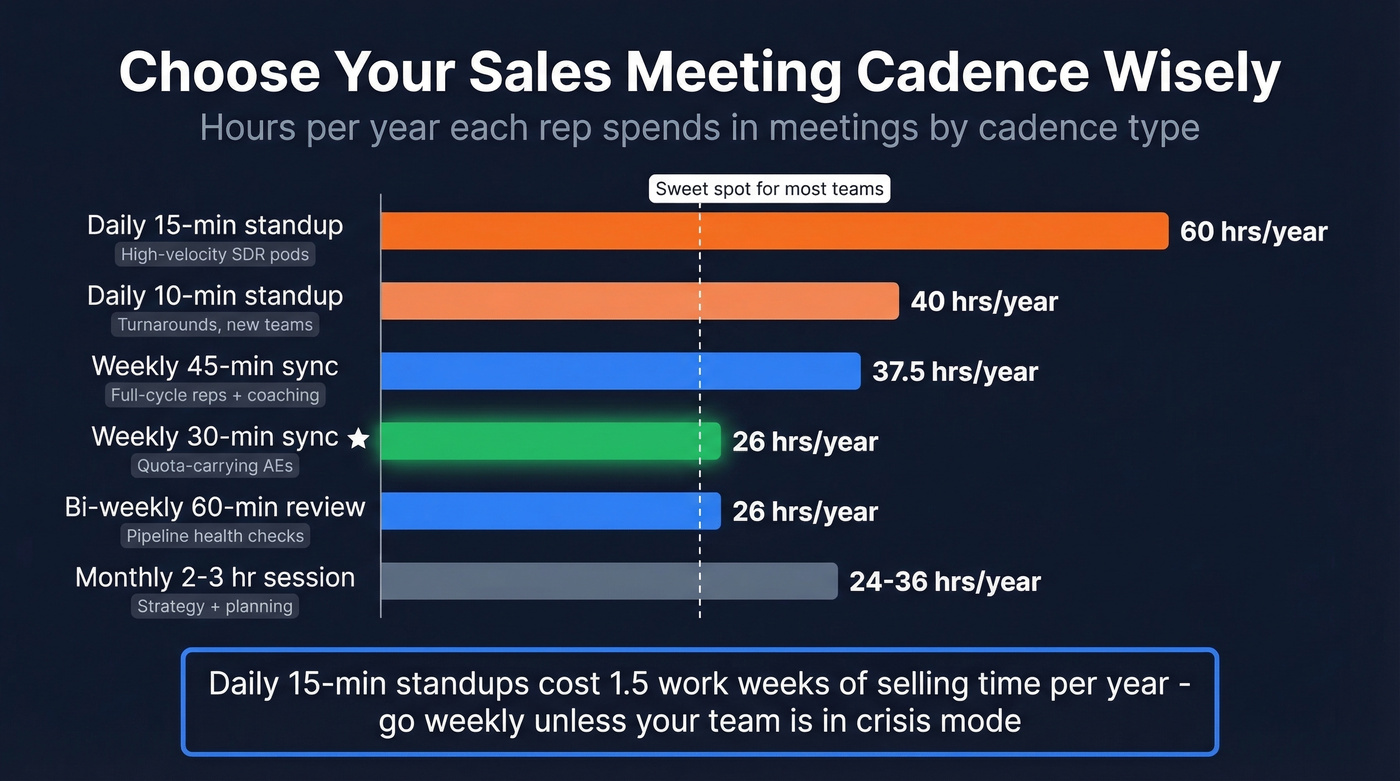
Lucid Meetings puts the math in perspective. Daily 15-minute standups cost 60 hours a year - about 1.5 work weeks of selling time gone. Unless your team is in crisis mode or ramping brand-new SDRs, weekly is the right default.
For teams that need more frequent touchpoints without the time cost, try a daily sales huddle. Keep it to five minutes: one win, one blocker, one commitment for the day. No chairs, no slides, no laptops.
Five Mistakes That Kill Meetings
1. Letting 30 minutes balloon to 90. No time-boxed agenda means the meeting expands to fill whatever time people tolerate. Set a hard stop and honor it.
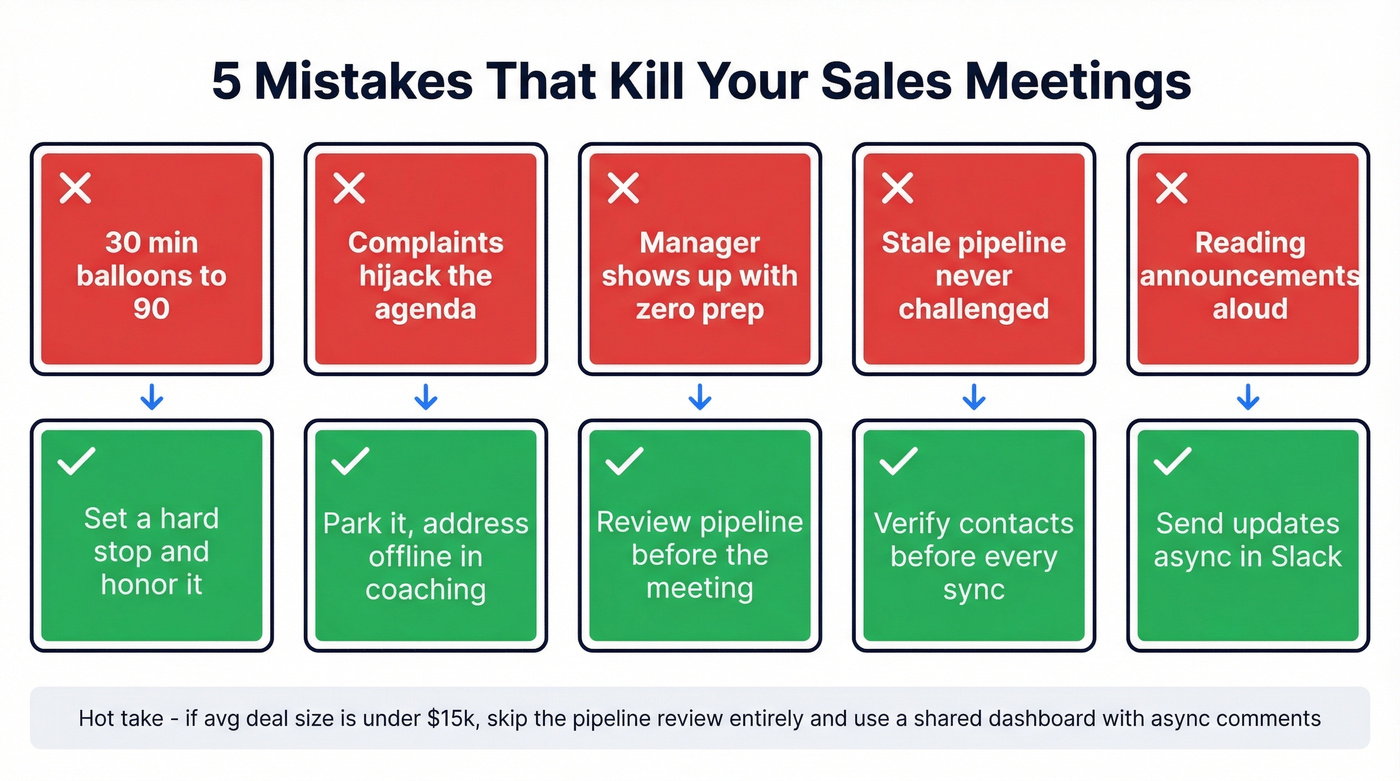
2. Letting complaints hijack the agenda. Venting about a lost deal feels productive. It isn't. Park it, address it offline or in a dedicated coaching session where the rep can get real feedback instead of a group therapy moment.
3. Zero prep from the manager. If you haven't reviewed the pipeline before the meeting, you'll spend 15 minutes catching up in real time - on everyone else's clock. That's the kind of thing that makes reps resent the meeting entirely.
4. Never challenging stale pipeline. We've all seen the same prospect sitting in Stage 3 for four months with nobody asking why. If half your pipeline review covers contacts with bounced emails and disconnected numbers, you don't have a meeting problem - you have a data problem. Run your list through Prospeo before the next sync so you're reviewing reachable opportunities, not dead contacts.

5. Reading announcements that belong in Slack. Product updates, comp plan tweaks, marketing collateral drops - send those async. Every announcement you read aloud is a minute stolen from deal strategy.
Here's a hot take: if your team's average deal size is under $15k, you probably don't need a pipeline review meeting at all. A shared dashboard with async comments will do more for velocity than a weekly round-robin where reps narrate CRM fields out loud.
Your reps already lose 70% of their time to non-selling tasks. Don't let bad contact data waste the meeting time they have left. Prospeo gives you 300M+ verified profiles with direct dials that actually pick up - so deal reviews focus on strategy, not data cleanup.
Give your team contacts worth talking about in the next sync.
Beating Holiday Meeting Blues
End-of-quarter holidays and long weekends are notorious for tanking meeting attendance and energy. Don't cancel - shorten. Cut the sync to 15 minutes and focus exclusively on the two or three deals that can close before the break. Replace the skill drill with a quick round of wins from the quarter. It keeps morale up when half the team is mentally checked out, and the shortened format makes it feel worth showing up for rather than another obligation on a short week.
Running Hybrid and Remote Meetings
Assign a facilitator to manage flow and monitor chat, plus a notetaker for action items - without these roles, remote participants get talked over every single time. Rotate meeting times for timezone equity; if your EMEA reps always get the 7 PM slot, you'll lose them mentally first, then literally.
Push updates that don't require live discussion to Slack threads or Loom recordings. And keep camera-on policies for small deal-strategy sessions only - a remote sales meeting format with a 20-person all-hands with mandatory cameras is just Zoom fatigue with extra steps. Let's be honest: nobody's paying closer attention because their webcam is on. They're just more self-conscious.
FAQ
How long should a weekly sales meeting be?
Thirty minutes, time-boxed with a written agenda. Atlassian found 80% of workers say meetings could be done in half the time. A tight 30-minute sync with clear action items beats a meandering 60-minute session every time.
What are the best topics for a sales meeting?
Wins, pipeline movement, one skill drill or deal strategy discussion, blockers, and locked action items with owners. Skip announcements - send those async. Rotate the middle block across objection handling, competitive intel, and win/loss analysis to keep the conversation fresh week over week.
How do you keep pipeline reviews from wasting time?
Verify your contact data before the meeting. Tools like Prospeo flag risky emails and unreachable numbers so you only review reachable prospects, turning a 30-minute review into 15 minutes of real decisions.
When should you add a brainstorming session?
Brainstorming works best when the team is stuck on a recurring objection, entering a new market segment, or trying to crack a high-value account. Keep it structured: define the problem in two minutes, generate ideas for eight, then vote on the top two to test. Unstructured brainstorming tends to eat the entire agenda and leave everyone feeling busy but directionless.