


Propane Pricing, Reviews, Pros and Cons: The 2026 Homeowner's Guide
One homeowner on Reddit reported a $760 bill for roughly 26 days of heating after a propane top-off. Another on Houzz summed up the frustration bluntly: propane is often the fuel you end up with when natural gas isn't available, and it can feel like you're paying a premium for that reality.
If you're researching propane before committing, you're already ahead of most buyers. Per-gallon price is only part of what you actually pay. Here's an honest look at what propane costs in 2026, what real homeowners say about it, and the tradeoffs that matter most.
What Propane Costs Right Now
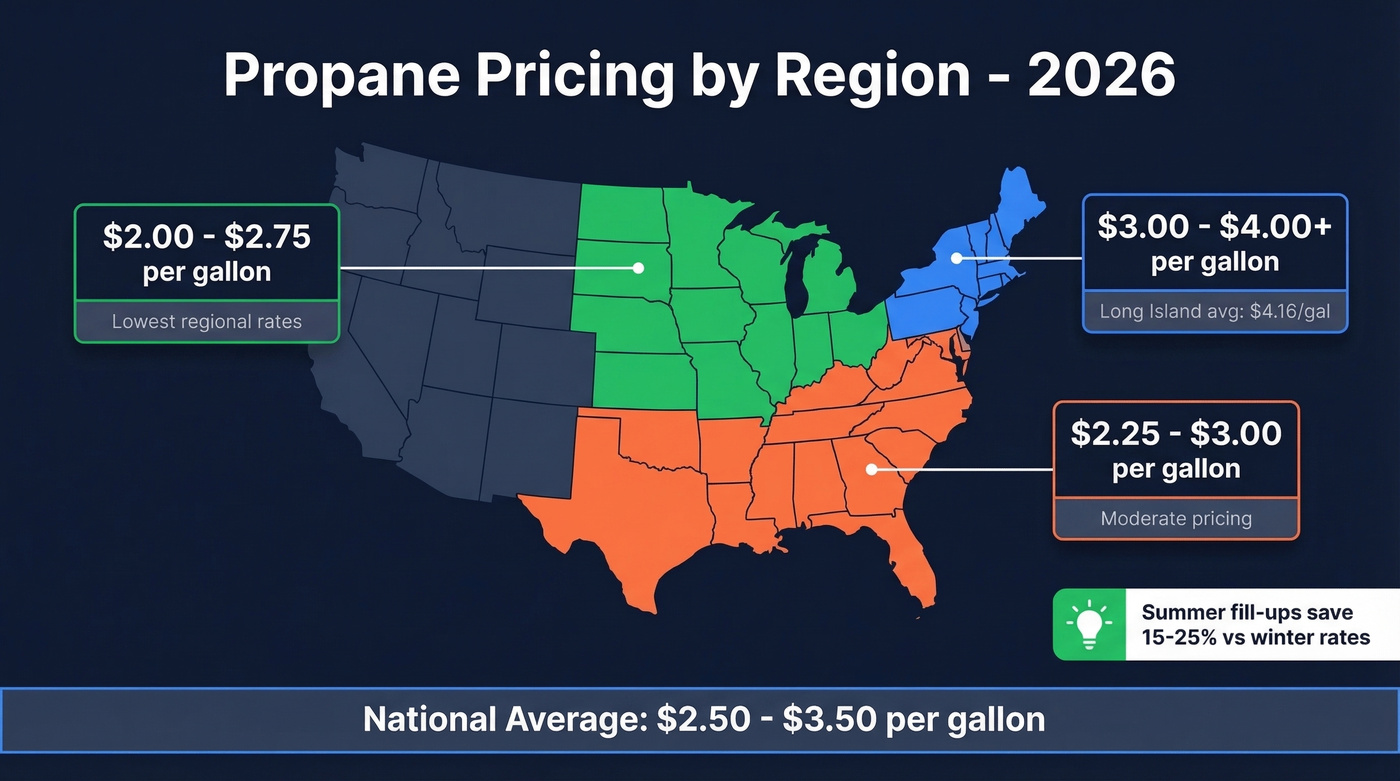
Residential propane commonly lands around $2.50-$3.50 per gallon nationally, though where you live can swing that number dramatically. In higher-cost Northeast markets, $4.00+ per gallon happens regularly - one Long Island survey snapshot listed an average of $4.16/gal.
| Cost Item | Typical Range |
|---|---|
| Per gallon (national avg) | $2.50-$3.50 |
| Northeast per gallon | $3.00-$4.00+ |
| Midwest per gallon | $2.00-$2.75 |
| South per gallon | $2.25-$3.00 |
| Annual heating (avg home) | $1,500-$2,500 |
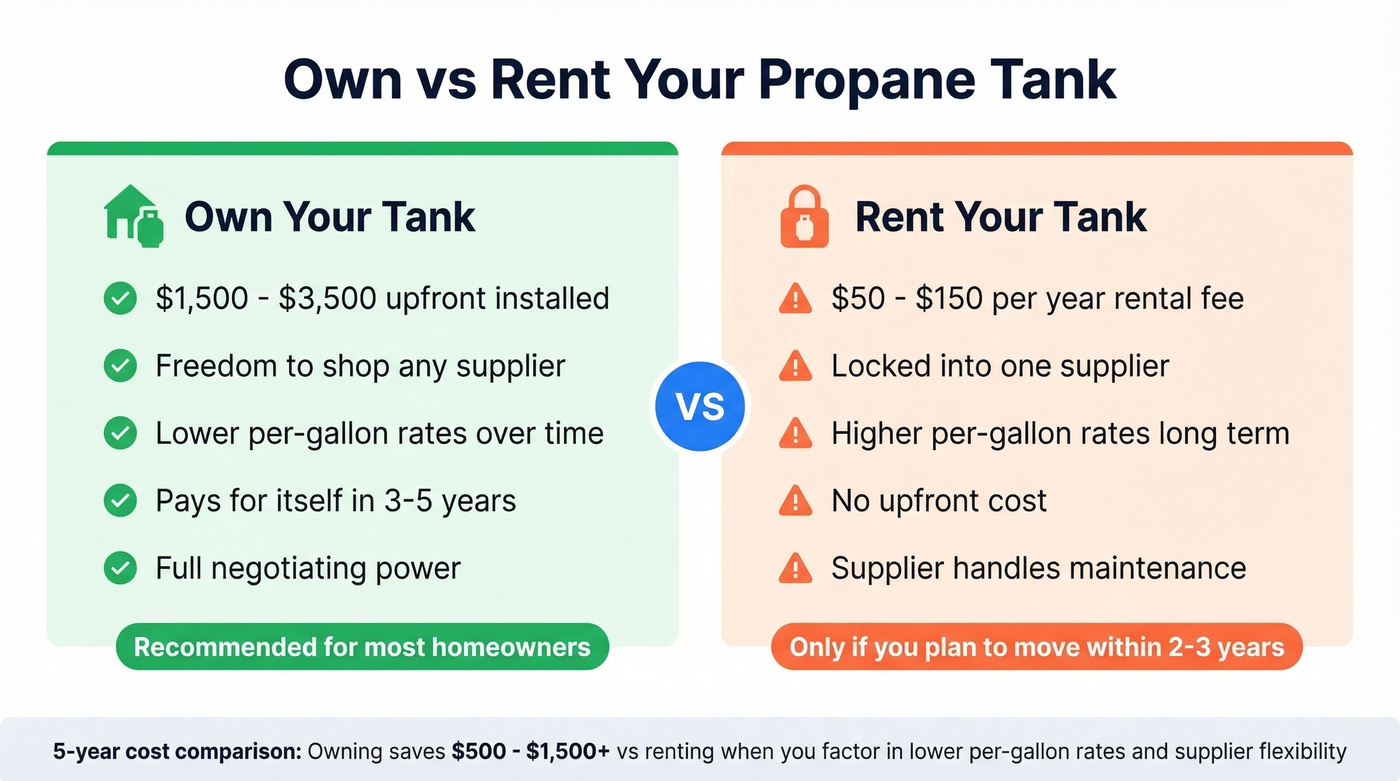
| 500-gal tank (purchased) | $1,500-$3,500 installed |
| Tank rental | $50-$150/year |
| Furnace installation | $2,500-$5,000 |
| Delivery fee | $0-$75 per fill |
A summer fill-up between May and September is often 15-25% cheaper than a mid-winter delivery. On a big fill, that's real money. If you buy 400-500 gallons and the seasonal swing is $0.50-$1.00 per gallon, you're looking at $200-$500 in savings just for planning ahead.
Pros and Cons
Pros:
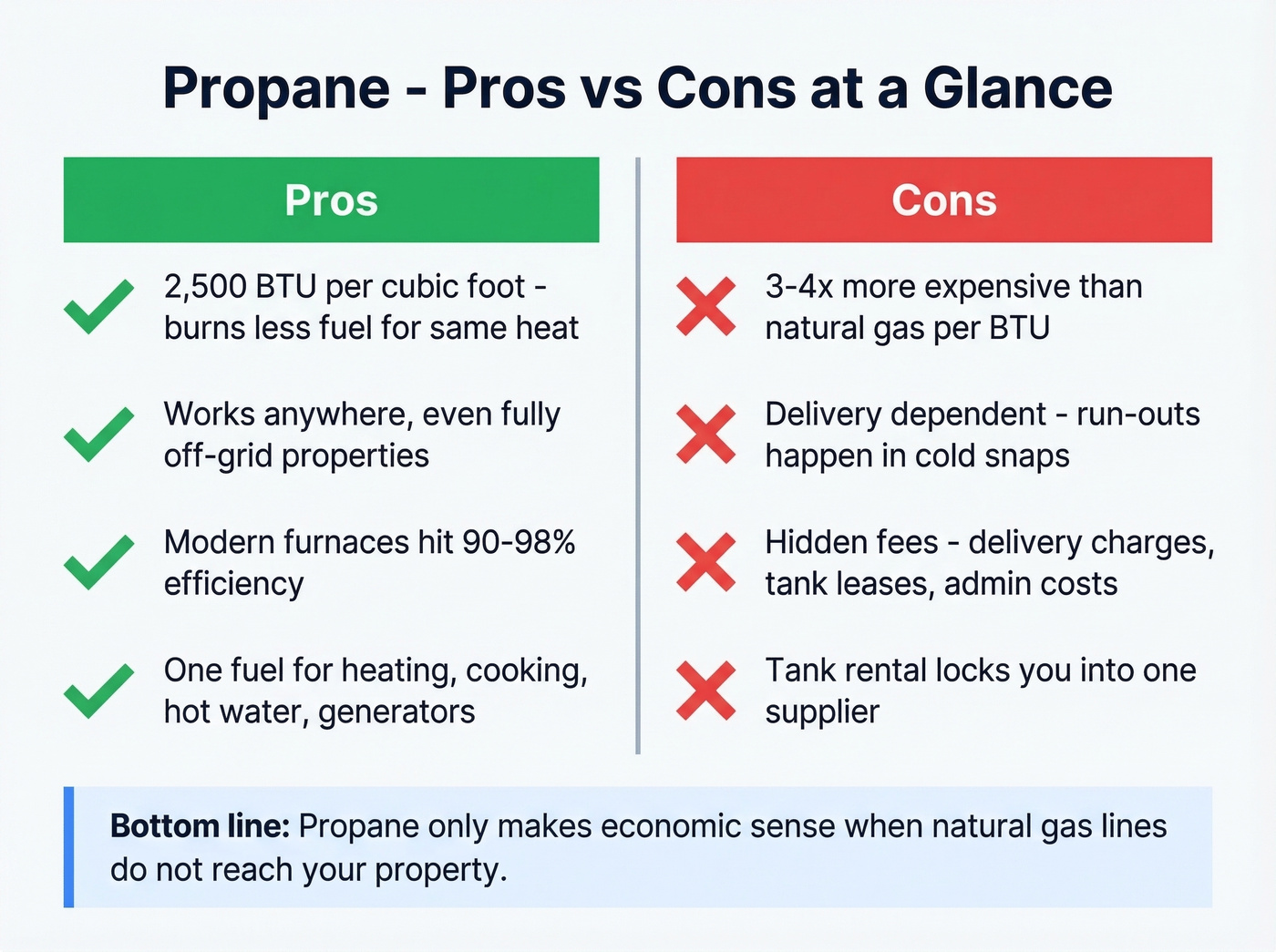
- Higher energy density than natural gas - roughly 2,500 BTUs per cubic foot vs. 1,030 - so you burn less volume for the same heat output
- Works anywhere, including off-grid properties where gas lines don't reach
- Modern propane furnaces commonly hit 90-98% efficiency
- One fuel covers heating, cooking, water heaters, generators, and pool heaters
Cons:
- Often far more expensive per BTU than natural gas where both are available (homeowners on r/homeowners consistently describe it as 3-4x the cost)
- You're dependent on deliveries, and run-outs happen, especially during cold snaps when every customer is calling at once
- Supplier pricing can be opaque, with delivery fees, tank leases, admin charges, and required safety visits that don't show up in the headline per-gallon quote
- Tank rental can lock you into a single supplier, killing your negotiating power
Here's the thing: if natural gas is available at your property, propane almost never wins on cost. Propane only makes economic sense when gas lines don't reach you.

Comparing propane suppliers means getting multiple quotes. If you're the supplier chasing commercial accounts, the same principle applies - you need to reach the right decision-makers fast. Prospeo gives propane distributors 98% accurate emails and 125M+ verified mobile numbers for property managers and facility buyers.
Reach commercial property decision-makers before your competitors do.
Hidden Fees and How Pricing Actually Works
Propane suppliers sell under a few contract styles, and each one has tradeoffs worth understanding before you sign anything:
| Contract Type | How It Works | Watch For |
|---|---|---|
| Fixed-rate | Locks per-gallon price for the season | Painful if market drops |
| Variable-rate | Floats with the market | Brutal in cold winters |
| Cap pricing | Sets a ceiling, you benefit from drops | Usually costs extra to add the cap |
| Pre-buy | Purchase set gallons at a locked price | Unused gallon policies vary by company |
Watch for introductory teaser rates. Some suppliers offer a very low first-fill price and then raise the rate - so the "average price you paid" over a season is much higher than the number that got you in the door. We've seen this pattern come up repeatedly in homeowner forums, and it catches people off guard every time.
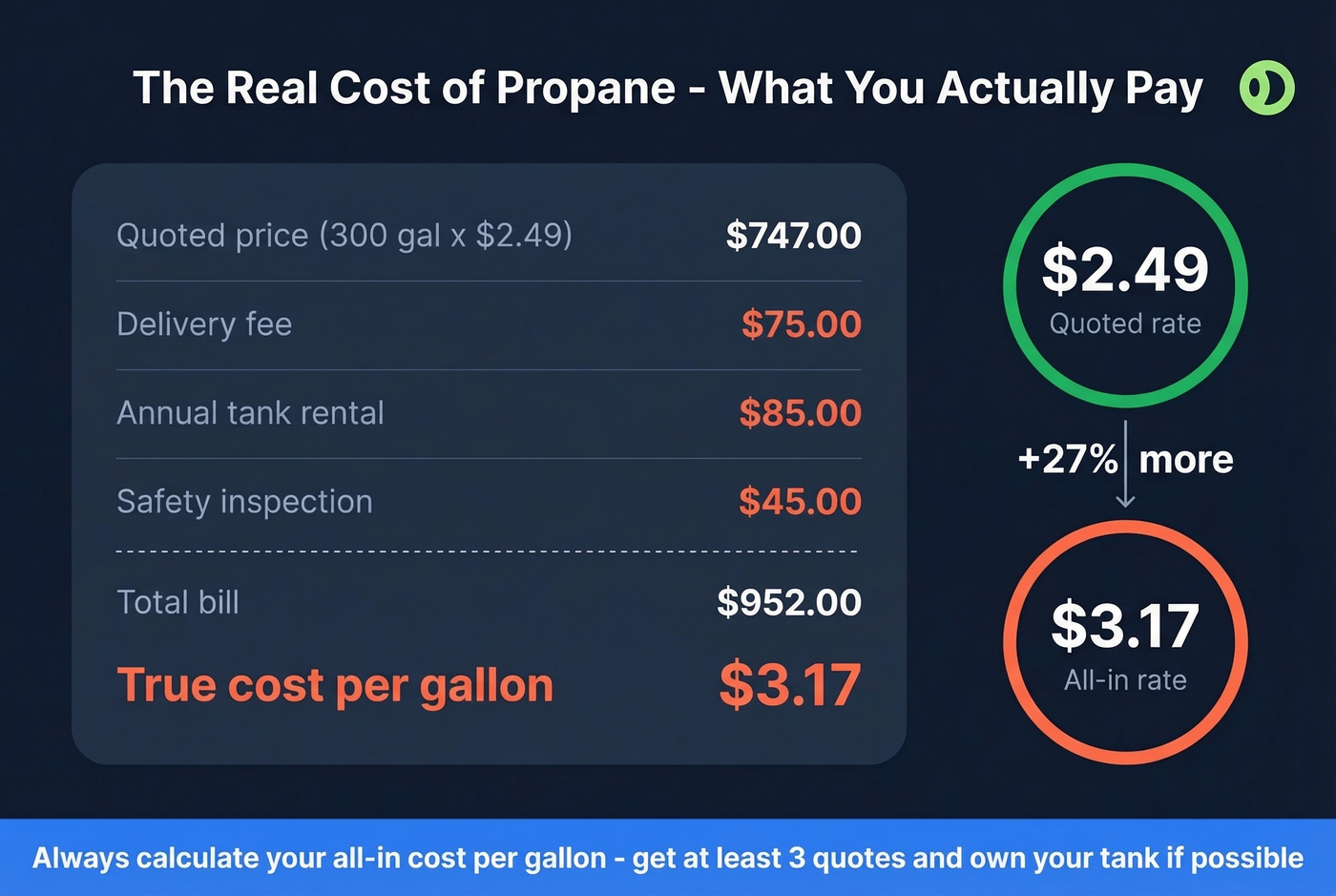
Let's break down the math that actually matters. Always compute your all-in cost per gallon, not just the posted rate.
A supplier quoting $2.49/gal on a 300-gallon fill is $747 for fuel. Add a $75 delivery fee, $85 annual tank rental, and a $45 safety inspection, and that's $205 in extra charges. Total bill: $952. All-in cost: $3.17/gal - a full 27% more than the quoted rate.
Get at least three supplier quotes, and own your tank if you can. Renting ties you to one supplier, and locked-in customers pay more over time. Period.
How Propane Suppliers Find Commercial Accounts
If you're on the other side of this equation - a propane distributor looking for commercial accounts - the prospecting game has changed. Distributors increasingly use B2B data platforms like Prospeo to find verified emails and direct dials for property managers and facility decision-makers, reaching the people who actually choose propane for multi-unit and commercial properties. If you're building a repeatable outbound motion, it helps to standardize your sales prospecting techniques and keep your lead generation workflow tight.
Propane distributors waste hours cold-calling from directories that are months out of date. Prospeo refreshes its 300M+ contact database every 7 days - not every 6 weeks like other providers - so you're always reaching current decision-makers at verified emails for roughly $0.01 each.
Ditch the outdated directories and connect with real buyers today.
FAQ
Is propane cheaper than natural gas?
No. Natural gas is usually much cheaper per BTU where both options are available. In homeowner discussions, propane is consistently described as costing 3-4x as much as natural gas. Propane only makes economic sense when gas lines don't reach your property - skip it if you have a natural gas option.
Should I own or rent my propane tank?
Own it if you can. A 500-gallon tank commonly runs $1,500-$3,500 installed, and ownership gives you the freedom to shop suppliers instead of being locked into the tank owner's pricing. The upfront cost typically pays for itself within 3-5 years through lower per-gallon rates and the ability to switch when a better deal comes along.
When's the cheapest time to buy propane?
Summer, between May and September, when prices are typically 15-25% lower than peak winter rates. Schedule a fill-up every year during this window, even if your tank isn't empty. It's one of the easiest ways to cut annual propane costs by $200-$500.
How do propane suppliers find new commercial customers?
Many distributors now use B2B data platforms to identify property managers and facility decision-makers with verified contact information. This replaces cold-calling from outdated directories and helps suppliers reach accounts that are actively managing multi-unit or commercial properties.