

The Psychology of the Sale: What Actually Works (and What Doesn't)
You nailed the discovery call - perfect rapport, textbook questions, the prospect nodding along. Then your follow-up email bounces. The phone number goes to a fax machine. Every psychological principle you deployed evaporates because you never actually reached the buyer.
That's the gap nobody talks about when they write about the psychology of the sale. 86% of B2B purchases stall, and 81% of buyers end up dissatisfied with the provider they choose. Buyers define their purchase requirements 83% of the time before they ever speak with sales. In 6sense's 2026 benchmark, average sales cycles dropped from 11.3 to 10.1 months year-over-year, and 49% of buyers say economic pressures shortened those cycles further. Meanwhile, 94% of buyers now use LLMs during their research process. The window to influence a decision is shrinking, and the buyer sitting across from you is better informed than any buyer in history.
What you need (quick version): Buyers commit neurologically before they "decide" consciously - align emotion and logic, don't pick one. Cialdini's principles work, but only when backed by real constraints. Loss aversion, anchoring, and the endowment effect close more deals than reciprocity alone. Psychology without accurate prospect data is theater. Frameworks like SPIN and Challenger turn psychology into repeatable conversations.
What Sales Psychology Actually Means
Most articles on this topic open with some version of "buyers are emotional, not logical." That's lazy, and it's wrong. Leonard Mlodinow's work shows that emotion and logic aren't opposing forces - they're inseparable. Emotions guide attention and processing. Logic validates the direction emotions point toward.
The psychology of the sale is friction removal. Every buyer has objections, biases, and decision fatigue standing between them and a purchase they'd actually benefit from. Understanding those barriers - and designing your sales process to reduce them - is what separates reps who close from reps who "build relationships" and hope for the best.
Here's the reframe that matters: psychology doesn't make people buy. It removes the reasons they don't.
What Neuroscience Actually Shows
A 2022 study in Frontiers in Human Neuroscience put EEG caps on real shoppers browsing their own shopping apps. No lab conditions, no hypothetical scenarios - actual purchase decisions. The researchers found two neural markers that consistently distinguished buy from no-buy: frontal alpha asymmetry peaks and frontal theta power peaks.
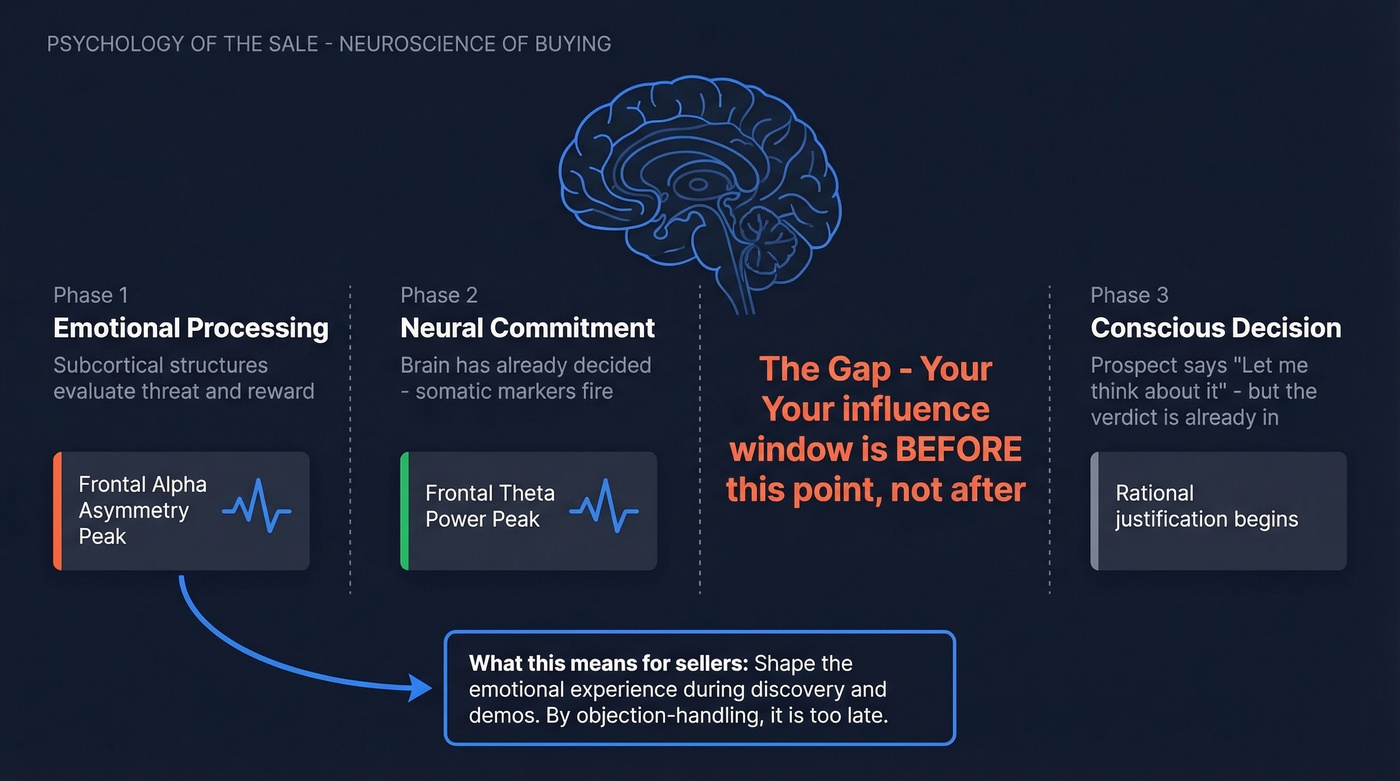
The brain commits to a purchase before the conscious mind "decides." Damasio's somatic marker hypothesis predicted this decades ago - emotional experiences create physiological shortcuts that guide future decisions before rational analysis kicks in. The EEG data confirms it in a naturalistic buying context. Some sales trainers call this the "lizard brain" sales response, the idea that primal, fast-acting neural circuits evaluate threat and reward before the prefrontal cortex weighs in. The label is reductive, but the underlying neuroscience is sound: subcortical structures do process buying signals before conscious deliberation begins.
What this means for sellers: by the time a prospect says "let me think about it," the neural verdict is already in. Your job isn't to convince them during objection-handling. It's to shape the emotional experience earlier - during discovery, during the demo, during every touchpoint before the "decision" moment arrives.
Cialdini's 7 Principles - With the Numbers
Every competitor article covers Cialdini. Here are the experiments behind the principles, because the numbers are what make them actionable.
Reciprocity
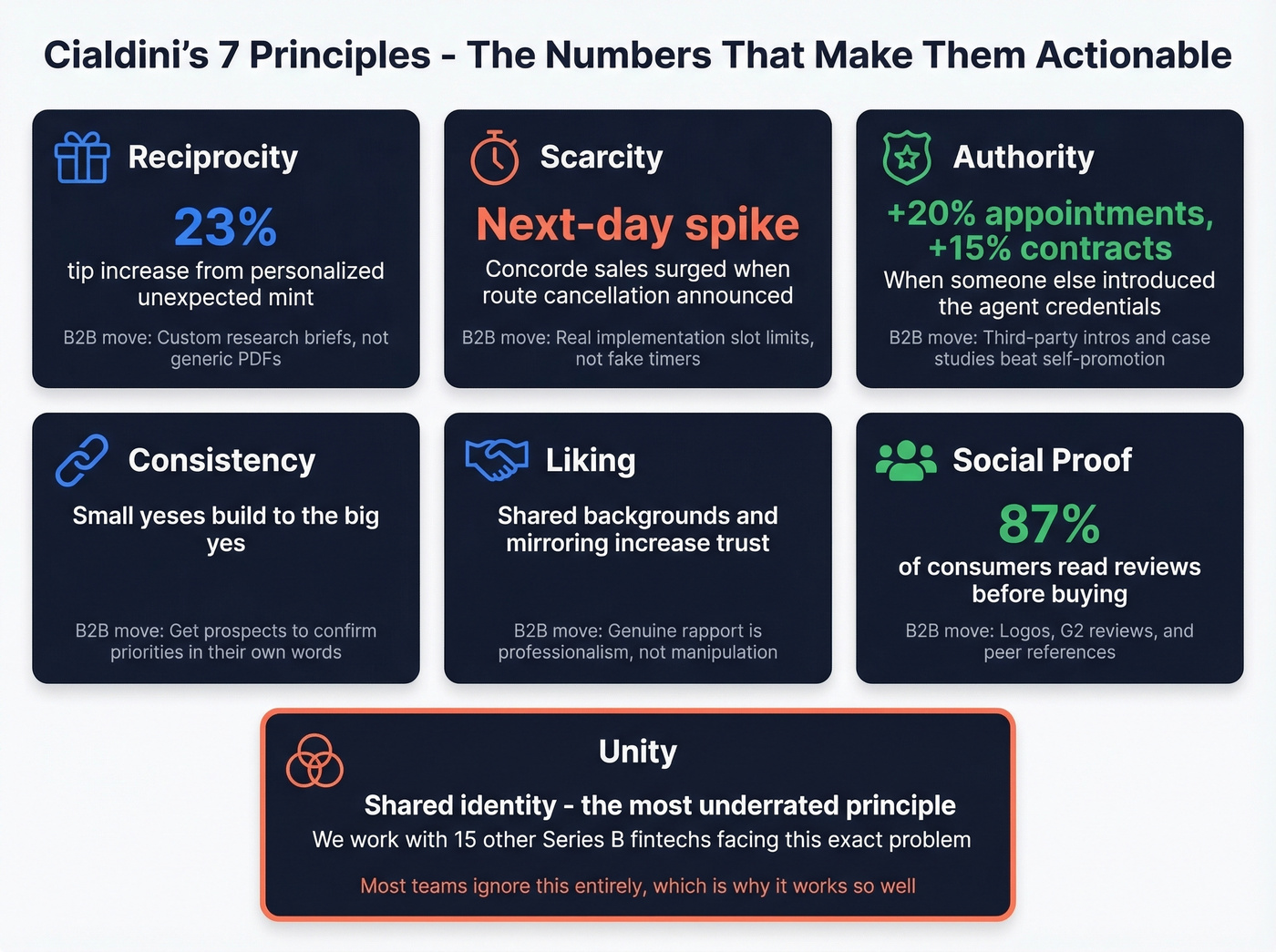
Reciprocity surprises people with its magnitude. In the famous restaurant study, giving diners one mint with the check increased tips by 3%. Two mints: 14%. But one mint, walking away, then turning back and saying "for you nice people, here's an extra mint" increased tips 23%. Personalization and unexpectedness multiplied the effect.
In B2B, reciprocity shows up as the custom research brief, the unsolicited competitive analysis, the intro to someone in your network. Generic "value adds" don't trigger it. Personalized, unexpected ones do.
Scarcity and Authority
Scarcity works even when nothing about the product changes. When British Airways announced it was ending its London-to-New York Concorde route, sales spiked the next day. Same seats, same flight, same price. In Worchel's 1975 cookie jar study, cookies from a nearly empty jar were rated as more desirable than identical cookies from a full jar - scarcity literally changed perceived taste. In sales, scarcity means limited implementation slots or a pricing window tied to quarter-end. It does not mean a countdown timer that resets when you clear your cookies.
Authority has measurable ROI. In a real estate study, when reception staff introduced agents with a brief credential mention - "Let me connect you with Peter, who has 15 years of experience" - appointments increased 20% and signed contracts rose 15%. The agent didn't change their pitch. Someone else established authority before the conversation started. This is why case studies, published research, and third-party introductions outperform self-promotion every time.
Consistency, Liking, and Social Proof
Consistency exploits the human need to align actions with prior commitments. "Can you confirm this is a priority for Q3?" is a consistency trigger. So is getting a prospect to articulate their problem in their own words during discovery. Small yeses build toward the large yes.
Liking is underestimated in B2B. People buy from people they like. Shared backgrounds, genuine compliments, and mirroring communication styles all increase liking. Deliberate rapport-building isn't manipulation - it's professionalism.
Social proof scales differently in B2B. The Ice Bucket Challenge raised $115 million for ALS. In B2B, the mechanism is the same - logos, case studies, and peer references replace viral videos. According to BrightLocal's 2024 survey, 87% of consumers read online reviews for local businesses. B2B buyers do the same on G2 and within their peer networks.
Unity - The Underrated 7th Principle
Unity is Cialdini's most underrated principle. It's the shared-identity trigger - shared group membership, shared challenges, shared values. When a seller says "we work with 15 other Series B fintech companies facing this exact compliance problem," that's unity. It signals belonging, not just capability.
Most sales teams ignore this principle entirely, which is exactly why it's so powerful when you don't.
Beyond Cialdini - The Bias Playbook
Cialdini gives you the persuasion framework. Cognitive biases give you the decision-architecture toolkit. These five biases show up in most B2B deals.
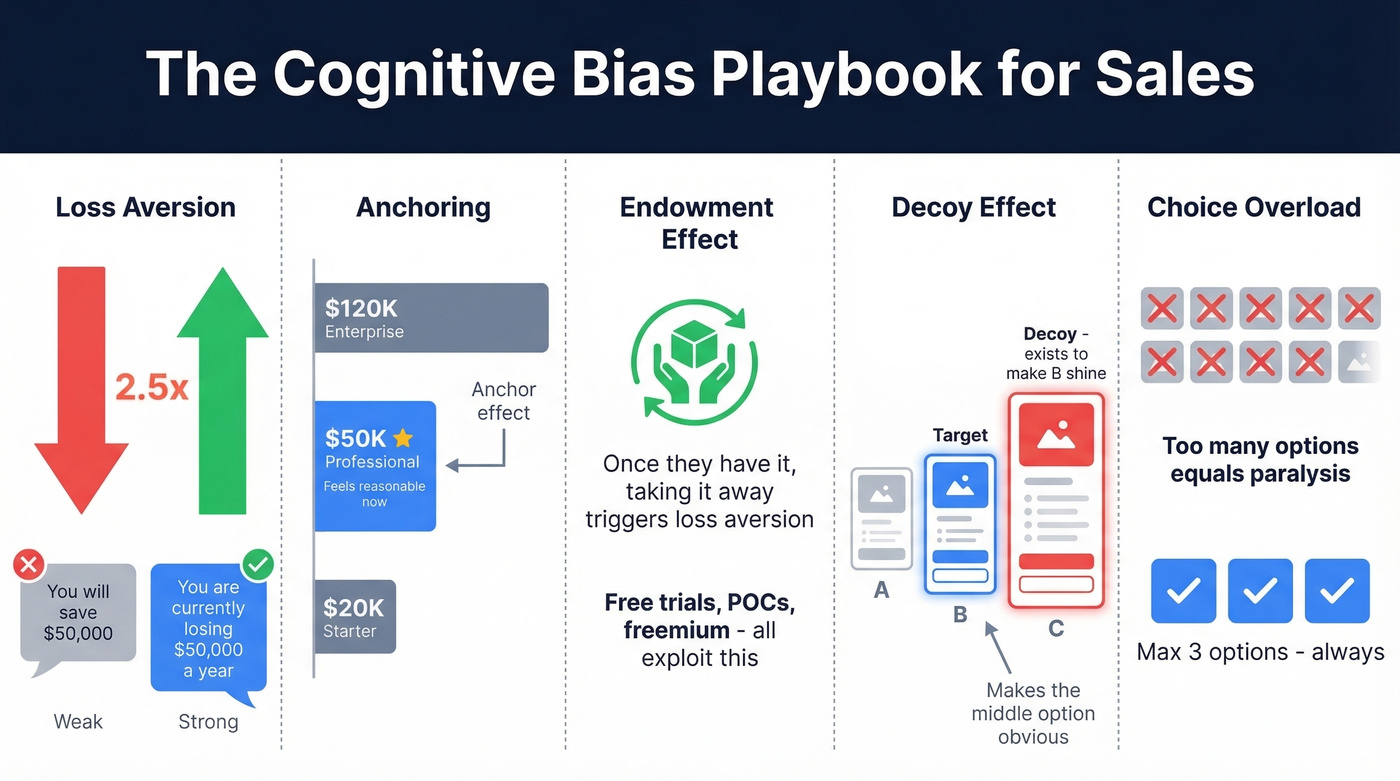
| Bias | What It Does | Sales Application |
|---|---|---|
| Loss aversion | Losing hurts 2.5x more than gaining | Frame around losses |
| Anchoring | First number sets the reference | Show top tier first |
| Endowment effect | People overvalue what they possess | Free trials, POCs |
| Decoy effect | Third option makes the target shine | 3-tier pricing with decoy |
| Choice overload | Too many options = paralysis | Max 3 options |
Loss aversion is the most powerful bias in sales. The pain of losing is about 2.5 times stronger than the pleasure of an equivalent gain. "You'll save $50,000" is less motivating than "you're currently losing $50,000 a year to this problem." Same math, completely different psychological impact.
Anchoring is why you show the enterprise tier first on your pricing page. A $50,000 annual contract feels expensive in isolation. After seeing the $120,000 enterprise tier, it feels reasonable. We've watched prospects visibly relax when they see the mid-tier price after being anchored to the top number - it's that consistent.
The endowment effect is why free trials convert. Once someone has your product - even temporarily - they psychologically own it. Taking it away triggers loss aversion. This is the core engine behind freemium SaaS.
The decoy effect and choice overload work in tandem. Offer three options, not two and not seven. The middle option should be your target, and the third option should make it look like the obvious choice. As one bias-aware selling framework puts it: three clear paths at most.

You just read it: the brain commits before the conscious mind decides. Every bounced email and dead phone number is a missed neural window you'll never get back. Prospeo's 98% email accuracy and 7-day data refresh mean your psychology actually reaches the buyer - not a fax machine.
Stop perfecting your pitch and start reaching real decision-makers.
The Seller's Psychology
Most sales psychology content focuses exclusively on the buyer. But the seller's internal state determines whether any of these principles get deployed effectively.
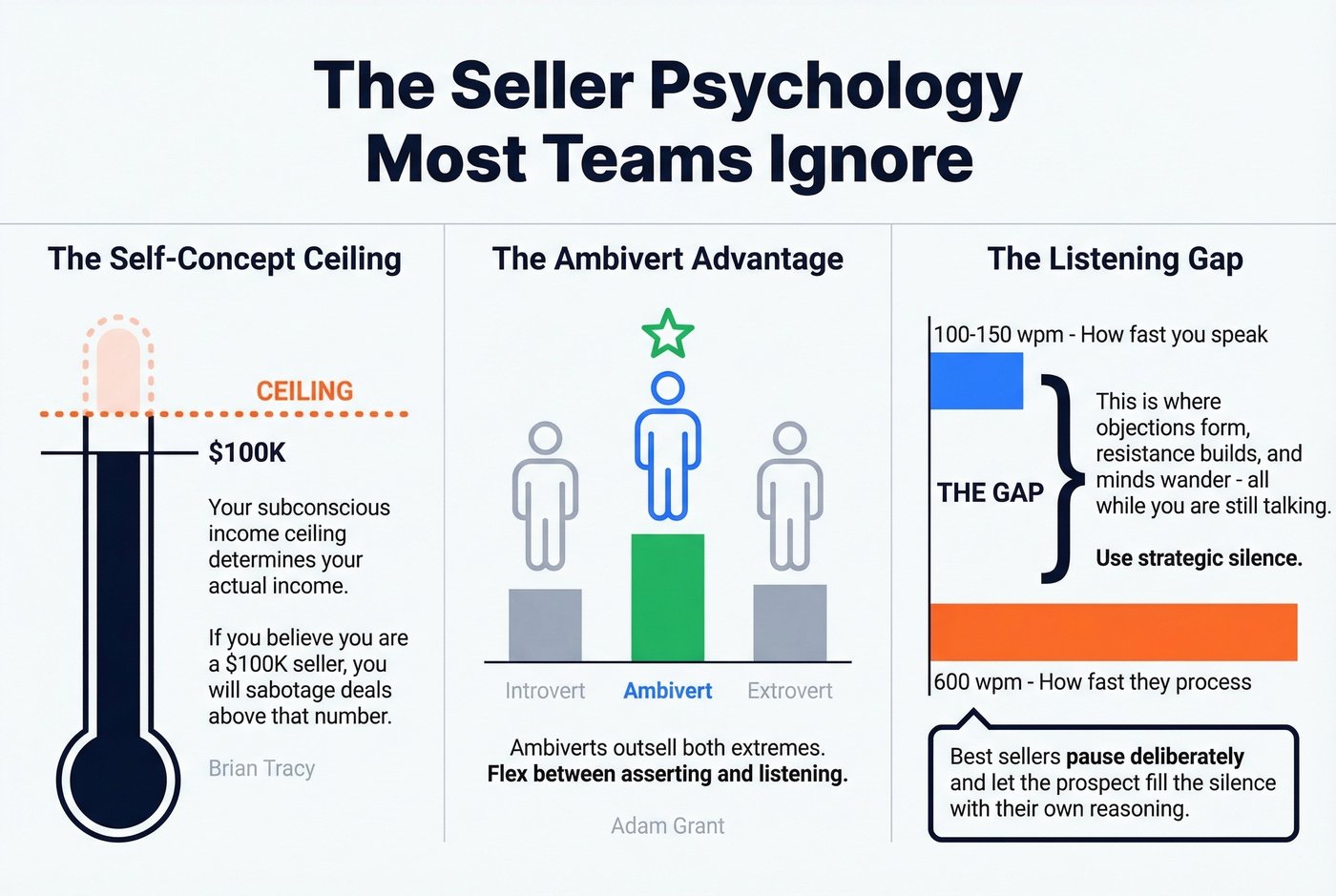
Brian Tracy's self-concept framework makes a blunt argument: your self-concept determines your income ceiling. If you subconsciously believe you're a $100K/year seller, you'll unconsciously sabotage deals that would push you past that number. His seven key result areas - prospecting, building rapport, identifying needs, presenting, answering objections, closing, and generating resales - aren't just a sales process. They're a diagnostic for where your self-concept is weakest.
Adam Grant's research adds a counterintuitive finding: ambiverts outsell both introverts and extroverts. The stereotypical aggressive closer isn't the top performer. Neither is the quiet listener. The seller who can flex between asserting and listening - calibrating in real time - wins.
Here's a data point that changed how our team thinks about listening: humans speak at 100-150 words per minute but process language at roughly 600 wpm. That gap is where your prospect's mind wanders, forms objections, and builds resistance - all while you're still talking. The best sellers use that gap deliberately, pausing to let the prospect's processing catch up and fill the silence with their own reasoning. Jeremy Miner's NEPQ framework is built heavily around strategic silence and question sequencing, especially in cold outreach, because it forces the buyer to do more of the persuading.
Vibe Selling vs. Evidence-Based Approaches
You've probably seen the term "vibe selling" floating around sales communities. Loosely defined, it means selling based on energy, intuition, and emotional resonance rather than structured methodology - reading the room and adjusting your approach based on feel rather than a playbook. The appeal is obvious: rigid frameworks can feel stifling, and there's a kernel of truth in the idea that calibrating to a prospect's emotional state in real time is genuinely valuable.
But here's the problem. Vibes without structure is just improvisation with no feedback loop. Buyer decision psychology works because it gives you repeatable principles grounded in research. Intuition is the output of pattern recognition - and pattern recognition improves when you have a framework to organize what you're noticing. The best sellers combine both: structured methodology for the process, emotional attunement for the moments between the steps. Skip this approach if you're a newer rep still building your pattern library; you need the structure first.
Frameworks That Turn Psychology Into Conversations
Knowing principles is one thing. Using them in a 47-second cold call or a 30-minute discovery meeting is another.
SPIN Selling is psychology disguised as a questioning framework. Situation questions establish context. Problem questions surface pain. Implication questions amplify that pain by connecting it to broader consequences. Need-payoff questions let the prospect articulate the value of solving the problem in their own words - triggering consistency and the endowment effect simultaneously.
Here's what this looks like in practice: a rep selling compliance software asks, "What happens to your team when an audit finds a gap?" That's an implication question. It connects the surface problem - manual compliance tracking - to a consequence the prospect hadn't articulated: team disruption, executive scrutiny, potential fines. The prospect talks themselves into the urgency. We've seen reps double their discovery-to-proposal conversion rate just by adding two implication questions to their standard call flow.
The Challenger Sale is status quo bias disruption packaged as a methodology. Challengers teach prospects something new about their business, tailor the message to the stakeholder's priorities, and take control of the commercial conversation. It works because it breaks the buyer out of the default "do nothing" decision that kills most deals.
Companies with a formal sales process see 18% more revenue growth than those without one. The process itself isn't magic - it forces consistent application of psychological principles that would otherwise be deployed randomly.
What Kills Sales Psychology in Practice
You can master every principle on this page and still lose if the foundation is broken.
The common mistakes are well-documented: emphasizing price over value, talking more than listening, pitching the wrong stakeholder, failing to qualify. These aren't just tactical errors - each one undermines a specific psychological principle. Pitching the wrong stakeholder means your unity and authority signals land on someone who can't act on them. Failing to qualify means you're deploying scarcity and loss aversion on someone who was never going to buy.
But here's the mistake nobody writes about: bad data. Every psychological principle requires reaching the right person with accurate contact information. If your emails bounce, rapport-building never starts. Tools like Prospeo exist to solve this at the foundation - 98% email accuracy, data refreshed every 7 days - so your outreach actually reaches a human who can say yes.
Speed matters too. Deals closed within 50 days have a 47% win rate. After 50 days, win rates drop to 20% or lower. Buyers now engage sellers at 61% of their journey, down from 69%. Every day spent chasing bad contact data is a day your deal slides past that threshold.
Let's be honest: if your deal size is under $20K, you probably don't need a sophisticated multi-touch psychological sequence. You need verified contact data, a clear value prop, and speed. Most deals at that price point are won or lost on whether you reached the right person fast enough - not on whether you deployed the endowment effect correctly.
Persuasion vs. Manipulation
The line between persuasion and manipulation is thinner than most sales trainers admit. But it's not invisible.
Fake scarcity is the fastest way to destroy trust. Countdown timers that reset when you refresh the page. "Only 2 seats left" on a webinar with unlimited capacity. "This price expires Friday" when the same price is available Monday. Buyers aren't stupid, and the internet has a long memory. Ethical scarcity uses real constraints - genuine implementation capacity limits, pricing tied to a fiscal quarter, a pilot program with actual enrollment caps.
The test we use: would the buyer thank you afterward? If the answer is yes - if the principles you deployed helped them make a decision they're genuinely better off for - that's persuasion. If you created artificial pressure to force a decision they'd regret, that's manipulation. The consensus on ethics in sales tends to agree: the reps who build real careers are the ones whose closed-won customers actually refer them to other buyers.
The psychology of the sale is friction removal, not weaponry. The principles in this article work precisely because they align with how humans naturally make good decisions. Abuse them and you'll close one deal. Use them ethically and you'll build a career.
Cialdini's principles, loss aversion, anchoring - none of it matters if your prospect data is stale. Prospeo gives you 300M+ profiles with 30+ filters including buyer intent and job changes, so you can apply sales psychology to buyers who are actually in-market. At $0.01 per email, bad data is no longer an excuse.
Turn psychology into pipeline with data that connects you to real buyers.
FAQ
What's the difference between sales psychology and manipulation?
Persuasion removes friction for a buyer who already has a need. Manipulation creates artificial pressure to force a decision the buyer wouldn't make with full information. The simplest test: would the buyer thank you afterward? If yes, it's persuasion. If they'd feel tricked, you crossed the line.
Do Cialdini's principles work in B2B sales?
Yes, but they manifest differently than in consumer contexts. Social proof means case studies and customer logos, not star ratings. Scarcity means limited implementation slots, not countdown timers. Authority means published research and industry credentials, not uniforms. The principles are universal - execution is context-dependent.
What's the most underrated sales psychology principle?
Unity - Cialdini's 7th principle. It's the shared-identity trigger that makes enterprise deals close. "We work with 12 other companies in your exact situation" is more powerful than any discount. Most sellers skip it entirely, which is why it's such an advantage when you don't.
How does data quality affect sales psychology?
Every psychological principle requires reaching the right person first. Bounced emails and disconnected numbers mean rapport-building never starts. Accurate, frequently refreshed contact data ensures outreach lands with a real decision-maker so the psychology has a chance to work.
What is vibe selling, and does it actually work?
Vibe selling means selling based on intuition, energy, and emotional attunement rather than a rigid methodology. It can work for experienced reps who've internalized enough patterns to read a room accurately. Relying on vibes alone lacks a feedback loop, though - pairing intuition with evidence-based frameworks like SPIN or Challenger gives you both adaptability and repeatability.