

Quo vs RingCentral: The Honest Comparison for 2026
Add RingCentral's Call Queues Booster at $35/mo and their Business SMS Booster at $25/mo, and you're staring at $720/year in add-ons before you've paid for a single seat. For most teams weighing Quo vs RingCentral, that gap is the entire decision.
30-Second Verdict
Use Quo if you're a team under 15-20 people who need calls, texts, and a shared inbox without the overhead. It holds a 4.7/5 on G2 across 3,294 reviews - overwhelmingly from small businesses.
Use RingCentral if you're 20+ people and need call center routing, video conferencing, desk phone support, and deep enterprise integrations. It sits at 4.2/5 on G2 with 1,313 reviews, skewing mid-market.
Skip both if your real problem isn't routing calls - it's reaching the right people. Neither tool verifies the contact data you're dialing. Prospeo covers 125M+ verified mobiles with a 30% pickup rate, refreshed every 7 days, so your reps aren't burning call blocks on dead numbers.
What You'll Actually Pay
Quo's pricing is straightforward. RingCentral's isn't - the base plan looks competitive until you start adding the modules most teams actually need.
| Quo | RingCentral | Winner | |
|---|---|---|---|
| G2 Rating | 4.7/5 (3,294 reviews) | 4.2/5 (1,313 reviews) | Quo |
| Starter/Core (annual) | $15/user/mo | $30/user/mo (RingEX Core) | Quo |
| Mid-tier (annual) | $23/user/mo | ~$25-35/user/mo | Quo |
| Top tier (annual) | $35/user/mo | ~$35-45/user/mo | Tie |
| 5-person team TCO | ~$75/mo | ~$150-225/mo | Quo |
| AI Agent | Sona: $49/mo (100 calls) | AI Receptionist: $39/mo | RingCentral |
| SMS add-on | $19.50 setup + $1.50-3/mo | SMS Booster: $25/mo | Quo |
| Call Queues | Ring groups + call routing/menus (IVR) | $35/mo add-on | Quo |
| Native integrations | Zapier/Make (7,000+) | 500+ native | RingCentral |
| Desk phones | No (app only) | Yes | RingCentral |
| Contract | Cancel anytime | Annual/multi-year, auto-renews | Quo |
| Best for | Teams under 15-20 | Teams 20+ | - |
The real kicker is RingCentral's add-on pricing. Call queues ($35), Business SMS Booster ($25), and AI Conversation Expert (starts at $60) are all separate line items. A 10-person team on RingCentral can easily hit $500+/mo once you layer in the features Quo bundles by default.
Here's the thing: RingCentral is the more capable platform. Nobody's arguing that. But most teams under 20 people are paying for capabilities they'll never touch. If your average deal size is under $15k, Quo's simplicity is the better investment.
AI Agents: Sona vs AI Receptionist
Both platforms offer AI-powered call answering, but the packaging differs significantly. Quo's Sona runs on a credit-based system - $49/mo gets you about 100 calls, with overage rates that depend on your tier. It handles lead qualification, message capture, and routing within the Quo app.
RingCentral's AI Receptionist starts at $39/mo as an add-on to any RingEX plan. They've also launched AIR Everywhere, a standalone version starting at $59/mo that works on any phone system - a genuinely clever move for teams stuck on legacy PBX setups. It supports British/Australian English, Spanish, and French, plus appointment booking into Google Calendar and Outlook.
We've found that Sona's credit model works out cheaper for teams handling under ~50 after-hours calls per month. Past that threshold, RingCentral's flat-rate add-on starts making more sense.

You're comparing dialers, but the real bottleneck isn't your phone system - it's what you're dialing. Prospeo gives your reps 125M+ verified mobile numbers, refreshed every 7 days, with a 30% pickup rate. That means fewer voicemails, more live conversations, and zero wasted call blocks.
Stop burning call blocks on dead numbers. Start dialing verified contacts.
CRM Integrations
This is where RingCentral pulls ahead for HubSpot-heavy teams. Their embedded HubSpot integration uses an SDK - not a Chrome extension - so you get native calling, SMS logging, workflow triggers, and offline activity sync directly inside HubSpot. RingSense layers on AI-generated transcripts, summaries, and action items that auto-save to contact records. RingCentral also brings 500+ native integrations, including a tight Microsoft Teams integration that matters for enterprise buyers.
Quo takes a different approach, leaning on Zapier (7,000+ integrations) and Make (2,200+) as its connectivity backbone, plus a built-in mini CRM with shared contacts and conversation history. For teams that want zero-config CRM sync with deep bi-directional data flow, RingCentral's native approach wins. For teams that just need calls logged and contacts shared, Quo's built-in tools are plenty.
What Real Users Say
The G2 data tells a clear story about who uses each product. About 91% of Quo's reviews come from small businesses under 50 employees. RingCentral splits at roughly 58% small business and 35% mid-market.
Quo earns praise for ease of use (835 G2 mentions), customer support (412), and call recording (325). The product does what it says without a learning curve. Main complaints center on connection issues (215 mentions) and call disconnections (101) - annoying, but not dealbreakers for most users given the responsive support team.
RingCentral's G2 reviews flag poor customer support, complex processes, and call quality as recurring negatives. The Reddit sentiment is harsher. On r/VOIP, users report echo, low volume, and breakups across different connection types, plus frustration with SMS registration fees.
Neither platform is immune to VoIP call quality issues. But Quo users forgive it more because the product is simple and support actually picks up. RingCentral users feel trapped - which brings us to contracts.
The Contract Problem
Let's be honest: this is where RingCentral's reputation takes the biggest hit.
One r/sysadmin user posted a warning that their 2-year contract auto-renewed for another full two years without proactive notice. They couldn't get out. Another user on r/RingCentral reported spending over 60 hours on hold trying to cancel - and only succeeded after filing complaints with the FCC and FTC. Sixty hours. To cancel a phone plan.
The BBB lists 570 complaints against RingCentral in the last three years, with 184 closed in just the last 12 months. Billing and cancellation dominate the complaint categories. Quo's model is cancel-anytime, no contract. For a team under 20, the ability to walk away next month without filing a federal complaint is a genuine differentiator.
Verify Before You Dial
Neither Quo nor RingCentral verifies the numbers your reps are calling. The best phone system in the world doesn't help if half your contact list is stale. We've seen teams invest heavily in their dialer setup only to watch reps hit voicemail 85%+ of the time because the underlying data was garbage - numbers that changed jobs, switched carriers, or simply went dark months ago.
Pairing either phone system with a verification layer like Prospeo's Mobile Finder (125M+ verified numbers, 30% pickup rate, 7-day refresh cycle) means reps actually reach people instead of leaving voicemails into the void. If you're building a modern outbound stack, start with data enrichment and a clean source of sales prospecting databases before you optimize routing.
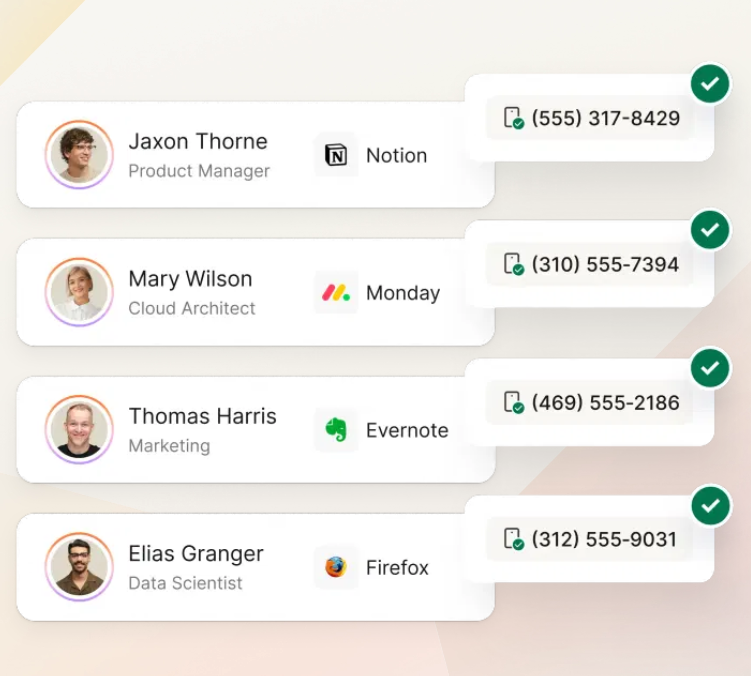
Neither Quo nor RingCentral verifies your contact data - they just route calls to whatever numbers you feed them. Prospeo's 5-step verification ensures 98% accuracy on emails and 30% pickup on mobiles, at $0.01 per lead. No contracts, cancel anytime - sound familiar?
Fix the data before you upgrade the dialer.
FAQ
Is Quo the same as OpenPhone?
Yes - Quo is the new name for OpenPhone. Same product, same team. If you see old reviews or articles referencing OpenPhone, they're talking about what's now called Quo.
Can I use desk phones with Quo?
No. Quo is app-only across desktop, mobile, and browser. If your team requires IP desk phones or conference room hardware, RingCentral supports them natively with certified Poly and Yealink devices. Skip Quo entirely if physical phones are non-negotiable.
Which platform is better for teams under 10 people?
Quo wins by a wide margin. A 10-person team pays roughly $150/mo on Quo's starter plan versus $300+/mo on RingCentral before add-ons. You also avoid annual contracts and get cancel-anytime flexibility - which, given the RingCentral cancellation horror stories above, isn't a small thing.
How do I make sure I'm calling verified numbers?
Run your contact list through a verification tool before loading it into your dialer. Prospeo's Mobile Finder covers 125M+ verified numbers globally at a 30% pickup rate - compared to the 12-15% industry average - so reps spend time on live conversations, not voicemail.