

ReachInbox vs Apollo.io: Sending Power vs Data Depth
Apollo is a database that sends. ReachInbox is a sender that finds leads. If you're weighing ReachInbox vs Apollo.io, understand this first: different tools, different jobs - picking the wrong one means you're fighting the tool instead of closing deals.
Apollo.io wins if you need a massive B2B contact database with advanced filters and can tolerate a mediocre sending experience. ReachInbox wins if deliverability is your top priority and you need multi-inbox management with unlimited email accounts on paid plans. Skip both if your real problem is bad data - bounces, outdated emails, trashed domain reputation. Fix the data layer before you ever hit send.
Feature Comparison at a Glance
| Feature | Apollo.io | ReachInbox | Winner |
|---|---|---|---|
| G2 Rating | 4.7/5 (9,512 reviews) | 4.6/5 (71 reviews) | Apollo (review volume) |
| Starting Price | Free; paid from $49/user/mo (annual) | Free; paid from $30/mo (annual) | ReachInbox |
| Best For | Prospecting + data | Sending + deliverability | Depends on job |
| Key Limitation | Sending delays, spam issues | Smaller database, basic reports | - |
| Warmup | Third-party network; 10-40/day (max 50) | Built-in warmup on paid plans | ReachInbox |
| Inbox Management | Limited | Multi-inbox rotation | ReachInbox |
| Compliance | GDPR & CCPA compliant | Not a data-layer compliance tool | Apollo |
| Time to ROI | Not reported | 4 months (G2) | ReachInbox |
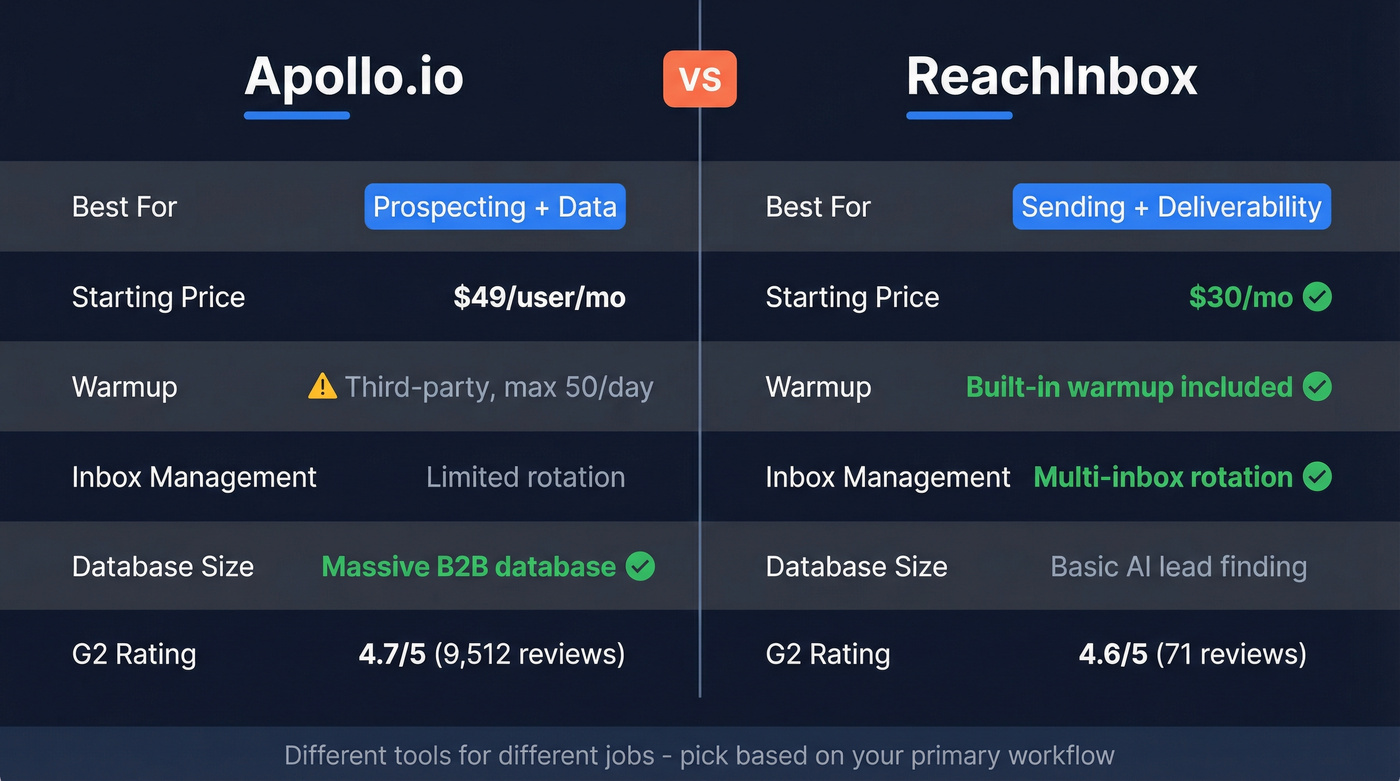
Deliverability Head-to-Head
Here's where these two tools diverge sharply. Apollo's warmup connects you to a third-party provider that sends system-generated messages to a private network. Their own guidance puts warmup at a minimum of two weeks, typically 10-40 emails per day, with a hard ceiling of 50. Apollo also recommends sending limits around 50/day per mailbox, 6/hour, with a 10-minute delay between sends. That's tight.
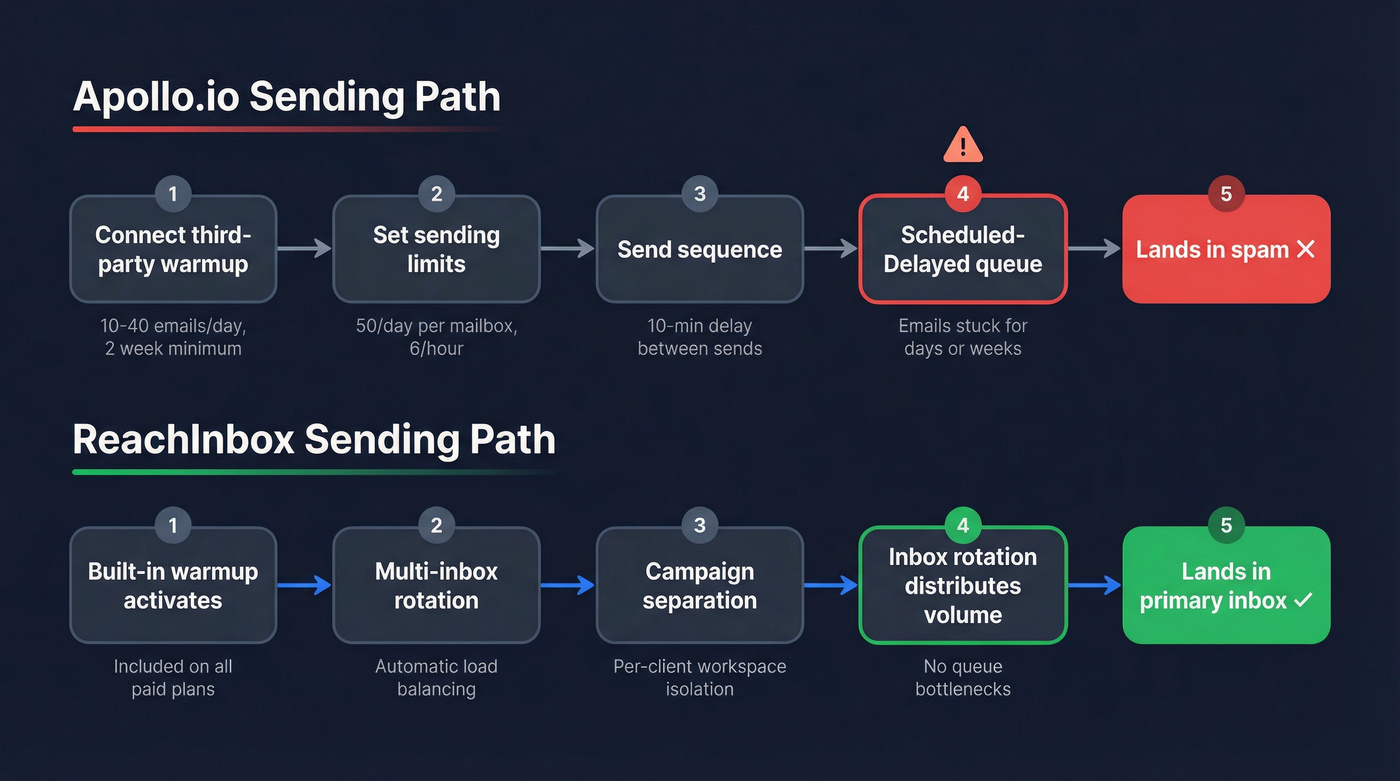
The real pain shows up in Apollo's "Scheduled-Delayed" queue. Users on r/coldemail report emails stuck for weeks between sequence steps - step one fires, then step two sits in limbo far past the configured delay. Others report that sequences sent through Apollo land in spam, while the same copy sent directly from Gmail hits the inbox. That's a sending infrastructure problem, not a content problem.
ReachInbox was built around this exact gap. Built-in warmup and inbox rotation come standard, and multi-inbox management is the core workflow. G2 users report a one-month implementation timeline and ROI within four months. Reddit's cold email community calls ReachInbox "still underrated" - good inbox rotation and campaign separation without the price tag of Instantly (from ~$47/mo) or Smartlead (from ~$39/mo). Reporting is basic, but the core job - getting emails into inboxes - is solid.
Use ReachInbox if you're running 5+ inboxes and need reliable delivery without babysitting queues. Skip it if you need deep analytics or complex automation workflows.
Data and Prospecting
Apollo's massive contact database is the reason most teams sign up. Advanced filters - including technographics and intent-style data on higher tiers - let you build targeted lists fast. The credit system typically works at 1 credit per email reveal and 5 credits per phone number, with credits that don't roll over. Heavy prospecting teams burn through credits quickly, and Apollo's ongoing migration to a new credit system means different accounts on the same plan can have different limits depending on when they migrated. It's messy.
The trade-off with any shared database: your competitors are pulling the same contacts. Personalization and timing matter more than list size.
ReachInbox includes AI lead finding, but it isn't a database-first tool. It's functional for basic lead discovery, but you won't get the filter depth or volume Apollo offers. Think of it as a convenience feature, not a competitive advantage.
Let's be honest about how most teams actually use these: Apollo is where you build the list, ReachInbox is where you send it. Many teams run both for exactly this reason.

Apollo gives you the list. ReachInbox gets it delivered. But neither fixes bad data. Prospeo's 98% email accuracy means your sends actually land - not bounce. At $0.01/email with a 7-day refresh cycle, you get cleaner contacts than Apollo (79% accuracy) without the per-seat pricing trap.
Stop paying to send emails that bounce. Start with data that connects.
Pricing Breakdown
| Apollo.io | ReachInbox (billed yearly) | |
|---|---|---|
| Free | $0 (2 sequences; limited credits) | $0 (3 email accounts, 250 emails/mo) |
| Starter/Basic | $49/user/mo annual ($59 monthly) | $30/mo (10K emails/mo) |
| Mid-tier | $79/user/mo annual ($99 monthly) | $75/mo (250K emails/mo) |
| Top tier | $119/user/mo annual ($149 monthly), min 3 seats | $225/mo (1M emails/mo) |
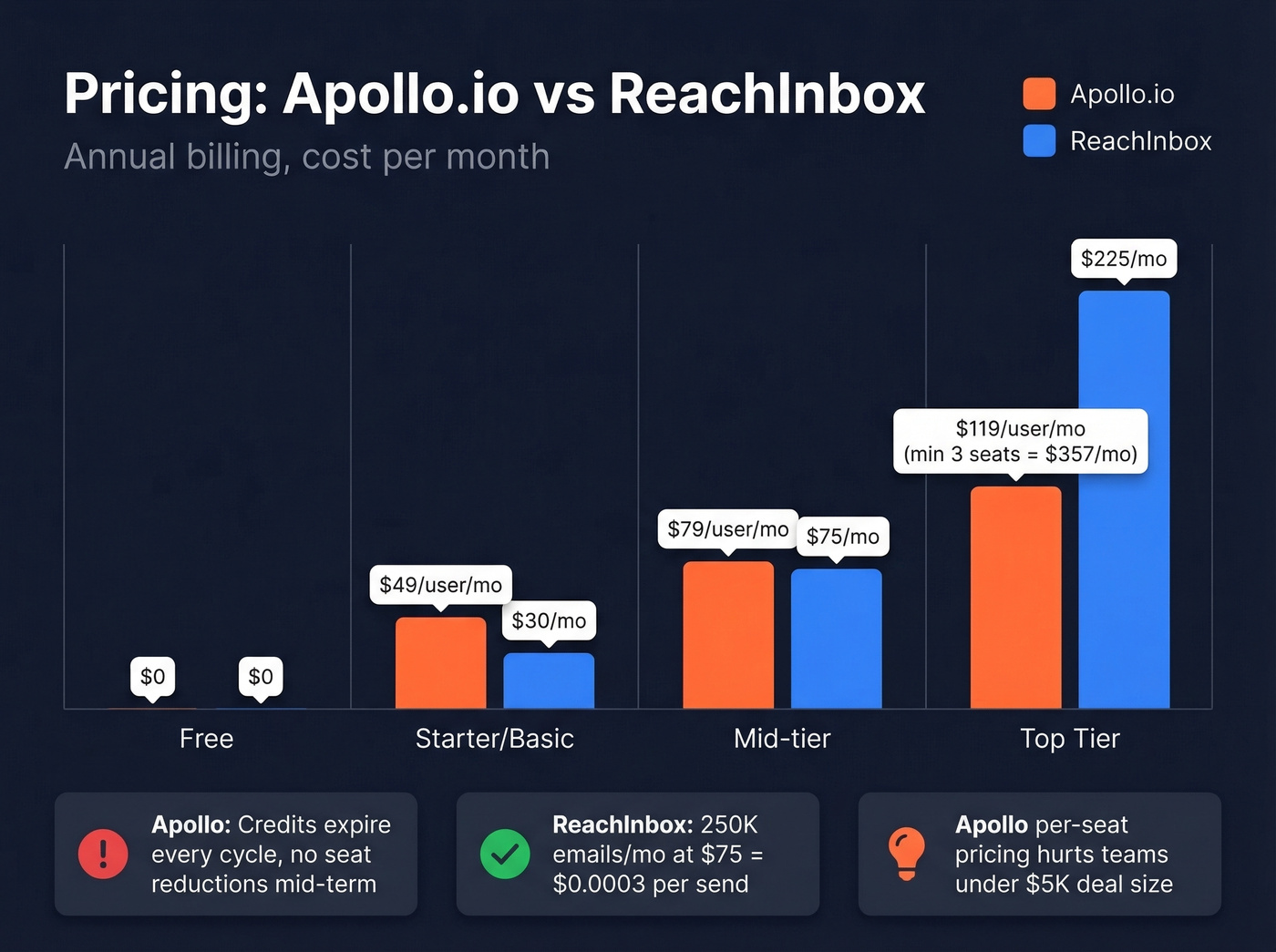
Apollo's hidden costs add up. You can't reduce seats mid-term. Credits expire every billing cycle. Advanced filters like technographics, revenue, and intent data are gated to higher tiers. Monthly billing bumps prices to $59/$99/$149 for Basic/Professional/Organization.
Apollo's throughput is also constrained by its own deliverability guardrails - roughly 50 emails/day per mailbox, or about 1,500 sends/month from one inbox. Once you factor in seat costs and credit consumption for reveals and exports, Apollo gets expensive fast for high-volume outreach.
ReachInbox is built for volume economics. At 250,000 emails per month on the Growth plan, you're paying about $0.0003 per email sent (leads acquired separately). The volume math isn't close.
If your average deal size is under $5K, Apollo's per-seat pricing will eat your margins before you close enough deals to justify it. ReachInbox's pricing makes the math work for high-volume, lower-ACV outbound.
Who Should Pick Which
Solo SDR who wants one tool: Apollo. You get data and sending in one place. Accept the deliverability trade-offs or connect multiple mailboxes to spread volume.
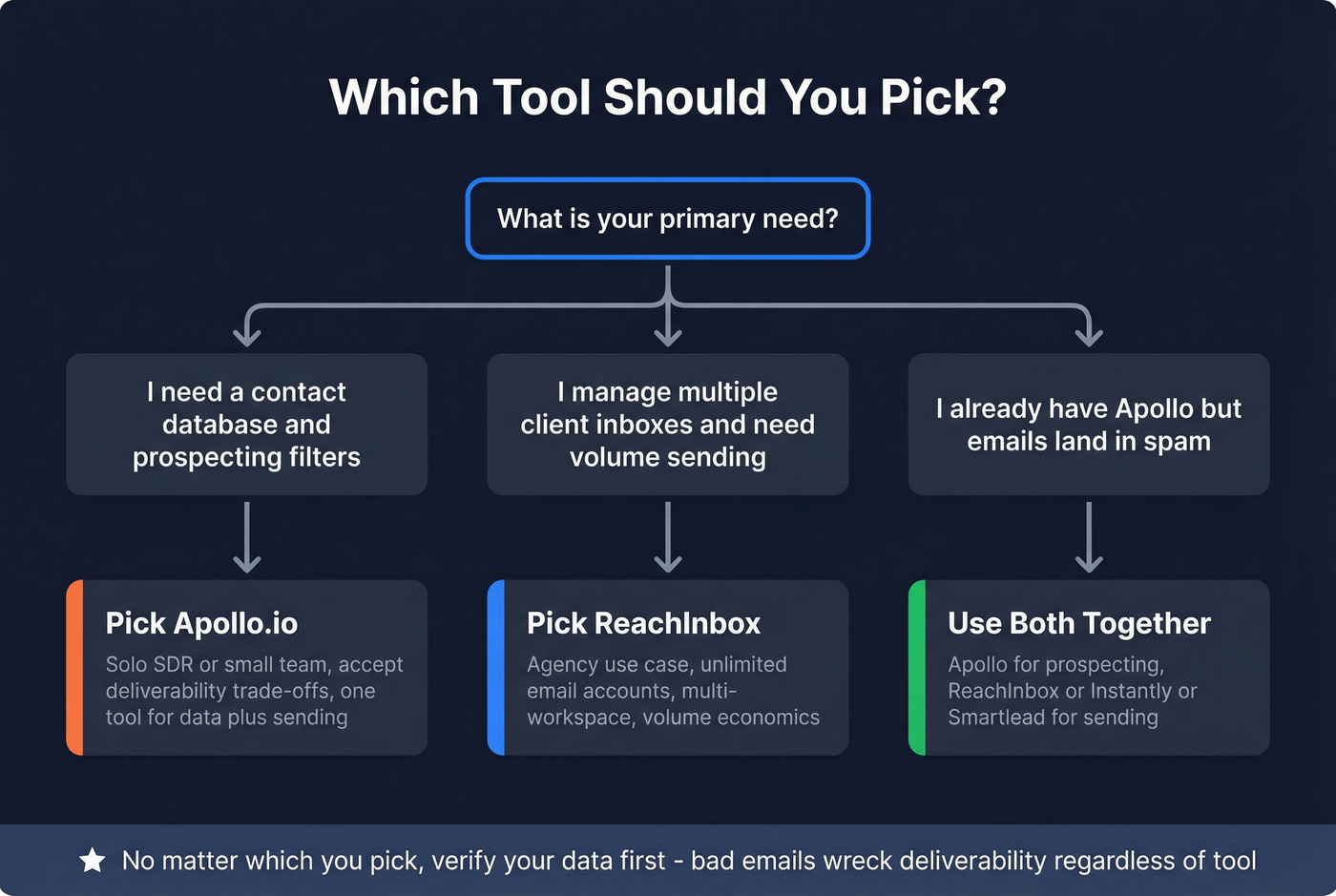
Agency managing multiple clients: ReachInbox. Unlimited email accounts on paid plans, multi-inbox rotation, and multiple workspaces make it purpose-built for this use case. Apollo's per-seat model gets expensive fast across client accounts - the minimum 3-seat requirement on the Organization tier alone runs $357/mo before you've sent a single email.
Team already on Apollo but hitting a deliverability wall: Keep Apollo for prospecting. Export your lists and send through ReachInbox, Instantly, or Smartlead. We've seen this migration path come up repeatedly in cold email communities, and it's the most common fix for the "great data, terrible inbox placement" problem.
Fix Your Data First
Neither tool solves the upstream problem. Apollo's data accuracy varies by region - G2 reviewers flag this consistently, and in our testing, Apollo's email accuracy sits around 79%. ReachInbox has instant verification on upload, but it's lightweight compared to a dedicated email verification platform.

Teams running Apollo + ReachInbox still hit deliverability walls when the underlying data is stale. Prospeo refreshes every 7 days - not every 6 weeks. Export verified contacts into ReachInbox, Instantly, or Smartlead and watch your bounce rate drop below 4%.
Clean data in, booked meetings out. 75 free verified emails to prove it.
FAQ
Which tool is better for agencies?
ReachInbox. Unlimited email accounts on paid plans, workspace separation, and tiered pricing beat Apollo's per-seat model when you're managing five or ten client accounts.
Is Apollo.io's free plan enough for cold email?
For testing, yes - you can run up to 2 active sequences. For real outbound, no. Apollo's recommended 50-email/day limit per mailbox and third-party warmup make it a trial environment at best. You'll hit the ceiling within a week of serious prospecting.
What's a good free option for email verification?
Prospeo offers 75 verified emails per month on its free tier - enough to test data quality before committing. It returns 98% accuracy with spam-trap and honeypot removal, which outperforms both Apollo's built-in verification and most standalone tools.