

Renewal Management: The Operational Playbook Most Guides Won't Give You
It's Q4. The CFO pings you about a $45,000 renewal for a tool your team barely touches. You check the contract - the auto-renewal window closed two weeks ago. You're locked in for another year.
That failure plays out at thousands of companies every quarter, and it's entirely preventable. The problem isn't complexity. It's that nobody owns the process until it's too late.
Most guides on this topic read like glossary entries - they'll define the term, list some software categories, then leave you to figure out the rest. This is the operational playbook instead: timelines, negotiation tactics, metrics, mistakes, and the tools that actually help.
What You Need (Quick Version)
- Start 120 days out, not 2 weeks. The single biggest lever is time. Every day you wait erodes your negotiating position. Jump to the playbook →
- Build a negotiation packet with usage data before the vendor calls you. Companies that negotiate strategically save 10-30% on SaaS contracts. That's real money when your average SaaS spend is $49M. Jump to negotiation tactics →
- Know your numbers. Benchmarkit's 2025 benchmarks put median GRR at 88% and median NRR at 101% - if you're below those, your renewal process is leaking revenue. Jump to metrics →
What Is Renewal Management?
Renewal management is the process of evaluating, renegotiating, and deciding on contracts before they auto-renew or expire. It covers SaaS subscriptions, service agreements, licenses, and any recurring vendor relationship with a renewal date.
There are two lenses, and they matter. On the buyer side (procurement, IT, finance), it means auditing what you're paying for, killing waste, and negotiating better terms. On the seller side (customer success, account management), it means retaining customers, expanding accounts, and forecasting renewal revenue accurately. For seller-side teams, account renewal management is where revenue retention lives or dies - it's the operational backbone of any customer success function.
This playbook covers both angles but leans heavier on the buyer side - that's where most companies hemorrhage money without realizing it. The seller-side metrics (GRR, NRR, churn) show up in the benchmarks section, because even if you're managing vendor renewals, you need to understand how your own customers think about renewing with you.
Why It Matters in 2026
The scale of the problem has gotten absurd. According to Zylo's 2025 SaaS Management Index, the average company now spends $49M annually on SaaS across 275 applications - with spending up 9.3% year-over-year. That's $4,830 per employee, and IT only controls 26.1% of that spend. Lines of business control 70%. Gartner projects worldwide SaaS spending at $299B in 2025, up 19.2% year-over-year - and the renewal challenge is only getting bigger.
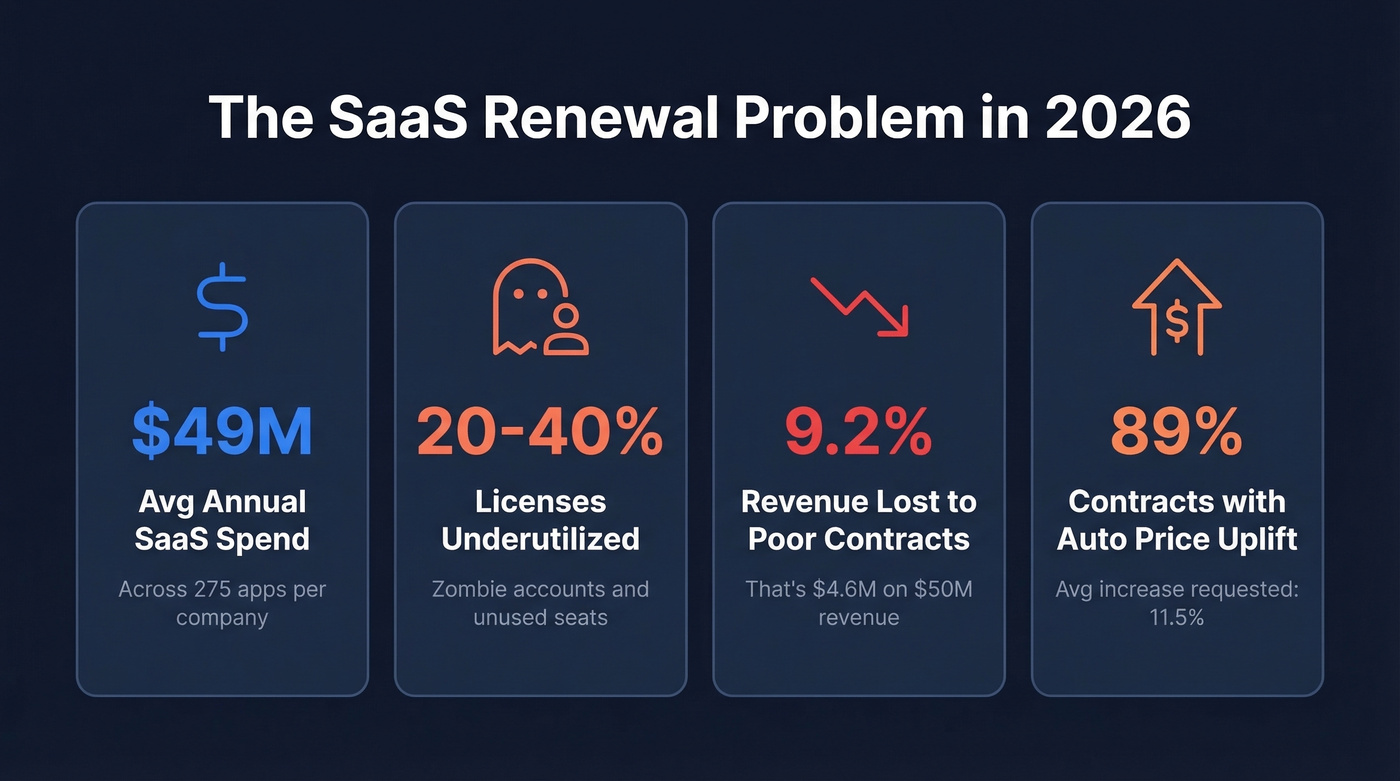
An estimated 20-40% of SaaS licenses go underutilized or completely unused. World Commerce & Contracting puts the bottom-line loss from ineffective contract management at roughly 9.2%. For a company with $50M in annual revenue, that's $4.6M in value leakage.
Renewal tracking is a major time sink when it's scattered across inboxes, spreadsheets, and shared drives - especially when you're chasing quotes, approvals, and notice-period deadlines with no centralized system.
AI bundling surcharges are the newest headache. Vendors are tacking on 15-20% price increases by bundling AI features you didn't ask for into existing tiers. If you aren't auditing line items, you're absorbing these silently. Vendors are also shrinking notice windows from 60 to 30 days, giving you less time to evaluate and negotiate. Miss that window and you're auto-renewed at whatever price they set.
Auto-price-uplift clauses appeared in 89% of SaaS contracts in 2024, with average requested increases running around 11.5%. If your contract doesn't cap annual increases, you're giving the vendor a blank check. The math on retention versus acquisition hasn't changed either - acquiring a new customer still costs 4-5x more than retaining an existing one. Whether you're managing renewals as a buyer or a seller, the economics demand a real process.
The T-Minus 120 Renewal Playbook
The biggest mistake is treating a renewal as an event instead of a process. It isn't a decision you make on the deadline - it's a 120-day operation with distinct phases. Some procurement teams flag renewal dates 12 months in advance for budgeting, even though active negotiation starts at 120 days.
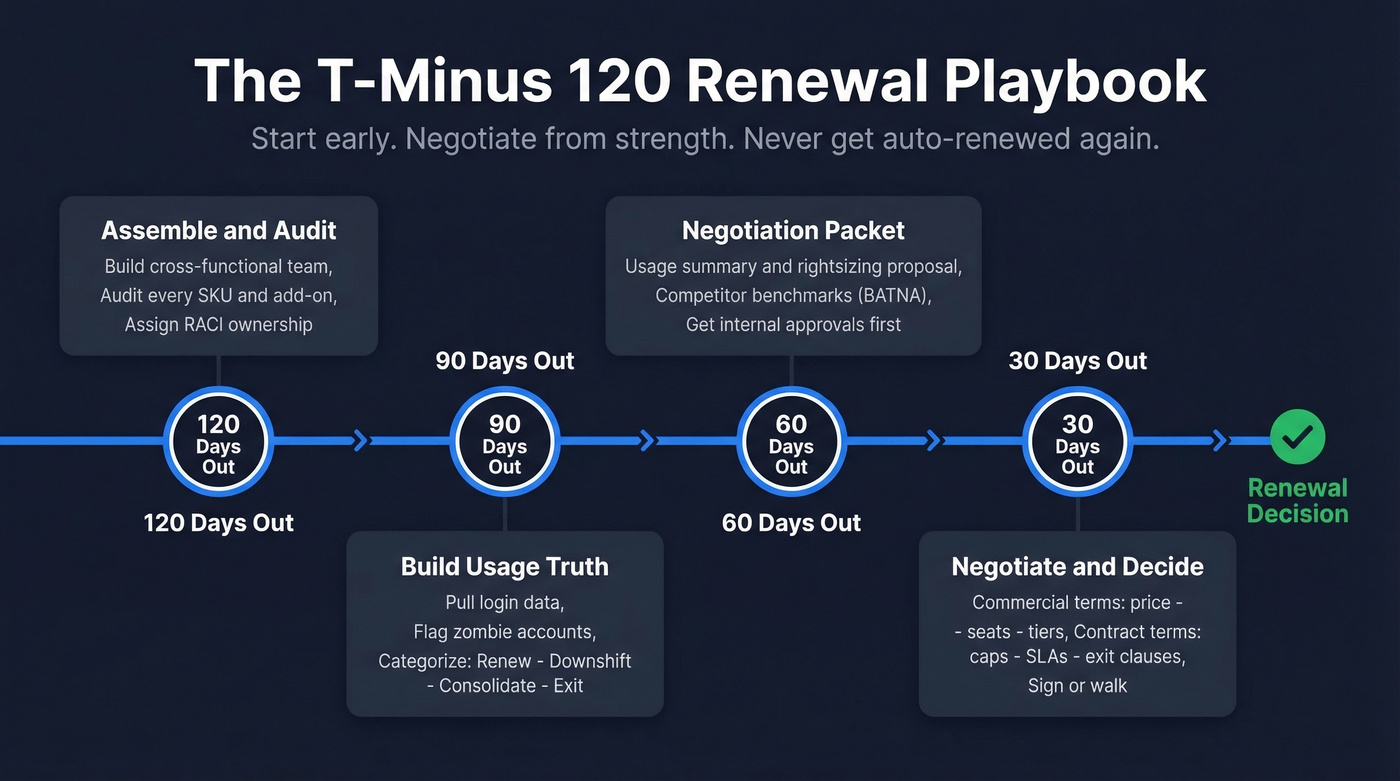
One data point we keep coming back to: a $20M B2B SaaS company reduced churn by 28% in three months after implementing this exact type of structured 120-day workflow. The timeline works.
120 Days Out - Assemble and Audit
Stand up your cross-functional renewal team. You need IT (technical fit and integration assessment), finance (budget and ROI), legal (contract risk), and at least one end user who actually touches the product daily. Assign clear ownership - RACI-style - so nobody assumes someone else is handling it.
Audit the full renewal scope: every SKU, add-on, support tier, integration fee, and professional services line item. Most teams only look at the headline subscription cost and miss the $8K in "premium support" they've never used.
90 Days Out - Build Your Usage Truth
This is where the real leverage comes from. Pull usage data and identify zombie accounts - users with zero logins in the past 90 days. Flag bloated licenses where someone's on an enterprise tier but only uses basic features. Check for duplicate tools across departments and ex-employees who are still licensed.
Categorize every line item into one of four buckets: renew as-is, downshift (reduce tier or seats), consolidate (merge with another tool), or exit. This becomes your negotiation foundation.
While you're at it, verify your stakeholder contact list is current. Champions change roles, decision-makers leave companies. Use a data enrichment tool like Prospeo to refresh emails and direct dials before outreach begins - you don't want your negotiation kickoff email bouncing.
60 Days Out - Build the Negotiation Packet
Assemble everything into a single document your team can rally around. The packet should include:
- Your current contract and price list
- A scope sheet of what you're actually using
- A usage summary with the zombie/bloat analysis
- Your rightsizing proposal
- Competitor benchmarks (this is your BATNA - best alternative to a negotiated agreement)
- Your desired commercial and legal terms
Run internal approvals before the vendor sends their quote. If you're waiting for your CFO to sign off while the vendor's clock is ticking, you've already lost leverage.
30 Days Out - Negotiate and Decide
Negotiate in two layers. The commercial layer covers price, structure, seat counts, and tier adjustments. The contractual layer covers notice periods, termination rights, price caps, SLAs, and data portability.
Use timing pressure - vendors have quotas too. Quarter-end and year-end negotiations consistently yield better terms because reps need to close deals. A multi-year commitment can unlock deeper discounts, but only offer it in exchange for meaningful concessions like price caps, exit clauses, and true-down rights.
Sign or walk. If the terms don't work, you've had 90 days to evaluate alternatives. That's the whole point of starting early.
Renewal Calendar Quick-Reference: Track five dates for every contract - the renewal date, the auto-renew deadline, the notice-period cutoff, your internal kickoff date (120 days out), and the approval target date. Miss any one and the timeline collapses.

Your renewal negotiation is only as strong as your stakeholder map. When champions leave and decision-makers change roles mid-cycle, outdated contacts kill your leverage. Prospeo's enrichment engine returns 50+ data points per contact at a 92% match rate - verified emails, direct dials, and current job titles refreshed every 7 days.
Stop sending negotiation kickoff emails that bounce.
How to Negotiate Renewals
Companies that negotiate strategically save 10-30% on SaaS renewals. Companies that don't negotiate absorb 5-15% annual price increases as a matter of course. A $100K contract with a 10% annual increase becomes $146,410 in four years if you never push back.
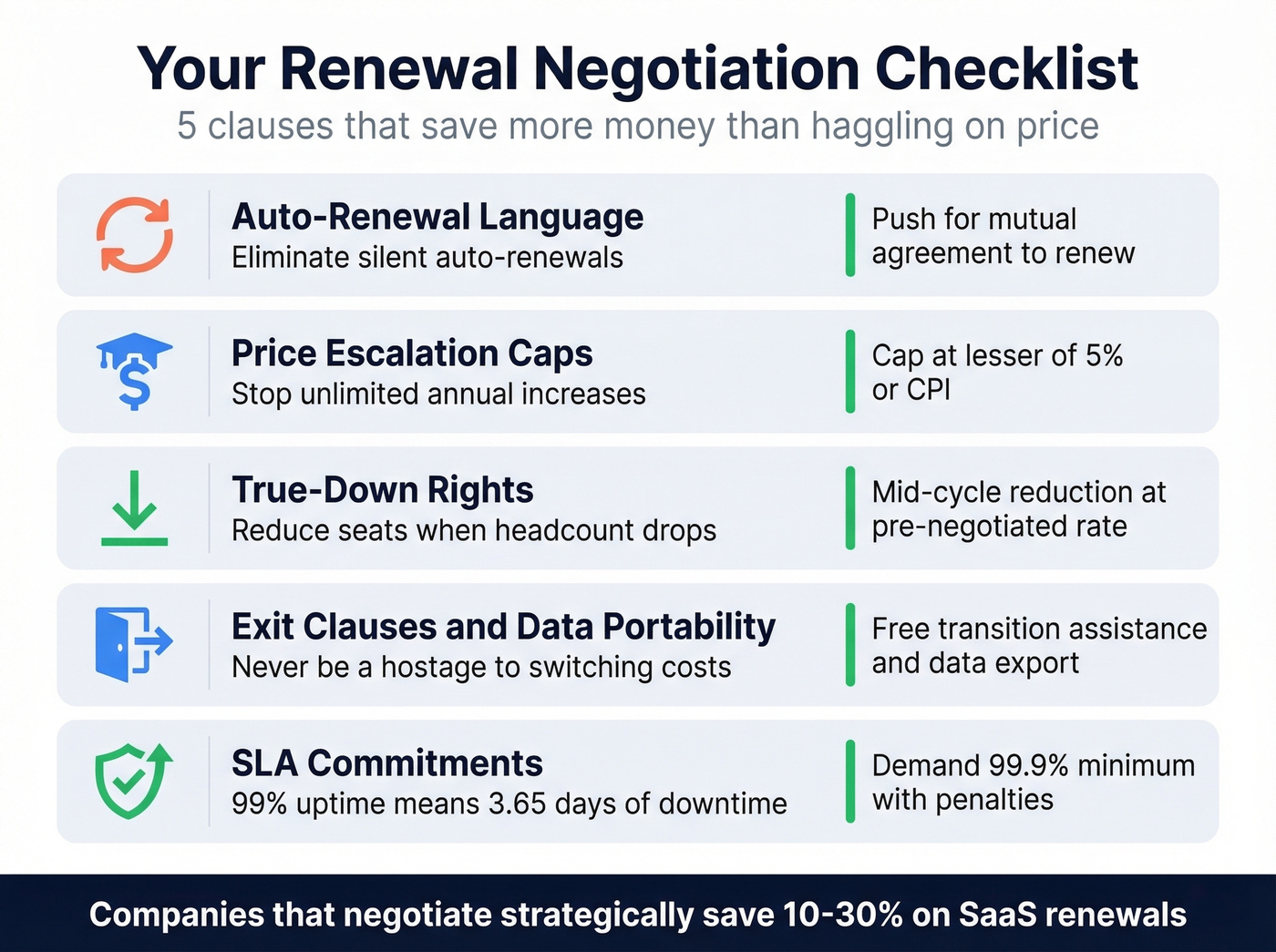
Here's the thing: most of your leverage lives in the contract language, not the price line.
Auto-Renewal Language
Push for "mutual agreement to renew" - meaning the contract expires unless both parties actively sign. This eliminates the silent auto-renewal trap entirely.
Price Escalation Caps
Negotiate a cap of the lesser of 5% or CPI. Without this, vendors can increase prices by whatever the market will bear. The fact that 89% of SaaS contracts include automatic price uplift clauses - and most buyers don't negotiate them - is genuinely maddening.
True-Down Rights
If you reduce headcount or usage mid-term, you should be able to reduce your license count at the next renewal (or mid-cycle) at the pre-negotiated rate. Without this, you're paying for seats nobody's using.
Exit Clauses and Data Portability
Include transition assistance at no extra cost and a clear data export process. Getting locked into a tool because migrating your data is prohibitively expensive isn't a renewal - it's a hostage situation.
SLA Commitments
Know what the uptime numbers actually mean in practice:
| SLA % | Annual Downtime |
|---|---|
| 99% | 3.65 days |
| 99.5% | 1.83 days |
| 99.9% | 8.76 hours |
| 99.99% | 52.56 minutes |
The difference between 99% and 99.9% is about 3.29 days of downtime per year. If the vendor's quoting 99% uptime like it's impressive, push back - that's almost four days of outages.
Key Renewal Metrics
Whether you're managing renewals as a buyer or tracking them as a seller, these are the numbers that matter.
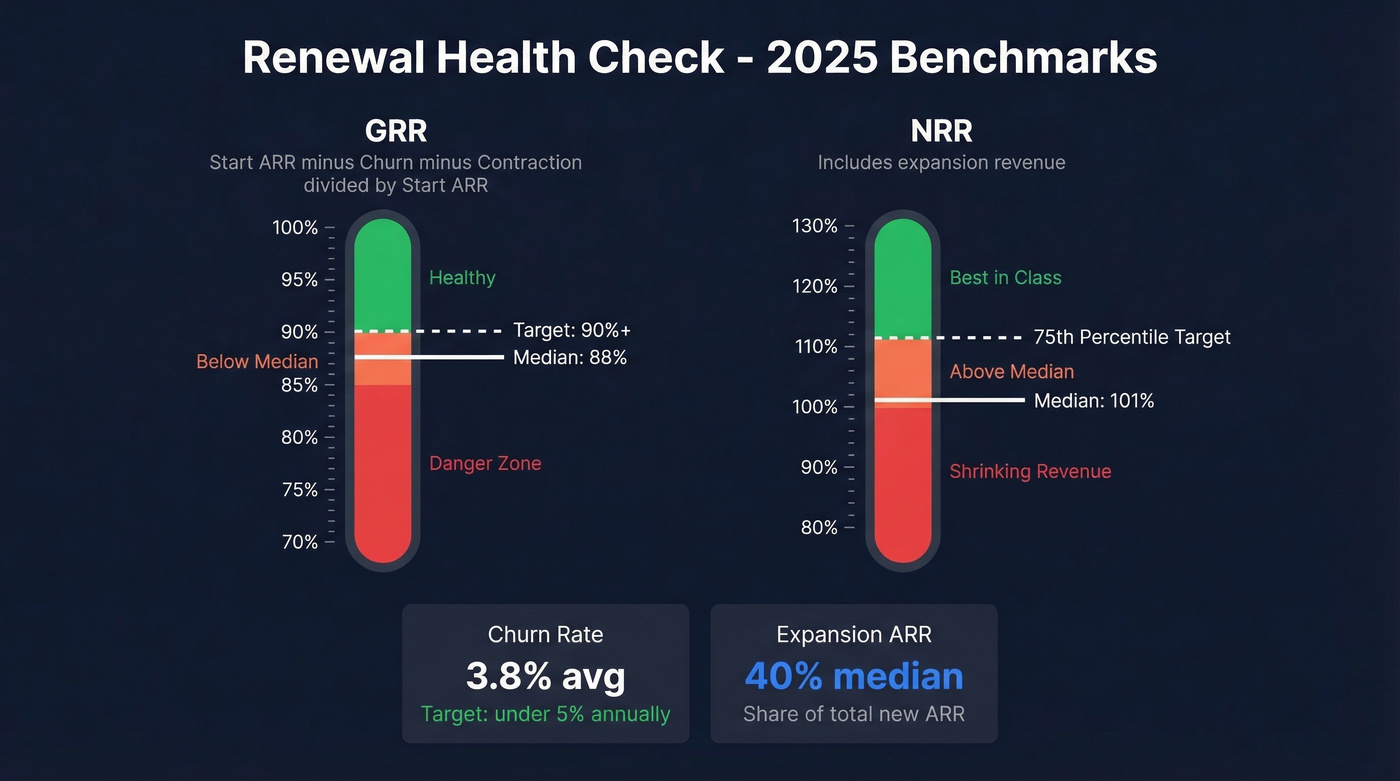
| Metric | Formula | 2025 Benchmark | Target |
|---|---|---|---|
| Churn Rate | (Lost / Start) x 100 | 3.8% avg; 4.9% B2B | <5% annually |
| GRR | (Start ARR - Churn - Contraction) / Start ARR | 88% median | 90%+ |
| NRR | (Start ARR + Expansion - Churn - Contraction) / Start ARR | 101% median | 111% (75th pctl) |
| Expansion ARR | % of Total New ARR | 40% median | 40%+ |
Let's be honest: if your average contract value is under five figures, you probably don't need enterprise-grade renewal software. A disciplined spreadsheet and calendar reminders will outperform a $50K CLM platform that nobody actually uses. The tool isn't the problem - the process is.
GRR has slipped from 90% to 88% over the past three years, meaning more companies are losing revenue at renewal even before accounting for expansion. If your GRR is below 88%, your contract renewal process has a structural problem - not just a pricing problem.
NRR at 101% means the median SaaS company is barely growing from its existing base. The 75th percentile target of 111% is where best-in-class companies operate, and getting there requires a deliberate expansion motion layered on top of solid retention. Teams that treat renewal and expansion as a unified revenue motion - rather than separate workstreams - consistently outperform those that silo them. CAC payback of 12-15 months reinforces why retention matters: if it takes over a year to recoup acquisition costs, every churned customer is a direct P&L hit.
Common Mistakes That Cost Money
We've watched teams make the same mistakes repeatedly. These six cost the most.
1. Starting too late. Two weeks before renewal is a fire drill, not a strategy. You've lost all negotiating leverage because the vendor knows you can't evaluate alternatives in time. Start 120 days out for strategic contracts, 90 days minimum for everything else.
2. One-size-fits-all outreach. Not every renewal deserves the same attention. A $500/month auto-renewal? Fine. A $50K+ contract needs a full negotiation cycle. Segment by spend, risk, and strategic importance.
3. Pitching the wrong person. The VP who signed the deal last year may have never logged in. Tailor the conversation to their priorities - cost, ROI, strategic alignment - not feature adoption.
4. Data without recommendations. Every usage report should lead to an action: renew, downshift, consolidate, or exit. Diagnosis without prescription wastes everyone's time.
5. Negotiating without usage evidence. Walking into a renewal conversation without concrete utilization data is like negotiating a salary without knowing the market rate. You'll accept whatever they put in front of you.
6. Sending outreach to stale contacts. Your CRM says the champion's email is jane@company.com. Jane left four months ago. Your renewal reminder bounced, and now you're scrambling to find the new decision-maker with two weeks left. Prospeo refreshes contact data every 7 days and verifies emails at 98% accuracy, so your renewal outreach reaches the actual decision-maker - not a dead inbox.
Renewal Management Software
If you're managing fewer than 50 contracts, a well-maintained spreadsheet with calendar reminders works fine. Skip the rest of this section. Beyond that threshold, you need purpose-built tooling. One case study from Yates Construction showed $15,000/month in savings and a 25% reduction in contract administration costs after implementing a CLM solution - that's the kind of ROI that justifies the investment.
When evaluating tools, look for four capabilities: automated renewal alerts (30/60/90 day triggers), a centralized contract repository, customizable workflow automation, and integrations with your existing ERP, CRM, and procurement stack.
CLM Tools
Contract lifecycle management platforms handle the full contract journey, with renewal tracking as a core feature. Juro and Ironclad are popular mid-market options - both offer collaborative contract editing, automated workflows, and strong integrations. Enterprise teams often choose Icertis or Cobblestone for complex multi-entity structures and regulatory requirements. LogicManager and Insight round out the category for teams that need risk-focused contract oversight.
Pricing runs $300-$1,500/mo for SMB plans; enterprise deployments range from $50K-$250K+/year. Concord starts at $399/mo as a more accessible entry point.
SaaS Spend and Procurement
These platforms focus on SaaS spend visibility and vendor negotiation. Zylo is a leading SaaS management platform - their dataset covers 40M+ licenses and $40B in spend, which means their benchmarking data is useful beyond just the software itself.
Vendr acts as a buying concierge, handling negotiations on your behalf. Spendflo takes a similar concierge approach but bundles procurement automation with assisted buying, making it a strong fit for mid-market teams that want vendor negotiations handled without building an internal procurement function. Axonius adds an asset management angle, catching shadow SaaS and redundant apps that other tools miss. Pricing is custom across the board, and typical annual contracts run $15K-$60K/year depending on portfolio size.
Customer Success Platforms
For seller-side teams managing customer renewals, CSPs are your operating system. Gainsight is the enterprise default - powerful but heavy, $50K+/year. For mid-market teams, ChurnZero and Vitally offer strong renewal playbooks and health scoring at $1K-$5K/month. Totango, Planhat, and Custify round out the category with varying strengths in segmentation and automation.
One note on ChurnZero: the reporting can feel rigid, and there's a real learning curve. Budget time for onboarding.
CRM and Data Tools
Salesforce (plans commonly start around $25/user/mo) and HubSpot (free CRM tier available) both track renewal dates, but neither manages the renewal process end-to-end. They're the system of record, not the system of action. At scale, pair your CRM with a dedicated CLM tool.
If you're evaluating systems of record, it helps to see examples of a CRM side-by-side before you commit.
| Category | Example Tools | Best For | Typical Pricing |
|---|---|---|---|
| CLM | Juro, Ironclad, Icertis | Full contract lifecycle | $300-$1,500/mo (SMB) |
| SaaS Mgmt | Zylo, Vendr, Spendflo | Spend visibility, negotiation | $15K-$60K/yr |
| CS Platforms | Gainsight, ChurnZero, Vitally | Customer retention | $1K-$5K/mo (mid-market) |
| CRM | Salesforce, HubSpot | Record-keeping, triggers | $0-$300/user/mo |
Managing 275 apps means tracking hundreds of vendor contacts that go stale every quarter. Prospeo gives you 98% accurate emails and 125M+ verified mobile numbers so your procurement team reaches the right rep on the first try - not two weeks after the auto-renewal window closes.
Get direct dials to every vendor contact for $0.01 per email.
FAQ
What's the Difference Between Renewal and Contract Management?
Renewal management is a subset of contract management focused specifically on the renew-or-exit decision. Contract management covers the full lifecycle - creation, execution, compliance, and amendments. You can run a solid renewal process without a full CLM platform, but you can't run effective contract management without a renewal process.
When Should Renewal Prep Start?
120 days before the renewal date for strategic contracts worth $25K+, and 90 days minimum for everything else. Set automated alerts at 30, 60, and 90 days that notify stakeholders across legal, finance, and procurement - missing a single notice-period deadline can lock you into unfavorable terms for another year.
How Do You Calculate Renewal Rate?
Renewal rate equals customers who renewed divided by customers up for renewal, multiplied by 100. For a revenue-weighted view, substitute customer counts with ARR values. Aim for 90%+ on a revenue-weighted basis - anything below 85% signals a systemic retention problem, not just isolated churn.
How Do You Keep Stakeholder Contacts Current for Renewals?
Use a data enrichment tool with frequent refresh cycles. A 7-day refresh cycle (versus the 6-week industry average) prevents the common scenario where your renewal outreach bounces because the champion changed roles months ago. Stale contacts are one of the most overlooked causes of missed renewal windows.
Own the process before the process owns your budget. Start at 120 days, build your usage truth, negotiate with data, and never let an auto-renewal deadline sneak past you again.