

Resilience in Sales Isn't a Mindset - It's a System
It's 9:15 AM. Your rep just got hung up on for the third time. Yesterday's "hot lead" ghosted. The pipeline review is in two hours, and there's nothing new to show.
This is where most resilience in sales advice tells reps to "stay positive" and "embrace rejection." That advice is useless - because 67% of sales professionals are close to burnout, and 48% of salespeople never even attempt a follow-up after the first interaction. The problem isn't that reps lack grit. The problem is that nobody built them a system.
Three Things That Actually Move the Needle
If you take nothing else from this piece, take these:
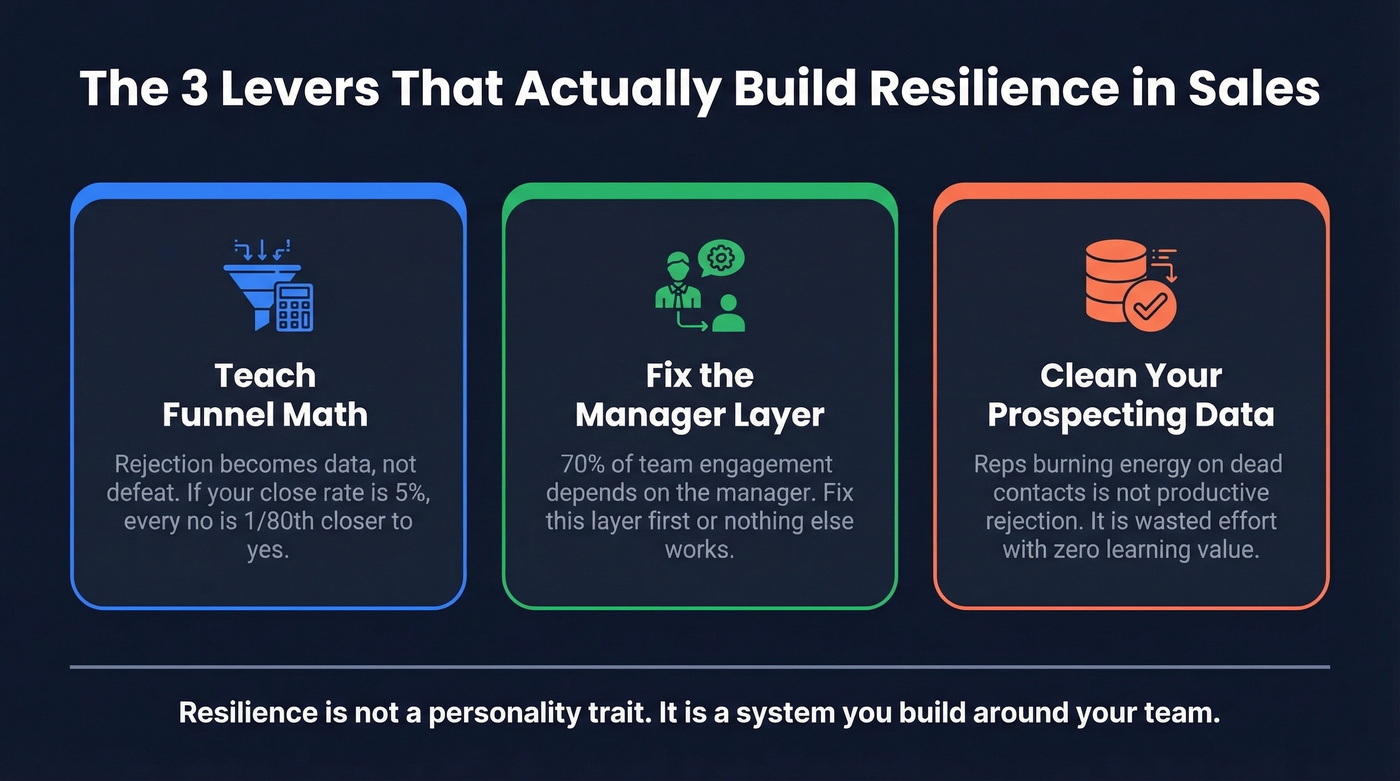
- Teach your team funnel math so rejection becomes data, not defeat.
- Fix the manager layer - 70% of team engagement depends on it.
- Clean up your prospecting data so reps aren't burning energy on dead contacts.
Everything below expands on those three levers.
Why Employers Rank It #2
Resilience isn't a soft skill you mention in a performance review and forget about. The World Economic Forum's Future of Jobs Report ranks resilience, flexibility, and agility as the #2 core skill employers demand globally - 67% of employers call it essential. That's a 17-point jump from 2023. Only analytical thinking ranks higher.
The WEF also projects that 39% of core skills will change by 2030. Sales sits at the sharp end of that volatility: quota pressure, rejection cycles, shifting buyer behavior, and comp plans that change every fiscal year. Seven in ten sales professionals report significant stress. 60% fear negative perceptions if they take time off. This capacity to recover and perform under pressure isn't a nice-to-have anymore. It's the skill that determines whether your team survives the quarter.
What the Science Actually Says
Let's kill the "resilience is a muscle" metaphor. It's everywhere in sales content, and it's wrong.
Resilience isn't a fixed trait you either have or don't. The Wither or Thrive model - a peer-reviewed framework from resilience researchers - describes it as a dynamic trajectory that shifts over time based on the stressors you face, the support systems around you, your coping mechanisms, and your environment. This matters for sales leaders because it means the trait can be engineered.
You can change the stressors by setting realistic targets. You can improve the support systems through engaged managers. You can upgrade the coping mechanisms with better mental models and fix the environment with clean data and functional tools. A rep who seems fragile in a toxic, high-pressure org with bad data might thrive in a well-structured one. The person didn't change. The system did.

You just read that 48% of reps never follow up - and bad data makes it worse. Every bounce kills momentum and chips away at confidence. Prospeo's 98% email accuracy and 7-day data refresh mean your reps reach real people, not dead inboxes. When contacts actually connect, persistence feels like progress instead of punishment.
Fix the data so your reps can focus on selling, not recovering.
Numbers That Reframe Rejection
Most reps quit before the sale starts. That's not motivational fluff - it's what the data shows.
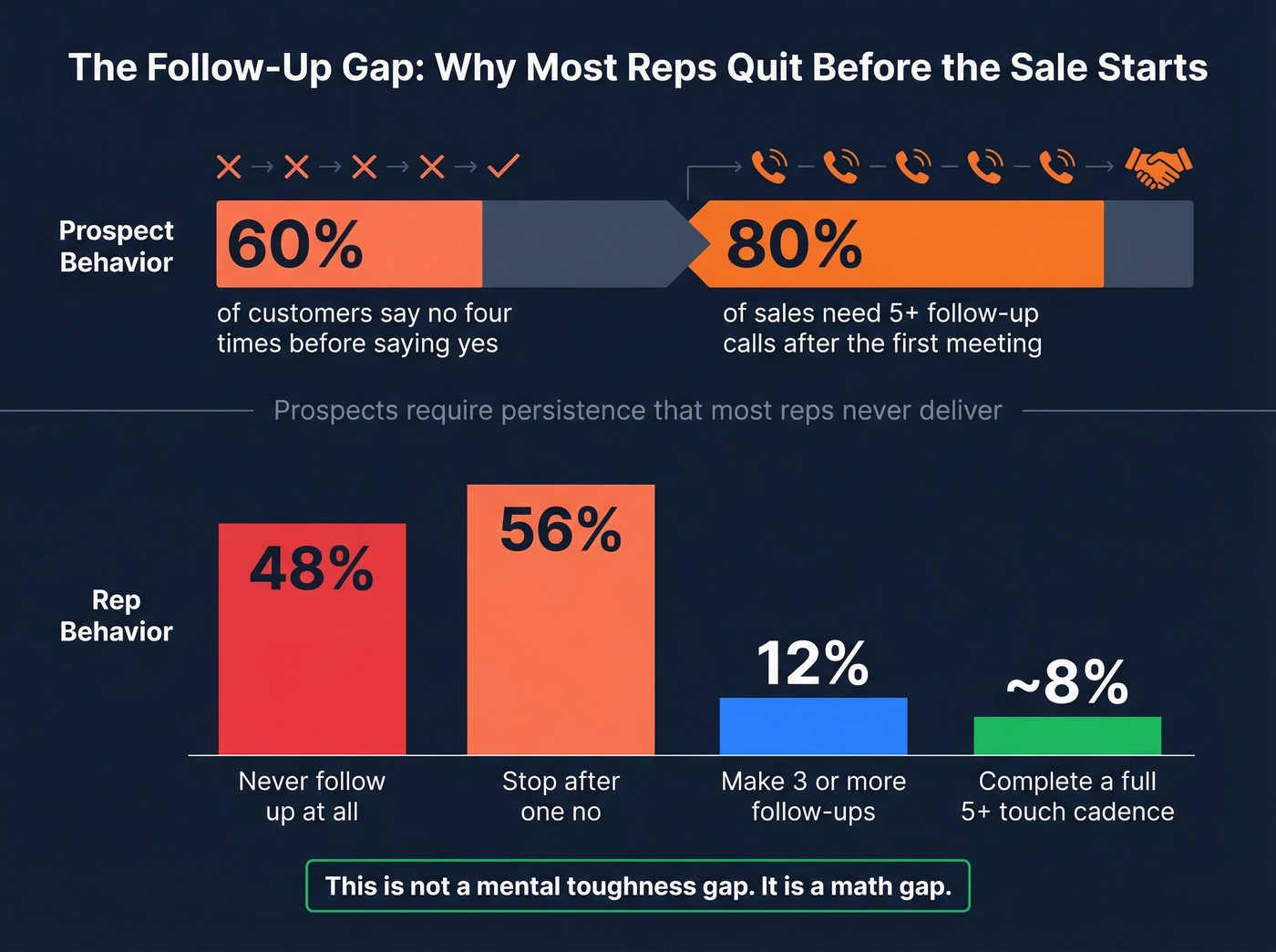
Invesp's follow-up research found that 60% of customers say "no" four times before accepting an offer. 80% of sales require an average of five follow-up calls after the initial meeting. And yet only 12% of salespeople make three or more follow-ups. Only 44% follow up after a single "no," and 48% never follow up at all.
The majority of prospects require persistence that the majority of reps never deliver. This isn't a mental toughness gap. It's a math gap. When reps understand that "no" is the statistically expected outcome for touches one through four, rejection stops feeling like failure and starts feeling like progress through a sequence.
Seven Tactics for Bouncing Back
Funnel Math as a Daily Reframe
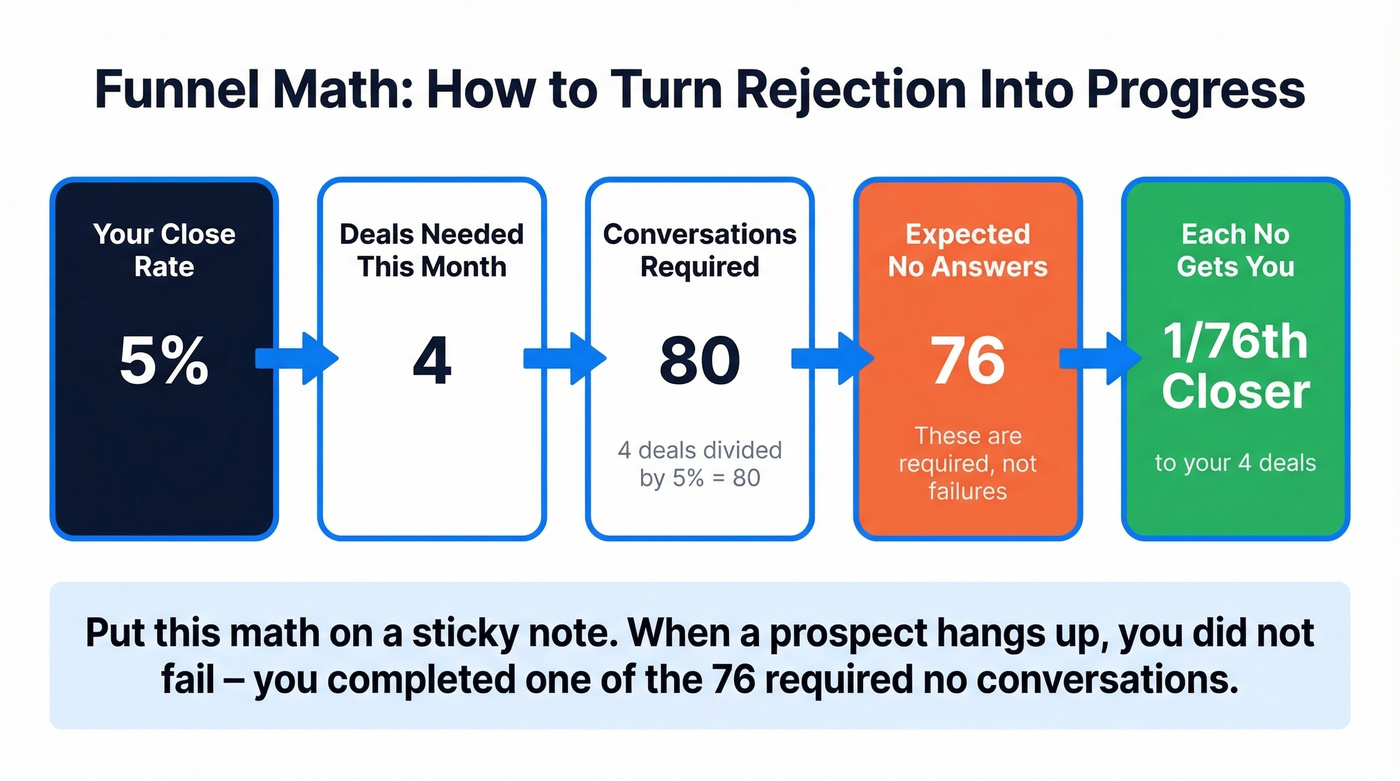
If your close rate is 5% and you need four deals this month, you need roughly 80 conversations. Every "no" gets you 1/80th closer. Convert your rejection rate into expected-dials-per-deal math and put it on a sticky note. When a prospect hangs up, you didn't fail - you completed one of the 76 required "no" conversations.
Control the Controllable
The consensus on r/salestechniques is that stoic principles translate directly to selling. You can't control whether a prospect picks up. You can control your call volume, your preparation, and your tone. Discipline means treating every "no" as information about timing, fit, or messaging - not as a judgment of your worth.
Diagnose, Don't Persuade
Here's a reframe from r/sales worth stealing: stop thinking of sales as convincing someone to buy. Think of it as diagnosing whether a prospect has a problem you can solve. If they don't, moving on isn't rejection - it's a correct diagnosis. This shifts the emotional weight from "they don't want me" to "this wasn't a fit."
Block Calls, Protect Focus
Task-switching kills momentum and drains cognitive energy. Structure your day into three dedicated calling blocks - early morning, midday, and late afternoon - with short breaks between each. Protect those blocks from Slack, email, and CRM admin. We've seen this single change separate reps who hit quota consistently from those who scramble at month-end.
Review Your Game Tape
Pick one call per day - ideally one that didn't go well - and listen for patterns. Are you talking too much in the first 30 seconds? Missing buying signals? Rushing the close? You can't fix what you can't see, and game tape makes the invisible visible.
Plan 7-10 Touches Before Moving On
Before you decide a prospect is dead, commit to a full cadence across email, phone, and social. This removes the daily emotional decision of "should I try again?" The answer is always yes until the cadence is complete. Research shows responding within an hour makes salespeople 7x more likely to qualify a lead, so speed matters as much as persistence.
Build a Support Network
The reps who sustain performance over years almost always have a peer group - a Slack community, a weekly call with other AEs, or a manager who actually coaches. This isn't "talk to someone when you're stressed." It's infrastructure. Showing up for your team and your pipeline every day becomes far easier when you have people holding you accountable. Build that network before you need it.
The Manager's Playbook
Individual tactics only go so far. If the system around the rep is broken, no amount of stoicism or funnel math will save them.
Fix the Targets First
Your VP just raised Q3 targets by 15% because Q2 missed. Here's what happens next: the team's best reps start interviewing elsewhere, and the middle of the pack mentally checks out. McKinsey's research on sales resilience confirms this pattern - companies often respond to downturns by raising targets, which further demoralizes teams already under pressure.
The fix is scenario-based target setting: model best-case, likely, and worst-case scenarios, then set realistic targets for each unit and individual. Targets should stretch performance, not break people.
Engage or Lose Them
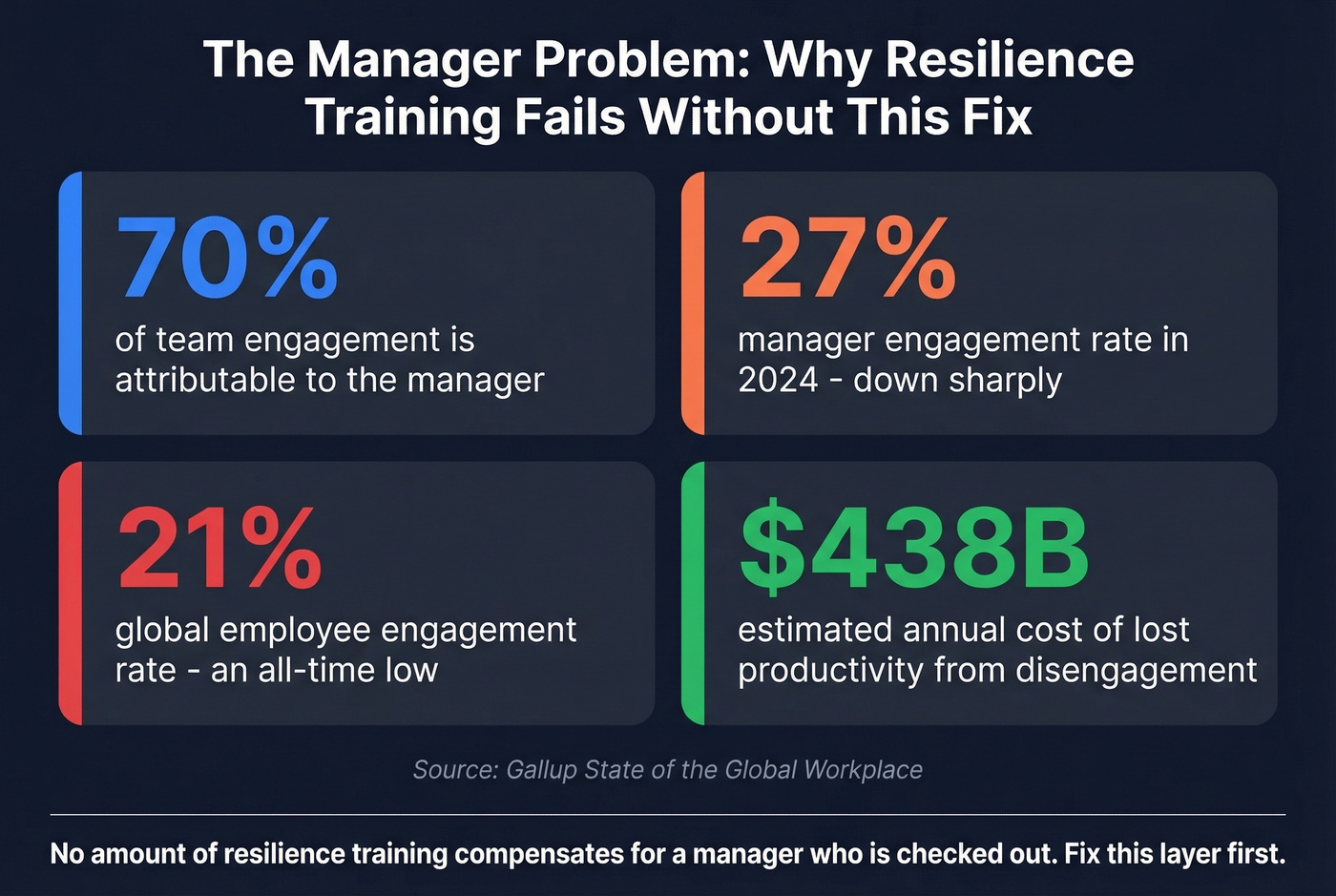
Gallup's data is stark: 70% of team engagement is attributable to the manager. Manager engagement itself fell to just 27% in 2024. Global employee engagement dropped to 21%, costing an estimated $438 billion in lost productivity. No amount of resilience training compensates for a manager who's checked out. Fix the manager layer first.
Run Weekly Zoom-Out Reviews
Daily pipeline pressure creates tunnel vision. In our experience, the teams that recover fastest from bad quarters are the ones where managers run weekly perspective reviews - contextualizing short-term rejection within longer pipeline trends. A rep who booked zero meetings this week but added 40 qualified contacts to their cadence isn't failing. They're loading the spring.
The Hidden Resilience Killer: Bad Data
Look, here's the thing most people miss: the biggest threat to resilience in sales isn't rejection. It's wasted effort that never had a chance of turning into a conversation.
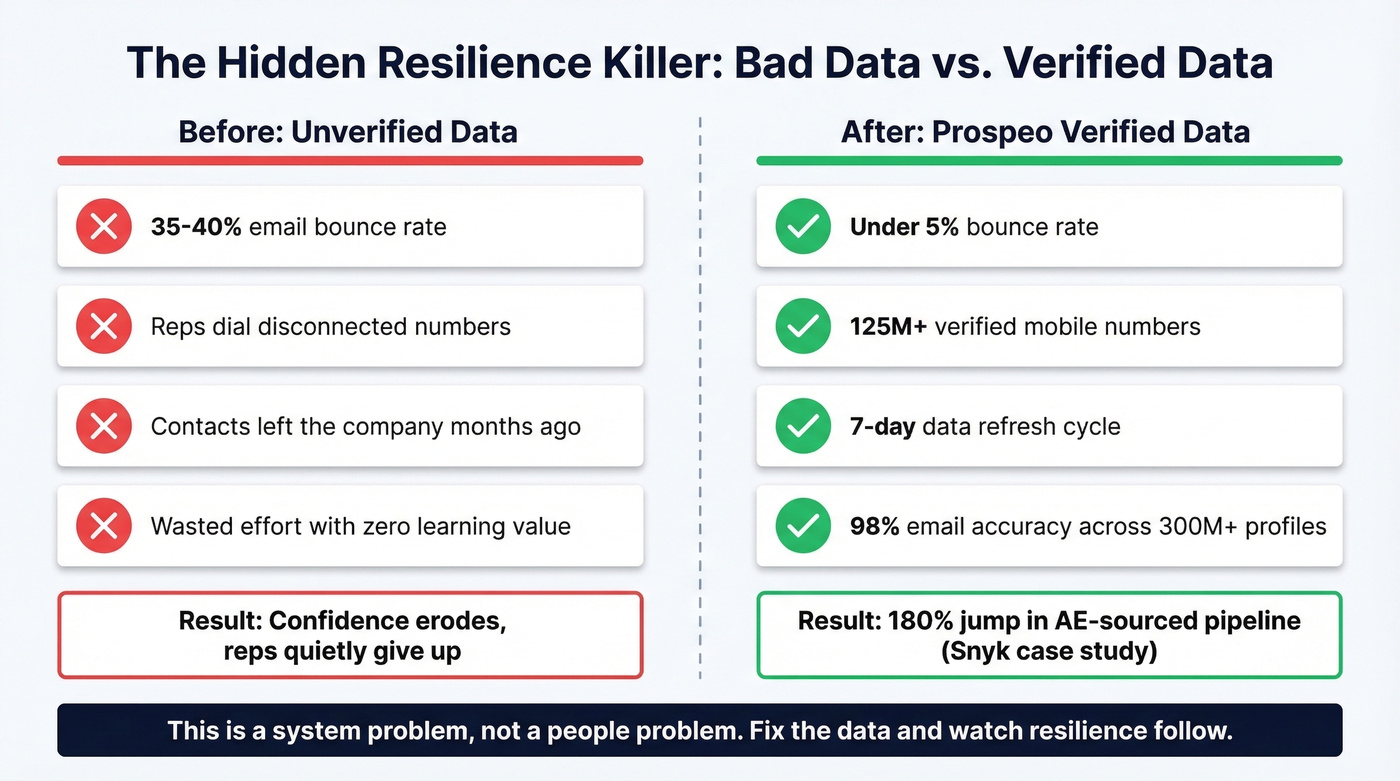
When a rep dials a disconnected number, sends an email that bounces, or reaches someone who left the company six months ago, that's not productive rejection. That's wasted effort with zero learning value. It doesn't toughen anyone up. It just erodes confidence and burns hours. Snyk saw this firsthand - their bounce rate ran 35-40% before switching to verified contact data. After the switch, it dropped to under 5%, and AE-sourced pipeline jumped 180%.
Prospeo addresses this at the source. With 300M+ professional profiles, 98% email accuracy, 125M+ verified mobile numbers, and a 7-day data refresh cycle, reps spend their energy on real conversations instead of dead contacts. The difference between dialing a verified direct number and guessing at a switchboard isn't just efficiency - it's the difference between a rep who feels productive and one who's quietly giving up.
Skip this if your bounce rate is already under 5%. But if your team is burning through lists and half the numbers are dead, that's a system problem, not a people problem.
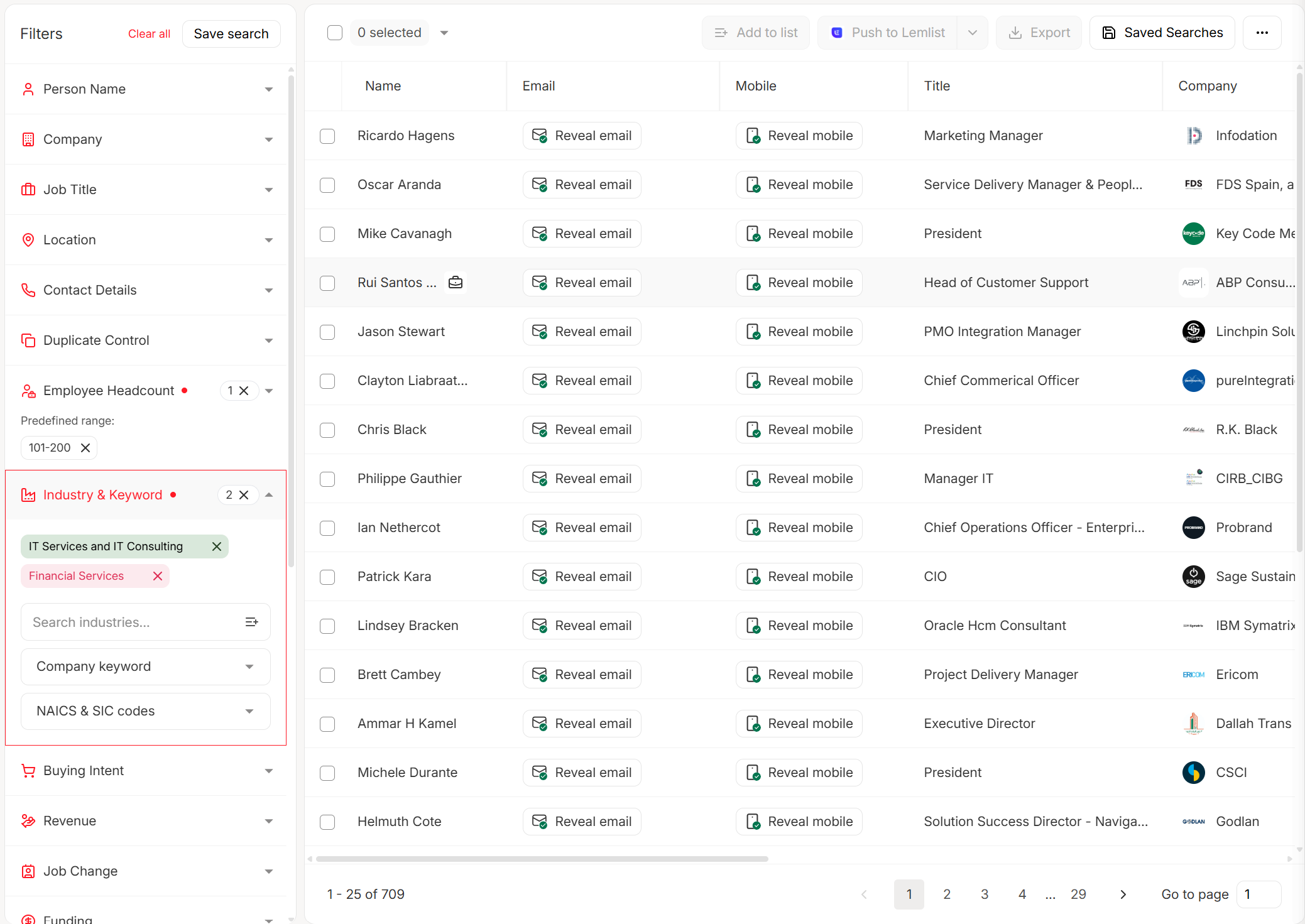
The article's point is clear: resilience is a system, not a personality trait. Clean prospecting data is one of the three levers that actually moves the needle. Prospeo gives your team 300M+ verified profiles at $0.01/email - so reps spend energy on conversations, not chasing ghosts. Teams using Prospeo book 26% more meetings than ZoomInfo users.
Build the system that makes your reps unstoppable.
FAQ
What does resilience mean in sales?
It's the capacity to maintain performance through repeated rejection and sustained pressure. Research shows it's shaped by mindset, management quality, and tools - not a fixed personality trait. Reps don't need to be tougher; they need better infrastructure around them.
How is grit different from resilience?
Grit is long-term passion and perseverance toward a goal over months or years. Resilience is the ability to recover from setbacks in the moment. The best reps need both - grit to stay in the profession and resilience to bounce back after a bad week. Both are trainable through systems, not just willpower.
Is resilience a learnable skill?
Yes. The WEF ranks it #2 among employer-demanded skills globally. Science shows it shifts based on coping mechanisms, environment, and stressor intensity - all factors you can change. Funnel math, structured cadences, and engaged managers build it without requiring personality change.
Why do so many salespeople burn out?
Systemic factors drive most burnout: unrealistic targets, disengaged managers (only 27% are engaged per Gallup), bad prospecting data that wastes effort, and stigma around taking time off. Individual mindset can't compensate for broken systems - fix the infrastructure first.
What tools help reps stay resilient?
Clean prospecting data eliminates wasted dials - one of the biggest daily morale killers. Pair that with a structured cadence tool and weekly coaching, and you address the three biggest systemic drains on rep energy.