

How to Structure Your Revenue Operations Team in 2026
Sales says $2.1M in pipeline. Marketing says $1.4M. CS says renewals are "on track" but can't produce a number. Three departments, three revenue figures, and a board meeting in six days.
That's when companies realize they need a real revenue operations team structure - not a buzzword on a slide deck, but an actual function with actual people who own the number. According to Gartner, 75% of the highest-growth companies will adopt a RevOps model by 2026, up from less than 30% a few years ago. The gap between those companies and everyone else keeps widening, and it's not subtle.
The Quick Version
- Under $2M ARR: Don't hire. Use a fractional consultant, 10-40 hours/month. Fix CRM hygiene, build basic reporting, document processes.
- $4-5M ARR: First full-time hire - a Director-level generalist who designs the revenue system. Go function-based from day one.
- Series B+ ($8M+): Build the team out to 3-5 people. RevOps most commonly reports to the CRO. Never to Sales, Marketing, or CS individually.
Companies with dedicated RevOps report 36% more revenue growth than those without.
When You Actually Need a RevOps Team
The trigger isn't headcount. It's symptoms.
You're in the danger zone at 30-75 employees or 10-15 quota-carrying reps, but the real signals are operational: pipeline numbers conflict across departments, you're running 5+ disconnected GTM tools, forecasting lives in spreadsheets, and nobody owns the end-to-end revenue lifecycle. The ARR band where first hires typically happen is $2M-$8M, with $4-5M as the common sweet spot. Above $8M without RevOps? You're already bleeding money you can't see because nobody's measuring the right things.
Two Org Models, One Clear Winner
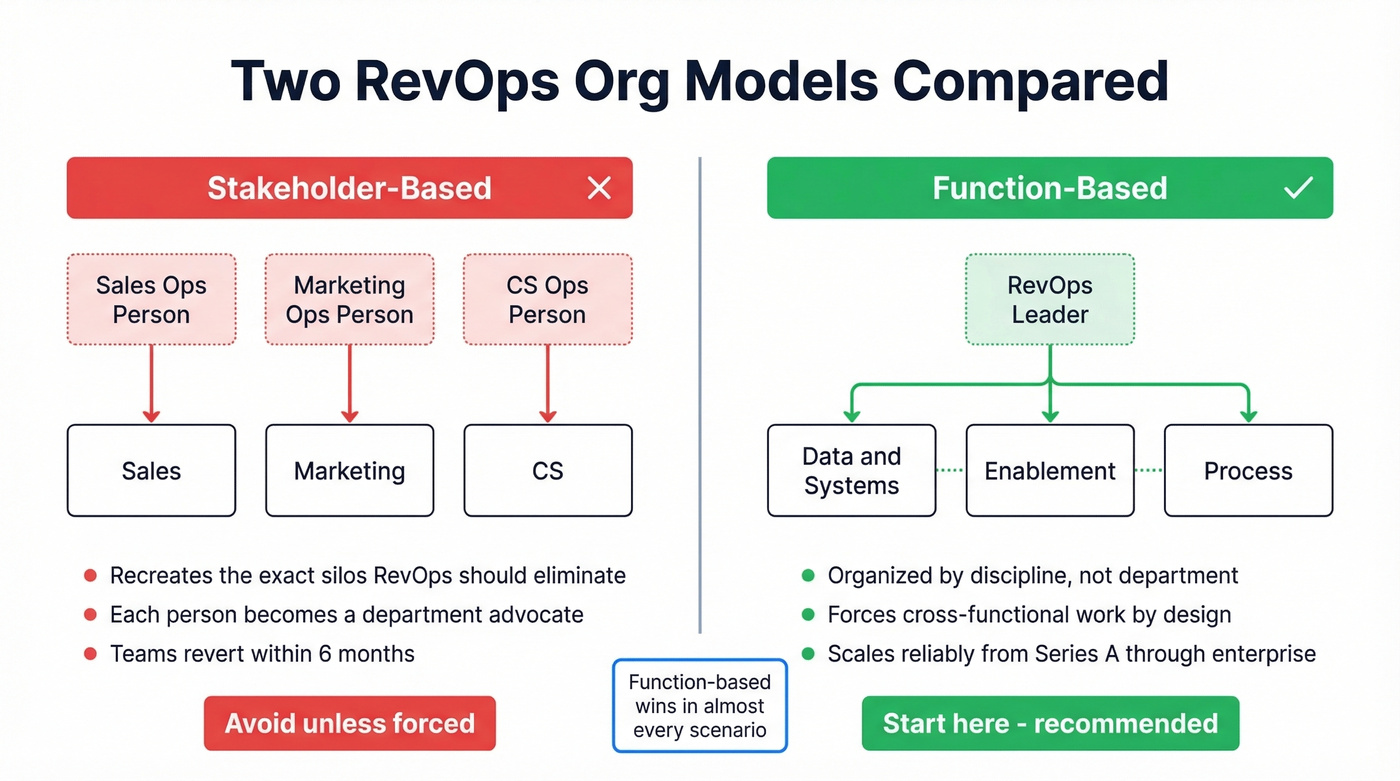
There are really only two ways to organize a RevOps function: stakeholder-based or function-based.
| Stakeholder-Based | Function-Based | |
|---|---|---|
| Structure | Ops person per department | Specialists by discipline |
| Risk | Recreates silos | Requires cross-dept trust |
| Best for | Strong dept leaders | Most growth-stage companies |
| Verdict | Avoid unless forced | Start here |
Stakeholder-based structures - one ops person embedded in Sales, one in Marketing, one in CS - recreate the exact silos RevOps was supposed to eliminate. We've seen teams try this model and revert within six months because each embedded person becomes a department advocate instead of a cross-functional operator.
Function-based wins in almost every scenario. You organize around data/systems, enablement, and process, which forces cross-functional work by design rather than by hope. This is the revenue operations model that scales most reliably from Series A through enterprise.
RevOps Team Structure by Stage
Here's a reality check: only 17.1% of RevOps professionals work in teams of 10 or more. Most teams are small. Match your structure to your stage, not to some aspirational org chart you saw on a SaaS blog.
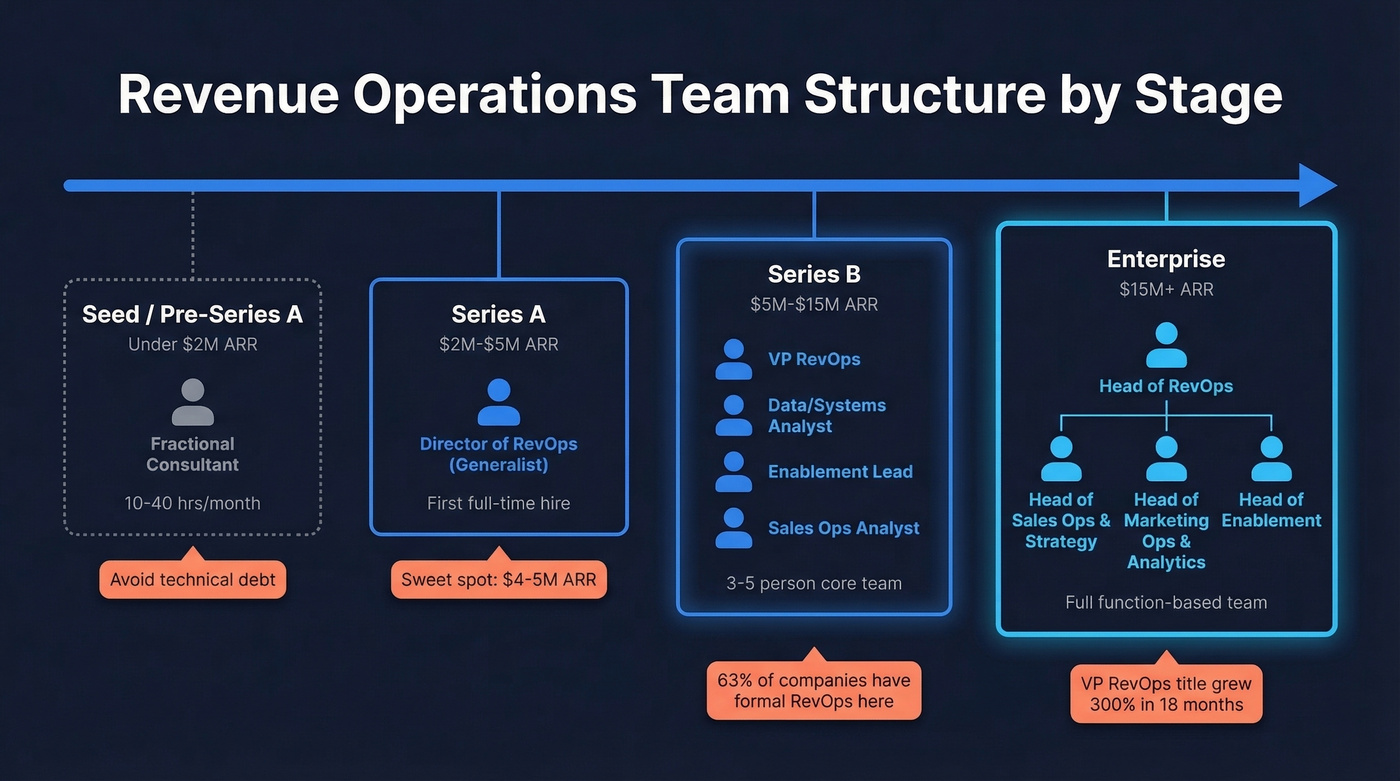
Seed / Pre-Series A
No dedicated hire. A fractional consultant at 10-40 hours/month handles CRM hygiene, basic reporting, and process documentation. Your only job at this stage is to avoid creating technical debt that a future RevOps hire has to undo. Keep it lightweight but intentional - document your naming conventions, standardize deal stages, and pick a CRM you won't outgrow in 18 months.
Series A ($2M-$5M ARR)
Your first full-time hire should be a Director-level RevOps generalist. Not a Salesforce admin. Not a marketing ops specialist. Someone who can design the revenue system and build it themselves.
Director-level is the sweet spot: strategic enough to see the whole picture, hands-on enough to execute without a team underneath them.
Series B ($5M-$15M ARR)
This is where you build the core team.
| Role | Focus | When to Add |
|---|---|---|
| VP RevOps | Strategy, reporting lines, GTM alignment | Immediately |
| Data/Systems Analyst | CRM architecture, enrichment, integrations | With VP |
| Enablement Lead | Training, content, process adoption | Quarter 2 |
| Sales Ops Analyst | Pipeline, forecasting, territory planning | 15-20 reps |
63% of small businesses already have a formal RevOps team at this stage. But here's the part that should frustrate you: 50.6% of RevOps teams operate with zero dedicated budget. If you're building a team without giving them resources, you've created a governance function that can't govern. That's worse than not having one at all.
Enterprise ($15M+ ARR)
Full function-based team with a leadership layer: Head of RevOps, Head of Sales Ops & Strategy, Head of Marketing Ops & Analytics, Head of Enablement. The VP of Revenue Operations title has grown 300% over the past 18 months, which tells you where the market is heading.
Where RevOps Should Report
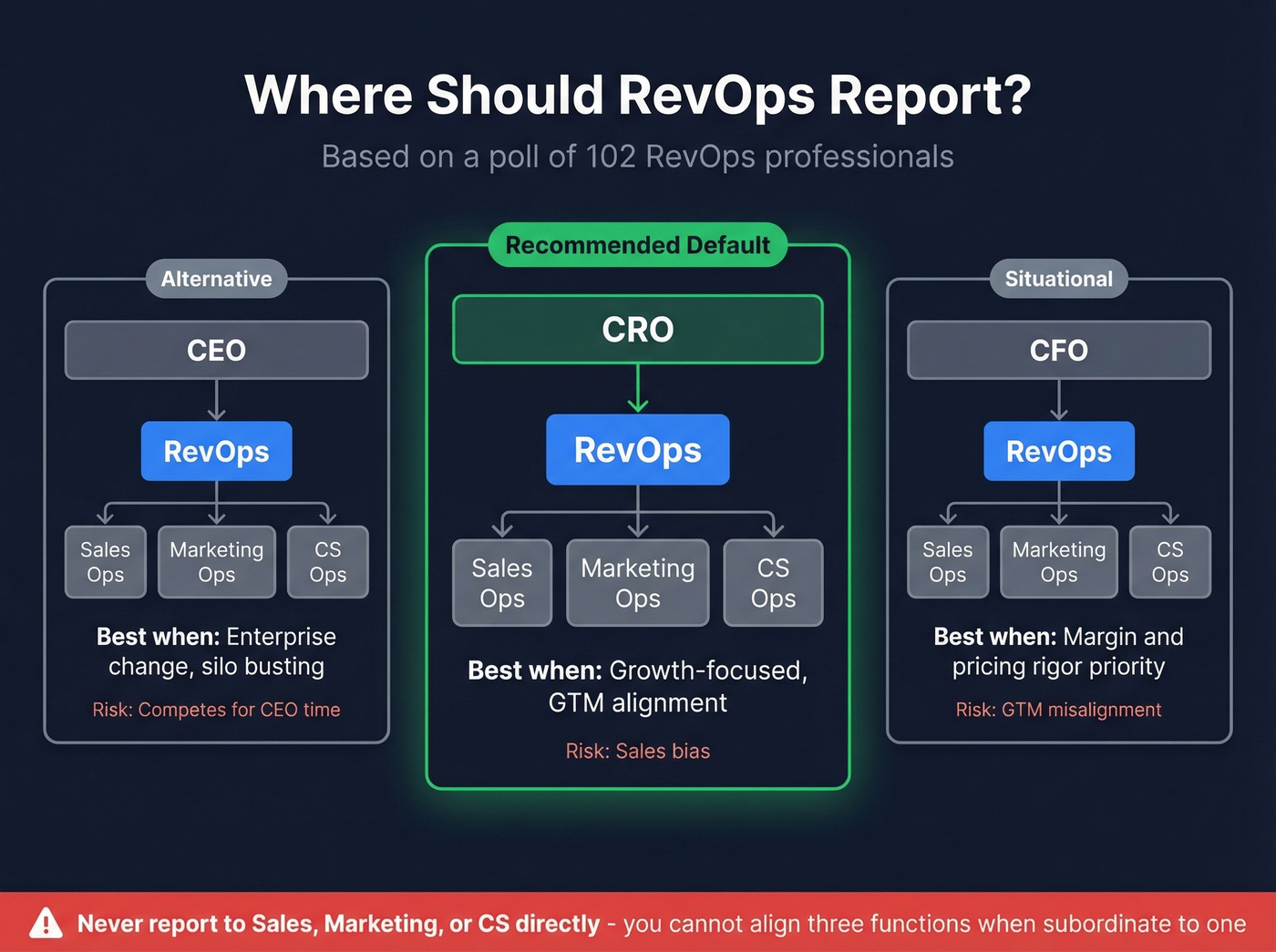
A poll of 102 RevOps professionals found the majority voted CRO. We agree - with caveats.
| Reports To | Best When | Risk |
|---|---|---|
| CRO (default) | Growth-focused, GTM alignment | Sales bias |
| CEO | Enterprise change, silo busting | Competes for CEO time |
| CFO | Margin/pricing rigor priority | GTM misalignment |
RevOps should never report to Sales, Marketing, or Customer Success directly. That defeats the entire purpose - you can't align three functions when you're subordinate to one of them. CRO is the default for growth-stage companies. CEO works when you need top-down transformation. CFO makes sense in margin-focused businesses but risks disconnecting RevOps from the GTM motion entirely.

Your RevOps team's first job is eliminating conflicting data across departments. Prospeo's CRM enrichment returns 50+ data points per contact at a 92% match rate - so pipeline numbers stay consistent from marketing through CS. At $0.01 per email, you won't need to fight for that dedicated budget.
Give your RevOps team data that actually aligns the revenue org.
What RevOps Owns
The metrics RevOps is accountable for define the team's authority. At minimum, your team should own pipeline velocity, forecast accuracy, lead response time, and revenue efficiency (net new ARR / total GTM spend).
In our experience, teams that also track meeting conversion rate and customer engagement score catch problems two quarters earlier than those relying on lagging indicators alone. Establish a RACI for every metric. If nobody owns the number, nobody fixes it when it breaks.
Hiring Sequence and 2026 Salaries
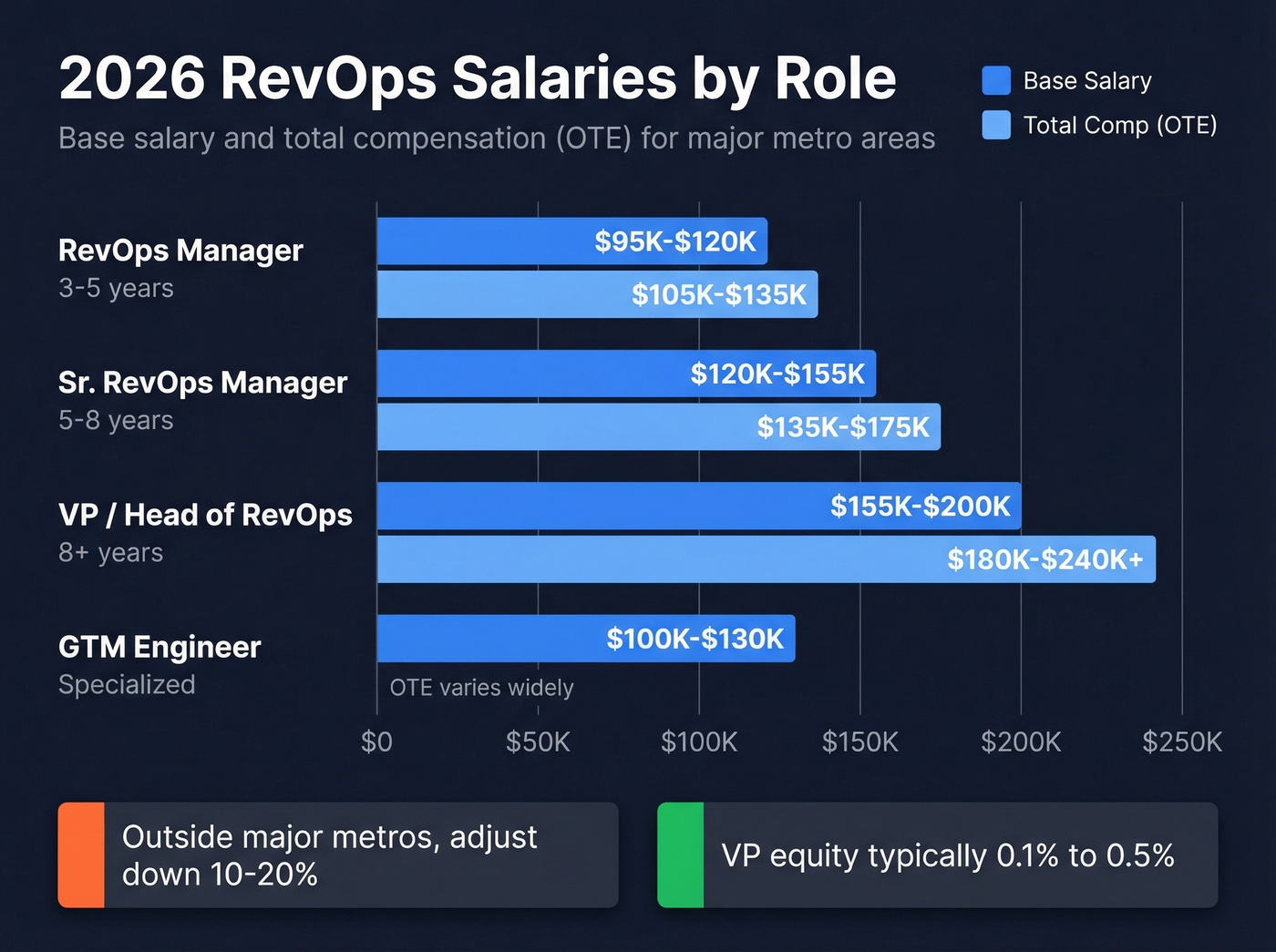
The most common mistake is hiring too late or too junior. Let's be honest: we've never talked to a RevOps leader who said "I hired my ops person too early." The regret always runs the other direction.
| Role | Base Salary | Total Comp (OTE) |
|---|---|---|
| RevOps Manager (3-5 yrs) | $95K-$120K | $105K-$135K |
| Sr. RevOps Manager (5-8 yrs) | $120K-$155K | $135K-$175K |
| VP/Head of RevOps (8+ yrs) | $155K-$200K | $180K-$240K+ |
| GTM Engineer | $100K-$130K | - |
Outside major metros, adjust down 10-20%. VP-level equity typically runs 0.1%-0.5%.
If you're paying a "Salesforce admin" $85K to do strategy work, you've got accidental RevOps - and it's costing you more than hiring the right person at the right level ever would.
The GTM Engineer Question
GTM Engineering builds infrastructure. RevOps runs strategy. They're complementary, not interchangeable.
The consensus on r/SalesOperations is that the GTM Engineer role boomed around outbound workflow building - Clay waterfalls, enrichment logic, multi-provider sequencing - but it's narrowing fast as tools let non-engineers generate workflows via natural language. Skip this role if your outbound motion is straightforward and your RevOps lead is technically capable. The best GTM Engineers are becoming system architects, not workflow builders, and that distinction matters when you're deciding where to spend your next headcount.
Mistakes That Break RevOps Teams
Building RevOps the wrong way is worse than not building it at all. These are the four failures we see most often:
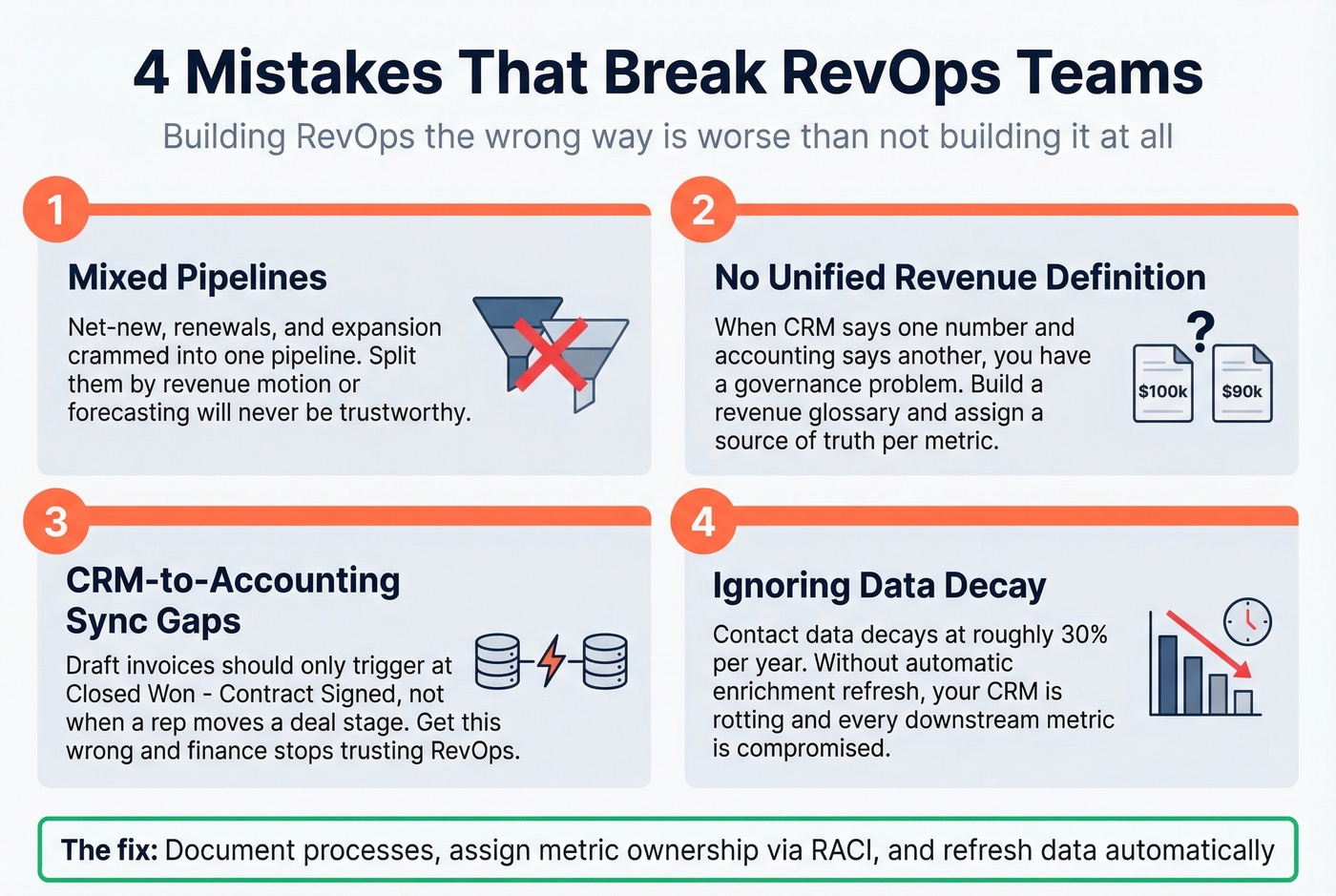
Mixed pipelines. Net-new, renewals, and expansions crammed into one pipeline. Split them by revenue motion or your forecasting will never be trustworthy. This sounds basic, but a surprising number of Series B companies still haven't done it.
No unified revenue definition. When CRM says one number and accounting says another, you don't have a data problem - you have a governance problem. Build a revenue glossary and assign a source of truth per metric.
CRM-to-accounting sync gaps. A draft invoice should only trigger at "Closed Won - Contract Signed," not when a rep moves a deal stage. Get this wrong and finance will stop trusting anything RevOps produces.
Ignoring data decay. Contact data decays at roughly 30% per year. If your enrichment layer isn't refreshing records automatically, your CRM is rotting - and every downstream metric is compromised. Prospeo's 7-day refresh cycle prevents the slow decay that makes RevOps teams distrust their own systems.
Your RevOps Data Layer
RevOps teams own data quality. Forecasting, routing, territory planning, and reporting all depend on clean, current records. A well-designed revenue operations team structure falls apart if the underlying data is stale or incomplete.
This is where enrichment infrastructure matters. Prospeo plugs into Salesforce or HubSpot natively, enriching records with 50+ data points per contact at a 92% API match rate and 98% email accuracy. At roughly $0.01 per lead with a free tier to start, it's tooling a RevOps team can deploy on day one without a procurement cycle - which matters when you're a three-person ops team that doesn't have six weeks to evaluate vendors. If you’re comparing providers, start with a shortlist of data enrichment services.
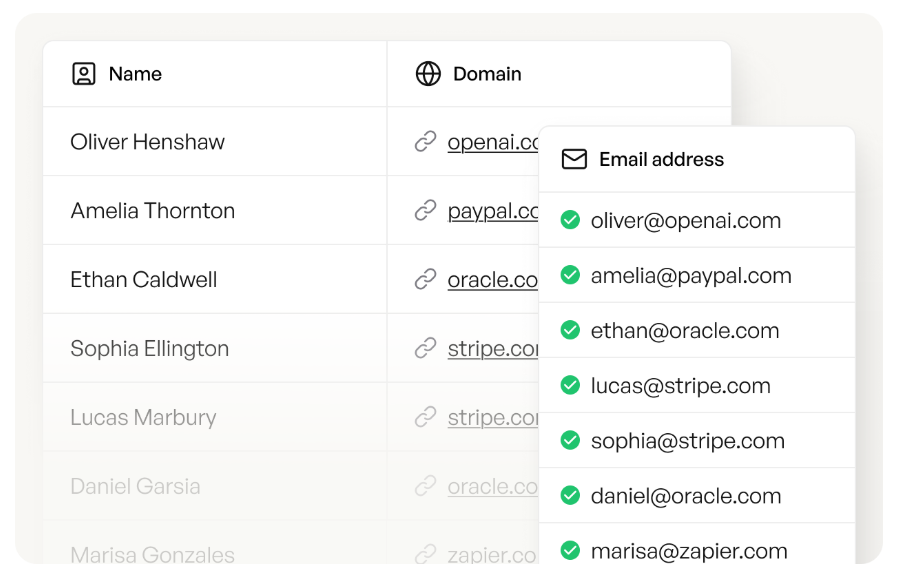
Half of RevOps teams operate with zero dedicated budget. Prospeo is 90% cheaper than ZoomInfo - 300M+ profiles, 125M+ verified mobiles, and 7-day data refresh cycles that keep your CRM clean without enterprise contracts. Your Data/Systems Analyst will thank you.
Enterprise-grade data without the enterprise pricing or sales calls.
FAQ
How big should a RevOps team be?
Most RevOps teams are small - only 17.1% have 10 or more members. A team of 3-4 (VP plus functional specialists) handles most Series B companies well. Scale based on GTM complexity, not headcount benchmarks.
What's the difference between RevOps and Sales Ops?
Sales Ops optimizes the sales function. RevOps aligns the entire revenue lifecycle - marketing, sales, and customer success - under one operational strategy. RevOps is the umbrella; Sales Ops is one pillar underneath it.
Where should RevOps report?
To the CRO in most growth-stage companies. Never to Sales, Marketing, or CS directly - that recreates the silos RevOps exists to break. CEO reporting works during top-down transformation; CFO reporting suits margin-focused businesses but risks GTM misalignment.
What tools does a RevOps team need on day one?
A CRM (Salesforce or HubSpot), a data enrichment platform to keep contact records accurate, a sequencing tool for outbound, and a BI layer for reporting. Start lean - four tools, not fourteen.