

Revenue Ops vs Sales Ops: What Actually Changes (and What It Means for Your Career)
Your CEO just came back from a conference and announced "we're moving to RevOps." Your Sales Ops team of two is wondering what that means for their jobs, their titles, and their comp. Meanwhile, Sales Ops teams spend 68% of their time on non-sales functions - up from 39% in 2019. The revenue ops vs sales ops question isn't just about titles. It's about whether a structural change actually fixes the problem or just renames it.
RevOps isn't a rebrand of Sales Ops. It's a different operating model - and the difference matters for your org chart, your budget, and your paycheck.
The Short Answer
What's the real difference? Scope. Sales Ops optimizes the sales team. RevOps aligns the entire revenue engine - marketing, sales, and customer success - under one operational umbrella.
Which pays more? RevOps, especially at scale. Median OTE for RevOps roles runs ~$129,155. A Sales Ops Specialist averages $62,523. The gap widens at the director and VP level.
Which should your company build? Start with a Sales Ops generalist if you're under $5M ARR. Hire a Director+ RevOps lead once you've hit go-to-market fit. Build a full RevOps team at $20M+ ARR.
What Is Sales Operations?
Sales Ops exists to make the sales team more effective. It's the function that turns a group of reps into a system - with defined territories, accurate forecasts, and a tech stack that doesn't make people want to quit.
Core responsibilities include territory planning and quota management, sales forecasting and pipeline reporting, compensation design and administration, managing the sales tech stack (CRM, engagement tools, CPQ), and onboarding documentation for new reps. The key metrics are what you'd expect: win rate, pipeline velocity, quota attainment, average deal size.
Sales Ops typically reports to the VP of Sales or CSO, and its authority stops at the boundary of the sales org. That's both its strength - deep focus - and its limitation - no cross-functional pull.
What Is Revenue Operations?
RevOps takes the operational discipline of Sales Ops and extends it across the full customer lifecycle. Gartner defines it as "an end-to-end model unifying customer engagement across functions by integrating people, processes, and technology." In practice, one team owns the data, systems, and processes that connect marketing, sales, and customer success. Marketing Ops doesn't disappear - RevOps subsumes its operational layer while preserving specialized execution.
Stephen Diorio of the Revenue Enablement Institute put it well: B2B growth is now a "digital, data-driven, and technology-enabled team sport." No single department can optimize revenue alone.
The most useful framework breaks RevOps into four pillars:
- Process - handoff architecture, SLAs between teams, funnel definitions
- Enablement - cross-functional training, adoption, and change management
- Insights - dashboards, attribution modeling, forecasting
- Systems/Tools - tech stack ownership, integrations, data governance
One emerging role worth watching: the GTM Engineer. This is a technical operator who bridges strategy and systems - writing scripts, building custom integrations, and automating workflows that used to require a developer. It's where RevOps is heading for companies with complex tech stacks.
RevOps metrics are broader: ARR, CAC, CLTV, net revenue retention. And the reporting line matters. RevOps typically reports to the CRO, COO, or CFO - someone with cross-functional authority. If your RevOps person reports to the VP of Sales, you don't have RevOps. You have Sales Ops with a fancier title.
Key Differences at a Glance
| Dimension | Sales Ops | RevOps |
|---|---|---|
| Scope | Sales team only | Marketing + Sales + CS |
| Key metrics | Win rate, quota attainment | ARR, CAC, CLTV, NRR |
| Reports to | VP Sales / CSO | CRO / COO / CFO |
| Data ownership | Consumes CRM data | Owns the data layer |
| Tech stack | Sales tools only | Full GTM stack |
| Lifecycle coverage | Pipeline to close | Awareness to renewal |
| Cross-functional pull | Limited | High (by design) |
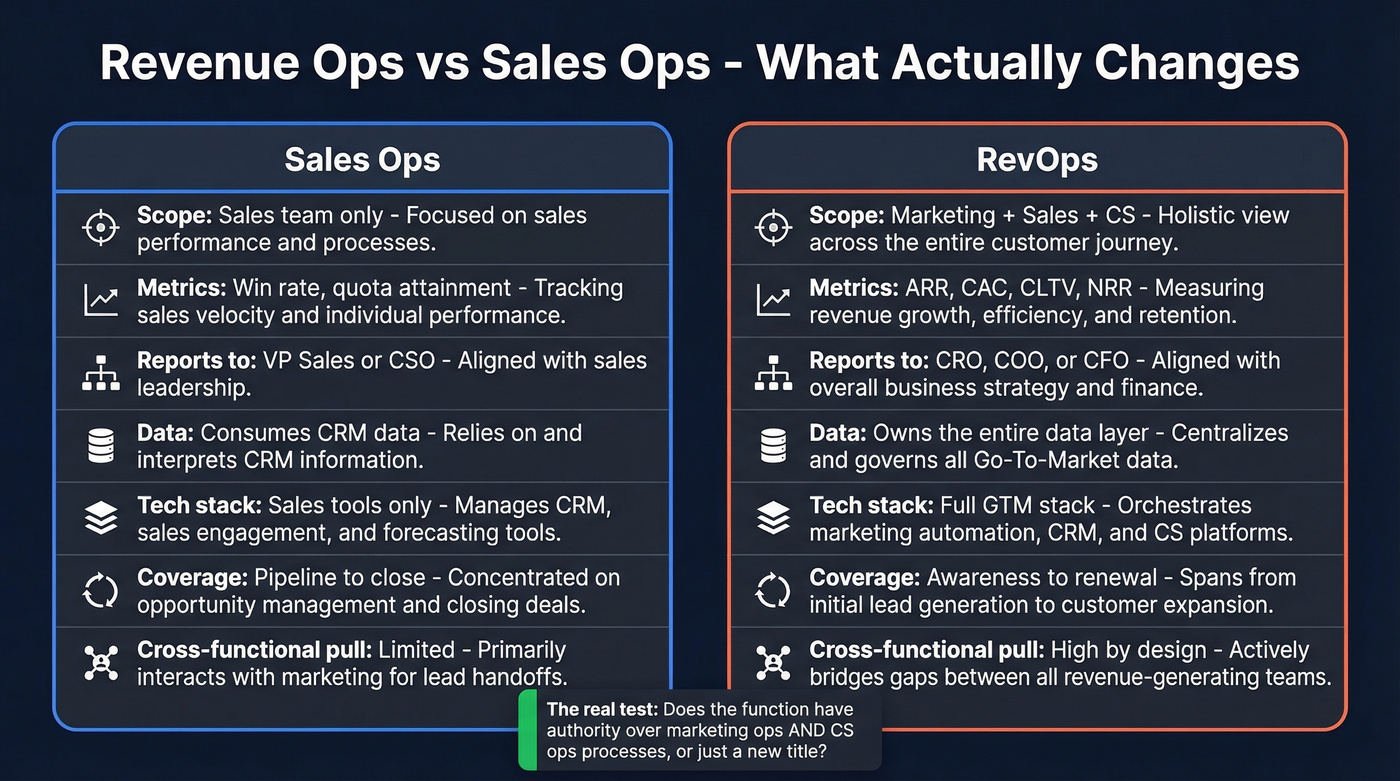
The reporting line distinction isn't academic. When RevOps reports to the head of sales, it inevitably prioritizes sales workflows over marketing attribution or CS health scores. That defeats the entire purpose. A RevOps function needs organizational neutrality to arbitrate between departments, and that only works when it sits above any single function.
Here's the thing: most companies that say they've "adopted RevOps" have actually just renamed their Sales Ops team. The test is simple. Does the function have authority over marketing ops and CS ops processes, or does it just have a new Slack channel name? If you're evaluating this for your own org, that authority question is the one that matters most.

RevOps teams align marketing, sales, and CS around shared data. That alignment breaks the moment your contact data bounces. Prospeo delivers 98% email accuracy on 300M+ profiles - refreshed every 7 days, not every 6 weeks - so every team in your revenue engine works from the same trusted source.
Give your RevOps stack a data layer that doesn't decay between syncs.
Salary Comparison in 2026
Let's talk money, because that's what the Reddit threads on this topic are really asking about. The consensus on r/salesoperations and r/RevOps is clear: if you switch from Sales Ops to RevOps, you're looking at a raise - often a significant one at the manager+ levels.
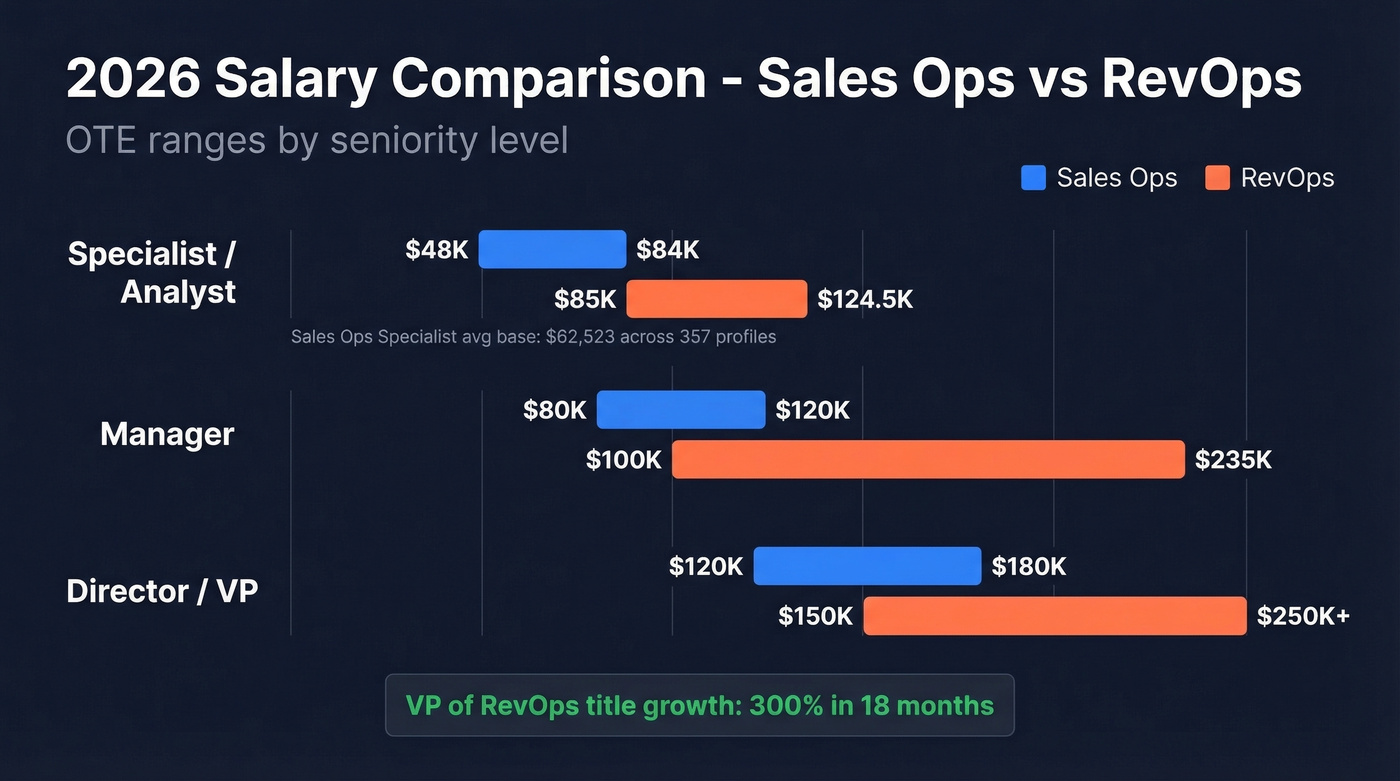
| Level | Sales Ops Range | RevOps Range |
|---|---|---|
| Specialist / Analyst | $48K-$84K | $85K-$124.5K |
| Manager | $80K-$120K | $100K-$235K |
| Director / VP | $120K-$180K | $150K-$250K+ |
The Sales Ops Specialist baseline is well-documented: $62,523 average base across 357 profiles. RevOps median OTE runs ~$129,155, with RevOps Managers ranging from $100K to $235K depending on experience and company size. RevOps managers typically see 10-20% bonuses on top of base, with annual raises averaging around 5%.
Company size drives a massive delta on the RevOps side. Small startups under 50 employees pay a median OTE around $100K. Enterprise companies with 1,000+ employees push that to ~$162K - roughly 60% higher for the same title. The VP of RevOps title has grown 300% in 18 months, which tells you where the market is placing its bets.
There's an uncomfortable pattern in Sales Ops compensation: a seven-year ceiling. Beyond about seven years of experience, additional tenure yields diminishing salary returns. The market rewards technical skills - revenue intelligence, SQL, analytics, AI fluency - more than years on the job. Entry-level Sales Ops ranges grew 8.44% in 2024, while senior ranges contracted by 10.18% that same year. That's salary compression, and it's a career signal worth paying attention to. For many practitioners, the comp gap between these two paths is reason enough to start building cross-functional skills now.
When to Choose Each
The distinction maps directly to your company's growth stage.
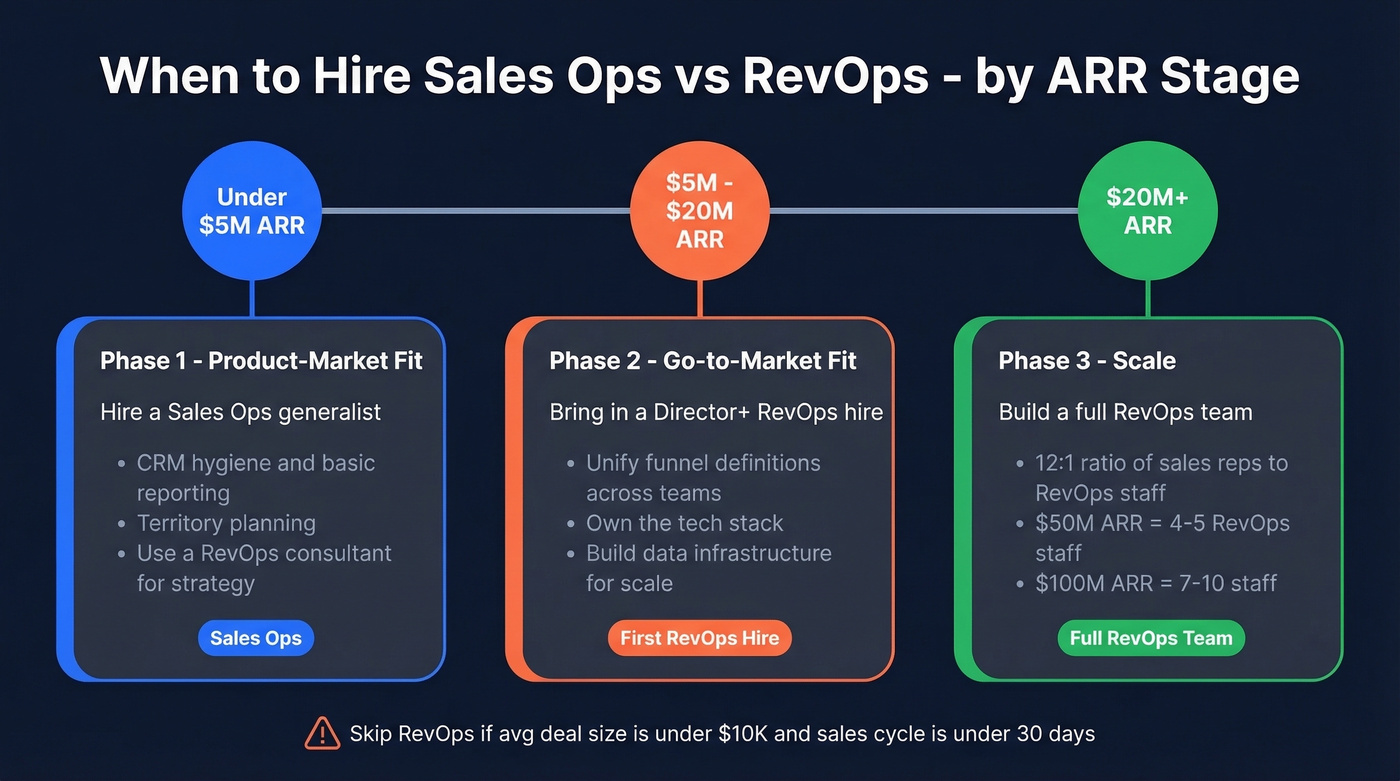
Phase 1: Product-Market Fit (under $5M ARR). Hire a Sales Ops generalist. This person handles CRM hygiene, basic reporting, and territory planning. Don't hire a RevOps lead yet - you don't have enough cross-functional complexity to justify it. For strategic RevOps thinking at this stage, use a consultant or RevOps-as-a-service partner.
Phase 2: Go-to-Market Fit ($5M-$20M ARR). Bring in a Director+ RevOps hire. At this stage, your revenue leader shouldn't be spending 10 hours a week building dashboards in the CRM. You need someone who can unify funnel definitions across marketing and sales, own the tech stack, and build the data infrastructure for scale.
Phase 3: Scale ($20M+ ARR). Build a full RevOps team. A PeerSignal analysis of 2,500 B2B SaaS companies found a 12:1 ratio of sales reps to RevOps personnel. At $50M ARR, that's typically 4-5 RevOps staff. At $100M, 7-10. At $200M, 14-19. Sales Ops doesn't disappear - it becomes a specialization within the broader RevOps org.
Skip the RevOps hire entirely if your average deal size is under $10K and your sales cycle is under 30 days. A sharp Sales Ops generalist with a good data stack will outperform a premature RevOps build every time. Don't let org-chart envy drive a structural change your business isn't ready for.
The Business Case for RevOps
By 2026, 75% of the highest-growth companies will have adopted a RevOps model.
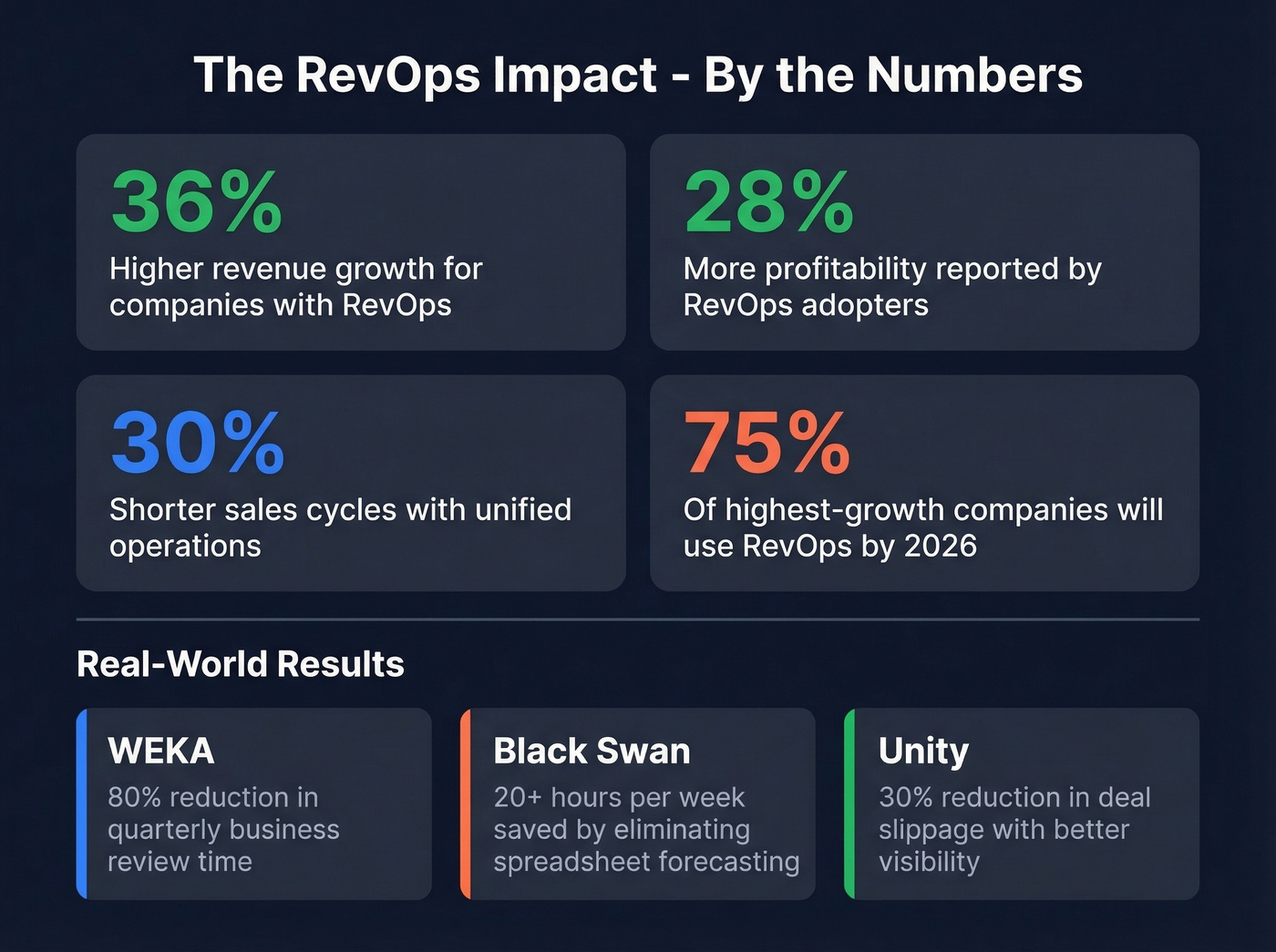
The numbers back it up. Qwilr's 2026 RevOps research found that companies with RevOps report 36% higher revenue growth and up to 28% more profitability than those without. RevOps can also shorten the sales cycle by up to 30%.
But the case studies hit harder than the benchmarks. WEKA reduced quarterly business review time by 80% after unifying data and forecasting under a RevOps function. Black Swan gained 20+ hours per week by eliminating spreadsheet-based forecasting. Unity cut deal slippage by 30% with better visibility into sales performance. We've seen similar patterns in our own work - the biggest wins don't come from adding headcount. They come from eliminating the friction between teams that were never designed to share data in the first place.
Common Transition Mistakes
The fastest way to fail at a RevOps transition is to move fast and break things. Specifically, three things.
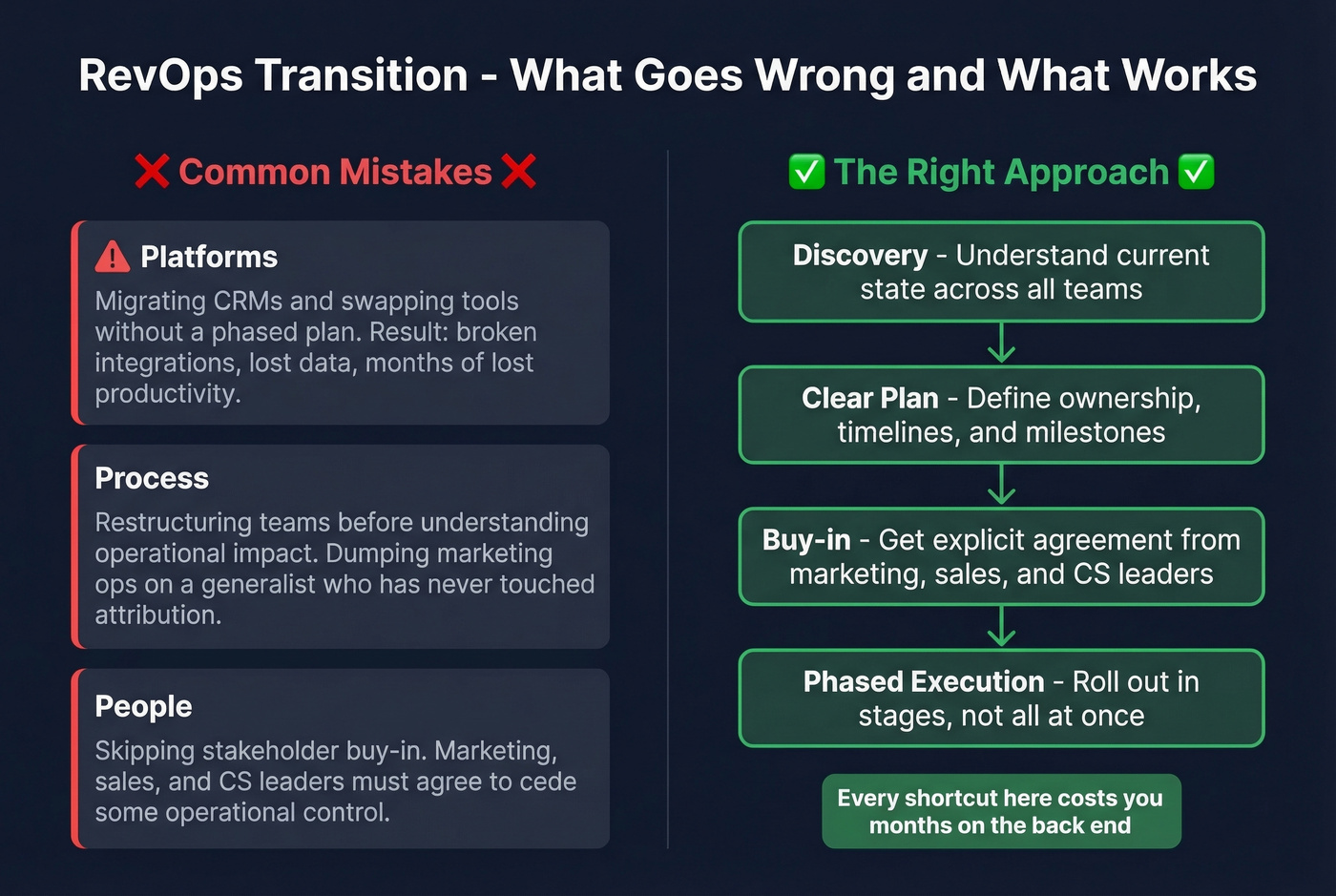
Platforms. Migrating CRMs, swapping automation tools, or consolidating tech stacks without a phased transition plan. The result is broken integrations, lost data, and a productivity crater that takes months to climb out of.
Process. Restructuring teams or cutting headcount before understanding the operational impact. If you dissolve the Marketing Ops function and dump those responsibilities on a RevOps generalist who's never touched attribution modeling, you'll get worse attribution - not better alignment.
People. Skipping stakeholder buy-in. RevOps requires marketing, sales, and CS leaders to cede some operational control. Without explicit agreement on who owns what, you get resistance, workarounds, and a slow reversion to the old model.
Discovery first, then a clear plan, then buy-in, then phased execution. Every shortcut here costs you months on the back end.
The Data Foundation Both Functions Need
The real question isn't which function you build. It's whether your ops function owns the data layer or just consumes it.
That 68% non-sales time stat from the intro? A huge chunk of it is data cleanup - reps fixing bounced emails, ops teams deduplicating records, managers reconciling conflicting reports. Whether you call the team Sales Ops or RevOps, bad data makes everyone slower.
CRM enrichment is the shared requirement. Both functions need accurate contact data flowing into Salesforce or HubSpot without manual intervention. Prospeo's enrichment API handles this at 98% email accuracy on a 7-day refresh cycle, returning 50+ data points per contact with an 83% enrichment match rate. At ~$0.01/email with no contracts, the free tier lets you test without a procurement process. If you're comparing vendors, start with a shortlist of data enrichment services and map them to your CRM workflows.
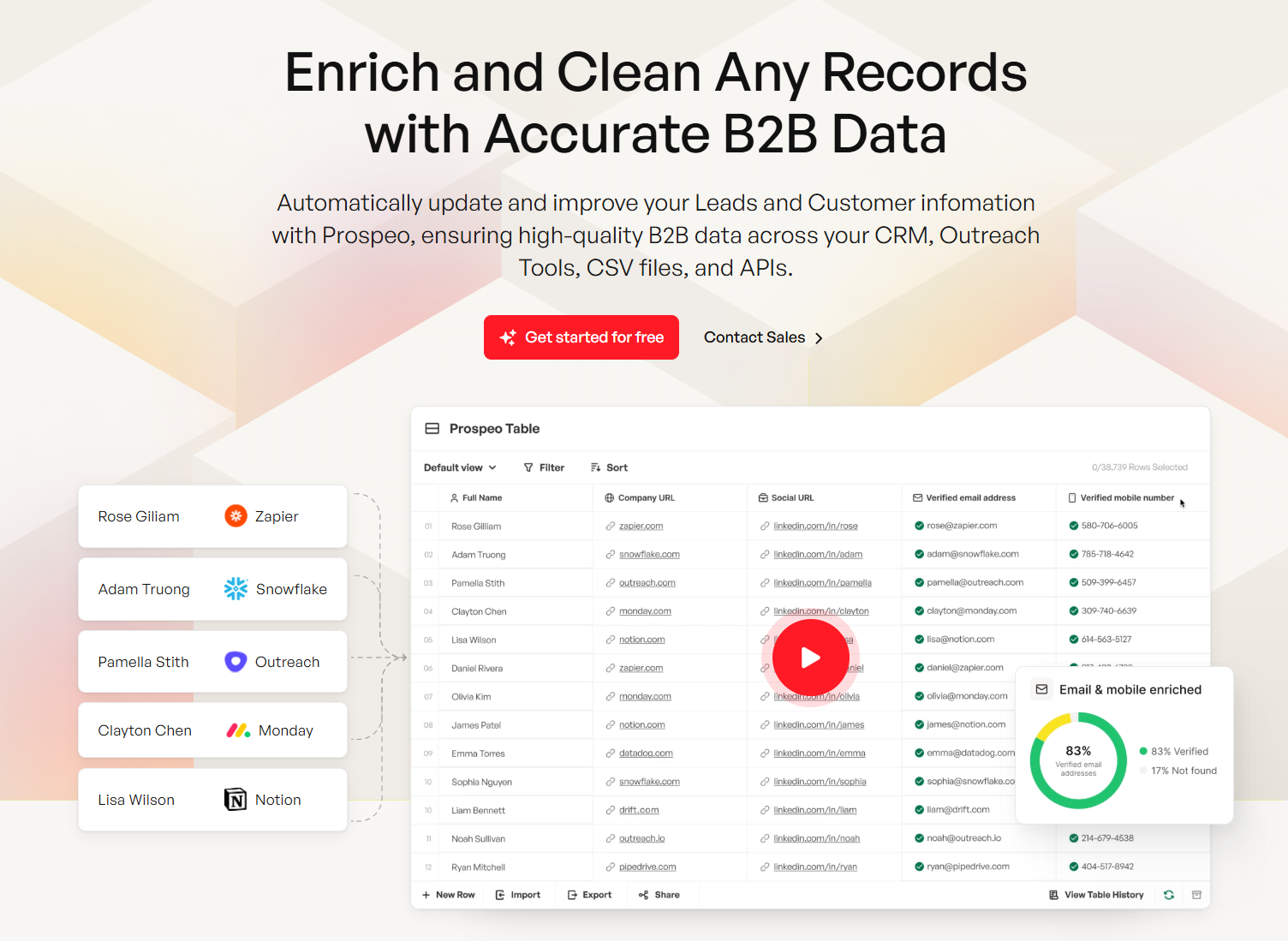
Sales Ops or RevOps, your pipeline velocity depends on reaching real buyers. Prospeo's 125M+ verified mobile numbers hit a 30% pickup rate, and CRM enrichment returns 50+ data points per contact at a 92% match rate - all at $0.01 per email. No contracts, no sales calls required.
Stop letting bad data compress your team's performance ceiling.
FAQ
Can a Sales Ops person transition to RevOps?
Yes - Sales Ops is one of the most common feeder roles into RevOps. Add cross-functional stakeholder management, fluency in marketing and CS metrics, and data governance to your skill set. Practitioners who make the switch often earn promotions within their first year. The day-to-day difference is largely about breadth: you go from owning one team's processes to orchestrating across three.
Do companies need both functions?
At scale, yes. Sales Ops handles day-to-day process optimization - quotas, territories, forecasting - while RevOps owns the cross-functional data layer and strategic alignment. Define a RACI matrix so both functions know where one ends and the other begins. Most $50M+ ARR companies run Sales Ops as a specialization inside the RevOps org.
What tools do RevOps teams use?
The core stack includes a CRM (Salesforce or HubSpot), revenue intelligence (Clari), sales engagement (Outreach or Salesloft), and a data enrichment platform for CRM accuracy. Early-stage teams can run lean on a free tier; $50M+ companies typically need dedicated tooling for each pillar.
Is this debate just about job titles?
No. While some companies simply rebrand Sales Ops as RevOps, the structural difference is real: RevOps carries cross-functional authority over marketing, sales, and customer success operations. If the role doesn't come with that mandate, the title change is cosmetic - and the silos remain intact.