

10 RingCentral Alternatives That Won't Surprise You on the Invoice
You just opened your RingCentral invoice and there's a line item you didn't authorize. Again. A "change order" charge - weekly - that support can't explain even after you've emailed screenshots and your contract. You're not alone, and you're not crazy.
RingCentral's feature set is genuinely deep. But for a growing number of teams, the billing surprises, add-on creep, and support black holes have turned a solid platform into a liability. The best RingCentral alternatives solve these problems without creating new ones. Here's what to switch to, and how to avoid trading one headache for another.
Why Teams Ditch RingCentral in 2026
The complaints follow a pattern. On r/sysadmin, users report being charged weekly with invoices labeled "change order" despite never signing one - and support can't itemize or explain the charges even after weeks of follow-up. That's not a bug. That's a billing culture problem.
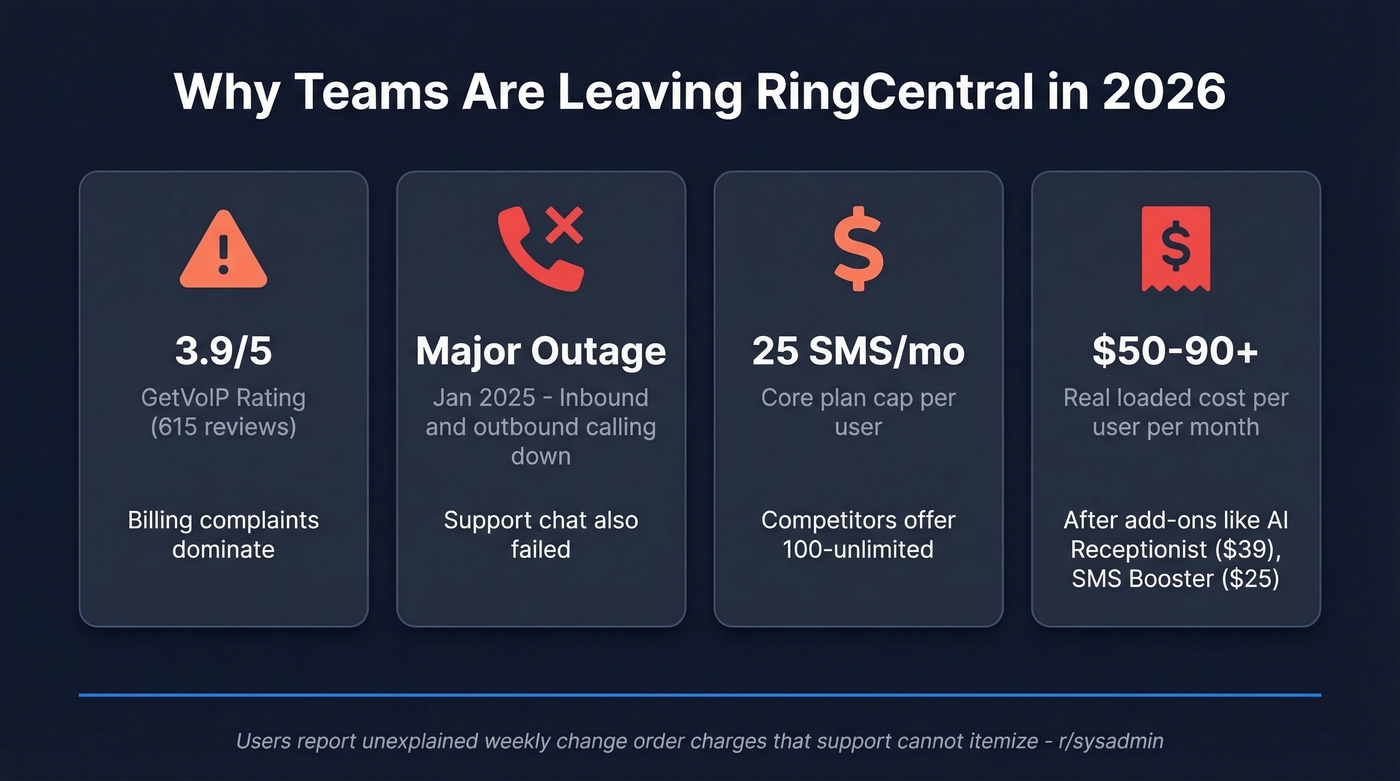
Then there's reliability. In early 2025, a major outage caused inbound and outbound calling difficulties across the platform. A healthcare provider found out from a patient who couldn't reach them. The chat support button didn't work during the outage. Call forwarding to personal cells failed. When calling goes down and you can't even reach support, trust evaporates fast.
The numbers back up the frustration. RingCentral sits at 3.9/5 on GetVoIP across 615 reviews and 4.2/5 on G2 with 1,313 reviews. Common themes in negative reviews: invoices higher than quoted, changes that should take 48 hours stretching to two weeks, mobile app latency, and complex settings that require dedicated IT.
And the nickel-and-diming adds up. RingCentral's Core plan caps SMS at 25 messages per user per month. Want an AI Receptionist? That's $39/month extra. SMS Booster? $25. Call Queues? $35. The list price is a starting point, not a destination.
Here's the thing: if your SDRs are complaining about dead numbers and low connect rates, the problem might not be RingCentral at all. It might be your contact data. More on that below.
Our Picks (TL;DR)
Best overall VoIP switch: Nextiva - $15/user/mo, strongest all-around package for teams under 100. Transparent pricing, solid support reputation.
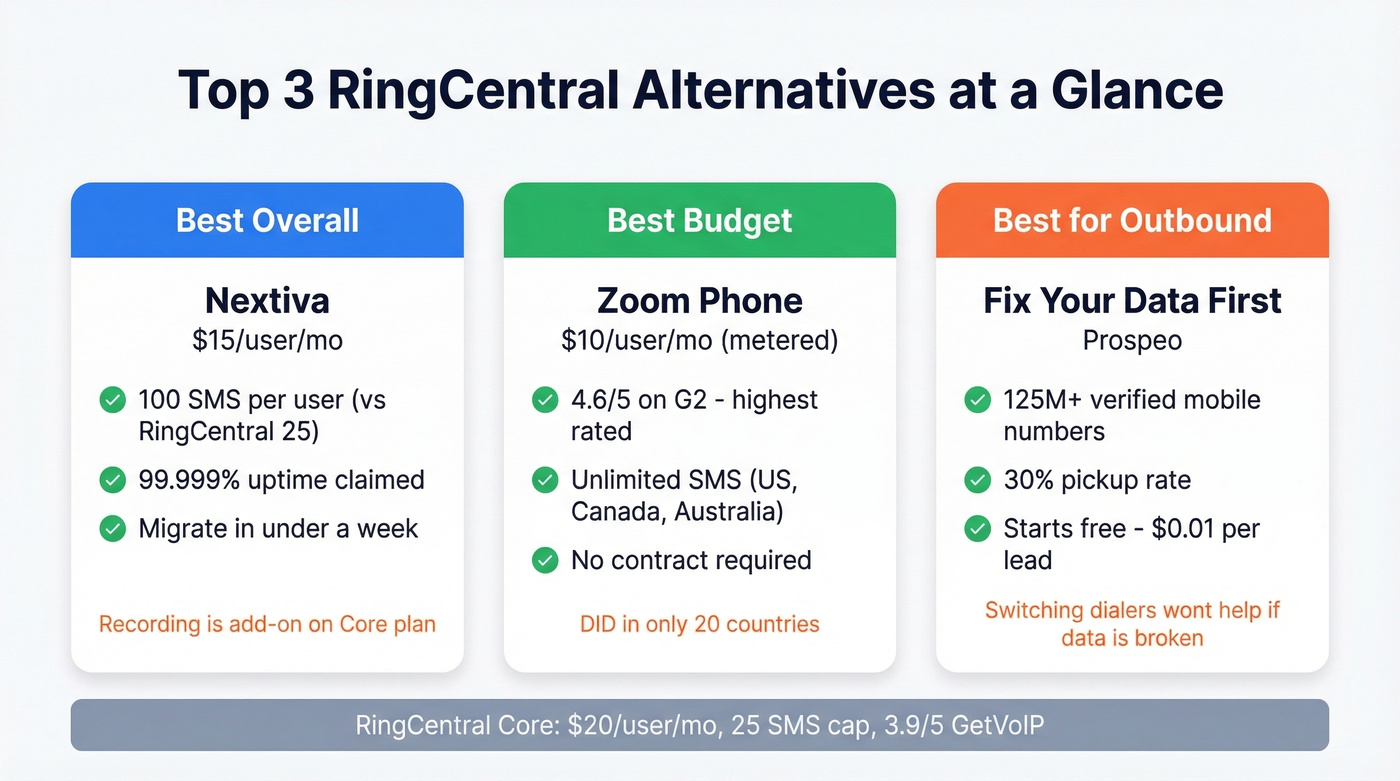
Best budget option: Zoom Phone - $10/user/mo metered, 4.6/5 on G2 with 2,640 reviews. Highest-rated in our G2 snapshot, and unlimited SMS where RingCentral caps you at 25.
Best for outbound teams: If your real problem is connect rates rather than call quality, fix your contact data first. Prospeo delivers 98% email accuracy and 125M+ verified mobiles with a 30% pickup rate - free to start.
Side-by-Side Comparison
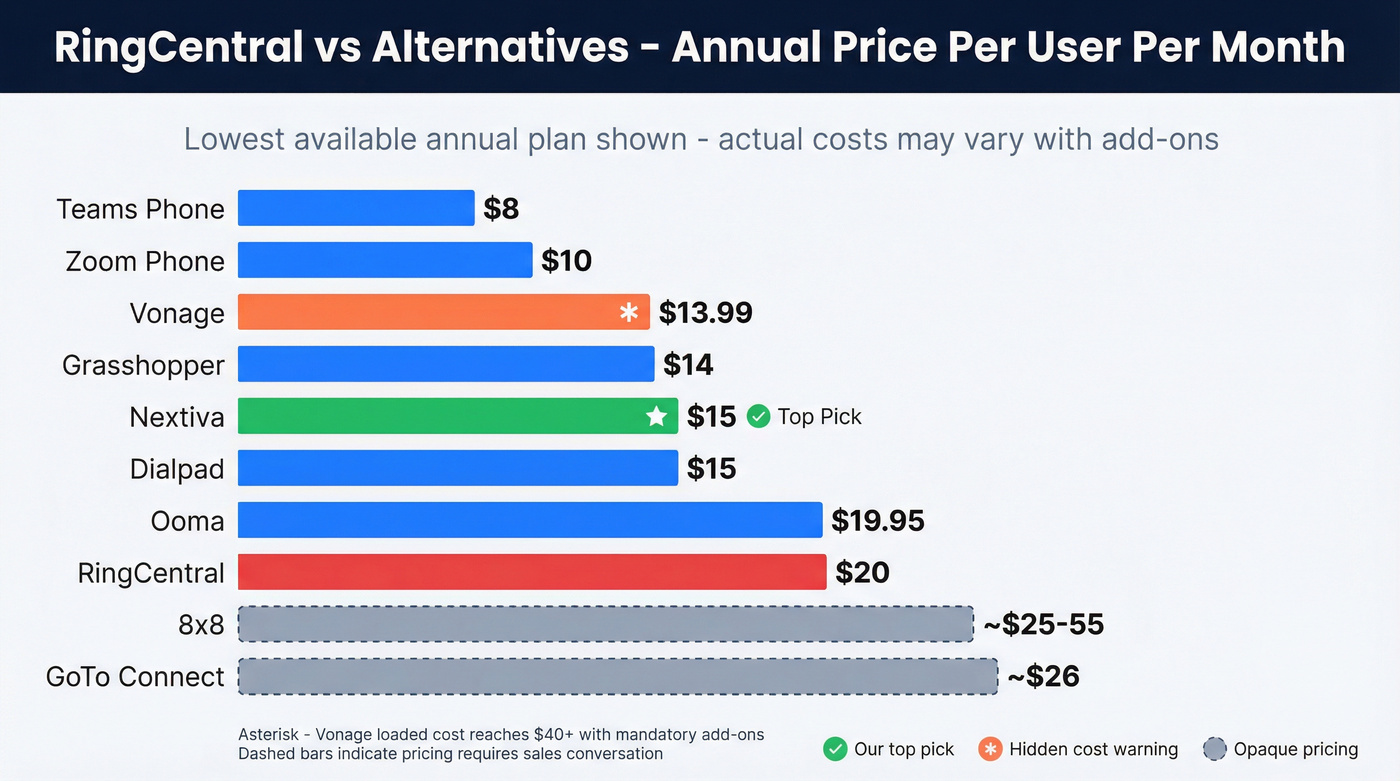
Pricing shown is annual per-user where available; monthly rates noted separately.
Pricing & Fit
| Tool | Annual $/user/mo | Best For | G2 Rating | Key Limitation |
|---|---|---|---|---|
| Nextiva | $15 | All-around switch | - | Recording is add-on on Core |
| Zoom Phone | $10 (metered) | Budget teams | 4.6/5 (2,640) | DID in only 20 countries |
| Dialpad | $15 | AI-first teams | - | 10-person meeting cap |
| Teams Phone | $8 | Microsoft shops | - | Requires Microsoft 365 |
| 8x8 | ~$25-55 (quote) | Global teams | - | Pricing not self-serve |
| Vonage | $13.99 | API customization | - | True cost hits $40+ |
| GoTo Connect | ~$26 | Mid-market | - | Pricing requires sales |
| Ooma | $19.95 | Small offices | - | Limited integrations |
| Grasshopper | $14 | Solopreneurs | - | No UCaaS features |
Contract & SMS Details
| Tool | Monthly Price | Contract? | SMS Limits |
|---|---|---|---|
| Nextiva | ~$20 | 12-mo min | 100/user (Core) |
| Zoom Phone | $10 (metered) | No | Unlimited (US/CA/AU) |
| Dialpad | $27 | Annual saves | Varies |
| Teams Phone | $8 | No | Via Teams |
| 8x8 | Quote only | Varies | Varies |
| Vonage | $19.99 | 1-year | Add-on |
| GoTo Connect | Quote only | Varies | Included |
| Ooma | $19.95 | No | Varies |
| Grasshopper | $14 | No | N/A |
Top RingCentral Competitors Reviewed
Nextiva - Best All-Around Switch
Use this if you want the closest thing to a painless migration from RingCentral. Nextiva's Core plan at $15/user/mo is cheaper than RingCentral's $20/user/mo Core plan on an annual subscription, and you get 100 SMS per user - four times RingCentral's 25. The Engage tier at $25 bumps that to 500 SMS and adds more advanced routing.
Skip this if you need call recording out of the box. It's an add-on on Core, which is annoying for a plan that otherwise checks every box. The annual pricing requires a 12-month minimum term for teams of 1-100 employees. Not a dealbreaker, but know what you're signing.
We've seen teams migrate in under a week with minimal disruption, and Nextiva claims 99.999% uptime - about six minutes of downtime per year. The Power Suite CX tier at $75/user is overkill for most. Stick with Core or Engage unless you're running a contact center.
Zoom Phone - Best for Budget Teams
Use this if you want the cheapest credible VoIP with the highest user satisfaction scores. Zoom Phone's metered plan starts at $10/user/mo. The Regional Unlimited plan at $15 and Global Select at $20 cover most use cases.
Skip this if you need international DID numbers. Zoom covers 20 countries versus RingCentral's 80. For US/Canada-focused teams, that gap doesn't matter. For global orgs, it's a real constraint.
Zoom Phone holds a 4.6/5 on G2 with 2,640 reviews - the highest-rated option in our comparison. In our testing, call quality matched RingCentral at a fraction of the price. Zoom also offers unlimited SMS for US, Canada, and Australia numbers, a massive upgrade from RingCentral's 25/user cap on Core. If you're already in the Zoom ecosystem for meetings, adding Phone is a no-brainer.
Dialpad - Best for AI-First Teams
Dialpad is the right pick if AI-powered call intelligence is your priority. Its AI engine provides real-time transcription and automatically generates post-call summaries after every conversation. The Standard plan at $15/user/mo (annual) matches Nextiva's entry price, and the interface is clean enough that reps actually enjoy using it.
The tradeoffs are real, though. Meetings cap at 10 participants, which kills it for all-hands or larger team calls. The Standard plan limits you to 3 ring groups - that gets tight fast for multi-department teams. Monthly billing jumps to $27, nearly double the annual rate. For everything beyond AI call coaching, Nextiva offers more flexibility at the same price point.
If you're comparing AI-first dialers and call intelligence stacks, see our Dialpad breakdown.
Teams Phone - Microsoft Shops Only
Teams Phone at $8/user/mo is the cheapest option on this list, but only if you're already paying for Microsoft 365. Let's be honest: this isn't a standalone VoIP solution. It's a phone add-on to an ecosystem you're either already committed to or you're not.
If your company runs on Microsoft 365, Teams Phone is the obvious choice. If you don't, the prerequisite makes it a non-starter. There's no middle ground here.
8x8 - Best for Global Teams
8x8 supports DID numbers in 55+ countries and virtual numbers in 120+ countries, with unmetered calling to 14 or 48 countries depending on your plan. RingCentral offers DID numbers in 80 countries, so both work for international coverage - but 8x8 is built to lean into global deployments.
The problem is 8x8 won't tell you what it costs. Their pricing page is a wall of "Request a Quote" buttons. Expect $25-55/user/mo based on industry benchmarks, but you won't know until you talk to sales. Base plans also lack the AI tools that Dialpad includes by default, which matters if call intelligence is on your roadmap.
Vonage - Watch the Hidden Costs
Vonage advertises $13.99/user/mo on annual plans. The real number lands closer to $40+ once you add E911 fees ($1/line), the RCIP recovery charge ($3.50/extension), and essential add-ons like call queues ($14.99/mo) and recording ($49.99/mo). Best for API-heavy customization teams; everyone else should look elsewhere.
GoTo Connect - Solid but Opaque
Estimated at ~$26/user/mo for the Phone System tier and ~$34 for CX. Pricing requires talking to sales. GoTo Connect highlights free calls to 50+ countries, 24/7 support, and 99.999% reliability. Competitive, but hard to recommend without a conversation first.
Ooma - Small Offices
Essentials at $19.95, Pro at $24.95, Pro Plus at $29.95. Simple setup, solid for teams under 20. You'll outgrow Ooma quickly if you need Salesforce or HubSpot connectivity - the integration library is thin compared to Nextiva or Zoom.
Grasshopper - Solopreneurs
True Solo at $14/mo, Solo Plus at $25, Small Business at $55/mo. A virtual phone system, not a UCaaS platform - no video, no team messaging. Perfect for freelancers who just need a professional business number and nothing else.

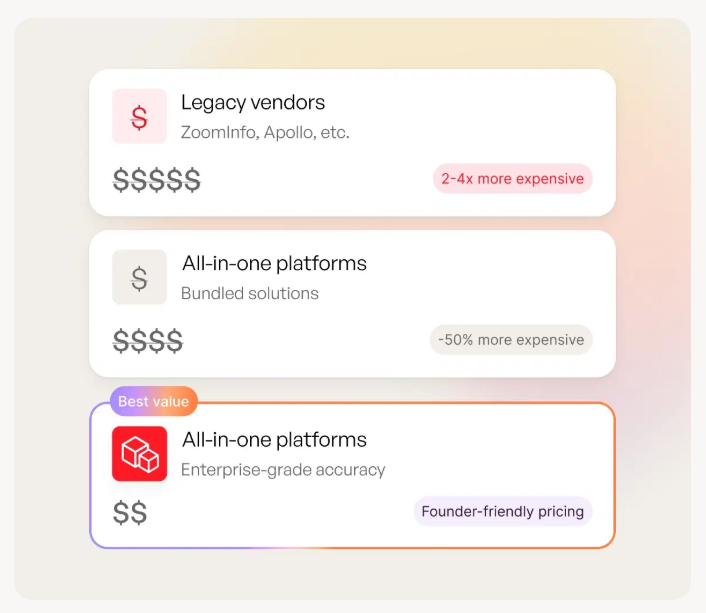
Switching VoIP platforms won't fix low connect rates if your reps are dialing dead numbers. Prospeo gives you 125M+ verified mobile numbers with a 30% pickup rate - 2.4x higher than ZoomInfo. At $0.01 per lead, it costs less than one month of RingCentral's SMS Booster add-on.
Stop blaming your phone system. Start dialing numbers that actually ring.
What You'll Actually Pay
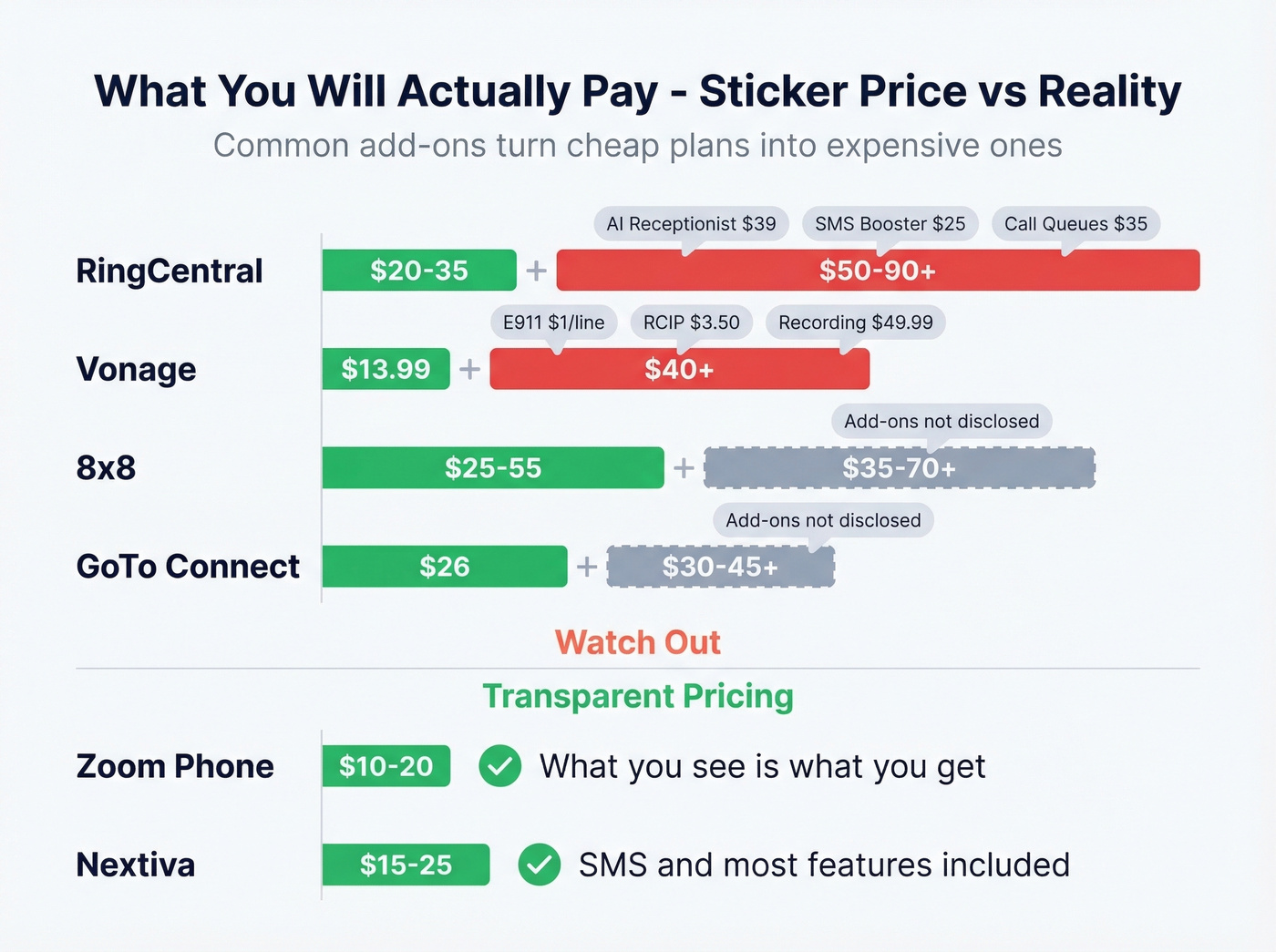
The sticker price on VoIP platforms is almost never what you'll pay. Here's what "loaded" pricing looks like for the worst offenders:
| Platform | Base Price | Common Add-Ons | Loaded Price |
|---|---|---|---|
| RingCentral | $20-$35/user/mo (annual) | AI Receptionist $39, SMS Booster $25, Call Queues $35 | $50-90+/user/mo |
| Vonage | $13.99/user/mo | E911 $1, RCIP $3.50, recording $49.99 | $40+/user/mo |
| 8x8 | ~$25-55/user/mo | Not disclosed | $35-70+/user/mo |
| GoTo Connect | ~$26/user/mo | Not disclosed | $30-45+/user/mo |
Contrast that with Zoom Phone ($10-20, what you see is what you get) and Nextiva ($15-25, with SMS and most features included). Pricing transparency isn't a nice-to-have - it's a signal of how a vendor treats customers.
Fix Your Data Before You Switch
Here's the contrarian take most VoIP comparison articles won't give you: switching phone systems won't fix your outbound problem if your contact data is broken. Your dialer is worthless if your SDRs are calling disconnected numbers.
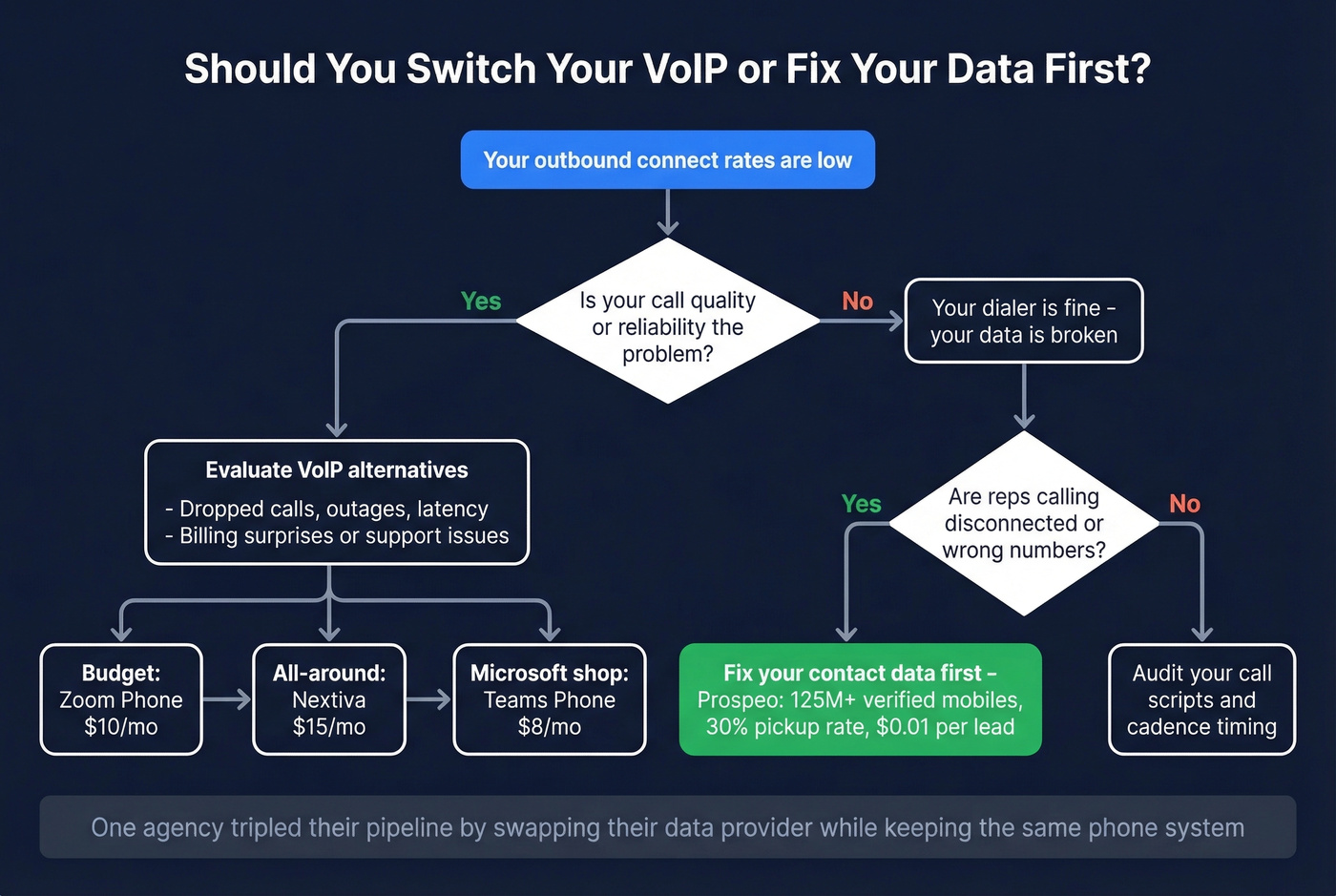
We've watched teams spend months evaluating and migrating phone platforms only to realize their connect rates didn't budge. The bottleneck was never the dialer - it was the data feeding it. One agency we spoke with tripled their pipeline after swapping their data provider while keeping the same phone system.
The self-serve model is straightforward. Search with 30+ filters including buyer intent, technographics, job changes, and funding signals. Export verified contacts and push them straight to your sequencer via Salesforce, HubSpot, Lemlist, or Instantly. No annual contracts, no "talk to sales" gates. Pricing runs about $0.01 per email versus roughly $1 per lead at ZoomInfo, and the free tier gives you 75 verified emails per month to test it.
If you're rebuilding your outbound stack, start with sales prospecting techniques that improve list quality before you scale volume.
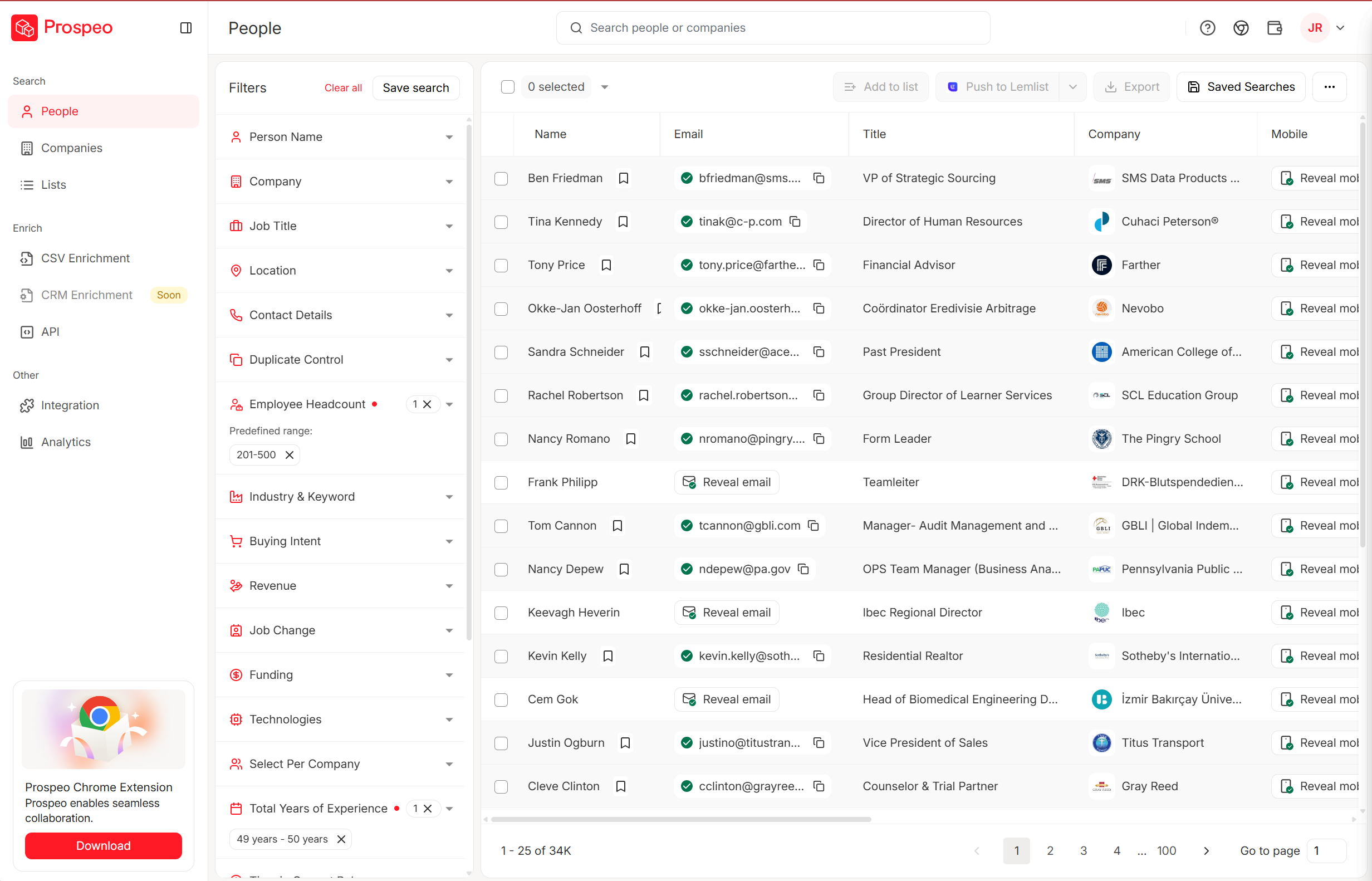
Before you migrate platforms, run the math. If your SDRs connect on 11% of dials, a new VoIP won't move the needle. Prospeo's 98% accurate contact data and 125M+ verified direct dials turn the same call block into 3x more conversations - no new phone system required.
Triple your connect rate without switching a single platform.
How to Choose by Team Size
1-10 users: Grasshopper or Ooma. Keep it simple, keep it cheap.
11-50 users: Nextiva, Zoom Phone, or Dialpad. Nextiva's Core plan is the safest bet for teams that want everything in one place without surprises.
50-200 users: Nextiva, 8x8, or GoTo Connect. 8x8 wins on global reach if you can stomach the quote process.
200+ users: 8x8 or Microsoft Teams Phone. At this scale, ecosystem integration trumps everything else.
If you're also standardizing your pipeline tooling, pair your phone decision with a contact management software review so reps aren't juggling systems.
How to Switch from RingCentral
- Check your contract end date. Early termination fees are real. Time your switch to align with renewal.
- Export call logs and recordings. Once you cancel, access disappears. Download everything first.
- Submit your number porting request to the new provider before canceling RingCentral. Porting typically takes 5-10 business days.
- Run both systems in parallel for at least a week. Test inbound routing, voicemail, and auto-attendant flows before cutting over.
- Update IVR flows and auto-attendant greetings. These don't transfer automatically - rebuild them in the new system before going live.
For outbound-heavy teams, a repeatable cold calling system matters as much as the provider you pick.
FAQ
Is RingCentral worth it in 2026?
For large enterprises with dedicated IT teams, yes - the 300+ integrations are hard to match. For teams under 50, the complexity and add-on costs make Nextiva or Zoom Phone a better fit. The entry price balloons fast once you add modules most teams actually need.
What's the cheapest alternative to RingCentral?
Microsoft Teams Phone at $8/user/mo if you already have Microsoft 365. For standalone VoIP, Zoom Phone at $10/user/mo metered. Both undercut RingCentral significantly without requiring long-term contracts.
Can I keep my phone numbers when switching?
Yes. Every major VoIP provider supports number porting. Submit your request to the new provider before canceling RingCentral - porting takes 5-10 business days. Don't cancel until porting is confirmed complete.
How do I improve outbound connect rates after switching?
The phone system matters less than your contact data. Verified mobile numbers with a 30% pickup rate and 98% email accuracy often make a bigger impact on connect rates than switching VoIP providers. Fix the data layer first with a tool like Prospeo, then optimize the dialing platform.